Overview
Environmental science passages represent one of the most frequently tested passage types in the LSAT Reading Comprehension section. These passages explore topics such as climate change, ecosystem dynamics, pollution control, conservation biology, renewable energy, and environmental policy. Unlike pure science passages that focus solely on technical mechanisms, lsat environmental science passages typically blend scientific concepts with policy implications, ethical considerations, and debates among researchers or stakeholders. This interdisciplinary nature makes them particularly challenging—students must track not only the scientific content but also the argumentative structure, competing viewpoints, and the author's perspective on controversial environmental issues.
Understanding how to approach environmental science passages is essential for LSAT success because they appear in approximately 15-20% of Reading Comprehension sections. These passages test your ability to comprehend complex scientific information, identify logical relationships between evidence and conclusions, distinguish between factual claims and interpretive arguments, and recognize how authors use scientific data to support broader policy or philosophical positions. The LSAT frequently uses environmental topics because they naturally involve the kind of nuanced reasoning, competing interpretations, and evidence-based argumentation that the exam is designed to assess.
Mastering passage subjects and strategies for environmental science content builds directly on fundamental reading comprehension skills while requiring specialized approaches. These passages connect to broader LSAT competencies including argument analysis, viewpoint tracking, and the ability to distinguish between descriptive and prescriptive claims. Success with environmental science passages strengthens your overall ability to handle technical content across all passage types, making this topic a high-yield investment of study time that pays dividends throughout the Reading Comprehension section.
Learning Objectives
- [ ] Identify how Environmental science passages appears in LSAT questions
- [ ] Explain the reasoning pattern behind Environmental science passages
- [ ] Apply Environmental science passages to solve LSAT-style problems accurately
- [ ] Distinguish between descriptive scientific content and normative policy arguments within environmental passages
- [ ] Track multiple viewpoints when passages present competing theories or stakeholder perspectives
- [ ] Recognize common structural patterns in environmental science passages (problem-solution, cause-effect, theory-evidence)
- [ ] Evaluate the strength of evidence and identify gaps in environmental arguments
Prerequisites
- Basic reading comprehension skills: Ability to identify main ideas, supporting details, and passage structure—essential foundation for all LSAT passages
- Understanding of argument structure: Recognition of premises, conclusions, and logical relationships—environmental passages frequently embed arguments within descriptive content
- Familiarity with scientific reasoning: Comfort with hypothesis-testing, evidence evaluation, and causal claims—environmental passages rely heavily on scientific methodology
- Ability to track multiple viewpoints: Skill in distinguishing author's view from others' perspectives—environmental topics often present competing theories or stakeholder positions
Why This Topic Matters
Environmental science passages hold significant real-world relevance as they address pressing contemporary issues including climate change mitigation, biodiversity loss, sustainable resource management, and the intersection of science with public policy. Legal professionals regularly encounter environmental law, regulatory compliance, and cases involving scientific expert testimony, making this passage type directly applicable to legal practice. The ability to parse complex scientific arguments and evaluate evidence quality translates directly to skills attorneys use when working with expert witnesses, reviewing technical documents, or arguing cases involving environmental regulations.
On the LSAT, environmental science passages appear with high frequency—typically 1-2 passages per exam cycle. These passages generate questions testing main idea comprehension (15-20% of questions), specific detail retrieval (25-30%), inference drawing (30-35%), author's attitude or purpose (10-15%), and application of passage principles to new scenarios (10-15%). The LSAT favors environmental topics because they naturally involve the analytical reasoning the exam assesses: weighing competing explanations, evaluating evidence sufficiency, recognizing assumptions, and distinguishing between what is stated versus what is implied.
Common manifestations include passages discussing: ecosystem restoration projects and their effectiveness; debates over climate change attribution and response strategies; conflicts between economic development and conservation; emerging technologies for pollution control or renewable energy; scientific controversies regarding species protection; and the role of traditional ecological knowledge versus Western scientific approaches. These passages frequently present a scientific consensus while acknowledging dissenting views, describe policy dilemmas where scientific uncertainty complicates decision-making, or trace the evolution of scientific understanding on an environmental issue.
Core Concepts
Structure of Environmental Science Passages
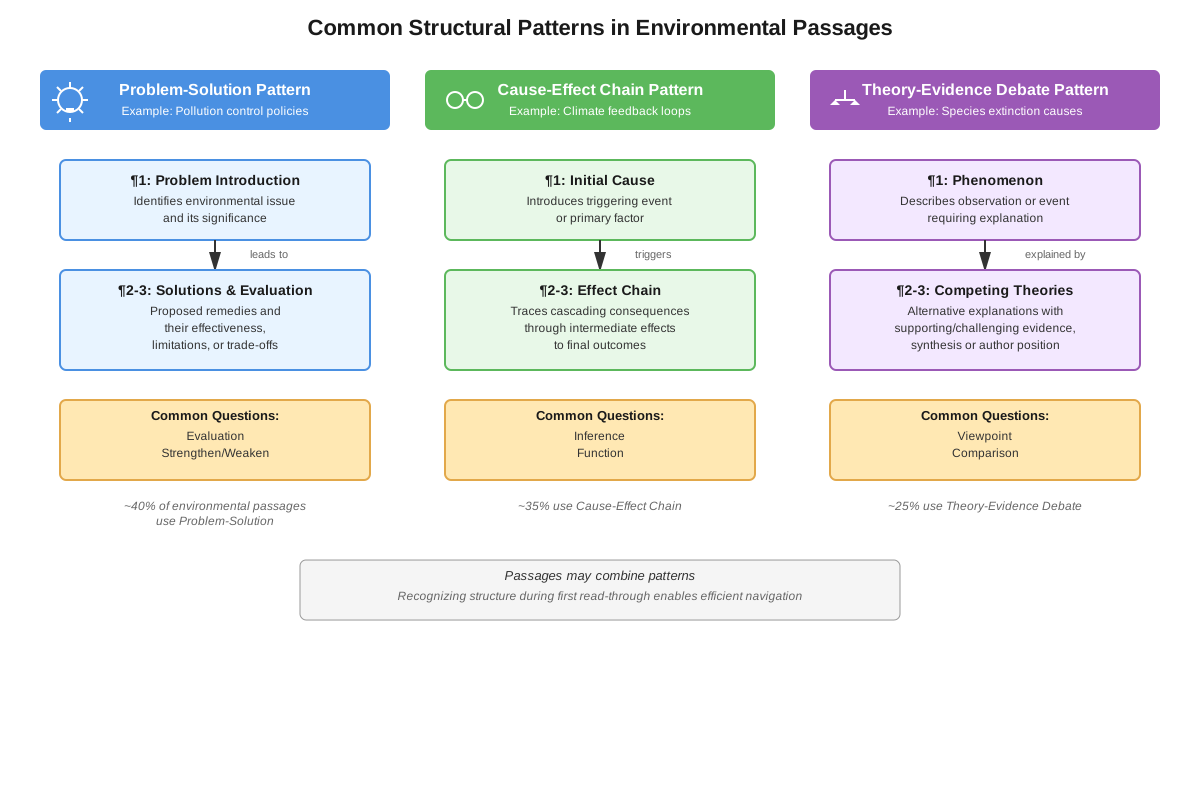
Environmental science passages on the LSAT typically follow several predictable organizational patterns. The problem-solution structure presents an environmental challenge (deforestation, ocean acidification, invasive species) followed by proposed remedies and their limitations. The theory-evidence structure introduces a scientific hypothesis about environmental phenomena, then marshals supporting data while potentially acknowledging contradictory findings. The comparative structure contrasts different approaches to environmental management (market-based versus regulatory solutions) or competing scientific explanations for observed environmental changes.
Recognizing these structures immediately upon reading helps predict where key information will appear and what questions will likely be asked. Problem-solution passages typically generate questions about the effectiveness of proposed solutions or potential objections. Theory-evidence passages often ask about the strength of support for claims or what would weaken/strengthen the argument. Comparative passages frequently test your ability to distinguish between the approaches and identify their respective advantages or limitations.
Scientific Content Versus Policy Arguments
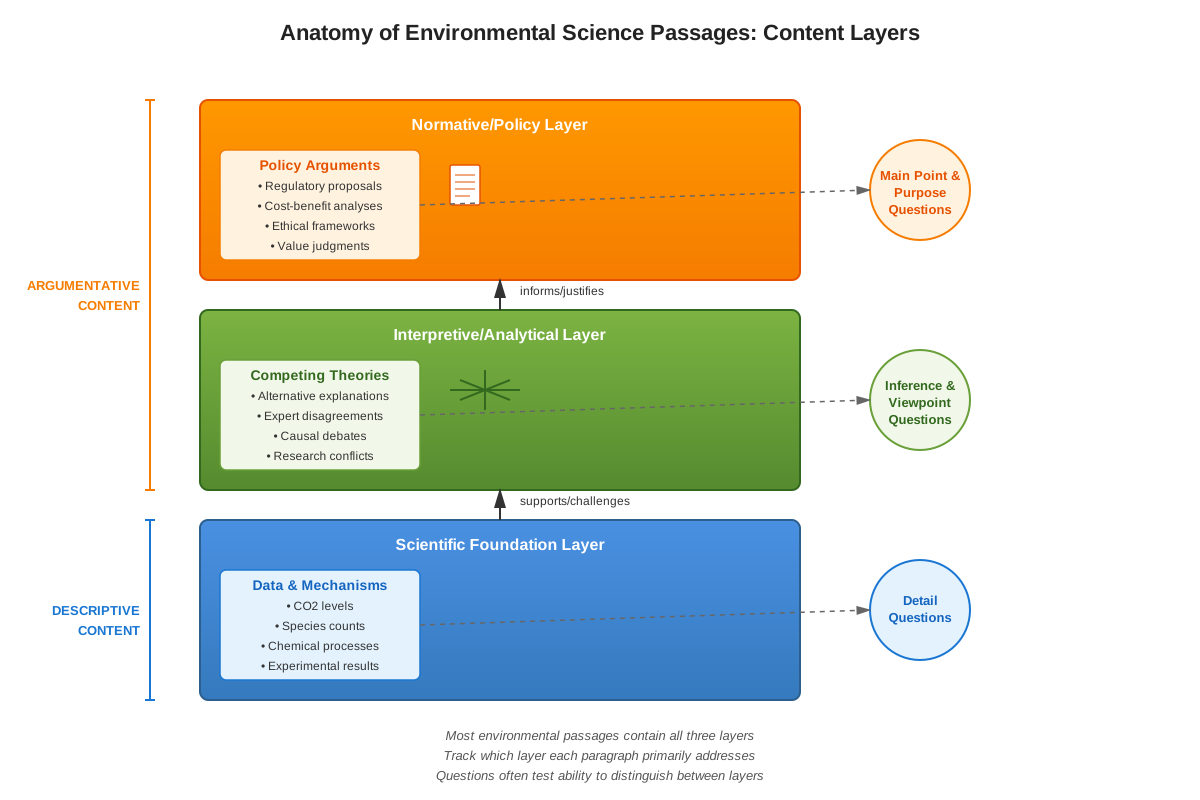
A critical distinction in lsat environmental science passages separates descriptive scientific claims from normative policy recommendations. Descriptive content explains what is (ecosystem functions, pollution mechanisms, species behaviors) using empirical evidence. Normative content argues what should be done (policy prescriptions, ethical obligations, management priorities) based on values, priorities, and interpretations of scientific findings.
The LSAT frequently tests whether students can distinguish these domains. A passage might describe how wetlands filter pollutants (descriptive science), then argue that governments should therefore protect wetlands through regulation (normative policy). Questions may ask what the passage "establishes" versus what it "recommends," or test whether you recognize that policy conclusions require value judgments beyond scientific data alone. Strong readers track this distinction throughout, noting when authors shift from explaining mechanisms to advocating positions.
Viewpoint Tracking in Environmental Debates
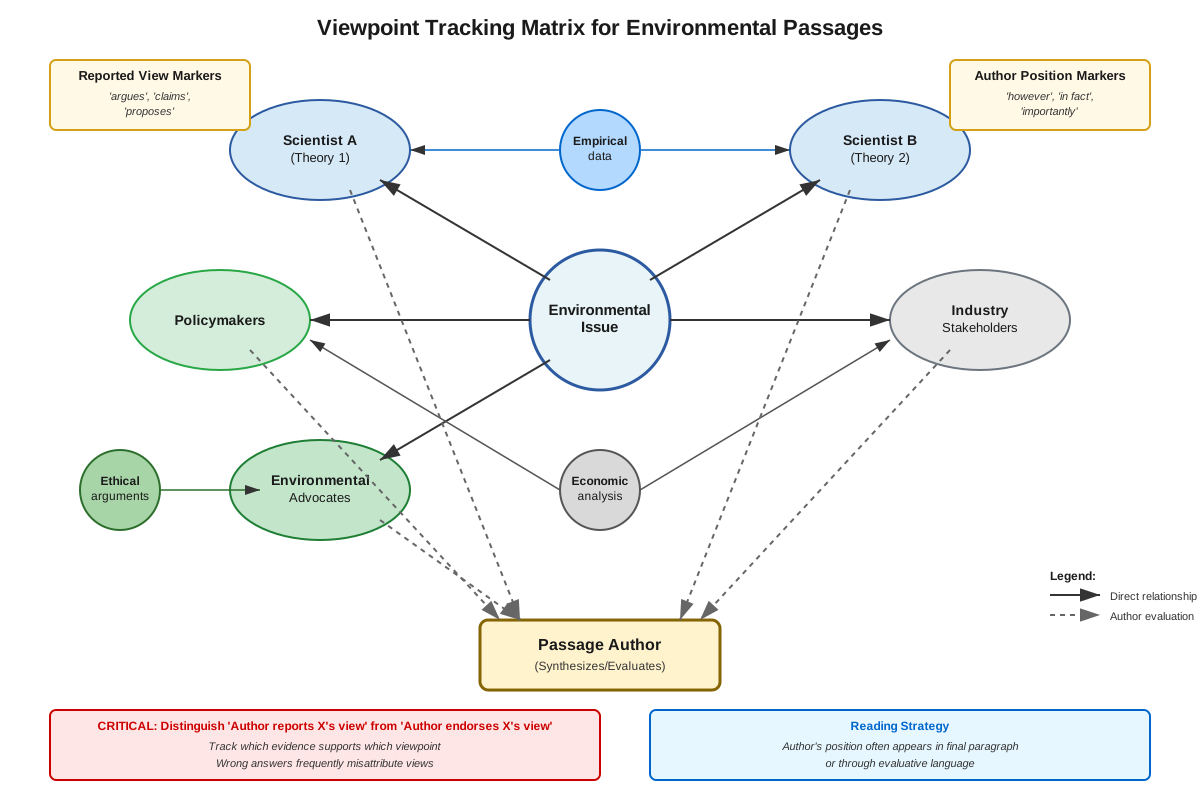
Environmental passages commonly present multiple perspectives: the scientific consensus, dissenting researchers, industry stakeholders, environmental advocates, indigenous communities, or policymakers. Reading comprehension success requires maintaining clear mental separation between these viewpoints while tracking the author's own position, which may align with one perspective, synthesize multiple views, or remain neutral while presenting competing positions.
Effective viewpoint tracking involves noting attribution markers ("Some scientists argue," "Critics contend," "The author suggests") and recognizing when the passage shifts between perspectives. The LST frequently asks questions like "Which of the following would the critics mentioned in lines 23-27 most likely agree with?" or "The author's attitude toward the traditional approach can best be described as..." Answering these requires precise tracking of who believes what throughout the passage.
Evidence Types and Strength
Environmental science passages employ various evidence types with differing persuasive force. Empirical data from controlled experiments or systematic observations provides strong support for causal claims. Correlational evidence shows relationships but cannot definitively establish causation—a common source of LSAT questions testing whether students recognize this limitation. Theoretical models predict outcomes based on assumptions, with strength depending on model validation. Expert consensus carries weight but can be challenged by new findings. Anecdotal examples illustrate concepts but don't prove general patterns.
The LSAT tests your ability to evaluate evidence strength and recognize what types of evidence would strengthen or weaken arguments. A passage might describe correlational data linking pesticide use to bee population decline, then a question asks what finding would most strengthen the causal claim (perhaps experimental data showing pesticide exposure causes bee mortality under controlled conditions).
Common Environmental Science Topics
Certain environmental themes recur frequently on the LSAT. Climate change passages discuss attribution science (distinguishing human from natural causes), feedback mechanisms (how warming triggers additional warming), mitigation strategies (reducing emissions), or adaptation approaches (adjusting to unavoidable changes). Ecosystem management passages explore restoration ecology, invasive species control, biodiversity conservation, or sustainable resource harvesting. Pollution passages examine sources, transport mechanisms, health effects, or remediation technologies.
Conservation biology passages address species protection, habitat preservation, extinction risks, or conflicts between human development and wildlife. Environmental policy passages analyze regulatory approaches, market-based mechanisms (carbon pricing, cap-and-trade), cost-benefit analysis of environmental protection, or environmental justice issues. Renewable energy passages compare technologies, discuss implementation challenges, or evaluate environmental trade-offs of different energy sources.
Temporal Dynamics and Causation
Environmental processes unfold over various timescales, and passages often trace how understanding evolved or how environmental changes progressed. The LSAT tests whether students can track temporal sequences, distinguish between immediate and long-term effects, and recognize how time lags complicate environmental management. A passage might explain how CFCs released decades ago continue damaging the ozone layer, testing whether you understand the delayed consequences.
Causal reasoning pervades environmental passages. Strong readers distinguish between necessary causes (required for an effect), sufficient causes (alone capable of producing an effect), and contributing factors (increase likelihood but don't guarantee an effect). Questions frequently test whether you recognize that correlation doesn't prove causation, that multiple factors may contribute to environmental changes, or that proposed causal mechanisms require empirical validation.
Uncertainty and Scientific Controversy
Unlike some science passages presenting settled knowledge, environmental passages often acknowledge uncertainty, ongoing debates, or evolving understanding. The LSAT uses this uncertainty to test sophisticated reasoning: Can you distinguish between fundamental disagreement versus debate over details? Do you recognize that scientific uncertainty doesn't equally validate all positions? Can you identify what evidence would help resolve controversies?
Passages might present competing explanations for environmental phenomena (multiple hypotheses for amphibian declines), debates over interpretation of data (whether observed changes exceed natural variability), or disagreements about appropriate responses to environmental challenges (precautionary principle versus waiting for definitive proof). Questions test your ability to characterize these disagreements accurately and recognize what would strengthen one position over another.
Concept Relationships
The core concepts within environmental science passages form an interconnected framework. Passage structure (problem-solution, theory-evidence, comparative) determines how scientific content and policy arguments are organized and presented. Recognizing structure helps predict where descriptive science will transition to normative recommendations. Viewpoint tracking becomes essential when passages use comparative structures presenting multiple stakeholder perspectives on environmental issues.
Evidence types and strength directly connect to uncertainty and scientific controversy—passages present debates precisely because evidence is incomplete, ambiguous, or subject to interpretation. Understanding evidence evaluation enables you to assess why controversies persist and what would help resolve them. Temporal dynamics and causation underlie most environmental science content, whether passages describe ecosystem processes, trace policy evolution, or explain how environmental problems developed.
These concepts collectively support the learning objectives: identifying how environmental passages appear (through recognizing common topics and structures), explaining reasoning patterns (by understanding evidence types, causal claims, and viewpoint presentation), and applying strategies to solve problems (by integrating all concepts to answer questions efficiently). The relationship flows: Structure recognition → Content categorization (science vs. policy) → Viewpoint tracking → Evidence evaluation → Temporal/causal understanding → Question answering.
High-Yield Facts
⭐ Environmental science passages appear in 15-20% of LSAT Reading Comprehension sections, making them one of the most frequent passage types
⭐ The LSAT frequently tests the distinction between descriptive scientific claims (what is) and normative policy recommendations (what should be done)
⭐ Correlation does not prove causation—passages often present correlational evidence while questions test whether you recognize this limitation
⭐ Author's viewpoint may differ from perspectives presented in the passage—track attribution carefully to distinguish who believes what
⭐ Scientific uncertainty or ongoing debate does not mean all positions are equally valid—the LSAT tests nuanced evaluation of competing claims
- Environmental passages typically blend scientific content with policy, ethical, or economic considerations, requiring multidimensional analysis
- Common structural patterns include problem-solution, theory-evidence, and comparative frameworks that predict question types
- Evidence strength varies: controlled experiments > correlational studies > theoretical models > anecdotal examples
- Temporal sequences matter—passages often trace how understanding evolved or how environmental changes progressed over time
- Multiple causation is common in environmental issues—single-factor explanations are often oversimplifications
- The precautionary principle (acting despite uncertainty) versus waiting for definitive proof represents a recurring policy debate
- Indigenous or traditional ecological knowledge versus Western scientific approaches appears as a comparative theme
- Questions frequently ask what would strengthen or weaken environmental arguments, requiring evidence evaluation skills
- Environmental passages often present a scientific consensus while acknowledging minority dissenting views
- Trade-offs between environmental protection and economic development generate questions about competing priorities
Quick check — test yourself on Environmental science passages so far.
Try Flashcards →Common Misconceptions
Misconception: Environmental science passages are purely factual and don't involve argumentation → Correction: These passages frequently embed arguments within descriptive content, particularly when discussing policy implications, competing theories, or appropriate responses to environmental challenges. Recognizing argumentative elements is essential for answering questions about author's purpose, reasoning, or what would strengthen/weaken claims.
Misconception: If a passage presents multiple viewpoints, the author doesn't have a position → Correction: Authors often present competing perspectives while subtly favoring one through word choice, amount of space devoted to each view, or explicit evaluation. Questions frequently test whether you detected the author's actual stance despite balanced presentation of alternatives.
Misconception: Scientific uncertainty means we can't draw any conclusions → Correction: The LSAT tests sophisticated reasoning about uncertainty—recognizing that incomplete evidence may still support provisional conclusions, that some explanations have stronger support than others despite ongoing debate, and that uncertainty about details doesn't invalidate broader understanding.
Misconception: All evidence presented in a passage equally supports the main conclusion → Correction: Passages often include evidence of varying strength, tangential information, or data that actually complicates rather than supports the main argument. Questions test whether you can distinguish central supporting evidence from peripheral details or recognize when evidence is weaker than the author's confidence suggests.
Misconception: Environmental passages require prior knowledge of environmental science → Correction: The LSAT provides all necessary information within the passage. While familiarity with scientific reasoning helps, questions are answerable based solely on passage content. In fact, relying on outside knowledge can lead to wrong answers if it contradicts passage information.
Misconception: Longer passages with more technical detail are always harder → Correction: Passage difficulty depends more on argumentative complexity, viewpoint tracking demands, and question types than on technical vocabulary or length. A shorter passage with subtle viewpoint shifts may be more challenging than a longer passage with clear structure and explicit argumentation.
Worked Examples
Example 1: Distinguishing Science from Policy
Passage excerpt: "Studies demonstrate that constructed wetlands effectively remove nitrogen and phosphorus from agricultural runoff, reducing downstream eutrophication by up to 70%. However, wetland construction requires land that could otherwise be farmed, creating opportunity costs for agricultural producers. Given the substantial public benefits of improved water quality, governments should provide financial incentives for farmers who convert marginal cropland to wetlands."
Question: The passage does which of the following?
(A) Establishes that wetland construction is economically beneficial for farmers
(B) Demonstrates that agricultural runoff is the primary cause of eutrophication
(C) Presents empirical evidence and uses it to support a policy recommendation
(D) Argues that water quality concerns should always outweigh agricultural productivity
(E) Proves that government incentives will successfully encourage wetland construction
Worked Solution:
Step 1: Identify the passage structure. The first sentence presents empirical evidence (studies showing wetland effectiveness). The second sentence acknowledges a complication (opportunity costs). The third sentence makes a policy recommendation (governments should provide incentives).
Step 2: Evaluate each answer choice against passage content.
(A) Incorrect—the passage explicitly notes opportunity costs for farmers, indicating economic challenges rather than benefits.
(B) Incorrect—the passage states agricultural runoff contributes to eutrophication but doesn't claim it's the primary cause. This overstates the passage's claim.
(C) Correct—this accurately describes the passage structure: empirical evidence (wetland effectiveness data) followed by a policy recommendation (government incentives). The word "should" in the final sentence signals the normative policy claim.
(D) Incorrect—the passage makes a specific recommendation about this case but doesn't argue for an absolute priority ("always") of water quality over agriculture.
(E) Incorrect—the passage recommends incentives but doesn't prove they will succeed. This confuses recommendation with demonstrated effectiveness.
Key takeaway: This question tests the core distinction between descriptive scientific content and normative policy arguments. The correct answer recognizes both elements and their relationship, while wrong answers either miss the policy component, overstate claims, or confuse recommendation with proof.
Example 2: Viewpoint Tracking and Evidence Evaluation
Passage excerpt: "Traditional fire suppression policies, dominant throughout the 20th century, aimed to eliminate all wildfires from forested ecosystems. Ecologists now recognize that this approach disrupted natural fire cycles, allowing fuel accumulation that makes contemporary fires more severe. However, some forestry officials argue that prescribed burning—intentionally setting controlled fires to reduce fuel loads—poses unacceptable risks to nearby communities and air quality. Recent studies from the Southwest suggest that strategic prescribed burning reduces catastrophic fire risk by 60% while producing smoke emissions far lower than those from uncontrolled wildfires."
Question: The passage suggests that the forestry officials' concerns about prescribed burning are:
(A) Entirely unfounded given the ecological benefits of fire
(B) Addressed by evidence showing prescribed burning produces less smoke than wildfires
(C) Shared by the ecologists who advocate for prescribed burning
(D) Based on outdated understanding of fire ecology
(E) The primary reason prescribed burning hasn't been widely adopted
Worked Solution:
Step 1: Identify the relevant viewpoints. The passage presents: (1) historical fire suppression approach, (2) current ecological understanding recognizing fire's natural role, (3) forestry officials' concerns about prescribed burning risks, and (4) recent research findings.
Step 2: Locate what the passage says about forestry officials' concerns. They worry about risks to communities and air quality. The passage then presents research showing prescribed burning produces lower emissions than wildfires.
Step 3: Determine the passage's treatment of these concerns. By immediately following the officials' concerns with contradictory evidence, the passage suggests (though doesn't explicitly state) that the research addresses these concerns.
Step 4: Evaluate answer choices.
(A) Incorrect—"entirely unfounded" is too strong. The passage presents evidence that mitigates concerns but doesn't dismiss them as baseless.
(B) Correct—the passage structure (concern about smoke → evidence that prescribed burning produces less smoke than wildfires) suggests the research addresses this specific concern. The word "suggests" in the question stem indicates we're making a supported inference, not finding explicit statement.
(C) Incorrect—nothing indicates ecologists share these concerns. The passage presents officials' concerns as a counterpoint to ecological advocacy.
(D) Incorrect—the passage doesn't characterize the officials' understanding as outdated. Their concerns are about practical risks, not fire ecology understanding.
(E) Incorrect—the passage doesn't discuss adoption rates or identify primary barriers. This goes beyond passage content.
Key takeaway: This question requires tracking multiple viewpoints and recognizing how the passage structures information to suggest relationships between concerns and evidence. The correct answer identifies an implicit connection (research addressing concerns) rather than an explicit statement, demonstrating the inference skills the LSAT tests.
Exam Strategy
Initial Reading Approach
When encountering an environmental science passage, invest the first 30-45 seconds identifying the passage type and structure. Ask: Is this presenting a problem and solutions? Comparing competing theories? Tracing evolution of understanding? Advocating a policy position? This structural recognition guides where you'll find key information and predicts likely question types.
Mark viewpoint shifts with notation (brackets, asterisks, or mental flags). When you see phrases like "Critics argue," "Some researchers contend," or "However, others believe," note that a new perspective is being introduced. This prevents the common error of attributing one viewpoint's claims to another perspective or to the author.
Trigger Words and Phrases
Certainty qualifiers signal important nuances: "may," "might," "could," "suggests," "indicates" versus "proves," "demonstrates," "establishes." The LSAT frequently tests whether you recognize these distinctions—a passage might say evidence "suggests" a conclusion while a wrong answer claims it "proves" the conclusion.
Contrast markers ("however," "nevertheless," "despite," "although") indicate viewpoint shifts, complications, or counterevidence. These transitions often precede information that questions will target. When you see contrast markers, slow down and ensure you understand what's being contrasted.
Causal language ("causes," "leads to," "results in," "because") versus correlational language ("associated with," "correlated with," "linked to") distinguishes strong from weak causal claims. Questions frequently test this distinction.
Attribution markers ("according to," "researchers found," "critics claim") identify whose viewpoint is being presented. Careful tracking prevents misattribution errors.
Process of Elimination Strategies
For environmental science passages, eliminate answers that:
- Overstate certainty: If the passage says "may contribute," eliminate answers saying "is the primary cause"
- Confuse correlation with causation: If passage presents correlational data, eliminate answers claiming proven causal relationships
- Misattribute viewpoints: If the passage says "critics argue X," eliminate answers attributing X to the author or other groups
- Introduce outside knowledge: Eliminate answers requiring environmental science knowledge not provided in the passage
- Confuse descriptive and normative: If a question asks what the passage "establishes," eliminate policy recommendations; if it asks what the author "advocates," eliminate purely descriptive content
Time Allocation
Environmental science passages typically warrant 3.5-4 minutes for initial reading due to their technical content and multiple viewpoints. However, this investment pays off through faster question answering—approximately 45-60 seconds per question versus 60-75 seconds when you rush the initial reading and must repeatedly return to the passage.
For questions asking about specific details or viewpoints, use line references or content memory to locate relevant passage sections quickly. For main idea or primary purpose questions, rely on your structural understanding from initial reading rather than rereading extensively. For inference questions, identify the relevant passage section, then evaluate each answer choice against that specific content.
Memory Techniques
SAVED for tracking environmental passage elements:
- Structure (problem-solution, theory-evidence, comparative)
- Author's viewpoint (distinct from other perspectives presented)
- Viewpoints (multiple perspectives and who holds each)
- Evidence types (empirical, correlational, theoretical, anecdotal)
- Descriptive vs. normative (science vs. policy)
CITE for evidence evaluation:
- Controlled experiments (strongest causal evidence)
- Inference from correlation (weaker—doesn't prove causation)
- Theoretical models (strength depends on validation)
- Examples and anecdotes (illustrative but not probative)
Visualization strategy: Picture environmental passages as having two parallel tracks—a "science track" explaining mechanisms and evidence, and a "policy/values track" making recommendations or presenting debates. Questions will ask you to work within one track or recognize connections between them. Mentally separating these tracks prevents confusion between what science shows and what people argue should be done.
Viewpoint mapping: As you read, create a mental table with columns for different stakeholders (scientists, industry, environmentalists, policymakers, indigenous communities) and rows for their positions on key issues. This organization prevents viewpoint confusion and speeds up answering questions about what specific groups would agree with or how they'd respond to new information.
Summary
Environmental science passages represent a high-frequency, high-yield LSAT passage type that blends scientific content with policy arguments, ethical considerations, and competing stakeholder perspectives. Success requires recognizing common structural patterns (problem-solution, theory-evidence, comparative), distinguishing descriptive scientific claims from normative policy recommendations, tracking multiple viewpoints while identifying the author's position, and evaluating evidence strength and type. These passages test sophisticated reasoning about causation, correlation, uncertainty, and the relationship between empirical findings and value-based conclusions. The LSAT uses environmental topics because they naturally involve the analytical skills central to legal reasoning: weighing competing explanations, evaluating evidence sufficiency, recognizing assumptions, and distinguishing between what is stated versus implied. Mastering environmental science passages requires integrating structural analysis, viewpoint tracking, evidence evaluation, and careful attention to language nuances—skills that transfer across all Reading Comprehension passage types and strengthen overall LSAT performance.
Key Takeaways
- Environmental science passages appear frequently (15-20% of RC sections) and blend scientific content with policy, ethical, and economic considerations requiring multidimensional analysis
- The critical distinction between descriptive scientific claims (what is) and normative policy recommendations (what should be) generates numerous LSAT questions testing whether you recognize this difference
- Viewpoint tracking is essential—passages often present multiple perspectives while the author maintains a distinct position that questions will test
- Evidence evaluation skills are paramount: recognize that correlation ≠ causation, controlled experiments provide stronger support than anecdotal examples, and scientific uncertainty doesn't mean all positions are equally valid
- Structural recognition (problem-solution, theory-evidence, comparative) predicts question types and guides efficient information location during question answering
- Careful attention to language qualifiers (may/might versus proves/demonstrates) and attribution markers (critics argue, researchers found) prevents common errors
- Time invested in thorough initial reading (3.5-4 minutes) pays dividends through faster, more accurate question answering
Related Topics
Scientific Method and Hypothesis Testing: Understanding how scientists formulate hypotheses, design experiments, and interpret results deepens comprehension of environmental science passages that discuss research methodologies and evidence evaluation. Mastering environmental passages builds foundation for this more technical content.
Comparative Passage Strategies: Many environmental passages present competing viewpoints in a structure similar to formal comparative passages. Skills developed with environmental passages transfer directly to handling paired passages that present contrasting perspectives.
Author's Tone and Attitude: Environmental passages frequently require identifying subtle authorial positions despite balanced presentation of multiple views. This skill connects to broader Reading Comprehension competencies in detecting tone, attitude, and implicit argumentation.
Argument Structure and Reasoning: The policy arguments embedded in environmental passages exemplify the argument patterns tested throughout the LSAT. Analyzing these arguments strengthens skills applicable to Logical Reasoning sections and argumentative passages in Reading Comprehension.
Natural Science Passages: Environmental science passages share characteristics with other science passages (biology, physics, astronomy) including technical vocabulary, causal reasoning, and theory-evidence relationships. Mastering environmental passages facilitates handling all natural science content.
Practice CTA
Now that you've mastered the core concepts and strategies for environmental science passages, it's time to apply this knowledge to actual LSAT-style practice questions. The flashcards will reinforce key distinctions (descriptive vs. normative, correlation vs. causation, viewpoint tracking) while practice passages allow you to implement the SAVED and CITE frameworks in realistic exam conditions. Remember: environmental science passages are high-yield content that appears frequently on the LSAT. Your investment in mastering this passage type will pay dividends not only on environmental passages themselves but across all Reading Comprehension content through strengthened skills in structural analysis, viewpoint tracking, and evidence evaluation. Approach practice deliberately, reviewing both correct and incorrect answers to understand the reasoning patterns the LSAT rewards. You've built the foundation—now solidify it through focused application!
Sign up free to keep reading
Create a free AnvayaPrep account to finish this LSAT guide on Environmental science passages — plus flashcards and practice questions.