Overview
Feminist theory passages represent a recurring and intellectually demanding category within LSAT Reading Comprehension sections. These passages typically explore theoretical frameworks that examine gender-based power structures, challenge traditional assumptions about knowledge production, and critique historical exclusions in various fields including law, literature, science, and philosophy. The LSAT frequently features passages that discuss feminist critiques of legal reasoning, feminist approaches to epistemology, or feminist reinterpretations of canonical works and historical events.
Understanding how to navigate lsat feminist theory passages is essential because they exemplify the exam's commitment to testing analytical reading skills across diverse academic disciplines. These passages often present complex arguments that require students to track multiple viewpoints, understand nuanced theoretical distinctions, and recognize how authors build support for non-traditional perspectives. The density of abstract concepts and the unfamiliarity many test-takers have with feminist theoretical frameworks make these passages particularly challenging, yet they follow predictable structural patterns once those patterns are identified.
Within the broader context of reading comprehension and passage subjects and strategies, feminist theory passages share characteristics with other humanities and social science passages while presenting unique challenges. They frequently employ comparative analysis (contrasting feminist approaches with traditional ones), present evolutionary arguments (showing how feminist thought has developed), and engage in critique (identifying limitations in established frameworks). Mastering these passages strengthens skills applicable across all LSAT reading comprehension questions, particularly the ability to understand complex argumentative structures and recognize authorial purpose.
Learning Objectives
- [ ] Identify how feminist theory passages appear in LSAT questions
- [ ] Explain the reasoning pattern behind feminist theory passages
- [ ] Apply feminist theory passages to solve LSAT-style problems accurately
- [ ] Recognize common structural elements and argumentative moves in feminist theory passages
- [ ] Distinguish between different schools or approaches within feminist theory as presented in passages
- [ ] Anticipate question types most frequently associated with feminist theory passages
- [ ] Evaluate answer choices by identifying subtle misrepresentations of feminist theoretical claims
Prerequisites
- Basic passage structure recognition: Understanding how LSAT passages organize main points, supporting evidence, and authorial viewpoint is essential because feminist theory passages follow these same structural conventions while adding theoretical complexity.
- Ability to track multiple perspectives: Feminist theory passages frequently contrast traditional and feminist viewpoints, requiring the skill to distinguish whose position is being presented at any given moment.
- Comfort with abstract concepts: These passages discuss theoretical frameworks rather than concrete events, so familiarity with handling abstract reasoning is necessary.
- Understanding of basic argumentative structures: Recognizing how authors build support for claims, present counterarguments, and draw conclusions forms the foundation for analyzing any theoretical passage.
Why This Topic Matters
Feminist theory passages appear with notable regularity on the LSAT, typically showing up in approximately 10-15% of Reading Comprehension sections. The LSAC (Law School Admission Council) deliberately includes passages from diverse academic disciplines to ensure the exam tests pure analytical reading ability rather than specialized content knowledge. Feminist theory passages serve this purpose excellently because they present sophisticated arguments that most test-takers haven't encountered in their undergraduate coursework, yet they remain fully comprehensible through careful reading.
These passages carry practical significance beyond test preparation. Legal education and practice increasingly engage with feminist jurisprudence, critical legal studies, and questions about how legal systems perpetuate or challenge systemic inequalities. Exposure to feminist theoretical frameworks through LSAT passages provides valuable preparation for law school coursework in constitutional law, employment discrimination, family law, and legal theory.
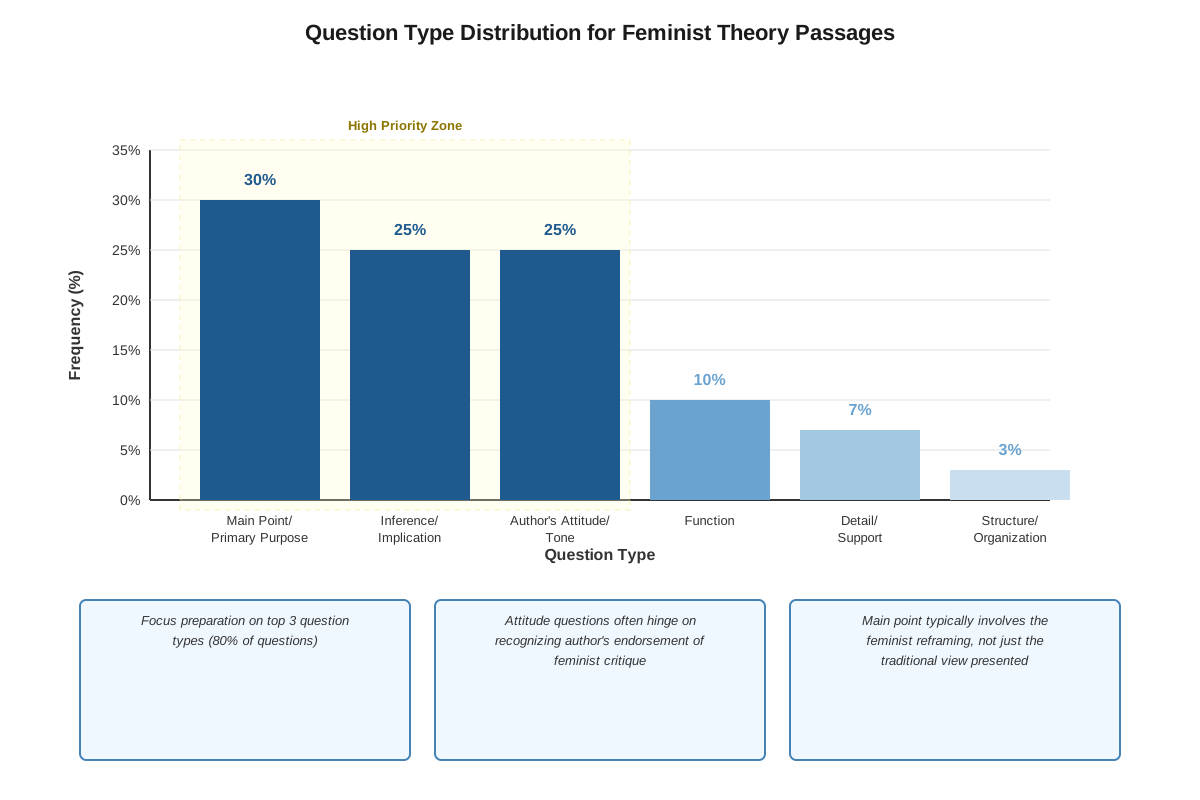
On the exam itself, feminist theory passages commonly appear in several forms: passages discussing feminist critiques of scientific objectivity, passages examining feminist reinterpretations of literary or historical works, passages exploring feminist approaches to legal reasoning, and passages comparing different waves or schools of feminist thought. Question types associated with these passages frequently include main point questions, author's attitude questions, function questions (asking why the author includes specific information), and inference questions requiring careful attention to what the passage actually states versus what it implies.
Core Concepts
Characteristic Features of Feminist Theory Passages
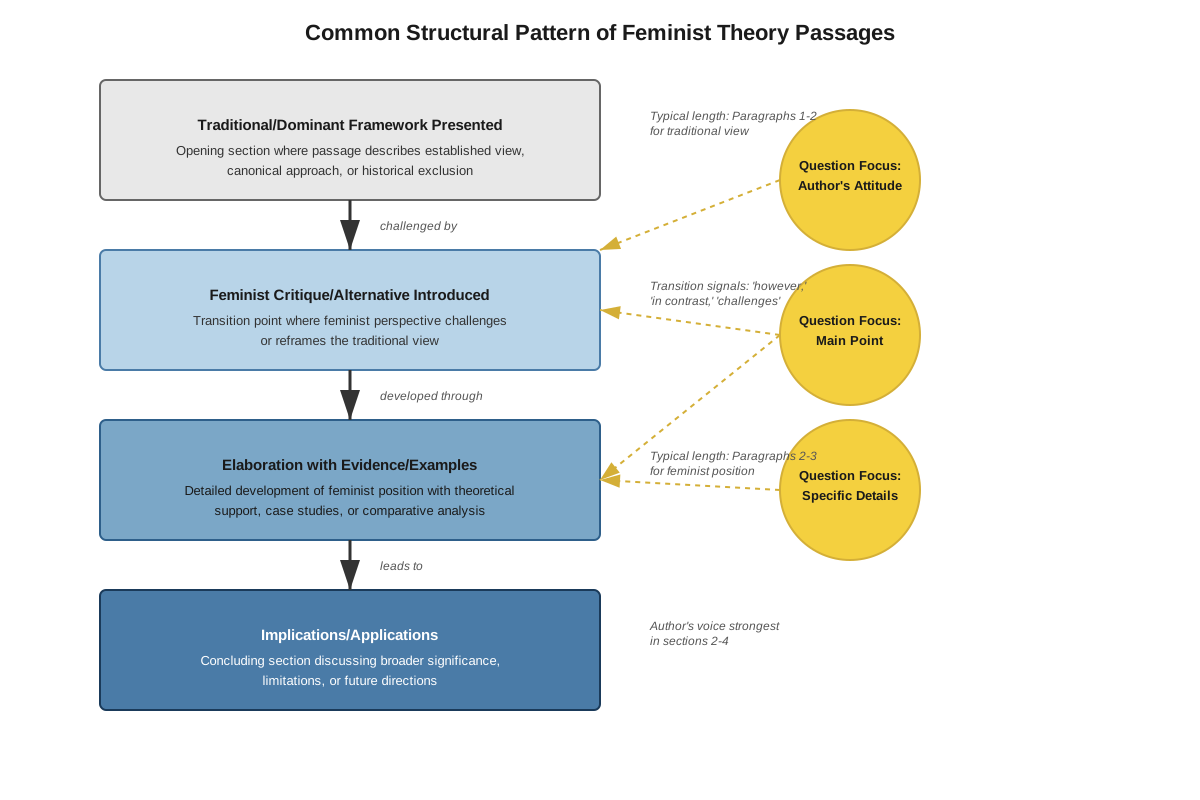
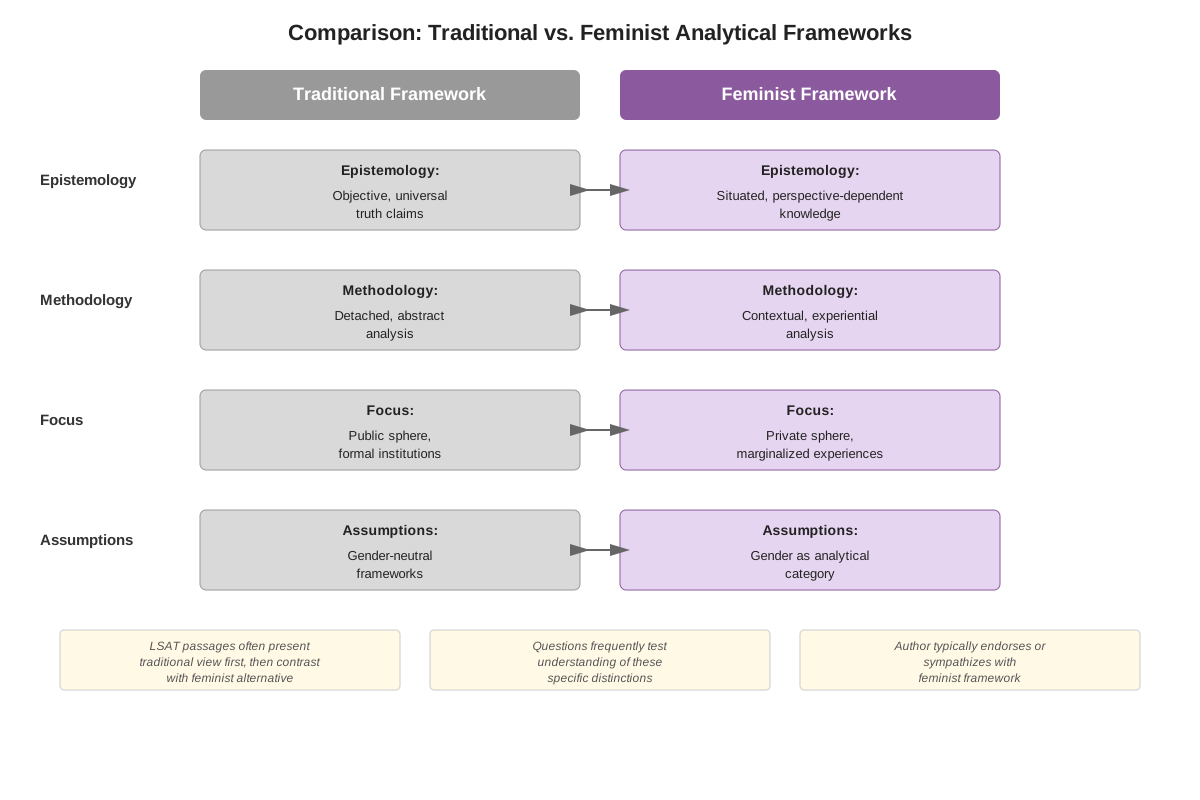
Feminist theory passages on the LSAT share several identifying characteristics that distinguish them from other passage types. First, they typically present a critique or reexamination of established frameworks, whether in law, science, literature, or other fields. The passage structure often begins by describing a traditional approach or assumption, then introduces a feminist perspective that challenges or complicates that traditional view. This comparative structure is crucial to recognize because many questions will test whether students can accurately distinguish between the traditional view being critiqued and the feminist alternative being proposed.
Second, these passages frequently employ epistemological arguments—discussions about how knowledge is produced, validated, and disseminated. For example, a passage might argue that traditional scientific methodology claims objectivity while actually reflecting masculine biases, or that legal reasoning presents itself as neutral while incorporating gendered assumptions. Understanding that these passages often operate at the level of examining knowledge systems themselves, rather than simply presenting factual information, helps test-takers anticipate the types of claims and evidence they'll encounter.
Third, feminist theory passages regularly discuss power structures and systemic exclusion. They may examine how certain voices have been marginalized in academic disciplines, how legal frameworks have historically disadvantaged women, or how cultural narratives have reinforced gender hierarchies. The LSAT presents these discussions in academically rigorous ways, focusing on the logical structure of arguments rather than emotional appeals.
Common Argumentative Patterns
Several argumentative patterns recur across lsat feminist theory passages. The "traditional view versus feminist critique" pattern presents an established position, identifies its limitations or hidden assumptions, and proposes a feminist alternative. Test-takers must track which claims belong to which perspective and understand the specific grounds on which the feminist critique challenges the traditional view.
The "evolution of feminist thought" pattern traces how feminist theory has developed over time, often distinguishing between different waves, schools, or approaches. These passages might contrast liberal feminism with radical feminism, or discuss how feminist legal theory has evolved from seeking equal treatment to recognizing that formal equality may perpetuate substantive inequality. Questions on these passages frequently test whether students can accurately characterize the differences between approaches.
The "application and illustration" pattern presents a feminist theoretical framework and then demonstrates how it illuminates specific cases, texts, or phenomena. For instance, a passage might explain feminist narratology and then show how it reveals gendered assumptions in classic literature. The key skill here is understanding both the general theoretical principle and how it applies to particular examples.
Theoretical Vocabulary and Concepts
While the LSAT never requires prior knowledge of feminist theory, passages do introduce and explain theoretical concepts that students must grasp quickly. Common concepts include:
| Concept | Typical LSAT Explanation |
|---|---|
| Essentialism | The view that gender categories reflect fixed, inherent characteristics versus the view that gender is socially constructed |
| Standpoint epistemology | The idea that knowledge is shaped by one's social position, and that marginalized perspectives may reveal aspects of reality obscured from dominant perspectives |
| Formal versus substantive equality | The distinction between treating everyone identically (formal equality) and addressing different circumstances to achieve equitable outcomes (substantive equality) |
| Patriarchal structures | Systems that privilege masculine perspectives, experiences, or interests, often presented as neutral or universal |
| Intersectionality | The recognition that gender intersects with race, class, and other identity categories to create distinct experiences |
Understanding these concepts as they're defined within specific passages—rather than importing outside knowledge—is crucial for LSAT success.
Authorial Stance and Tone
Feminist theory passages on the LSAT typically adopt one of three authorial stances. The advocacy stance presents a feminist argument with clear authorial support, using language that signals agreement with the feminist perspective being discussed. The explanatory stance describes feminist theoretical approaches in a more neutral, expository manner, focusing on explaining the theory without strong evaluative language. The comparative stance presents multiple perspectives, including feminist ones, while maintaining analytical distance.
Recognizing authorial stance is essential because many questions ask about the author's attitude, purpose, or likely agreement with various statements. Subtle linguistic cues—such as "importantly," "merely," "unfortunately," or "successfully demonstrates"—signal the author's evaluative position. Feminist theory passages often include these cues when distinguishing between perspectives the author endorses and those being critiqued.
Structural Elements
Most feminist theory passages follow a predictable structure that aids comprehension. The opening typically establishes context by describing a traditional approach, historical situation, or conventional understanding. The transition introduces the feminist perspective, often signaled by phrases like "however," "feminist theorists argue," or "this approach has been challenged." The development elaborates the feminist argument, providing supporting evidence, examples, or theoretical reasoning. The conclusion may summarize the implications, suggest further applications, or acknowledge limitations.
Mapping this structure while reading helps test-takers anticipate where key information appears and quickly locate details when answering questions. The transition point—where the passage shifts from traditional to feminist perspective—is particularly high-yield because many questions test whether students can distinguish between these viewpoints.
Concept Relationships
The concepts within feminist theory passages interconnect systematically. Epistemological arguments (about how knowledge is produced) → lead to → critiques of specific disciplines or practices (showing how those knowledge-production methods have excluded or distorted certain perspectives) → which motivate → alternative approaches or frameworks (feminist methodologies that address identified limitations).
Similarly, discussions of power structures → connect to → analyses of systemic exclusion → which explain → why traditional frameworks appear neutral but actually reflect particular interests → thereby justifying → the need for feminist reexamination.
These passages relate to prerequisite knowledge of basic argumentative structure by adding layers of theoretical complexity to familiar patterns. The skill of tracking multiple perspectives, developed through other LSAT passages, becomes particularly crucial here because feminist theory passages inherently involve contrasting viewpoints. The ability to identify main points and supporting evidence applies directly, though the abstract nature of theoretical arguments requires more careful attention to precise language.
Feminist theory passages also connect to other passage subjects and strategies within Reading Comprehension. They share with science passages the need to understand specialized terminology as defined in context. They resemble law passages in their attention to reasoning structures and implications. They parallel humanities passages in their interpretive and evaluative dimensions. Mastering feminist theory passages thus reinforces skills applicable across all passage types while developing comfort with theoretical abstraction.
High-Yield Facts
⭐ Feminist theory passages appear in approximately 10-15% of LSAT Reading Comprehension sections, making them a regular but not overwhelming presence on the exam.
⭐ The most common structure contrasts a traditional view (presented first) with a feminist critique or alternative (presented second), and questions frequently test whether students can distinguish between these perspectives.
⭐ Authorial stance in feminist theory passages ranges from advocacy to neutral explanation, and identifying this stance is crucial for attitude and purpose questions.
⭐ These passages never require prior knowledge of feminist theory; all necessary concepts are defined or explained within the passage itself.
⭐ Questions on feminist theory passages frequently ask about the function of specific paragraphs or examples—why the author includes particular information rather than just what that information states.
- Feminist theory passages often employ epistemological arguments that examine how knowledge is produced and validated rather than simply presenting factual claims.
- Common theoretical distinctions include essentialism versus social construction, formal versus substantive equality, and different waves or schools of feminist thought.
- The transition point where passages shift from traditional to feminist perspective is high-yield territory for questions testing viewpoint distinction.
- These passages regularly discuss power structures and systemic exclusion, but in academically rigorous ways focused on logical argumentation.
- Answer choices on feminist theory passages often include subtle distortions that misrepresent the scope, strength, or specific grounds of claims made in the passage.
- Comparative passages (paired passages) sometimes feature feminist theory in one or both passages, requiring careful tracking of which author makes which claims.
- The vocabulary in feminist theory passages, while potentially unfamiliar, is always contextualized sufficiently for comprehension without outside knowledge.
Quick check — test yourself on Feminist theory passages so far.
Try Flashcards →Common Misconceptions
Misconception: Feminist theory passages require agreement with feminist positions to answer questions correctly. → Correction: The LSAT tests reading comprehension and analytical reasoning, not political agreement. Questions ask what the passage states, implies, or how it's structured—not whether students personally endorse the views presented. Correct answers follow from the passage's content regardless of one's own beliefs.
Misconception: Prior knowledge of feminist theory provides an advantage on these passages. → Correction: The LSAT is designed so that all necessary information appears in the passage itself. In fact, outside knowledge can be detrimental if it leads students to import ideas not actually stated in the passage. The correct approach is to rely exclusively on what the passage says, treating it as a self-contained unit.
Misconception: Feminist theory passages are inherently more difficult than other passage types. → Correction: While these passages may feel unfamiliar to some test-takers, they follow the same structural and logical patterns as other LSAT passages. The perceived difficulty often stems from unfamiliarity with theoretical discourse rather than actual increased complexity. With practice recognizing their patterns, these passages become as manageable as any other type.
Misconception: The "traditional view" presented in feminist theory passages is always wrong or completely rejected. → Correction: Passages often present nuanced positions where feminist perspectives complicate, refine, or add to traditional views rather than entirely replacing them. Careful reading reveals the specific scope and nature of the critique, which may acknowledge certain strengths in traditional approaches while identifying particular limitations.
Misconception: All feminist theory passages present a single, unified feminist perspective. → Correction: Many passages explicitly distinguish between different feminist approaches, schools of thought, or historical waves. Questions frequently test whether students can accurately characterize these internal distinctions within feminist theory.
Misconception: Emotional or politically charged language signals the correct answer on feminist theory passages. → Correction: Correct answers match the passage's actual claims and tone. If the passage maintains an analytical, measured tone, answers using strong emotional language are likely incorrect. The LSAT rewards precision in matching the passage's specific language and stance.
Worked Examples
Example 1: Identifying Viewpoint Distinction
Passage Excerpt: "Traditional legal scholarship has long maintained that judicial reasoning operates through the neutral application of established principles to particular cases. However, feminist legal theorists have argued that this purported neutrality obscures the extent to which legal principles themselves reflect gendered assumptions. For instance, the reasonable person standard in tort law, while presented as objective, has historically incorporated masculine norms of behavior, thereby disadvantaging plaintiffs whose conduct reflects different, but equally reasonable, patterns of response."
Question: According to the passage, traditional legal scholarship would most likely agree with which of the following statements?
Answer Choices:
(A) Legal principles inevitably reflect the gendered assumptions of those who formulated them.
(B) The reasonable person standard should be reformulated to account for diverse patterns of behavior.
(C) Judicial reasoning applies established legal principles without introducing subjective bias.
(D) Feminist legal theory has successfully demonstrated the limitations of traditional approaches.
(E) Masculine norms of behavior have historically influenced the development of tort law.
Analysis: This question tests the ability to distinguish between the traditional view and the feminist critique. The passage explicitly states that "traditional legal scholarship has long maintained that judicial reasoning operates through the neutral application of established principles." This directly supports choice (C).
Choice (A) represents the feminist position, not the traditional view. Choice (B) suggests a reform that traditional scholarship, as presented, would not endorse. Choice (D) attributes agreement with feminist critique to traditional scholarship, which contradicts the passage's structure. Choice (E) might be acknowledged by traditional scholarship but isn't what they would "most likely agree with" given the passage's emphasis on their belief in neutrality.
Correct Answer: (C)
Learning Objective Connection: This example demonstrates how to identify how feminist theory passages appear in LSAT questions (specifically, viewpoint distinction questions) and apply understanding of the reasoning pattern (traditional view versus feminist critique) to solve problems accurately.
Example 2: Function Question
Passage Excerpt: "Early feminist literary criticism focused primarily on recovering neglected works by women authors and documenting the misogyny in canonical texts. While valuable, this approach, according to some theorists, left intact the fundamental assumption that literary merit could be assessed through universal, objective standards. More recent feminist narratology challenges this assumption by examining how narrative structures themselves encode gendered perspectives. Consider, for example, the convention of narrative closure through marriage in nineteenth-century novels. This convention, far from being a neutral storytelling device, reflects and reinforces particular ideologies about women's proper social role."
Question: The author's discussion of narrative closure through marriage (final sentence) primarily serves to:
Answer Choices:
(A) Illustrate how feminist narratology applies its theoretical framework to specific textual features
(B) Demonstrate that nineteenth-century novels were more sexist than contemporary works
(C) Argue that marriage should not appear as a plot element in literary fiction
(D) Support the claim that early feminist literary criticism was methodologically flawed
(E) Prove that narrative structures cannot be analyzed using objective standards
Analysis: Function questions ask why the author includes specific information. The passage introduces feminist narratology as an approach that "examines how narrative structures themselves encode gendered perspectives." The marriage example immediately follows this introduction, providing a concrete illustration of this theoretical approach in action.
Choice (A) correctly identifies this illustrative function. Choice (B) makes a comparative claim not supported by the passage. Choice (C) misreads analysis as prescription—the passage analyzes what marriage-as-closure does, not what should appear in fiction. Choice (D) is too strong; the passage calls early approaches "valuable" even while noting their limitations. Choice (E) overstates the claim; the passage argues that supposedly neutral standards actually encode perspectives, not that objective analysis is impossible.
Correct Answer: (A)
Learning Objective Connection: This example shows how to explain the reasoning pattern behind feminist theory passages (moving from general theoretical framework to specific application) and apply this understanding to solve function questions accurately.
Exam Strategy
When approaching feminist theory passages on the LSAT, begin by identifying the passage's basic structure during your initial read-through. Mark or mentally note where the passage transitions from describing a traditional view to presenting a feminist perspective. This transition point is crucial because many questions will test your ability to distinguish between these viewpoints.
Trigger words and phrases that signal important shifts include: "however," "feminist theorists argue," "challenges this assumption," "in contrast," "traditional approaches," "overlooks," "fails to account for," and "reveals." When you encounter these phrases, slow down slightly and ensure you understand what distinction is being drawn.
Pay careful attention to scope and strength of claims. Feminist theory passages often make nuanced arguments that acknowledge complexity rather than presenting absolute positions. Answer choices frequently include distortions that make claims too strong ("always," "never," "completely") or too weak ("suggests the possibility" when the passage actually "demonstrates"). Match the passage's precise level of commitment.
For process of elimination, first eliminate answers that confuse viewpoints—attributing feminist positions to traditional scholars or vice versa. Next, eliminate answers that distort scope or strength. Then eliminate answers that, while possibly true in the real world, aren't supported by the passage. The remaining answer should match what the passage actually states or necessarily implies.
Time allocation for feminist theory passages should follow standard LSAT reading comprehension timing: approximately 3-4 minutes for the initial read-through and 5-6 minutes for questions. Don't get bogged down trying to fully understand every theoretical nuance on first reading. Focus on grasping the overall structure and main claims, then return to specific details when questions direct you there.
Exam Tip: If you find yourself confused by theoretical terminology, look for the passage's explanation or definition. The LSAT always provides sufficient context to understand specialized terms. Don't panic if concepts seem unfamiliar—that's by design, and the passage contains everything you need.
When facing inference questions on feminist theory passages, remember that correct inferences stay very close to what's explicitly stated. The LSAT rarely requires large inferential leaps. If an answer choice seems to require substantial outside reasoning or assumptions, it's likely incorrect.
For main point questions, the correct answer typically captures both the topic (feminist theory's approach to X) and the passage's specific claim about that topic. Wrong answers often capture only the topic without the specific argument, or they focus on a supporting detail rather than the overarching point.
Memory Techniques
CRAFT - Remember the common structure of feminist theory passages:
- Context: Traditional view or historical background
- Reexamination: Feminist critique or alternative perspective
- Argument: Supporting reasoning and evidence
- Function: Examples or applications
- Takeaway: Implications or conclusions
VIEW - Track whose perspective you're reading:
- Viewpoint: Whose position is being presented?
- Identify: Mark transitions between perspectives
- Evaluate: What's the author's stance toward each view?
- Watch: Look for subtle cues signaling agreement or disagreement
Visualization strategy: Picture feminist theory passages as a conversation between two speakers—one presenting a traditional view, another responding with a feminist perspective. Mentally assign each claim to the appropriate "speaker" to maintain clarity about viewpoint distinctions.
Acronym for common theoretical concepts: STEPS
- Standpoint epistemology (knowledge shaped by social position)
- Traditional versus feminist approaches (common comparative structure)
- Essentialism versus social construction (recurring theoretical debate)
- Power structures and systemic exclusion (frequent themes)
- Scope and strength (precision in characterizing claims)
Summary
Feminist theory passages represent a regular and predictable component of LSAT Reading Comprehension, appearing in approximately 10-15% of sections. These passages typically present theoretical frameworks that critique traditional approaches in law, literature, science, or other fields, examining how established methods may incorporate hidden assumptions or exclude certain perspectives. The most common structure contrasts a traditional view with a feminist alternative, and questions frequently test whether students can accurately distinguish between these perspectives. Success on these passages requires no prior knowledge of feminist theory—all necessary concepts are explained within the passage itself. Instead, success depends on careful attention to passage structure, precise tracking of viewpoints, and matching answer choices to the passage's specific claims rather than general impressions. The skills developed through mastering feminist theory passages—handling abstract theoretical arguments, distinguishing nuanced positions, and recognizing authorial stance—transfer directly to other challenging LSAT passages and to the analytical reading required in law school.
Key Takeaways
- Feminist theory passages follow predictable structural patterns, most commonly contrasting traditional views with feminist critiques or alternatives
- Questions on these passages frequently test viewpoint distinction—the ability to accurately identify which perspective makes which claims
- No prior knowledge of feminist theory is required or advantageous; rely exclusively on what the passage states
- Authorial stance varies from advocacy to neutral explanation; identifying this stance is crucial for attitude and purpose questions
- The transition point where passages shift from traditional to feminist perspective is high-yield territory for questions
- Answer choices often include subtle distortions of scope, strength, or specific grounds of claims—precision in matching the passage is essential
- These passages develop transferable skills in handling theoretical abstraction and nuanced argumentation applicable across all LSAT reading comprehension
Related Topics
Comparative passages in Reading Comprehension: Feminist theory sometimes appears in paired passages where two authors present different perspectives. Mastering single feminist theory passages provides essential preparation for tracking viewpoints across comparative passages.
Law and legal reasoning passages: Feminist legal theory represents a specific application of broader feminist frameworks. Understanding feminist theory passages enhances comprehension of passages discussing legal reasoning, judicial interpretation, and jurisprudential debates.
Science and objectivity passages: Many feminist theory passages critique claims of scientific objectivity, connecting to broader LSAT themes about methodology, bias, and knowledge production that appear across science passages.
Humanities passages on literary criticism and interpretation: Feminist literary criticism represents one approach among many interpretive frameworks. Skills in analyzing feminist theory passages transfer to understanding other schools of literary or cultural criticism.
Practice CTA
Now that you've developed a comprehensive understanding of feminist theory passages, it's time to apply these concepts to actual LSAT questions. Work through the practice questions associated with this topic, paying particular attention to viewpoint distinction and function questions. Use the flashcards to reinforce your recognition of common structural patterns and theoretical concepts. Remember: these passages become significantly more manageable once you recognize their predictable patterns. With focused practice, you'll develop confidence in approaching any feminist theory passage the LSAT presents. Your investment in mastering this challenging passage type will pay dividends not only on test day but throughout your legal education.
Sign up free to keep reading
Create a free AnvayaPrep account to finish this LSAT guide on Feminist theory passages — plus flashcards and practice questions.