Overview
Literary criticism passages represent one of the most intellectually demanding and frequently tested passage types on the LSAT Reading Comprehension section. These passages explore theoretical approaches to literature, debates about interpretation, analyses of specific works or authors, and discussions of literary movements or techniques. Unlike passages from natural sciences or law, literary criticism passages require students to navigate abstract theoretical frameworks, nuanced arguments about meaning and interpretation, and often complex philosophical positions about the nature of art and textuality.
Understanding how to approach lsat literary criticism passages is essential because they appear regularly on every LSAT administration, typically comprising one of the four passages in the Reading Comprehension section. These passages test not only comprehension skills but also the ability to track subtle distinctions between competing interpretive frameworks, understand the relationship between theoretical claims and textual evidence, and recognize how authors position themselves within ongoing scholarly debates. The LSAT uses literary criticism passages to assess higher-order reasoning skills: synthesizing abstract concepts, evaluating argumentative structures, and distinguishing between an author's view and views the author describes or critiques.
Within the broader framework of reading comprehension and passage subjects and strategies, literary criticism passages occupy a unique position. They share characteristics with humanities passages (emphasis on interpretation and perspective) but demand particular attention to theoretical vocabulary, methodological assumptions, and the rhetorical moves scholars make when advancing interpretive claims. Mastering these passages requires developing specific strategies for handling abstract language, tracking multiple viewpoints, and understanding how literary scholars construct and support arguments about texts, authors, and interpretive practices.
Learning Objectives
- [ ] Identify how Literary criticism passages appears in LSAT questions
- [ ] Explain the reasoning pattern behind Literary criticism passages
- [ ] Apply Literary criticism passages to solve LSAT-style problems accurately
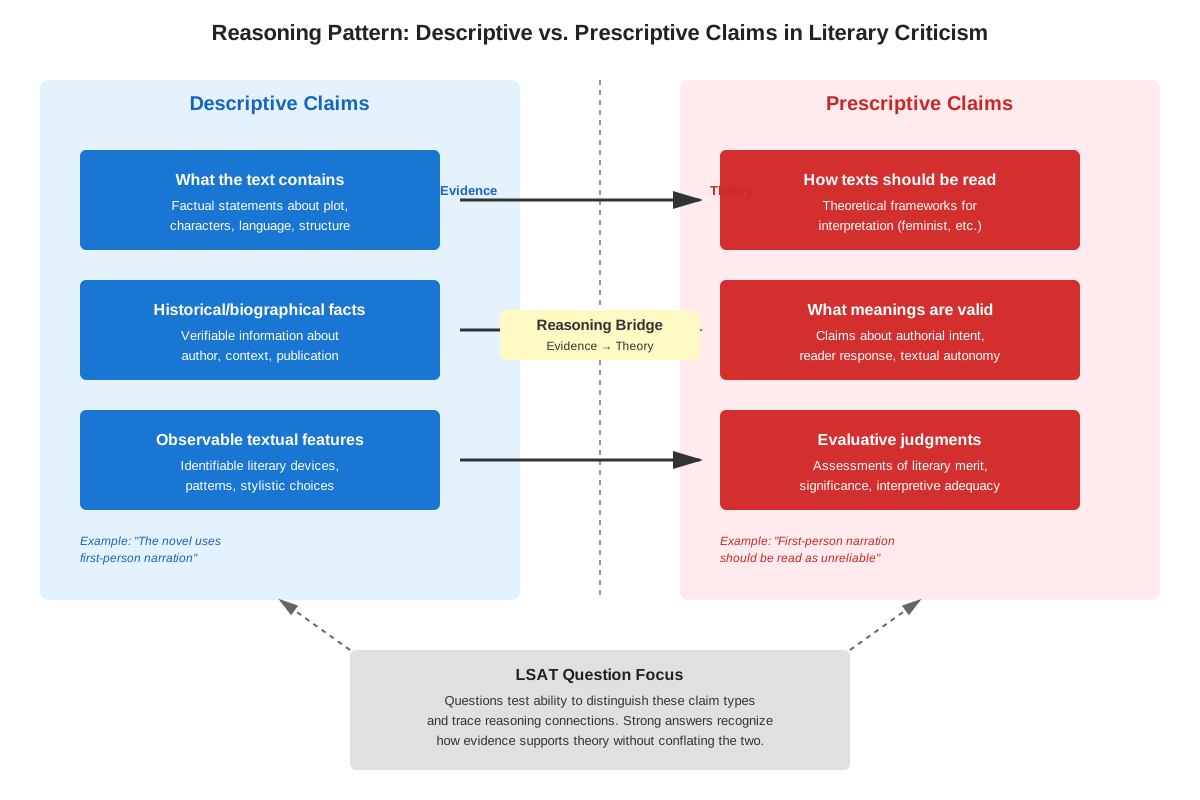
- [ ] Distinguish between descriptive content about literary works and prescriptive theoretical claims about interpretation
- [ ] Recognize common structural patterns in literary criticism arguments (thesis, counterargument, synthesis)
- [ ] Evaluate the relationship between specific textual examples and broader theoretical frameworks
- [ ] Identify the author's attitude toward competing schools of literary thought
Prerequisites
- Basic reading comprehension skills: Ability to identify main ideas, supporting details, and passage structure forms the foundation for tackling more complex literary criticism content
- Understanding of argument structure: Recognizing premises, conclusions, and counterarguments is essential since literary criticism passages frequently present debates between interpretive approaches
- Familiarity with LSAT question types: Knowledge of inference, main point, author's attitude, and function questions enables efficient application of passage-specific strategies
- Comfort with abstract language: Literary theory employs specialized vocabulary and conceptual frameworks that require tolerance for ambiguity and careful attention to definitions provided in context
Why This Topic Matters
Literary criticism passages matter profoundly for LSAT success because they test the analytical and interpretive skills central to legal reasoning. Law school requires constant engagement with competing interpretations of texts (statutes, precedents, contracts), evaluation of theoretical frameworks (jurisprudential philosophies), and synthesis of abstract principles with concrete cases—precisely the skills literary criticism passages assess.
Exam statistics reveal that literary criticism passages appear on virtually every LSAT, typically as one of the four Reading Comprehension passages. These passages generate questions across all major types: main point (testing grasp of the author's central thesis), inference (requiring synthesis of theoretical claims), function (asking why the author includes specific examples or discusses particular theories), and author's attitude (assessing tone toward competing viewpoints). Data from recent LSATs shows that literary criticism passages average 5-8 questions per passage, with inference and function questions being particularly common.
Common manifestations include: passages discussing New Criticism versus reader-response theory; analyses of how specific authors (often from marginalized traditions) challenge dominant literary conventions; explorations of how literary movements (modernism, postcolonialism) reflect broader cultural shifts; debates about authorial intention versus textual autonomy; and discussions of how literary form relates to social or political content. The LSAT favors passages that present a clear scholarly debate or that advance a specific interpretive claim about literature's relationship to culture, history, or meaning-making.
Core Concepts
Structure of Literary Criticism Arguments
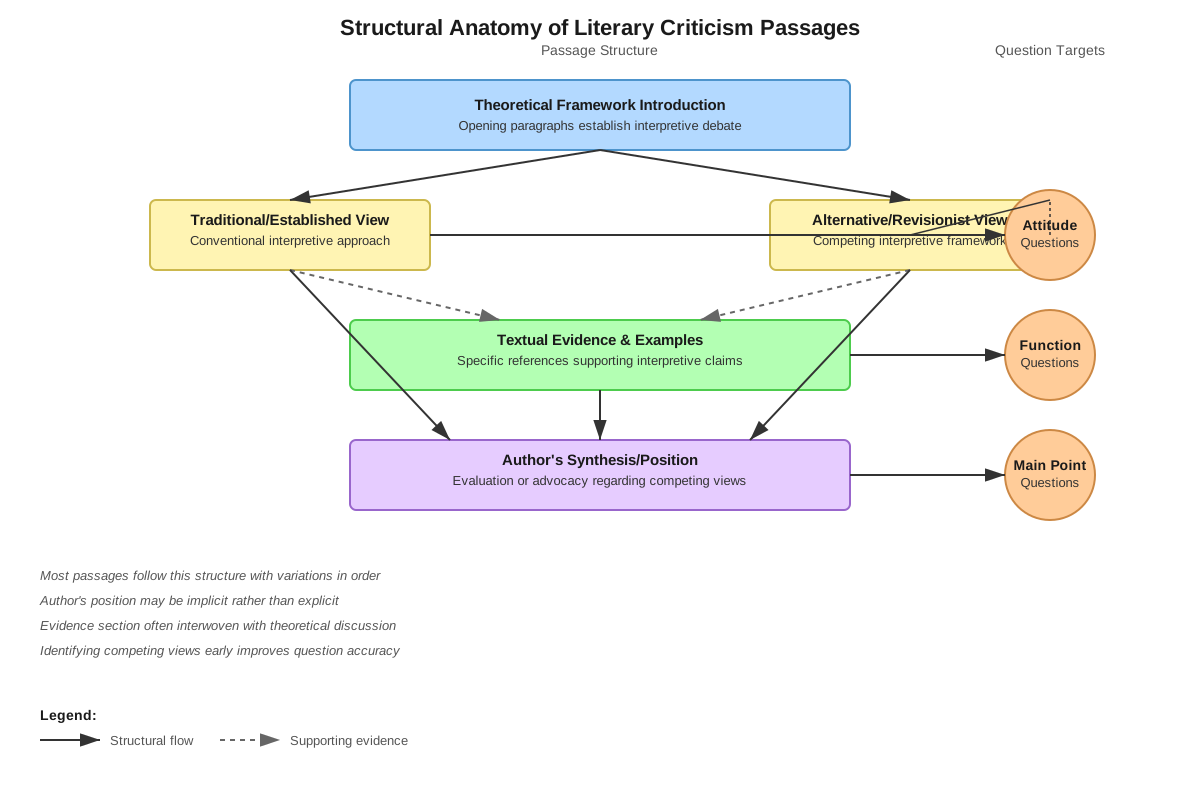
Literary criticism passages on the LSAT follow recognizable argumentative patterns. Most commonly, they present a thesis about how literature should be interpreted, how a particular author or work functions, or how literary criticism itself should be practiced. This thesis typically appears early (often in the first or second paragraph) and is supported through a combination of theoretical reasoning and specific textual examples.
The standard structure includes:
- Introduction of a critical question or debate (e.g., "How should readers approach ambiguity in modernist poetry?")
- Presentation of existing approaches (often traditional or dominant views)
- Introduction of the author's position (which may challenge, refine, or synthesize existing views)
- Supporting evidence and reasoning (theoretical arguments, textual examples, logical implications)
- Consideration of objections or limitations (acknowledging complexity or counterarguments)
- Conclusion or implications (what this means for understanding literature more broadly)
Understanding this structure enables efficient passage mapping and accurate prediction of where answers to specific questions will be located.
Theoretical Frameworks and Schools of Thought
Literary criticism passages frequently reference or compare different interpretive frameworks. While the LSAT does not require prior knowledge of these theories, recognizing their basic orientations helps track arguments:
| Framework | Central Focus | Key Concern |
|---|---|---|
| Formalism/New Criticism | Text itself, independent of context | How literary devices create meaning |
| Reader-response | Reader's experience and interpretation | How meaning emerges through reading |
| Historical/Biographical | Author's life and historical context | How context illuminates textual meaning |
| Marxist/Materialist | Economic and class relations | How literature reflects/challenges power structures |
| Feminist/Gender | Gender dynamics and representation | How texts construct or contest gender norms |
| Postcolonial | Colonial power and cultural identity | How literature addresses imperialism and resistance |
LSAT passages typically explain these frameworks sufficiently within the passage itself, but recognizing the basic orientation helps anticipate arguments and track distinctions.
The Role of Evidence in Literary Arguments
Unlike scientific passages that rely on empirical data, lsat literary criticism passages employ distinctive forms of evidence:
- Textual quotations or descriptions: Specific passages from literary works that illustrate interpretive claims
- Patterns across works: Recurring themes, techniques, or structures that support broader arguments
- Theoretical reasoning: Logical implications of accepting certain premises about interpretation
- Historical or cultural context: Information about the conditions under which texts were produced or received
- Comparative analysis: Contrasts between different authors, works, or periods that highlight specific features
The LSAT tests whether students can identify what function this evidence serves—does it support the main thesis, illustrate a competing view, provide necessary background, or acknowledge a limitation?
Author's Attitude and Rhetorical Positioning
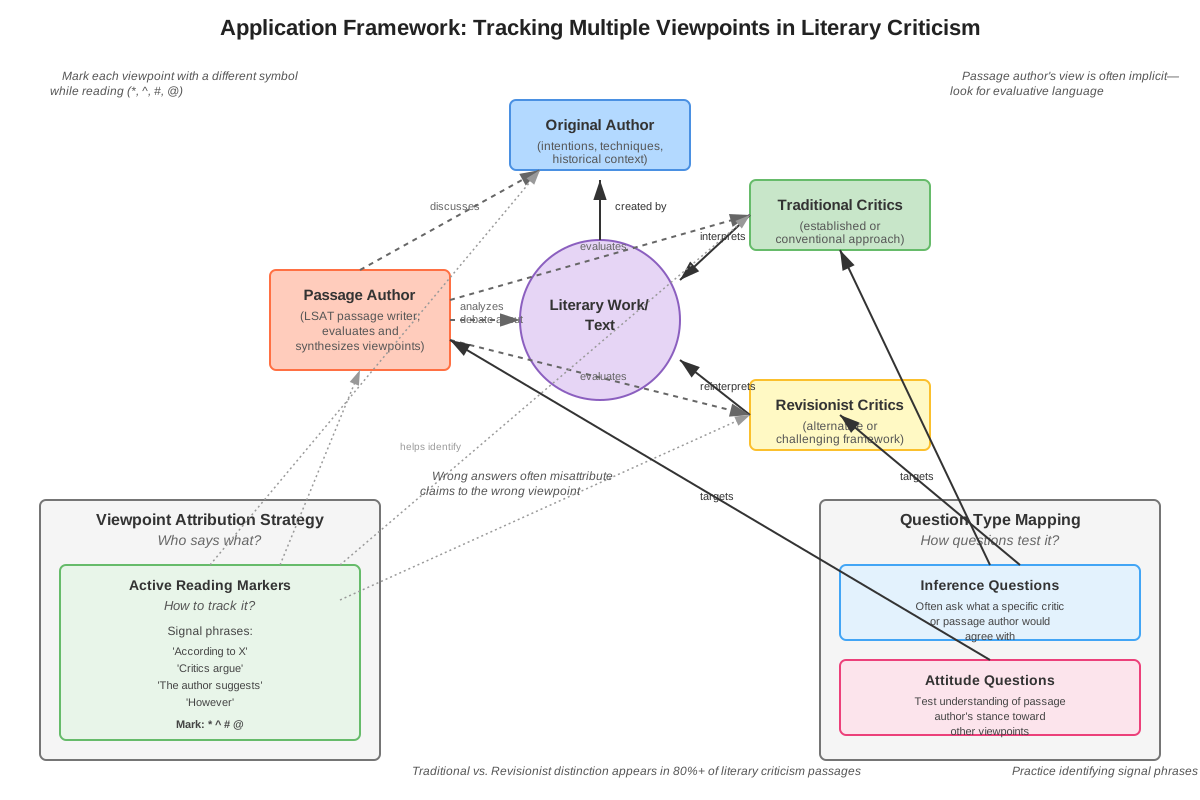
A critical skill for literary criticism passages involves distinguishing between:
- Views the author endorses: The passage's actual argument or thesis
- Views the author describes neutrally: Positions explained for context without judgment
- Views the author critiques or rejects: Opposing positions the author argues against
- Views the author partially accepts: Positions the author finds valuable but incomplete
Tracking these distinctions requires attention to attitude markers: words like "unfortunately," "merely," "importantly," "however," "indeed," "surprisingly," and "although" that signal the author's stance. The LST frequently asks questions that hinge on these subtle distinctions.
The Relationship Between Particular and General
Literary criticism passages constantly move between specific examples (particular texts, authors, or passages) and general claims (broad theories about interpretation, literature's social function, or how meaning operates). Understanding this relationship is crucial:
- Specific examples typically illustrate or support general theoretical claims
- General claims provide frameworks for understanding specific examples
- Sometimes specific examples complicate or challenge general theories, leading to refined positions
Questions often test whether students understand this relationship: "The author discusses [specific work] primarily in order to..." or "The passage suggests that [general theory] would interpret [specific example] as..."
Methodological Assumptions
Literary critics make methodological assumptions—often unstated premises about how interpretation should proceed. Common assumptions include:
- Whether authorial intention is relevant or accessible
- Whether texts have determinate meanings or multiple valid interpretations
- Whether literature primarily reflects or shapes social reality
- Whether formal features or contextual factors are more significant
- Whether interpretation should focus on conscious artistry or unconscious cultural forces
LSAT passages often implicitly contrast different methodological assumptions, and questions may ask students to identify what assumption underlies a particular interpretive approach.
Concept Relationships
The concepts within literary criticism passages form an interconnected system. Theoretical frameworks determine what counts as relevant evidence and how that evidence should be interpreted. For example, a New Critical approach treats textual features as primary evidence, while a historical approach prioritizes contextual information. This methodological choice reflects deeper assumptions about meaning and interpretation.
The structure of arguments in these passages typically moves from general theoretical claims to specific examples and back, creating a dialectical relationship between particular and general. The author's rhetorical positioning—how they situate themselves relative to other scholars—shapes the entire argument structure, determining which views receive extended discussion, which are briefly acknowledged, and which are subjected to critique.
Relationship map: Methodological Assumptions → Theoretical Framework → Types of Evidence Valued → Argument Structure → Rhetorical Positioning → Specific Interpretive Claims
This topic connects to prerequisite knowledge of argument structure by applying those general principles to the specific domain of literary interpretation. It relates to broader passage subjects and strategies by exemplifying how different subject matters (science, law, humanities) employ distinctive forms of reasoning and evidence while still conforming to testable patterns of organization and argumentation.
High-Yield Facts
⭐ Literary criticism passages appear on virtually every LSAT, typically as one of four Reading Comprehension passages, making them unavoidable for test-takers.
⭐ The author's view is often distinct from views the author describes, and questions frequently test whether students can distinguish between positions the passage endorses versus merely explains.
⭐ Specific textual examples serve to illustrate broader theoretical claims, and function questions commonly ask why the author discusses a particular work or author.
⭐ Attitude markers (however, unfortunately, importantly, merely) signal the author's stance toward different interpretive approaches and are crucial for answering author's attitude questions.
⭐ Literary criticism passages typically present a debate or advance a specific interpretive claim rather than simply describing a literary work or author.
- Theoretical vocabulary is always defined or explained sufficiently within the passage; no outside literary knowledge is required or advantageous.
- The relationship between form and content (how literary techniques create meaning) is a recurring theme across literary criticism passages.
- Passages often discuss how marginalized or non-canonical authors challenge dominant literary traditions or interpretive assumptions.
- Questions about "primary purpose" or "main point" require identifying the passage's central argumentative claim, not just its topic.
- Comparative structures (contrasting two theories, two authors, or two periods) are common organizational patterns in literary criticism passages.
- The LSAT favors passages that have clear argumentative stakes—something is being debated, challenged, or newly understood.
- Inference questions often require synthesizing theoretical claims with specific examples to determine what the author would likely conclude about a new case.
Quick check — test yourself on Literary criticism passages so far.
Try Flashcards →Common Misconceptions
Misconception: Literary criticism passages require prior knowledge of literary theory or specific authors and works.
Correction: The LSAT is designed to test reading comprehension and reasoning, not specialized knowledge. All necessary information about theories, authors, and works is provided within the passage. In fact, outside knowledge can sometimes mislead students if it conflicts with how the passage presents information.
Misconception: The main point of a literary criticism passage is simply the literary work or author being discussed.
Correction: The main point is the argumentative claim the passage makes about interpretation, literary criticism, or how we should understand texts. A passage discussing Virginia Woolf's novels has a main point about what those novels reveal about modernist technique or gender representation, not simply "Virginia Woolf's novels."
Misconception: When a passage describes multiple theoretical approaches, it endorses all of them equally.
Correction: Passages typically advance a specific position, even when describing multiple views. Careful attention to attitude markers and the structure of the argument reveals which position the author supports, critiques, or finds incomplete.
Misconception: Abstract theoretical language means the passage is poorly written or deliberately obscure.
Correction: Literary criticism employs specialized vocabulary to make precise distinctions between interpretive approaches. This language serves a function, and the LSAT tests whether students can track these distinctions despite the abstract terminology.
Misconception: Specific examples (quotations, plot summaries, descriptions of literary techniques) are less important than theoretical claims.
Correction: The LSAT frequently tests understanding of how specific examples function within the argument. Questions ask why the author includes a particular example, what it illustrates, or how it relates to the broader thesis. Both theoretical claims and specific examples are equally testable.
Misconception: Literary criticism passages are subjective, so any reasonable interpretation is acceptable.
Correction: While literary interpretation involves judgment, LSAT passages present specific, defensible arguments with clear logical structures. Correct answers must be supported by explicit textual evidence, and wrong answers can be definitively eliminated based on what the passage actually states or implies.
Worked Examples
Example 1: Identifying Author's Attitude
Passage excerpt: "Traditional formalist critics have long maintained that a poem's meaning resides entirely within its formal properties—meter, imagery, structure—independent of historical context or authorial biography. While this approach usefully directs attention to the text itself, it unfortunately neglects how literary works inevitably reflect and respond to their cultural moment. Recent scholarship on Romantic poetry, for instance, has demonstrated that even the most seemingly personal lyrics engage with contemporary political debates in ways formalist analysis cannot capture."
Question: The author's attitude toward formalist criticism can most accurately be described as:
Step 1 - Identify attitude markers: "While...usefully" (partial acknowledgment), "unfortunately neglects" (criticism), "cannot capture" (limitation)
Step 2 - Determine overall stance: The author acknowledges some value ("usefully directs attention") but ultimately critiques formalism's limitations ("unfortunately neglects," "cannot capture")
Step 3 - Eliminate extreme options: The author is neither wholly dismissive (acknowledges usefulness) nor fully supportive (identifies significant limitations)
Step 4 - Select nuanced answer: The correct answer will reflect "qualified criticism" or "partial acceptance with reservations"—acknowledging value while identifying important limitations.
Connection to learning objectives: This example demonstrates how to identify the author's attitude (Learning Objective 1) by recognizing the reasoning pattern of acknowledging-then-critiquing (Learning Objective 2) and applying this understanding to eliminate incorrect answer choices (Learning Objective 3).
Example 2: Function of Specific Examples
Passage excerpt: "Morrison's novels consistently employ what might be called 'narrative fragmentation'—non-linear chronology, multiple perspectives, and gaps in the story that readers must actively reconstruct. In Beloved, for instance, the traumatic history of slavery emerges gradually through fragmented memories rather than straightforward exposition. This technique is not merely stylistic innovation; it enacts at the formal level the psychological reality of trauma, which resists linear narrative and coherent representation. By requiring readers to piece together the story, Morrison makes the interpretive process itself mirror the characters' struggle to construct meaning from devastating historical experience."
Question: The author discusses Beloved primarily in order to:
Step 1 - Identify the general claim: Morrison uses narrative fragmentation to enact trauma's psychological reality
Step 2 - Identify the specific example: Beloved's fragmented presentation of slavery's traumatic history
Step 3 - Determine the relationship: The specific example illustrates how the general technique (fragmentation) serves a specific function (enacting trauma)
Step 4 - Eliminate wrong answer types:
- NOT to summarize the plot (the passage uses the novel to make a theoretical point)
- NOT to compare it to other novels (no comparison is made)
- NOT to critique it (the author presents it positively as an example)
Step 5 - Select correct answer: The correct answer will indicate that Beloved illustrates or exemplifies how narrative fragmentation enacts psychological reality—showing the general claim in action.
Connection to learning objectives: This example shows how literary criticism passages use specific works to support theoretical claims (Learning Objective 2), how to identify this pattern in LSAT questions (Learning Objective 1), and how to apply this understanding to eliminate wrong answers and select correct ones (Learning Objective 3).
Exam Strategy
Initial Passage Approach
When encountering a literary criticism passage, invest 30-45 seconds in strategic preview:
- Read the first sentence of each paragraph to identify the argumentative structure
- Note whether the passage presents a debate (multiple views) or advances a single argument
- Identify any theoretical terms that appear repeatedly (these are likely central to the argument)
- Locate specific examples (author names, work titles) and note which paragraphs contain them
Trigger Words and Phrases
Theory-signaling language: "approach," "framework," "methodology," "school of thought," "interpretive strategy"—indicates discussion of how critics analyze literature
Debate markers: "traditionally," "recently," "some critics argue," "however," "by contrast"—signals competing viewpoints
Evidence introduction: "for instance," "for example," "consider," "in [work title]"—indicates shift from theory to specific illustration
Attitude indicators: "unfortunately," "merely," "importantly," "significantly," "surprisingly," "indeed"—reveals author's stance
Relationship markers: "reflects," "enacts," "embodies," "challenges," "subverts," "reinforces"—describes how literary features relate to broader meanings
Process of Elimination Tips
For main point questions: Eliminate answers that:
- Describe only the topic without the argumentative claim
- Focus on a specific example rather than the broader thesis
- Overstate the author's position (too extreme)
- Include elements not mentioned in the passage
For function questions (why does the author discuss X?): Eliminate answers that:
- Describe what X is rather than why it's included
- Attribute purposes inconsistent with the author's overall argument
- Suggest the example contradicts the main point (unless the passage explicitly presents it as a complication)
For inference questions: Eliminate answers that:
- Require outside knowledge of literary theory or specific works
- Go beyond what the passage's logic supports
- Contradict explicit statements in the passage
- Confuse the author's view with views the author merely describes
Time Allocation
- Initial reading: 3-3.5 minutes (literary criticism passages often require slightly slower reading due to abstract language)
- Question answering: 5-6 minutes for 6-7 questions
- Return to passage: Budget time to locate specific references; don't rely on memory for detail questions
- Difficult questions: If stuck, eliminate clearly wrong answers, flag the question, and return if time permits
Exam Tip: For literary criticism passages, the relationship between theoretical claims and specific examples is heavily tested. As you read, actively note which examples support which claims, creating a mental or physical map of these connections.
Memory Techniques
TRACES Mnemonic for Literary Criticism Elements
Theoretical framework (what interpretive approach?)
Relationship between form and content (how do techniques create meaning?)
Author's attitude (what's the passage's stance?)
Comparison or debate (what views are contrasted?)
Examples and their function (why include specific works?)
Structure of argument (how does the reasoning unfold?)
Visualization Strategy: The Pyramid
Visualize literary criticism arguments as a pyramid:
- Top: Broad theoretical claim (e.g., "Literature reflects cultural anxieties")
- Middle: Specific interpretive framework or methodology (e.g., "Psychoanalytic approach to modernist fiction")
- Bottom: Concrete textual examples (e.g., "Stream of consciousness in Woolf's Mrs. Dalloway")
Arguments move up (from examples to theory) or down (from theory to examples). Questions test whether you can navigate this pyramid in both directions.
Acronym: DAVE for Author's Attitude
Describes neutrally (no attitude markers)
Accepts/Agrees (positive markers: "importantly," "successfully")
Views skeptically (qualified markers: "while," "although")
Explicitly rejects (negative markers: "unfortunately," "fails to")
When reading, mark which of these applies to each view discussed.
The "So What?" Test
For each theoretical claim or specific example, ask "So what?"—what larger point does this support? This mental habit helps track the argument's logic and prepares you for function questions.
Summary
Literary criticism passages on the LSAT present arguments about how literature should be interpreted, how specific works or authors function, or how literary criticism itself should be practiced. These passages follow recognizable structures: introducing a critical question, presenting existing approaches, advancing the author's position, and supporting it through theoretical reasoning and specific textual examples. Success requires distinguishing between views the author endorses versus merely describes, understanding how specific examples illustrate broader theoretical claims, and tracking the author's attitude through careful attention to rhetorical markers. The LSAT tests these passages through main point questions (identifying the central argumentative claim), function questions (determining why specific examples are included), inference questions (synthesizing theoretical claims with examples), and attitude questions (recognizing the author's stance toward competing views). No outside knowledge of literary theory is required; all necessary information appears within the passage. Mastery involves recognizing common structural patterns, tracking the relationship between particular and general, identifying methodological assumptions underlying different interpretive approaches, and efficiently navigating between theoretical claims and supporting evidence.
Key Takeaways
- Literary criticism passages appear on virtually every LSAT and test the ability to track abstract arguments, distinguish competing viewpoints, and understand how evidence supports theoretical claims
- The main point is always an argumentative claim about interpretation or literary criticism, not simply the topic or work being discussed
- Specific textual examples serve to illustrate broader theoretical claims; function questions frequently test understanding of this relationship
- Author's attitude must be carefully distinguished from views the passage merely describes; attitude markers (however, unfortunately, importantly) are crucial signals
- No outside knowledge of literary theory is required or advantageous; all necessary information is provided within the passage
- The relationship between form and content—how literary techniques create or convey meaning—is a recurring theme across literary criticism passages
- Success requires active reading that maps the argument structure, tracks multiple viewpoints, and notes connections between theoretical claims and specific examples
Related Topics
Humanities Passages (General): Literary criticism is a subset of humanities passages, which also include philosophy, art history, and music criticism. Mastering literary criticism passages builds skills applicable to all humanities content: tracking abstract arguments, understanding interpretive frameworks, and evaluating how evidence supports theoretical claims.
Comparative Reading Passages: Some LSAT Reading Comprehension sections include paired passages that present different perspectives on the same topic. Literary criticism is a common subject for these comparative passages, requiring synthesis of competing interpretive approaches—an advanced application of the skills developed through single literary criticism passages.
Argument Structure in Logical Reasoning: The argumentative patterns in literary criticism passages (premise-conclusion relationships, consideration of objections, use of examples) mirror structures tested in Logical Reasoning. Strengthening skills in one section reinforces the other.
Complex Scientific Passages: While content differs dramatically, complex scientific passages share with literary criticism passages the challenge of abstract vocabulary, theoretical frameworks, and the relationship between general principles and specific examples. Strategies for handling abstraction transfer across these passage types.
Practice CTA
Now that you've mastered the core concepts and strategies for literary criticism passages, it's time to apply this knowledge to actual LSAT-style questions. The practice questions and flashcards will reinforce your ability to identify argument structures, track author's attitude, understand the function of specific examples, and efficiently navigate between theoretical claims and supporting evidence. Remember: literary criticism passages are highly learnable. With focused practice using the strategies outlined in this guide, you'll develop the confidence and skills to tackle these passages efficiently and accurately on test day. Each practice passage you complete strengthens your pattern recognition and deepens your mastery of this high-yield LSAT topic.
Sign up free to keep reading
Create a free AnvayaPrep account to finish this LSAT guide on Literary criticism passages — plus flashcards and practice questions.