Overview
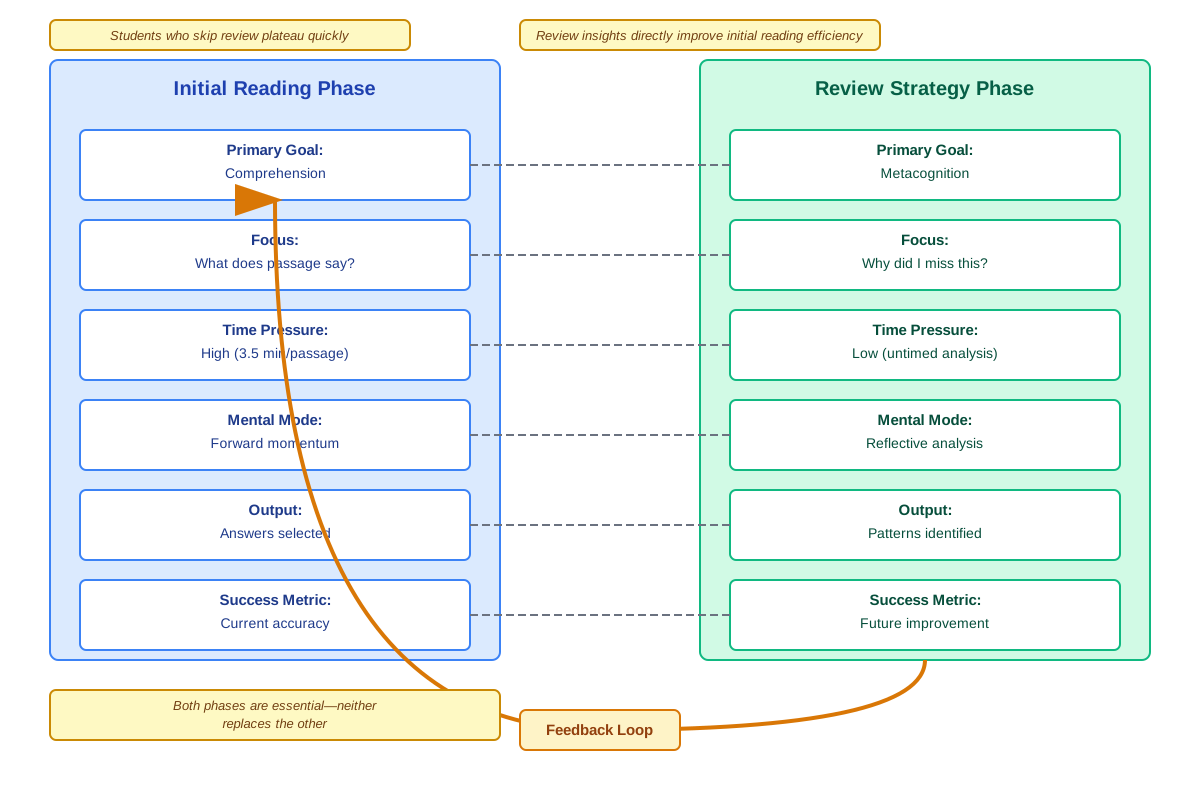
RC review strategy is a systematic approach to analyzing and evaluating Reading Comprehension passages on the LSAT after completing an initial read-through and question set. This critical skill involves revisiting passages with fresh perspective, identifying missed details, recognizing structural patterns that were overlooked, and understanding why certain answer choices were correct or incorrect. Unlike the initial reading phase where students focus on comprehension and main ideas, the review phase emphasizes metacognition—thinking about one's thinking—and strategic pattern recognition that builds long-term competency.
Mastering LSAT RC review strategy transforms how students approach the entire Reading Comprehension section. Rather than viewing each passage as an isolated challenge, effective review creates a feedback loop that identifies recurring question types, common trap answers, and personal blind spots. This metacognitive awareness allows students to refine their initial reading strategy, adjust their annotation techniques, and develop more sophisticated prediction skills for future passages. The review phase is where raw practice converts into measurable score improvement.
Within the broader context of passage subjects and strategies, RC review strategy serves as the capstone skill that integrates all other Reading Comprehension techniques. While initial reading strategies focus on comprehension and passage mapping, and question-specific strategies address individual item types, review strategy provides the analytical framework that connects these elements. Students who implement systematic review protocols consistently outperform those who simply complete more passages without reflection, making this one of the highest-yield investments of study time in reading comprehension preparation.
Learning Objectives
- [ ] Identify how RC review strategy appears in LSAT questions
- [ ] Explain the reasoning pattern behind RC review strategy
- [ ] Apply RC review strategy to solve LSAT-style problems accurately
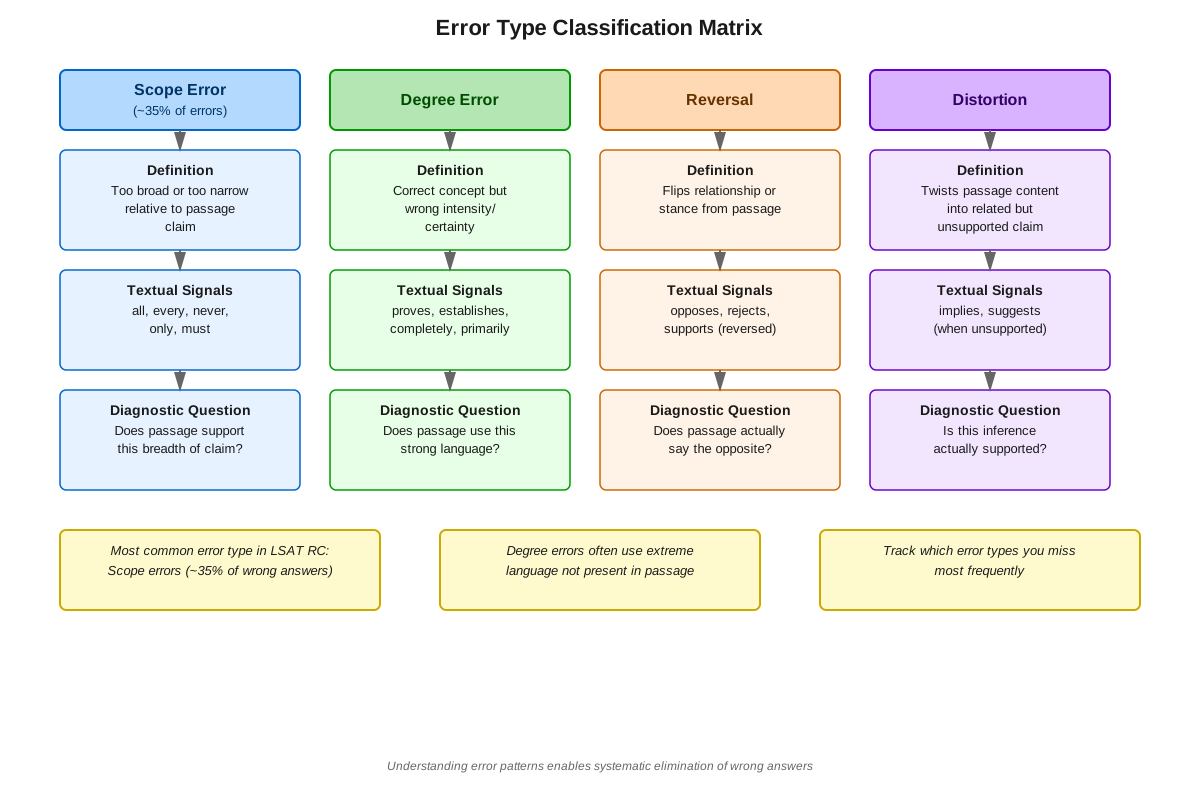
- [ ] Analyze incorrect answer choices to determine the specific error type (scope, degree, reversal, or distortion)
- [ ] Construct a personalized error log that categorizes mistakes by passage type and question category
- [ ] Evaluate the effectiveness of initial reading strategies by comparing predicted answers with correct answers
- [ ] Synthesize patterns across multiple passages to identify recurring personal weaknesses and systemic LSAT patterns
Prerequisites
- Basic passage reading comprehension: Understanding main ideas, author's purpose, and passage structure is essential because review strategy builds upon initial comprehension rather than replacing it
- Familiarity with LSAT question types: Knowledge of inference, main point, function, and detail questions enables targeted review of specific question categories
- Annotation and passage mapping skills: Previous experience marking up passages provides the foundation for evaluating whether initial annotations captured critical information
- Time management fundamentals: Understanding basic pacing allows students to allocate appropriate time for review without compromising initial passage completion
Why This Topic Matters
Effective RC review strategy directly addresses the most significant barrier to LSAT Reading Comprehension improvement: the gap between understanding content and selecting correct answers. Research on LSAT performance indicates that students who implement systematic review protocols improve their RC scores by an average of 3-5 points over those who simply complete more passages. This improvement stems from the review phase's unique ability to reveal the difference between what students think they understand and what the LSAT actually tests.
On the LSAT, Reading Comprehension accounts for approximately 27% of the total score (one full section of four), making it a high-stakes component that can significantly impact overall performance. Within this section, the ability to learn from completed passages—rather than treating each as a disposable practice exercise—multiplies the value of every study session. Students who review effectively need fewer total practice passages to achieve target scores because each passage yields multiple learning opportunities.
lsat rc review strategy appears most prominently in the test preparation phase rather than during the actual exam, but its effects manifest in every aspect of test-day performance. Common applications include: identifying personal patterns in wrong answer selection (such as consistently falling for "too extreme" answer choices), recognizing passage structures that historically cause difficulty (like comparative passages or science-heavy content), and developing more accurate prediction skills that reduce reliance on process of elimination. Additionally, systematic review reveals which question types deserve more initial time investment and which can be handled more quickly, enabling more sophisticated time allocation strategies.
Core Concepts
The Three-Phase Review Cycle
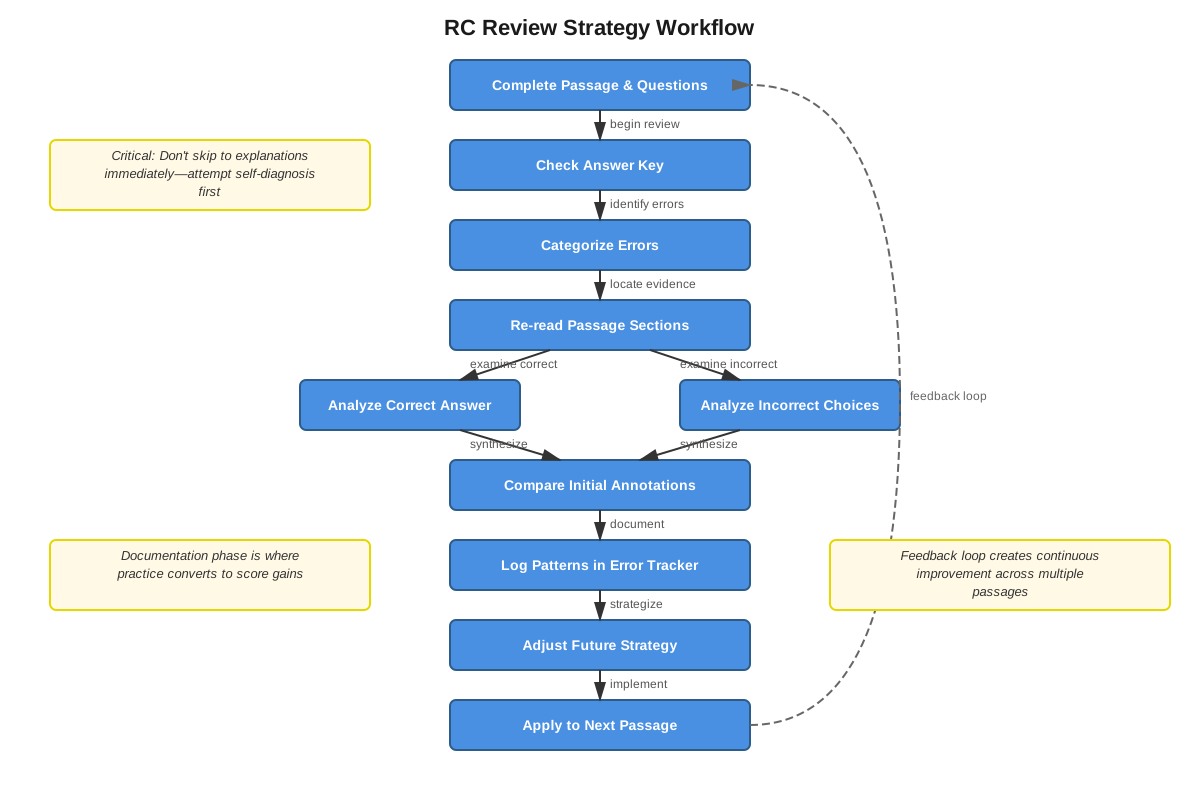
The foundation of effective rc review strategy rests on a structured three-phase approach that transforms passive answer-checking into active learning. The immediate review phase occurs within 10-15 minutes of completing a passage, while details remain fresh in working memory. During this phase, students examine each question independently, identifying the specific textual evidence that supports the correct answer and the precise flaw in each incorrect choice. This immediate feedback prevents the consolidation of incorrect reasoning patterns.
The analytical review phase takes place 24-48 hours after initial completion, allowing students to approach the passage with reduced emotional investment in their original answer choices. This temporal distance enables more objective evaluation of reasoning processes. Students reconstruct their thought process for each question, comparing their initial approach with the optimal strategy. This phase emphasizes pattern recognition across questions rather than individual item analysis.
The cumulative review phase occurs after completing 10-15 passages, focusing on meta-patterns that transcend individual passages. Students analyze their error logs to identify systematic weaknesses, such as consistent struggles with author's attitude questions or recurring difficulty with passages containing multiple viewpoints. This phase produces actionable insights that inform adjustments to initial reading strategy and time allocation.
Error Categorization Framework
Effective review requires precise classification of mistakes according to their underlying cause. Comprehension errors occur when students misunderstand passage content, leading to incorrect answer selection based on faulty premises. These errors signal the need for adjusted reading strategies, such as slower initial reading or more detailed annotation of complex arguments.
Recognition errors happen when students understand the passage correctly but fail to identify which information answers the specific question asked. These mistakes indicate insufficient question stem analysis or inadequate passage mapping. Students experiencing frequent recognition errors benefit from enhanced annotation systems that make key information more retrievable.
Trap answer errors involve selecting incorrect choices that the test makers deliberately designed to appeal to common misreadings or logical fallacies. The LSAT consistently employs specific trap types: scope errors (answers too broad or too narrow), degree errors (answers too strong or too weak), reversal errors (answers stating the opposite of passage content), and distortion errors (answers mixing passage elements incorrectly). Identifying which trap types most frequently ensnare a particular student enables targeted countermeasures.
Timing errors result from rushing through questions or passages, leading to careless mistakes that wouldn't occur under untimed conditions. These errors require different interventions than content-based mistakes, typically involving pacing adjustments and strategic skipping protocols.
Evidence-Based Answer Justification
The cornerstone of reading comprehension review involves articulating the specific textual evidence supporting each correct answer. This process, called evidence mapping, requires students to identify the exact lines or paragraphs that make an answer choice correct and explain the logical connection between passage content and answer wording. Strong evidence mapping includes three components: the relevant passage location (paragraph and approximate line), the specific content that supports the answer, and the reasoning bridge connecting passage language to answer choice language.
For incorrect answers, effective review demands identifying the disqualifying flaw—the specific reason each wrong answer fails. Rather than vague assessments like "this seems wrong," students must articulate precise objections: "This answer choice is too extreme because it uses 'always' while the passage only supports 'typically,'" or "This answer reverses the causal relationship described in paragraph three." This precision trains the analytical skills necessary for efficient process of elimination during timed conditions.
Comparative Answer Analysis
Beyond individual answer evaluation, sophisticated review includes comparative answer analysis—systematically comparing the correct answer with the most tempting wrong answer to understand the distinction. This technique addresses a common student complaint: "I narrowed it to two choices but picked the wrong one." By analyzing the subtle differences between competitive answer choices, students develop the discrimination skills necessary for consistent accuracy.
Comparative analysis follows a structured protocol: First, identify what both answers have in common (usually some connection to passage content). Second, articulate the specific difference between them (often involving scope, degree, or precision). Third, determine which passage evidence definitively supports one answer over the other. Fourth, identify the reasoning error that made the wrong answer appealing. This systematic approach converts frustrating near-misses into valuable learning opportunities.
Question Type Pattern Recognition
Effective lsat rc review strategy includes tracking performance across different question types to identify category-specific weaknesses. The LSAT employs several recurring question categories, each testing distinct skills: main point questions assess global comprehension, function questions evaluate understanding of passage structure, inference questions test logical reasoning, detail questions measure careful reading, and application questions require extending passage principles to new contexts.
Students should maintain a question type performance matrix that tracks accuracy rates for each category across multiple passages. This data reveals whether struggles stem from specific question types (suggesting targeted skill development) or from particular passage subjects (indicating content-area weaknesses). For example, a student who consistently misses inference questions but excels at detail questions needs to focus on logical reasoning skills rather than careful reading.
| Question Type | Skills Tested | Common Traps | Review Focus |
|---|---|---|---|
| Main Point | Global comprehension, synthesis | Too narrow, too broad | Verify answer encompasses entire passage |
| Function | Structural awareness | Confusing content with purpose | Identify role in author's argument |
| Inference | Logical reasoning | Unsupported leaps | Ensure answer must be true based on passage |
| Detail | Careful reading | Distortions, reversals | Match answer precisely to passage language |
| Application | Principle extension | Imperfect analogies | Verify structural similarity to passage scenario |
Passage Difficulty Assessment
Not all passages deserve equal review time. Strategic students conduct passage difficulty assessment to prioritize review efforts. This assessment considers three factors: objective difficulty (passage complexity, question difficulty, and average student performance), subjective difficulty (personal struggle with specific content or structure), and learning potential (opportunity for skill development versus reinforcement of existing strengths).
High-priority passages for intensive review include those where the student performed below their average accuracy, passages containing question types that historically cause difficulty, and passages representing structures or subjects likely to appear on test day. Lower-priority passages include those where the student achieved perfect or near-perfect accuracy through solid reasoning (rather than lucky guessing) and passages covering content or structures already mastered through previous review.
Concept Relationships
The concepts within RC review strategy form an interconnected system where each element reinforces the others. The Three-Phase Review Cycle provides the temporal framework within which all other review activities occur, ensuring that review happens at optimal intervals for learning consolidation. Within each phase, the Error Categorization Framework supplies the analytical lens for examining mistakes, while Evidence-Based Answer Justification provides the specific methodology for understanding why answers are correct or incorrect.
Comparative Answer Analysis builds directly upon evidence-based justification by applying those same analytical skills to the subtle distinctions between competitive answer choices. This technique particularly addresses recognition errors and trap answer errors identified through the categorization framework. Meanwhile, Question Type Pattern Recognition operates at a higher level of abstraction, synthesizing insights from multiple passages to reveal systematic patterns that inform strategic adjustments.
Passage Difficulty Assessment serves as the meta-skill that governs resource allocation across all other review activities, ensuring that limited study time focuses on the highest-yield learning opportunities. This assessment draws upon data from question type tracking and error categorization to make informed prioritization decisions.
The relationship to prerequisite topics flows naturally: basic passage comprehension provides the foundation upon which review strategy builds, while familiarity with question types enables the categorization and pattern recognition that make review productive. The connection to related topics in passage subjects and strategies is bidirectional—review insights inform adjustments to initial reading strategies, while improved initial strategies reduce the number of errors requiring review.
Concept Flow: Initial Passage Completion → Immediate Review (Error Categorization + Evidence Mapping) → Analytical Review (Comparative Analysis + Question Type Tracking) → Cumulative Review (Pattern Recognition + Difficulty Assessment) → Strategic Adjustments to Initial Reading → Improved Future Performance
Quick check — test yourself on RC review strategy so far.
Try Flashcards →High-Yield Facts
⭐ The immediate review phase (within 10-15 minutes of passage completion) produces 3x more learning retention than delayed review conducted days later
⭐ Approximately 70% of LSAT RC errors fall into four trap answer categories: scope errors, degree errors, reversals, and distortions
⭐ Students who maintain detailed error logs improve their RC scores 40% faster than those who simply check answers without categorization
⭐ The most common student error pattern is selecting answers that are too extreme, accounting for roughly 30% of all mistakes
⭐ Comparative answer analysis (examining why the correct answer beats the second-best choice) eliminates 60% of "narrowed to two" errors within 4-6 weeks of consistent practice
- Evidence-based answer justification should identify specific passage lines (not just paragraphs) to maximize precision and learning transfer
- Question type performance tracking requires minimum 10 passages to establish reliable patterns; earlier data may reflect random variation
- Timing errors decrease by approximately 50% when students implement strategic skipping protocols informed by passage difficulty assessment
- The analytical review phase (24-48 hours post-completion) optimally balances memory retention with emotional distance from original answers
- Cumulative review sessions should occur after every 10-15 passages to identify meta-patterns before they become entrenched habits
Common Misconceptions
Misconception: Review means simply checking whether answers were right or wrong → Correction: Effective review requires understanding the specific reasoning that makes correct answers right and identifying the precise flaw in each wrong answer, not just tallying scores
Misconception: More passages always equals better preparation → Correction: Ten passages with thorough review produce better results than thirty passages without review; quality of analysis matters more than quantity of exposure
Misconception: If the correct answer makes sense during review, no further analysis is needed → Correction: Understanding why an answer is correct is only half the learning; identifying why wrong answers are tempting and how to avoid those traps is equally important
Misconception: Error patterns can be identified after just 3-4 passages → Correction: Reliable pattern recognition requires data from at least 10 passages across varied subjects and structures; premature conclusions lead to misguided strategy adjustments
Misconception: Review should happen immediately after checking answers while everything is fresh → Correction: While immediate review has value, the analytical review phase (24-48 hours later) provides crucial perspective that immediate review cannot offer; both phases serve distinct purposes
Misconception: All mistakes indicate the same underlying problem and require the same solution → Correction: Comprehension errors, recognition errors, trap answer errors, and timing errors have different root causes and require different interventions; treating all mistakes identically wastes study time
Misconception: Perfect accuracy on a passage means no review is necessary → Correction: Even passages answered correctly offer learning opportunities through examining why wrong answers were successfully eliminated and whether correct answers were selected for the right reasons or through lucky guessing
Worked Examples
Example 1: Comprehensive Passage Review
Scenario: A student completed a passage about judicial interpretation theories, answering 6 of 8 questions correctly. The two errors were on an inference question and a function question.
Step 1 - Immediate Review (Error Categorization)
For the inference question, the student selected an answer stating that "most judges reject originalist interpretation." The correct answer stated that "originalist interpretation faces practical implementation challenges."
Error categorization: This is a degree error (trap answer). The passage discussed challenges to originalism but never provided evidence about what "most judges" believe. The student's answer was too strong and introduced unsupported quantification.
For the function question asking why the author mentioned a specific court case, the student selected "to provide an example of originalist reasoning." The correct answer was "to illustrate a limitation of originalist methodology."
Error categorization: This is a recognition error. The student correctly understood the passage content but failed to recognize that the question asked about the author's purpose (critical perspective) rather than the content itself (what the case demonstrated).
Step 2 - Evidence-Based Answer Justification
Inference question correct answer: Lines 34-38 state: "Originalist judges often struggle to apply 18th-century constitutional language to modern technological contexts, creating interpretive gaps that the methodology itself cannot resolve." This directly supports "practical implementation challenges" without making claims about judicial preferences.
Function question correct answer: The case appears in paragraph 3, which begins with "However, originalism faces significant obstacles..." The case serves as evidence for this critical claim, making "illustrate a limitation" the correct characterization of its function.
Step 3 - Comparative Answer Analysis
Inference question: Both the selected answer and correct answer relate to problems with originalism. The key distinction is that the correct answer describes an objective challenge (implementation difficulty) supported by passage evidence, while the wrong answer makes an unsupported claim about judicial attitudes. The trap worked because the student confused "the passage criticizes originalism" with "the passage says judges reject originalism."
Function question: Both answers correctly identify that the case relates to originalism. The distinction lies in recognizing that function questions ask about the author's purpose, not the content itself. The case content showed originalist reasoning, but the author's purpose in including it was to critique that reasoning.
Step 4 - Pattern Recognition and Strategic Adjustment
This student shows vulnerability to degree errors (making unsupported quantitative claims) and needs to strengthen function question analysis by consistently asking "Why did the author include this?" rather than "What does this say?" The strategic adjustment involves adding a verification step: before selecting inference answers, confirm that the passage explicitly supports any quantitative or evaluative claims; for function questions, identify the paragraph's purpose before evaluating answer choices.
Example 2: Question Type Performance Analysis
Scenario: After completing 12 passages, a student reviews their question type performance matrix and discovers the following accuracy rates: Main Point (90%), Detail (85%), Function (65%), Inference (70%), Application (60%).
Step 1 - Identify Pattern
The student excels at questions requiring careful reading and global comprehension but struggles with questions requiring structural analysis (function) and logical reasoning (inference, application). This pattern suggests strong reading comprehension but underdeveloped analytical skills.
Step 2 - Drill Down into Error Types
Reviewing the specific function question errors reveals that 70% involve confusing content with purpose—the student correctly identifies what a passage segment says but misidentifies why the author included it. For inference questions, 60% of errors involve selecting answers that go beyond what the passage supports, indicating insufficient attention to the "must be true" standard.
Step 3 - Develop Targeted Intervention
For function questions, the student implements a two-step protocol: (1) Before reading answer choices, write one sentence describing the paragraph's role in the overall argument; (2) Eliminate any answer choice that describes content rather than purpose. For inference questions, the student adds a verification step: before selecting an answer, identify the specific passage evidence that makes it must be true, not just probably true.
Step 4 - Track Improvement
Over the next 6 passages, the student applies these targeted strategies and tracks performance. Function question accuracy improves to 78% and inference accuracy to 80%, confirming that the interventions addressed the underlying skill gaps rather than surface-level symptoms.
Exam Strategy
When approaching LSAT Reading Comprehension with review strategy in mind, students should implement a forward-looking review mindset even during initial passage completion. This means making brief mental notes of uncertainty or confusion as they occur, marking questions that required extensive deliberation, and flagging answer choices that were difficult to eliminate. These real-time observations guide subsequent review priorities.
Trigger phrases for review-worthy questions include any instance where the student thinks "I'm not sure about this," "both of these seem right," or "I don't see clear evidence for any answer." Questions generating these reactions deserve immediate flagging for thorough review regardless of whether the selected answer proves correct. Often, correct answers selected through uncertain reasoning indicate lucky guessing rather than solid understanding.
Process-of-elimination tips specific to review strategy: During review, reconstruct the elimination process for each question. Identify which answers were eliminated immediately, which required careful consideration, and which competed for selection. This reconstruction reveals whether the student's elimination criteria align with LSAT standards. Common misalignments include eliminating answers that "seem boring" (often correct answers are straightforward rather than exciting) or keeping answers that "sound sophisticated" (trap answers frequently use impressive language to mask logical flaws).
Time allocation for review: Immediate review should take approximately 50% of the time spent on initial passage completion (if a passage took 10 minutes, allocate 5 minutes for immediate review). Analytical review requires less time per passage (3-4 minutes) because it focuses on specific questions rather than comprehensive analysis. Cumulative review sessions should last 30-45 minutes and occur after every 10-15 passages.
Exam Tip: During actual LSAT administration, review strategy cannot be applied to the current section, but the skills developed through review practice—precise evidence identification, trap answer recognition, and comparative analysis—operate automatically, improving real-time decision-making.
Strategic skipping informed by review insights: Students should analyze their error logs to identify question types that historically consume excessive time without yielding correct answers. These become prime candidates for strategic skipping during timed practice and actual test administration. For example, a student who consistently misses application questions despite spending 2+ minutes per question should consider skipping these initially and returning if time permits.
Memory Techniques
SCOPE mnemonic for trap answer identification:
- Scope (too broad or too narrow)
- Certainty (too strong or too weak - degree errors)
- Opposite (reversal of passage content)
- Parts mixed (distortion - combining passage elements incorrectly)
- Evidence absent (unsupported by passage)
The "Three E's" for evidence-based justification:
- Exact location (identify specific lines)
- Explicit connection (articulate the logical link)
- Eliminate alternatives (explain why other answers fail)
TRAP acronym for common wrong answer types:
- Too extreme
- Reversal
- Assumption (requires outside knowledge)
- Partial truth (contains some passage content but makes unsupported claims)
Visualization for the three-phase review cycle: Picture a spiral staircase where each level represents a review phase. The immediate review (bottom level) focuses on individual steps (questions). The analytical review (middle level) examines the staircase structure (patterns within a passage). The cumulative review (top level) provides a bird's-eye view of the entire staircase system (meta-patterns across passages).
The "24-Hour Rule" for analytical review: Wait at least one day before conducting analytical review to ensure emotional distance from original answers. Visualize this as letting a photograph develop—immediate viewing shows only a blur, but proper development time reveals clear details.
Summary
RC review strategy represents the systematic approach to analyzing completed Reading Comprehension passages that transforms passive practice into active learning. The foundation rests on a three-phase review cycle: immediate review (within 10-15 minutes) for error categorization and evidence mapping, analytical review (24-48 hours later) for pattern recognition and comparative analysis, and cumulative review (after 10-15 passages) for meta-pattern identification and strategic adjustment. Effective review requires precise error categorization distinguishing comprehension errors, recognition errors, trap answer errors, and timing errors, each demanding different interventions. Evidence-based answer justification—identifying specific passage lines supporting correct answers and articulating precise flaws in wrong answers—develops the analytical precision necessary for consistent accuracy. Comparative answer analysis addresses the common challenge of narrowing to two choices by systematically examining the distinctions between competitive answers. Question type performance tracking reveals category-specific weaknesses that inform targeted skill development. Students who implement comprehensive review protocols consistently outperform those who complete more passages without reflection, making review strategy one of the highest-yield investments in LSAT preparation.
Key Takeaways
- The three-phase review cycle (immediate, analytical, cumulative) maximizes learning retention and pattern recognition across different time scales
- Error categorization into comprehension, recognition, trap answer, and timing errors enables targeted interventions rather than generic "try harder" approaches
- Evidence-based answer justification requires identifying specific passage lines and articulating logical connections, not just confirming that correct answers "make sense"
- Approximately 70% of RC errors fall into four trap categories (scope, degree, reversal, distortion), making trap recognition a high-yield skill
- Question type performance tracking across minimum 10 passages reveals systematic weaknesses that inform strategic adjustments to reading and answering approaches
- Comparative answer analysis—examining why the correct answer beats the second-best choice—eliminates the majority of "narrowed to two" errors
- Quality of review matters more than quantity of passages; ten thoroughly reviewed passages produce better results than thirty passages without analysis
Related Topics
Passage Mapping and Annotation Techniques: Review strategy insights directly inform adjustments to initial passage mapping, creating a feedback loop where review reveals which annotation approaches capture the most useful information for question answering.
Question Type Specific Strategies: Deep understanding of review strategy enables more sophisticated application of question-type-specific approaches, as students learn to recognize which strategies work best for their individual reasoning patterns.
Time Management and Pacing Protocols: Error logs and passage difficulty assessments generated through review strategy provide the data necessary for evidence-based time allocation decisions rather than arbitrary pacing rules.
Comparative Passage Strategies: The analytical skills developed through general RC review strategy apply with particular force to comparative passages, where relationship identification and viewpoint tracking become critical.
Advanced Inference Techniques: Students who master review strategy develop the precise logical reasoning skills necessary for tackling the most difficult inference questions that separate good scores from elite scores.
Practice CTA
Now that you understand the systematic approach to RC review strategy, it's time to apply these concepts to actual LSAT passages. Begin with the practice questions designed for this topic, implementing the three-phase review cycle on each passage. Use the flashcards to reinforce error categorization and trap answer recognition. Remember: every passage you review thoroughly is worth three passages completed without reflection. Your investment in systematic review now will compound into significant score improvements as patterns become clear and your analytical precision sharpens. The difference between a good LSAT score and a great one often lies not in how many passages you complete, but in how deeply you learn from each one.
Sign up free to keep reading
Create a free AnvayaPrep account to finish this LSAT guide on RC review strategy — plus flashcards and practice questions.