Overview
Statutory interpretation passages represent one of the most challenging and frequently tested passage types in the LSAT Reading Comprehension section. These passages examine how courts, judges, and legal scholars analyze and apply written laws—statutes, regulations, constitutional provisions, and legal codes—to specific cases and situations. Unlike passages that simply describe legal history or theory, statutory interpretation passages focus on the methodological approaches judges use when determining what a law means and how it should be applied when the text is ambiguous, unclear, or seemingly in conflict with other legal principles.
Understanding statutory interpretation is essential for LSAT success because these passages test multiple skills simultaneously: the ability to follow complex legal reasoning, distinguish between competing interpretive methods, track how different approaches lead to different outcomes, and evaluate the strengths and weaknesses of various judicial philosophies. The LSAT frequently presents passages that contrast textualist approaches (focusing strictly on the words of the statute) with purposivist approaches (considering legislative intent), or that explore how judges balance literal meaning against practical consequences. These passages often include detailed examples of specific cases where different interpretive methods would yield different results.
Within the broader framework of Reading Comprehension and passage subjects and strategies, statutory interpretation passages connect to several key skills: identifying author viewpoint, tracking multiple perspectives, understanding argument structure, and recognizing how abstract principles apply to concrete situations. Mastering these passages requires developing a systematic approach to mapping the relationships between interpretive theories, understanding the implications of each method, and recognizing how the LSAT tests your comprehension through questions about application, inference, and comparative analysis.
Learning Objectives
- [ ] Identify how statutory interpretation passages appear in LSAT questions
- [ ] Explain the reasoning pattern behind statutory interpretation passages
- [ ] Apply statutory interpretation passages to solve LSAT-style problems accurately
- [ ] Distinguish between major schools of statutory interpretation (textualism, purposivism, intentionalism)
- [ ] Predict how different interpretive methods would resolve specific legal ambiguities
- [ ] Analyze the structure of arguments comparing competing interpretive approaches
- [ ] Evaluate the strengths and limitations of various interpretive methodologies as presented in passages
Prerequisites
- Basic reading comprehension skills: Ability to identify main ideas, supporting details, and author's tone in complex academic prose
- Logical reasoning fundamentals: Understanding of how arguments are constructed, including premises, conclusions, and supporting evidence
- Familiarity with passage structure: Recognition of common organizational patterns such as comparison/contrast, problem/solution, and theory/application
- Vocabulary for legal and academic discourse: Comfort with formal language and abstract concepts commonly found in law-related texts
Why This Topic Matters
Statutory interpretation passages appear with remarkable frequency on the LSAT, typically comprising 15-25% of all Reading Comprehension passages. The LSAC (Law School Admission Council) includes these passages because they directly assess skills essential for law school success: the ability to parse complex legal texts, understand competing analytical frameworks, and apply abstract principles to specific scenarios. Legal practice fundamentally involves interpreting written laws, making this topic both practically relevant and academically significant.
In real-world legal practice, statutory interpretation forms the foundation of countless judicial decisions, administrative rulings, and legal arguments. When Congress passes a law stating that employers cannot discriminate based on "sex," does that include sexual orientation? When a statute prohibits "vehicles" in a park, does that include bicycles, ambulances, or war memorials? These questions require interpretive methodologies, and understanding how judges approach such questions is central to legal reasoning.
On the LSAT, statutory interpretation passages commonly appear in several formats: passages contrasting two or more interpretive schools, passages examining a single judge's or scholar's approach to interpretation, passages analyzing how different methods would resolve a specific legal controversy, or passages discussing the evolution of interpretive theory over time. Questions typically test your ability to identify the main features of each approach, apply these approaches to new scenarios, understand the implications and consequences of different methods, and recognize the author's attitude toward various interpretive philosophies.
Core Concepts
The Nature of Statutory Interpretation
Statutory interpretation refers to the process by which courts determine the meaning of legislative texts—statutes, regulations, and constitutional provisions—when applying them to specific cases. This process becomes necessary when statutory language is ambiguous, when multiple interpretations seem plausible, when literal application would produce absurd results, or when the statute's relationship to other laws is unclear. The central challenge is that language is inherently imprecise, and legislators cannot anticipate every situation to which a law might apply.
LSAT statutory interpretation passages typically present this challenge through concrete examples: a statute uses a particular term, and courts must decide whether that term encompasses a specific situation not explicitly mentioned in the text. The passage then explores how different interpretive approaches would resolve this ambiguity, often revealing that the choice of method significantly affects the outcome.
Major Schools of Interpretation
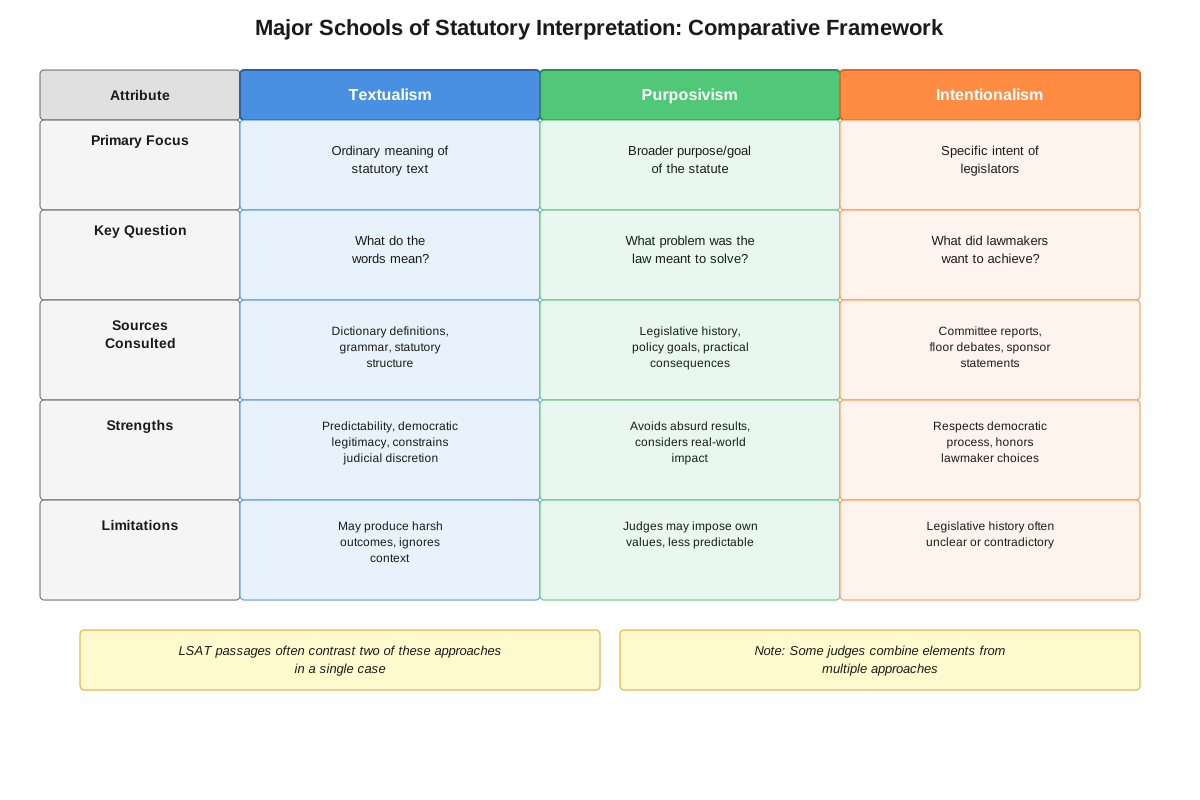
Textualism
Textualism holds that courts should interpret statutes based solely on the ordinary meaning of the statutory text at the time of enactment. Textualists argue that the words of the statute—as they would be understood by a reasonable person reading them—constitute the law itself. This approach rejects consideration of legislative history, committee reports, or statements by individual legislators about what they intended the law to accomplish.
The textualist reasoning pattern follows this structure:
- Identify the relevant statutory language
- Determine the ordinary, plain meaning of those words
- Apply that meaning consistently, even if it produces unexpected results
- Refuse to consider extrinsic evidence of legislative intent
Textualists argue this approach respects democratic principles because only the text—not committee discussions or floor speeches—went through the formal legislative process and received the president's signature. They also contend that textualism provides greater predictability and constrains judicial discretion.
Purposivism
Purposivism maintains that courts should interpret statutes in light of their underlying purpose or the problem the legislature sought to address. Purposivists examine not just the words but the broader statutory scheme, the mischief the law was designed to remedy, and the practical consequences of different interpretations. They argue that faithful interpretation requires understanding what the legislature was trying to accomplish.
The purposivist reasoning pattern includes:
- Identify the statute's overall purpose or goal
- Determine what problem the legislature sought to solve
- Interpret ambiguous terms in ways that advance this purpose
- Consider whether a proposed interpretation would produce absurd or unjust results
- Examine the statute's structure and relationship to other laws
Purposivists contend that rigid adherence to text can defeat legislative goals when language proves imprecise or when circumstances change in ways legislators could not anticipate.
Intentionalism
Intentionalism focuses on discovering what the legislature actually intended when it enacted the statute. Intentionalists examine legislative history—committee reports, floor debates, sponsor statements—to determine the specific intent behind particular statutory provisions. This approach treats the statute as an expression of legislative will that courts should faithfully implement.
The intentionalist approach involves:
- Examine the statutory text as a starting point
- Consult legislative history to determine specific intent
- Give weight to committee reports and sponsor statements
- Resolve ambiguities in favor of the interpretation that matches demonstrated legislative intent
Critics of intentionalism argue that legislatures are collective bodies without a single "intent," and that legislative history can be manipulated or selectively cited to support predetermined conclusions.
Common Interpretive Tools and Canons
Regardless of their theoretical orientation, judges employ various interpretive canons—rules of thumb for resolving ambiguities:
| Canon | Description | Example |
|---|---|---|
| Expressio unius | Expressing one thing excludes others | If a statute lists "cars, trucks, and motorcycles," it likely excludes bicycles |
| Ejusdem generis | General terms are limited by specific terms that precede them | "Dogs, cats, and other animals" likely means other pets, not all animals |
| Noscitur a sociis | Words are known by their companions | "Arms" in a list with "weapons" means military arms, not body parts |
| Avoid absurdity | Interpret to avoid absurd results | Don't interpret "no vehicles in the park" to prohibit baby strollers |
| Constitutional avoidance | Prefer interpretations that avoid constitutional problems | Choose the reading that doesn't raise First Amendment concerns |
The Role of Precedent and Stare Decisis
Statutory interpretation passages often discuss how prior judicial interpretations affect current cases. The doctrine of stare decisis (let the decision stand) means courts generally follow earlier interpretations of statutes, even if judges today might interpret the text differently. However, passages may explore when courts feel justified in overturning prior interpretations, particularly when the earlier decision was clearly erroneous or has proven unworkable.
Dynamic vs. Static Interpretation
Some passages explore the temporal dimension of interpretation: should courts interpret statutory terms according to their meaning when enacted (originalism or static interpretation), or should meaning evolve with changing social understanding (dynamic interpretation or living constitutionalism)? For example, does "cruel and unusual punishment" mean what it meant in 1791, or should courts consider contemporary standards of decency?
Chevron Deference and Administrative Interpretation
Advanced statutory interpretation passages may discuss how courts treat agency interpretations of statutes. Under the Chevron doctrine, courts sometimes defer to reasonable agency interpretations of ambiguous statutes that the agency administers, recognizing agency expertise and political accountability.
Concept Relationships
The concepts within statutory interpretation form an interconnected framework. The fundamental challenge—textual ambiguity—necessitates interpretive methodologies. The three major schools (textualism, purposivism, and intentionalism) represent competing responses to this challenge, each prioritizing different values: textualism prioritizes democratic legitimacy and predictability, purposivism prioritizes practical effectiveness and justice, and intentionalism prioritizes fidelity to legislative will.
These schools employ overlapping interpretive canons as practical tools, though they disagree about which canons are legitimate and how to apply them. All three approaches must contend with precedent (stare decisis), which constrains interpretive freedom regardless of methodology. The static vs. dynamic interpretation debate cuts across the three schools, representing a separate dimension of disagreement about whether meaning is fixed at enactment or evolves over time.
The relationship map flows as follows:
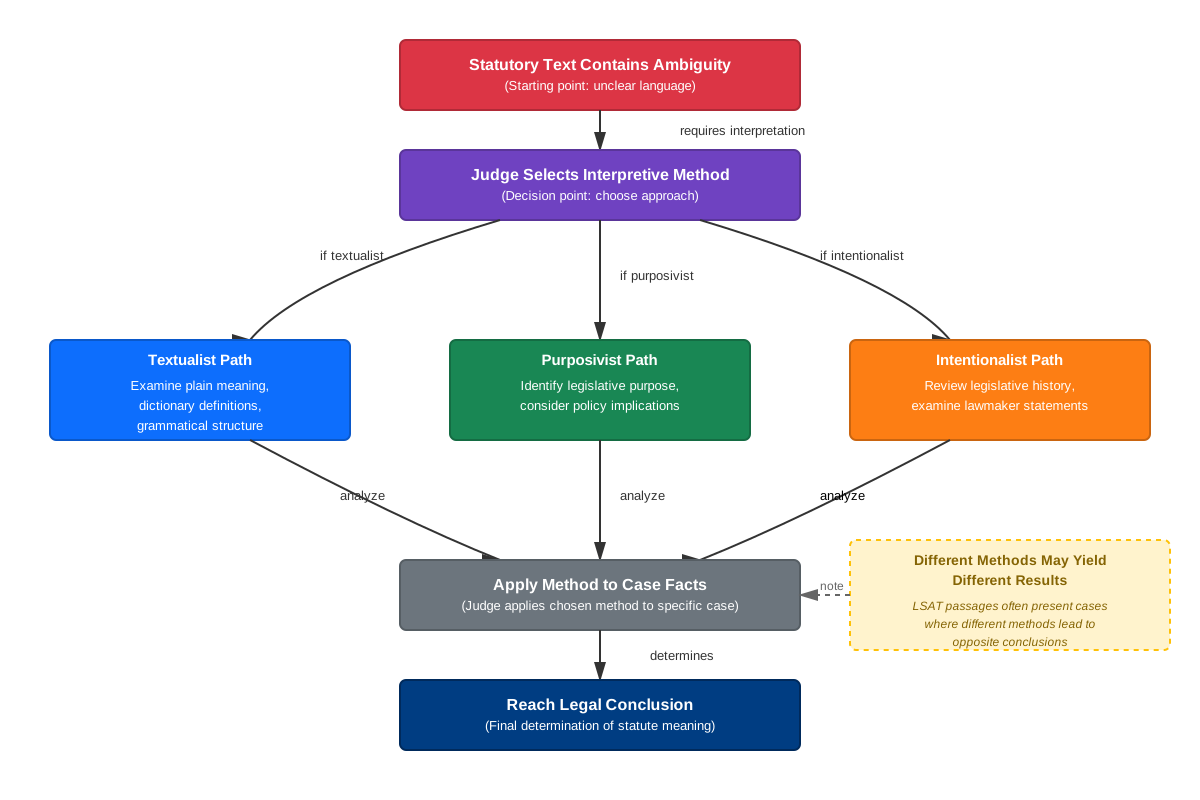
Statutory Ambiguity → necessitates → Interpretive Methodology → branches into → Textualism, Purposivism, Intentionalism → each employs → Interpretive Canons → all constrained by → Precedent → all must address → Static vs. Dynamic Interpretation
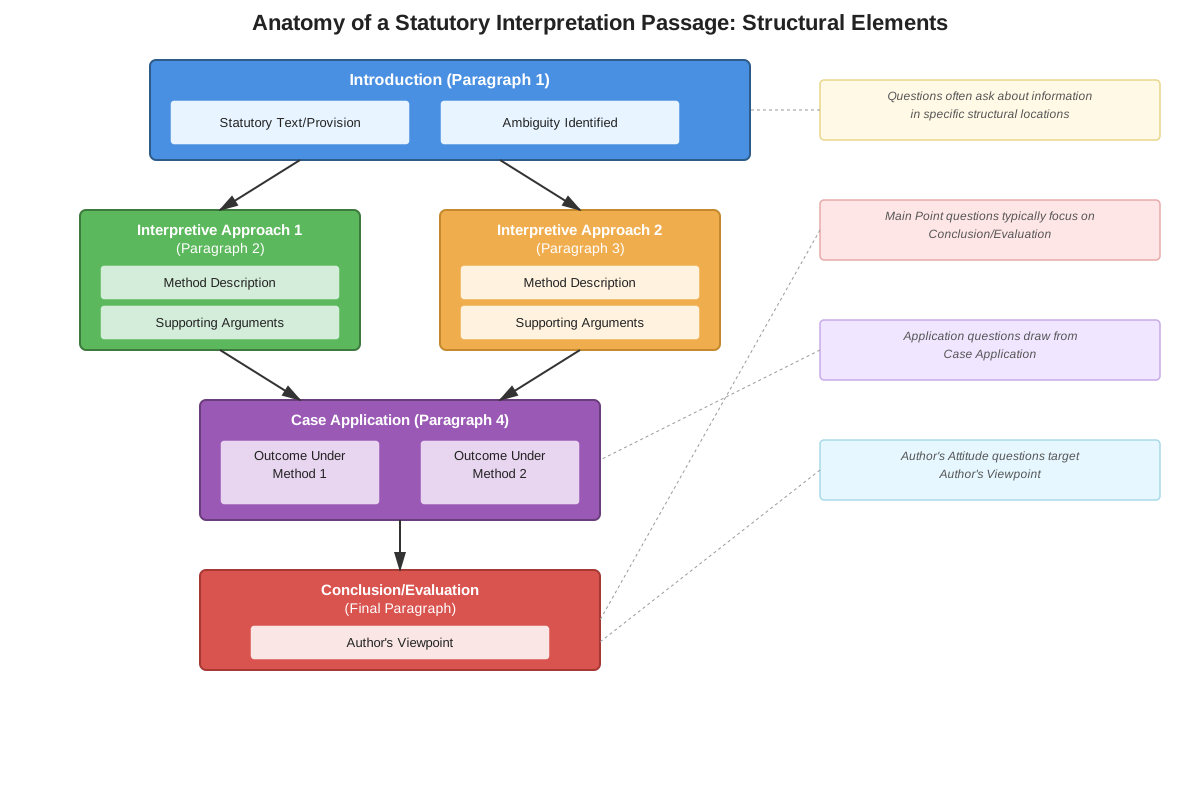
Understanding these relationships helps predict passage structure: LSAT passages often introduce an interpretive problem, present two or more approaches, apply each to a specific case, and evaluate the strengths and weaknesses of each method. Questions then test whether you can track these relationships and apply the reasoning to new scenarios.
High-Yield Facts
⭐ Textualism focuses exclusively on the ordinary meaning of statutory words, rejecting legislative history and intent as interpretive guides
⭐ Purposivism interprets statutes in light of their underlying purpose and the problem the legislature sought to solve
⭐ Different interpretive methods often lead to different outcomes when applied to the same statutory ambiguity
⭐ Interpretive canons are rules of thumb that help resolve ambiguities, but different schools disagree about their legitimacy and application
⭐ LSAT passages frequently contrast two approaches by showing how each would resolve a specific legal question differently
- Intentionalism relies heavily on legislative history, including committee reports and floor debates, to determine what the legislature intended
- The doctrine of stare decisis means courts generally follow prior interpretations even if they would interpret the statute differently today
- Static interpretation holds that statutory meaning is fixed at the time of enactment, while dynamic interpretation allows meaning to evolve
- The "plain meaning rule" states that when statutory text is clear and unambiguous, courts should apply it without consulting other sources
- Textualists argue that only the statutory text went through the formal legislative process and thus has legal force
- Purposivists contend that rigid textualism can defeat legislative goals when language proves imprecise or circumstances change
- The absurdity doctrine allows courts to depart from literal text when it would produce absurd results
- Chevron deference involves courts deferring to reasonable agency interpretations of ambiguous statutes the agency administers
- The rule of lenity requires that ambiguous criminal statutes be interpreted in favor of defendants
- Expressio unius est exclusio alterius means that expressing one thing excludes others not mentioned
Quick check — test yourself on Statutory interpretation passages so far.
Try Flashcards →Common Misconceptions
Misconception: All judges use the same method to interpret statutes, so passages about interpretation are just describing a single process.
Correction: Statutory interpretation is highly contested, with different judges and scholars advocating fundamentally different approaches. LSAT passages exploit this disagreement by contrasting methods and showing how they lead to different results.
Misconception: Textualism means ignoring the purpose of a statute entirely.
Correction: Textualists consider purpose to the extent it's evident from the statutory text itself and its structure, but they reject consulting legislative history or extrinsic evidence of intent. They argue the text itself reflects whatever purpose the legislature successfully enacted into law.
Misconception: Purposivism allows judges to ignore statutory text and substitute their own policy preferences.
Correction: Purposivism still begins with the text and requires judges to identify the legislature's purpose, not their own preferences. Purposivists argue they're being faithful to what the legislature was trying to accomplish, not substituting their judgment.
Misconception: Legislative history always provides clear evidence of what the legislature intended.
Correction: Legislative history is often contradictory, incomplete, or strategically created to influence future interpretation. Different legislators may have supported the same text for different reasons, making it difficult to identify a single "legislative intent."
Misconception: The interpretive method doesn't matter because all approaches reach the same result.
Correction: LSAT passages specifically highlight cases where different methods lead to different outcomes. The choice of interpretive philosophy has real consequences for how laws are applied.
Misconception: Statutory interpretation passages are just about legal theory with no practical application.
Correction: These passages always ground theoretical discussions in concrete examples showing how interpretive choices affect real cases and real people. The LSAT tests your ability to apply abstract principles to specific scenarios.
Misconception: Once a court interprets a statute, that interpretation is permanent and unchangeable.
Correction: While stare decisis creates presumption in favor of prior interpretations, courts can overrule earlier decisions, and legislatures can amend statutes to clarify or change their meaning.
Worked Examples
Example 1: Textualism vs. Purposivism
Passage Excerpt: "A federal statute prohibits 'discharge of pollutants' into navigable waters. The Clean Water Company operates a facility that draws water from a river, uses it for cooling, and returns it to the river 20 degrees warmer but chemically unchanged. Judge Martinez, a textualist, argues that 'pollutant' ordinarily means a foreign substance added to water, and since the company adds no substance, it discharges no pollutant. Judge Chen, a purposivist, contends that the statute's purpose is protecting water quality, and thermal pollution harms aquatic ecosystems just as chemical pollution does, so heated water should qualify as a pollutant."
Question: According to the passage, Judge Martinez and Judge Chen would most likely disagree about which of the following?
Analysis:
- Identify the interpretive approaches: Judge Martinez uses textualism (focusing on ordinary meaning of "pollutant"), while Judge Chen uses purposivism (focusing on the statute's protective purpose)
- Map the reasoning patterns:
- Martinez: "pollutant" → ordinary meaning → foreign substance → heat isn't a substance → no violation
- Chen: statute's purpose → protect water quality → heat harms quality → heat is a pollutant → violation
- Predict the disagreement: They would disagree about whether the ordinary meaning of "pollutant" should control when that meaning might not advance the statute's protective purpose
- Connect to learning objectives: This demonstrates how different interpretive methods lead to different outcomes (application objective) and shows the characteristic reasoning pattern of each approach (explanation objective)
Answer approach: Look for an answer choice that captures the core disagreement—whether statutory purpose should override ordinary textual meaning when they conflict, or whether "pollutant" can include something (heat) that isn't a substance in the ordinary sense.
Example 2: Applying Interpretive Canons
Passage Excerpt: "A statute prohibits 'selling, trading, or otherwise transferring firearms to convicted felons.' The defendant gave a firearm to his brother, a convicted felon, as a gift. The prosecution argues that 'otherwise transferring' includes gifts. The defense invokes ejusdem generis, arguing that 'otherwise transferring' should be limited to transfers similar to selling and trading—that is, transfers involving consideration or exchange—and gifts don't qualify."
Question: The defense's argument depends on which principle of statutory interpretation?
Analysis:
- Identify the canon: The passage explicitly mentions ejusdem generis, which limits general terms by the specific terms that precede them
- Understand the application:
- Specific terms: "selling, trading" (both involve exchange/consideration)
- General term: "otherwise transferring"
- Canon's effect: limits "otherwise transferring" to transfers similar to selling/trading
- Result: excludes gifts (no consideration)
- Recognize the reasoning structure: The defense uses an interpretive canon to narrow the statute's scope by arguing the general term should be read in light of the specific examples
- Connect to passage strategies: LSAT passages often present arguments using specific canons and test whether you understand how the canon operates and what it assumes
Answer approach: The correct answer will identify ejusdem generis or describe its function (limiting general terms by specific preceding terms). Wrong answers might describe other canons or mischaracterize how this canon works.
Exam Strategy
Approaching Statutory Interpretation Passages
First read: Focus on identifying the interpretive approaches discussed and the specific legal question or ambiguity at issue. Map the structure: Is the passage contrasting two methods? Applying one method to multiple cases? Critiquing a particular approach?
Annotation strategy: Mark each interpretive school mentioned and note its key features. Use symbols: "T" for textualism, "P" for purposivism, "I" for intentionalism. When the passage applies a method to a specific case, note the outcome each method produces.
Trigger words and phrases to watch for:
- Textualism indicators: "plain meaning," "ordinary understanding," "dictionary definition," "text itself," "what the statute says"
- Purposivism indicators: "legislative purpose," "underlying goal," "mischief the statute addresses," "practical consequences," "statutory scheme"
- Intentionalism indicators: "legislative history," "committee reports," "floor debates," "what Congress intended," "sponsor statements"
- Canon indicators: "expressio unius," "ejusdem generis," "avoid absurdity," "rule of lenity"
Question-Type Specific Strategies
Application questions ("How would Judge X likely rule on..."):
- Identify which interpretive method Judge X uses
- Apply that method's reasoning pattern to the new scenario
- Eliminate answers that use a different method's reasoning
- Choose the answer that follows the method's logic, even if it seems counterintuitive
Comparison questions ("Judge X and Judge Y would most likely disagree about..."):
- Identify each judge's interpretive approach
- Find the point where these approaches lead to different conclusions
- Eliminate answers where both methods would agree
- Choose the answer that captures the fundamental methodological difference
Inference questions ("The passage suggests that textualists would most likely..."):
- Identify the core commitments of the approach mentioned
- Extrapolate those commitments to the new situation
- Eliminate answers inconsistent with the approach's principles
- Choose the answer most aligned with the method's values and reasoning
Time Allocation
Statutory interpretation passages typically require 9-10 minutes total (4 minutes reading, 5-6 minutes answering questions). These passages are dense and require careful tracking of multiple perspectives, so don't rush the initial read. However, once you've mapped the structure and identified the approaches, questions often become straightforward applications of the reasoning patterns you've identified.
Process of Elimination Tips
Eliminate answers that:
- Confuse which judge or scholar holds which view
- Apply the wrong interpretive method to a scenario
- Mischaracterize the core features of an interpretive approach
- Claim agreement where the passage shows disagreement (or vice versa)
- Go beyond what the passage states about a particular method's implications
Favor answers that:
- Accurately track the reasoning pattern of the specified approach
- Recognize how different methods lead to different outcomes
- Identify the core values or principles underlying each approach
- Apply the passage's reasoning to new scenarios in a logically consistent way
Memory Techniques
The TIP Mnemonic for Major Schools
Textualism = Text only (ordinary meaning of words)
Intentionalism = Intent of legislature (legislative history)
Purposivism = Purpose of statute (problem being solved)
Visualizing Interpretive Approaches
Imagine three judges looking at the same statute:
- Textualist: Wears reading glasses, holds only the statute, refuses to look at anything else
- Intentionalist: Surrounded by stacks of legislative history documents, committee reports, and transcripts
- Purposivist: Holds the statute but also looks at the real-world problem it addresses, considering practical effects
Canon Acronym: EENA
Expressio unius (expressing one excludes others)
Ejusdem generis (general limited by specific)
Noscitur a sociis (words known by companions)
Avoid absurdity (don't interpret to produce absurd results)
The Interpretation Spectrum
Remember that interpretive approaches exist on a spectrum from most text-focused to most context-focused:
Strict Textualism ← → Flexible Textualism ← → Purposivism ← → Intentionalism ← → Dynamic Interpretation
Most LSAT passages focus on the middle range, contrasting textualism with purposivism or intentionalism.
Summary
Statutory interpretation passages examine how courts determine the meaning of legislative texts when language is ambiguous or application is unclear. These passages, which appear frequently on the LSAT, typically contrast different interpretive methodologies—primarily textualism (focusing on ordinary meaning of statutory words), purposivism (considering the statute's underlying purpose), and intentionalism (examining legislative history to determine intent). Each approach employs characteristic reasoning patterns and leads to different outcomes when applied to the same legal question. Success with these passages requires identifying which interpretive method each judge or scholar uses, understanding the core principles and values underlying each approach, tracking how different methods would resolve specific ambiguities, and applying these reasoning patterns to new scenarios. The LSAT tests these skills through application questions (how would a particular approach resolve a new case), comparison questions (where would different approaches disagree), and inference questions (what would a particular approach imply about related issues). Mastering statutory interpretation passages means recognizing the structure of interpretive arguments, distinguishing between competing methodologies, and predicting how each method's logic would extend to novel situations.
Key Takeaways
- Statutory interpretation passages contrast different methodologies for determining statutory meaning, most commonly textualism, purposivism, and intentionalism
- Textualism focuses exclusively on ordinary meaning of statutory words; purposivism considers the statute's underlying purpose; intentionalism examines legislative history
- Different interpretive approaches often lead to different outcomes when applied to the same statutory ambiguity—this is the core tension LSAT passages exploit
- Success requires identifying which approach each judge/scholar uses and applying that approach's characteristic reasoning pattern to new scenarios
- Interpretive canons (expressio unius, ejusdem generis, avoid absurdity) are tools all approaches may use, though they disagree about their legitimacy and application
- LSAT questions test your ability to track multiple perspectives, distinguish between approaches, and predict how each method would resolve specific legal questions
- These passages always ground theoretical discussions in concrete examples—focus on understanding how abstract principles apply to specific cases
Related Topics
Constitutional Interpretation: Extends statutory interpretation principles to constitutional texts, exploring originalism vs. living constitutionalism and the unique challenges of interpreting a centuries-old foundational document. Mastering statutory interpretation provides the foundation for understanding these more complex constitutional debates.
Administrative Law and Agency Deference: Examines how courts review agency interpretations of statutes, including Chevron deference and Auer deference. Understanding basic statutory interpretation is essential before tackling the additional layer of agency involvement.
Comparative Passage Analysis: Many statutory interpretation passages appear as comparative passages, presenting two perspectives on interpretive methodology. Skills developed here transfer directly to other comparative passage types.
Legal Reasoning in Logical Reasoning Section: The interpretive principles and reasoning patterns in statutory interpretation passages connect to argument structure, principle application, and parallel reasoning questions in the Logical Reasoning section.
Judicial Philosophy Passages: Broader passages about judicial role, activism vs. restraint, and the proper scope of judicial power often incorporate statutory interpretation as a key example of these philosophical debates.
Practice CTA
Now that you've mastered the core concepts of statutory interpretation passages, it's time to put your knowledge into action. Work through the practice questions to test your ability to identify interpretive approaches, track reasoning patterns, and apply these methods to new scenarios. Use the flashcards to reinforce key concepts, canons, and the distinguishing features of each interpretive school. Remember: statutory interpretation passages reward systematic analysis and careful attention to how different methods lead to different outcomes. With practice, you'll develop the pattern recognition skills that make these passages manageable and even predictable. Your investment in mastering this high-yield topic will pay dividends throughout the Reading Comprehension section!
Sign up free to keep reading
Create a free AnvayaPrep account to finish this LSAT guide on Statutory interpretation passages — plus flashcards and practice questions.