Overview
Theory-heavy humanities passages represent one of the most intellectually demanding categories within LSAT Reading Comprehension. These passages typically explore abstract philosophical concepts, literary criticism, aesthetic theory, cultural analysis, or interpretive frameworks from disciplines such as art history, musicology, or critical theory. Unlike more concrete science or law passages, theory-heavy humanities passages require test-takers to navigate dense argumentation, follow complex chains of reasoning about abstract ideas, and understand how authors position their views relative to competing theoretical frameworks. The language tends toward the academic and sophisticated, with frequent use of specialized terminology and nuanced distinctions between closely related concepts.
Mastering lsat theory-heavy humanities passages is essential because they consistently appear on every LSAT administration and often generate the most challenging question sets. These passages test not just comprehension but the ability to track subtle shifts in authorial perspective, distinguish between an author's view and views they're describing, and understand how abstract theoretical claims relate to concrete examples. The LSAT uses these passages to assess higher-order reasoning skills: synthesizing complex information, recognizing argumentative structure in abstract discourse, and applying theoretical frameworks to new situations.
Within the broader context of reading comprehension and passage subjects and strategies, theory-heavy humanities passages require a distinct approach compared to scientific or legal texts. While science passages demand attention to experimental methodology and evidence, and law passages focus on rules and their applications, humanities passages center on interpretive frameworks, conceptual distinctions, and the evolution of ideas. Success requires developing specific strategies for unpacking dense theoretical prose, identifying the author's analytical moves, and maintaining clarity about whose perspective is being presented at any given moment.
Learning Objectives
- [ ] Identify how theory-heavy humanities passages appear in LSAT questions
- [ ] Explain the reasoning pattern behind theory-heavy humanities passages
- [ ] Apply theory-heavy humanities passages to solve LSAT-style problems accurately
- [ ] Distinguish between the author's own theoretical position and theories being described or critiqued
- [ ] Map the relationship between abstract theoretical claims and concrete examples within passages
- [ ] Recognize common structural patterns in humanities argumentation (thesis-antithesis-synthesis, historical progression, comparative analysis)
- [ ] Evaluate answer choices by identifying subtle misrepresentations of theoretical nuance
Prerequisites
- Basic passage reading strategies: Understanding how to identify main ideas, supporting details, and passage structure provides the foundation for tackling more complex theoretical content
- Argument structure recognition: Familiarity with premises, conclusions, and logical relationships enables tracking how abstract claims build upon one another
- Vocabulary in context skills: The ability to infer meaning from context is crucial when encountering specialized humanities terminology
- Perspective tracking: Experience distinguishing author's views from others' views prepares students for the multiple theoretical voices common in humanities passages
Why This Topic Matters
Theory-heavy humanities passages appear in approximately 25-30% of LSAT Reading Comprehension sections, making them one of the most frequent passage types. Every LSAT typically includes at least one passage dealing with aesthetic theory, literary criticism, philosophical analysis, or cultural interpretation. These passages generate questions across all major question types: main point, detail, inference, function, author's attitude, and application questions. The abstract nature of the content makes these passages particularly effective at discriminating between high-scoring and mid-range test-takers.
In real-world legal practice, attorneys regularly engage with theoretical frameworks when interpreting constitutional principles, analyzing jurisprudential theories, or constructing arguments about legal philosophy. The skills developed through theory-heavy humanities passages—parsing dense academic prose, tracking complex argumentation, and maintaining precision about subtle conceptual distinctions—directly transfer to reading judicial opinions, scholarly legal articles, and theoretical policy analyses.
Common manifestations on the LSAT include passages about: aesthetic theories of art interpretation, debates within literary criticism (formalism vs. contextualism), philosophical accounts of meaning or representation, cultural theories about identity or social phenomena, historiographical methods, and theoretical frameworks in musicology or art history. These passages frequently present a theoretical debate, trace the evolution of a concept through different thinkers, or apply an abstract framework to analyze specific cultural artifacts.
Core Concepts
Characteristics of Theory-Heavy Humanities Passages
Theory-heavy humanities passages share several distinctive features that set them apart from other LSAT passage types. First, they operate at a high level of abstraction, discussing concepts, frameworks, and interpretive approaches rather than concrete facts or empirical findings. The subject matter involves ideas about ideas—theories of interpretation, philosophical accounts of aesthetic experience, or analytical frameworks for understanding cultural phenomena.
Second, these passages employ specialized academic vocabulary drawn from humanities disciplines. Terms like "hermeneutics," "phenomenology," "semiotics," "dialectical," "ontological," or "epistemological" appear regularly, often without explicit definition. The LSAT expects test-takers to infer meaning from context or recognize that precise understanding of technical terms matters less than grasping their function within the argument.
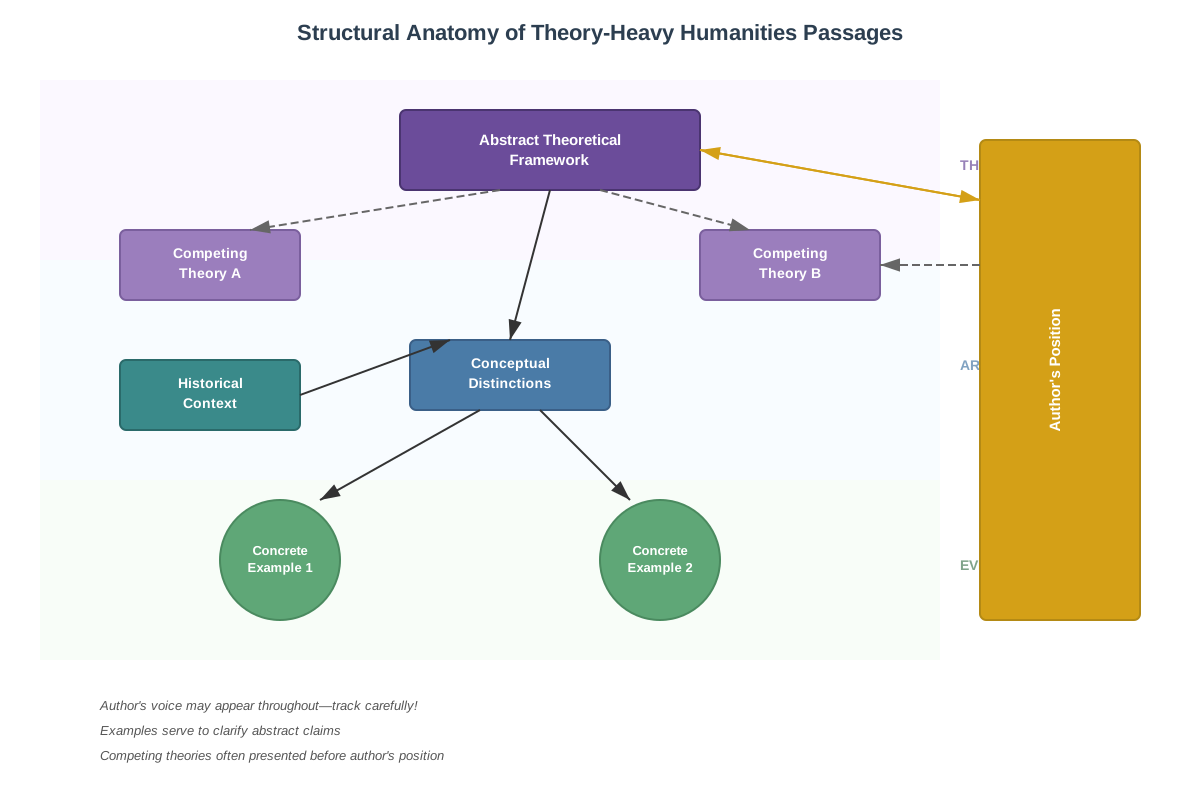
Third, the argumentative structure typically involves positioning ideas relative to other ideas. Authors present theoretical frameworks, contrast them with alternative approaches, trace intellectual genealogies, or synthesize competing perspectives. The passage's "action" consists of conceptual moves: distinguishing, refining, critiquing, or extending theoretical positions.
Common Structural Patterns
Theory-heavy humanities passages follow recognizable organizational templates. The historical progression pattern traces how a concept or theory evolved over time, often showing how later thinkers responded to or modified earlier positions. For example, a passage might explain how formalist literary criticism emerged as a reaction to biographical approaches, then describe how reader-response theory challenged formalism.
The thesis-antithesis-synthesis pattern presents a theoretical position, introduces a competing or opposing view, then either advocates for one position, proposes a middle ground, or suggests how both perspectives capture partial truths. This dialectical structure requires careful tracking of which view is being discussed at each moment.
The framework application pattern introduces an abstract theoretical approach, then demonstrates its application to specific cases or texts. The passage might explain a particular theory of aesthetic interpretation, then show how it illuminates aspects of specific artworks that other approaches miss.
The comparative analysis pattern examines two or more theoretical frameworks side-by-side, highlighting their differences in assumptions, methods, or implications. These passages require maintaining clarity about multiple complex positions simultaneously.
The Role of Examples in Theoretical Passages
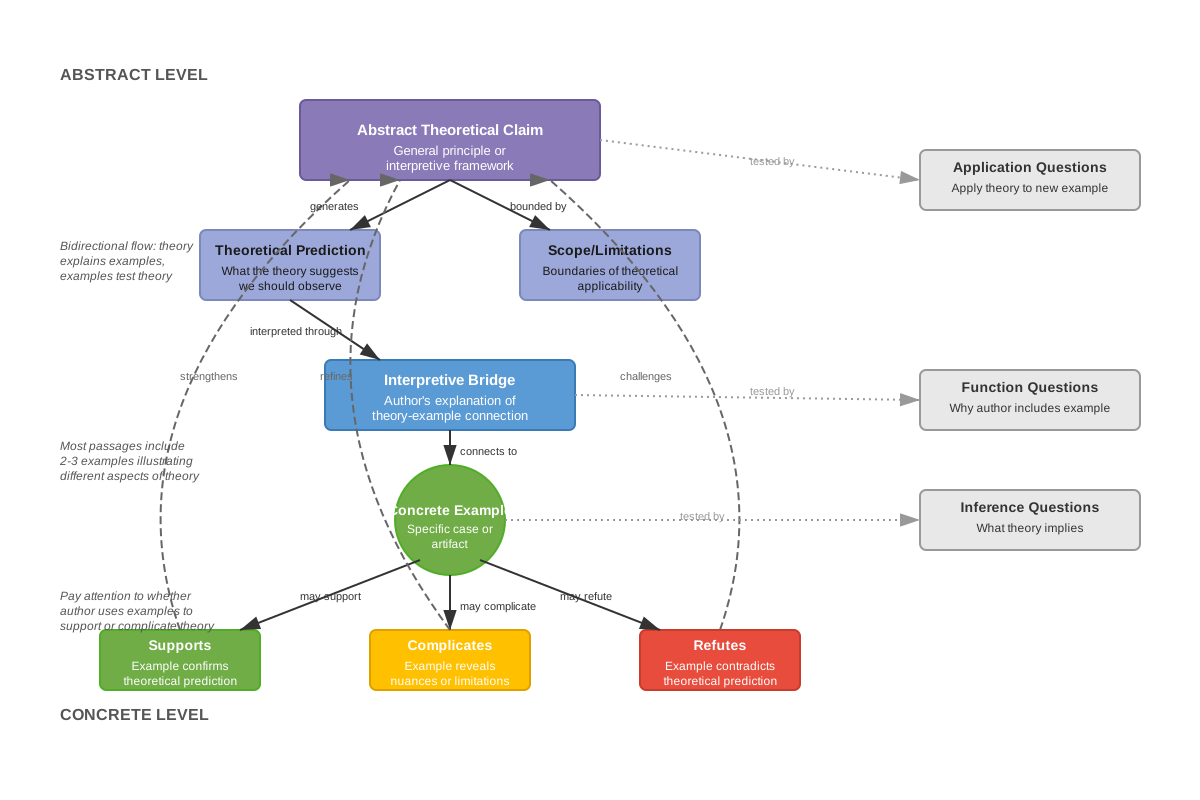
Unlike science passages where examples provide evidence, examples in humanities passages typically serve illustrative or clarificatory functions. A passage discussing theories of metaphor might reference specific poetic lines not to prove the theory but to demonstrate how it works in practice. Understanding this distinction is crucial: the LSAT often asks about the function of examples, and recognizing that they illustrate rather than prove theoretical claims is essential.
Examples also help ground abstract concepts, providing concrete anchors for otherwise difficult ideas. When reading theory-heavy passages, actively connect examples back to the theoretical points they illustrate. Ask: "What aspect of the theory does this example clarify?" This connection often becomes the basis for function questions.
Perspective Tracking in Theoretical Discourse
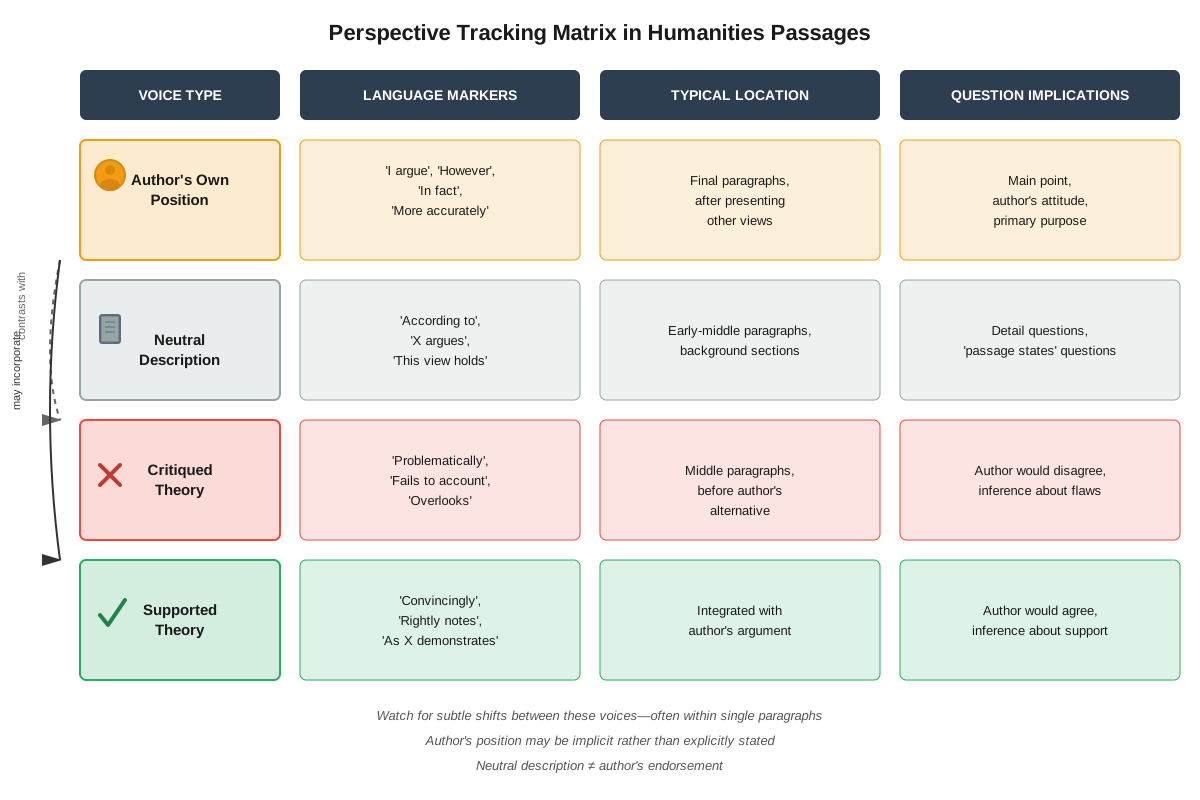
Theory-heavy humanities passages present particular challenges for perspective tracking—determining whose view is being expressed at any given moment. These passages frequently describe multiple theoretical positions, and the author's own stance may be subtle or emerge only gradually. The passage might spend several paragraphs explaining a theory the author ultimately critiques, or present competing views before revealing a preference.
Key linguistic markers help track perspective shifts:
- Attribution phrases: "According to X," "Y argues that," "Z's theory holds"
- Evaluative language: "convincingly," "problematically," "overlooks," "illuminates"
- Contrast markers: "however," "by contrast," "alternatively"
- Synthesis signals: "both approaches," "a more nuanced view," "reconciling these perspectives"
Abstract-to-Concrete Relationships
Successful navigation of theory-heavy passages requires constantly mapping relationships between abstract theoretical claims and concrete manifestations. When a passage introduces a theoretical principle, anticipate that it will either provide examples or discuss implications. When examples appear, identify which theoretical point they support or illustrate.
This bidirectional thinking—moving from theory to application and from examples back to theoretical significance—mirrors the reasoning tested in application questions, where test-takers must apply a passage's theoretical framework to new scenarios.
Argumentation in Humanities Discourse
Unlike scientific arguments that rely on empirical evidence, humanities argumentation proceeds through conceptual analysis, internal coherence, explanatory power, and theoretical consistency. A passage might argue for a particular interpretive framework by showing how it resolves apparent contradictions, accounts for phenomena other theories ignore, or maintains greater consistency with fundamental principles.
Recognizing these argumentative moves helps answer inference and reasoning questions. When a passage claims one theory is "more adequate" than another, the support typically involves showing superior explanatory capacity, not empirical proof.
Concept Relationships
The core concepts within theory-heavy humanities passages form an interconnected system. Structural patterns determine how perspective tracking challenges arise: a thesis-antithesis-synthesis structure requires tracking at least three distinct viewpoints, while a historical progression pattern demands understanding how later positions respond to earlier ones. The role of examples directly relates to abstract-to-concrete relationships—examples serve as the concrete manifestations that illuminate abstract theoretical principles.
Argumentation in humanities discourse shapes how authors use structural patterns: because humanities arguments rely on conceptual analysis rather than empirical evidence, passages often employ comparative structures that weigh theoretical frameworks against each other based on explanatory power and internal coherence.
These concepts connect to prerequisite knowledge in specific ways: basic passage reading strategies provide the foundation for identifying structural patterns, while argument structure recognition enables understanding argumentation in humanities discourse. Perspective tracking builds on the prerequisite skill of distinguishing author's views from others' views, but adds complexity by introducing multiple theoretical positions and subtle authorial positioning.
Relationship map:
- Passage characteristics → determine → Structural patterns
- Structural patterns → create → Perspective tracking challenges
- Abstract theoretical claims ↔ bidirectional relationship ↔ Concrete examples
- Humanities argumentation style → shapes → How structural patterns develop
- All concepts → collectively enable → Accurate question answering
High-Yield Facts
⭐ Theory-heavy humanities passages appear in approximately 25-30% of LSAT Reading Comprehension sections, making them one of the most frequent passage types
⭐ Examples in humanities passages typically illustrate theoretical points rather than provide empirical evidence for claims
⭐ The author's own theoretical position often emerges gradually and may not be explicitly stated until late in the passage
⭐ Evaluative language (e.g., "convincingly," "problematically," "overlooks") signals the author's perspective on theories being discussed
⭐ Application questions on theory-heavy passages require applying the passage's theoretical framework to new scenarios not mentioned in the text
- Specialized humanities vocabulary can often be understood functionally without knowing precise definitions
- Thesis-antithesis-synthesis structures require tracking at least three distinct theoretical positions
- Historical progression patterns show how later theories respond to or modify earlier positions
- Comparative analysis passages demand maintaining clarity about multiple complex frameworks simultaneously
- Function questions frequently ask about the role of examples in supporting or illustrating theoretical claims
- Inference questions often test understanding of what a theoretical framework would imply about situations not explicitly discussed
- Detail questions may ask about subtle distinctions between closely related theoretical positions
Quick check — test yourself on Theory-heavy humanities passages so far.
Try Flashcards →Common Misconceptions
Misconception: All content in a theory-heavy passage represents the author's own views → Correction: These passages frequently describe multiple theoretical positions, and the author may spend considerable space explaining views they ultimately critique or reject. Always track attribution carefully and watch for evaluative language that signals the author's stance.
Misconception: Understanding every specialized term is necessary for answering questions correctly → Correction: While some terminology matters, the LSAT designs passages so that functional understanding—grasping how a concept operates within the argument—suffices. Context clues and the concept's role in the passage's logic matter more than dictionary definitions.
Misconception: Examples in humanities passages prove the theoretical claims → Correction: Unlike scientific passages where examples provide evidence, humanities examples typically illustrate how a theory works or clarify abstract concepts. They demonstrate application rather than provide proof.
Misconception: The main point is always stated explicitly in the first or last paragraph → Correction: In theory-heavy passages, the main point often involves a nuanced position that emerges through the entire passage's argumentation. The author might present multiple views before revealing their own synthesis or evaluation.
Misconception: These passages require prior knowledge of philosophy or literary theory → Correction: The LSAT provides all necessary information within the passage. While humanities background can provide comfort with the discourse style, every question is answerable based solely on passage content.
Misconception: Abstract passages are inherently harder than concrete ones → Correction: While theory-heavy passages require different strategies, they follow predictable patterns. Once you recognize structural templates and develop perspective-tracking skills, these passages become manageable and even predictable.
Worked Examples
Example 1: Tracking Perspective in a Literary Theory Passage
Passage excerpt: "Formalist critics of the mid-twentieth century argued that literary texts should be analyzed as autonomous aesthetic objects, independent of authorial biography or historical context. The meaning of a poem, they contended, resided entirely in its internal formal properties—imagery, structure, and linguistic patterns. This approach, while yielding sophisticated close readings, ultimately proved too restrictive. By severing texts from their cultural contexts, formalism could not account for how literature engages with social and political realities. Contemporary critics have therefore adopted more contextualist approaches, examining how texts both reflect and shape the historical moments of their creation."
Question: The author's attitude toward formalist criticism can best be described as:
Step 1 - Identify perspective markers: The passage uses "argued" and "contended" (neutral attribution) when describing formalist views, but shifts to evaluative language with "ultimately proved too restrictive" and "could not account for."
Step 2 - Track the argumentative movement: The passage presents formalism (paragraphs 1-2), acknowledges its strengths ("sophisticated close readings"), identifies its limitations ("too restrictive"), then presents an alternative ("contemporary critics have therefore adopted").
Step 3 - Synthesize the author's stance: The author recognizes formalism's contributions but views it as inadequate, favoring the contextualist approach that addresses formalism's limitations.
Step 4 - Evaluate answer choices: The correct answer would indicate qualified criticism or acknowledgment of both strengths and limitations. Wrong answers might suggest complete rejection (too strong) or full endorsement (contradicts the critique).
Connection to learning objectives: This example demonstrates how to identify perspective in theory-heavy passages (Objective 1), explains the reasoning pattern of presenting-then-critiquing theoretical positions (Objective 2), and shows how to apply this understanding to attitude questions (Objective 3).
Example 2: Applying a Theoretical Framework
Passage excerpt: "According to reception theory, a text's meaning is not fixed by authorial intention but emerges through the interaction between text and reader. Different readers, bringing different experiences and expectations, generate different valid interpretations. The text provides constraints—not all readings are equally supportable—but within these constraints, multiple legitimate meanings coexist. This theory challenges the notion of a single 'correct' interpretation, instead viewing meaning as a collaborative production between text and reader."
Question: Based on the passage, reception theory would most likely support which of the following claims about a novel?
Step 1 - Extract the theoretical principles: (1) Meaning emerges from text-reader interaction, (2) Different readers generate different valid interpretations, (3) The text constrains but doesn't determine meaning, (4) Multiple legitimate meanings can coexist.
Step 2 - Anticipate applications: The theory would support claims about interpretive plurality, reader contribution to meaning, and the absence of single correct readings. It would reject claims about fixed authorial meaning or purely subjective interpretation (since texts provide constraints).
Step 3 - Evaluate answer choices: Look for options that reflect interpretive plurality within textual constraints. Eliminate choices suggesting either complete interpretive freedom (ignores textual constraints) or single fixed meanings (contradicts the theory's core claim).
Step 4 - Verify consistency: Ensure the chosen answer aligns with all aspects of the theory, not just one principle.
Connection to learning objectives: This example shows how theory-heavy passages appear in application questions (Objective 1), demonstrates the reasoning pattern of framework-to-application (Objective 2), and illustrates the process of applying theoretical principles to new scenarios (Objective 3).
Exam Strategy
Initial Reading Approach
When encountering a theory-heavy humanities passage, adjust reading speed and focus. These passages reward careful initial reading more than rapid skimming. Invest time upfront to understand the theoretical landscape, as this investment pays dividends when answering questions. Read actively, pausing after each paragraph to mentally summarize: "What theoretical position was just presented? Whose view is this? How does it relate to what came before?"
Create a mental or marginal "map" of the passage's theoretical terrain. Note when new positions are introduced, when the author evaluates theories, and when examples appear. This map becomes your reference point for all questions.
Trigger Words and Phrases
Certain linguistic markers signal important moments in theory-heavy passages:
Attribution markers (signals whose view is being presented): "According to," "X argues," "Y's theory," "proponents claim," "critics contend"
Evaluation markers (signals author's perspective): "convincingly," "problematically," "fails to account for," "successfully explains," "overlooks," "illuminates"
Contrast markers (signals shift between positions): "however," "by contrast," "alternatively," "whereas," "on the other hand"
Synthesis markers (signals integration of views): "both approaches," "reconciling these perspectives," "a more nuanced view," "incorporating insights from"
Function markers (signals role of examples): "for instance," "to illustrate," "consider," "as exemplified by"
Question-Type Specific Strategies
Main Point questions: In theory-heavy passages, the main point often involves the author's position on a theoretical debate or their synthesis of competing views. Look for evaluative language and the passage's ultimate destination, not just its starting point.
Detail questions: These test precise understanding of theoretical distinctions. Return to the passage to verify exact wording, as wrong answers often subtly misrepresent nuanced positions.
Inference questions: Apply the theoretical framework's logic to new situations. Ask: "What would this theory predict or imply about this scenario?"
Function questions: For examples, identify which theoretical point they illustrate. For paragraphs, determine their role in the overall argumentative structure (presenting a view, critiquing it, offering an alternative).
Attitude questions: Track evaluative language throughout the passage. The author's attitude often emerges gradually through accumulated evaluative markers rather than explicit statements.
Process of Elimination Tips
Wrong answers in theory-heavy passage questions often:
- Confuse whose view is being described: Attribute to the author a position they're merely explaining
- Overstate or understate the author's position: Turn qualified criticism into complete rejection, or acknowledgment into endorsement
- Misrepresent subtle distinctions: Conflate closely related but distinct theoretical positions
- Ignore textual constraints: In application questions, suggest interpretations the passage's framework wouldn't support
- Reverse relationships: Claim a theory implies the opposite of what it actually suggests
Time Allocation
Theory-heavy passages typically warrant slightly more initial reading time (4-5 minutes) than other passage types, given their density and complexity. However, this investment reduces time spent returning to the passage during questions. If you've built a solid understanding of the theoretical landscape and tracked perspectives carefully, questions become more straightforward.
For individual questions, spend extra time on application questions, which require careful reasoning about how theoretical principles extend to new scenarios. Detail questions, conversely, should be relatively quick—return to the passage, verify the specific claim, and select the answer that matches exactly.
Memory Techniques
The PACE Framework for Perspective Tracking
Position: Whose theoretical position is being described?
Attribution: What language signals whose view this is?
Critique: Does the author evaluate this position? How?
Evolution: How does this position relate to others in the passage?
Apply PACE to each paragraph to maintain clarity about the theoretical landscape.
The TEASE Acronym for Theoretical Passage Structure
Theory introduced: Initial theoretical framework presented
Examples provided: Concrete illustrations of the theory
Alternatives discussed: Competing or contrasting theoretical positions
Synthesis or stance: Author's position or integration of views
Extensions or implications: What the theory suggests about broader issues
Not every passage includes all elements, but this sequence captures common patterns.
Visualization Strategy: The Theoretical Debate Table
Mentally construct a table with columns for different theoretical positions and rows for key dimensions:
| Dimension | Theory A | Theory B | Author's View |
|---|---|---|---|
| Core claim | |||
| Strengths | |||
| Limitations | |||
| Examples |
Populate this mental table as you read, creating a structured representation of the theoretical landscape.
The "Whose View?" Margin Note System
For each paragraph, write a brief margin note indicating whose perspective dominates: "Formalists," "Author critiques," "Reception theory," "Author's synthesis." This creates a visual map of perspective shifts that you can reference when answering questions.
Summary
Theory-heavy humanities passages represent a distinct and frequently appearing category within LSAT Reading Comprehension, characterized by abstract theoretical content, specialized academic vocabulary, and complex argumentation about interpretive frameworks and conceptual distinctions. Success requires mastering specific skills: tracking multiple theoretical perspectives, distinguishing the author's views from positions being described, understanding how examples illustrate rather than prove theoretical claims, and applying abstract frameworks to concrete scenarios. These passages follow predictable structural patterns—historical progressions, thesis-antithesis-synthesis, framework applications, and comparative analyses—that, once recognized, make the content more navigable. The key to excellence lies in careful initial reading that maps the theoretical terrain, active perspective tracking using attribution and evaluative markers, and understanding that humanities argumentation relies on conceptual analysis and explanatory power rather than empirical evidence. Questions test not just comprehension but the ability to reason with theoretical frameworks, making these passages powerful discriminators of higher-order analytical skills essential for legal education and practice.
Key Takeaways
- Theory-heavy humanities passages appear in 25-30% of Reading Comprehension sections and test higher-order reasoning about abstract concepts and interpretive frameworks
- Examples in these passages illustrate theoretical points rather than provide empirical evidence; understanding their function is crucial for answering questions correctly
- Perspective tracking is essential—carefully distinguish between the author's views and theoretical positions being described using attribution and evaluative language markers
- These passages follow predictable structural patterns (historical progression, thesis-antithesis-synthesis, framework application, comparative analysis) that aid comprehension once recognized
- Application questions require reasoning about how theoretical frameworks would apply to new scenarios, demanding deep understanding of the theory's logic and implications
- Success depends on investing time in careful initial reading to map the theoretical landscape, which reduces time spent on individual questions
- Wrong answers typically confuse perspectives, misrepresent subtle distinctions, or overstate/understate the author's position
Related Topics
Scientific Passages with Theoretical Content: While theory-heavy humanities passages focus on interpretive frameworks, some science passages discuss theoretical models in physics or competing hypotheses in evolutionary biology, requiring similar skills in tracking multiple explanatory frameworks.
Comparative Reading Passages: The Comparative Reading format often pairs passages with different theoretical perspectives on the same topic, intensifying the perspective-tracking challenges central to theory-heavy humanities passages.
Law Passages on Jurisprudential Theory: Legal philosophy passages discussing theories of constitutional interpretation, legal realism versus formalism, or theories of justice combine legal content with the abstract theoretical reasoning characteristic of humanities passages.
Author's Attitude and Tone Questions Across Passage Types: Mastering perspective tracking in theory-heavy passages strengthens skills for attitude questions in all passage types, as the techniques for identifying evaluative language transfer broadly.
Practice CTA
Now that you've developed a comprehensive understanding of theory-heavy humanities passages, it's time to apply these strategies to actual LSAT passages. Work through the practice questions, paying special attention to tracking perspectives, identifying structural patterns, and understanding how examples function within theoretical arguments. Use the flashcards to reinforce key concepts and test your ability to quickly recognize the markers and patterns discussed in this guide. Remember: theory-heavy passages become significantly more manageable once you recognize their predictable structures and develop systematic approaches to perspective tracking. Your investment in mastering this challenging passage type will pay substantial dividends on test day, as these passages consistently appear and often separate high scorers from the rest. Approach your practice with confidence—you now have the conceptual framework and strategic tools to excel.
Sign up free to keep reading
Create a free AnvayaPrep account to finish this LSAT guide on Theory-heavy humanities passages — plus flashcards and practice questions.