Overview
Extreme language traps in RC represent one of the most frequently tested—and most frequently missed—elements in LSAT Reading Comprehension. These traps exploit test-takers' tendency to overlook the precise degree or scope of claims made in both passages and answer choices. The LSAT deliberately crafts incorrect answer choices that contain absolute, categorical, or overly broad language that goes beyond what the passage actually states or supports. Conversely, correct answers typically employ measured, qualified language that accurately reflects the nuanced claims presented in the passage.
Understanding extreme language traps is essential for achieving a competitive LSAT score because they appear across virtually all reading comprehension question types—from main point and primary purpose questions to inference and author's attitude questions. The test-makers know that under time pressure, students often gravitate toward answer choices that "sound right" or capture the general theme of a passage, even when those choices make claims that are too strong, too absolute, or too categorical to be supported by the text. Mastering this concept requires developing a heightened sensitivity to qualifier words, scope limitations, and the precise boundaries of what an author has actually argued versus what seems plausible or related.
This topic sits at the intersection of careful reading and strategic test-taking. It connects directly to fundamental RC skills like identifying the author's tone, understanding argument structure, and distinguishing between what is stated, implied, and unsupported. Extreme language awareness also reinforces the critical LSAT principle that correct answers must be defensible based solely on the passage text—not on outside knowledge, reasonable assumptions, or general plausibility.
Learning Objectives
- [ ] Identify how extreme language traps in RC appears in LSAT questions
- [ ] Explain the reasoning pattern behind extreme language traps in RC
- [ ] Apply extreme language traps in RC to solve LSAT-style problems accurately
- [ ] Distinguish between appropriately qualified language and unjustified extreme claims in answer choices
- [ ] Recognize the specific qualifier words that signal measured versus absolute claims
- [ ] Evaluate whether passage evidence supports the scope and strength of answer choice language
- [ ] Predict which answer choices are likely to contain extreme language traps based on question type
Prerequisites
- Basic passage comprehension skills: Understanding main ideas, supporting details, and passage structure is necessary before evaluating the precision of language in answer choices
- Familiarity with LSAT question formats: Knowing the standard question types (inference, main point, strengthen/weaken, etc.) helps identify where extreme language traps most commonly appear
- Understanding of argument structure: Recognizing premises, conclusions, and the scope of claims enables students to assess whether answer choices accurately reflect passage content
- Vocabulary knowledge: A solid grasp of common qualifier words and their implications is essential for detecting subtle differences in claim strength
Why This Topic Matters
Extreme language traps appear in approximately 60-70% of LSAT Reading Comprehension sections, making them one of the highest-yield concepts for score improvement. These traps are particularly prevalent in Must Be True/Inference questions, Main Point questions, and Author's Attitude questions, where the difference between a correct and incorrect answer often hinges on a single word that makes a claim too strong or too absolute.
In real-world legal practice, attorneys must make precisely calibrated arguments that accurately reflect the strength of available evidence. Overstating a claim can undermine credibility, while understanding the exact scope of precedent or statutory language is crucial for effective advocacy. The LSAT tests this skill because it's fundamental to legal reasoning—lawyers must constantly evaluate whether the evidence supports a strong conclusion, a probable conclusion, or merely a possible conclusion.
On the exam, extreme language traps most commonly appear when passages discuss theories, historical interpretations, or scientific findings where the author presents a nuanced view but answer choices offer absolute or categorical versions of those views. For example, if a passage states that "many scholars believe" a particular interpretation, an incorrect answer might claim that this interpretation is "universally accepted" or "definitively proven." These traps also frequently appear in comparative passages, where answer choices may overstate the degree of agreement or disagreement between the two authors.
Core Concepts
What Constitutes Extreme Language
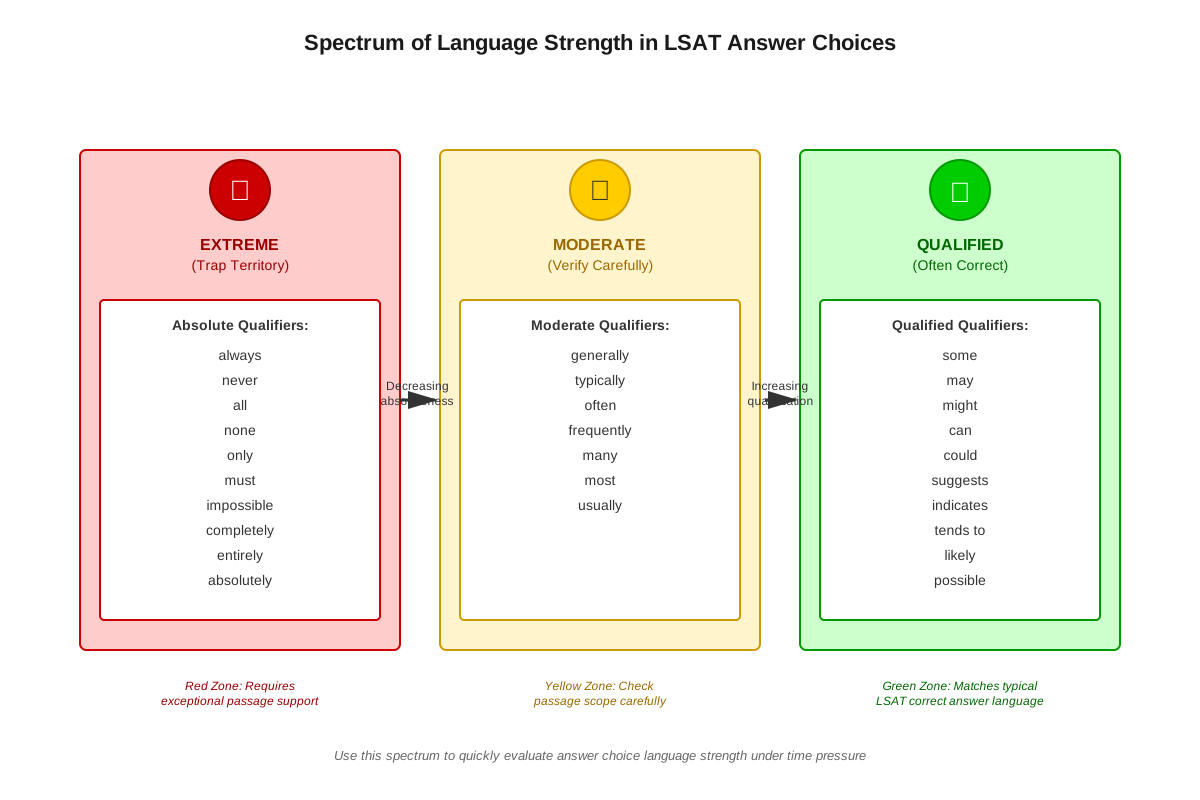
Extreme language refers to words and phrases that make absolute, categorical, or unqualified claims. These include terms like "always," "never," "all," "none," "only," "must," "impossible," "inevitable," "completely," "entirely," and "exclusively." Such language leaves no room for exceptions, alternatives, or degrees of truth. In contrast, qualified language includes terms like "often," "usually," "many," "some," "may," "might," "can," "tends to," "generally," "typically," and "suggests." These words acknowledge limitations, possibilities, and degrees of certainty.
The LSAT exploits the fact that academic and legal writing—the types of passages featured in RC—typically employs qualified language because scholars and experts recognize the complexity of their subjects. Authors rarely make absolute claims unless they have ironclad evidence. Therefore, answer choices containing extreme language are disproportionately likely to be incorrect because they misrepresent the measured tone and limited scope of passage claims.
The Mechanics of Extreme Language Traps
Lsat extreme language traps in rc operate through several distinct mechanisms:
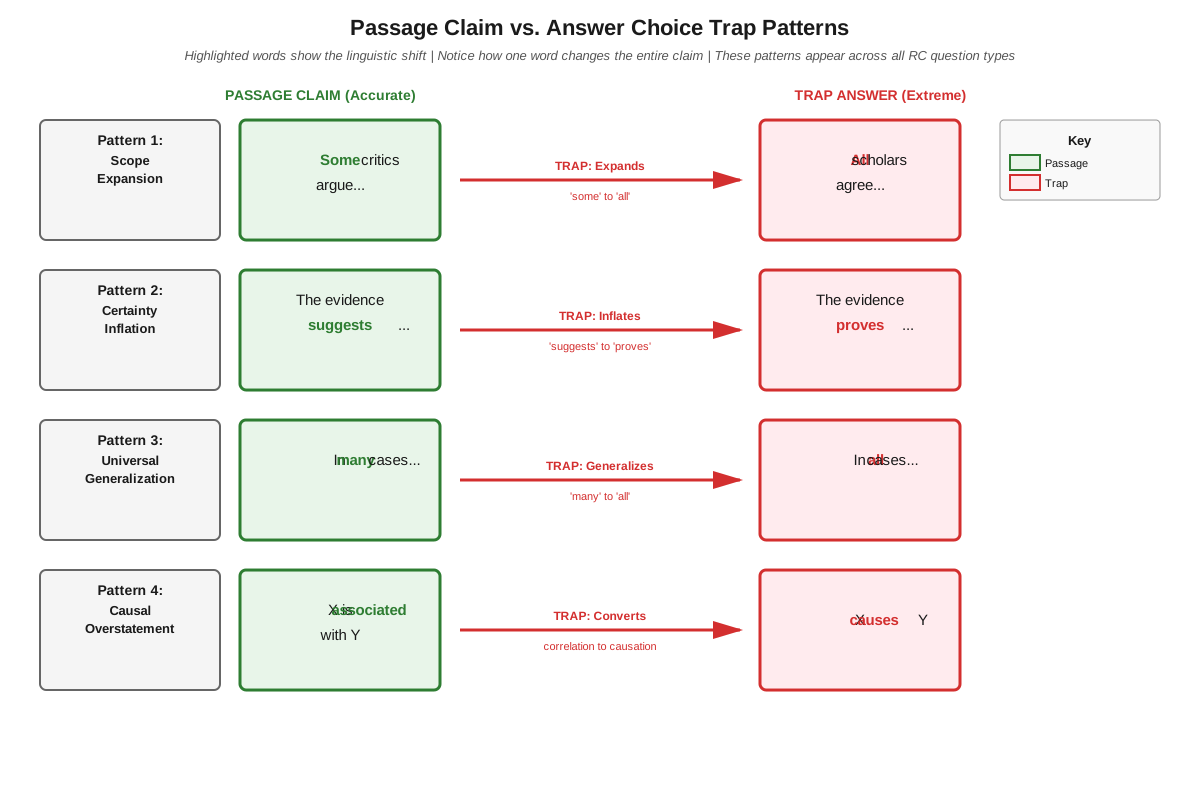
- Scope expansion: An answer choice takes a claim made about a limited group or context and expands it to apply universally
- Certainty inflation: An answer choice converts a possibility, likelihood, or tendency into an absolute certainty
- Elimination of exceptions: An answer choice removes qualifications or acknowledged limitations present in the passage
- Temporal absolutism: An answer choice changes "has been" or "was" to "always has been" or "will always be"
- Comparative extremes: An answer choice uses superlatives ("most," "best," "only") when the passage merely indicates preference or superiority
Recognizing Trap Patterns by Question Type
Different reading comprehension question types feature extreme language traps in characteristic ways:
| Question Type | Common Trap Pattern | Example |
|---|---|---|
| Main Point | Overstating the author's conclusion or making it more absolute | Passage: "suggests a new approach may be valuable" → Wrong answer: "proves the new approach is superior" |
| Inference/Must Be True | Claiming certainty about something only implied or suggested | Passage: "most experts believe" → Wrong answer: "all experts agree" |
| Author's Attitude | Using extreme emotional language when the author is measured | Passage: author "questions" a theory → Wrong answer: author "completely rejects" the theory |
| Strengthen/Weaken | Introducing absolute claims that go beyond what's needed | Passage about a correlation → Wrong answer requiring "the only possible cause" |
| Except/Least | Correct answer may contain extreme language that's NOT supported | All wrong answers are supported; correct answer makes unsupported absolute claim |
The Relationship Between Passage Tone and Answer Language
A critical insight for avoiding extreme language traps is recognizing that correct answers typically mirror the tone and qualification level of the passage itself. If a passage presents a tentative hypothesis, the correct answer will likely use tentative language. If a passage describes an established fact, stronger language may be appropriate. This principle means that students should:
- Identify the author's level of certainty about each major claim
- Note any explicit qualifications, limitations, or acknowledgments of uncertainty
- Match answer choice language to the passage's degree of commitment
For example, if an author writes "Recent evidence suggests that X may contribute to Y," the author has committed only to the possibility of a contributory relationship. An answer choice stating "X causes Y" would be too strong, as would "X is the primary factor in Y." A correct answer might state "X could be a factor in Y" or "Evidence indicates a possible relationship between X and Y."
Extreme Language in Comparative Passages
Comparative passages present unique extreme language challenges because answer choices may overstate the degree of agreement, disagreement, or relationship between the two authors. Common traps include:
- Claiming authors "completely disagree" when they differ on one aspect but agree on others
- Stating one author "would reject" the other's entire argument when they would only question specific elements
- Using "both authors agree" when only one author addresses the topic
- Claiming one author's view is "incompatible with" the other's when they're actually complementary
The "Reasonable but Unsupported" Trap
A sophisticated variant of extreme language traps involves answer choices that make reasonable, plausible claims that happen to be too strong for the passage evidence. These choices are particularly dangerous because they may align with the test-taker's background knowledge or common sense. For instance, if a passage discusses how a particular policy reduced crime in one city, an answer choice might claim the policy "would be effective in any urban environment." This seems reasonable, but the passage only provides evidence for one city—the universal claim is unsupported and therefore too extreme.
Concept Relationships
The concept of extreme language traps connects directly to several fundamental RC skills. Careful reading of passage claims → enables recognition of qualification level → which allows evaluation of answer choice language → leading to elimination of extreme traps. This chain of reasoning shows that extreme language awareness isn't a standalone trick but rather an application of precise reading comprehension.
Extreme language traps also relate closely to scope errors, where answer choices discuss topics or groups beyond what the passage addresses. Both involve answer choices that exceed the boundaries of passage support, though scope errors concern subject matter while extreme language concerns degree of certainty or universality.
The relationship to author's tone and attitude is particularly important. An author's tone (skeptical, enthusiastic, neutral, cautious) provides crucial context for evaluating whether extreme language in an answer choice accurately reflects the passage. A skeptical author is unlikely to make absolute positive claims, while an enthusiastic advocate might use stronger language—though rarely as extreme as trap answers suggest.
Finally, extreme language awareness connects to inference questions through the principle that valid inferences must be supported by passage evidence. Extreme language often signals an inference that goes beyond what the passage can support, making it invalid despite being plausible or related to passage content.
High-Yield Facts
⭐ Answer choices with absolute language (always, never, all, none, only, must) are incorrect approximately 80% of the time in LSAT RC
⭐ Correct answers typically contain qualified language (some, many, often, can, may, suggests) that mirrors passage tone
⭐ If a passage uses tentative language about a claim, answer choices making that claim absolute are almost certainly wrong
⭐ Extreme language traps appear most frequently in inference questions and main point questions
⭐ The word "only" in an answer choice should trigger immediate scrutiny—it's correct less than 20% of the time
- Comparative passages frequently feature traps that overstate the degree of agreement or disagreement between authors
- Author attitude questions often include wrong answers with extreme emotional language (outraged, ecstatic, completely dismissive)
- When a passage acknowledges limitations or exceptions to a theory, correct answers will preserve those qualifications
- Superlatives (most, best, worst, primary, chief) in answer choices often signal extreme language traps unless the passage explicitly makes such comparisons
- Time-related absolutes ("has always been," "will never change") are typically incorrect unless the passage explicitly discusses historical constancy or future certainty
- The phrase "the only" in an answer choice is almost always too extreme unless the passage explicitly rules out all alternatives
- Correct answers to inference questions rarely use stronger language than the passage itself uses
Quick check — test yourself on Extreme language traps in RC so far.
Try Flashcards →Common Misconceptions
Misconception: Extreme language is always wrong in LSAT answer choices → Correction: Extreme language is incorrect when it exceeds what the passage supports, but if a passage makes an absolute claim with strong evidence, the correct answer may appropriately use absolute language. The key is matching answer language to passage support.
Misconception: Qualified language always indicates a correct answer → Correction: While qualified language is more often correct, wrong answers can use qualified language while still misrepresenting passage content through scope errors, distortions, or discussing unsupported topics. Qualification is necessary but not sufficient for correctness.
Misconception: If something is true in the real world, extreme language about it is acceptable → Correction: LSAT RC answers must be supported by the passage alone, regardless of outside knowledge. Even factually accurate extreme claims are wrong if the passage doesn't support them.
Misconception: Authors who are enthusiastic about a topic will use extreme language → Correction: Even passionate advocates in LSAT passages typically acknowledge limitations, alternative views, or areas of uncertainty. Academic and legal writing maintains measured language even when arguing for a position.
Misconception: Extreme language traps only appear in obviously wrong answers → Correction: The most dangerous extreme language traps appear in otherwise attractive answers that correctly capture passage themes but overstate the degree of certainty or universality. These require careful word-by-word analysis.
Misconception: Comparative passages require identifying complete agreement or disagreement → Correction: Authors in comparative passages typically agree on some points while disagreeing on others. Answer choices claiming total agreement or complete opposition are usually too extreme.
Worked Examples
Example 1: Inference Question with Extreme Language Trap
Passage excerpt: "Recent archaeological findings in the Mediterranean region have led many historians to reconsider the traditional timeline for the development of maritime trade. While the evidence is not conclusive, it suggests that organized trade networks may have emerged several centuries earlier than previously thought. Dr. Martinez argues that these findings, combined with linguistic evidence, provide compelling support for revising the established chronology."
Question: Based on the passage, which of the following can be properly inferred?
Answer choices:
- (A) The traditional timeline for maritime trade development has been definitively disproven
- (B) Dr. Martinez believes the evidence conclusively establishes an earlier timeline
- (C) Archaeological findings provide some support for reconsidering the timeline of maritime trade development
- (D) All historians now agree that maritime trade emerged earlier than previously believed
- (E) The linguistic evidence alone proves that trade networks developed centuries earlier
Analysis:
Choice (A) contains extreme language: "definitively disproven." The passage states evidence is "not conclusive" and has "led many historians to reconsider"—this indicates ongoing debate, not definitive disproof. Eliminate.
Choice (B) uses "conclusively establishes." The passage explicitly states the evidence is "not conclusive," directly contradicting this answer. The word "conclusively" is an extreme language trap. Eliminate.
Choice (C) uses qualified language: "some support" and "reconsidering." This accurately reflects the passage's measured tone and the statement that evidence "suggests" earlier development and has led to "reconsideration." This mirrors the passage's qualification level. Strong contender.
Choice (D) contains "all historians now agree"—an absolute claim. The passage says "many historians," not all, and describes "reconsideration," not agreement. "All" is extreme language unsupported by the text. Eliminate.
Choice (E) uses "alone proves"—extreme language on two counts. The passage discusses findings "combined with" linguistic evidence (not alone) and describes "compelling support" (not proof). Eliminate.
Correct answer: (C) — This answer avoids extreme language traps by using appropriately qualified language that matches the passage's tone and level of certainty.
Example 2: Author's Attitude Question with Extreme Language
Passage excerpt: "Thompson's theory of cultural diffusion has gained considerable attention in recent years, though it is not without its critics. While the theory offers an elegant explanation for certain patterns of technological spread, it may oversimplify the complex interactions between societies. The archaeological record provides some support for Thompson's central claims, but alternative explanations remain viable and deserve serious consideration."
Question: The author's attitude toward Thompson's theory can best be described as:
Answer choices:
- (A) Completely dismissive of its explanatory value
- (B) Enthusiastically supportive of all its claims
- (C) Cautiously appreciative while acknowledging limitations
- (D) Entirely convinced of its superiority to alternatives
- (E) Absolutely certain it will be disproven
Analysis:
Choice (A): "Completely dismissive" is extreme language. The author acknowledges the theory "offers an elegant explanation" and has "some support"—this is not dismissive. Eliminate.
Choice (B): "Enthusiastically supportive of all its claims" contains extreme language ("all"). The author notes the theory "may oversimplify" and that "alternative explanations remain viable"—this shows measured evaluation, not enthusiastic support for all claims. Eliminate.
Choice (C): "Cautiously appreciative while acknowledging limitations" uses appropriately qualified language. The author notes positive aspects ("elegant explanation," "some support") while also identifying concerns ("may oversimplify," "not without critics," "alternatives remain viable"). This matches the balanced, measured tone. Strong contender.
Choice (D): "Entirely convinced" and "superiority" are extreme. The author explicitly states "alternative explanations remain viable," which contradicts being entirely convinced of superiority. Eliminate.
Choice (E): "Absolutely certain it will be disproven" is extreme and unsupported. The author suggests limitations but doesn't predict disproof. Eliminate.
Correct answer: (C) — This answer captures the author's balanced perspective without extreme language, matching the passage's measured evaluation.
Exam Strategy
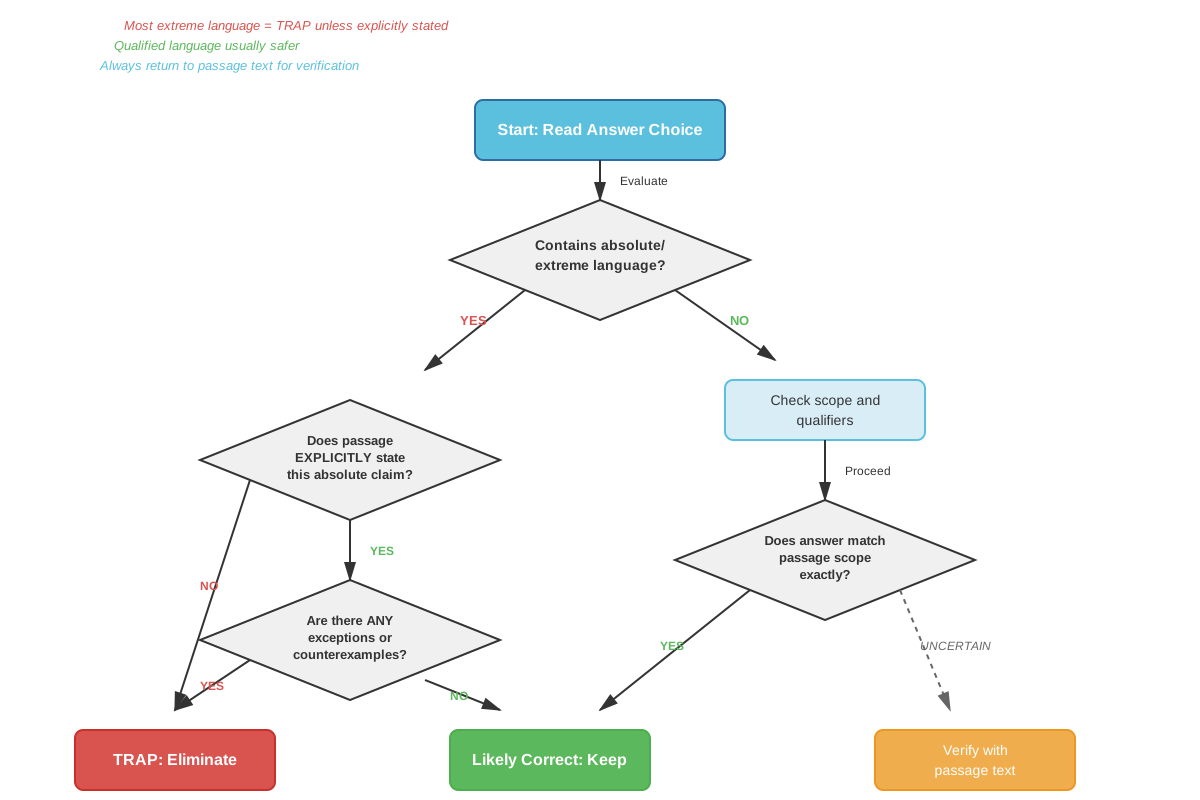
When approaching LSAT Reading Comprehension questions, implement this systematic process for identifying and avoiding extreme language traps:
Step 1: During passage reading, note the author's qualification level for major claims. Mark phrases like "suggests," "may," "some scholars believe," or "appears to" that indicate measured language. Also note any rare instances where the author makes absolute claims with strong support.
Step 2: Before reading answer choices, predict the approximate strength of language the correct answer should use based on the question type and relevant passage content. For inference questions, expect language equal to or weaker than the passage. For main point questions, expect language matching the author's conclusion.
Step 3: As you read each answer choice, flag any extreme language words immediately. Create a mental checklist: always, never, all, none, only, must, completely, entirely, impossible, inevitable, proves, definitively. When you encounter these words, the answer requires extra scrutiny.
Step 4: For flagged answers, return to the passage and verify whether the extreme language is actually supported. Ask: "Does the passage really say this applies to ALL cases?" or "Does the author actually claim this is the ONLY explanation?" If not, eliminate.
Step 5: Between two attractive answers, choose the one with more qualified language unless you can find explicit passage support for the stronger claim. The LSAT rewards precision over boldness.
Exam Tip: Time pressure makes extreme language traps more dangerous. Under stress, test-takers gravitate toward answers that "sound right" thematically even when the language is too strong. Slow down for 3-5 seconds when evaluating answer choices to check qualification level.
Trigger words to watch for in answer choices:
- High-risk extreme words: only, never, always, all, none, must, impossible, proves, definitively, completely, entirely, exclusively
- Moderate-risk words: most, best, primary, chief, mainly, predominantly (these can be correct but require verification)
- Low-risk qualified words: some, many, often, can, may, suggests, tends to, generally, typically
Process of elimination strategy: On difficult questions where you're unsure, eliminate answers with extreme language first. This often reduces five choices to two or three, significantly improving your odds even if you must guess.
Memory Techniques
SCAN acronym for extreme language detection:
- Superlatives (best, worst, most, only)
- Certainty words (must, proves, definitively)
- Absolutes (always, never, all, none)
- No-exception claims (completely, entirely, exclusively)
Visualization technique: Picture a volume dial when reading answer choices. Passage claims are set at a certain volume level (loud for strong claims, quiet for tentative ones). Answer choices that "turn up the volume" beyond the passage level are likely wrong. This mental image helps you assess whether answer language matches passage strength.
The "Lawyer's Hedge" mnemonic: Remember that legal and academic writers—the types featured in LSAT passages—typically hedge their claims with qualifications. Think "Lawyers Love Limitations" to remind yourself that qualified language is more common in correct answers.
Color-coding mental strategy: As you read, mentally "color" extreme language red (danger), qualified language green (safe), and moderate language yellow (verify). This creates a visual mental map of answer choice risk levels.
Summary
Extreme language traps in RC represent a high-yield LSAT concept that appears across virtually all reading comprehension question types. These traps exploit test-takers' tendency to select answers that capture passage themes while overlooking that the language makes claims too absolute, categorical, or universal to be supported by the text. Mastery requires developing sensitivity to qualifier words, understanding the relationship between passage tone and appropriate answer language, and systematically evaluating whether extreme claims are actually supported. The fundamental principle is that correct answers mirror the qualification level of the passage—tentative passages yield tentative answers, while strongly-supported claims may justify stronger language. Success depends on slowing down to analyze the precise strength of claims in both passages and answer choices, resisting the temptation to select thematically-related answers that overstate what the passage actually says. By recognizing common extreme language patterns, understanding how they vary by question type, and applying systematic evaluation strategies, students can dramatically improve accuracy on Reading Comprehension questions.
Key Takeaways
- Extreme language (always, never, all, none, only, must) appears in approximately 80% of incorrect RC answer choices
- Correct answers typically use qualified language (some, many, often, may, suggests) that mirrors passage tone
- The key question is not whether language is extreme in isolation, but whether it exceeds what the passage supports
- Different question types feature characteristic extreme language patterns—inference questions and main point questions are highest risk
- Under time pressure, test-takers gravitate toward thematically-correct answers with unsupported extreme language—slow down to check qualification level
- Comparative passages frequently include traps that overstate agreement or disagreement between authors
- When choosing between two attractive answers, select the more qualified option unless you can cite explicit passage support for stronger language
Related Topics
Scope Errors in RC: While extreme language concerns the degree or certainty of claims, scope errors involve answer choices that discuss subjects, groups, or contexts beyond what the passage addresses. Mastering extreme language traps provides a foundation for recognizing scope errors.
Author's Tone and Attitude: Understanding how to identify and characterize an author's attitude is closely related to extreme language awareness, as tone determines the appropriate strength of language in correct answers.
Valid vs. Invalid Inferences: Extreme language awareness is essential for inference questions, where the distinction between what must be true and what might be true often hinges on qualification level.
Passage Structure and Main Point: Recognizing how authors build arguments and qualify their conclusions helps predict the appropriate language strength for main point and primary purpose questions.
Practice CTA
Now that you understand extreme language traps in RC, it's time to apply this knowledge to actual LSAT questions. The practice questions and flashcards for this topic will help you develop the automatic recognition skills needed to spot these traps under time pressure. Focus on identifying the qualification level in passages and systematically evaluating whether answer choice language exceeds passage support. Remember: every extreme language trap you catch is a point earned. Your ability to recognize these patterns will improve dramatically with deliberate practice—start now to build this essential skill!
Sign up free to keep reading
Create a free AnvayaPrep account to finish this LSAT guide on Extreme language traps in RC — plus flashcards and practice questions.