Overview
Half-right answer traps represent one of the most insidious and frequently encountered wrong answer types in LSAT Reading Comprehension questions. These deceptive answer choices contain elements that are partially correct—they may accurately reflect one aspect of the passage while simultaneously introducing a subtle distortion, overstatement, or irrelevant detail that renders the entire answer incorrect. The LSAT test makers deliberately craft these answers to exploit the natural tendency of test-takers to recognize familiar language or concepts from the passage and select an answer before fully evaluating its accuracy.
Understanding and identifying half-right answer traps is essential for achieving a competitive LSAT score because these traps appear across all reading comprehension question types, including main point questions, inference questions, detail questions, and author's attitude questions. Students who fail to recognize these traps often find themselves choosing answers that "feel right" because they contain accurate passage information, only to discover they've fallen victim to a carefully constructed distortion. The ability to distinguish between answers that are entirely correct and those that are only partially correct separates high scorers from average performers.
Half-right answer traps relate directly to the broader skill of critical reading and precise answer evaluation that underlies all LSAT Reading Comprehension success. They test not only whether students understand passage content but also whether they can maintain rigorous standards of accuracy when evaluating answer choices. Mastering this concept builds upon foundational skills in passage mapping, question stem analysis, and wrong answer pattern recognition, while also preparing students for the even more nuanced challenges of comparative reading passages and complex inference questions.
Learning Objectives
- [ ] Identify how half-right answer traps appear in LSAT questions
- [ ] Explain the reasoning pattern behind half-right answer traps
- [ ] Apply half-right answer traps recognition to solve LSAT-style problems accurately
- [ ] Distinguish between fully correct answers and half-right traps within 30 seconds per answer choice
- [ ] Articulate the specific element that makes a half-right answer incorrect
- [ ] Develop a systematic verification process to avoid selecting half-right answers under time pressure
Prerequisites
- Passage structure analysis: Understanding how LSAT passages are organized enables recognition of where accurate information appears and where answer choices distort that information
- Question stem classification: Knowing what each question type asks for helps identify when an answer provides the right information for the wrong question
- Active reading strategies: The ability to identify main ideas, supporting details, and author's tone provides the foundation for evaluating answer accuracy
- Basic wrong answer patterns: Familiarity with extreme language, out-of-scope answers, and opposite answers helps contextualize half-right traps within the broader taxonomy of wrong answers
Why This Topic Matters
Half-right answer traps appear in approximately 40-60% of all LSAT Reading Comprehension questions, making them the single most common wrong answer type test-takers encounter. Unlike obviously incorrect answers that introduce completely foreign concepts or contradict the passage, half-right answers require careful analysis because they contain genuine passage content that can create a false sense of security. Students who learn to identify these traps typically see score improvements of 3-5 points in the Reading Comprehension section alone.
In real-world legal practice, the skill of identifying half-right arguments directly translates to evaluating opposing counsel's claims, analyzing contract language, and distinguishing between valid and flawed legal reasoning. Attorneys must constantly assess whether statements are entirely accurate or contain subtle distortions—precisely the skill LSAT Reading Comprehension tests through half-right answer traps.
On the LSAT, half-right answer traps most commonly appear in:
- Inference questions (Must Be True/Most Strongly Supported): where answers combine one supported claim with one unsupported leap
- Main Point questions: where answers accurately describe a supporting detail but mischaracterize it as the central argument
- Detail questions (According to the Passage): where answers quote passage language but apply it to the wrong context
- Author's Attitude questions: where answers correctly identify the author's view on one topic but incorrectly extend it to another
Core Concepts
Anatomy of a Half-Right Answer Trap
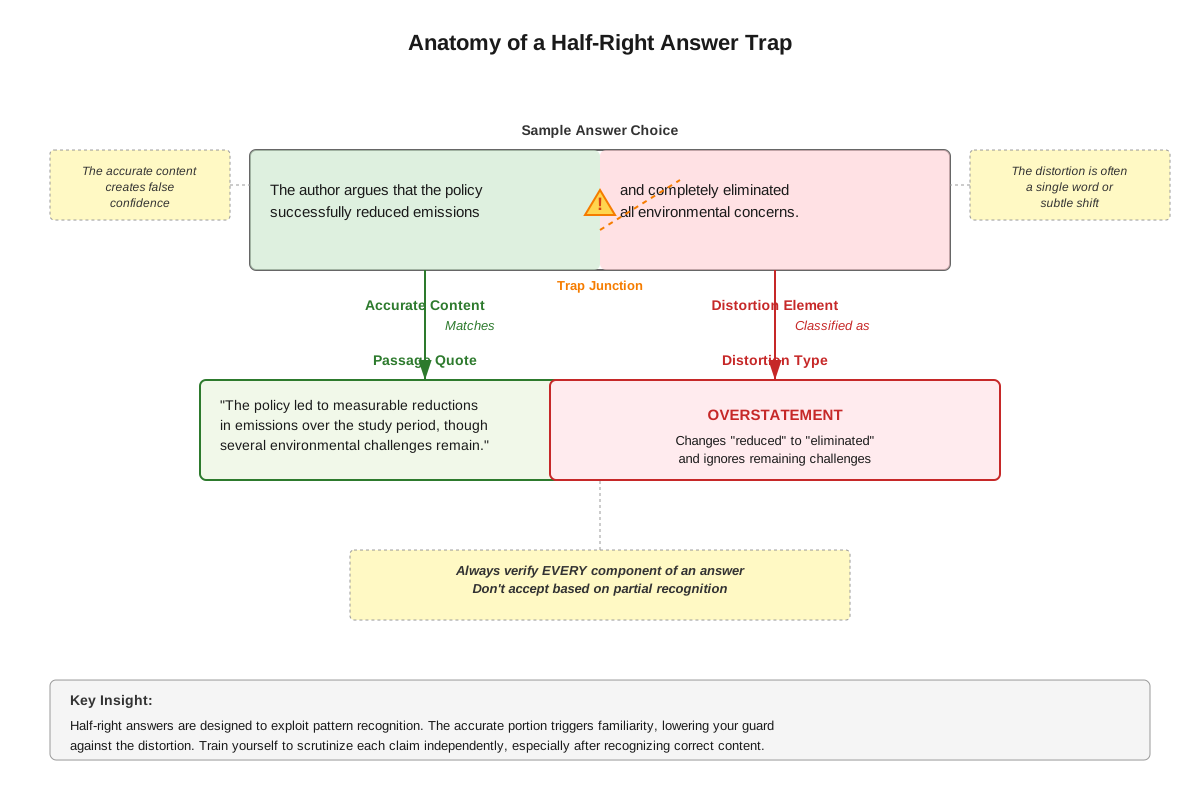
A half-right answer trap consists of two components: the accurate element and the distorting element. The accurate element typically includes language, concepts, or ideas taken directly from or strongly supported by the passage. This element serves as bait, triggering recognition and creating initial confidence in the answer. The distorting element introduces a subtle change that renders the entire answer incorrect—this might be an overstatement, an unsupported connection, a scope shift, or a misattribution.
The power of half-right answers lies in their exploitation of cognitive biases. When test-takers recognize familiar passage content, they experience a "recognition heuristic" that creates positive feelings toward the answer. Under time pressure, many students stop their analysis once they've identified the accurate element, failing to scrutinize the distorting element with equal care. The LSAT deliberately places the accurate element first in many half-right answers, knowing that primacy effects make test-takers more likely to weight early information heavily.
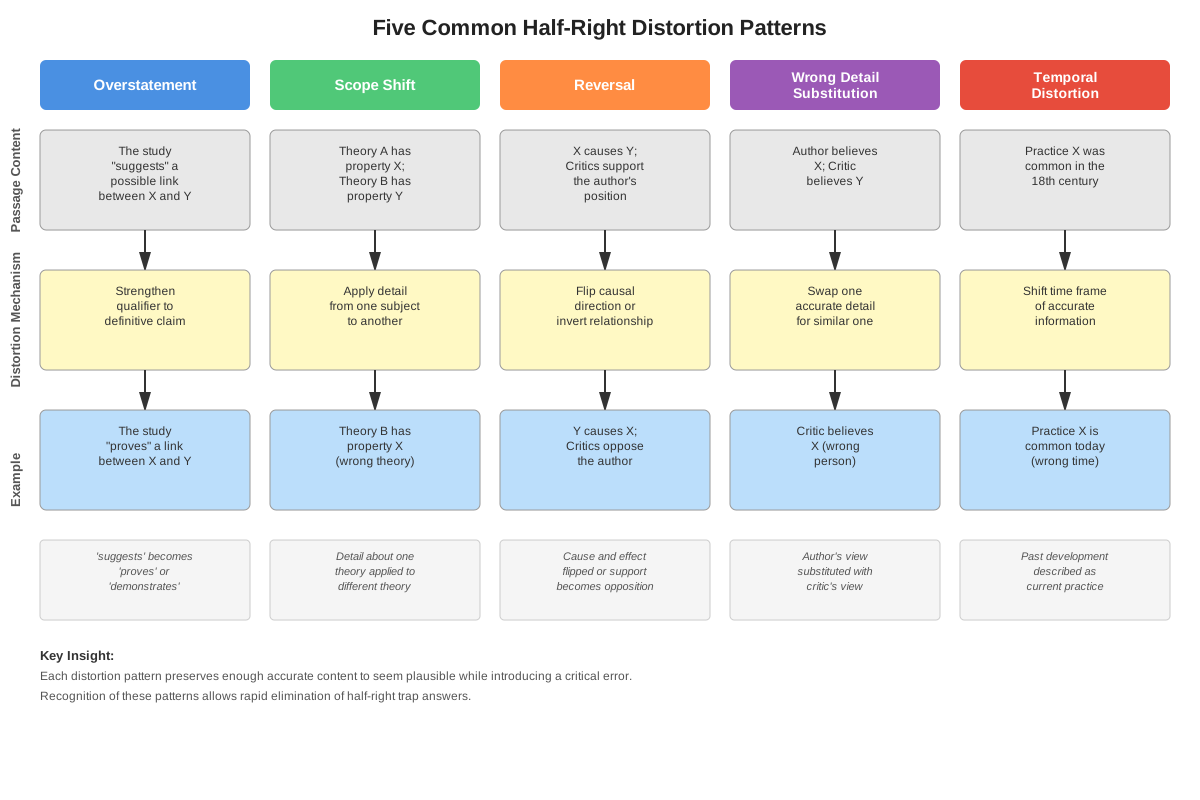
The Five Types of Distorting Elements
| Distortion Type | Mechanism | Example Pattern |
|---|---|---|
| Scope Shift | Accurate detail about X applied to Y | Passage discusses mammals; answer discusses "all animals" |
| Degree Distortion | Accurate claim intensified or weakened | Passage says "suggests"; answer says "proves conclusively" |
| Temporal Misalignment | Accurate information assigned to wrong time period | Passage describes past event; answer places it in present |
| Causal Fabrication | Two accurate facts incorrectly linked as cause-effect | Passage mentions A and B separately; answer claims A caused B |
| Attribution Error | Accurate view assigned to wrong person/group | Passage states author's view; answer attributes it to critics |
Scope shift distortions take accurate information about a specific subject and inappropriately broaden or narrow its application. For instance, if a passage discusses how certain Renaissance painters used perspective techniques, a half-right answer might state that "Renaissance artists employed innovative visual methods." The shift from "certain painters" to "artists" (which includes sculptors, architects, etc.) and from "perspective techniques" to "visual methods" (much broader) creates inaccuracy despite the answer's superficial correctness.
Degree distortions modify the strength or certainty of passage claims. The LSAT frequently presents passages where authors "suggest," "indicate," or "imply" conclusions, then offers half-right answers stating the author "demonstrates," "proves," or "establishes" those same conclusions. The underlying claim is accurate, but the degree of certainty is inflated beyond what the passage supports.
Temporal misalignment occurs when answers take accurate historical information and present it as current, or vice versa. Legal and scientific passages often discuss how theories or practices have evolved; half-right answers may describe a past approach as if it remains current, or present a contemporary development as if it were historical.
Causal fabrication represents one of the most dangerous half-right patterns. The LSAT loves to present passages that mention two phenomena without establishing a causal relationship, then offer answers that claim one caused the other. Both phenomena are accurately described, but the causal connection is invented.
Attribution errors assign accurate statements to the wrong source. A passage might present the author's view in paragraph one and critics' objections in paragraph two; a half-right answer might accurately describe the author's position but attribute it to the critics, or vice versa.
Recognition Strategies
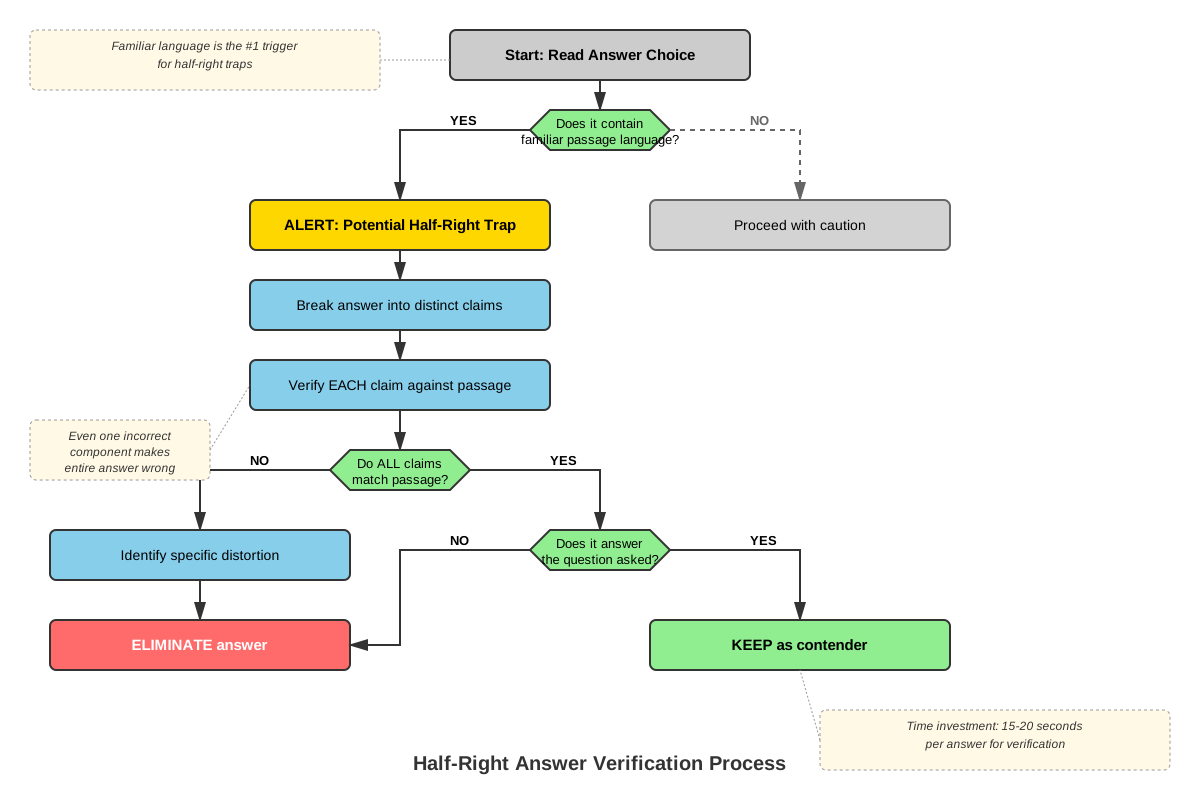
Identifying half-right answer traps requires a two-stage verification process. First, test-takers must confirm that the answer contains accurate passage information—this validates the "right" portion. Second, and more critically, they must scrutinize every element of the answer to identify potential distortions. This second stage demands asking specific questions:
- Scope verification: Does this answer apply passage information to the exact same subject, or has the scope shifted?
- Degree checking: Does this answer use the same level of certainty/strength as the passage?
- Temporal alignment: Does this answer place events/claims in the same time frame as the passage?
- Causal validation: If this answer suggests a cause-effect relationship, does the passage explicitly support that connection?
- Attribution confirmation: Is this claim/view assigned to the same person/group as in the passage?
The most effective approach involves reading each answer choice with deliberate skepticism, treating even familiar-sounding language as potentially problematic until verified. High-scoring test-takers develop the habit of mentally articulating why each element of an answer is correct, rather than simply feeling that the answer "sounds right."
The Contrast with Fully Correct Answers
Understanding half-right traps requires recognizing what distinguishes them from fully correct answers. Correct LSAT Reading Comprehension answers maintain perfect fidelity to the passage in every dimension: scope, degree, temporal frame, causal relationships, and attribution. They may paraphrase passage language, but they never distort passage meaning. When a correct answer makes a claim, every element of that claim must be defensible by direct reference to specific passage text.
The key distinction lies in the standard of proof. A half-right answer might be "mostly true" or "true in general," but LSAT correct answers must be "entirely true based on passage content." This distinction becomes especially important in inference questions, where correct answers must be conclusions that follow necessarily from passage information, not merely plausible extensions of passage ideas.
Common Placement Patterns
LSAT test makers strategically position half-right answer traps to maximize their effectiveness. These answers frequently appear in position (B) or (D)—early enough to catch test-takers before they've evaluated all options, but not in the first position where scrutiny tends to be highest. When a half-right answer appears in position (E), it often serves as a final temptation for test-takers who have eliminated other answers and feel pressure to select something.
Half-right answers also tend to appear in clusters with other sophisticated wrong answer types. A question might include one half-right answer, one extreme answer, one out-of-scope answer, and one opposite answer, along with the correct answer. This distribution forces test-takers to apply multiple wrong answer recognition skills simultaneously.
Concept Relationships
Half-right answer traps exist within a broader ecosystem of wrong answer patterns in LSAT Reading Comprehension. They represent a middle ground between obviously incorrect answers (those that introduce completely foreign concepts or directly contradict the passage) and correct answers (those that maintain perfect accuracy). Understanding this spectrum helps test-takers calibrate their evaluation standards.
The relationship flows as follows: Active reading → identifies passage content → enables recognition of accurate elements in answers → triggers need for verification of all answer components → reveals distorting elements → leads to elimination of half-right traps → increases probability of selecting fully correct answers.
Half-right answer traps connect directly to question stem analysis because the type of distortion often correlates with question type. Inference questions frequently feature causal fabrication distortions, while main point questions often include scope shift distortions that elevate supporting details to primary importance. Detail questions commonly employ attribution errors and temporal misalignments.
The concept also relates to passage structure understanding because recognizing where information appears in the passage helps identify when answers misattribute claims or combine information from different contexts. Test-takers who map passages effectively can quickly verify whether an answer's attribution is accurate or whether it has conflated distinct passage elements.
Quick check — test yourself on Half-right answer traps so far.
Try Flashcards →High-Yield Facts
⭐ Half-right answer traps appear in 40-60% of all LSAT Reading Comprehension questions, making them the most common wrong answer type
⭐ The accurate element in a half-right answer typically appears first, exploiting primacy effects and recognition heuristics
⭐ Scope shifts represent the most frequent type of distortion in half-right answers, particularly in main point and inference questions
⭐ Degree distortions most commonly involve strengthening language (changing "suggests" to "proves" or "some" to "all")
⭐ Causal fabrication distortions are especially prevalent in science and social science passages where correlation is discussed
- Half-right answers often use exact passage language for the accurate element while paraphrasing the distorting element
- Attribution errors most frequently occur in passages that present multiple viewpoints or contrast author's views with others' perspectives
- Temporal misalignment distortions appear most often in historical passages and passages discussing theoretical evolution
- Half-right answers in inference questions typically combine one supported claim with one unsupported logical leap
- The distorting element in a half-right answer is usually subtle—changing one word or phrase rather than introducing entirely new concepts
Common Misconceptions
Misconception: If an answer contains accurate passage information, it must be correct → Correction: Correct LSAT answers must be entirely accurate in every element; partial accuracy is insufficient. An answer can quote the passage directly and still be wrong if it distorts scope, degree, causation, attribution, or temporal frame.
Misconception: Half-right answers are easy to spot because they contain obvious errors → Correction: Half-right answers are deliberately crafted to be subtle. The distorting element often involves changing a single word (like "some" to "most") or making a small logical leap that seems reasonable but isn't supported. Test-takers must scrutinize every word.
Misconception: If an answer "sounds right" or feels familiar, it's probably correct → Correction: Half-right answers are designed to trigger recognition and feel familiar because they contain genuine passage content. This feeling of familiarity is precisely what makes them dangerous. Correct answers must be verified through systematic analysis, not intuition.
Misconception: The accurate element in a half-right answer is always a direct quote from the passage → Correction: While half-right answers often include quoted language, they may also paraphrase passage content accurately in the "right" portion. The distortion can occur in either quoted or paraphrased material.
Misconception: Half-right answers only appear in difficult questions → Correction: Half-right answer traps appear across all difficulty levels. Even relatively straightforward questions include half-right answers to trap test-takers who read carelessly or fail to verify all answer elements.
Misconception: Once you've identified one wrong element in an answer, you don't need to check the rest → Correction: While finding one definitive error is sufficient to eliminate an answer, developing the habit of analyzing entire answers builds the verification skills necessary to avoid half-right traps. Some answers contain multiple distortions.
Worked Examples
Example 1: Inference Question with Causal Fabrication
Passage excerpt: "The decline in bee populations has coincided with increased use of neonicotinoid pesticides in agricultural regions. Scientists have documented that bees exposed to these pesticides in laboratory settings show impaired navigation abilities. Environmental advocates have called for restrictions on neonicotinoid use."
Question: Based on the passage, which of the following can be most reasonably inferred?
Half-right answer: "The increased use of neonicotinoid pesticides has caused the decline in bee populations, leading environmental advocates to demand restrictions."
Analysis: This answer contains three accurate elements: (1) increased neonicotinoid use is mentioned, (2) bee population decline is mentioned, and (3) environmental advocates have called for restrictions. However, the answer commits causal fabrication by stating that neonicotinoid use "has caused" the decline. The passage only states these phenomena "coincided"—temporal correlation, not causation. The passage provides evidence that could support a causal relationship (laboratory findings), but it never establishes causation definitively. The phrase "leading environmental advocates to demand" also suggests the causation prompted the advocacy, creating a second unsupported causal chain.
Correct approach: Verify each claim independently. "Increased use" ✓ "Decline in populations" ✓ "Has caused" ✗ (passage says "coincided," not "caused"). The single word "caused" transforms an otherwise accurate answer into a half-right trap.
Fully correct answer alternative: "Laboratory research has demonstrated that neonicotinoid exposure impairs certain bee behaviors."
This answer makes only claims directly supported by the passage without fabricating causal relationships.
Example 2: Main Point Question with Scope Shift
Passage excerpt: "Legal scholars have debated whether the Fourth Amendment's protection against unreasonable searches applies to digital data stored on smartphones. Recent Supreme Court decisions have suggested that individuals maintain a reasonable expectation of privacy in their cell phone contents. However, lower courts have reached inconsistent conclusions when applying these principles to specific cases involving GPS tracking data."
Question: Which of the following best expresses the main point of the passage?
Half-right answer: "Courts have struggled to determine how Fourth Amendment protections apply to modern technology."
Analysis: This answer contains accurate information—courts have indeed struggled with Fourth Amendment application, and the passage discusses modern technology (smartphones, GPS). However, it commits a scope shift distortion. The passage specifically discusses smartphone data and GPS tracking, not "modern technology" broadly. More importantly, the passage focuses specifically on the Fourth Amendment's application to digital data and GPS tracking, not Fourth Amendment protections generally. The answer broadens both the technology scope (from specific digital contexts to all modern technology) and the legal scope (from specific types of searches to Fourth Amendment protections generally).
Correct approach: Identify the passage's specific focus. Subject: Fourth Amendment application. Specific context: smartphone data and GPS tracking. Main tension: Supreme Court suggestions vs. lower court inconsistency. The correct answer must maintain this precise scope.
Fully correct answer alternative: "While the Supreme Court has indicated that Fourth Amendment privacy protections extend to smartphone contents, lower courts have applied this principle inconsistently in GPS tracking cases."
This answer maintains the specific scope of the passage without inappropriate broadening.
Exam Strategy
When approaching LSAT Reading Comprehension questions, implement a systematic verification protocol for every answer choice to avoid half-right traps:
Step 1: Read the question stem carefully to understand exactly what the question asks. Half-right answers often provide accurate information that answers a different question than the one asked.
Step 2: Predict an answer based on passage content before reading the choices. This prediction serves as a benchmark against which to evaluate answers and reduces susceptibility to recognition-based traps.
Step 3: Read each answer completely before making any judgment. Many test-takers select half-right answers because they stop reading after encountering the accurate element.
Step 4: Apply the five verification questions to each answer:
- Scope: Same subject/breadth as passage?
- Degree: Same strength/certainty as passage?
- Temporal: Same time frame as passage?
- Causal: Any cause-effect claims supported by passage?
- Attribution: Claims assigned to correct source?
Step 5: Articulate the specific flaw in eliminated answers. This practice builds pattern recognition and prevents second-guessing.
Exam Tip: When an answer "feels right" but you can't articulate exactly why it's correct, treat it as suspicious. Half-right answers exploit vague positive feelings. Correct answers can always be defended with specific passage references.
Trigger words for distortions:
- Degree intensifiers: "proves," "establishes," "demonstrates," "all," "none," "always," "never," "must"
- Causal language: "caused," "led to," "resulted in," "because," "therefore," "consequently"
- Scope broadeners: "generally," "typically," "in most cases," "often," "usually"
- Attribution phrases: "the author believes," "critics argue," "scholars maintain"
Time allocation: Spend 10-15 seconds per answer choice, with extra time on answers that contain familiar passage language. The recognition trigger indicates higher half-right trap probability.
Process of elimination: Eliminate obviously wrong answers first (out-of-scope, opposite, extreme), then scrutinize remaining answers for half-right patterns. The final two answers often include one half-right trap and one correct answer.
Memory Techniques
SCREAM - Mnemonic for the five verification questions to identify distortions:
- Scope: Has the subject or breadth changed?
- Causation: Are cause-effect claims supported?
- Right source: Is attribution accurate?
- Exaggeration: Has degree/certainty been inflated?
- Anachronism: Is the time frame correct?
- Misalignment: Do all elements match passage content?
The "Two-Part Test" visualization: Picture each answer as a bridge with two supports. The accurate element is one support (looks solid), but the distorting element is a cracked support. The entire bridge (answer) fails even if one support is perfect. This image reinforces that partial accuracy equals complete incorrectness.
The "Exact Match" mantra: When evaluating answers, repeat "exact match" to maintain rigorous standards. Scope must exactly match, degree must exactly match, attribution must exactly match. "Close enough" is never enough on the LSAT.
Color-coding mental strategy: Mentally highlight accurate elements in green and distorting elements in red as you read each answer. This visualization helps separate the two components and prevents the accurate element from creating a "halo effect" that obscures the distortion.
Summary
Half-right answer traps represent the most sophisticated and frequently encountered wrong answer type in LSAT Reading Comprehension, appearing in 40-60% of questions across all question types. These answers combine accurate passage content (the "right" element) with subtle distortions (the "wrong" element) that render the entire answer incorrect. The five primary distortion types—scope shifts, degree distortions, temporal misalignments, causal fabrications, and attribution errors—each exploit different aspects of passage content. Success in avoiding these traps requires systematic verification of every answer element using the SCREAM framework, maintaining rigorous standards of accuracy, and resisting the recognition heuristic that makes familiar-sounding answers feel correct. Test-takers must develop the discipline to scrutinize answers that contain accurate information with the same care they apply to obviously suspicious answers, understanding that partial accuracy is insufficient on the LSAT. Mastering half-right answer trap recognition typically improves Reading Comprehension scores by 3-5 points and builds the precise analytical skills essential for legal reasoning.
Key Takeaways
- Half-right answer traps contain both accurate passage content and subtle distortions, making them more dangerous than obviously incorrect answers
- The five distortion types (scope shift, degree distortion, temporal misalignment, causal fabrication, attribution error) account for virtually all half-right traps
- Systematic verification using the SCREAM framework prevents selection of half-right answers under time pressure
- Recognition of familiar passage language should trigger increased scrutiny, not confidence, as this familiarity is deliberately engineered
- Correct LSAT answers maintain perfect fidelity to passage content in scope, degree, temporal frame, causation, and attribution—partial accuracy is always insufficient
- Articulating specific reasons why answers are correct or incorrect builds pattern recognition and prevents second-guessing
- Half-right answers most commonly appear in inference questions (causal fabrication), main point questions (scope shifts), and detail questions (attribution errors)
Related Topics
Extreme Answer Elimination: Understanding how to identify and eliminate answers containing extreme language (all, none, always, never) complements half-right trap recognition, as some half-right answers combine accurate content with extreme distortions.
Out-of-Scope Answer Recognition: Learning to identify answers that introduce concepts not discussed in the passage helps distinguish between half-right answers (which distort passage content) and out-of-scope answers (which introduce foreign content).
Inference Question Strategy: Mastering half-right traps is essential for inference questions, where the line between supported and unsupported conclusions is especially fine and causal fabrication distortions are most common.
Passage Mapping Techniques: Developing strong passage mapping skills enables quick verification of answer elements, as test-takers can rapidly locate where information appears and confirm whether answers accurately represent that information.
Comparative Reading Passages: Half-right trap recognition becomes even more critical in comparative passages, where answers may accurately describe one passage but incorrectly apply that information to the other passage or to both passages.
Practice CTA
Now that you understand the mechanics of half-right answer traps and have learned systematic strategies for identifying them, it's time to apply these skills to actual LSAT questions. Complete the practice questions for this topic, paying special attention to answers that contain familiar passage language—these are your opportunities to practice the SCREAM verification framework. As you work through practice problems, articulate the specific distortion in each half-right answer you encounter. This deliberate practice will transform half-right trap recognition from a conscious process into an automatic skill, enabling you to navigate even the most sophisticated wrong answers with confidence. Review the flashcards to reinforce the five distortion types and verification questions until they become second nature. Your ability to avoid half-right traps will directly translate to higher scores and greater consistency across all Reading Comprehension questions.
Sign up free to keep reading
Create a free AnvayaPrep account to finish this LSAT guide on Half-right answer traps — plus flashcards and practice questions.