Overview
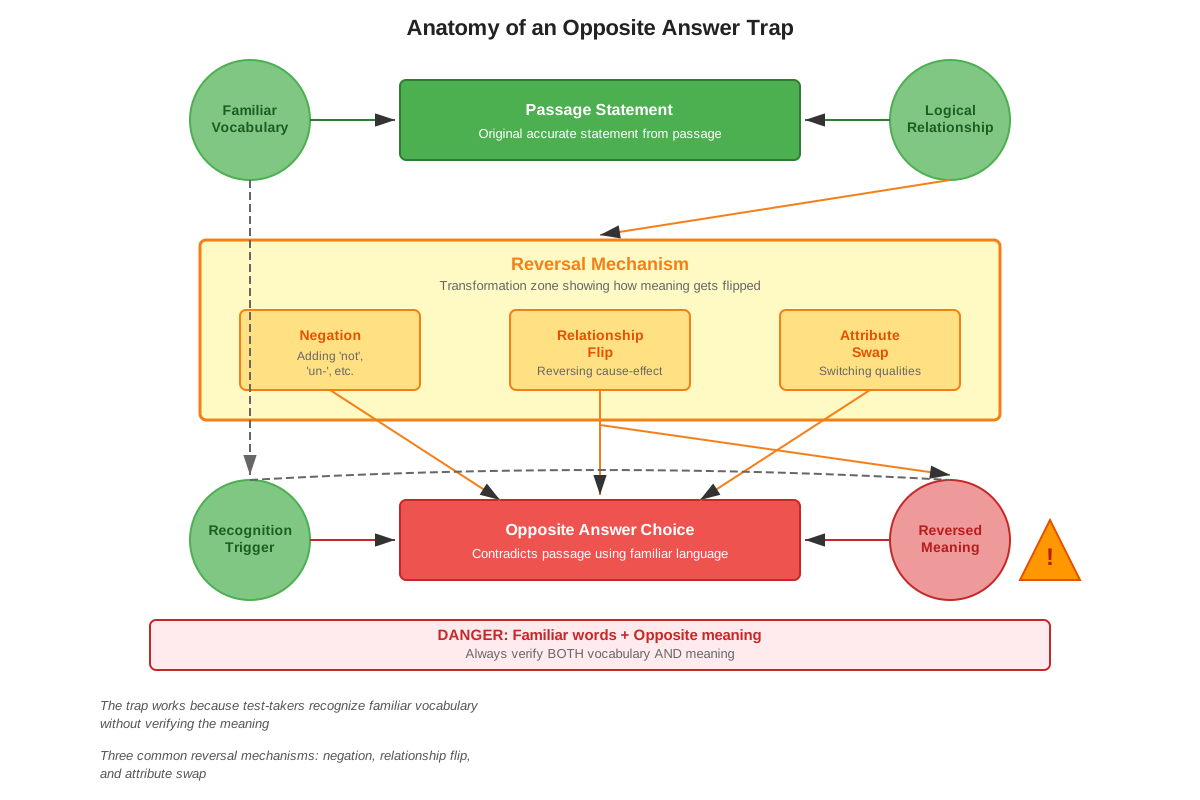
Opposite answer traps represent one of the most insidious and frequently encountered wrong answer types in LSAT Reading Comprehension questions. These deceptive answer choices deliberately present information that contradicts what the passage actually states, yet they do so in a way that feels plausible to test-takers who are reading quickly or relying on partial recall. The LSAT test makers craft these traps by taking genuine concepts from the passage and reversing their meaning, negating their truth value, or flipping the relationship between ideas. Students who fall for opposite answer traps typically do so because they recognize familiar language from the passage without carefully verifying whether the answer choice accurately represents the passage's position.
Understanding and avoiding lsat opposite answer traps is essential for achieving a competitive score on the LSAT. These traps appear across all reading comprehension question types, including main point questions, detail questions, inference questions, and author's attitude questions. The prevalence of opposite answers reflects the LSAT's emphasis on precise reading and careful attention to logical relationships. Test-takers must develop the discipline to verify not just that an answer choice discusses relevant content, but that it accurately represents the passage's stance on that content.
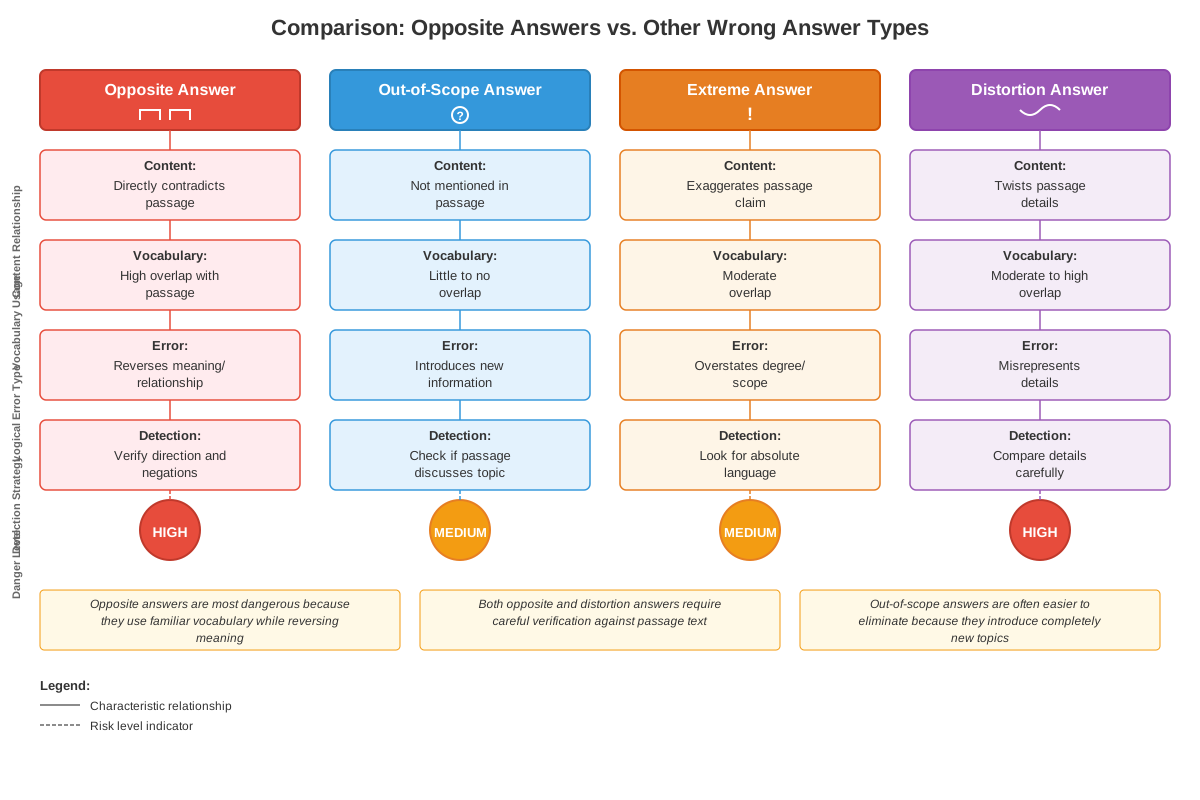
Within the broader landscape of reading comprehension strategy, recognizing opposite answer traps connects directly to fundamental skills like active reading, passage mapping, and answer choice verification. While other wrong answer types might introduce information not mentioned in the passage or distort details through exaggeration, opposite answers are particularly dangerous because they engage with the passage's actual content—they simply reverse it. Mastering this topic requires developing a systematic approach to comparing answer choices against passage text, paying special attention to qualifying language, logical operators, and the direction of relationships between concepts.
Learning Objectives
- [ ] Identify how Opposite answer traps appears in LSAT questions
- [ ] Explain the reasoning pattern behind Opposite answer traps
- [ ] Apply Opposite answer traps to solve LSAT-style problems accurately
- [ ] Distinguish opposite answer traps from other wrong answer types (out-of-scope, extreme, distortion)
- [ ] Develop a systematic verification process to catch reversed meanings before selecting an answer
- [ ] Recognize the specific linguistic markers that signal potential opposite answer traps
- [ ] Predict where opposite answer traps are most likely to appear based on question type and passage structure
Prerequisites
- Basic passage comprehension skills: The ability to understand main ideas and supporting details forms the foundation for detecting when answer choices contradict passage content.
- Familiarity with LSAT question stems: Understanding what different question types ask for helps identify when an opposite answer might be particularly tempting.
- Knowledge of logical relationships: Recognizing cause-effect, comparison, and contrast structures enables detection of reversed relationships in answer choices.
- Experience with active reading techniques: Passage annotation and mapping provide reference points for verifying answer choice accuracy.
Why This Topic Matters
Opposite answer traps matter because they exploit a fundamental vulnerability in human reading comprehension: the tendency to recognize familiar content without verifying its accuracy. Research on LSAT performance indicates that opposite answers account for approximately 20-30% of all wrong answer choices in Reading Comprehension sections, making them one of the most common trap types test-takers encounter. Students who learn to systematically identify and eliminate opposite answers can improve their Reading Comprehension scores by 2-4 points on average.
In actual LSAT passages, opposite answer traps appear most frequently in questions that ask about the author's viewpoint, the relationship between two theories, or the purpose of a particular paragraph. The test makers strategically place these traps in positions where test-takers are most likely to be moving quickly—often as answer choice (A) or (B) to catch those who don't read all options, or as answer choice (D) or (E) to trap those experiencing decision fatigue. Detail questions about specific claims and inference questions about what the passage suggests are particularly rich hunting grounds for opposite answers.
The practical significance extends beyond test day. The skill of carefully verifying that a summary or paraphrase accurately represents source material—rather than reversing it—is fundamental to legal reasoning, academic research, and professional communication. Lawyers must ensure their characterizations of precedent cases don't inadvertently reverse holdings; researchers must accurately represent prior studies; business professionals must correctly convey stakeholder positions. The LSAT tests this skill because it's essential to legal practice.
Core Concepts
Definition and Mechanism of Opposite Answer Traps
An opposite answer trap is a wrong answer choice that states the reverse, negation, or contradiction of what the passage actually claims. These answers are constructed by taking accurate passage content and systematically inverting its meaning through negation words (not, never, rarely), antonyms (increase/decrease, support/oppose), or reversed relationships (cause becomes effect, criticism becomes endorsement). The mechanism relies on recognition without verification: test-takers see familiar terms and concepts from the passage and experience a false sense of correctness without checking whether the answer choice's claim matches the passage's actual position.
The psychological effectiveness of opposite answers stems from several cognitive factors. First, they trigger recognition memory—the test-taker remembers seeing these concepts discussed in the passage. Second, they often use sophisticated vocabulary and complex sentence structures that sound authoritative and test-like. Third, they exploit the natural tendency to skim answer choices rather than reading them with the same care applied to the passage itself. Fourth, they capitalize on the difficulty of holding precise details in working memory, especially after reading a dense 450-word passage.
Types of Opposites
Opposite answer traps manifest in several distinct forms, each requiring slightly different detection strategies:
| Type | Mechanism | Example Pattern |
|---|---|---|
| Direct Negation | Adds or removes "not," "never," "rarely" | Passage: "The theory is supported." → Trap: "The theory is not supported." |
| Antonym Substitution | Replaces key term with its opposite | Passage: "Critics praised the approach." → Trap: "Critics condemned the approach." |
| Reversed Relationship | Flips cause-effect or comparison | Passage: "A led to B." → Trap: "B led to A." |
| Inverted Attribution | Assigns a view to the wrong party | Passage: "Smith argues X; Jones argues Y." → Trap: "Smith argues Y." |
| Contradicted Inference | States opposite of what's implied | Passage implies optimism → Trap: states pessimism |
Linguistic Markers and Red Flags
Certain linguistic features make answer choices more susceptible to being opposite traps. Qualifying language such as "not," "never," "rarely," "fails to," "rejects," "contradicts," and "undermines" should trigger heightened scrutiny. When an answer choice contains these terms, test-takers must verify not just that the passage discusses the relevant topic, but that the passage actually expresses the negative stance the answer claims.
Comparative and evaluative terms also warrant careful attention. Words like "more/less," "better/worse," "superior/inferior," "increase/decrease," and "strengthen/weaken" establish directional relationships that can easily be reversed. If a passage states that "Method A proved more effective than Method B," an opposite trap might claim "Method B demonstrated superior results to Method A." The concepts are familiar, but the relationship is inverted.
Attribution verbs that assign positions to specific parties—"argues," "claims," "believes," "criticizes," "endorses," "questions"—create opportunities for opposite traps through misattribution. A passage might present Author X criticizing Theory Y while Author Z defends it; an opposite trap would reverse these positions. This type is particularly common in comparative passages where two perspectives are contrasted.
Strategic Placement in Question Types
Opposite answer traps don't appear randomly; they're strategically deployed based on question type. In main point questions, opposite traps often present the view the author argues against as if it were the author's own position. For author's attitude questions, they might describe the author as "skeptical" when the passage shows enthusiasm, or "supportive" when the passage expresses criticism.
Detail questions asking "According to the passage..." or "The author states that..." frequently include opposite traps that contradict explicit passage claims. These are often the most straightforward to catch if test-takers return to the relevant passage section. Inference questions present a more subtle challenge: the opposite trap might state something that contradicts what the passage implies, even if that implication wasn't stated directly.
Function questions asking why the author mentions something or what purpose a paragraph serves can include opposite traps that reverse the rhetorical purpose—claiming the author introduces a theory to criticize it when actually the author introduces it to support it, for example.
The Verification Process
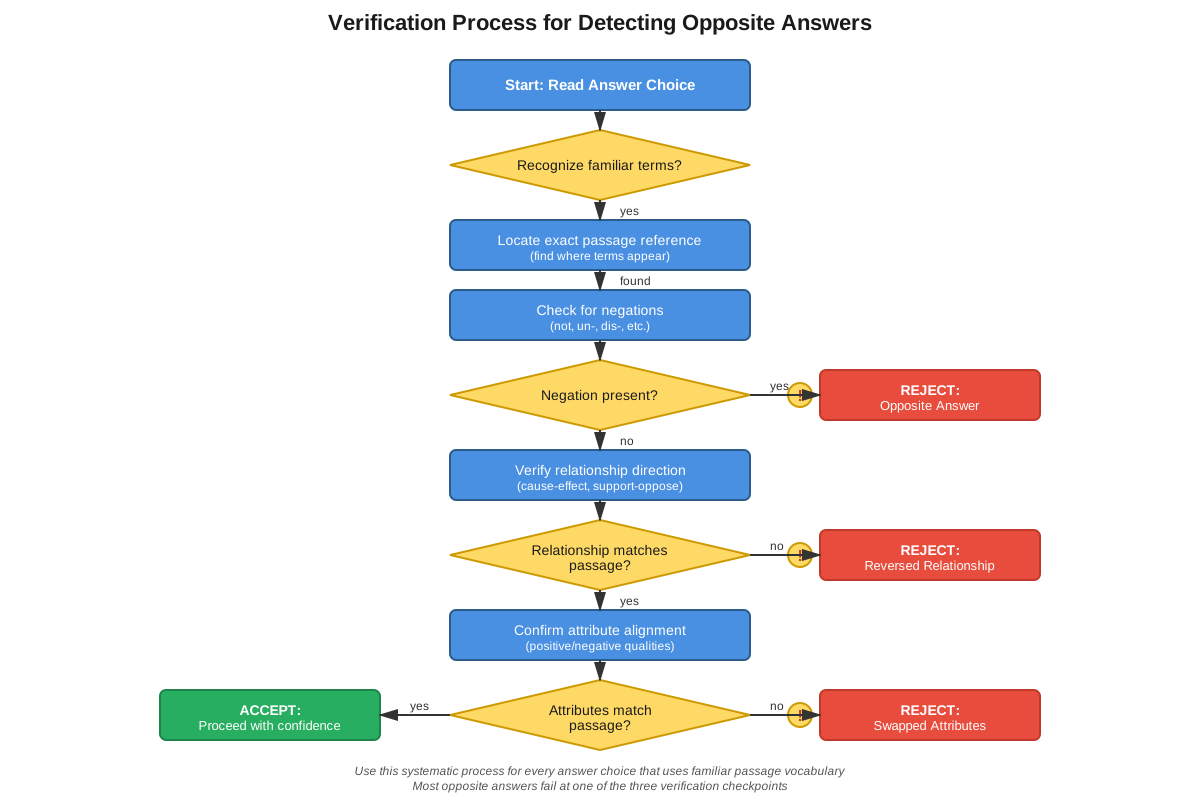
Avoiding opposite answer traps requires a systematic verification process. First, identify the key claim in the answer choice—what specific assertion is being made? Second, locate the relevant passage section that discusses this topic. Third, perform a direct comparison between the answer choice's claim and the passage's statement, paying special attention to qualifying language, directional terms, and attribution. Fourth, ask explicitly: "Does this answer say the same thing as the passage, or the opposite?"
This process must become automatic through practice. High-scoring test-takers develop an internal alarm system that triggers whenever they encounter potential reversal language. They've trained themselves to pause and verify rather than selecting based on topic recognition alone.
Concept Relationships
The concept of opposite answer traps connects hierarchically to the broader category of wrong answer types in LSAT Reading Comprehension. While out-of-scope answers introduce information not discussed in the passage and extreme answers overstate the passage's claims, opposite answers engage directly with passage content but reverse its meaning. Understanding this distinction helps test-takers categorize wrong answers efficiently during elimination.
Opposite answer traps relate directly to active reading strategies and passage mapping. When test-takers create effective passage maps noting the author's position, contrasting viewpoints, and the direction of arguments, they create reference tools that make opposite answers easier to spot. The relationship flows: Strong passage comprehension → Accurate passage mapping → Efficient opposite answer detection.
The connection to logical reasoning is also significant. Recognizing opposite answers requires understanding logical relationships: if the passage establishes that X causes Y, an answer claiming Y causes X reverses the causal relationship. If the passage presents Theory A as superior to Theory B, an answer claiming B's superiority contradicts the passage's comparison. These logical structures—causation, comparison, temporal sequence—form the framework within which opposites operate.
Textual Relationship Map:
Active Reading → Passage Mapping → Identifying Key Claims → Answer Choice Analysis → Detecting Reversal Language → Verification Against Passage → Eliminating Opposite Traps → Selecting Correct Answer
Quick check — test yourself on Opposite answer traps so far.
Try Flashcards →High-Yield Facts
⭐ Opposite answer traps appear in approximately 20-30% of Reading Comprehension wrong answer choices, making them one of the most common trap types.
⭐ The most frequent form of opposite trap involves direct negation—adding or removing "not" or similar negating terms.
⭐ Opposite answers are most common in author's attitude questions and main point questions, where they present the view the author opposes as if it were the author's position.
⭐ Test-takers fall for opposite traps primarily due to recognition without verification—they see familiar concepts without checking whether the relationship is accurate.
⭐ Reversed cause-effect relationships represent a particularly subtle form of opposite trap that requires careful attention to logical structure.
- Opposite traps often appear in answer choice positions (A), (B), or (D) to maximize their effectiveness at catching test-takers.
- Comparative passages generate more opposite answer opportunities because they present contrasting viewpoints that can be easily misattributed.
- The presence of qualifying language like "not," "never," "fails to," or "rejects" should trigger immediate verification against the passage.
- Opposite answers typically use sophisticated vocabulary and complex sentence structures to appear more credible.
- Detail questions with specific line references generate fewer opposite traps than questions requiring synthesis across multiple paragraphs.
- When two answer choices seem to contradict each other, one is often an opposite trap and the other may be correct—this signals the need for careful verification.
Common Misconceptions
Misconception: If an answer choice discusses topics mentioned in the passage, it must be accurate.
Correction: Opposite answer traps deliberately use familiar passage content but reverse its meaning. Topic recognition alone is insufficient; the specific claim must be verified against the passage.
Misconception: Opposite answers are easy to spot because they're obviously wrong.
Correction: Opposite answers are carefully crafted to sound plausible and often differ from the correct answer by a single word or phrase. They require systematic verification to detect reliably.
Misconception: Only detail questions contain opposite answer traps.
Correction: Opposite traps appear across all question types, but are especially common in main point, author's attitude, and inference questions where they can reverse the passage's overall stance or implications.
Misconception: If you remember the passage well, you don't need to verify answer choices against the text.
Correction: Memory is fallible, especially under test conditions. Even with strong comprehension, verification is essential because opposite traps exploit the gap between recognition and precise recall.
Misconception: Opposite answers always use obvious reversal words like "not" or antonyms.
Correction: While direct negation is common, opposite traps can also reverse relationships, misattribute positions, or contradict implications without using explicit reversal language. Reversed cause-effect relationships, for example, might not contain any negating terms.
Misconception: The correct answer and an opposite trap will always be clearly distinguishable.
Correction: Sometimes the difference between correct and opposite is subtle—a single qualifying word or a slight shift in attribution. This is why careful, word-by-word comparison is necessary.
Worked Examples
Example 1: Author's Attitude Question
Passage excerpt: "While early critics dismissed the new architectural movement as frivolous and impractical, recent scholarship has demonstrated its profound influence on contemporary design principles. The movement's emphasis on integrating natural elements into urban spaces has proven both aesthetically pleasing and functionally beneficial, contradicting the initial skepticism."
Question: The author's attitude toward the architectural movement can best be described as:
Answer choices:
(A) Dismissive of its practical applications
(B) Appreciative of its contributions to design
(C) Neutral regarding its aesthetic value
(D) Skeptical of recent scholarly assessments
(E) Critical of its integration of natural elements
Analysis:
First, identify the author's actual position. The passage indicates the author believes the movement has "profound influence," has "proven both aesthetically pleasing and functionally beneficial," and contradicts "initial skepticism." This is clearly a positive assessment.
Now examine each answer:
(A) is an opposite answer trap. The passage explicitly states the movement has proven "functionally beneficial," directly contradicting "dismissive of its practical applications." This reverses the author's position by attributing to the author the view held by "early critics."
(B) accurately captures the author's positive assessment and is the correct answer.
(C) contradicts the passage's clear positive stance—the author is not neutral.
(D) is another opposite trap. The author cites "recent scholarship" approvingly as demonstrating the movement's influence. Being "skeptical of recent scholarly assessments" reverses the author's actual position.
(E) reverses the author's explicit statement that integration of natural elements has "proven both aesthetically pleasing and functionally beneficial."
Key lesson: This example shows how opposite traps work by taking the view the author argues against (early critics' dismissiveness) and presenting it as the author's own position. The trap in (A) uses familiar concepts (practical applications) but reverses the author's stance.
Example 2: Detail Question with Reversed Relationship
Passage excerpt: "The introduction of new irrigation techniques in the region led to increased crop yields, which in turn stimulated economic growth and population expansion. This agricultural innovation served as the catalyst for broader social transformation."
Question: According to the passage, which of the following accurately describes the relationship between agricultural innovation and economic growth?
Answer choices:
(A) Economic growth enabled investment in agricultural innovation
(B) Agricultural innovation preceded and contributed to economic growth
(C) Agricultural innovation and economic growth occurred independently
(D) Economic growth had minimal impact on agricultural development
(E) The relationship between the two remains unclear from available evidence
Analysis:
The passage establishes a clear causal sequence: irrigation techniques → increased yields → economic growth. Agricultural innovation is explicitly identified as the "catalyst" for subsequent changes.
(A) is an opposite answer trap that reverses the causal relationship. The passage states innovation led to growth, not that growth enabled innovation. This is a reversed cause-effect trap.
(B) correctly captures the temporal and causal relationship stated in the passage and is the correct answer.
(C) contradicts the passage's explicit causal connection.
(D) reverses the relationship by suggesting growth affected agriculture, when the passage indicates the opposite direction.
(E) contradicts the passage's clear statement of the relationship.
Key lesson: Reversed relationship traps are particularly subtle because they use all the correct concepts but flip the direction of causation or temporal sequence. Test-takers must pay careful attention to which element the passage identifies as cause versus effect.
Exam Strategy
When approaching LSAT Reading Comprehension questions, implement a systematic strategy to catch opposite answer traps before they catch you. First, during passage reading, actively note the author's position, any contrasting viewpoints, and the direction of relationships (what causes what, what's compared favorably to what). Create brief margin notes like "Author supports X" or "Theory A > Theory B" to establish clear reference points.
Second, when reading answer choices, develop a heightened sensitivity to trigger words that signal potential opposite traps: "not," "never," "fails to," "rejects," "contradicts," "undermines," "opposes," "criticizes," "dismisses," "skeptical," and "questions." When you encounter these terms, immediately verify against the passage rather than relying on memory.
Third, employ the "same or opposite?" verification technique. For each answer choice that seems plausible, explicitly ask: "Does this say the same thing as the passage, or the opposite?" This simple question forces active comparison rather than passive recognition.
Fourth, watch for misattribution traps in passages presenting multiple viewpoints. Create a simple mental or written chart: "Author: believes X; Critics: believe Y; Proponents: believe Z." Then verify that answer choices attribute positions to the correct parties.
Fifth, use process of elimination strategically. When you identify an opposite answer trap, eliminate it confidently and move on. Don't second-guess yourself—if an answer contradicts the passage, it's wrong regardless of how sophisticated it sounds.
Time allocation: Spend an extra 5-10 seconds verifying answer choices that contain reversal language rather than rushing to select based on topic recognition. This small time investment prevents costly errors. For a typical Reading Comprehension question, allocate approximately 1 minute total: 10-15 seconds to understand the question stem, 20-30 seconds to locate relevant passage content, and 30-40 seconds to evaluate answer choices with verification.
Exam Tip: If two answer choices seem to directly contradict each other, one is likely an opposite trap and the other may be correct. This signals that careful verification is essential—return to the passage and check which statement aligns with the text.
Memory Techniques
OPPOSITE Acronym for systematic verification:
- Observe reversal language (not, never, fails to)
- Pinpoint the key claim in the answer choice
- Passage location—find where this topic is discussed
- Orient to author's actual position
- Same or opposite?—explicitly compare
- Invert mentally—would the opposite of this answer be correct?
- Test attribution—is the view assigned to the right party?
- Eliminate confidently if it's reversed
Visualization Strategy: Picture a seesaw or balance scale. When reading the passage, place the author's position on one side. When evaluating answer choices, ask whether each answer belongs on the same side (correct or neutral) or the opposite side (opposite trap). This visual metaphor helps maintain awareness of directional relationships.
The "Not Not" Technique: When an answer choice contains negating language, mentally remove the negation and see if the resulting statement matches the passage. If "The author does not support Theory X" becomes "The author supports Theory X" after removing "not," check whether this modified version matches the passage. If it does, the original answer with "not" is an opposite trap.
Color Coding Mental Map: During passage reading, mentally assign colors to positions: author's view (green), opposing view (red), neutral description (yellow). When evaluating answers, check whether they match the correct color for their content.
Summary
Opposite answer traps represent one of the most prevalent and dangerous wrong answer types in LSAT Reading Comprehension, appearing in approximately 20-30% of incorrect choices. These traps work by presenting familiar passage content with reversed meaning—through direct negation, antonym substitution, reversed relationships, or misattribution of viewpoints. Test-takers fall victim to opposite traps primarily through recognition without verification: they see familiar concepts and select answers without carefully checking whether the specific claim matches the passage's actual position. Avoiding these traps requires systematic verification, heightened attention to qualifying and reversal language, and explicit comparison between answer choices and passage text. The skill of detecting opposite answers connects directly to active reading, passage mapping, and understanding logical relationships. Mastery requires developing an automatic verification process that triggers whenever potential reversal language appears, ensuring that topic recognition is always paired with accuracy verification.
Key Takeaways
- Opposite answer traps reverse passage meaning through negation, antonyms, reversed relationships, or misattribution—they use familiar content but flip its direction
- These traps appear most frequently in main point and author's attitude questions, where they present the view the author opposes as the author's position
- Recognition without verification is the primary cause of falling for opposite traps—seeing familiar topics creates false confidence
- Systematic verification using the "same or opposite?" question is essential for reliable detection
- Trigger words like "not," "never," "fails to," "rejects," and "contradicts" should activate immediate passage verification
- Reversed cause-effect relationships represent particularly subtle opposite traps requiring attention to logical structure
- Spending 5-10 extra seconds to verify answer choices with reversal language prevents costly errors and improves accuracy significantly
Related Topics
Other Wrong Answer Types: Understanding opposite traps provides a framework for recognizing out-of-scope answers (introducing new information), extreme answers (overstating claims), and distortion answers (warping details). Mastering opposite traps makes these other types easier to identify through contrast.
Logical Reasoning Flaw Questions: The skill of detecting reversed relationships transfers directly to Logical Reasoning, where flaw questions often involve reversed causation or confused necessary/sufficient conditions.
Comparative Passage Strategy: Comparative passages generate more opposite answer opportunities due to contrasting viewpoints. Mastering opposite trap detection is essential preparation for handling these complex passage pairs.
Active Reading and Annotation: Developing stronger passage mapping skills creates better reference points for verifying answer choices, making opposite trap detection more efficient and reliable.
Practice CTA
Now that you understand the mechanics and detection strategies for opposite answer traps, it's time to put this knowledge into practice. Attempt the practice questions designed specifically for this topic, paying special attention to implementing the verification techniques you've learned. Use the flashcards to reinforce recognition of trigger words and common opposite trap patterns. Remember: recognizing these traps in practice builds the automatic detection skills that will serve you on test day. Each opposite trap you catch in practice is one less error on your actual LSAT. Stay focused on the verification process, trust your systematic approach, and watch your accuracy improve.
Sign up free to keep reading
Create a free AnvayaPrep account to finish this LSAT guide on Opposite answer traps — plus flashcards and practice questions.