Overview
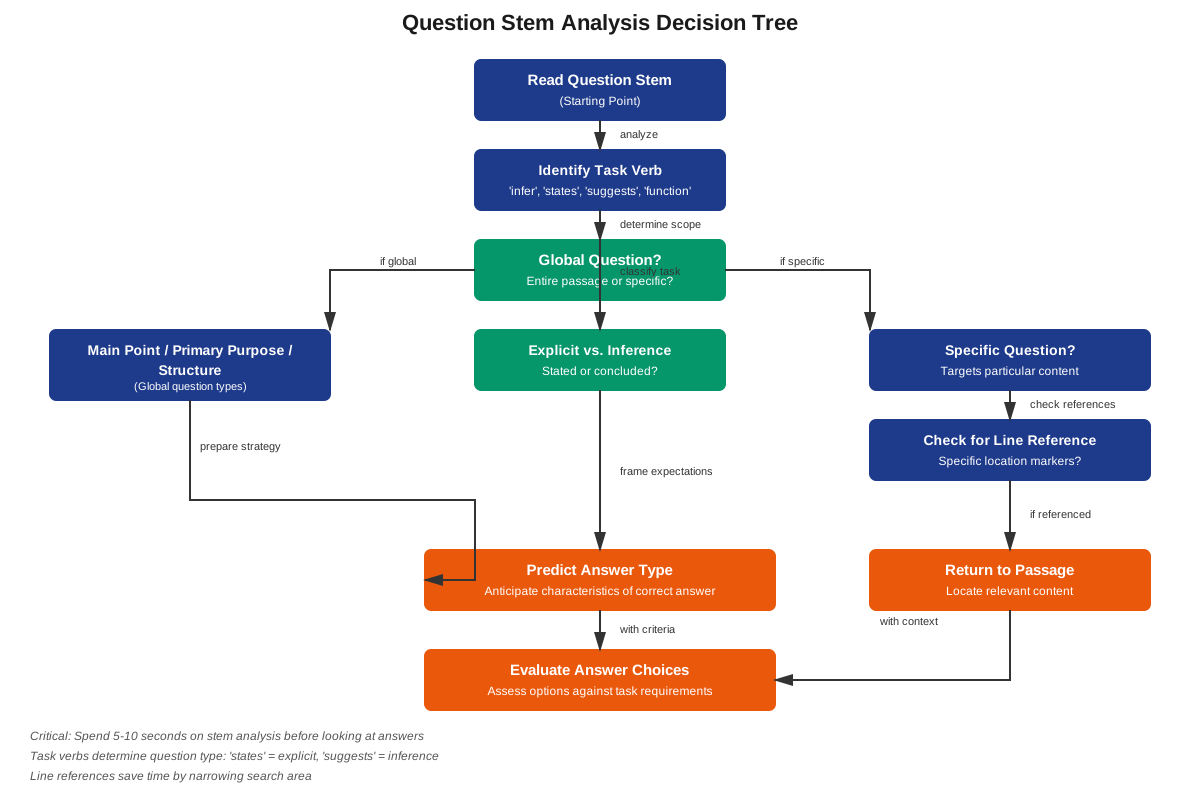
Question stem analysis in RC is the foundational skill that determines success or failure on LSAT Reading Comprehension questions. Before examining answer choices or even re-reading portions of the passage, skilled test-takers invest critical seconds analyzing the question stem to understand exactly what task the question demands. This analytical process involves identifying the question type, recognizing the scope of inquiry (global versus specific), noting any line references or content restrictions, and determining the logical relationship between the correct answer and the passage. Mastering this skill transforms Reading Comprehension from a subjective exercise in "finding what sounds right" into a systematic, predictable process.
The LSAT Reading Comprehension section presents approximately 27 questions across four passages, and every single question begins with a stem that contains precise instructions about what constitutes a correct answer. Students who skip careful stem analysis frequently select attractive wrong answers that address the wrong question—for example, choosing an answer that accurately describes passage content when the question asks for an inference, or selecting a statement the author would agree with when the question asks what the author explicitly stated. These errors cost points not because of comprehension failures but because of task identification failures.
Within the broader reading comprehension framework, question stem analysis serves as the bridge between passage comprehension and answer selection. It follows the initial passage reading and precedes the evaluation of answer choices, functioning as the strategic planning phase where test-takers determine their approach. Understanding reading comprehension question types through stem analysis enables students to activate the appropriate mental framework for each question, whether that involves recalling main ideas, making logical inferences, understanding structural relationships, or evaluating hypothetical scenarios.
Learning Objectives
- [ ] Identify how Question stem analysis in RC appears in LSAT questions
- [ ] Explain the reasoning pattern behind Question stem analysis in RC
- [ ] Apply Question stem analysis in RC to solve LSAT-style problems accurately
- [ ] Categorize question stems into their respective question types within 5 seconds
- [ ] Distinguish between stems requiring passage-based answers versus inference-based answers
- [ ] Recognize scope indicators that limit the relevant portion of the passage
- [ ] Predict the characteristics of correct answers based solely on stem analysis
Prerequisites
- Basic passage reading comprehension: Understanding main ideas, structure, and author's purpose is necessary because question stem analysis directs attention back to specific passage elements
- Familiarity with logical reasoning concepts: Many RC questions require inference-making and argument analysis skills that parallel Logical Reasoning section demands
- Understanding of passage structure: Recognizing how passages organize information (chronologically, by viewpoint, problem-solution) helps locate relevant content when stems reference specific passage functions
Why This Topic Matters
In legal practice, attorneys must identify precisely what a judge is asking before formulating responses—the same skill tested through question stem analysis. This cognitive ability to parse instructions, identify task requirements, and calibrate responses accordingly represents a core competency for legal reasoning. The LSAT tests this skill relentlessly because it predicts law school and professional success.
Statistically, lsat question stem analysis in rc impacts every single Reading Comprehension question, making it a 100% frequency topic. Approximately 35-40% of test-takers' errors on RC stem from misidentifying what the question asks rather than from comprehension failures. Students who master stem analysis typically improve their RC scores by 2-4 points within weeks because they stop selecting answers that are accurate but irrelevant to the question posed.
Common manifestations in exam passages include stems that ask for main points (testing global comprehension), specific detail questions (testing precise reading), inference questions (testing logical extension), function questions (testing structural understanding), application questions (testing principle transfer), and author agreement questions (testing viewpoint tracking). Each type demands different cognitive operations, and the stem provides the roadmap. Questions may reference specific lines ("According to lines 15-18..."), specific content ("The author's discussion of judicial precedent serves primarily to..."), or global passage elements ("Which one of the following most accurately expresses the main point..."). Recognizing these distinctions before examining answers prevents the most common error pattern: selecting answers that are true but don't answer the question asked.
Core Concepts
The Anatomy of Question Stems
Every question stem analysis in rc begins with understanding that stems contain three critical components: the task verb, the scope indicator, and the content focus. The task verb specifies the cognitive operation required—words like "infer," "suggests," "states," "primarily," "most accurately," and "according to" each demand different relationships between the correct answer and passage content. "According to the passage" requires direct textual support, while "the passage suggests" permits logical inference. "Most accurately expresses" demands precision, while "primarily serves to" asks for main purpose rather than secondary effects.
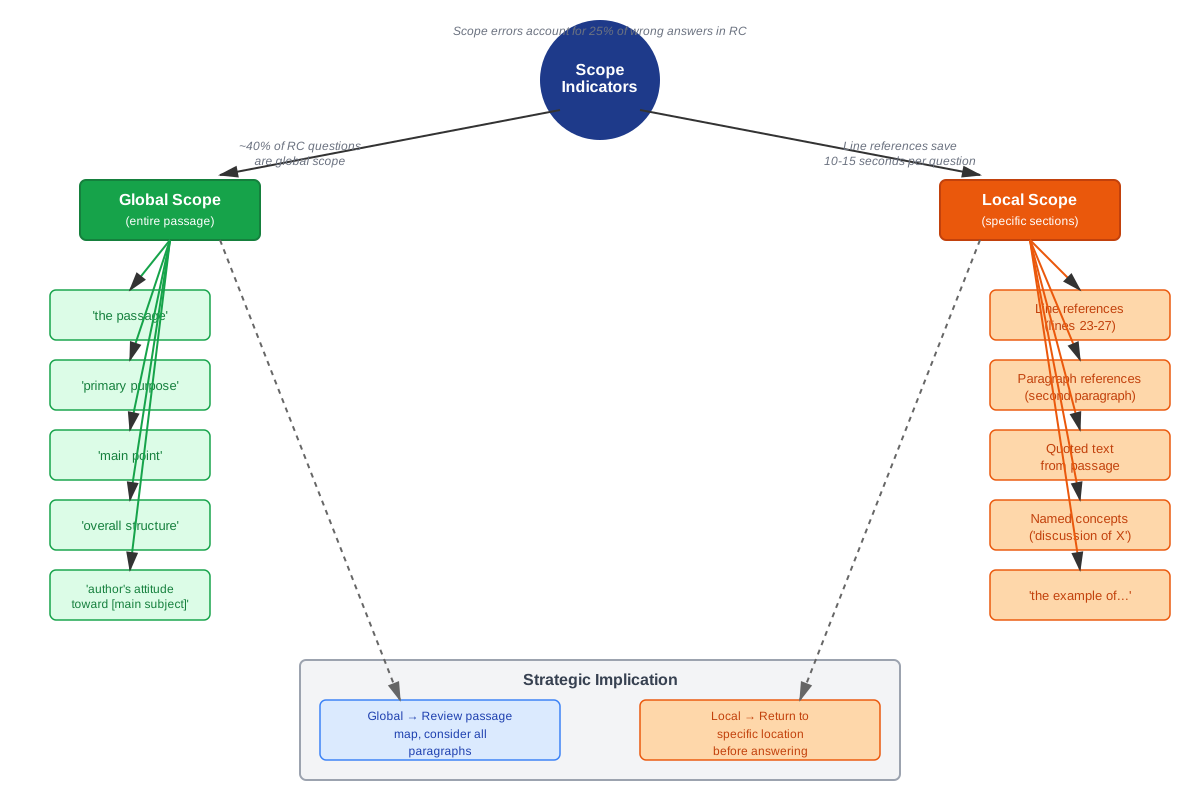
The scope indicator defines the boundaries of relevant passage content. Global scope stems use phrases like "the passage as a whole," "the main point," or "the primary purpose," signaling that correct answers must account for the entire passage rather than isolated sections. Specific scope stems reference particular lines, paragraphs, or content areas: "In lines 23-27," "the author's discussion of mitochondrial DNA," or "the second paragraph." These restrictions are not decorative—they define where to look and what to ignore.
The content focus identifies the subject matter or passage element under examination. This might reference specific concepts ("the relationship between common law and statutory law"), structural elements ("the function of the third paragraph"), rhetorical moves ("the author's attitude toward"), or logical relationships ("the author mentions X in order to"). Identifying this focus prevents the error of selecting answers about the right topic but wrong aspect.
Question Type Taxonomy
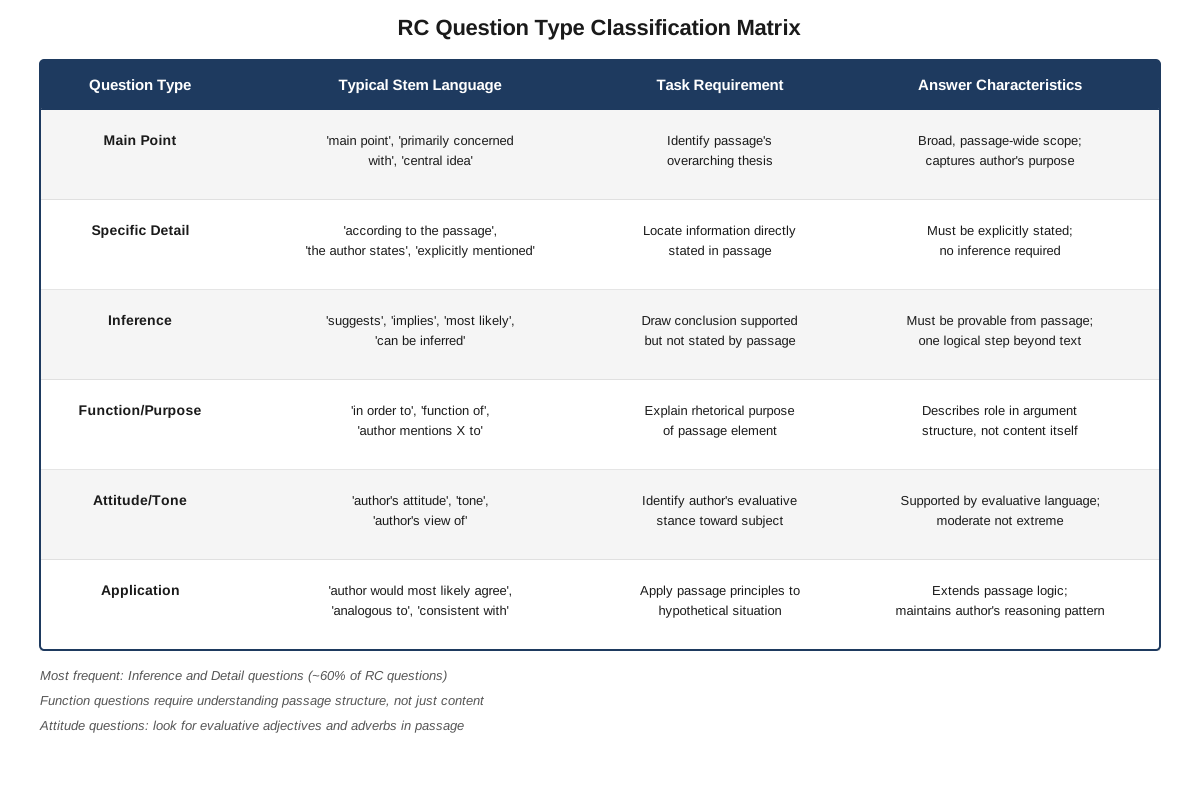
Reading comprehension question types fall into predictable categories, each identifiable through stem language patterns:
| Question Type | Stem Indicators | Task Required | Answer Characteristics |
|---|---|---|---|
| Main Point | "main point," "primarily concerned with," "central idea" | Synthesize entire passage | Broad enough to cover all paragraphs, specific enough to exclude irrelevant topics |
| Specific Detail | "according to," "the passage states," "explicitly mentioned" | Locate and paraphrase | Direct textual support, often paraphrased rather than quoted |
| Inference | "suggests," "implies," "most likely," "probably" | Extend beyond text logically | Must be supported but not stated; one logical step from passage |
| Function/Purpose | "in order to," "serves primarily to," "function of" | Identify rhetorical purpose | Describes why author included content, not what content says |
| Author Agreement | "author would agree," "consistent with author's view" | Apply author's perspective | Matches author's stated or implied viewpoint |
| Application | "most analogous," "similar to," "parallel" | Transfer principle to new context | Shares logical structure or principle with passage content |
| Tone/Attitude | "author's attitude," "tone," "regards X as" | Identify emotional/evaluative stance | Matches degree and direction of author's judgment |
Scope Recognition Strategies
Distinguishing between global and local scope represents perhaps the most critical stem analysis skill. Global questions require answers that account for the passage's overall message, structure, or purpose. Stems containing "passage as a whole," "primary purpose," "main point," or "overall structure" demand this comprehensive view. Students must resist selecting answers that accurately describe important passage components but fail to capture the complete picture. For instance, if a passage discusses three theories of judicial interpretation with the author ultimately advocating for one, the main point isn't merely that the author favors that theory—it's that the author evaluates multiple approaches before advocating for one.
Local questions restrict attention to specific passage segments. Line references ("lines 12-15") provide explicit boundaries. Paragraph references ("the second paragraph") limit scope to that structural unit. Content-specific references ("the author's discussion of precedent") focus on wherever that topic appears. When stems specify scope, information outside those boundaries is irrelevant—even if true and even if important to the passage overall. This restriction is a feature, not a bug: it tests whether students can isolate and analyze specific passage functions without contamination from other content.
Task Verb Precision
The difference between "states," "suggests," and "implies" is not stylistic variation—these verbs specify different evidentiary standards. "States," "explicitly mentions," "according to," and "identifies" require direct textual support. The correct answer must be a paraphrase of actual passage content, not an inference from it. Students should be able to point to specific sentences that say essentially what the answer choice says.
"Suggests," "implies," "indicates," and "supports" permit inference—logical conclusions that follow from passage content without being explicitly stated. The correct answer must be provable from passage information but represents a step beyond what the text directly says. This is precisely one inferential step, not multiple leaps of speculation.
"Primarily," "mainly," and "most" introduce comparative judgments. When a stem asks what a paragraph "primarily" does, multiple answer choices might describe things the paragraph does, but only one captures the main function. These stems test the ability to distinguish primary from secondary purposes, major from minor points.
Content Focus Identification
Beyond task and scope, stems specify what aspect of passage content to address. Structural questions ask about how passages organize information or what function specific elements serve: "The author mentions X in order to," "The third paragraph serves primarily to," "The passage is structured to." These questions test understanding of rhetorical architecture rather than content accuracy.
Viewpoint questions focus on author attitudes, agreements, or perspectives: "The author regards X as," "The author would most likely agree with," "The tone of the passage is best described as." These require tracking the author's voice separately from other viewpoints presented in the passage—a critical distinction in passages presenting multiple perspectives.
Relationship questions examine connections between passage elements: "The relationship between X and Y is most analogous to," "The author's discussion of X relates to Y by." These test understanding of how ideas connect rather than what the ideas are.
Concept Relationships
Question stem analysis functions as the central hub connecting all Reading Comprehension skills. The process begins with passage reading and annotation (prerequisite knowledge), which creates the mental map that stem analysis will reference. When a stem specifies "lines 15-20," effective annotation enables quick location and context retrieval.
Stem analysis directly determines answer choice evaluation strategy. Once the question type is identified, the test-taker knows what to look for: main point questions require checking each answer against all paragraphs; inference questions require finding passage support for each answer; function questions require identifying purpose rather than content. This creates a clear pathway: Passage Comprehension → Stem Analysis → Answer Evaluation Strategy → Correct Answer Selection.
Within stem analysis itself, the three components work hierarchically: Task Verb (what cognitive operation) → Scope (where to look) → Content Focus (what to look for). Identifying the task verb first prevents wasted effort—there's no point locating relevant passage content if you don't know what question you're answering. Scope identification second prevents considering irrelevant information. Content focus last directs attention to the specific aspect under examination.
The relationship between stem analysis and question type mastery is bidirectional. Analyzing stems teaches question type patterns, while knowing question types accelerates stem analysis. After analyzing hundreds of stems, students recognize patterns instantly: "most analogous to" always signals application questions; "primarily in order to" always signals function questions; "according to the passage" always signals specific detail questions.
Quick check — test yourself on Question stem analysis in RC so far.
Try Flashcards →High-Yield Facts
⭐ Every LSAT RC question stem contains three elements: task verb, scope indicator, and content focus—identifying all three before reading answers prevents 60-70% of common errors
⭐ "According to," "states," and "explicitly" require direct textual support; "suggests," "implies," and "indicates" permit one logical inference beyond the text
⭐ Global scope stems ("main point," "primary purpose," "passage as a whole") require answers that account for the entire passage, not just important parts
⭐ "Primarily" and "mainly" indicate that multiple answers may be partially correct, but only one captures the main purpose or most important function
⭐ Line references and paragraph citations restrict the scope of relevant information—content outside these boundaries is irrelevant regardless of accuracy
- Function questions ("in order to," "serves to") ask why the author included content, not what the content says
- Author agreement questions require matching the author's specific viewpoint, not general passage content or other perspectives presented
- "Most analogous" and "most similar" questions require identifying structural or logical parallels, not topical similarities
- Tone and attitude questions demand precise calibration—"cautiously optimistic" differs significantly from "enthusiastic"
- Inference questions require answers that must be true based on passage content, not answers that could be true or are likely true
- Application questions test whether students can transfer passage principles to new contexts while preserving logical structure
- "EXCEPT" and "LEAST" questions reverse the task—four answers will fit the stem's criteria, one will not
Common Misconceptions
Misconception: All question stems are asking essentially the same thing—what the passage says.
Correction: Question stems specify fundamentally different cognitive tasks. "What does the passage state?" requires locating information; "What does the passage suggest?" requires making inferences; "Why does the author mention X?" requires identifying rhetorical purpose. These are distinct operations requiring different approaches and yielding different correct answers.
Misconception: If an answer choice is true according to the passage, it's correct.
Correction: An answer must be both true and responsive to the specific question asked. A statement might accurately describe passage content but still be wrong if the question asks for the main point and the statement describes a supporting detail, or if the question asks what the passage states and the statement makes an inference.
Misconception: Line references are suggestions about where to look, not strict boundaries.
Correction: When a stem specifies "according to lines 15-20," information from lines 21-30 is out of scope even if highly relevant to the topic. Line references define strict boundaries testing whether students can isolate and analyze specific passage segments.
Misconception: "Primarily" and "mainly" are just emphasis words without changing the question's meaning.
Correction: These qualifiers fundamentally alter the task by introducing comparative judgment. Without "primarily," a question might have multiple correct answers; with it, students must identify which among several true statements is most important or most central.
Misconception: The difference between "suggests" and "implies" is insignificant stylistic variation.
Correction: While these terms are closely related and both permit inference, LSAT usage treats them as requiring the same evidentiary standard—one logical step beyond explicit text. The key distinction is between these inference-permitting verbs and direct-support verbs like "states" or "according to."
Misconception: Global questions can be answered by finding the most important paragraph and selecting an answer that describes it.
Correction: Global questions require answers that account for the entire passage structure and content. Even if one paragraph contains the author's main argument, the correct answer must acknowledge how other paragraphs contribute—providing background, presenting counterarguments, offering evidence, etc.
Worked Examples
Example 1: Distinguishing Task Verbs
Question Stem: "The passage suggests which one of the following about the relationship between statutory interpretation and judicial precedent?"
Analysis Process:
- Identify task verb: "suggests" — this permits inference, meaning the answer doesn't need to be explicitly stated but must be logically supportable from passage content
- Identify scope: No line reference or paragraph citation, but content-specific focus on "relationship between statutory interpretation and judicial precedent" — must search entire passage for relevant information about both concepts and their connection
- Identify content focus: Not asking what the passage says about either concept individually, but specifically about their relationship — the correct answer must address how they connect or interact
- Determine answer characteristics: The correct answer will:
- Describe a relationship between the two concepts
- Be supported by passage content but not necessarily stated directly
- Require synthesizing information that may appear in different passage locations
- Go one logical step beyond what the text explicitly says
- Approach strategy: Locate all passage references to both statutory interpretation and judicial precedent; identify what the passage says about each; determine what relationship the passage content logically supports even if not explicitly stated
Application: If the passage states that courts use precedent when statutes are ambiguous and that statutory language sometimes requires interpretation, the passage "suggests" (though doesn't state) that precedent plays a role in statutory interpretation—this is one logical step from the explicit content.
Example 2: Scope Recognition
Question Stem: "The author's discussion of mitochondrial DNA in lines 34-42 serves primarily to"
Analysis Process:
- Identify task verb: "serves primarily to" — this is a function question asking about rhetorical purpose, not content. Must identify why the author included this discussion, not what the discussion says
- Identify scope: Highly restricted—"lines 34-42" creates strict boundaries. Information about mitochondrial DNA appearing elsewhere in the passage is irrelevant. Must focus exclusively on this specific segment
- Identify content focus: "discussion of mitochondrial DNA" — but remember the task is identifying function, so must determine what role this discussion plays in the passage's overall argument or structure
- Determine answer characteristics: The correct answer will:
- Describe a rhetorical function (provide evidence, illustrate a concept, present a counterexample, introduce a complication, etc.)
- Account for why this specific discussion appears at this specific location
- Connect to the passage's broader argument or structure
- Use function language ("illustrate," "support," "challenge," "introduce") rather than content language
- Approach strategy: Read lines 34-42 while asking "Why is the author telling me this right now?" Consider what came before (what claim or idea needs support/illustration?) and what comes after (does this set up a subsequent point?). Identify the discussion's role in the passage architecture.
Application: If lines 34-42 describe how mitochondrial DNA testing resolved a disputed identification, and this appears in a passage arguing that scientific advances have transformed forensic investigation, the discussion "serves primarily to" provide a concrete example supporting the broader claim about scientific transformation—this is its function regardless of what specific content it contains.
Exam Strategy
Allocate 5-10 seconds per question stem for careful analysis before examining answer choices. This investment prevents the costly error of evaluating five answer choices against the wrong criteria. Students who rush to answers save 5 seconds but often spend 30+ seconds confused about why multiple answers seem correct—they're answering different questions than the stem asks.
Trigger word recognition accelerates stem analysis. Create mental categories:
- Direct support triggers: "according to," "states," "explicitly," "identifies," "mentions" → Must find textual evidence
- Inference triggers: "suggests," "implies," "indicates," "most likely," "probably" → One logical step permitted
- Function triggers: "in order to," "serves to," "functions to," "purpose of" → Identify why, not what
- Global triggers: "main point," "primary purpose," "passage as a whole," "overall" → Must account for entire passage
- Comparative triggers: "primarily," "mainly," "most," "best" → Multiple answers may be partially correct
Process of elimination becomes more powerful after stem analysis. For main point questions, eliminate answers that are too narrow (describe only one paragraph) or too broad (include topics not discussed). For inference questions, eliminate answers requiring multiple inferential leaps or contradicting passage content. For function questions, eliminate answers that describe content rather than purpose.
Time allocation: Spend more time on stem analysis for function and application questions (these are conceptually complex) and less on specific detail questions with line references (these are straightforward location tasks). If a stem confuses you, rephrase it in your own words: "What is this question really asking me to do?"
Common trap patterns: LSAT wrong answers often correctly answer a different question than the stem asks. After eliminating clearly wrong answers, check remaining choices against the stem: "Does this answer the question asked, or a different question?" An answer describing what the passage says is wrong if the question asks what the passage suggests. An answer describing passage content is wrong if the question asks about function.
Memory Techniques
S.T.A.R. Analysis for every stem:
- Scope: Global or local? Entire passage or specific section?
- Task: What cognitive operation? Direct support, inference, function, application?
- Aspect: What passage element? Content, structure, viewpoint, relationship?
- Requirement: What makes an answer correct for this specific question type?
The Function Question Mantra: "Not what it says, but why it's there" — repeat this when encountering "in order to" or "serves to" stems to avoid the common error of selecting answers that accurately describe content rather than identifying purpose.
Inference Boundary Rule: "One step, not a leap" — correct inference answers are exactly one logical step from passage content. If you need to make multiple assumptions or chain several inferences, you've gone too far.
Scope Visualization: Picture a spotlight. Global questions illuminate the entire passage stage; local questions spotlight specific sections. Information outside the spotlight is in darkness—irrelevant regardless of importance.
Task Verb Hierarchy:
- Tier 1 (Direct): states, according to, explicitly, mentions
- Tier 2 (Inference): suggests, implies, indicates, supports
- Tier 3 (Function): serves to, in order to, functions to
- Tier 4 (Application): analogous to, similar to, parallel
Summary
Question stem analysis in RC represents the critical bridge between passage comprehension and answer selection, transforming Reading Comprehension from subjective interpretation into systematic task execution. Every stem contains three essential components—task verb, scope indicator, and content focus—that together specify exactly what constitutes a correct answer. Mastering stem analysis means recognizing that "according to" demands different evidence than "suggests," that line references create strict boundaries, that "primarily" introduces comparative judgment, and that function questions ask why rather than what. The LSAT tests whether students can identify precisely what each question asks before evaluating answers, because this skill mirrors the legal reasoning ability to parse instructions and calibrate responses accordingly. Students who invest seconds in careful stem analysis before examining answer choices avoid the most common error pattern: selecting answers that are accurate but irrelevant to the question posed. This skill impacts every single Reading Comprehension question, making it the highest-yield topic in the entire section.
Key Takeaways
- Question stem analysis must identify three elements before examining answers: task verb (what operation), scope (where to look), and content focus (what aspect)
- Task verbs specify different evidentiary standards: "states/according to" requires direct textual support; "suggests/implies" permits one logical inference
- Scope indicators create strict boundaries—global stems require answers accounting for the entire passage; line references restrict relevant information to specified segments
- Function questions ("in order to," "serves to") ask why the author included content, not what the content says—this distinction eliminates most wrong answers
- "Primarily" and "mainly" introduce comparative judgment, meaning multiple answers may be partially correct but only one captures the main purpose
- Investing 5-10 seconds in stem analysis prevents the costly error of evaluating answer choices against wrong criteria
- The most common RC error is selecting answers that are true but don't answer the question asked—stem analysis prevents this by clarifying the task before considering options
Related Topics
Answer Choice Evaluation Strategies: After identifying what the question asks through stem analysis, students must systematically evaluate whether each answer choice fulfills those criteria—this includes recognizing common wrong answer patterns like scope shifts, degree errors, and reversed relationships.
Passage Structure and Organization: Understanding how passages organize information (chronologically, by viewpoint, problem-solution, theory-evaluation) enables quick location of relevant content when stems reference specific passage functions or elements.
Inference Question Techniques: Since inference questions represent approximately 25-30% of RC questions, mastering the specific skills for making valid single-step inferences while avoiding speculation becomes essential after learning to identify inference stems.
Comparative Reading Strategies: The fourth passage in each RC section presents two related shorter passages, requiring stem analysis skills that account for which passage (A, B, or both) the question addresses—an additional scope consideration.
Practice CTA
Now that you understand how to systematically analyze question stems, you're ready to apply these skills to actual LSAT passages. The practice questions and flashcards will reinforce your ability to quickly identify task verbs, recognize scope restrictions, and determine content focus—transforming these analytical steps into automatic habits. Each practice question you analyze strengthens the neural pathways that enable instant stem categorization during timed conditions. Remember: every point you gain in Reading Comprehension comes from answering questions correctly, and answering questions correctly begins with understanding exactly what each question asks. Your investment in mastering stem analysis will yield returns on every single RC question you encounter.
Sign up free to keep reading
Create a free AnvayaPrep account to finish this LSAT guide on Question stem analysis in RC — plus flashcards and practice questions.