Overview
Role of a sentence questions represent a critical category within LSAT reading comprehension that tests a student's ability to analyze the structural and rhetorical function of specific textual elements within a passage. Unlike questions that ask about content or main ideas, these questions require examinees to step back and evaluate why an author included a particular sentence—what purpose it serves in the broader argumentative or explanatory framework. This question type demands both micro-level comprehension of individual sentences and macro-level understanding of passage architecture.
These questions are essential for LSAT success because they assess analytical reading skills that law schools value highly: the ability to dissect arguments, recognize rhetorical strategies, and understand how individual components contribute to a larger persuasive or informative structure. Students who master role of a sentence questions demonstrate they can read not just for information, but for structure and strategy—skills fundamental to legal analysis where understanding the function of precedents, statutory language, and argumentative moves is paramount.
Within the broader landscape of reading comprehension question types, role of a sentence questions occupy a unique position. They bridge content-focused questions (which ask "what does the passage say?") and structure-focused questions (which ask "how is the passage organized?"). Mastering this question type strengthens performance across multiple question categories, as it develops the meta-cognitive awareness necessary for efficient, strategic reading under time pressure.
Learning Objectives
- [ ] Identify how Role of a sentence questions appears in LSAT questions
- [ ] Explain the reasoning pattern behind Role of a sentence questions
- [ ] Apply Role of a sentence questions to solve LSAT-style problems accurately
- [ ] Distinguish between content-based and function-based answer choices in role questions
- [ ] Analyze the relationship between a referenced sentence and surrounding textual elements
- [ ] Evaluate answer choices by matching structural language to passage architecture
- [ ] Predict the likely function of a sentence before reviewing answer choices
Prerequisites
- Basic passage comprehension skills: Understanding literal meaning is necessary before analyzing structural function
- Familiarity with argument structure: Recognizing premises, conclusions, and supporting evidence helps identify sentence roles
- Knowledge of common rhetorical patterns: Understanding comparison, contrast, exemplification, and qualification aids in function identification
- Ability to identify main ideas and author's purpose: Sentence function must be evaluated relative to the passage's overall goal
Why This Topic Matters
Role of a sentence questions appear with significant frequency on the LSAT, typically comprising 10-15% of all reading comprehension questions. Each reading comprehension section contains approximately 27 questions across four passages, meaning students can expect to encounter 2-4 role of a sentence questions per test section. Given that reading comprehension constitutes roughly one-third of the scored LSAT, mastering this question type directly impacts overall performance and percentile ranking.
In legal practice, attorneys constantly evaluate the function of textual elements—determining whether a case citation serves as binding precedent or mere illustration, whether statutory language creates an exception or establishes a general rule, whether a contractual clause modifies or reinforces other provisions. Role of a sentence questions directly assess this analytical skill, making them among the most practically relevant question types for predicting law school success.
These questions commonly appear in passages discussing complex arguments, scientific explanations, or historical analyses where authors employ sophisticated rhetorical strategies. They frequently reference sentences that introduce qualifications, provide examples, acknowledge counterarguments, establish context, or transition between ideas. The LSAT uses these questions to identify students who read actively and strategically rather than passively absorbing information.
Core Concepts
Defining Role of a Sentence Questions
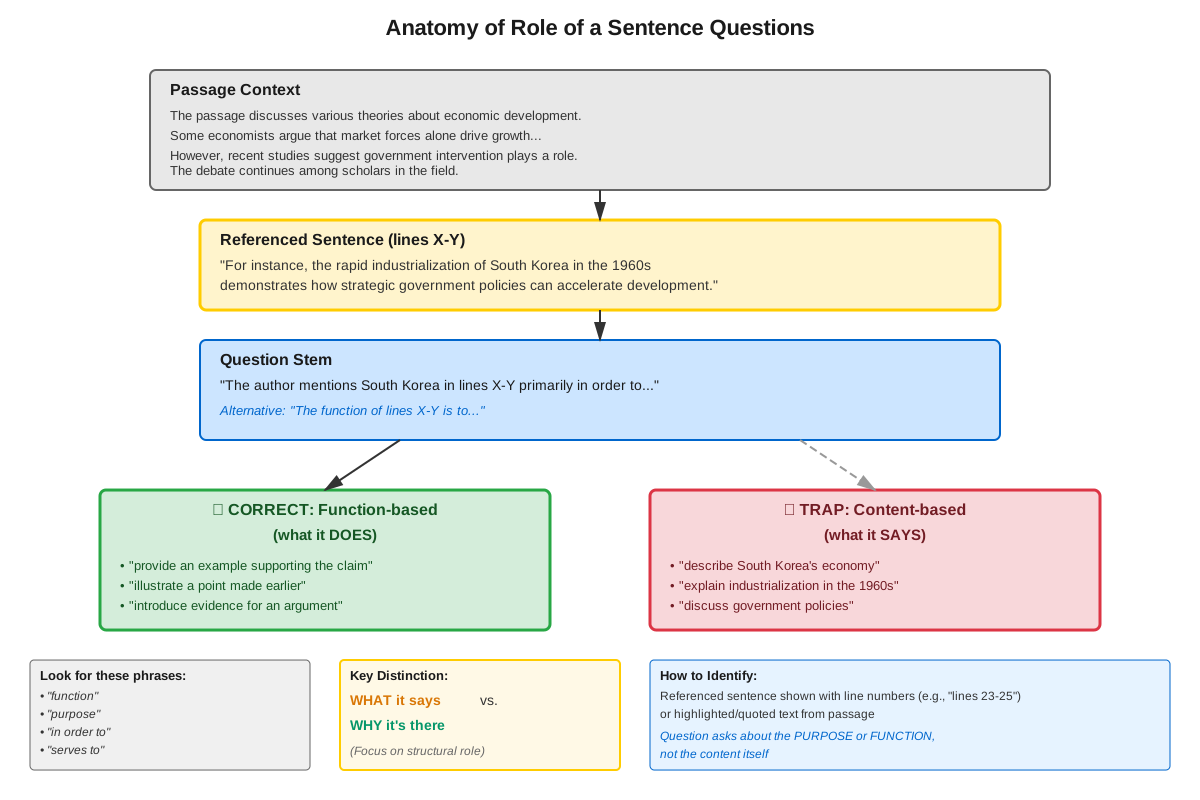
LSAT role of a sentence questions ask test-takers to identify the function or purpose of a specific sentence or textual element within a passage. These questions are distinguished by their focus on why something appears rather than what it says. The question stem typically includes phrases like "serves primarily to," "functions in the passage to," "the author mentions X in order to," or "the primary purpose of the reference to X is to."
The key distinction lies between content and function. While a sentence might state that "some researchers disagree with the dominant theory," its function might be to acknowledge a counterargument before refuting it, to demonstrate the controversial nature of the topic, or to introduce an alternative perspective the author will later support. Role questions test whether students can make this crucial analytical leap.
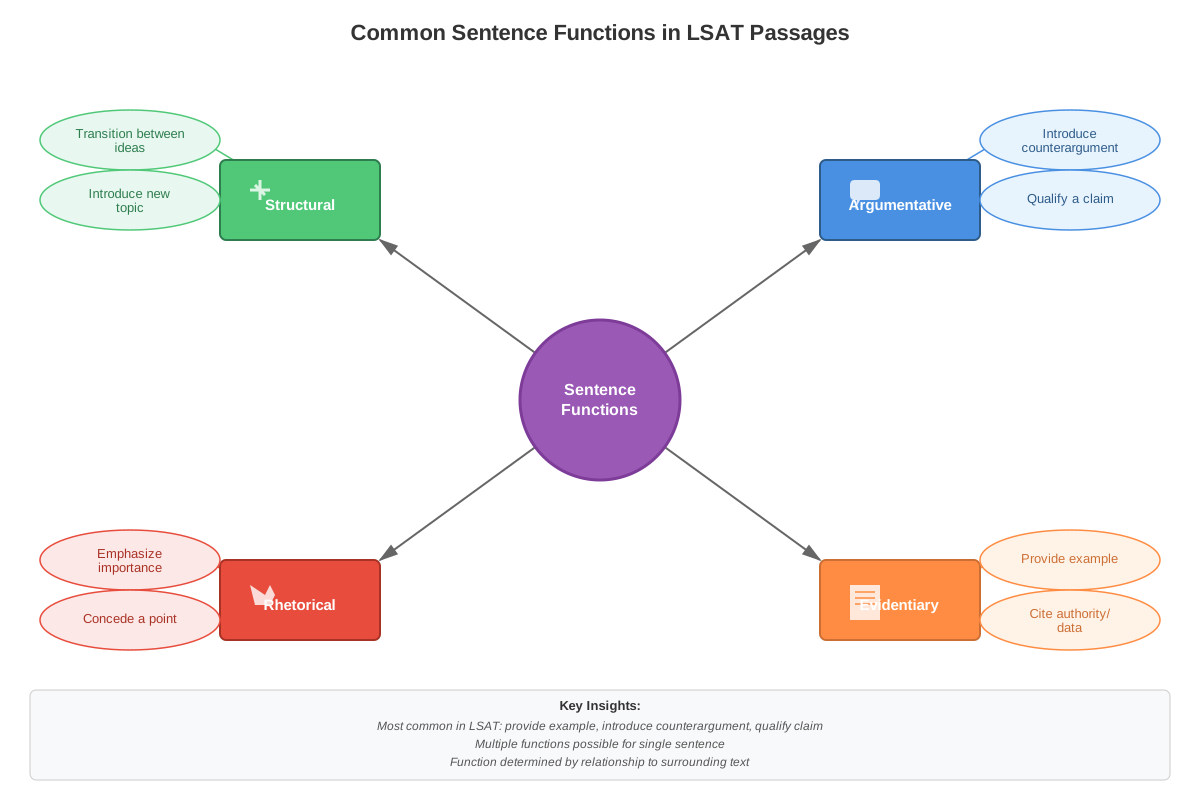
Common Sentence Functions
Understanding the typical roles sentences play in LSAT passages provides a framework for efficient analysis. The following table outlines the most frequently tested functions:
| Function | Description | Typical Indicators |
|---|---|---|
| Provide an example | Illustrates a general principle with a specific instance | "For instance," "such as," specific names/cases |
| Introduce a qualification | Limits or refines a previous claim | "However," "although," "except," "only when" |
| Acknowledge a counterargument | Presents an opposing view | "Critics argue," "some believe," "it might seem" |
| Establish context | Provides background necessary for understanding | Opening sentences, historical information |
| State the main claim | Articulates the author's primary thesis | Strong declarative statements, often early or late |
| Support a claim | Offers evidence or reasoning for a position | "Because," "since," data, studies, logical reasoning |
| Introduce a contrast | Highlights differences between ideas | "In contrast," "unlike," "whereas" |
| Transition between topics | Bridges different sections of the passage | "Turning to," "another consideration," "beyond" |
| Summarize or conclude | Recaps main points or draws final implications | "Thus," "therefore," "in sum," final paragraph |
The Analytical Framework for Role Questions
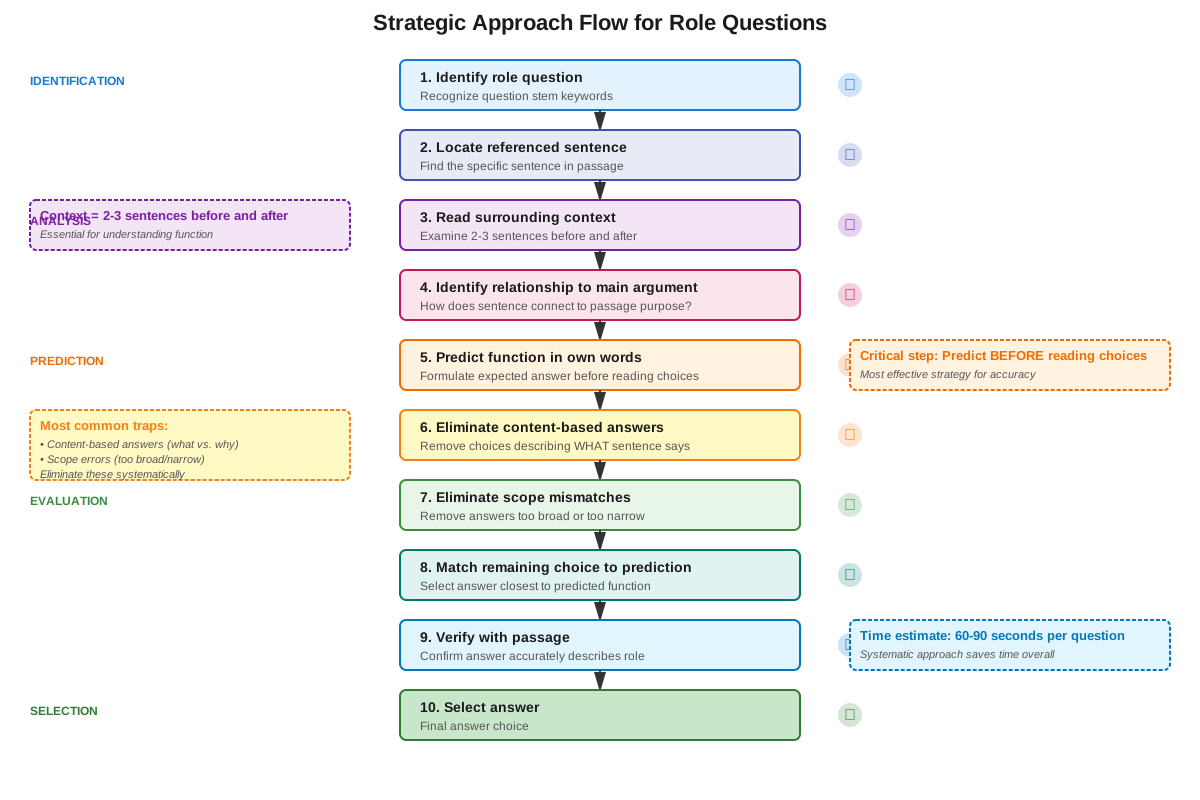
Approaching role of a sentence questions requires a systematic process:
- Locate the referenced sentence: Find the exact sentence or textual element mentioned in the question stem
- Read surrounding context: Examine 1-2 sentences before and after to understand the local argumentative flow
- Identify the sentence's content: Determine what the sentence literally says
- Analyze the sentence's function: Ask "Why did the author include this here? What does it accomplish?"
- Consider the passage structure: Relate the sentence to the paragraph's purpose and the passage's overall argument
- Predict the answer: Formulate your own description of the function before reviewing choices
- Evaluate answer choices: Match your prediction against options, eliminating those that describe content rather than function
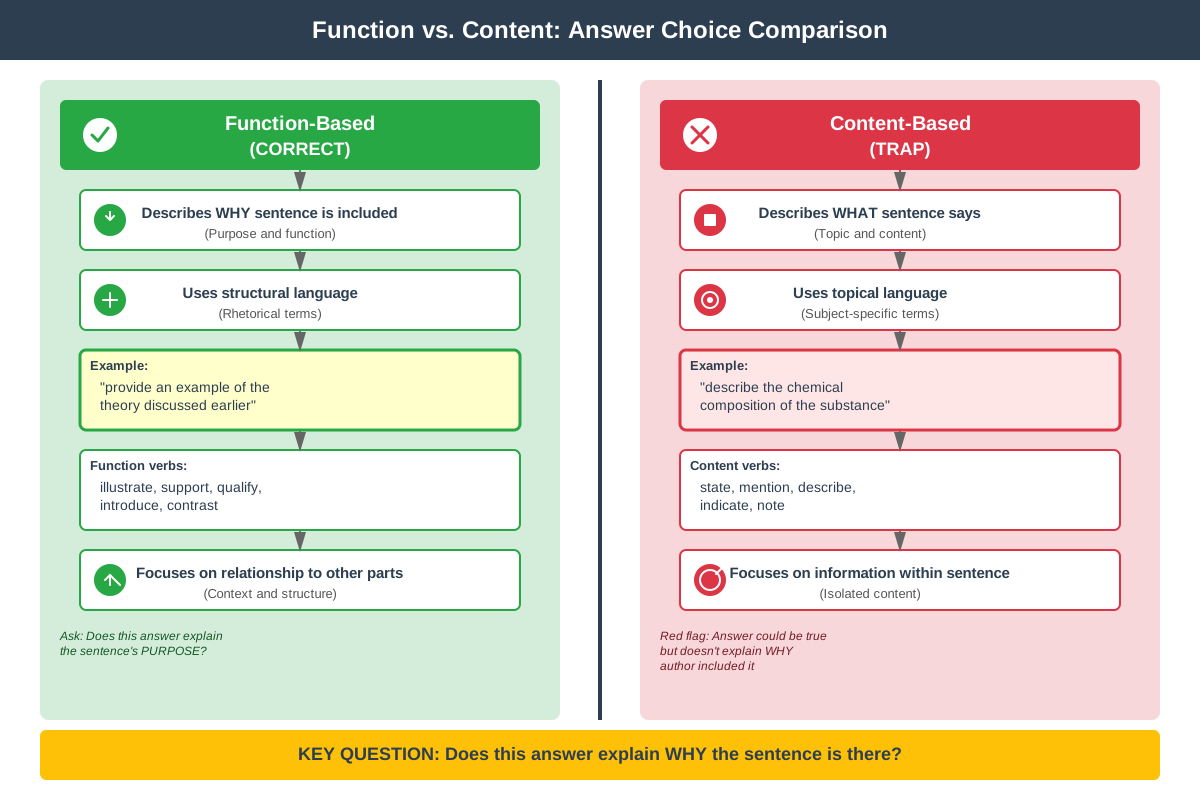
Content vs. Function: The Critical Distinction
The most common error in role questions stems from confusing what a sentence says with what it does. Consider this example:
Sentence: "The 1960s saw a dramatic increase in urban migration."
Content description (incorrect for role questions): "States that urban migration increased in the 1960s"
Function descriptions (potentially correct, depending on context):
- "Provides historical context for the demographic changes discussed later"
- "Establishes the timeframe for the phenomenon under analysis"
- "Introduces a trend that the author will explain through economic factors"
- "Offers evidence supporting the claim that industrialization affected population distribution"
Notice that function descriptions focus on the sentence's purpose within the argumentative structure, while content descriptions merely restate information. LSAT answer choices exploit this distinction, offering tempting wrong answers that accurately describe content but fail to identify function.
Relationship to Passage Architecture
Role of a sentence questions inherently test understanding of passage structure. Every sentence exists within multiple nested contexts:
- Immediate context: The surrounding sentences in the same paragraph
- Paragraph context: The paragraph's specific purpose within the passage
- Passage context: The overall argument, thesis, or explanatory goal
A sentence might serve one function locally (providing an example within a paragraph) while simultaneously serving a broader function globally (supporting the passage's main argument). Strong answers typically capture the most significant function relative to the question's scope.
Rhetorical Strategies and Sentence Function
Authors employ various rhetorical strategies that create predictable sentence functions:
Concession and refutation: Authors often acknowledge opposing views before refuting them. Sentences introducing counterarguments function to demonstrate fairness, establish credibility, or set up a rebuttal.
Exemplification: General claims require concrete illustration. Example sentences function to clarify abstract concepts, make arguments more persuasive, or demonstrate the scope of a phenomenon.
Qualification: Absolute claims invite criticism, so authors add nuance. Qualifying sentences function to limit scope, acknowledge exceptions, or prevent misinterpretation.
Elaboration: Complex ideas need unpacking. Elaborating sentences function to explain mechanisms, provide detail, or ensure reader comprehension.
Concept Relationships
The concepts within role of a sentence questions form an interconnected analytical framework. Understanding common sentence functions provides the vocabulary for describing what you observe when applying the analytical framework. The framework itself depends on maintaining the content vs. function distinction, which prevents the most common errors. All of these concepts operate within the context of passage architecture, as sentence function cannot be determined in isolation from structural context.
This topic connects directly to prerequisite knowledge of argument structure—recognizing premises and conclusions enables identification of supporting and concluding sentence functions. It also relates to main idea questions, as understanding a passage's overall purpose helps determine how individual sentences contribute to that purpose. Furthermore, role questions connect to inference questions, since identifying function often requires inferring authorial intent not explicitly stated.
The relationship map flows as follows:
Passage Architecture → provides context for → Individual Sentence → analyzed through → Content vs. Function Distinction → categorized using → Common Sentence Functions → identified via → Analytical Framework → produces → Accurate Answer Selection
Quick check — test yourself on Role of a sentence questions so far.
Try Flashcards →High-Yield Facts
⭐ Role of a sentence questions ask about function (why/purpose) rather than content (what/information)
⭐ The most common wrong answers accurately describe content but fail to identify function
⭐ Context is essential—read 1-2 sentences before and after the referenced sentence
⭐ Question stems typically include "serves to," "functions to," "in order to," or "primary purpose"
⭐ Predicting the answer before reviewing choices significantly improves accuracy
- Role questions typically appear 2-4 times per reading comprehension section
- The referenced sentence often appears in the middle of a paragraph rather than at the beginning or end
- Correct answers frequently use structural language like "introduce," "qualify," "illustrate," "support," or "contrast"
- Wrong answers often use language that's too broad or too narrow relative to the sentence's actual scope
- Sentences that acknowledge counterarguments often function to establish credibility or set up refutation
- Example sentences typically function to illustrate, clarify, or support a general claim
- Transitional sentences function to connect ideas, shift focus, or introduce new considerations
- The same sentence can serve multiple functions, but correct answers identify the primary or most significant function
- Understanding the paragraph's purpose helps predict individual sentence functions within that paragraph
Common Misconceptions
Misconception: Role questions are just asking what the sentence says in different words.
Correction: Role questions ask about structural function and purpose, not content. An answer that merely paraphrases the sentence's content is almost always incorrect, even if accurate.
Misconception: The correct answer must use language that appears in the passage.
Correction: Correct answers typically use structural or functional language (like "qualify," "illustrate," "support") that may not appear anywhere in the passage. The answer describes the sentence's role, not its content.
Misconception: You can answer role questions by reading only the referenced sentence.
Correction: Context is essential. The function of a sentence depends on what comes before and after it, the paragraph's purpose, and the passage's overall argument. Always read surrounding sentences.
Misconception: If a sentence provides an example, the answer must say "provides an example."
Correction: While this might be correct, the answer might instead describe why the example was provided—to support a claim, to clarify a concept, to demonstrate scope, etc. Focus on the most significant function.
Misconception: Longer, more detailed answer choices are more likely to be correct.
Correction: LSAT answer choices vary in length for strategic reasons. Correct answers are often concise and precise, while wrong answers may be lengthy but inaccurate. Evaluate based on accuracy, not length.
Misconception: The sentence's function is whatever the author explicitly states it is.
Correction: Authors rarely explicitly state "I'm now providing an example to illustrate my point." Function must be inferred from context, structure, and rhetorical patterns.
Worked Examples
Example 1: Qualifying Function
Passage excerpt:
"The traditional view holds that medieval guilds functioned primarily to restrict competition and maintain monopolistic control over trades. This interpretation, supported by economic historians throughout the twentieth century, emphasizes the exclusionary practices and price-fixing arrangements documented in guild records. However, recent scholarship has revealed that guilds also played crucial roles in quality control, skills training, and social welfare provision. While the competitive restrictions certainly existed, they may have been secondary to these other functions."
Question: The statement that "competitive restrictions certainly existed" (final sentence) serves primarily to:
Analysis:
- Locate: The phrase appears in the final sentence
- Context: The paragraph presents a traditional view, then introduces "recent scholarship" offering an alternative interpretation
- Content: The sentence acknowledges that competitive restrictions occurred
- Function: This is a concession—the author acknowledges a point supporting the traditional view while arguing for a different primary interpretation
- Prediction: The sentence functions to acknowledge the validity of the traditional view while maintaining that it misidentifies the primary function
Correct Answer: "Acknowledge an element of the traditional interpretation while maintaining that it mischaracterizes the primary purpose of guilds"
Why it's correct: This captures the qualifying function—the author concedes a point to the opposing view ("competitive restrictions certainly existed") while limiting its significance ("may have been secondary"). The sentence prevents critics from dismissing the new interpretation as ignoring documented evidence.
Common wrong answer: "State that medieval guilds engaged in competitive restrictions"
Why it's wrong: This describes the content (what the sentence says) rather than the function (why the author included it). While accurate as a content description, it fails to capture the sentence's role in the argumentative structure.
Example 2: Exemplification Function
Passage excerpt:
"Biomimicry—the practice of learning from and mimicking natural strategies to solve human design problems—has produced numerous technological innovations. The development of Velcro, inspired by burrs clinging to fabric, demonstrates how observation of natural mechanisms can lead to practical applications. Similarly, the design of Japan's bullet trains incorporated principles derived from the kingfisher's beak shape to reduce noise and increase efficiency. These examples illustrate biomimicry's potential to address engineering challenges through biological insights."
Question: The author's reference to Velcro and bullet trains serves primarily to:
Analysis:
- Locate: Second and third sentences provide specific examples
- Context: First sentence defines biomimicry and makes a general claim about its productivity; final sentence draws a conclusion
- Content: The sentences describe two specific biomimicry applications
- Function: These are concrete examples supporting the general claim that biomimicry has "produced numerous technological innovations"
- Prediction: The examples function to illustrate and support the opening claim with concrete instances
Correct Answer: "Provide specific instances that support the claim that biomimicry has generated technological innovations"
Why it's correct: This accurately identifies the exemplification function—moving from general claim to specific supporting examples. The answer uses functional language ("provide instances," "support the claim") rather than merely describing content.
Common wrong answer: "Describe two technologies that were inspired by natural mechanisms"
Why it's wrong: While this accurately describes what the sentences say, it fails to identify their function within the passage structure. It's a content description rather than a functional analysis.
Another wrong answer: "Demonstrate that biomimicry is the most effective approach to engineering challenges"
Why it's wrong: This overstates the function. The examples support the claim that biomimicry "has produced" innovations, not that it's "the most effective approach." This answer goes beyond what the examples actually accomplish in the argumentative structure.
Exam Strategy
Identifying Role Questions
Role questions are identifiable by specific trigger phrases in the question stem:
- "serves primarily to"
- "functions in the passage to"
- "the author mentions X in order to"
- "the primary purpose of the reference to X is to"
- "the author discusses X primarily to"
- "X is used by the author to"
Exam Tip: When you see these phrases, immediately shift your analytical focus from content to function. Ask "Why is this here?" rather than "What does this say?"
The Pre-Phrase Strategy
Before reviewing answer choices, formulate your own description of the sentence's function. This prevents the LSAT from manipulating your thinking through cleverly worded wrong answers. Your pre-phrase should:
- Use functional language (illustrate, support, qualify, contrast, introduce, etc.)
- Connect the sentence to surrounding context
- Identify the primary function if multiple functions exist
Process of Elimination Tactics
Eliminate content descriptions: Any answer that merely restates what the sentence says without identifying its purpose is wrong. Look for answers that lack functional verbs.
Eliminate scope errors: Wrong answers often describe functions that are too broad (claiming a single example "proves" a theory) or too narrow (missing the sentence's significance to the larger argument).
Eliminate context mismatches: If an answer describes a function that doesn't fit the surrounding sentences or paragraph purpose, eliminate it. The sentence's function must make sense within its context.
Verify with the passage: After selecting an answer, quickly verify by asking "Does this sentence actually accomplish what the answer claims?" This catches subtle mischaracterizations.
Time Management
Role questions typically require 60-90 seconds—slightly more than detail questions but less than complex inference questions. Allocate time as follows:
- 15-20 seconds: Locate sentence and read context
- 15-20 seconds: Analyze function and pre-phrase
- 20-30 seconds: Evaluate answer choices
- 10-15 seconds: Verify selection
If you're struggling to identify function after 30 seconds of analysis, mark the question and return to it after completing easier questions. Sometimes answering other questions about the same passage clarifies structural relationships.
Memory Techniques
The FIESTA Mnemonic
Remember common sentence functions with FIESTA:
- Function: Introduce or transition
- Illustrate: Provide examples
- Elaborate: Explain or provide detail
- Support: Offer evidence or reasoning
- Temper: Qualify or limit claims
- Acknowledge: Recognize counterarguments
The "Why Here?" Visualization
When analyzing a sentence, visualize the passage as a building. Each sentence is a brick. Ask: "Why did the architect place this brick here? What structural purpose does it serve?" This mental image reinforces that you're analyzing architecture, not just reading content.
The Function-First Flip
Train yourself to automatically flip from content to function by practicing this transformation:
Content: "The sentence says X"
Function: "The sentence says X in order to [accomplish Y]"
Always complete the "in order to" phrase. This forces functional thinking.
Summary
Role of a sentence questions assess the ability to analyze textual structure and identify the purpose of specific sentences within a passage's argumentative or explanatory framework. These questions require distinguishing between content (what a sentence says) and function (why it appears and what it accomplishes). Success depends on reading sentences within their context, understanding common rhetorical patterns, and recognizing that correct answers use structural language to describe purpose rather than merely paraphrasing content. The analytical framework involves locating the sentence, examining surrounding context, identifying content, analyzing function relative to passage architecture, pre-phrasing an answer, and systematically evaluating choices. Mastering this question type strengthens overall reading comprehension performance by developing meta-cognitive awareness of how arguments are constructed and how individual textual elements contribute to larger persuasive or informative goals.
Key Takeaways
- Role questions test function (why/purpose) rather than content (what/information)—this distinction is fundamental to success
- Always read surrounding context; a sentence's function cannot be determined in isolation
- Pre-phrase your answer before reviewing choices to avoid manipulation by wrong answers
- Correct answers use structural/functional language like "illustrate," "qualify," "support," "introduce," or "acknowledge"
- The most common wrong answers accurately describe content but fail to identify function
- Common functions include providing examples, qualifying claims, acknowledging counterarguments, supporting positions, and establishing context
- Eliminate answers that are too broad, too narrow, or that mischaracterize the relationship between the sentence and surrounding text
Related Topics
Structure Questions: These ask about overall passage organization rather than individual sentence function, but the analytical skills overlap significantly. Mastering role questions provides the foundation for understanding larger structural patterns.
Purpose Questions: These ask about the author's overall purpose in writing the passage. Understanding individual sentence functions contributes to identifying the passage's broader purpose.
Inference Questions: Many inference questions require understanding why an author included certain information, making role analysis a valuable supporting skill.
Argument Structure in Logical Reasoning: The same analytical framework for identifying sentence function applies to analyzing argument components in the Logical Reasoning section, making this a transferable skill.
Practice CTA
Now that you understand the framework for analyzing role of a sentence questions, it's time to apply these concepts to actual LSAT passages. The practice questions and flashcards will reinforce your ability to distinguish content from function, recognize common rhetorical patterns, and systematically analyze sentence purpose within passage architecture. Remember: this question type rewards active, strategic reading. Each practice question is an opportunity to strengthen the analytical skills that law schools value most. Approach practice deliberately, applying the analytical framework consistently, and you'll see measurable improvement in both accuracy and efficiency.
Sign up free to keep reading
Create a free AnvayaPrep account to finish this LSAT guide on Role of a sentence questions — plus flashcards and practice questions.