Overview
Scope traps in RC represent one of the most frequently tested and challenging aspects of LSAT reading comprehension questions. These traps occur when answer choices extend beyond, narrow, or otherwise misrepresent the precise boundaries of what the passage actually discusses or supports. The LSAT test-makers deliberately craft wrong answer choices that sound plausible but fail because they make claims that are too broad, too narrow, too extreme, or simply outside the domain of what the passage addresses. Understanding scope is fundamental because even if an answer choice contains accurate real-world information or logical reasoning, it remains incorrect if it doesn't match the specific scope established by the passage.
Mastering scope traps is essential for achieving a competitive LSAT score because these traps appear across virtually all reading comprehension question types—from main point and primary purpose questions to inference and strengthen/weaken questions. Students who fail to recognize scope violations often eliminate correct answers while selecting attractive distractors, leading to systematic score depression. The ability to precisely calibrate what a passage does and does not support separates high scorers from average performers.
Within the broader landscape of reading comprehension skills, scope awareness connects directly to active reading strategies, passage mapping, and answer choice evaluation techniques. It requires synthesizing information about the author's purpose, the passage's structure, and the precise language used to make claims. Scope analysis serves as a foundational skill that enhances performance on every passage type—whether dealing with humanities, social sciences, natural sciences, or law passages—making it one of the highest-yield topics for focused study.
Learning Objectives
- [ ] Identify how scope traps in RC appears in LSAT questions
- [ ] Explain the reasoning pattern behind scope traps in RC
- [ ] Apply scope traps in RC to solve LSAT-style problems accurately
- [ ] Distinguish between answer choices that are too broad versus too narrow in scope
- [ ] Recognize when answer choices introduce out-of-scope concepts not addressed in the passage
- [ ] Evaluate the degree of certainty or strength of claims to match passage scope
- [ ] Predict common scope trap patterns before evaluating answer choices
Prerequisites
- Basic passage comprehension skills: Understanding main ideas and supporting details is necessary before evaluating whether answer choices accurately reflect passage scope
- Familiarity with LSAT question stems: Recognizing what different question types ask for helps determine the appropriate scope of correct answers
- Active reading techniques: The ability to identify author's purpose, tone, and argument structure provides the foundation for scope analysis
- Understanding of inference versus explicit statement: Distinguishing what passages directly state from what they imply is essential for evaluating scope boundaries
Why This Topic Matters
Scope traps represent the single most common reason test-takers eliminate correct answers and select wrong ones on LSAT reading comprehension questions. Research on LSAT performance patterns indicates that scope violations appear in approximately 60-70% of wrong answer choices across all RC question types. This makes scope awareness not just important but absolutely critical for competitive performance.
In real-world legal practice, attorneys must constantly evaluate whether arguments, evidence, and precedents fall within the scope of relevant legal questions. The LSAT tests this skill because it predicts success in law school case analysis and legal writing. Lawyers who make scope errors—arguing points beyond what their evidence supports or failing to address the full scope of legal issues—produce ineffective advocacy.
On the LSAT specifically, scope traps appear most frequently in:
- Main point questions: Wrong answers often state ideas too broadly or too narrowly compared to the passage's actual focus
- Inference questions: Incorrect choices frequently go beyond what the passage supports, making claims that require additional assumptions
- Strengthen/weaken questions: Distractors commonly address tangential issues outside the argument's scope
- Purpose questions: Wrong answers mischaracterize the breadth or focus of the author's intent
- Application questions: Incorrect choices extend principles beyond their stated domain
Understanding scope traps transforms reading comprehension from a subjective exercise into a systematic, predictable process where wrong answers reveal themselves through identifiable patterns.
Core Concepts
What Constitutes Scope in Reading Comprehension
Scope refers to the precise boundaries of what a passage discusses, supports, or implies. It encompasses three dimensions: topical scope (what subjects the passage addresses), temporal scope (what time periods or contexts are relevant), and strength scope (how strongly or certainly the passage makes its claims). Every passage establishes its scope through explicit statements, the author's purpose, and the evidence presented.
The LSAT tests scope awareness because legal reasoning demands precision about what arguments do and do not establish. A passage might discuss one theory's advantages without claiming it's the best theory overall, or it might present historical evidence from one period without making claims about other eras. Recognizing these boundaries prevents overreading or underreading the passage.
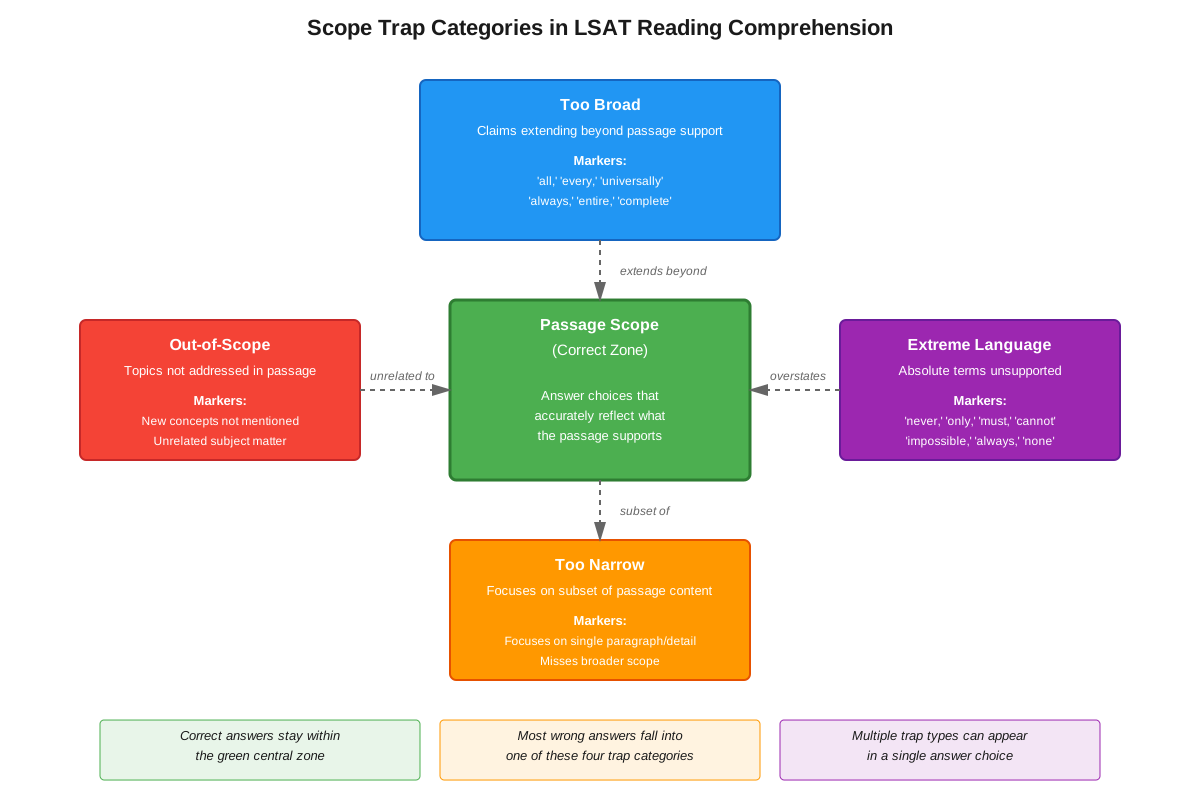
The Four Primary Types of Scope Traps
Too Broad Scope Violations
Too broad answer choices make claims that extend beyond what the passage actually covers. These choices take a specific point the passage makes and generalize it inappropriately. For example, if a passage discusses how one particular environmental regulation succeeded in reducing pollution in coastal areas, a too-broad answer might claim the passage shows environmental regulations are generally effective, or that this approach would work for all pollution types.
The mechanism behind too-broad traps exploits test-takers' tendency to extrapolate from specific examples to general principles. The LSAT deliberately includes answer choices that represent reasonable real-world inferences but go beyond what the passage text actually supports. These traps are especially common in main point questions, where wrong answers often describe a broader topic area rather than the passage's specific focus within that area.
Too Narrow Scope Violations
Too narrow answer choices focus on a detail or subset of the passage's discussion while missing the broader point. If a passage argues that three factors contributed to a historical event and devotes roughly equal attention to each, a too-narrow answer might mention only one factor or focus on a supporting example rather than the main argument.
These traps succeed because the answer choice contains accurate information from the passage, making it tempting. Test-takers who focus on recognizing familiar content rather than evaluating scope fall for these distractors. Too-narrow answers appear frequently in primary purpose and main point questions, where they describe a paragraph's focus rather than the passage's overall scope.
Out-of-Scope Violations
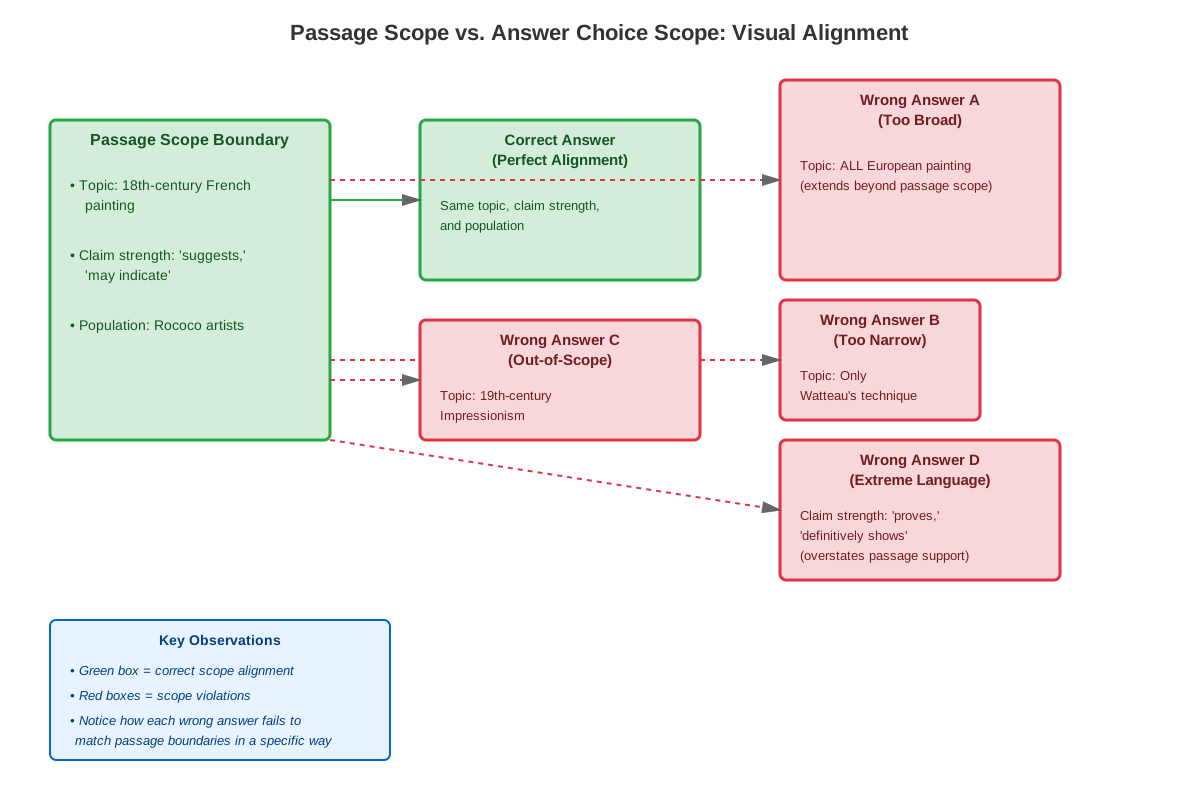
Out-of-scope answer choices introduce concepts, comparisons, or claims that the passage simply doesn't address. These might discuss related topics, make reasonable assumptions, or present information that would logically connect to the passage's subject—but the passage itself never discusses them. For instance, if a passage analyzes the artistic techniques in one painter's work, an out-of-scope answer might compare that painter to other artists the passage never mentions.
Out-of-scope traps are particularly insidious in inference questions, where test-takers sometimes confuse "reasonable to assume" with "supported by the passage." The LSAT requires that inferences be directly supported by passage content, not merely consistent with it or plausible given real-world knowledge.
Degree/Strength Scope Violations
Degree scope violations occur when answer choices use language that's too strong, too weak, or otherwise mismatches the certainty level of the passage's claims. A passage might suggest that evidence "indicates" or "suggests" a conclusion, while a wrong answer states that the evidence "proves" or "demonstrates" it. Conversely, if a passage makes a definitive claim, wrong answers might inappropriately hedge with words like "possibly" or "might."
| Passage Language | Appropriate Answer Language | Scope Violation Language |
|---|---|---|
| "suggests," "indicates" | "supports the view," "provides evidence" | "proves," "establishes conclusively" |
| "demonstrates," "shows" | "establishes," "proves" | "hints at," "might suggest" |
| "one factor," "contributes to" | "plays a role," "is among the causes" | "the primary cause," "the determining factor" |
| "some scholars argue" | "a position has been advanced" | "scholars agree," "it is accepted that" |
Recognizing Scope Through Passage Structure
Scope is established through multiple textual signals. The opening paragraph typically sets topical scope by introducing the subject and often narrowing to the specific aspect the passage will address. Transition words like "however," "specifically," "in particular," and "although" signal scope boundaries by indicating what the passage will and won't focus on.
Qualifying language throughout the passage defines strength scope. Words like "may," "can," "often," "some," "typically," and "in certain contexts" limit the scope of claims. Conversely, words like "always," "never," "all," "must," and "only" expand claims to absolute scope. The LSAT tests whether readers track these qualifiers accurately.
The conclusion or final paragraph often reinforces scope by restating the main point with its proper boundaries. Passages that end with limitations, caveats, or acknowledgments of what remains unknown are explicitly defining their scope boundaries—information that becomes crucial for evaluating answer choices.
Scope in Different Question Types
Different reading comprehension question types require different scope awareness strategies:
Main Point/Primary Purpose Questions: The correct answer must match the passage's scope exactly—not too broad (describing the general topic area), not too narrow (focusing on one paragraph or example), and not out-of-scope (introducing concepts the passage doesn't address).
Inference Questions: These require the most precise scope calibration. Correct inferences stay within what the passage directly supports, while wrong answers often make reasonable but unsupported leaps. The passage might state that X causes Y in certain conditions; a scope trap would claim X always causes Y or that X is the only cause of Y.
Strengthen/Weaken Questions: Scope traps introduce information about tangential issues. If the passage argues that a policy succeeded for reason A, a scope trap might discuss reason B that the passage never mentioned, even if B seems relevant to the policy's success.
Concept Relationships
The core concepts within scope traps form an interconnected system. Understanding what constitutes scope provides the foundation for recognizing the four primary types of scope violations. Each violation type (too broad, too narrow, out-of-scope, and degree violations) represents a different way answer choices can fail to match the passage's boundaries, but all stem from the same fundamental principle: correct answers must align precisely with what the passage establishes.
Passage structure analysis → enables → scope identification → enables → scope trap recognition → leads to → accurate answer selection
Scope awareness connects to prerequisite knowledge of active reading because identifying scope requires tracking the author's purpose, main arguments, and supporting evidence throughout the passage. It builds on inference skills by requiring students to distinguish between what passages directly support versus what seems reasonable but lacks textual backing.
The relationship to other reading comprehension question types is bidirectional: understanding scope improves performance on all question types, while practicing different question types reveals how scope operates in various contexts. Main point questions teach topical scope boundaries, inference questions develop strength scope calibration, and application questions reinforce understanding of when principles extend beyond their stated domain.
High-Yield Facts
⭐ Approximately 60-70% of wrong answer choices in LSAT reading comprehension contain scope violations
⭐ The most common scope trap is the "too broad" answer that generalizes beyond the passage's specific focus
⭐ Correct answers to main point questions match the passage's scope exactly—never broader or narrower
⭐ Out-of-scope answers often introduce reasonable concepts that the passage simply never discusses
⭐ Qualifying language (may, can, some, often) in passages must be reflected in correct answer choices
- Scope violations appear across all passage types (humanities, sciences, social sciences, law)
- Answer choices that use extreme language (always, never, only, all) usually violate scope unless the passage uses equally strong language
- Too-narrow answers typically focus on supporting examples rather than main arguments
- Inference questions require that correct answers be directly supported by passage text, not merely consistent with it
- Degree scope violations often involve mismatching certainty levels between passage claims and answer language
- Passages that acknowledge limitations or alternative views are explicitly defining their scope boundaries
- The correct answer to a primary purpose question describes what the author actually does, not the general topic area
- Scope traps in strengthen/weaken questions introduce information about issues the argument doesn't address
Quick check — test yourself on Scope traps in RC so far.
Try Flashcards →Common Misconceptions
Misconception: If an answer choice contains information from the passage, it must be correct.
Correction: Answer choices can contain accurate passage information but still be wrong due to scope violations—they might focus too narrowly on a detail while missing the main point, or they might combine passage information with out-of-scope claims.
Misconception: Reasonable real-world inferences are acceptable for LSAT inference questions.
Correction: LSAT inference questions require that correct answers be directly supported by passage text. An inference might be reasonable or likely true in the real world but still be incorrect if the passage doesn't provide sufficient support within its scope.
Misconception: The longest or most detailed answer choice is usually correct.
Correction: Length and detail don't determine correctness. Too-broad answers are often lengthy because they include extra claims beyond the passage's scope. The correct answer matches the passage's scope precisely, regardless of length.
Misconception: If a passage discusses a topic, any answer about that general topic is within scope.
Correction: Topical scope requires precision. A passage might discuss one aspect of a topic while leaving other aspects unaddressed. An answer choice about the general topic area but focusing on unaddressed aspects is out-of-scope.
Misconception: Extreme language (always, never, only) in answer choices is always wrong.
Correction: While extreme language often signals scope violations, it's correct when the passage itself makes absolute claims using similarly strong language. The key is matching the passage's degree of certainty, not avoiding strong language categorically.
Misconception: The correct answer to a main point question should cover everything the passage mentions.
Correction: Main point answers should capture the passage's primary focus and scope, not enumerate every detail. An answer that tries to include all passage content often becomes too broad or loses focus on what the passage emphasizes.
Worked Examples
Example 1: Main Point Question with Too Broad Trap
Passage Summary: A passage discusses how the introduction of the printing press in 15th-century Europe facilitated the spread of scientific knowledge by making texts more widely available to scholars. The passage focuses specifically on how this increased access allowed scientists in different regions to build on each other's work more rapidly than had been possible when manuscripts were rare and expensive. The passage provides examples from astronomy and medicine.
Question: Which one of the following most accurately expresses the main point of the passage?
Answer Choices:
(A) The printing press revolutionized European society by making information accessible to the general public.
(B) Technological innovations have historically played a crucial role in advancing human knowledge.
(C) The printing press accelerated scientific progress in Europe by enabling broader distribution of scientific texts among scholars.
(D) Astronomy and medicine advanced more rapidly in the 15th century than in previous centuries.
(E) The high cost of manuscripts before the printing press limited scientific collaboration.
Analysis:
(A) Too Broad Scope Violation: This answer extends beyond the passage's focus. While the passage discusses the printing press in Europe, it specifically addresses scientific knowledge among scholars, not information accessibility for "the general public." This generalizes the passage's specific claim inappropriately.
(B) Too Broad Scope Violation: This answer moves to an extremely general claim about technological innovations throughout history. The passage discusses one specific technology (printing press) in one specific context (15th-century European science). This represents a classic too-broad trap that describes the general topic area rather than the passage's specific focus.
(C) CORRECT: This answer matches the passage's scope precisely. It specifies the printing press (the technology discussed), identifies the context (scientific progress in Europe), and captures the mechanism (broader distribution among scholars). The scope is neither too broad nor too narrow.
(D) Too Narrow Scope Violation: While the passage mentions astronomy and medicine as examples, these are supporting details, not the main point. This answer focuses on specific fields rather than the broader point about how the printing press affected scientific knowledge generally.
(E) Too Narrow Scope Violation: This captures one element mentioned in the passage (manuscript costs limiting collaboration) but misses the main point about how the printing press solved this problem. It focuses on the problem rather than the passage's emphasis on the solution and its effects.
Key Lesson: The correct answer to a main point question must match the passage's scope exactly—specific enough to capture the actual focus, but broad enough to encompass the full argument rather than just supporting details.
Example 2: Inference Question with Degree Scope Violation
Passage Content: "Recent studies have shown a correlation between regular meditation practice and reduced stress levels in participants. Researchers measured cortisol levels before and after an eight-week meditation program and found that 73% of participants showed decreased cortisol. However, the researchers noted that the study's sample size was limited and that participants were not randomly selected, as all had voluntarily enrolled in the meditation program. The researchers concluded that while the results are promising, further research with more rigorous methodology would be needed to establish meditation's effectiveness definitively."
Question: The passage most strongly supports which one of the following?
Answer Choices:
(A) Meditation has been proven to reduce stress in most people who practice it regularly.
(B) The study provides evidence suggesting a relationship between meditation and stress reduction, though limitations prevent definitive conclusions.
(C) Random selection of participants would likely have produced different results in the meditation study.
(D) Cortisol levels are the most reliable indicator of stress reduction.
(E) Future research will probably confirm that meditation reduces stress.
Analysis:
(A) Degree Scope Violation: The passage explicitly states that results are "promising" but that "further research would be needed to establish meditation's effectiveness definitively." This answer uses "proven," which violates the passage's careful limitation of its claims. The passage supports that evidence exists, not that effectiveness is proven.
(B) CORRECT: This answer matches the passage's scope and degree of certainty perfectly. It acknowledges the evidence ("provides evidence suggesting") while respecting the limitations the passage emphasizes ("though limitations prevent definitive conclusions"). The language calibration matches the passage's qualified claims.
(C) Out-of-Scope Violation: While the passage mentions that random selection wasn't used and identifies this as a limitation, it never suggests or implies that different results would have occurred with random selection. This makes a claim the passage doesn't support.
(D) Out-of-Scope Violation: The passage uses cortisol levels as one measure of stress but never compares different stress indicators or claims cortisol is "most reliable." This introduces a comparison the passage doesn't make.
(E) Degree Scope Violation: The passage states results are "promising" but never predicts what future research will show. "Will probably confirm" expresses a level of certainty about future outcomes that the passage doesn't support. The passage leaves open what further research might find.
Key Lesson: Inference questions require precise matching of the passage's degree of certainty. Correct answers use qualifying language that reflects the passage's level of confidence, while scope traps often make claims that are too strong, too weak, or extend beyond what the passage addresses.
Exam Strategy
Pre-Reading Strategy for Scope Awareness
Before diving into answer choices, invest 30-45 seconds identifying the passage's scope boundaries. Ask three questions: (1) What specific aspect of the topic does this passage address? (2) How strongly does the author make claims—with certainty or with qualifications? (3) What does the passage explicitly NOT discuss despite being related to the topic?
Create a mental or physical scope map while reading. Note when the author narrows focus (words like "specifically," "in particular," "one aspect"), acknowledges limitations (words like "however," "although," "may"), or explicitly states what the passage won't address. These textual signals define scope boundaries that will be tested in answer choices.
Trigger Words for Scope Traps
Too Broad Triggers: Watch for answer choices using words like "generally," "overall," "in all cases," "throughout history," or "universally" when the passage discusses specific contexts, time periods, or conditions. Also beware of answers that remove qualifiers the passage includes—if the passage says "often" but an answer says "always," that's a scope violation.
Too Narrow Triggers: Be suspicious of answer choices that focus heavily on specific examples, particular paragraphs, or supporting details when the question asks for main points or primary purposes. Words like "specifically," "in particular," or "especially" in answer choices may signal inappropriate narrowing.
Out-of-Scope Triggers: Eliminate answer choices that introduce new concepts, make comparisons the passage doesn't make, or discuss related topics the passage never addresses. If you find yourself thinking "that seems reasonable but I don't remember reading about it," the answer is likely out-of-scope.
Degree Triggers: Create a mental scale of certainty language. Strong words (proves, establishes, demonstrates, always, never, only, must) require strong passage support. Moderate words (suggests, indicates, supports, often, typically, can) require moderate passage support. Mismatches signal scope violations.
Process of Elimination Technique
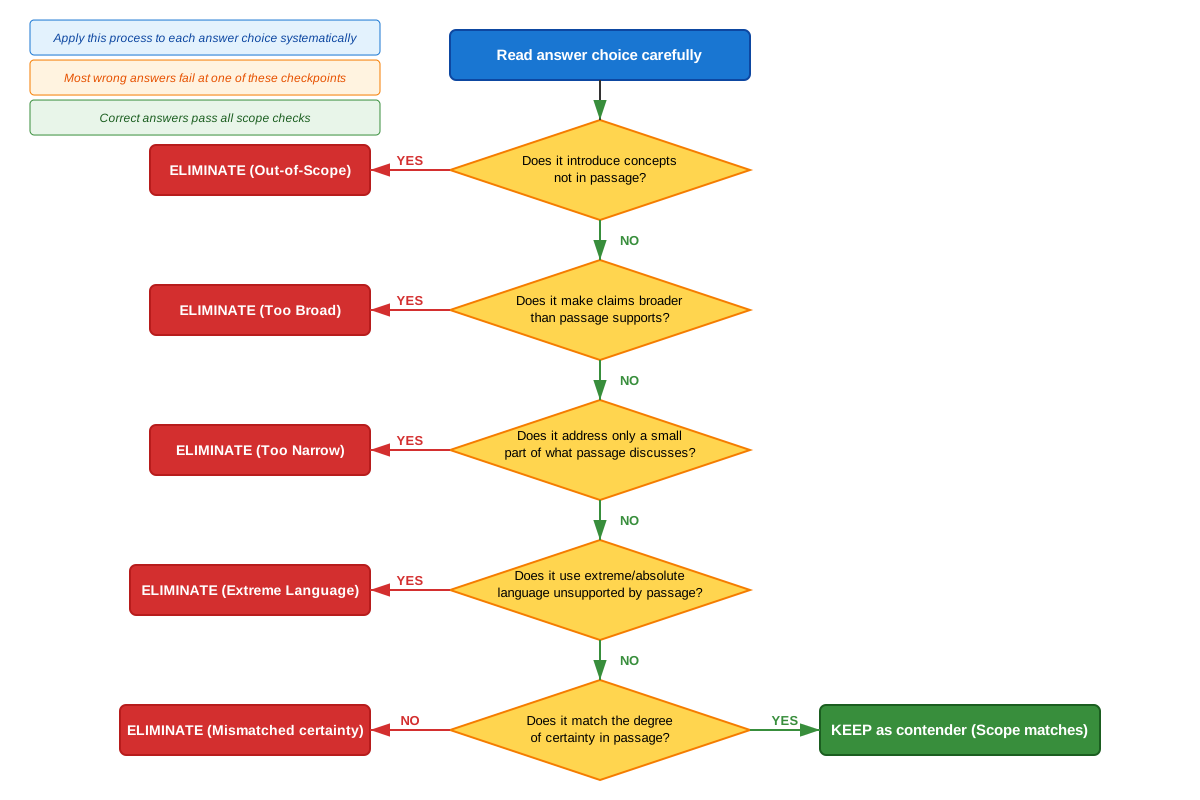
Use a two-pass approach for scope-heavy questions. First pass: Eliminate obvious scope violations—answers that are clearly too broad, too narrow, or out-of-scope. This typically eliminates 2-3 answer choices quickly. Second pass: Among remaining choices, evaluate degree scope carefully, checking whether the strength of claims matches passage language.
When stuck between two answers, return to the passage and locate specific text that would support each answer. The correct answer will have direct textual support matching its scope, while the trap answer will require you to make assumptions, extrapolate beyond what's stated, or ignore qualifying language.
Time Allocation
Don't rush scope analysis. Spending an extra 15-20 seconds carefully evaluating scope often prevents the 60+ seconds wasted when you select a wrong answer, second-guess yourself, and re-read. Scope evaluation is time-efficient because it provides a systematic, objective basis for elimination rather than relying on subjective "feel."
For main point and primary purpose questions, expect scope to be the primary differentiator between correct and incorrect answers. Allocate slightly more time to these questions for careful scope calibration. For detail questions, scope is less central, so move more quickly.
Memory Techniques
The SCOPE Acronym
Specificity: Does the answer match how specific or general the passage is?
Certainty: Does the answer's strength match the passage's degree of confidence?
Omissions: Does the answer include topics the passage omits?
Paragraph vs. Passage: Does the answer capture the whole passage or just part?
Extreme language: Does the answer use absolute terms the passage doesn't support?
Visualization Strategy
Picture the passage's scope as a spotlight illuminating a specific area on a stage. The correct answer stays within that lit area. Too-broad answers extend into the darkness beyond the spotlight. Too-narrow answers focus on just one corner of the lit area. Out-of-scope answers point to a completely different part of the stage the spotlight never reaches.
The Goldilocks Principle
Remember that scope must be "just right"—not too broad, not too narrow, but matching the passage exactly. When evaluating answer choices, explicitly ask: "Is this too big, too small, or just right compared to what the passage actually discusses?"
Qualifier Tracking Mnemonic
Use "MOCS" to remember common qualifying words that define scope:
May, Might, Many
Often, Occasionally
Can, Could
Some, Sometimes, Suggests
When passages use these words, correct answers must reflect similar qualification levels.
Summary
Scope traps in RC represent the most prevalent category of wrong answer choices on LSAT reading comprehension questions, appearing in 60-70% of incorrect options across all question types. Mastering scope requires understanding that correct answers must match the passage's boundaries precisely across three dimensions: topical scope (what subjects are discussed), temporal scope (what contexts apply), and strength scope (how certainly claims are made). The four primary scope violations—too broad, too narrow, out-of-scope, and degree mismatches—each exploit different tendencies in test-takers, from inappropriate generalization to focus on familiar details over main arguments. Success requires systematic analysis: identifying scope boundaries during active reading, recognizing trigger words that signal scope violations, and using process of elimination to match answer choices against the passage's precise boundaries. The key insight is that even factually accurate or logically reasonable answer choices are incorrect if they extend beyond, narrow below, or otherwise misrepresent what the passage actually establishes within its defined scope.
Key Takeaways
- Scope violations appear in the majority of wrong answer choices, making scope awareness the highest-yield skill for improving RC performance
- Correct answers match passage scope exactly—neither broader nor narrower than what the passage discusses and supports
- The four scope trap types (too broad, too narrow, out-of-scope, degree violations) require different recognition strategies but all stem from misalignment with passage boundaries
- Qualifying language in passages (may, can, some, often, suggests) must be reflected in correct answer choices—mismatches in certainty level signal scope violations
- Main point and primary purpose questions test scope most directly, requiring answers that capture the passage's full focus without extending beyond it
- Out-of-scope answers often seem reasonable or related to the topic but introduce concepts the passage never addresses
- Systematic scope analysis during reading and answer evaluation transforms RC from subjective interpretation into objective pattern recognition
Related Topics
Wrong Answer Pathologies in RC: Understanding scope traps provides foundation for recognizing other systematic wrong answer patterns including reversal traps, extreme language traps, and half-right answers. Mastering scope enables more sophisticated wrong answer analysis.
Active Reading and Passage Mapping: Scope identification depends on effective active reading strategies that track author's purpose, argument structure, and main versus supporting ideas. Strengthening these skills enhances scope awareness.
Inference Question Strategies: Scope is particularly crucial for inference questions, where the line between supported and unsupported claims determines correctness. Deep scope mastery enables more confident inference question performance.
Comparative Reading Passages: Scope becomes more complex in comparative passages where students must track each passage's scope separately and identify areas of overlap versus divergence. Scope trap mastery prepares students for these advanced challenges.
Practice CTA
Now that you understand how scope traps operate and how to identify them systematically, it's time to apply these concepts to actual LSAT passages. Complete the practice questions associated with this topic, paying special attention to identifying the specific type of scope violation in each wrong answer choice. Use the flashcards to reinforce recognition of trigger words and scope boundaries. Remember: scope awareness is a skill that improves dramatically with deliberate practice. Each passage you analyze with scope consciousness builds pattern recognition that will serve you throughout the reading comprehension section. You're developing the precise analytical skills that separate top scorers from the rest—keep practicing!
Sign up free to keep reading
Create a free AnvayaPrep account to finish this LSAT guide on Scope traps in RC — plus flashcards and practice questions.