Overview
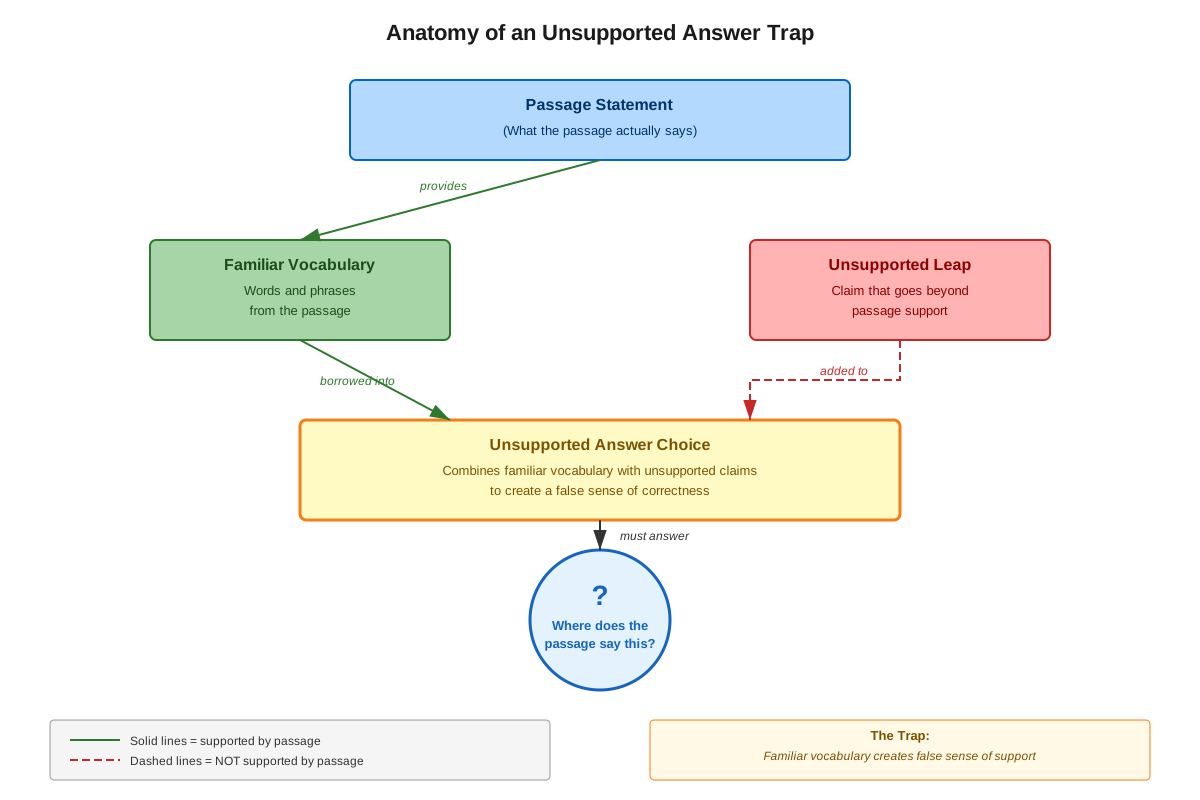
Unsupported answer traps represent one of the most frequently encountered wrong answer types in LSAT Reading Comprehension questions. These deceptive choices appear plausible at first glance because they relate to the passage topic and use familiar vocabulary from the text. However, they make claims that go beyond what the passage actually states or implies. The LSAT test makers deliberately craft these answers to exploit a common reading habit: assuming information that seems reasonable or making logical leaps that the passage itself never makes. Recognizing and eliminating unsupported answers is essential for achieving a competitive score, as these traps appear across virtually all reading comprehension question types, including main point, inference, detail, and author's attitude questions.
The challenge with unsupported answer traps lies in their subtlety. Unlike answers that directly contradict the passage or introduce completely irrelevant information, unsupported answers often feel "close enough" to what the passage says. They might take a concept mentioned in the passage and extend it slightly beyond the text's scope, or they might combine two separate ideas in a way the author never intended. This makes them particularly dangerous for test-takers who read quickly or rely on general impressions rather than precise textual evidence. Mastering the identification of unsupported answers requires developing a rigorous standard of proof: every correct answer must be directly supported by specific language in the passage.
Understanding unsupported answer traps connects directly to the broader skill of close reading and evidence-based reasoning that underlies all LSAT Reading Comprehension success. This topic builds upon fundamental passage analysis skills and serves as a foundation for more advanced question-type strategies. By learning to distinguish between what a passage actually says versus what seems reasonable to infer, students develop the critical thinking precision that the LSAT measures and that law schools value in prospective students.
Learning Objectives
- [ ] Identify how unsupported answer traps appear in LSAT questions across different question types
- [ ] Explain the reasoning pattern behind unsupported answer traps and why test makers include them
- [ ] Apply strategies to eliminate unsupported answer traps and solve LSAT-style problems accurately
- [ ] Distinguish between properly supported inferences and unsupported logical leaps
- [ ] Recognize the specific language patterns and structural features that signal unsupported answers
- [ ] Develop a systematic verification process to confirm answer choices against passage text
- [ ] Analyze the relationship between passage scope and answer choice validity
Prerequisites
- Basic passage reading comprehension: Understanding main ideas, supporting details, and passage structure is necessary to evaluate whether answer choices align with textual content
- Familiarity with LSAT question stems: Recognizing what different questions ask for (inference vs. explicit detail vs. main point) helps determine the appropriate standard of support required
- Understanding of scope and degree: Distinguishing between absolute and qualified claims enables identification of answers that overstate or understate passage content
- Knowledge of wrong answer categories: Awareness that multiple trap types exist provides context for why unsupported answers represent one specific category among several
Why This Topic Matters
Unsupported answer traps appear with remarkable frequency on the LSAT Reading Comprehension section, making them one of the highest-yield topics for focused study. Research on released LSAT exams indicates that approximately 30-40% of wrong answer choices across all reading comprehension question types fall into the unsupported category. This prevalence means that developing expertise in identifying these traps can directly improve performance on multiple questions per test, potentially raising a scaled score by several points.
In real-world legal practice, the skill of distinguishing between supported and unsupported claims mirrors the essential attorney competency of arguing only what evidence actually establishes. Lawyers must avoid making assertions that go beyond what their evidence proves, as unsupported claims can be challenged, dismissed, or even result in sanctions. The LSAT tests this foundational skill because law schools seek students who can reason precisely from textual evidence—a core requirement for case analysis, statutory interpretation, and legal writing.
On the exam, unsupported answer traps appear most commonly in inference questions (which ask what must be true or is most supported by the passage), main point questions (where wrong answers often overstate or understate the author's actual thesis), and detail questions (where answers may reference passage topics but misrepresent specific claims). They also frequently appear in author's attitude questions, where answer choices might attribute views to the author that the passage never actually endorses. Understanding this pattern helps students maintain vigilance across all question types rather than assuming certain questions are immune to this trap.
Core Concepts
Definition of Unsupported Answer Traps
An unsupported answer trap is a wrong answer choice that makes a claim not adequately justified by the passage text. These answers fail the fundamental test of LSAT Reading Comprehension: they cannot be proven true using only the information provided in the passage. The key characteristic distinguishing unsupported answers from other wrong answer types is that they don't directly contradict the passage (which would make them obviously wrong), nor do they introduce completely irrelevant information (which would also be easily eliminated). Instead, they occupy a middle ground—they seem plausible and relate to passage content, but they make assertions that go beyond what the text actually states or reasonably implies.
The LSAT operates on a strict standard of textual support. For an answer to be correct, a test-taker must be able to point to specific language in the passage that proves the answer choice true. This doesn't mean the answer must quote the passage verbatim—paraphrasing is common—but the underlying claim must be defensible using passage evidence. Unsupported answers fail this test by adding information, making assumptions, or drawing conclusions that require knowledge or reasoning beyond what the passage provides.
The Spectrum of Support
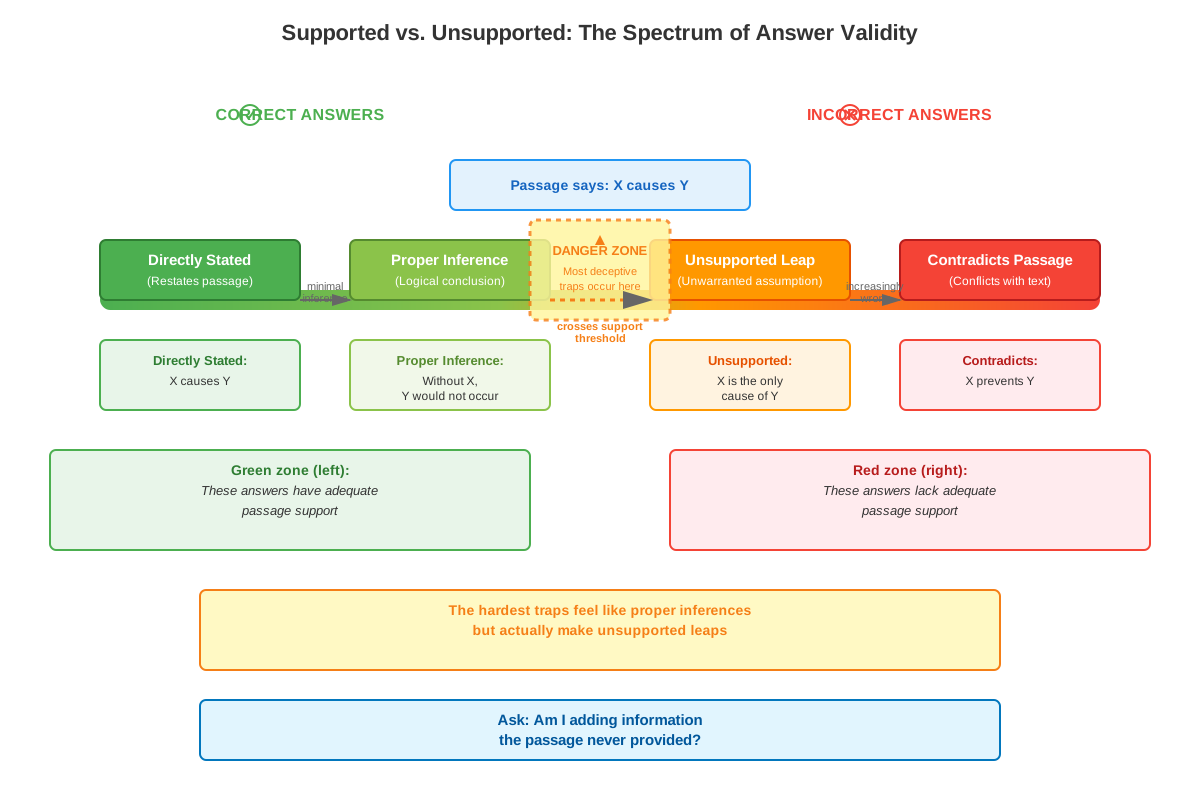
Understanding unsupported answers requires recognizing that textual support exists on a spectrum:
| Level of Support | Description | LSAT Acceptability |
|---|---|---|
| Explicit Statement | The passage directly states the claim in clear language | Always acceptable |
| Strong Inference | The claim must be true based on combining passage statements | Acceptable for inference questions |
| Reasonable Inference | The claim is likely true but not definitively proven | Generally acceptable |
| Weak Inference | The claim could be true but requires assumptions | Borderline/Usually unsupported |
| Speculation | The claim might be true but lacks passage basis | Unsupported |
| Assumption | The claim requires outside knowledge or unstated premises | Unsupported |
The LSAT typically draws the line between "reasonable inference" and "weak inference." Correct answers, even for inference questions, must be strongly supported—meaning they follow necessarily or almost necessarily from passage content. Unsupported answers fall below this threshold, requiring test-takers to make logical leaps the passage doesn't justify.
Common Manifestations of Unsupported Answers
Overgeneralization: The passage discusses a specific case, example, or limited scenario, but the answer choice extends the claim to a broader category. For instance, if a passage describes how a particular 18th-century novelist used symbolism, an unsupported answer might claim that "18th-century novelists frequently employed symbolic techniques" when the passage only discussed one author.
Temporal Extension: The passage describes a situation at one point in time, but the answer choice assumes this situation continues, began earlier, or will persist into the future without passage support. A passage might state that "in 1995, the policy was controversial," while an unsupported answer claims "the policy remained controversial throughout the decade."
Causal Assumption: The passage presents two facts or events, and the answer choice assumes a causal relationship between them that the passage never establishes. The passage might mention that "enrollment declined" and separately note that "tuition increased," while an unsupported answer states "the tuition increase caused enrollment to decline."
Degree Distortion: The passage makes a qualified or moderate claim, but the answer choice intensifies it using stronger language. The passage might say an approach is "useful" while the unsupported answer claims it is "essential" or "the most effective method."
Scope Expansion: The passage focuses on one aspect of a topic, but the answer choice makes claims about related aspects never discussed. A passage about the economic effects of a policy might generate an unsupported answer about the policy's social or environmental effects.
The Psychology Behind Unsupported Traps
Test makers design unsupported answers to exploit predictable cognitive biases and reading habits. The familiarity bias causes test-takers to favor answers containing words and concepts from the passage, even when those elements are combined in unsupported ways. The reasonableness bias leads students to select answers that align with common sense or real-world knowledge, forgetting that LSAT questions must be answered based solely on passage content.
Additionally, unsupported answers exploit confirmation bias—the tendency to notice information that confirms initial impressions while overlooking contradictory details. A student who forms a general impression of a passage's argument might select an answer that matches that impression without verifying that the specific claim is actually supported. Time pressure exacerbates these tendencies, as students under time constraints are more likely to rely on general impressions rather than careful verification.
Verification Process for Identifying Support
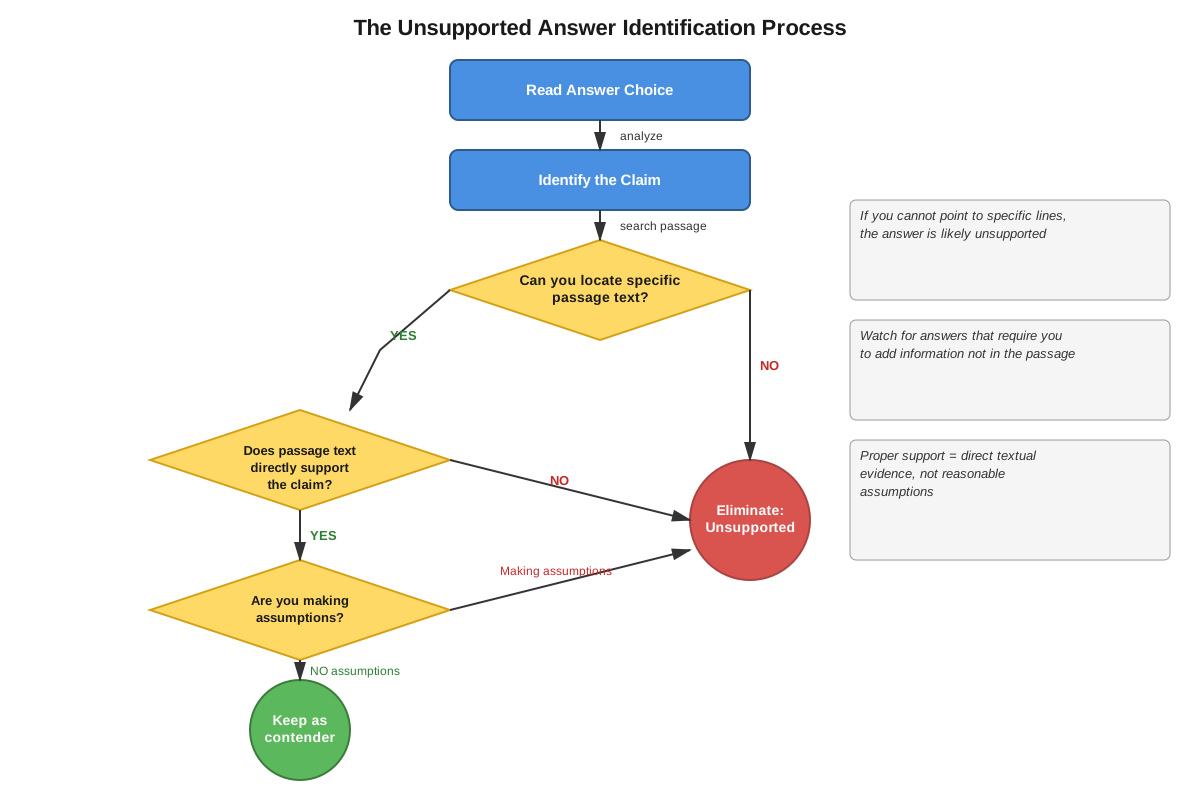
To systematically identify unsupported answers, effective test-takers employ a rigorous verification process:
- Identify the claim: Break down exactly what the answer choice asserts
- Locate relevant passage content: Find the specific lines or paragraph that would support this claim
- Compare precisely: Check whether the passage actually makes this exact claim or necessarily implies it
- Check for gaps: Identify any logical leaps, assumptions, or additional information needed to bridge passage content to the answer choice
- Apply the "prove it" standard: Ask whether you could defend this answer to a skeptical questioner using only passage text
This process must become automatic through practice. Initially, it may feel time-consuming, but with repetition, students develop pattern recognition that allows rapid identification of unsupported elements.
Distinguishing Unsupported from Other Wrong Answer Types
Unsupported answers differ from other common wrong answer categories:
- Contradictory answers directly oppose passage statements (e.g., passage says X increased, answer says X decreased)
- Out-of-scope answers introduce topics or concepts the passage never mentions
- Extreme answers use absolute language (always, never, only) that the passage doesn't support
- Distortion answers twist or misrepresent what the passage actually says
While these categories sometimes overlap, unsupported answers are specifically characterized by making claims that go beyond passage content rather than contradicting it, introducing new topics, or misrepresenting existing content. An answer can be unsupported without being extreme, out-of-scope, or contradictory—it simply lacks adequate textual justification.
Concept Relationships
The concept of unsupported answer traps connects hierarchically to broader Reading Comprehension skills. At the foundation lies close reading ability—the capacity to understand precisely what a passage states. This enables evidence-based reasoning, which involves connecting claims to specific textual support. Unsupported answer identification builds directly on these skills by requiring students to evaluate whether answer choices meet the standard of adequate support.
Within the topic itself, the concepts form a logical progression: understanding the definition of unsupported answers → recognizing the spectrum of support → identifying common manifestations → understanding the psychology behind the traps → applying a systematic verification process → distinguishing unsupported from other wrong answer types. Each concept builds on the previous one, creating a comprehensive framework for mastering this skill.
Unsupported answer traps also connect laterally to other question-type strategies. For inference questions, recognizing unsupported answers is particularly critical because these questions explicitly test the boundary between supported and unsupported conclusions. For main point questions, unsupported answers often take the form of overgeneralizations that go beyond the author's actual thesis. For strengthen/weaken questions in Reading Comprehension, understanding what is and isn't supported helps identify which additional information would actually affect the argument.
The relationship map flows as follows: Close Reading → Evidence Evaluation → Unsupported Answer Recognition → Systematic Elimination → Correct Answer Selection → Improved Score. Mastering unsupported answer identification also prepares students for Logical Reasoning sections, where similar skills of evaluating argument support are essential.
High-Yield Facts
⭐ Unsupported answer traps appear in approximately 30-40% of wrong answer choices across all Reading Comprehension question types, making them the most common trap category.
⭐ An answer choice can be factually true in the real world but still be unsupported and therefore wrong if the passage doesn't establish it.
⭐ Inference questions require strong support—correct inferences must be proven by passage content, not merely consistent with it.
⭐ The presence of passage vocabulary in an answer choice does not guarantee the answer is supported; test makers deliberately use familiar terms in unsupported combinations.
⭐ Unsupported answers often result from combining two separate passage claims in a way the author never intended or stated.
- Temporal assumptions (extending claims across time periods not covered in the passage) are a frequent form of unsupported answer
- Causal relationships must be explicitly stated or clearly implied in the passage; correlation alone doesn't support causation claims
- Degree words (most, least, primary, essential) in answer choices require specific passage support for that level of intensity
- Scope expansion—making claims about aspects of a topic the passage never addresses—is a classic unsupported answer pattern
- The correct answer to any Reading Comprehension question must be defensible using only information from the passage, without requiring outside knowledge
- Unsupported answers often appear more sophisticated or nuanced than correct answers, exploiting the assumption that complex = correct
- When two answers seem equally supported, the one requiring fewer assumptions or logical steps is typically correct
Quick check — test yourself on Unsupported answer traps so far.
Try Flashcards →Common Misconceptions
Misconception: If an answer choice sounds reasonable or aligns with common sense, it must be correct.
Correction: The LSAT tests reading comprehension, not general knowledge. An answer must be supported by passage text regardless of whether it seems reasonable based on outside knowledge. Many unsupported answers are deliberately designed to sound plausible to exploit this tendency.
Misconception: Inference questions allow for creative interpretation and educated guessing beyond what the passage states.
Correction: Even inference questions require strong textual support. A correct inference must be proven by passage content, not merely consistent with it. The LSAT tests logical reasoning from evidence, not speculative thinking.
Misconception: If an answer choice uses words and phrases directly from the passage, it must be supported.
Correction: Test makers intentionally construct unsupported answers using passage vocabulary to create false familiarity. The presence of familiar terms doesn't guarantee the claim itself is supported—the specific combination and assertion must be verified against passage content.
Misconception: Unsupported answers are always obviously wrong and easy to eliminate.
Correction: Unsupported answers are often subtle and require careful analysis to identify. They typically relate closely to passage content and differ from correct answers by small but crucial distinctions in scope, degree, or logical connection.
Misconception: If the passage doesn't explicitly contradict an answer choice, that answer could be correct.
Correction: The standard isn't merely "not contradicted"—it's "actively supported." An answer choice must be proven true by passage content, not simply fail to be proven false. Absence of contradiction is insufficient.
Misconception: Longer, more detailed answer choices are more likely to be correct because they show deeper understanding.
Correction: Test makers often make unsupported answers longer and more complex to appear authoritative. Length and complexity don't indicate correctness—only alignment with passage content matters.
Misconception: If you can construct a logical argument connecting passage content to an answer choice, that answer is supported.
Correction: If your logical argument requires assumptions, additional premises, or reasoning steps not present in the passage, the answer is unsupported. The passage itself must establish the connection, not your supplementary reasoning.
Worked Examples
Example 1: Detail Question with Unsupported Trap
Passage Excerpt: "The 1920s saw significant changes in urban architecture, with architects like Le Corbusier advocating for functionalist designs that prioritized utility over ornamentation. This movement represented a sharp departure from the elaborate Victorian styles that had dominated the previous century. Le Corbusier's famous dictum that 'a house is a machine for living' encapsulated the new philosophy."
Question: According to the passage, Le Corbusier's architectural philosophy:
Answer Choices:
(A) Influenced most urban architects during the 1920s
(B) Prioritized functional utility over decorative elements
(C) Was universally adopted by the end of the decade
(D) Represented the first challenge to Victorian architectural styles
(E) Completely eliminated ornamentation from building design
Analysis:
Step 1 - Identify what each answer claims:
- (A) Claims widespread influence among architects
- (B) Claims prioritization of function over decoration
- (C) Claims universal adoption by decade's end
- (D) Claims it was the first challenge to Victorian styles
- (E) Claims complete elimination of ornamentation
Step 2 - Locate relevant passage support:
The passage states Le Corbusier "advocat[ed] for functionalist designs that prioritized utility over ornamentation."
Step 3 - Verify each answer:
(A) UNSUPPORTED: The passage says Le Corbusier advocated this approach and that "the 1920s saw significant changes," but never states that most architects were influenced by him specifically. This is a scope expansion—the passage discusses Le Corbusier's views but doesn't quantify his influence.
(B) SUPPORTED: This directly paraphrases "prioritized utility over ornamentation." The passage explicitly states this.
(C) UNSUPPORTED: The passage never discusses adoption rates or what happened by the end of the decade. This is a temporal extension beyond passage scope.
(D) UNSUPPORTED: The passage says Le Corbusier's movement "represented a sharp departure" from Victorian styles, but never claims it was the "first" challenge. This adds information not present in the text.
(E) UNSUPPORTED: The passage says the philosophy prioritized utility "over" ornamentation, not that it "completely eliminated" it. This is a degree distortion—the passage indicates a shift in priority, not total elimination.
Correct Answer: (B)
Key Lesson: Notice how four of the five answers relate to passage content but make claims that go beyond what the text actually states. Answer (A) seems reasonable—if there were "significant changes," surely Le Corbusier influenced many architects—but the passage never actually makes this claim. This exemplifies how unsupported answers exploit reasonable assumptions.
Example 2: Inference Question with Unsupported Trap
Passage Excerpt: "Recent studies of coral reef ecosystems have revealed unexpected resilience in certain species. While many coral varieties have suffered severe bleaching due to rising ocean temperatures, researchers documented that Porites lobata colonies in some Pacific locations maintained their symbiotic algae populations even when surrounding species experienced widespread bleaching. The mechanism behind this resilience remains unclear, though scientists hypothesize it may involve genetic variations that allow these particular colonies to tolerate higher temperatures."
Question: The passage most strongly supports which of the following inferences?
Answer Choices:
(A) Genetic variations are the primary factor determining coral resilience to temperature changes
(B) Porites lobata will likely survive future temperature increases better than other coral species
(C) Some Porites lobata colonies demonstrated greater temperature tolerance than surrounding coral species
(D) Rising ocean temperatures will eventually affect all coral species equally
(E) The resilience observed in Porites lobata has been documented in other coral varieties as well
Analysis:
Step 1 - Identify what each answer claims:
- (A) Claims genetic variations are the primary factor
- (B) Claims future survival advantage for Porites lobata
- (C) Claims demonstrated greater tolerance in some colonies
- (D) Claims eventual equal impact on all species
- (E) Claims similar resilience documented in other varieties
Step 2 - Apply inference standards:
For inference questions, the correct answer must be proven by passage content, not merely consistent with it.
Step 3 - Verify each answer:
(A) UNSUPPORTED: The passage says scientists "hypothesize" genetic variations "may" be involved. This tentative language doesn't support claiming genetic variations "are the primary factor." This distorts the degree of certainty and makes a causal claim the passage doesn't establish.
(B) UNSUPPORTED: This makes a prediction about the future that the passage doesn't support. The passage describes past observations but never claims these will continue or predict future survival. This is a temporal extension.
(C) SUPPORTED: The passage states that Porites lobata "maintained their symbiotic algae populations even when surrounding species experienced widespread bleaching." Maintaining algae while others bleach demonstrates greater tolerance. This inference follows necessarily from passage content.
(D) UNSUPPORTED: This contradicts the passage's emphasis on differential resilience among species. The passage suggests the opposite—that different species respond differently.
(E) UNSUPPORTED: The passage specifically discusses Porites lobata and mentions that "many coral varieties have suffered severe bleaching," but never states that similar resilience has been documented in other varieties. This adds information not present.
Correct Answer: (C)
Key Lesson: Answer (B) is particularly tempting because it seems like a reasonable inference—if these corals showed resilience in the past, they'll likely continue to do so. However, the passage never makes claims about future outcomes, and the LSAT doesn't credit predictions that go beyond passage scope. Answer (A) demonstrates how unsupported answers can distort the certainty level of passage claims, turning a hypothesis into a definitive statement.
Exam Strategy
Approaching Questions Systematically
When facing any Reading Comprehension question, implement this process to identify unsupported answers:
- Read the question stem carefully to understand exactly what type of support is required (explicit detail vs. inference vs. main point)
- Predict an answer based on passage content before looking at choices, creating a mental benchmark for adequate support
- Evaluate each answer choice individually rather than comparing choices to each other initially
- For each choice, ask: "Can I point to specific passage lines that prove this claim?"
- Eliminate unsupported answers systematically before selecting your final answer
Trigger Words and Red Flags
Certain language patterns in answer choices should heighten your vigilance for unsupported claims:
Absolute language: always, never, only, all, none, exclusively, completely, entirely
- These require very strong passage support; passages rarely make absolute claims
Superlatives: most, least, best, worst, primary, chief, main
- These require the passage to explicitly establish a ranking or hierarchy
Causal language: caused, led to, resulted in, because of, due to
- Causal relationships must be explicitly stated or clearly implied, not assumed from correlation
Temporal extensions: will, continued to, began, has always, remains
- Claims about time periods not covered in the passage are typically unsupported
Quantifiers: many, most, few, frequently, rarely, typically
- These require passage support for the specific quantity or frequency claimed
Process of Elimination Techniques
The "Prove It" Challenge: For each answer choice, imagine you must defend it to a skeptical questioner using only passage text. If you can't construct a defense without making assumptions or adding information, the answer is unsupported.
The Assumption Test: Ask what additional information or premises would need to be true for this answer to be correct. If the answer requires any assumptions beyond passage content, eliminate it.
The Scope Check: Verify that the answer choice doesn't expand beyond the passage's scope in terms of:
- Time period (past, present, future)
- Population (specific examples vs. general categories)
- Topic aspects (economic vs. social vs. political dimensions)
- Certainty level (definite vs. possible vs. hypothetical)
The Paraphrase Verification: If an answer seems to paraphrase passage content, verify that it's a true paraphrase rather than a subtle distortion. Check that no key qualifiers, limitations, or conditions have been dropped.
Time Allocation Advice
Spending an extra 15-20 seconds carefully verifying answer support is almost always worthwhile, as it prevents careless errors on questions you have the knowledge to answer correctly. However, if you find yourself unable to locate passage support for any answer after a thorough search, consider these strategies:
- Return to the passage: Quickly re-skim the relevant section to ensure you haven't missed key information
- Choose the least unsupported: If all answers seem problematic, select the one requiring the smallest logical leap
- Flag and move on: If genuinely stuck, make your best guess, flag the question, and return if time permits
The key is avoiding the trap of selecting an answer that "feels right" without verification. Unsupported answers are designed to feel right—that's what makes them effective traps.
Memory Techniques
The PROVE Acronym
Use PROVE to remember the verification process for checking answer support:
- Point to specific passage lines
- Read the answer claim precisely
- Observe any gaps or assumptions
- Verify the scope and degree match
- Eliminate if unsupported
The "Three Bridges Too Far" Visualization
Imagine the passage as one island and each answer choice as another island. The correct answer has a solid bridge of textual support connecting it to the passage. Unsupported answers require you to build additional bridges using assumptions, outside knowledge, or logical leaps. If you need to construct more than one bridge (make more than one assumption), the answer is unsupported. Visualize yourself trying to cross to each answer—if you'd fall into the water of unsupported speculation, eliminate that choice.
The Support Spectrum Mnemonic
Remember the levels of support using ESRWS:
- Explicit (always good)
- Strong inference (good for inference questions)
- Reasonable inference (usually acceptable)
- Weak inference (danger zone)
- Speculation (always wrong)
The "Says vs. Suggests" Distinction
Train yourself to distinguish between:
- Says: What the passage explicitly states
- Suggests: What the passage strongly implies
- Might mean: What seems reasonable but isn't proven (UNSUPPORTED)
Correct answers fall into the first two categories; unsupported answers fall into the third.
Summary
Unsupported answer traps represent the most common category of wrong answers in LSAT Reading Comprehension, appearing in 30-40% of incorrect choices across all question types. These traps are characterized by making claims that go beyond what the passage actually states or necessarily implies, despite using familiar passage vocabulary and relating to passage topics. The key to identifying unsupported answers lies in applying a rigorous standard of textual support: every correct answer must be defensible using specific passage content without requiring assumptions, outside knowledge, or logical leaps. Common manifestations include overgeneralizations, temporal extensions, causal assumptions, degree distortions, and scope expansions. Success requires developing systematic verification habits, recognizing trigger words that signal potential unsupported claims, and distinguishing between what a passage explicitly says, what it strongly implies, and what merely seems reasonable. Mastering this skill directly improves performance across all Reading Comprehension question types and builds the evidence-based reasoning ability essential for law school success.
Key Takeaways
- Unsupported answer traps make claims that go beyond passage content despite seeming plausible and using familiar passage vocabulary
- The correct standard is "actively supported by passage text," not merely "not contradicted by the passage"
- Common unsupported patterns include overgeneralization, temporal extension, causal assumption, degree distortion, and scope expansion
- Systematic verification using the "prove it" standard—pointing to specific passage lines that establish each claim—is essential for accurate answer selection
- Trigger words like absolutes (always, never), superlatives (most, best), and causal language (caused, led to) should heighten vigilance for unsupported claims
- Even inference questions require strong support; correct inferences must be proven by passage content, not merely consistent with it
- Spending extra time to verify answer support prevents careless errors and is almost always a worthwhile investment of testing time
Related Topics
Inference Question Strategies: Building on unsupported answer recognition, this topic explores the specific techniques for handling "must be true" and "most supported" questions, including how to distinguish between strong and weak inferences. Mastering unsupported answers provides the foundation for excelling at inference questions.
Scope and Degree Errors: This related topic examines how answer choices can be wrong by being too broad, too narrow, too strong, or too weak relative to passage claims. Understanding unsupported answers helps identify when scope or degree has been improperly modified.
Evidence-Based Elimination Strategies: This advanced topic covers systematic approaches to eliminating wrong answers across all Reading Comprehension question types, with unsupported answer recognition serving as one key elimination criterion among several.
Main Point and Primary Purpose Questions: These question types frequently feature unsupported answers that overstate or understate the author's actual thesis. The skills developed for identifying unsupported answers transfer directly to these question types.
Comparative Reading Passages: In comparative passages, unsupported answers often make claims about relationships between the two passages that aren't established, requiring even more careful verification of textual support across multiple texts.
Practice CTA
Now that you understand how to identify and eliminate unsupported answer traps, it's time to put these skills into practice. Work through the practice questions and flashcards for this topic, applying the PROVE verification process to each answer choice. Pay special attention to answers that feel plausible but require assumptions or logical leaps beyond passage content. Remember: every correct answer must be defensible using specific passage text. With focused practice, identifying unsupported answers will become automatic, significantly improving your Reading Comprehension performance and bringing you closer to your target LSAT score. You've built the knowledge foundation—now build the skill through deliberate practice!
Sign up free to keep reading
Create a free AnvayaPrep account to finish this LSAT guide on Unsupported answer traps — plus flashcards and practice questions.