Overview
Primary purpose questions are among the most frequently tested question types in LSAT reading comprehension, appearing in nearly every Reading Comprehension section. These questions ask test-takers to identify the author's main goal or overarching intent in writing the passage. Unlike detail questions that focus on specific information or inference questions that require drawing conclusions, primary purpose questions demand a holistic understanding of the passage's structure, tone, and central message.
Mastering primary purpose questions is essential for LSAT success because they test a fundamental skill: the ability to distinguish between what an author discusses and why the author wrote the passage. Students often confuse supporting details or secondary themes with the primary purpose, leading to incorrect answer choices. These questions typically appear as the first or second question in a passage set, and answering them correctly provides a strategic advantage by establishing a clear framework for understanding subsequent questions about the same passage.
Within the broader landscape of reading comprehension question types, primary purpose questions serve as a bridge between structural analysis and content comprehension. They require synthesizing information about passage organization, authorial tone, and argumentative strategy. Success with these questions enhances performance on related question types, including main point questions, organization questions, and tone questions, as all require understanding the author's overarching goals and methods.
Learning Objectives
- [ ] Identify how Primary purpose questions appears in LSAT questions
- [ ] Explain the reasoning pattern behind Primary purpose questions
- [ ] Apply Primary purpose questions to solve LSAT-style problems accurately
- [ ] Distinguish between primary purpose and main point in passage analysis
- [ ] Evaluate answer choices by matching scope and level of generality to the passage
- [ ] Recognize common wrong answer patterns in primary purpose questions
- [ ] Synthesize passage structure, tone, and content to determine authorial intent
Prerequisites
- Basic passage reading skills: Understanding how to read actively and identify topic sentences is necessary for grasping overall passage structure
- Familiarity with passage types: Recognizing whether a passage is argumentative, explanatory, comparative, or narrative helps predict likely primary purposes
- Understanding of scope: Distinguishing between broad and narrow claims is essential for evaluating whether an answer choice matches the passage's scope
- Paragraph function recognition: Knowing how individual paragraphs contribute to overall passage structure aids in identifying the author's overarching goal
Why This Topic Matters
Primary purpose questions appear with remarkable consistency on the LSAT, typically comprising 15-20% of all Reading Comprehension questions. In a standard LSAT with four reading passages and 26-28 questions total, test-takers can expect to encounter 4-6 primary purpose questions. This frequency makes them one of the highest-yield question types to master.
Beyond their statistical importance, primary purpose questions serve as foundational questions that, when answered correctly, provide a roadmap for the entire passage. Test-takers who correctly identify the primary purpose gain confidence and clarity that carries through to subsequent questions. Conversely, misidentifying the primary purpose often leads to a cascade of errors on related questions about passage structure, tone, and author's attitude.
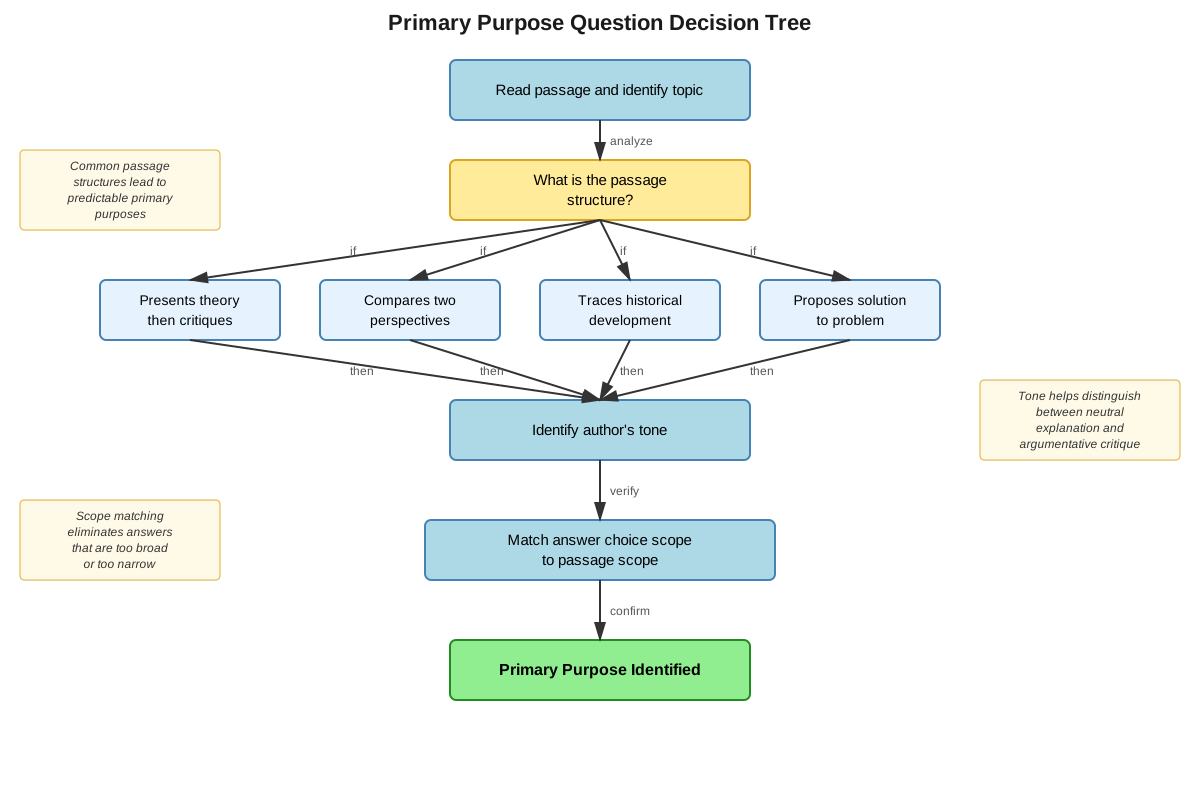
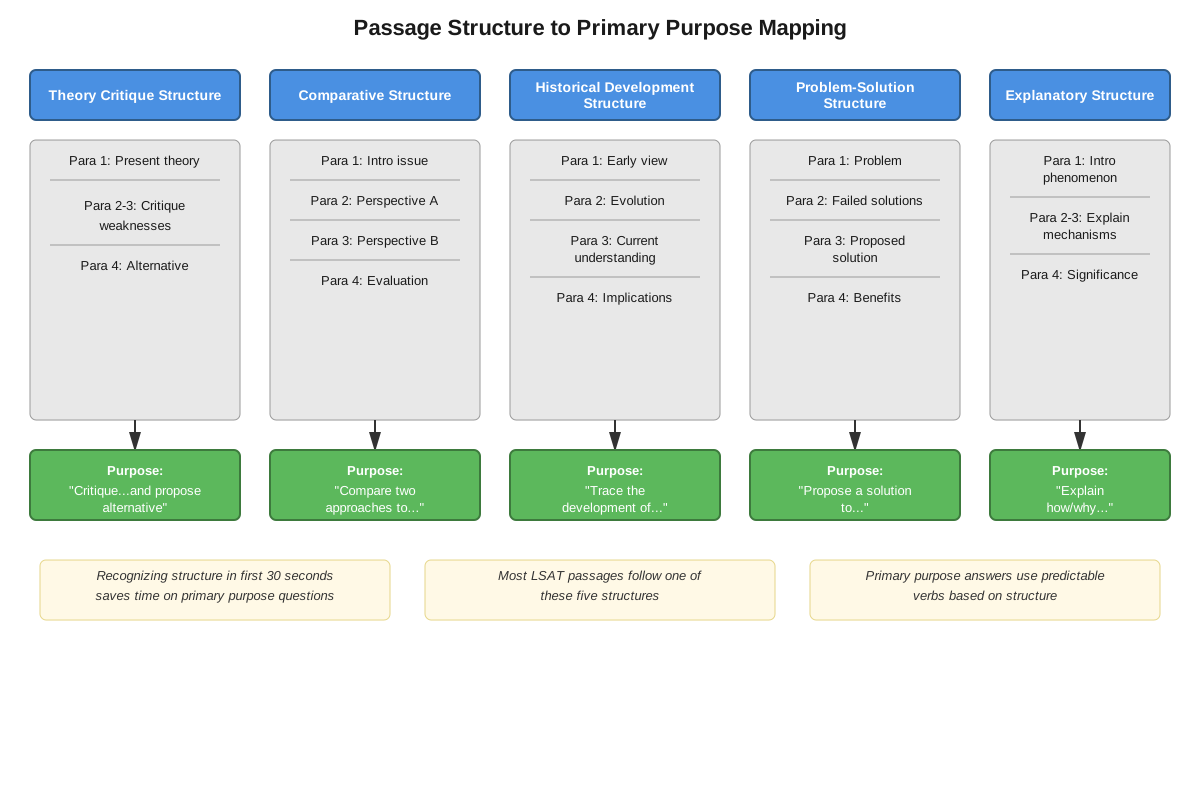
In actual LSAT passages, primary purpose questions commonly appear in several contexts: passages that present and critique a theory, passages that compare two perspectives, passages that trace historical development of an idea, and passages that propose solutions to problems. The ability to quickly categorize a passage's primary purpose allows for more efficient time management and more accurate prediction of likely question types that will follow.
Core Concepts
Defining Primary Purpose Questions
Primary purpose questions ask test-takers to identify the author's main goal or overarching objective in writing the passage. These questions are distinguished by characteristic question stems such as "Which one of the following most accurately expresses the main point of the passage?" or "The primary purpose of the passage is to..." or "The author's central concern in the passage is to..."
The key distinction lies in understanding that primary purpose refers to what the author is doing rather than what the author is saying. While a main point question asks for the central claim or thesis, a primary purpose question asks about the author's intent or function in writing. For example, an author might describe a scientific theory (purpose) while the main point is that the theory has been recently validated (content).
Common Primary Purpose Categories
LSAT passages typically fall into several recognizable primary purpose categories:
| Purpose Category | Description | Typical Indicators |
|---|---|---|
| Explain/Describe | Author presents information about a topic neutrally | "Describes," "explains," "traces the development" |
| Argue/Advocate | Author takes a position and defends it | Strong evaluative language, "argues that," "demonstrates" |
| Critique/Challenge | Author questions or refutes an existing view | "However," "critics argue," "challenges the notion" |
| Compare/Contrast | Author examines similarities and differences | "Unlike," "in contrast," "both approaches" |
| Resolve/Reconcile | Author addresses an apparent contradiction | "Paradox," "seeming inconsistency," "reconciles" |
| Propose | Author suggests a solution or new approach | "Should," "proposes," "recommends" |
Structural Analysis for Primary Purpose
Determining primary purpose requires analyzing passage structure systematically. The most reliable method involves a three-step process:
- Identify the passage type: Determine whether the passage is primarily informative, argumentative, analytical, or narrative
- Map the paragraph functions: Note what each paragraph accomplishes (introduces topic, presents theory, offers critique, provides evidence, etc.)
- Synthesize the overall trajectory: Trace how the passage moves from beginning to end and what the author accomplishes through this movement
The opening paragraph typically introduces the topic and often signals the author's purpose through specific language choices. Middle paragraphs develop the purpose through evidence, examples, or elaboration. The concluding paragraph frequently reinforces or extends the primary purpose, though not always explicitly.
Scope and Generality Matching
A critical skill for primary purpose questions involves matching the scope and level of generality between the passage and answer choices. The correct answer must be:
- Comprehensive enough to cover all major elements of the passage
- Specific enough to exclude topics not discussed
- Appropriately general without being vague or overly detailed
For example, if a passage discusses three different theories about language acquisition, an answer stating "to describe various approaches to understanding language acquisition" matches appropriate scope, while "to explain Chomsky's theory of universal grammar" is too narrow (covers only one theory) and "to discuss human cognition" is too broad (language acquisition is only one aspect of cognition).
Tone and Purpose Alignment
The author's tone—their attitude toward the subject matter—provides crucial evidence for determining primary purpose. An author writing with an objective, neutral tone likely has a descriptive or explanatory purpose. An author using evaluative language ("unfortunately," "remarkably," "misguided") likely has an argumentative or critical purpose.
Common tone indicators include:
- Neutral/Objective: "examines," "describes," "presents"
- Positive/Supportive: "demonstrates," "establishes," "validates"
- Critical/Skeptical: "challenges," "questions," "refutes"
- Balanced/Analytical: "evaluates," "assesses," "weighs"
Wrong Answer Patterns
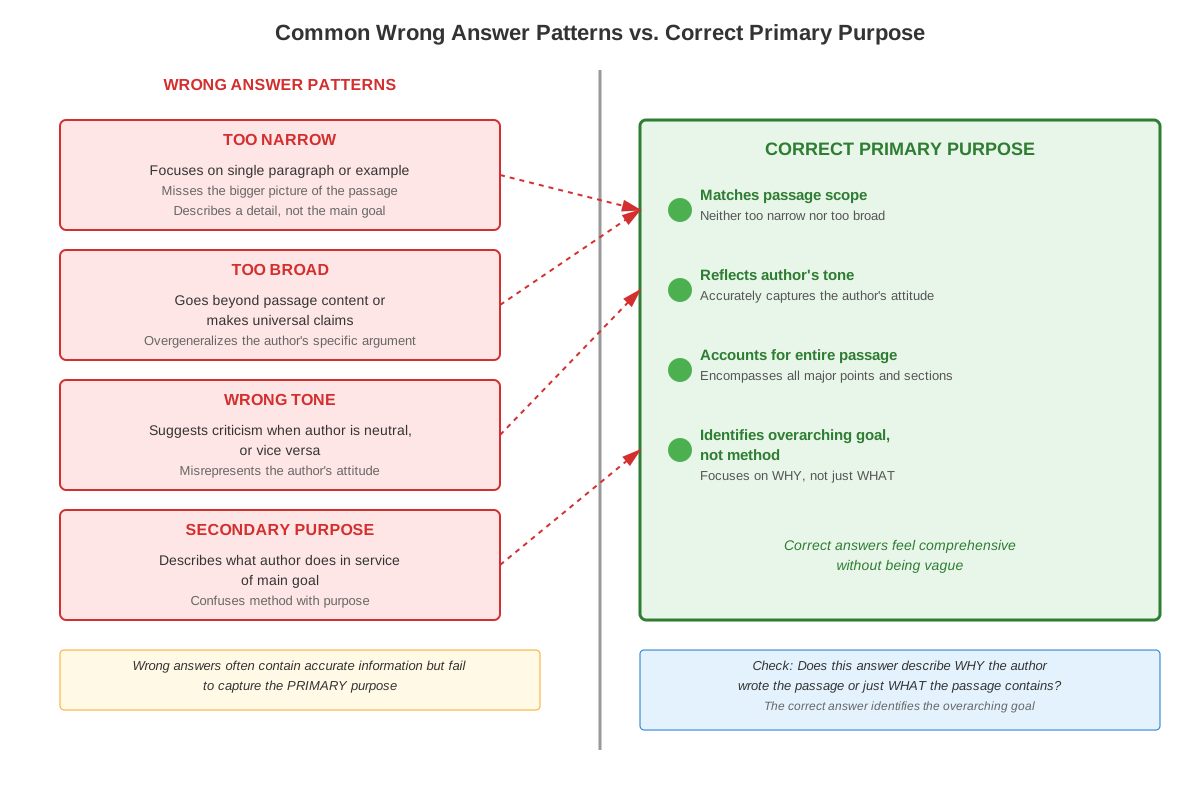
Primary purpose questions feature predictable wrong answer patterns:
Too Narrow: Focuses on a detail or single paragraph rather than the entire passage
Too Broad: Describes a general topic area without capturing the specific purpose
Reverses Emphasis: Treats a secondary point as primary or vice versa
Distorts Tone: Mischaracterizes the author's attitude (e.g., suggesting criticism when the author is supportive)
Mentions Unmentioned Elements: Includes topics or purposes not present in the passage
Confuses Means and Ends: Describes a method the author uses rather than the ultimate purpose
Concept Relationships
Primary purpose questions sit at the intersection of multiple reading comprehension skills. Understanding passage structure provides the framework for identifying purpose—recognizing how paragraphs function together reveals what the author aims to accomplish. Tone analysis feeds directly into purpose determination, as the author's attitude signals their intent. Scope recognition enables test-takers to eliminate answers that are too broad or too narrow.
The relationship flows as follows: Passage Structure Analysis → Paragraph Function Identification → Overall Purpose Synthesis → Answer Choice Evaluation. Each step builds on the previous one, creating a systematic approach to these questions.
Primary purpose questions also connect to other question types. Main point questions ask what the author says (the central claim), while primary purpose questions ask what the author does (the intent). Organization questions examine how the passage is structured, which directly supports understanding why it was written. Tone questions assess the author's attitude, which aligns with and supports the primary purpose.
Understanding these relationships creates efficiency: work done to answer a primary purpose question provides a foundation for answering subsequent questions about the same passage, particularly those involving structure, tone, and main ideas.
High-Yield Facts
⭐ Primary purpose questions appear in approximately 15-20% of all LSAT Reading Comprehension questions, making them one of the most frequently tested question types
⭐ The correct answer to a primary purpose question must account for the entire passage, not just one or two paragraphs
⭐ Primary purpose asks what the author DOES (function/intent), while main point asks what the author SAYS (central claim)
⭐ The first and last paragraphs typically provide the strongest clues about primary purpose
⭐ Wrong answers often focus on supporting details rather than overarching purpose
- Primary purpose questions commonly use stems including "primary purpose," "main point," "central concern," and "primarily in order to"
- Neutral, descriptive passages typically have purposes like "describe," "explain," or "trace the development"
- Argumentative passages typically have purposes like "argue," "advocate," "challenge," or "refute"
- The correct answer must match both the scope and tone of the passage
- Comparative passages (Passage A and Passage B) often have purposes related to contrasting viewpoints or approaches
- Authors rarely have multiple primary purposes—the correct answer identifies the single overarching goal
- Passages that present a problem typically have purposes involving proposing solutions or analyzing causes
Quick check — test yourself on Primary purpose questions so far.
Try Flashcards →Common Misconceptions
Misconception: Primary purpose and main point are the same thing → Correction: Primary purpose identifies the author's functional goal (what they're doing), while main point identifies the central claim (what they're saying). A passage might describe a theory (purpose) while arguing that the theory is flawed (main point).
Misconception: The primary purpose is always stated explicitly in the passage → Correction: Authors rarely state their purpose directly. Test-takers must infer purpose from passage structure, tone, and content. The purpose must be synthesized from the overall trajectory of the passage.
Misconception: If a topic is discussed extensively, it must be the primary purpose → Correction: Extensive discussion of a topic doesn't necessarily indicate primary purpose. An author might discuss a theory at length in order to critique it—the purpose is critique, not description of the theory.
Misconception: The correct answer should use sophisticated or technical language → Correction: Correct answers are often stated in straightforward, clear language. Overly complex or jargon-filled answer choices are frequently wrong answers designed to sound impressive.
Misconception: Primary purpose can be determined from reading only the first paragraph → Correction: While the opening paragraph provides important clues, determining primary purpose requires reading the entire passage to understand how it develops and concludes. The purpose becomes fully clear only after seeing the complete argumentative or explanatory arc.
Misconception: Every paragraph must directly relate to the primary purpose → Correction: While all paragraphs should support the overall purpose, some may provide background, address counterarguments, or offer tangential but relevant information. The primary purpose encompasses the passage's overall trajectory, not every individual detail.
Worked Examples
Example 1: Explanatory Science Passage
Passage Summary: A passage discusses the discovery of extremophiles (organisms living in extreme environments), describes several types found in various locations, explains how their existence has changed scientific understanding of life's requirements, and concludes by noting implications for the search for extraterrestrial life.
Question: The primary purpose of the passage is to
Answer Choices:
(A) argue that extremophiles provide definitive evidence of extraterrestrial life
(B) describe the discovery of extremophiles and explain their significance for scientific understanding
(C) compare different types of extremophiles found in various extreme environments
(D) challenge the traditional scientific view that life requires moderate conditions
(E) trace the historical development of microbiology as a scientific discipline
Analysis:
Step 1 - Identify passage type: This is an explanatory/informative passage with a neutral tone. The author presents information without taking a strong argumentative stance.
Step 2 - Map paragraph functions:
- Paragraph 1: Introduces extremophiles and their discovery
- Paragraph 2: Describes specific types and locations
- Paragraph 3: Explains how they changed scientific understanding
- Paragraph 4: Discusses implications for astrobiology
Step 3 - Evaluate scope and tone of each answer:
(A) Too strong and narrow: The passage mentions implications for searching for extraterrestrial life but doesn't argue for "definitive evidence." This overstates the author's claim and focuses only on the final paragraph.
(B) CORRECT: This matches the passage's scope (covers discovery and significance), tone (neutral "describe" and "explain"), and comprehensiveness (accounts for all major elements). The passage does describe extremophiles and explain why they matter scientifically.
(C) Too narrow: While the passage does compare types of extremophiles, this is only one paragraph's function, not the overarching purpose. This answer focuses on means (comparison) rather than ends (explaining significance).
(D) Distorts tone: "Challenge" suggests a more argumentative purpose than the passage exhibits. The author presents information about how understanding evolved rather than actively challenging a view.
(E) Too broad: The passage focuses specifically on extremophiles, not the entire field of microbiology. This answer fails to capture the specific focus of the passage.
Key Takeaway: The correct answer (B) uses appropriately neutral verbs ("describe," "explain"), covers the full scope of the passage, and captures both what the passage discusses (extremophiles) and why it matters (their significance).
Example 2: Argumentative Legal Passage
Passage Summary: A passage begins by describing a traditional legal doctrine, presents criticisms from recent scholars who argue the doctrine is outdated, provides examples of cases where the doctrine led to unjust outcomes, and concludes by advocating for reform of the doctrine.
Question: The author's primary purpose in the passage is to
Answer Choices:
(A) describe a legal doctrine and present arguments for its reform
(B) trace the historical development of a legal principle
(C) compare traditional and modern approaches to legal interpretation
(D) explain why a legal doctrine has remained unchanged despite criticism
(E) analyze the philosophical foundations of contemporary legal theory
Analysis:
Step 1 - Identify passage type: This is an argumentative passage. The author takes a position (the doctrine should be reformed) and supports it with evidence (criticisms and examples of unjust outcomes).
Step 2 - Map paragraph functions:
- Paragraph 1: Describes the traditional doctrine (background)
- Paragraph 2: Presents scholarly criticisms (supporting evidence)
- Paragraph 3: Provides case examples (supporting evidence)
- Paragraph 4: Advocates for reform (conclusion/main argument)
Step 3 - Evaluate answers:
(A) CORRECT: This answer captures both major components—describing the doctrine (paragraphs 1-3) and presenting arguments for reform (paragraphs 2-4). The phrase "present arguments for" appropriately captures the argumentative tone while acknowledging that the passage includes descriptive elements.
(B) Too narrow and wrong focus: The passage mentions the doctrine is "traditional" but doesn't trace its historical development. This answer focuses on something the passage doesn't do.
(C) Mischaracterizes structure: While the passage mentions traditional doctrine and modern criticisms, it's not structured as a balanced comparison. The purpose is advocacy, not comparison.
(D) Reverses the passage's point: The passage argues the doctrine SHOULD change, not explaining why it hasn't changed. This fundamentally misunderstands the author's intent.
(E) Too broad and off-topic: The passage focuses on one specific doctrine, not legal theory generally. "Philosophical foundations" also suggests a more abstract discussion than the passage provides.
Key Takeaway: The correct answer (A) acknowledges both the descriptive setup (necessary background) and the argumentative purpose (the author's ultimate goal). It uses "present arguments for" rather than simply "advocate," which accurately reflects that the author builds a case rather than merely asserting a position.
Exam Strategy
Systematic Approach to Primary Purpose Questions
Before reading answer choices, formulate a prediction by asking:
- What did the author DO in this passage? (describe, argue, critique, compare, etc.)
- What was the author's main topic or focus?
- What was the author's tone? (neutral, critical, supportive, balanced)
Combine these elements into a simple statement: "The author [verb] [topic] in order to [ultimate goal]." For example: "The author describes a scientific theory in order to explain its recent validation."
Trigger Words in Question Stems
Recognize these common phrasings for primary purpose questions:
- "The primary purpose of the passage is to..."
- "The author's main purpose in writing the passage is to..."
- "Which one of the following most accurately expresses the main point of the passage?"
- "The passage is primarily concerned with..."
- "The author's central concern in the passage is to..."
Exam Tip: Primary purpose questions often appear as the first or second question in a passage set. Answering them correctly provides a framework for subsequent questions.
Process of Elimination Strategy
Eliminate answers that:
- Focus on a single paragraph or detail (too narrow)
- Could apply to many passages on the general topic (too broad)
- Mention elements not discussed in the passage (out of scope)
- Mischaracterize the author's tone (wrong attitude)
- Confuse supporting points with primary purpose (wrong emphasis)
Keep answers that:
- Account for all major paragraphs
- Match the author's tone
- Use appropriately general language
- Capture both what is discussed and why
Time Management
Allocate approximately 45-60 seconds to primary purpose questions. These questions reward careful initial reading more than extended deliberation. If the passage was read actively with attention to structure, the correct answer should be recognizable quickly. If struggling between two answers, return to the passage's first and last paragraphs to confirm which answer better captures the overall trajectory.
Comparative Passages Strategy
For Passage A/Passage B questions asking about primary purpose:
- First determine each passage's individual purpose
- Then identify the relationship between purposes (agreement, disagreement, different aspects of same topic)
- The correct answer often involves "contrast," "compare," or "present different perspectives on"
Memory Techniques
PURPOSE Acronym
Paragraph functions - Map what each paragraph does
Understand the tone - Identify author's attitude
Read first and last carefully - These reveal overall intent
Predict before looking - Formulate your own answer
Overall scope matters - Must cover entire passage
Supporting details aren't primary - Focus on overarching goal
Eliminate mismatches - Remove answers that fail any criterion
The "Doing vs. Saying" Distinction
Visualize the author as a person with a goal. Primary purpose = what they're doing (their action/intent). Main point = what they're saying (their message/claim). When stuck, ask: "If I met this author, what would they say they were trying to accomplish by writing this?"
Scope Visualization
Imagine three concentric circles:
- Outer circle (too broad): General topic area
- Middle circle (correct scope): Specific focus of this passage
- Inner circle (too narrow): Individual details or paragraphs
The correct answer sits in the middle circle—specific enough to capture this passage's unique focus, general enough to encompass all major elements.
Summary
Primary purpose questions test the ability to identify an author's overarching goal in writing a passage, distinguishing between what the author discusses and why the passage was written. Success requires synthesizing passage structure, tone, and content to determine authorial intent. The correct answer must match the passage's scope (neither too broad nor too narrow), align with the author's tone, and account for all major elements of the passage. Common wrong answers focus on supporting details, mischaracterize tone, or fail to capture the complete scope. A systematic approach involves mapping paragraph functions, identifying passage type, and predicting the purpose before evaluating answer choices. These questions appear frequently on the LSAT (15-20% of Reading Comprehension questions) and provide a strategic advantage when answered correctly, as they establish a framework for understanding subsequent questions about the same passage.
Key Takeaways
- Primary purpose questions ask what the author DOES (function/intent), not what the author SAYS (central claim)
- The correct answer must account for the entire passage, matching both scope and tone
- First and last paragraphs typically provide the strongest clues about primary purpose
- Common wrong answers focus on supporting details, are too broad/narrow, or mischaracterize tone
- Predicting the purpose before reading answer choices improves accuracy and efficiency
- These questions appear in 15-20% of Reading Comprehension questions, making them high-yield for LSAT preparation
- Success with primary purpose questions enhances performance on related question types including main point, organization, and tone questions
Related Topics
Main Point Questions: While primary purpose identifies authorial intent, main point questions ask for the central claim or thesis. Mastering primary purpose provides a foundation for distinguishing between these closely related question types.
Passage Organization Questions: These questions explicitly test understanding of passage structure, which is the same skill used to determine primary purpose. Success with primary purpose questions directly transfers to organization questions.
Tone and Attitude Questions: Identifying the author's tone is a component of determining primary purpose. These question types reinforce each other, as tone provides evidence for purpose.
Function Questions: These ask about the role of specific paragraphs or sentences within the passage. Understanding how individual parts contribute to overall purpose helps answer both question types.
Comparative Reading: Passages A and B questions often ask about the relationship between two authors' purposes, requiring application of primary purpose analysis to multiple texts simultaneously.
Practice CTA
Now that you understand the systematic approach to primary purpose questions, it's time to apply these strategies to actual LSAT passages. Work through the practice questions, focusing on predicting the purpose before evaluating answer choices and eliminating answers that fail the scope, tone, or comprehensiveness tests. Pay special attention to how the first and last paragraphs signal authorial intent. Remember: these questions appear frequently and provide a strategic advantage for the entire passage set—mastering them is one of the highest-yield investments in your LSAT preparation. Challenge yourself to articulate why wrong answers fail and why the correct answer succeeds for each practice question you attempt.
Sign up free to keep reading
Create a free AnvayaPrep account to finish this LSAT guide on Primary purpose questions — plus flashcards and practice questions.