Overview
In LSAT Reading Comprehension passages, authors rarely present a single, monolithic perspective. Instead, passages frequently introduce multiple viewpoints on a topic, with one perspective serving as the primary focus and others functioning as contrasting or complementary positions. An alternative view represents any perspective, theory, interpretation, or position that differs from the main argument or dominant viewpoint presented in a passage. Understanding how to identify and analyze alternative views is crucial for success on the LSAT, as test-makers consistently design questions that require students to distinguish between competing perspectives, understand the relationships among different viewpoints, and recognize how authors position alternative views within their argumentative framework.
The ability to track viewpoints and argumentation through complex passages separates high-scoring test-takers from those who struggle with reading comprehension. Alternative views serve multiple rhetorical functions: they may represent positions the author ultimately refutes, theories that complement the main argument, historical perspectives that have been superseded, or competing interpretations that remain unresolved. The LSAT tests whether students can accurately identify these different functions and understand how alternative views contribute to the passage's overall argumentative structure. This skill extends beyond simple identification—students must grasp the logical relationships between views, recognize the evidence supporting each perspective, and understand the author's attitude toward each position presented.
Mastering alternative views connects directly to broader Reading Comprehension competencies, including understanding passage structure, identifying main ideas, recognizing author's tone and purpose, and analyzing argumentative techniques. When students can effectively track multiple viewpoints through a passage, they gain the analytical framework necessary to answer the most challenging question types, including those asking about passage organization, author's attitude, comparative relationships between perspectives, and the function of specific paragraphs or details within the broader argumentative context.
Learning Objectives
- [ ] Identify how Alternative view appears in LSAT questions
- [ ] Explain the reasoning pattern behind Alternative view
- [ ] Apply Alternative view to solve LSAT-style problems accurately
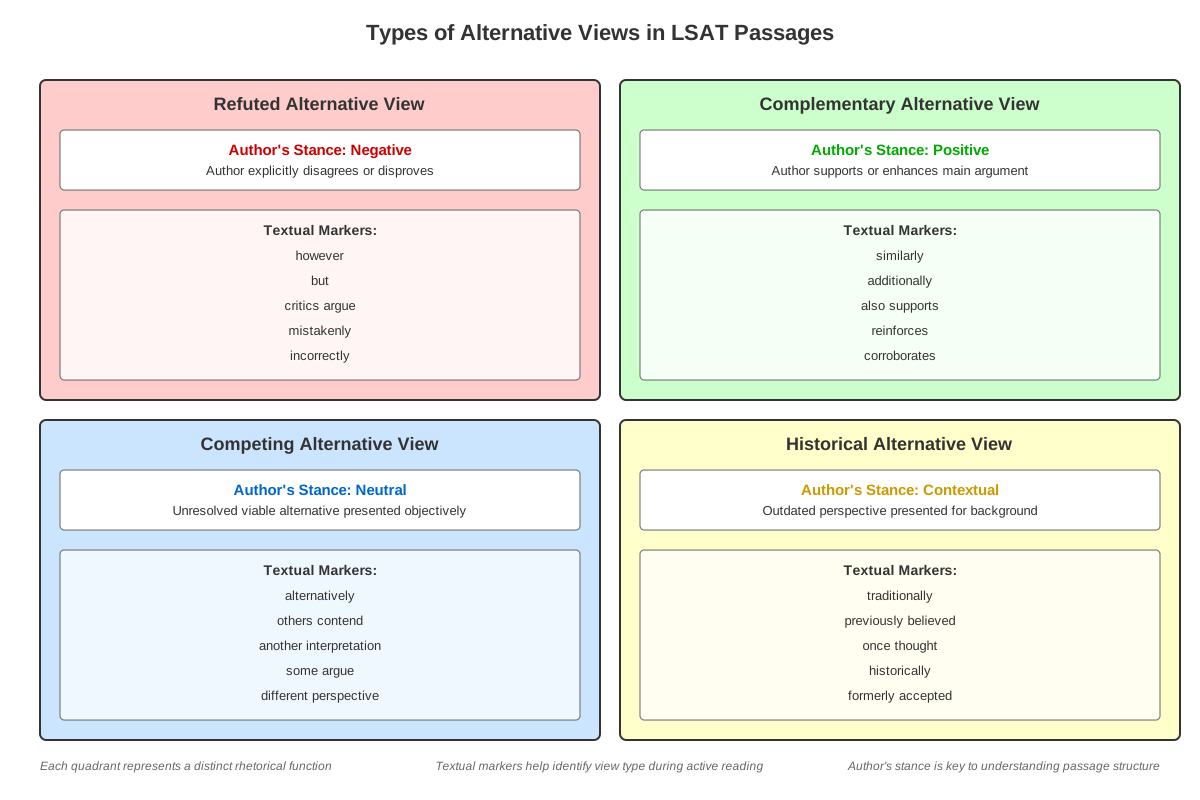
- [ ] Distinguish between different types of alternative views (refuted, complementary, competing, historical)
- [ ] Analyze the rhetorical function of alternative views within passage structure
- [ ] Evaluate the author's attitude toward alternative views using textual evidence
- [ ] Synthesize information from multiple viewpoints to answer comparative questions
Prerequisites
- Basic passage structure recognition: Understanding how LSAT passages are organized into introduction, body, and conclusion helps identify where alternative views typically appear
- Author's tone and attitude identification: Recognizing whether an author supports, opposes, or remains neutral toward ideas is essential for understanding their relationship to alternative views
- Main idea comprehension: Distinguishing the primary argument from secondary or opposing viewpoints requires first identifying what the passage's central claim actually is
- Evidence and support recognition: Understanding how authors use evidence to support or refute positions enables analysis of how alternative views are treated
Why This Topic Matters
Alternative views appear in approximately 70-80% of LSAT Reading Comprehension passages, making this one of the most frequently tested concepts on the exam. The LSAT consistently includes passages from law, humanities, social sciences, and natural sciences that present scholarly debates, competing theories, evolving interpretations, or contrasting methodological approaches. Questions explicitly testing alternative views account for 15-20% of all Reading Comprehension questions, but the skill of tracking multiple viewpoints implicitly supports success on an even larger percentage of questions, including those about passage structure, author's purpose, and inference.
In real-world legal practice, attorneys must constantly analyze competing arguments, understand opposing counsel's positions, identify weaknesses in alternative interpretations, and construct persuasive arguments that acknowledge and address contrary viewpoints. The LSAT's emphasis on alternative views directly reflects this professional necessity. Law school coursework similarly requires students to engage with dissenting opinions, competing legal theories, and evolving interpretations of precedent—all skills that begin with the ability to track and analyze multiple perspectives in complex texts.
Common manifestations of alternative views in LSAT passages include: scientific theories that challenge established paradigms, historical interpretations that revise previous understandings, legal scholars debating constitutional interpretation, critics responding to artistic movements, competing explanations for social phenomena, and methodological debates within academic disciplines. Test-makers favor passages where the author presents an alternative view either to refute it, to synthesize it with other perspectives, to trace intellectual history, or to present an unresolved scholarly debate. Recognizing these patterns enables strategic reading and more efficient question-answering.
Core Concepts
Defining Alternative Views in LSAT Context
An alternative view in LSAT alternative view questions refers to any perspective, interpretation, theory, explanation, or position that differs from another viewpoint presented in the passage—most commonly the author's main argument or the dominant theory under discussion. Alternative views are not merely tangential details; they represent substantive positions on the passage's central topic that offer different explanations, interpretations, or evaluations. These views may be explicitly labeled with phrases like "critics argue," "an opposing theory suggests," "traditional interpretations held," or "some scholars contend," but they may also be presented more subtly through reported speech, conditional statements, or historical contextualization.
The key characteristic distinguishing alternative views from mere supporting details is that they represent coherent positions with their own internal logic and evidentiary basis. An alternative view isn't simply a fact that contradicts another fact; it's a framework for understanding or interpreting information. For example, if a passage discusses climate change, an alternative view wouldn't be a single contradictory data point but rather a comprehensive theory explaining climate patterns differently than the main theory presented.
Types of Alternative Views
LSAT passages present alternative views in several distinct configurations, each serving different rhetorical purposes:
Refuted Alternative Views: The author presents a position specifically to argue against it. These views often appear early in passages, establishing what the author believes to be incorrect before presenting their own position. Signal phrases include "traditionally believed," "the conventional wisdom," "critics mistakenly argue," or "the prevailing view fails to account for." The author typically follows these presentations with counterevidence, logical objections, or demonstrations of inadequacy.
Complementary Alternative Views: Some passages present multiple perspectives that aren't in direct conflict but rather address different aspects of a phenomenon or represent different levels of analysis. For instance, a passage might present both a biological and a cultural explanation for human behavior, with the author suggesting both contribute to a complete understanding. These views coexist rather than compete.
Competing Unresolved Views: Many passages present scholarly debates where the author doesn't definitively endorse one position over others. Instead, the author may explain the merits and limitations of each view, describe the evidence supporting each, or simply present the state of current debate. The author's role becomes that of an explainer rather than an advocate.
Historical or Superseded Views: Passages frequently trace intellectual history, presenting views that were once dominant but have been replaced by newer understandings. These alternative views serve to contextualize current thinking and demonstrate intellectual progress or paradigm shifts within a field.
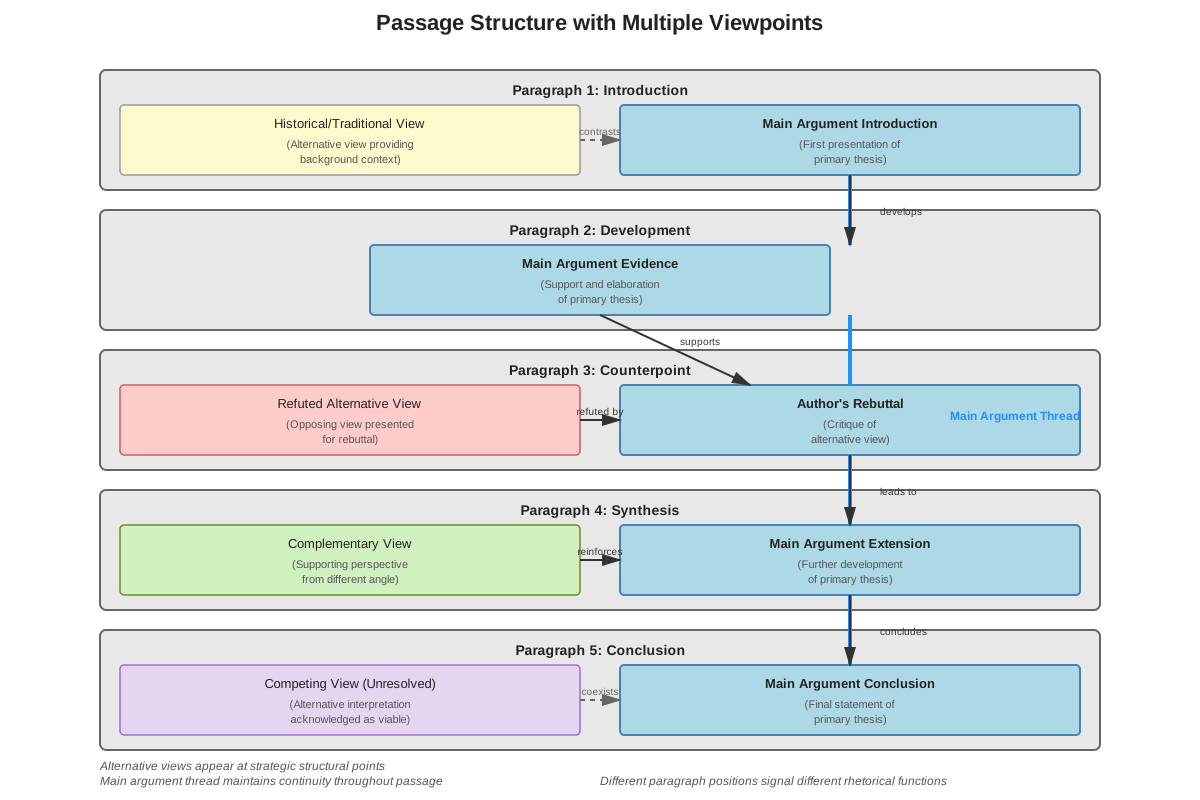
Structural Positions of Alternative Views
Understanding where alternative views typically appear helps with strategic reading and passage mapping:
| Passage Location | Common Function | Example Signal |
|---|---|---|
| Opening paragraph | Establish conventional wisdom to be challenged | "For decades, scholars believed..." |
| Second paragraph | Present opposing view after stating main idea | "Critics of this approach argue..." |
| Middle paragraphs | Introduce competing theories in scholarly debate | "An alternative explanation suggests..." |
| Before conclusion | Present final objection to be addressed | "Some might object that..." |
| Throughout | Integrate multiple perspectives in synthesis | "While X argues..., Y contends..." |
Author's Relationship to Alternative Views
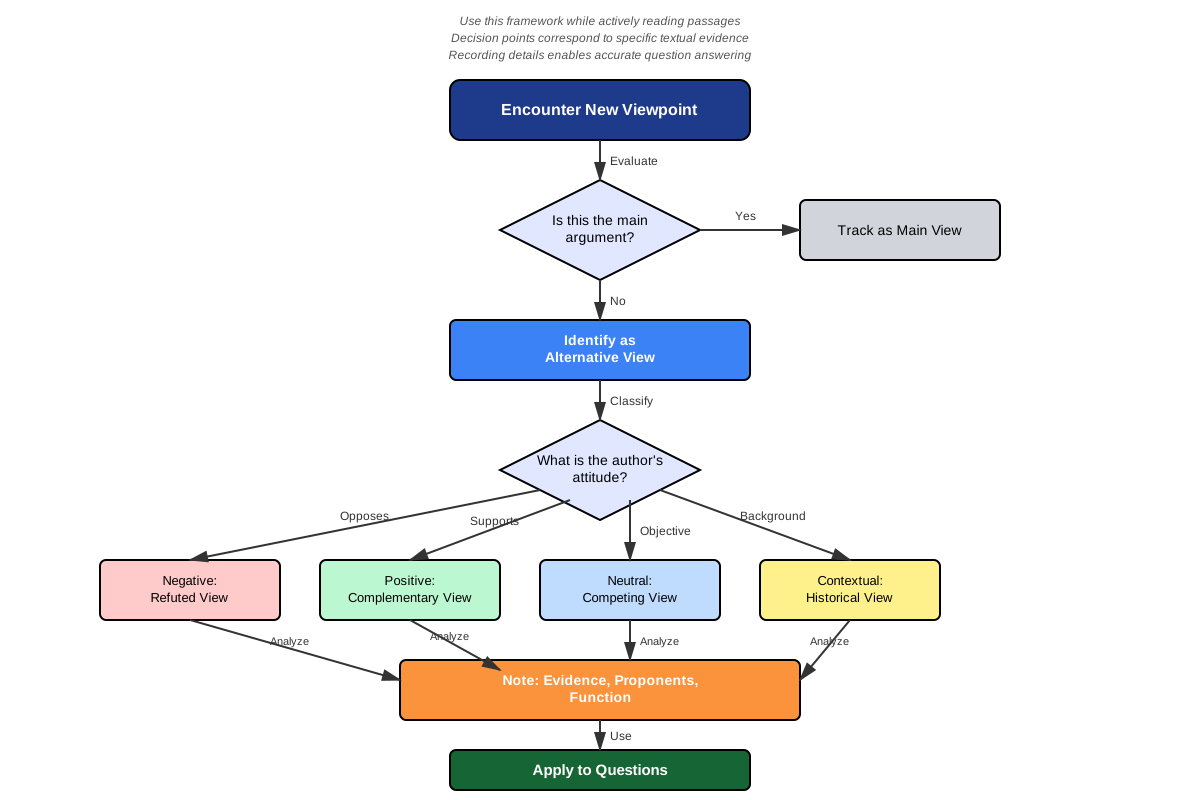
The author's attitude toward alternative views exists on a spectrum and significantly affects how students should understand the passage's argumentative structure:
Explicit Opposition: The author clearly disagrees with the alternative view, using language like "mistakenly," "fails to recognize," "overlooks," or "inadequately addresses." The passage structure typically involves presenting the alternative view, then systematically refuting it with evidence or logical argument.
Qualified Acceptance: The author acknowledges merit in an alternative view while suggesting limitations or necessary modifications. Signal phrases include "while X correctly identifies," "although this view captures," or "this perspective usefully highlights, but..."
Neutral Presentation: The author acts as a reporter of scholarly debate without clearly endorsing any position. The language remains descriptive rather than evaluative, using phrases like "proponents argue," "this school of thought maintains," or "scholars disagree about."
Synthetic Integration: The author suggests that multiple views each capture partial truth and proposes integrating insights from various perspectives. This approach often appears in passages discussing interdisciplinary topics or complex phenomena requiring multiple explanatory frameworks.
Identifying Alternative Views Through Textual Markers
Successful test-takers develop sensitivity to linguistic signals that introduce alternative views:
Attribution phrases: "According to critics," "Some scholars argue," "Opponents contend," "Traditional interpretations suggest," "An alternative school of thought maintains"
Contrast markers: "However," "In contrast," "On the other hand," "Conversely," "Nevertheless," "Despite this view"
Temporal markers indicating change: "Previously," "Historically," "Until recently," "The traditional view," "Earlier theories"
Hedging language indicating distance: "Supposedly," "Allegedly," "Purportedly," "It is claimed that," "The assumption that"
Conditional or hypothetical framing: "If one accepts," "Assuming that," "From this perspective," "Under this interpretation"
Functional Analysis of Alternative Views
Beyond identification, the LST tests whether students understand why authors include alternative views. Common functions include:
Establishing stakes: Showing what's at issue in a debate and why the author's position matters
Demonstrating expertise: Proving the author understands the full landscape of scholarly discussion
Strengthening the main argument: Refuting alternatives makes the author's position more persuasive by comparison
Providing context: Showing how current understanding evolved from or differs from previous thinking
Acknowledging complexity: Demonstrating that the topic involves legitimate disagreement and multiple valid considerations
Setting up synthesis: Presenting components that will be integrated into a more comprehensive view
Concept Relationships
Alternative views exist within a network of interconnected Reading Comprehension concepts. The relationship begins with passage structure recognition → which enables identification of alternative views → which requires understanding author's attitude → which supports analyzing argumentative techniques → which enables answering complex inference questions.
The connection to viewpoints and argumentation is direct: alternative views represent the "viewpoints" component, while understanding how authors use these views (to refute, support, contextualize, or synthesize) represents the "argumentation" component. Together, these skills enable students to map the logical architecture of complex passages.
Alternative views connect to main idea identification through contrast—understanding what the author opposes or distinguishes their position from clarifies what the author actually advocates. They connect to tone and attitude because recognizing whether an author supports, opposes, or remains neutral toward an alternative view requires careful attention to evaluative language and rhetorical positioning.
The relationship to evidence and support is bidirectional: authors present evidence both for and against alternative views, and students must track which evidence supports which position. This connects to inference questions because students must often infer the logical implications of accepting one view over another or predict what proponents of different views would likely argue about new scenarios.
Finally, alternative views connect to comparative reading passages (when two passages are presented together), where each passage may itself represent an alternative view to the other, requiring students to analyze relationships between entire texts rather than just within a single passage.
High-Yield Facts
⭐ Alternative views appear in 70-80% of LSAT Reading Comprehension passages, making them one of the most frequently tested concepts
⭐ The author's attitude toward an alternative view (supportive, opposed, neutral, qualified) is more important than the content of the view itself for answering many questions
⭐ Alternative views most commonly appear in the first or second paragraph, establishing context for the author's main argument
⭐ Signal phrases like "critics argue," "traditionally believed," and "an opposing view suggests" reliably indicate alternative views
⭐ Questions asking about "the author would most likely agree" often require distinguishing the author's view from alternative views presented
- Alternative views may be presented without explicit signal phrases, requiring inference from context and passage structure
- The same passage may contain multiple alternative views serving different rhetorical functions
- Historical or superseded views are alternative views even if no contemporary scholars hold them
- An alternative view may be correct within the passage's framework—"alternative" doesn't mean "wrong"
- Questions about passage organization frequently test whether students recognize where and why alternative views appear
- The evidence supporting an alternative view is distinct from evidence supporting the main argument; tracking which evidence supports which view is essential
- Authors sometimes present alternative views in conditional language ("if one accepts X, then Y follows") to analyze implications without endorsing the view
- Comparative passages may present alternative views both within each passage and between the two passages
Quick check — test yourself on Alternative view so far.
Try Flashcards →Common Misconceptions
Misconception: Alternative views are always wrong or inferior positions that the author rejects.
Correction: Alternative views serve multiple rhetorical functions. Authors may present alternative views neutrally in scholarly debates, acknowledge their partial validity, or even synthesize them with other perspectives. "Alternative" simply means "different from the main focus," not "incorrect."
Misconception: Any detail that contradicts the main argument is an alternative view.
Correction: Alternative views are coherent positions or interpretive frameworks, not isolated contradictory facts. A single piece of counterevidence isn't an alternative view unless it's presented as part of a broader theoretical position or interpretation.
Misconception: The author's view is always stated first, and alternative views come later.
Correction: Passages frequently open with alternative views (often conventional wisdom or traditional interpretations) before introducing the author's contrasting position. The structural pattern "old view → new view" is extremely common.
Misconception: If the author mentions a view, they must either fully support or completely reject it.
Correction: Authors often take nuanced positions, acknowledging strengths while noting limitations, accepting certain aspects while rejecting others, or presenting views as partially explanatory but incomplete.
Misconception: Alternative views are always explicitly labeled with phrases like "critics argue" or "an opposing view."
Correction: While signal phrases help identify alternative views, skilled authors often present them more subtly through reported speech, historical contextualization, or structural positioning. Students must infer from context when a different perspective is being introduced.
Misconception: Questions about alternative views only ask about the content of those views.
Correction: Questions frequently test the function of alternative views (why the author included them), the relationship between views (how they differ or relate), the author's attitude toward them, or what proponents of different views would likely argue about new scenarios.
Worked Examples
Example 1: Identifying Alternative Views and Author's Attitude
Passage Excerpt:
"For most of the twentieth century, art historians attributed the dramatic shift in Renaissance painting techniques primarily to the rediscovery of classical texts and the influence of humanist philosophy. This interpretation emphasized intellectual and cultural factors as the driving forces behind artistic innovation. Recent scholarship, however, has challenged this view by demonstrating the crucial role of technological developments, particularly advances in pigment chemistry and oil-based media. While the traditional interpretation correctly identifies the cultural context in which Renaissance art flourished, it overlooks the material conditions that made new artistic techniques physically possible. The availability of stable, vibrant pigments and slow-drying oils enabled artists to achieve effects of depth and luminosity that earlier tempera-based techniques could not produce, regardless of the artist's philosophical commitments or classical knowledge."
Analysis:
Step 1: Identify the alternative view
The alternative view is the "traditional interpretation" held by art historians "for most of the twentieth century"—that Renaissance painting innovations resulted primarily from rediscovery of classical texts and humanist philosophy (intellectual/cultural factors).
Step 2: Identify the main view
The main view, introduced as "recent scholarship," argues that technological developments (pigment chemistry and oil-based media) played a crucial role in Renaissance artistic innovation.
Step 3: Determine the author's attitude
The author takes a qualified acceptance position toward the alternative view. The phrase "while the traditional interpretation correctly identifies" acknowledges partial validity, but "it overlooks" indicates limitation. The author isn't completely rejecting the traditional view but rather arguing it's incomplete.
Step 4: Understand the rhetorical function
The alternative view serves to establish the conventional wisdom that the author will modify rather than completely refute. This sets up a synthesis where both cultural context and material conditions matter, but previous scholarship overemphasized one factor.
Step 5: Predict question types
This passage structure would likely generate questions about:
- The author's attitude toward the traditional interpretation (qualified acceptance)
- The primary purpose of the passage (to supplement an incomplete explanation)
- What the traditional interpretation "overlooks" or "fails to account for"
- The relationship between the two views (complementary rather than contradictory)
Example 2: Tracking Multiple Alternative Views
Passage Excerpt:
"Three competing theories attempt to explain the rapid extinction of megafauna in North America approximately 13,000 years ago. The overkill hypothesis attributes extinctions to overhunting by newly arrived human populations, pointing to the temporal correlation between human migration and species disappearance. Critics of this view argue that archaeological evidence of hunting is insufficient to account for continent-wide extinctions and that many species disappeared in regions with minimal human presence. The climate change hypothesis instead emphasizes the dramatic environmental shifts at the end of the Pleistocene epoch, suggesting that megafauna could not adapt quickly enough to changing vegetation patterns and temperature fluctuations. However, this explanation struggles to account for why these species survived previous glacial cycles but not this particular warming period. A third perspective, the hyperdisease hypothesis, proposes that pathogens introduced by humans or their domesticated animals caused epidemic die-offs among immunologically naive megafauna populations. Each theory has evidentiary support, yet none fully explains the extinction pattern's geographic and temporal specificity."
Analysis:
Step 1: Identify all views presented
- Overkill hypothesis (human overhunting)
- Climate change hypothesis (environmental shifts)
- Hyperdisease hypothesis (introduced pathogens)
- Implicit criticism of overkill hypothesis (insufficient archaeological evidence)
- Implicit criticism of climate change hypothesis (previous survival of glacial cycles)
Step 2: Determine the author's stance
The author presents all three theories neutrally, noting strengths and weaknesses of each. The final sentence ("Each theory has evidentiary support, yet none fully explains") indicates the author views this as an unresolved scholarly debate rather than endorsing one position.
Step 3: Understand the relationships among views
These are competing unresolved views—each offers a different primary explanation for the same phenomenon. They're not necessarily mutually exclusive (multiple factors could contribute), but each theory emphasizes a different causal mechanism.
Step 4: Track evidence and objections
- Overkill: Evidence = temporal correlation; Objection = insufficient archaeological evidence
- Climate change: Evidence = environmental shifts; Objection = previous survival of similar changes
- Hyperdisease: Evidence = (implied) epidemic patterns; Objection = (implied) lack of full explanation
Step 5: Predict question applications
Questions might ask:
- Which theory would be most strengthened/weakened by new evidence
- What proponents of each theory would likely argue about a new scenario
- The author's attitude toward the debate (neutral presentation of unresolved question)
- The primary purpose (to present competing explanations for a phenomenon)
- What all theories fail to adequately explain (geographic and temporal specificity)
Exam Strategy
Initial Reading Strategy: During the first read-through, actively mark alternative views with notation like "AV1," "AV2," or "trad view," "new view." Note the author's attitude with symbols like "+" (supports), "-" (opposes), or "~" (neutral/qualified). This creates a visual map of viewpoints that saves time when answering questions.
Trigger Words and Phrases: Train yourself to slow down and pay extra attention when encountering:
- Attribution phrases: "critics argue," "proponents contend," "scholars suggest"
- Temporal markers: "traditionally," "historically," "recently," "until now"
- Contrast markers: "however," "in contrast," "on the other hand," "nevertheless"
- Hedging language: "supposedly," "allegedly," "it is claimed"
- Conditional framing: "if one accepts," "from this perspective"
Question Stem Recognition: Certain question types reliably test alternative views:
- "The author's attitude toward [alternative view] is best described as..."
- "According to the passage, critics of [main view] argue that..."
- "The author mentions [alternative view] primarily in order to..."
- "With which of the following would the author most likely agree?"
- "The passage suggests that proponents of [alternative view] would most likely..."
Process of Elimination Tips:
- Eliminate answer choices that confuse which view is the author's and which is alternative
- Eliminate choices that mischaracterize the author's attitude (too extreme in either direction)
- Eliminate choices that attribute evidence to the wrong view
- Watch for choices that accurately describe an alternative view but incorrectly suggest the author endorses it
Time Allocation: Spend extra time during initial reading identifying and understanding the relationships among viewpoints—this investment pays off by making questions faster to answer. For passages with multiple alternative views, spend 15-20 seconds after reading creating a mental or written map of who argues what.
Common Question Traps:
- Answer choices that accurately describe an alternative view but ask about the author's view
- Choices that correctly identify that an alternative view exists but misstate its content
- Choices that confuse the function of an alternative view (why it's included) with its content (what it says)
- Choices that present the author's attitude as more extreme than textual evidence supports
Strategic Approach for Comparative Questions: When questions ask what proponents of different views would likely argue about a new scenario, return to the passage to identify the core principle or reasoning pattern of each view, then apply that principle to the new situation rather than relying on memory.
Memory Techniques
CRAFT Acronym for Alternative View Functions:
- Contrast: Highlighting differences with the main view
- Refute: Setting up a position to argue against
- Acknowledge: Showing awareness of other perspectives
- Frame: Providing historical or intellectual context
- Test: Exploring implications of different positions
The "View Map" Visualization: Picture the passage as a landscape with different territories representing different views. The author is a guide leading you through this landscape, sometimes pointing out territories they think are problematic, sometimes suggesting multiple territories have value, sometimes advocating for one territory over others. This spatial metaphor helps track multiple perspectives.
Attitude Spectrum Mnemonic - "NOSE":
- Neutral: Author presents without judgment
- Opposed: Author argues against the view
- Supportive: Author endorses the view
- Equivocal: Author sees both strengths and limitations
Signal Phrase Categories - "CATCH":
- Contrast words (however, nevertheless, in contrast)
- Attribution phrases (critics argue, scholars contend)
- Temporal markers (traditionally, historically, recently)
- Conditional framing (if one accepts, from this perspective)
- Hedging language (supposedly, allegedly, purportedly)
The "Three Questions" for Every Alternative View:
- What is the alternative view? (content)
- Why did the author include it? (function)
- How does the author feel about it? (attitude)
Answering these three questions for each alternative view creates a complete understanding that addresses most question types.
Summary
Alternative views represent perspectives, theories, or interpretations that differ from the main argument or dominant viewpoint in LSAT Reading Comprehension passages. Mastering this concept requires three interconnected skills: identifying when alternative views appear through structural position and linguistic signals, understanding the rhetorical function these views serve within the passage's argumentative framework, and accurately determining the author's attitude toward each view presented. Alternative views may be refuted, acknowledged as partially valid, presented neutrally in scholarly debates, or integrated into synthetic arguments. They typically appear in opening or early paragraphs, often introduced by attribution phrases, contrast markers, or temporal indicators. Success on LSAT questions requires distinguishing the author's position from alternative views, tracking which evidence supports which perspective, and understanding why authors include alternative views—whether to establish context, refute opposing positions, demonstrate complexity, or present unresolved debates. The ability to map multiple viewpoints through complex passages and maintain clarity about relationships among perspectives is essential for high performance on Reading Comprehension questions, particularly those testing passage structure, author's attitude, and comparative reasoning.
Key Takeaways
- Alternative views appear in 70-80% of LSAT passages and are tested directly or indirectly in the majority of Reading Comprehension questions
- Identifying alternative views requires attention to structural position, attribution phrases, contrast markers, and temporal indicators
- The author's attitude toward alternative views (opposed, supportive, neutral, qualified) is often more important for answering questions than the content of the views themselves
- Alternative views serve multiple rhetorical functions: establishing context, setting up refutation, acknowledging complexity, presenting scholarly debates, or providing components for synthesis
- Success requires distinguishing which evidence supports which view and avoiding the common trap of confusing the author's position with alternative views presented in the passage
- Strategic reading involves actively mapping viewpoints during initial passage reading, creating a mental or written guide to who argues what and how the author positions each view
- Questions about alternative views frequently test function (why included), relationships (how views differ), and application (what proponents would argue about new scenarios) rather than simple content recall
Related Topics
Author's Tone and Attitude: Understanding how authors signal their relationship to ideas through word choice, qualifiers, and rhetorical positioning builds directly on alternative view analysis and enables more sophisticated interpretation of complex passages.
Passage Structure and Organization: Recognizing common organizational patterns (problem-solution, chronological development, compare-contrast, thesis-antithesis-synthesis) helps predict where alternative views will appear and what function they serve.
Argumentation and Logical Reasoning: Analyzing how authors construct arguments, use evidence, and address counterarguments extends the skills developed through alternative view analysis into more complex logical territory.
Comparative Reading Passages: When two passages are presented together, each may represent an alternative view to the other, requiring application of viewpoint-tracking skills across entire texts rather than within single passages.
Inference and Implication Questions: Many inference questions require understanding what proponents of different views would likely argue about scenarios not explicitly discussed, building on the foundation of alternative view analysis.
Practice CTA
Now that you've mastered the conceptual framework for identifying and analyzing alternative views in LSAT Reading Comprehension passages, it's time to apply these skills to actual practice questions. The flashcards will help you internalize key signal phrases and common patterns, while the practice questions will challenge you to distinguish viewpoints, determine author attitudes, and understand rhetorical functions in realistic passage contexts. Remember: the difference between understanding alternative views conceptually and applying that understanding under timed conditions comes down to deliberate practice. Each practice question you work through strengthens the neural pathways that enable rapid, accurate viewpoint tracking during the actual exam. You've built the foundation—now it's time to construct mastery through application.
Sign up free to keep reading
Create a free AnvayaPrep account to finish this LSAT guide on Alternative view — plus flashcards and practice questions.