Overview
Argument structure in RC refers to the organizational framework and logical architecture that authors use to present claims, evidence, and reasoning within LSAT Reading Comprehension passages. Unlike the Logical Reasoning section where arguments are condensed into brief paragraphs, reading comprehension passages present extended arguments that unfold across multiple paragraphs, incorporating various viewpoints and argumentation strategies. Understanding how these arguments are constructed—identifying premises, conclusions, counterarguments, qualifications, and the relationships between different claims—is fundamental to answering questions accurately and efficiently.
This topic is essential for the LSAT because approximately 60-70% of Reading Comprehension questions require students to analyze how arguments function within passages. Questions may ask students to identify the author's main conclusion, recognize how evidence supports a claim, understand the role of a particular paragraph in the overall argument, or distinguish between the author's view and opposing perspectives. Without a systematic approach to mapping argument structure, students often struggle to differentiate between main points and supporting details, leading to confusion when answering questions under time pressure.
The relationship between argument structure and other Reading Comprehension concepts is foundational. Argument structure provides the skeleton upon which other analytical skills are built: identifying the main point requires understanding which claim serves as the ultimate conclusion; recognizing tone and attitude depends on understanding how the author positions their argument relative to others; and answering inference questions often requires tracing the logical connections between premises and conclusions. Mastering argument structure creates a framework for approaching every passage systematically, transforming what might seem like dense, intimidating text into a clear map of claims and support.
Learning Objectives
- [ ] Identify how Argument structure in RC appears in LSAT questions
- [ ] Explain the reasoning pattern behind Argument structure in RC
- [ ] Apply Argument structure in RC to solve LSAT-style problems accurately
- [ ] Distinguish between main conclusions, subsidiary conclusions, and supporting premises within complex passages
- [ ] Recognize and categorize different types of evidence (empirical data, expert testimony, analogies, hypothetical examples)
- [ ] Map the logical flow between paragraphs to understand how arguments build and develop throughout a passage
Prerequisites
- Basic understanding of premises and conclusions: Recognizing that arguments consist of claims (conclusions) supported by reasons (premises) is fundamental to identifying structure in longer passages.
- Familiarity with common argument patterns: Knowledge of basic reasoning structures (cause-and-effect, comparison-contrast, problem-solution) helps students recognize these patterns when they appear in extended form.
- Active reading skills: The ability to engage with text by annotating, paraphrasing, and questioning is necessary for tracking complex arguments across multiple paragraphs.
- Understanding of author's purpose: Recognizing whether an author aims to persuade, explain, critique, or synthesize helps predict how arguments will be structured.
Why This Topic Matters
Understanding argument structure in Reading Comprehension passages has profound practical applications beyond the LSAT. Legal documents, judicial opinions, academic articles, and policy analyses all employ complex argumentative structures where identifying the main thesis, supporting evidence, and counterarguments is essential for comprehension and response. Lawyers must regularly parse lengthy briefs and opinions to extract the core reasoning, making this skill directly relevant to legal practice.
On the LSAT specifically, argument structure appears in approximately 65-75% of Reading Comprehension questions across all four passages in the section. Question types that directly test argument structure include:
- Main Point/Primary Purpose questions (1-2 per passage): Require identifying the passage's central conclusion
- Function questions (1-2 per passage): Ask about the role a particular sentence, paragraph, or example plays in the overall argument
- Organization/Structure questions (0-1 per passage): Explicitly ask how the passage is structured
- Viewpoint questions (1-2 per passage): Require distinguishing between different positions presented and understanding how they relate to the author's argument
- Inference questions (2-3 per passage): Often require understanding logical relationships between claims
Common manifestations in exam passages include: passages presenting a theory followed by supporting evidence and addressing potential objections; passages contrasting two competing explanations for a phenomenon; passages tracing the historical development of an idea while critiquing earlier versions; and passages synthesizing multiple perspectives to advance a nuanced position. Recognizing these patterns immediately upon reading allows for more efficient comprehension and question-answering.
Core Concepts
Components of Argument Structure
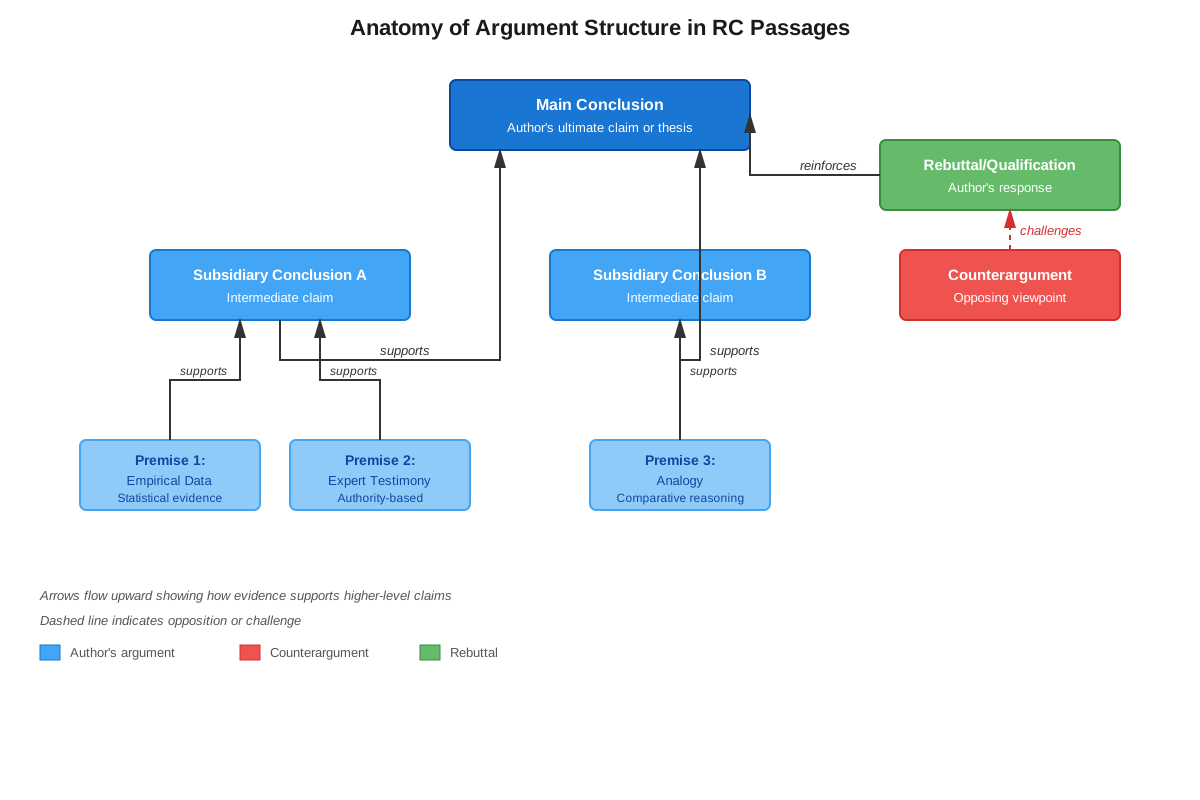
Every argument in LSAT Reading Comprehension passages consists of identifiable components that work together to advance the author's position. The main conclusion represents the author's ultimate claim—the central thesis the entire passage works to establish or defend. This differs from subsidiary conclusions, which are intermediate claims that support the main conclusion but are themselves supported by other premises. Premises are the foundational evidence, facts, examples, or reasons offered in support of conclusions.
Background information provides context necessary for understanding the argument but doesn't directly support any conclusion. Distinguishing background from premises is crucial: background sets the stage, while premises do argumentative work. For example, "The Industrial Revolution began in the 18th century" might be background, while "The Industrial Revolution led to unprecedented urbanization" could be a premise supporting a conclusion about social change.
Counterarguments and objections represent opposing views or potential challenges to the author's position. Authors typically introduce these to demonstrate awareness of alternative perspectives and to strengthen their own argument by refuting them. Concessions acknowledge valid points in opposing views without abandoning the main argument, often signaled by words like "although," "admittedly," or "while it's true that."
Structural Patterns in RC Passages
LSAT passages employ several recurring organizational patterns. The thesis-support pattern presents the main conclusion early (often in the first paragraph) and devotes subsequent paragraphs to providing evidence and addressing objections. This straightforward structure makes the main point clear but requires careful attention to how different types of evidence function.
The problem-solution pattern identifies an issue, explains why it matters, and proposes a resolution. The author's main conclusion typically involves advocating for or analyzing the proposed solution. The comparison-contrast pattern examines two or more theories, approaches, or phenomena, highlighting similarities and differences. The author's conclusion often involves arguing that one is superior or that a synthesis is needed.
The chronological development pattern traces how ideas, theories, or movements evolved over time. Authors using this structure typically conclude by evaluating the current state or predicting future developments. The critique pattern presents a theory or position (often in the first paragraph) and then systematically challenges it, with the author's main conclusion being that the critiqued view is flawed or incomplete.
| Structural Pattern | Typical Organization | Main Conclusion Location | Key Indicators |
|---|---|---|---|
| Thesis-Support | Conclusion → Evidence → Objections → Refutation | First or second paragraph | "This essay argues," "The central claim" |
| Problem-Solution | Problem → Significance → Solution → Evaluation | After solution is presented | "The challenge is," "One approach" |
| Comparison-Contrast | Theory A → Theory B → Analysis | Final paragraph or after both presented | "In contrast," "Similarly," "Unlike" |
| Chronological Development | Early views → Later developments → Current state | Final paragraph | "Initially," "Subsequently," "Today" |
| Critique | Target view → Problems → Alternative | After critique is complete | "However," "This view fails," "A better approach" |
Logical Relationships Between Claims
Understanding how claims relate to each other is central to mapping argument structure. Support relationships occur when one claim provides evidence for another. These can be direct support (Premise → Conclusion) or indirect support (Premise → Subsidiary Conclusion → Main Conclusion). Recognizing chains of reasoning helps identify which claims are foundational and which are derivative.
Contrast relationships occur when claims are presented as alternatives or opposites. Signal words include "however," "in contrast," "on the other hand," and "whereas." These relationships are crucial for understanding debates between different theorists or approaches. Causal relationships assert that one phenomenon produces or explains another, signaled by "because," "therefore," "as a result," and "consequently."
Qualification relationships occur when an author limits or refines a claim. Words like "typically," "generally," "in most cases," and "with some exceptions" indicate that the author is not making an absolute statement. Recognizing qualifications prevents overgeneralization when answering inference questions.
Paragraph Functions
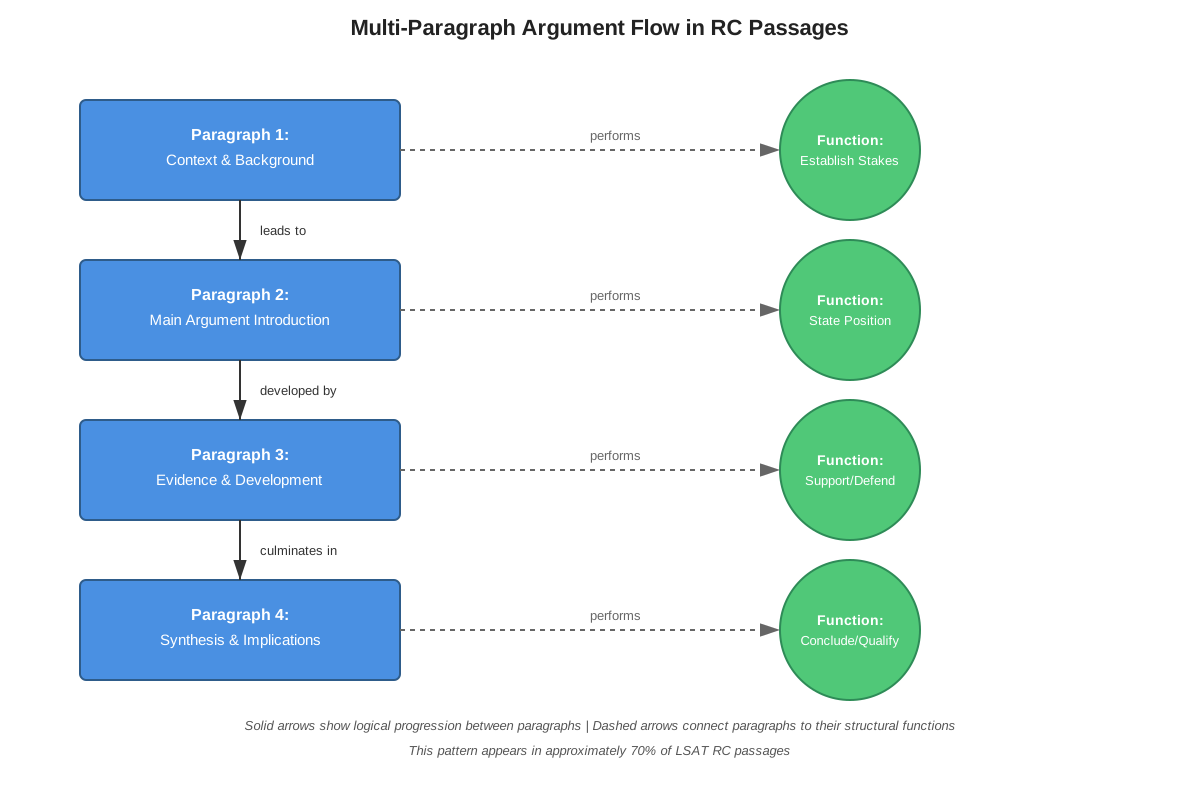
Each paragraph in an LSAT passage serves a specific function within the overall argument structure. The introduction paragraph typically provides background, establishes the topic's significance, and often (but not always) presents the main conclusion or thesis. The evidence paragraphs present data, examples, expert testimony, or reasoning that supports the author's claims.
Objection paragraphs introduce counterarguments or alternative views, while refutation paragraphs respond to these objections. Sometimes a single paragraph combines both functions. Elaboration paragraphs develop a point made earlier, providing additional detail or explanation. Conclusion paragraphs synthesize the argument, restate the main point, or discuss implications.
Understanding paragraph function allows students to predict what role information will play in questions. For example, if a paragraph introduces an objection, questions might ask about the author's response or how this objection relates to the main argument.
Identifying the Main Conclusion
The main conclusion is the single most important element of argument structure, yet it's not always explicitly stated or located in predictable positions. Several strategies help identify it:
- Ask "What is the author ultimately trying to convince me of?" The answer is the main conclusion.
- Look for conclusion indicators: "therefore," "thus," "consequently," "it follows that," "the point is"
- Identify what other claims support: If multiple premises and subsidiary conclusions all point toward one claim, that's likely the main conclusion.
- Check the author's tone and emphasis: The claim receiving the most argumentative attention is often the main conclusion.
- Eliminate background and evidence: What remains after removing purely factual or contextual information is likely the argumentative core.
The main conclusion may appear in the first paragraph (thesis-support pattern), the final paragraph (after building a case), or even in the middle of the passage (with earlier paragraphs providing background and later ones offering additional support).
Evidence Types and Their Functions
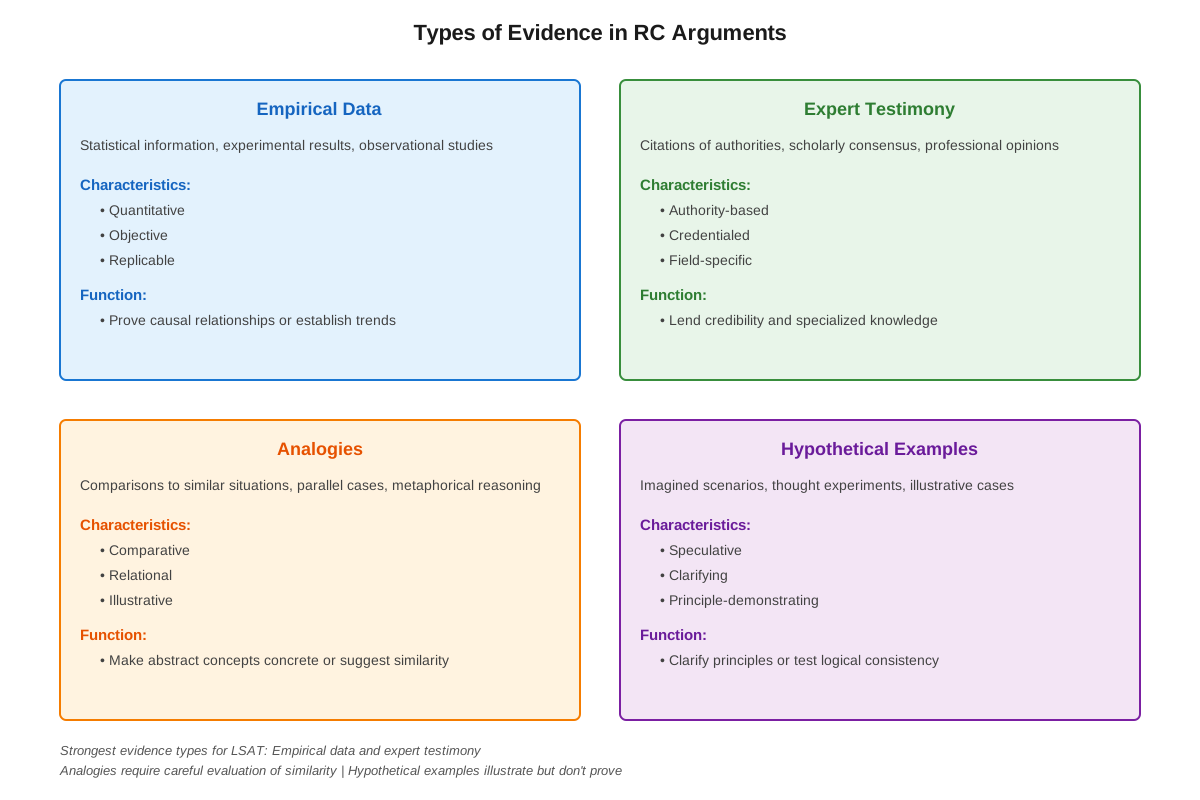
Different types of evidence serve different argumentative purposes. Empirical data (statistics, experimental results, observational studies) provides concrete support for factual claims. Expert testimony leverages authority to support claims, though LSAT passages often question whether experts are truly authoritative in the relevant domain.
Analogies draw parallels between the topic and something more familiar or better understood, arguing that what's true in one case should be true in another. Hypothetical examples illustrate how a principle would apply in imagined scenarios. Historical examples demonstrate that a pattern or principle has operated in the past.
Logical reasoning uses deductive or inductive inference to derive conclusions from accepted premises. Understanding which type of evidence an author employs helps predict potential weaknesses and anticipate questions about the argument's strength.
Concept Relationships
The concepts within argument structure form an interconnected system. Components of argument structure (premises, conclusions, counterarguments) are the building blocks that combine according to structural patterns (thesis-support, problem-solution, etc.). These patterns determine how paragraph functions are distributed throughout the passage. Understanding logical relationships between claims allows students to trace how components connect within whatever structural pattern the author employs.
Identifying the main conclusion requires synthesizing understanding of all other concepts: recognizing components, understanding the structural pattern, identifying paragraph functions, and tracing logical relationships. Evidence types function as specific kinds of premises, and recognizing them helps evaluate argument strength.
This topic connects to prerequisite knowledge of basic argument structure by extending those principles to longer, more complex texts. It enables progression to advanced topics like comparative reading (where two passages present different argument structures on the same topic), author's attitude and tone (which depends on understanding how the author positions their argument), and strengthening/weakening questions (which require identifying the argument's logical structure to determine what would support or undermine it).
Relationship map: Background Information → sets context for → Premises → support → Subsidiary Conclusions → support → Main Conclusion. Meanwhile, Counterarguments → are addressed by → Refutations → which strengthen → Main Conclusion. All of these components are organized according to Structural Patterns, with each element serving a Paragraph Function within the overall architecture.
Quick check — test yourself on Argument structure in RC so far.
Try Flashcards →High-Yield Facts
⭐ The main conclusion is not always in the first or last paragraph; it may appear anywhere in the passage, and identifying it requires understanding what claim all other statements support.
⭐ Counterarguments introduced by the author are not the author's view; they represent opposing positions that the author typically refutes or qualifies.
⭐ Background information does not support the conclusion; it provides context but performs no argumentative work, making it irrelevant to questions about how the argument is supported.
⭐ Subsidiary conclusions serve dual roles: they are supported by premises and in turn support the main conclusion, forming chains of reasoning.
⭐ Paragraph function questions require understanding the role of information in the overall argument, not just summarizing what the paragraph says.
- Signal words like "however," "moreover," "for example," and "consequently" indicate logical relationships between claims and help map argument structure.
- The author's main conclusion typically receives the most argumentative attention, with multiple paragraphs devoted to supporting or defending it.
- Evidence paragraphs can be distinguished from conclusion paragraphs by asking whether the information is presented as fact (evidence) or as a claim requiring support (conclusion).
- Concessions ("admittedly," "while it's true that") acknowledge opposing points without abandoning the main argument and often precede refutations.
- The structural pattern of a passage can often be predicted from the first paragraph, which typically signals whether the passage will critique, compare, trace development, or present a thesis.
Common Misconceptions
Misconception: The first sentence of a passage is always the main conclusion.
Correction: While passages sometimes begin with the thesis, many start with background information, a question, or a description of a problem. The main conclusion must be identified by determining what claim the entire passage works to establish, regardless of location.
Misconception: Every paragraph contains a new main point.
Correction: Paragraphs serve different functions within a unified argument structure. Some provide evidence for a single conclusion, others address objections, and still others elaborate on points made earlier. The passage has one main conclusion, not multiple competing ones.
Misconception: Longer or more detailed discussions indicate more important points.
Correction: Authors may devote significant space to explaining background, describing opposing views, or providing evidence without these elements being the main conclusion. Length indicates emphasis but not necessarily argumentative centrality.
Misconception: If the author mentions a theory or view, they endorse it.
Correction: Authors frequently present theories, positions, or arguments they intend to critique or contrast with their own view. Distinguishing between views the author presents and views the author endorses is crucial for understanding argument structure.
Misconception: All evidence equally supports the conclusion.
Correction: Some evidence provides direct support for the main conclusion, while other evidence supports subsidiary conclusions or addresses specific objections. Understanding the hierarchy of support is essential for evaluating argument strength and answering function questions.
Misconception: Argument structure in RC is the same as in Logical Reasoning.
Correction: While both involve identifying premises and conclusions, RC passages present extended arguments with multiple layers, competing viewpoints, and complex organizational patterns that unfold across multiple paragraphs, requiring different analytical strategies than the condensed arguments in LR.
Worked Examples
Example 1: Identifying Main Conclusion and Structure
Passage Excerpt:
"For decades, economists assumed that consumers make rational decisions based on complete information and consistent preferences. This model, known as rational choice theory, dominated economic thinking and policy-making throughout the mid-20th century. However, behavioral economists have demonstrated that actual consumer behavior systematically deviates from these predictions. Studies show that people exhibit loss aversion, preferring to avoid losses rather than acquire equivalent gains. They display anchoring bias, allowing irrelevant information to influence decisions. They make inconsistent choices depending on how options are framed. These findings suggest that traditional economic models fail to capture important aspects of human decision-making. Consequently, policy-makers should incorporate insights from behavioral economics when designing interventions intended to influence consumer behavior."
Analysis:
Step 1: Identify the structural pattern. The passage begins with background (traditional economic theory), introduces a challenge (behavioral economics findings), presents evidence (specific biases), and concludes with a recommendation. This follows a problem-solution pattern where the problem is inadequate traditional models and the solution is incorporating behavioral insights.
Step 2: Distinguish components.
- Background: "For decades, economists assumed..." and "This model, known as rational choice theory..."
- Counterargument (to be refuted): The implicit claim that rational choice theory adequately describes behavior
- Premises: "Studies show that people exhibit loss aversion..." "They display anchoring bias..." "They make inconsistent choices..."
- Subsidiary conclusion: "These findings suggest that traditional economic models fail to capture important aspects of human decision-making."
- Main conclusion: "Consequently, policy-makers should incorporate insights from behavioral economics when designing interventions intended to influence consumer behavior."
Step 3: Verify the main conclusion. The word "consequently" signals a conclusion. All other claims in the passage support this final recommendation: the background establishes what needs to be changed, the evidence shows why change is needed, and the subsidiary conclusion synthesizes the evidence. This is what the author ultimately wants to convince readers of.
Step 4: Map paragraph functions. If this were a full passage, we'd expect: Paragraph 1 (background on rational choice theory), Paragraph 2 (introduction of behavioral economics challenge), Paragraph 3 (detailed evidence of biases), Paragraph 4 (implications for policy). Each paragraph serves a distinct function in building toward the main conclusion.
Connection to learning objectives: This example demonstrates how to identify argument structure by recognizing the structural pattern, distinguishing between components, and tracing logical relationships to locate the main conclusion.
Example 2: Analyzing Function Within Argument Structure
Passage Excerpt:
"Critics of the new urban planning initiative argue that mixed-use development increases traffic congestion and reduces property values in residential areas. They point to several cities where such projects have generated complaints from long-time residents. However, these criticisms overlook important evidence. Comprehensive studies of mixed-use developments in comparable cities show that traffic actually decreases as residents walk to nearby shops and services rather than driving. Property values in these areas have increased by an average of 15% over five years, outpacing surrounding neighborhoods. The complaints cited by critics come primarily from the initial adjustment period and diminish significantly within two years of project completion."
Question: What function does the sentence "They point to several cities where such projects have generated complaints from long-time residents" serve in the passage?
Analysis:
Step 1: Identify the sentence's location in the argument structure. It appears in the first paragraph, immediately after the introduction of critics' views and before the author's response.
Step 2: Determine what type of component this represents. The sentence provides evidence for the critics' position (not the author's position). It supports the claim that mixed-use development has problems.
Step 3: Understand the sentence's role in the overall argument. The author introduces this evidence not to endorse it but to present the opposing view fully before refuting it. The word "However" in the next sentence signals that the author will challenge this evidence.
Step 4: Articulate the function. This sentence provides supporting evidence for a counterargument that the author will subsequently refute. It strengthens the opposing view temporarily to make the author's refutation more compelling.
Answer: The sentence presents evidence supporting a position that the author will challenge, demonstrating the strength of the opposing view before the author offers contrary evidence.
Connection to learning objectives: This example shows how understanding argument structure allows students to identify the function of specific sentences within the larger argumentative framework, a common question type on the LSAT.
Exam Strategy
When approaching Reading Comprehension passages, implement a systematic process for mapping argument structure:
First reading (3-4 minutes per passage):
- Read the first paragraph carefully to identify the topic, scope, and likely structural pattern
- As you read each subsequent paragraph, note its function (evidence? objection? elaboration?)
- Mark transition words that signal logical relationships ("however," "moreover," "consequently")
- Identify the main conclusion by asking what the author ultimately wants to convince you of
- Note where different viewpoints appear and how the author positions their argument relative to them
Trigger words for argument structure:
- Conclusion indicators: "therefore," "thus," "consequently," "it follows that," "suggests that," "demonstrates that"
- Premise indicators: "because," "since," "given that," "for the reason that," "as evidenced by"
- Contrast indicators: "however," "but," "yet," "nevertheless," "on the other hand," "in contrast"
- Continuation indicators: "moreover," "furthermore," "additionally," "in addition"
- Example indicators: "for instance," "for example," "to illustrate," "consider"
- Concession indicators: "admittedly," "although," "while it's true that," "granted"
Process-of-elimination tips:
- For main point questions, eliminate choices that describe only part of the passage (too narrow) or go beyond what the passage argues (too broad)
- For function questions, eliminate choices that misidentify whether information supports or opposes the author's view
- For structure questions, eliminate choices that describe patterns not present in the passage (e.g., saying the passage "compares two theories" when it only discusses one)
Time allocation:
- Spend 3-4 minutes on the initial reading, actively mapping structure
- This investment pays off by making questions answerable in 30-45 seconds each
- Don't rush the initial reading; understanding structure prevents time-consuming re-reading during questions
Exam Tip: Create a simple notation system for your scratch paper: "MC" for main conclusion, "SC" for subsidiary conclusion, "P" for premise, "OBJ" for objection, "REF" for refutation. Jot down paragraph numbers next to these labels to create a quick reference map.
Memory Techniques
MAPS - Remember the four key questions to ask about any passage:
- Main conclusion: What is the author ultimately arguing?
- Argument pattern: How is the passage organized?
- Paragraph functions: What role does each paragraph play?
- Support structure: How do premises connect to conclusions?
COPES - Remember the five common structural patterns:
- Comparison-contrast
- Objection-refutation (critique pattern)
- Problem-solution
- Evolution (chronological development)
- Support (thesis-support)
The "Skeleton" visualization: Picture the passage as a skeleton where the main conclusion is the skull (the "head" of the argument), subsidiary conclusions are the spine (supporting the head), premises are the ribs (supporting the spine), and counterarguments are external forces pushing against the skeleton that must be resisted. This image helps remember that all elements work together to support the main conclusion.
The "Conversation" technique: Think of passages as one side of a conversation where the author responds to others. Background is "Here's what we're talking about," counterarguments are "Some people say X," refutations are "But actually Y," and the main conclusion is "So here's what I think." This narrative frame makes structure more intuitive.
Summary
Argument structure in Reading Comprehension represents the organizational framework through which authors present claims, evidence, and reasoning across extended passages. Mastering this topic requires identifying the components of arguments (premises, conclusions, counterarguments, background), recognizing common structural patterns (thesis-support, problem-solution, comparison-contrast, chronological development, critique), understanding logical relationships between claims, determining paragraph functions, and accurately locating the main conclusion. Unlike the condensed arguments in Logical Reasoning, RC passages present complex, multi-layered arguments that unfold across multiple paragraphs and incorporate various viewpoints. Success on LSAT Reading Comprehension questions depends fundamentally on the ability to map this structure during the initial reading, creating a mental framework that makes questions about main point, function, organization, and viewpoints readily answerable. Students must distinguish between what authors present and what they endorse, recognize that evidence serves different functions within the argumentative hierarchy, and understand that paragraph length or detail doesn't necessarily indicate importance. By systematically applying strategies to identify structural patterns and trace logical relationships, students transform seemingly dense passages into clear argumentative maps.
Key Takeaways
- The main conclusion is the single claim that all other statements in the passage work to support, and it may appear anywhere in the passage, not just at the beginning or end
- Each paragraph serves a specific function (background, evidence, objection, refutation, elaboration, conclusion) within the overall argument structure
- Counterarguments presented by the author represent opposing views that will typically be refuted or qualified, not positions the author endorses
- Common structural patterns (thesis-support, problem-solution, comparison-contrast, chronological development, critique) can be predicted from the opening paragraph and help organize comprehension
- Subsidiary conclusions serve dual roles as both conclusions (supported by premises) and premises (supporting the main conclusion), forming chains of reasoning
- Signal words indicating logical relationships (however, moreover, consequently, for example) are essential markers for mapping argument structure
- Understanding argument structure during the initial reading makes questions answerable quickly and accurately, making the time investment worthwhile
Related Topics
Comparative Reading: Builds on argument structure by requiring students to analyze and compare the argumentative structures of two related passages, identifying points of agreement, disagreement, and different approaches to the same topic.
Author's Attitude and Tone: Depends on understanding argument structure because the author's attitude is revealed through how they position their argument relative to others, which claims they emphasize, and how they respond to counterarguments.
Inference Questions in RC: Requires understanding argument structure because valid inferences must be consistent with the logical relationships between claims established in the passage's argumentative framework.
Strengthening and Weakening in RC: Builds on argument structure by asking what additional information would support or undermine the author's reasoning, requiring clear identification of premises, conclusions, and logical gaps.
Practice CTA
Now that you understand the fundamental principles of argument structure in Reading Comprehension, it's time to apply these concepts to actual LSAT passages. Work through the practice questions associated with this topic, actively mapping the argument structure of each passage before attempting the questions. Use the flashcards to reinforce your ability to quickly identify structural patterns, paragraph functions, and logical relationships. Remember: understanding argument structure is not just about getting individual questions right—it's about developing a systematic approach that makes every Reading Comprehension passage more manageable and every question more predictable. The investment you make in mastering this foundational skill will pay dividends across the entire Reading Comprehension section. You've got this!
Sign up free to keep reading
Create a free AnvayaPrep account to finish this LSAT guide on Argument structure in RC — plus flashcards and practice questions.