Overview
Author skepticism is a critical analytical skill tested extensively in the LSAT Reading Comprehension section. This concept refers to the ability to identify when a passage author expresses doubt, reservation, or critical distance from a claim, theory, or viewpoint presented in the text. Unlike outright rejection or enthusiastic endorsement, skepticism occupies a nuanced middle ground where the author questions the validity, completeness, or applicability of an idea without necessarily dismissing it entirely. Recognizing lsat author skepticism requires careful attention to qualifying language, hedging phrases, and rhetorical signals that indicate the author's cautious or questioning stance.
Understanding author skepticism is essential for the LSAT because it directly impacts how test-takers interpret passage structure, evaluate answer choices, and distinguish between the author's own position and views the author merely describes. The LSAT frequently tests whether students can differentiate between what an author believes versus what an author reports, and skepticism often marks this crucial boundary. Questions about the author's attitude, primary purpose, or degree of agreement with various claims all hinge on accurately detecting skeptical language and reasoning patterns.
Within the broader framework of viewpoints and argumentation in reading comprehension, author skepticism connects to several fundamental skills: identifying multiple perspectives within a passage, understanding the author's rhetorical purpose, and evaluating the strength of evidence and reasoning. Mastering this topic enables students to navigate complex passages where the author presents competing theories, critiques established positions, or raises questions about conventional wisdom—all common scenarios in LSAT passages drawn from law, science, humanities, and social sciences.
Learning Objectives
- [ ] Identify how Author skepticism appears in LSAT questions
- [ ] Explain the reasoning pattern behind Author skepticism
- [ ] Apply Author skepticism to solve LSAT-style problems accurately
- [ ] Distinguish between author skepticism and complete rejection of an idea
- [ ] Recognize the specific linguistic markers that signal skeptical attitudes
- [ ] Evaluate the degree of skepticism expressed (mild doubt vs. strong criticism)
- [ ] Predict which answer choices align with a skeptical authorial stance
Prerequisites
- Basic passage structure analysis: Understanding how LSAT passages organize information, present multiple viewpoints, and develop arguments is necessary because skepticism often appears at structural transition points.
- Vocabulary of attitude and tone: Familiarity with words describing authorial stance (critical, supportive, neutral, ambivalent) provides the foundation for recognizing the specific nuances of skepticism.
- Distinguishing author's view from others' views: The ability to separate what the author believes from what the author describes is essential because skepticism specifically concerns the author's own evaluative position.
- Understanding evidence and reasoning: Recognizing how claims are supported helps identify when an author questions the adequacy of evidence or logic behind a position.
Why This Topic Matters
Author skepticism appears in approximately 15-20% of LSAT Reading Comprehension questions, making it one of the most frequently tested concepts in the viewpoints and argumentation category. Questions explicitly asking about the author's attitude, degree of agreement, or evaluation of a theory almost always require students to assess whether skepticism is present and, if so, its intensity. Additionally, primary purpose questions often hinge on recognizing that the author's goal is to "question," "raise doubts about," or "critically examine" rather than to "prove," "demonstrate," or "advocate."
In real-world legal practice, skepticism represents a fundamental analytical stance. Attorneys must critically evaluate evidence, question assumptions underlying arguments, and identify weaknesses in opposing positions without necessarily having definitive proof of an alternative. The LSAT tests this skill because it reflects the type of careful, questioning analysis essential to legal reasoning. Law students and lawyers regularly encounter situations where they must express measured doubt about a claim while acknowledging its possible merits—precisely the balanced perspective that author skepticism embodies.
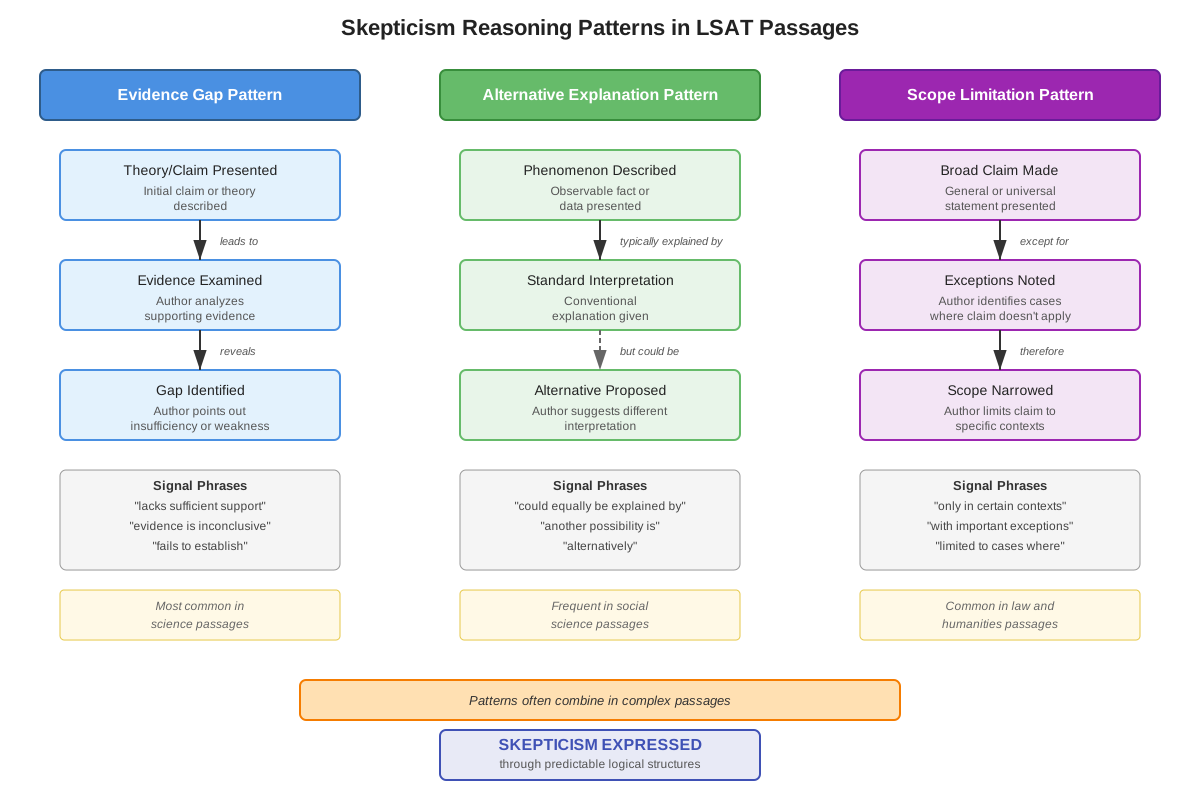
Common manifestations in LSAT passages include: scientific passages where the author questions a prevailing theory while presenting alternative explanations; humanities passages where the author critiques an interpretation of a text or historical event; social science passages where the author raises concerns about a methodology or conclusion; and legal passages where the author examines limitations of a judicial doctrine or legal framework. Recognizing these patterns helps students anticipate when skepticism is likely to appear and where to look for supporting evidence in the passage.
Core Concepts
Defining Author Skepticism
Author skepticism refers to the author's expression of doubt, reservation, or critical questioning regarding a claim, theory, methodology, or conclusion presented in the passage. This stance falls on a spectrum between neutral description and outright rejection. A skeptical author does not simply report information objectively, nor does the author completely dismiss the idea in question. Instead, the author signals that the claim warrants scrutiny, that evidence may be insufficient, that alternative explanations deserve consideration, or that conclusions may be premature or overstated.
The key characteristic distinguishing skepticism from other authorial stances is its provisional, questioning nature. The author maintains intellectual openness while expressing concern or doubt. This differs from criticism (which is more definitively negative), neutrality (which avoids evaluative judgment), and advocacy (which supports a position). Understanding this distinction is crucial for selecting correct answer choices that capture the author's nuanced position.
Linguistic Markers of Skepticism
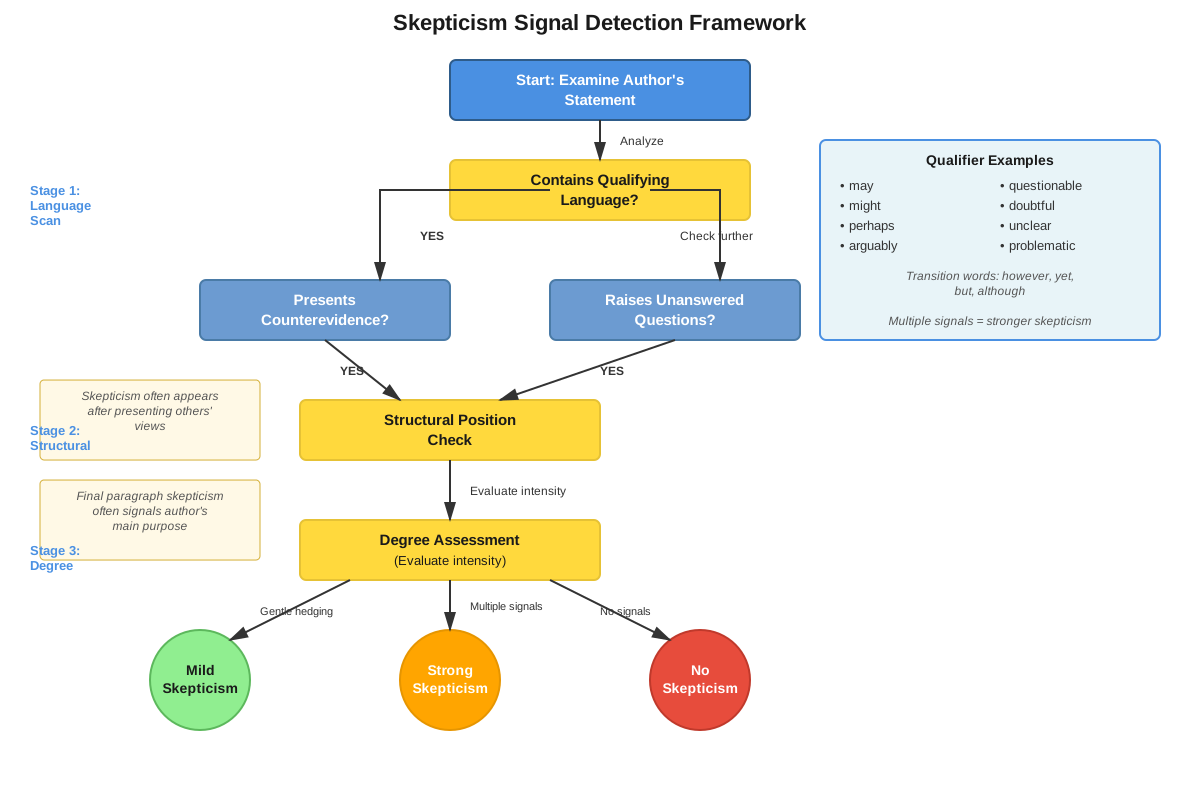
Several categories of language signal author skepticism in LSAT passages:
Qualifying phrases soften claims and indicate uncertainty: "may," "might," "could," "possibly," "perhaps," "arguably," "seemingly," "apparently," "allegedly," "supposedly," "purportedly." When these words appear in the author's own voice (not in reported speech), they often signal skepticism about the modified claim.
Hedging expressions limit the scope or certainty of statements: "to some extent," "in certain respects," "under specific conditions," "at least in theory," "on the surface," "at first glance." These phrases suggest the author sees limitations or exceptions to a claim.
Questioning language directly expresses doubt: "it is unclear whether," "it remains to be seen," "one might question," "it is doubtful that," "the evidence does not clearly establish," "this raises the question of whether." Such constructions explicitly frame claims as uncertain or problematic.
Contrastive structures juxtapose claims with countervailing considerations: "however," "yet," "nevertheless," "although," "while...," "despite claims that..." When the author uses these to introduce problems or limitations, skepticism is often present.
Evaluative adjectives and adverbs convey critical assessment: "questionable," "problematic," "insufficient," "inadequate," "unconvincing," "overstated," "premature," "hasty," "simplistic," "reductive." These terms directly express the author's negative evaluation of reasoning or evidence.
The Reasoning Pattern Behind Skepticism
Author skepticism typically follows a recognizable argumentative structure:
- Presentation of the claim or theory: The author introduces a position, often one held by others or representing conventional wisdom
- Acknowledgment of apparent strengths: The author may concede certain merits, evidence, or intuitive appeal
- Introduction of problems or limitations: The author raises concerns about evidence quality, logical gaps, unconsidered alternatives, or scope limitations
- Withholding of definitive judgment: Rather than conclusively rejecting the claim, the author leaves the question open or calls for further investigation
This pattern reflects the intellectual caution characteristic of academic and legal discourse. The author demonstrates awareness of complexity and avoids overconfident assertions while still advancing a critical perspective.
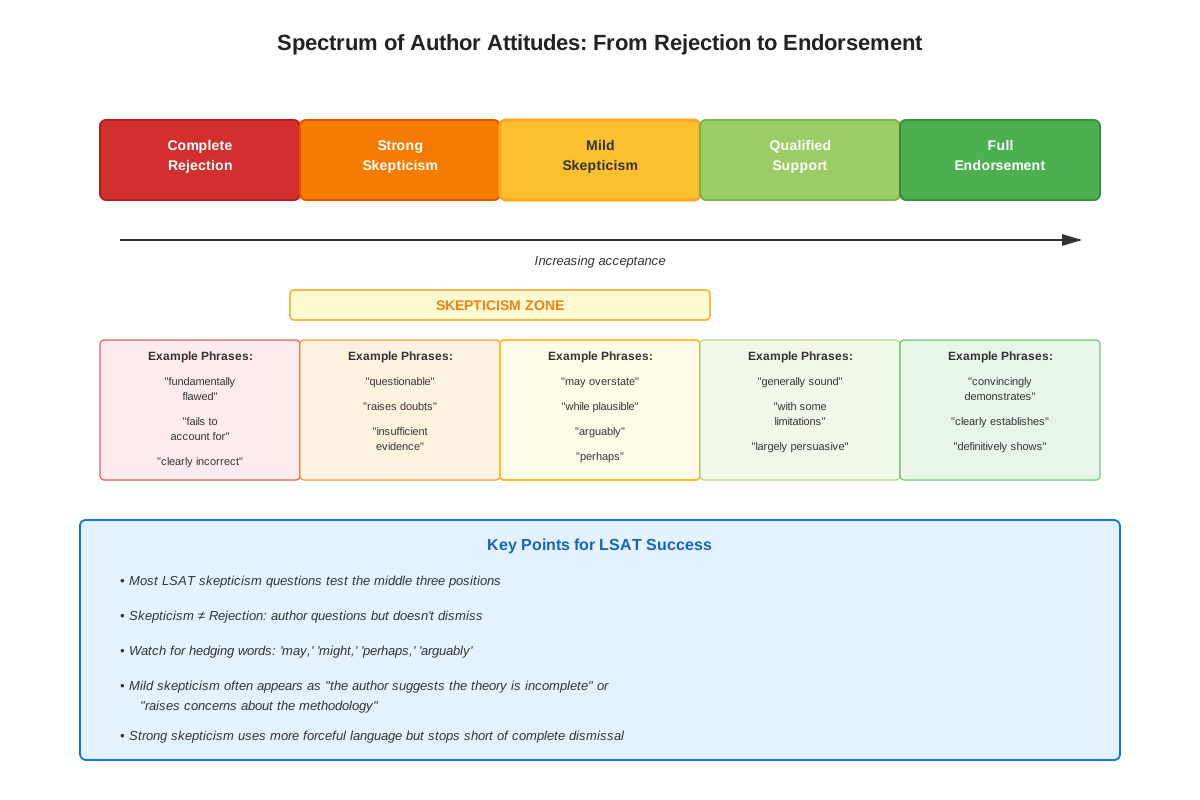
Degrees of Skepticism
Skepticism exists on a continuum of intensity:
| Degree | Characteristics | Example Language |
|---|---|---|
| Mild doubt | Minor reservations; mostly accepts claim with caveats | "While generally persuasive, the theory may not account for..." |
| Moderate skepticism | Significant concerns; balanced between acceptance and rejection | "The evidence is insufficient to establish..." |
| Strong skepticism | Serious doubts; leans toward rejection without fully dismissing | "It is highly questionable whether..." |
| Near rejection | Minimal credibility remaining; almost but not quite dismissive | "The claim is undermined by..." |
Correctly identifying the degree of skepticism is essential for answering questions about the author's attitude or level of agreement. Answer choices often present a range of skeptical positions, and selecting the one that matches the passage's intensity separates high scorers from average performers.
Skepticism vs. Related Concepts
Understanding what skepticism is not helps clarify the concept:
Skepticism vs. Neutrality: A neutral author presents information without evaluative judgment, maintaining equal distance from all positions. A skeptical author takes an evaluative stance, expressing doubt about specific claims while potentially supporting alternatives.
Skepticism vs. Criticism: Criticism involves more definitive negative judgment. A critic identifies flaws and argues against a position. A skeptic raises questions and expresses doubt without necessarily concluding the position is wrong.
Skepticism vs. Ambivalence: Ambivalence involves conflicting feelings or seeing equal merit in opposing positions. Skepticism involves doubt about a specific claim, not necessarily balanced uncertainty between alternatives.
Skepticism vs. Qualified Support: An author can support a claim while acknowledging limitations. This differs from skepticism, where the doubt is more central to the author's stance than the support.
Contextual Clues for Identifying Skepticism
Beyond specific words and phrases, broader contextual factors signal skepticism:
Passage structure: When an author devotes substantial space to problems, counterexamples, or alternative explanations after presenting a theory, this structural emphasis indicates skepticism.
Rhetorical questions: Questions posed by the author (not merely reported) often express skeptical doubt: "But does this explanation account for all the evidence?"
Comparison to alternatives: When the author presents alternative theories or explanations with equal or greater emphasis than the original claim, this suggests skepticism about the original.
Discussion of evidence quality: Detailed attention to methodological problems, sample size issues, or conflicting data points indicates the author questions the evidentiary basis for a claim.
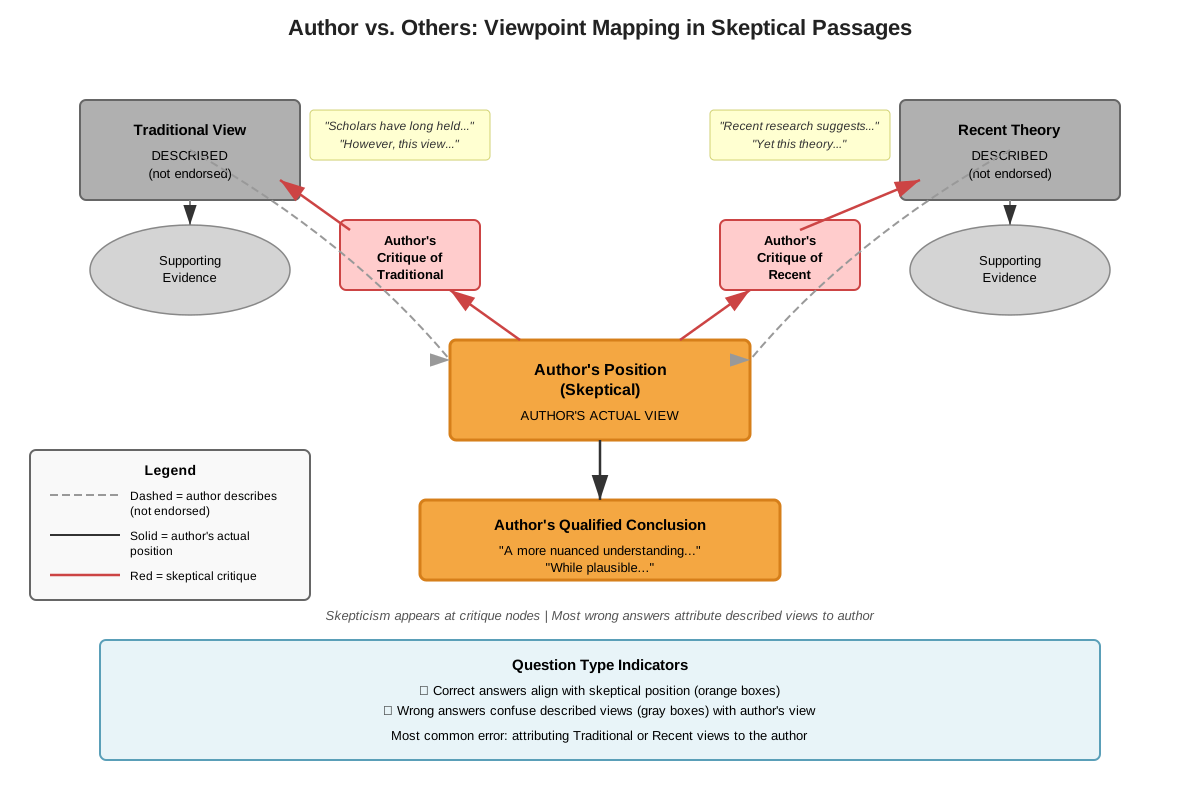
Attribution patterns: When the author consistently attributes a claim to others ("proponents argue," "supporters contend") while using the author's own voice to raise problems, this signals skeptical distance.
Concept Relationships
Author skepticism connects to several other Reading Comprehension concepts in a hierarchical and functional network. At the foundational level, identifying the author's viewpoint is the prerequisite skill—students must first distinguish the author's voice from other perspectives before assessing whether that voice expresses skepticism. This identification skill leads directly to evaluating authorial attitude, of which skepticism is one specific type.
Within the passage structure, skepticism often appears at transition points where the author shifts from describing a theory to critiquing it. These transitions typically involve contrastive language ("however," "yet," "but") that signals the author's own evaluative perspective is about to emerge. Understanding passage organization thus helps predict where skeptical language will appear.
Author skepticism also connects to argumentation analysis. When the author expresses skepticism, the reasoning typically involves identifying logical gaps, insufficient evidence, or unconsidered alternatives—all concepts from formal argument evaluation. The relationship flows: Argument Presentation → Evidence Evaluation → Identification of Weaknesses → Expression of Skepticism.
Furthermore, skepticism relates to comparative analysis within passages. LSAT passages frequently present multiple theories or viewpoints, and the author's skepticism toward one often correlates with implicit or explicit support for another. The relationship map looks like: Theory A (described) → Author Skepticism (expressed) → Theory B (favored alternative) → Author Support (implied or stated).
Finally, recognizing author skepticism enables accurate responses to several question types: attitude questions (requiring identification of skeptical tone), primary purpose questions (where "question" or "raise doubts" may be correct), agreement questions (requiring assessment of degree of skepticism), and inference questions (where the author's skeptical stance supports certain inferences while ruling out others).
High-Yield Facts
⭐ Author skepticism appears in 15-20% of LSAT Reading Comprehension questions, making it one of the most frequently tested attitude concepts.
⭐ Qualifying words like "may," "might," "could," "possibly," and "perhaps" in the author's own voice typically signal skepticism about the claim being modified.
⭐ Skepticism differs from rejection—a skeptical author expresses doubt without definitively dismissing a claim.
⭐ Contrastive transitions ("however," "yet," "nevertheless") often introduce the author's skeptical perspective after presenting others' views.
⭐ When the author devotes more space to problems with a theory than to its strengths, this structural emphasis indicates skepticism.
- Phrases like "it remains to be seen" and "it is unclear whether" explicitly express skeptical uncertainty.
- Rhetorical questions posed by the author (not reported from others) frequently signal skeptical doubt.
- Evaluative adjectives such as "questionable," "problematic," "insufficient," and "unconvincing" directly convey skepticism.
- Author skepticism often appears when discussing evidence quality, methodology, or logical reasoning behind a claim.
- Distinguishing between what the author describes versus what the author endorses is essential for identifying skepticism.
- Skepticism exists on a spectrum from mild doubt to near rejection, and answer choices often test ability to identify the correct degree.
- Attribution patterns matter: claims consistently attributed to others ("proponents argue") while problems appear in the author's voice signal skepticism.
- Skeptical passages often present alternative explanations or theories with equal or greater emphasis than the questioned claim.
Quick check — test yourself on Author skepticism so far.
Try Flashcards →Common Misconceptions
Misconception: Any criticism or negative language means the author completely rejects the claim.
Correction: Skepticism involves doubt and questioning, not necessarily complete rejection. The author may acknowledge some merit while expressing reservations about evidence, scope, or reasoning. Look for language that keeps the question open rather than definitively dismissing the claim.
Misconception: If the author presents a theory in detail, the author must support it.
Correction: LSAT passages frequently present theories in detail precisely to critique them. The amount of space devoted to a theory does not indicate support; instead, examine whether the author's own evaluative language expresses agreement or skepticism. Detailed presentation followed by problems or limitations indicates skepticism.
Misconception: Neutral, objective language means the author has no skepticism.
Correction: Authors can express skepticism while maintaining academic tone. Phrases like "the evidence does not establish" or "it is unclear whether" are objective in style but skeptical in substance. Focus on the logical relationship between claims and the author's assessment, not just emotional tone.
Misconception: Skepticism and ambivalence are the same thing.
Correction: Ambivalence involves seeing equal merit in opposing positions or having conflicting feelings. Skepticism involves doubt about a specific claim's validity. An author can be skeptical about one theory while clearly favoring another, showing no ambivalence.
Misconception: If the author acknowledges any strengths of a position, the author cannot be skeptical of it.
Correction: Sophisticated skepticism often involves acknowledging apparent strengths before raising more significant problems. The pattern "while X has some merit, it fails to account for Y" is classic skeptical reasoning. The overall thrust of the argument, not individual concessions, determines the author's stance.
Misconception: Qualifying language always indicates the author's skepticism about the qualified claim.
Correction: Context matters. If the author reports someone else's qualified claim ("proponents suggest the theory may explain..."), the qualification belongs to the proponents, not the author. Only qualifying language in the author's own voice indicates the author's skepticism.
Worked Examples
Example 1: Scientific Theory Passage
Passage excerpt: "The dominant theory explaining the extinction of megafauna in North America attributes their disappearance to human hunting pressure following human migration across the Bering land bridge approximately 13,000 years ago. Proponents point to the temporal correlation between human arrival and extinction events, as well as archaeological evidence of hunting. However, this explanation may be overly simplistic. Climate change during the same period produced dramatic shifts in vegetation patterns, potentially reducing food sources for these large herbivores. Moreover, the archaeological evidence of hunting, while suggestive, remains sparse relative to the number of species that disappeared. The extinction pattern also shows considerable geographic variation that the human hunting hypothesis does not adequately address. Whether human activity alone could have caused such widespread extinctions across diverse ecosystems remains an open question."
Question: The author's attitude toward the dominant theory of megafauna extinction can best be described as:
Analysis:
- Identify the claim: The dominant theory attributes extinction to human hunting
- Locate author's voice vs. others' views: "Proponents point to..." indicates others' views; "However, this explanation may be..." begins the author's own assessment
- Identify skeptical markers:
- "may be overly simplistic" (qualifying + evaluative)
- "potentially reducing" (hedging about alternative explanation)
- "remains sparse" (evaluative about evidence quality)
- "does not adequately address" (direct criticism)
- "remains an open question" (explicit expression of uncertainty)
- Assess degree of skepticism: The author raises multiple significant problems (climate alternative, sparse evidence, geographic variation) and explicitly states the question remains open. This indicates moderate to strong skepticism—not mild doubt, but not complete rejection either.
- Predict answer: Look for choices expressing significant doubt or questioning while avoiding complete rejection
Correct answer type: "skeptical of its sufficiency as a complete explanation" or "questioning whether it adequately accounts for all evidence"
Incorrect answer types to eliminate:
- "Strongly supportive" (contradicts the problems raised)
- "Completely dismissive" (too extreme; author keeps question open)
- "Neutral and objective" (ignores evaluative language)
- "Ambivalent" (author clearly leans toward doubt, not balanced uncertainty)
Example 2: Legal Theory Passage
Passage excerpt: "Recent scholarship has challenged the traditional interpretation of the Commerce Clause, arguing that the Framers intended a much narrower federal power to regulate interstate commerce than courts have recognized. These revisionist historians cite correspondence and convention debates suggesting the clause was designed primarily to prevent protectionist state barriers to trade, not to authorize broad federal economic regulation. While these historical sources deserve careful consideration, several factors suggest caution in accepting this revisionist view. First, the historical record is incomplete and subject to multiple interpretations; isolated statements by individual Framers may not reflect the broader understanding that informed ratification. Second, the revisionist interpretation struggles to explain why the Framers chose such broad language—'regulate Commerce'—if they intended only the narrow purpose revisionists attribute to them. Finally, early congressional practice, including legislation passed by Congresses containing many Framers, suggests a broader understanding of federal commerce power than revisionists acknowledge."
Question: Which of the following best describes the author's perspective on the revisionist interpretation of the Commerce Clause?
Analysis:
- Identify the claim: Revisionist historians argue for narrow interpretation of Commerce Clause
- Locate author's voice: "While these historical sources deserve careful consideration" acknowledges merit; "several factors suggest caution" introduces author's skeptical assessment
- Identify skeptical markers:
- "suggest caution in accepting" (explicit call for skepticism)
- "may not reflect" (qualifying about evidence)
- "struggles to explain" (identifies problem)
- Three separate problems listed (incomplete record, language choice, early practice)
- Note the structure: Author presents revisionist view → acknowledges it deserves consideration → raises three substantial problems → implies the view is questionable
- Assess degree: Moderate skepticism—the author doesn't dismiss the revisionist view but raises significant concerns that undermine confidence in it
Correct answer type: "The author finds the revisionist interpretation problematic despite its consideration of historical sources" or "The author questions whether the revisionist view adequately accounts for all relevant evidence"
Key reasoning: The author's acknowledgment that sources "deserve careful consideration" prevents this from being strong rejection, but the three problems raised prevent it from being mild doubt. The answer must capture this moderate skeptical position.
Exam Strategy
When approaching LSAT Reading Comprehension questions involving author skepticism, employ this systematic process:
Step 1: Distinguish author's voice from reported views
As you read, mark passages where the author describes others' positions versus where the author evaluates them. Attribution phrases like "proponents argue," "scholars contend," or "the theory holds" signal reported views. Transitions like "however," "yet," or "but" often introduce the author's own perspective.
Step 2: Flag skeptical language
Circle or mentally note qualifying words (may, might, could), hedging phrases (to some extent, in certain respects), questioning language (it is unclear, it remains to be seen), and evaluative terms (questionable, insufficient, problematic). These markers accumulate to reveal the author's skeptical stance.
Step 3: Assess structural emphasis
Count how many lines or sentences the author devotes to presenting a theory versus critiquing it. If critique receives equal or greater space, skepticism is likely present. Note whether the passage ends with problems or questions rather than affirmation.
Step 4: Identify the degree of skepticism
Use the intensity of language and number of problems raised to place the author's skepticism on the spectrum from mild doubt to near rejection. Multiple serious problems indicate stronger skepticism than a single minor caveat.
Step 5: Predict answer characteristics before reading choices
Based on your analysis, predict whether the correct answer will include words like "questions," "doubts," "skeptical," "unconvinced," or "problematic." This prediction helps you recognize the correct answer and avoid traps.
Exam Tip: Wrong answers on skepticism questions often fall into predictable categories: too extreme (complete rejection when author is merely skeptical), too weak (neutral when author expresses clear doubt), or reversed (supportive when author is skeptical). Eliminate these systematically.
Trigger phrases in questions that indicate skepticism is being tested:
- "The author's attitude toward X can best be described as..."
- "The author would most likely agree with which of the following about X?"
- "The author's primary purpose in discussing X is to..."
- "The author mentions Y in order to..."
- "Which of the following best describes the author's evaluation of X?"
Time allocation: Spend 15-20 seconds during initial passage reading specifically identifying where the author's evaluative voice appears. This upfront investment saves time on multiple questions that test authorial attitude. When a question asks about author's attitude, spend 10-15 seconds locating the relevant passage section before evaluating answer choices.
Process of elimination strategy:
- Eliminate answers that contradict explicit skeptical language in the passage
- Eliminate answers that are too extreme (complete rejection) or too weak (neutral)
- Between remaining choices, select the one whose intensity matches the passage's degree of skepticism
- Verify your choice by finding specific passage language that supports it
Memory Techniques
QUEST acronym for identifying author skepticism:
- Qualifying language (may, might, could, possibly)
- Uncertainty expressions (unclear, remains to be seen)
- Evaluative criticism (questionable, insufficient, problematic)
- Structural emphasis on problems over strengths
- Transitions introducing critique (however, yet, nevertheless)
Visualization strategy: Picture a scale with "Complete Rejection" on the left, "Neutral Description" in the middle, and "Strong Support" on the right. Author skepticism occupies the left-of-center zone—leaning toward doubt but not at the extreme. When reading passages, mentally place the author's stance on this scale.
The "Three Ps" of skeptical reasoning:
- Presentation of the claim or theory
- Problems raised by the author
- Provisional conclusion (question remains open)
This sequence helps you recognize the typical structure of skeptical passages and predict where skeptical language will appear.
Contrast pairs to remember distinctions:
- Skepticism vs. Rejection = "Questions" vs. "Dismisses"
- Skepticism vs. Neutrality = "Doubts" vs. "Describes"
- Skepticism vs. Ambivalence = "Leans against" vs. "Torn between"
Mnemonic for degrees of skepticism: "Mild Moderates Strongly Near-reject" (MMSN) creates a spectrum from weakest to strongest skepticism, helping you calibrate answer choice selection.
Summary
Author skepticism represents a nuanced analytical stance where the passage author expresses doubt, reservation, or critical questioning about a claim without completely rejecting it. This concept is tested extensively on the LSAT Reading Comprehension section, appearing in approximately 15-20% of questions through attitude, purpose, and agreement question types. Recognizing skepticism requires identifying specific linguistic markers including qualifying language, hedging phrases, questioning expressions, contrastive structures, and evaluative terms. The reasoning pattern behind skepticism typically involves presenting a claim, acknowledging possible strengths, raising significant problems or limitations, and withholding definitive judgment. Skepticism exists on a spectrum from mild doubt to near rejection, and correctly identifying the degree is essential for selecting accurate answer choices. Students must distinguish skepticism from related concepts including neutrality (which lacks evaluative judgment), criticism (which is more definitively negative), and ambivalence (which involves balanced uncertainty). Structural clues such as the relative space devoted to problems versus strengths, the use of rhetorical questions, and attribution patterns all help identify skeptical passages. Mastering this topic enables students to accurately interpret authorial stance, predict correct answer characteristics, and avoid common traps in LSAT Reading Comprehension questions.
Key Takeaways
- Author skepticism involves expressing doubt or questioning without complete rejection—it occupies a middle ground between neutral description and definitive dismissal
- Qualifying words like "may," "might," "could," and phrases like "it remains to be seen" are high-yield markers of skeptical language when they appear in the author's own voice
- Structural emphasis matters as much as specific words—when the author devotes more space to problems than strengths, skepticism is likely present
- Distinguish between what the author describes and what the author evaluates—skepticism concerns the author's own stance, not merely reported views
- Skepticism exists on a spectrum of intensity—correct answers must match the degree of doubt expressed, not just acknowledge that doubt exists
- Contrastive transitions like "however," "yet," and "nevertheless" frequently introduce the author's skeptical perspective after presenting others' positions
- Multiple problems raised by the author indicate stronger skepticism than a single caveat or limitation
Related Topics
Author's Primary Purpose: Understanding skepticism directly supports identifying when the author's purpose is to "question," "raise doubts about," or "critically examine" rather than to prove or advocate. Mastering skepticism enables more accurate responses to purpose questions.
Comparative Passage Analysis: In comparative passages, one author may express skepticism toward a position the other author supports. Recognizing skeptical markers helps distinguish the two authors' perspectives and answer questions about their relationship.
Inference Questions: The author's skeptical stance supports certain inferences (e.g., that the author would likely agree alternative explanations deserve consideration) while ruling out others (e.g., that the author fully accepts the questioned theory). Skepticism thus constrains the range of valid inferences.
Tone and Attitude Questions: Skepticism represents one specific type of authorial attitude. Understanding it enables progression to more nuanced attitude concepts including qualified support, measured criticism, and tentative endorsement.
Argument Structure Analysis: Recognizing skeptical reasoning patterns (claim → problems → open question) supports broader understanding of how LSAT passages construct arguments and develop ideas across multiple paragraphs.
Practice CTA
Now that you understand the concept of author skepticism, its linguistic markers, reasoning patterns, and strategic importance for the LSAT, you're ready to apply this knowledge. Attempt the practice questions associated with this topic, focusing on identifying skeptical language, assessing degrees of skepticism, and distinguishing skepticism from related concepts. Use the flashcards to reinforce high-yield facts and trigger phrases. Remember: recognizing author skepticism is a skill that improves with deliberate practice. Each passage you analyze strengthens your ability to detect nuanced authorial stances—a capability that will serve you not only on test day but throughout your legal education and career. You've built the foundation; now apply it with confidence.
Sign up free to keep reading
Create a free AnvayaPrep account to finish this LSAT guide on Author skepticism — plus flashcards and practice questions.