Overview
Descriptive claims in passages form the foundational bedrock of LSAT Reading Comprehension. Unlike prescriptive statements that advocate for what should be done or normative claims that express value judgments, descriptive claims present factual information, observations, or assertions about what is or was the case. These claims describe phenomena, report events, characterize positions, or present data without inherently arguing for a particular course of action. On the LSAT, the ability to identify and distinguish descriptive claims from other types of statements is crucial because test-makers frequently construct questions that require students to recognize what an author is merely reporting versus what the author is advocating, evaluating, or prescribing.
The LSAT Reading Comprehension section consistently tests whether students can parse the different functions that sentences serve within complex passages. Descriptive claims often provide the evidentiary foundation upon which arguments rest, establish background context, or present competing viewpoints that the author will later analyze. Understanding descriptive claims in passages enables test-takers to accurately map the structure of arguments, identify the author's own position versus positions being described, and answer questions about the passage's content with precision. This skill directly supports success on question types including "according to the passage," "the author mentions X in order to," and "which of the following is stated in the passage."
Within the broader framework of viewpoints and argumentation, descriptive claims serve as the raw material that authors use to construct their analytical frameworks. While arguments require both premises and conclusions, and while authors express their own perspectives through evaluative language, descriptive claims provide the objective (or purportedly objective) information that grounds these more complex rhetorical moves. Mastering the identification of descriptive claims allows students to distinguish between what is presented as fact within a passage and what represents interpretation, analysis, or advocacy—a distinction that appears repeatedly across LSAT descriptive claims in passages questions and forms a cornerstone of advanced reading comprehension skills.
Learning Objectives
- [ ] Identify how descriptive claims in passages appears in LSAT questions
- [ ] Explain the reasoning pattern behind descriptive claims in passages
- [ ] Apply descriptive claims in passages to solve LSAT-style problems accurately
- [ ] Distinguish descriptive claims from prescriptive, normative, and evaluative statements within complex passages
- [ ] Recognize the structural role that descriptive claims play in supporting or contextualizing arguments
- [ ] Analyze how authors use descriptive claims to present multiple viewpoints before offering their own analysis
- [ ] Evaluate the relationship between descriptive claims and the author's ultimate argumentative purpose
Prerequisites
- Basic sentence structure analysis: Understanding subject-predicate relationships helps identify what is being asserted about whom or what
- Distinction between fact and opinion: Recognizing the difference between verifiable statements and subjective judgments provides the foundation for identifying descriptive versus evaluative claims
- Passage structure awareness: Knowing how passages are organized (introduction, body paragraphs, conclusion) helps locate where descriptive claims typically appear
- Author's purpose recognition: Understanding why authors include information helps determine whether a claim is descriptive background or part of an argument
Why This Topic Matters
In professional and academic contexts, the ability to distinguish between descriptive and other types of claims is essential for critical reading, legal analysis, and scholarly research. Lawyers must differentiate between factual assertions and legal conclusions, researchers must separate observational data from interpretive frameworks, and policy analysts must distinguish between descriptions of current conditions and recommendations for change. This fundamental analytical skill underlies effective comprehension across disciplines.
On the LSAT, descriptive claims appear in approximately 85-90% of Reading Comprehension passages, making this one of the most frequently tested concepts. Questions explicitly testing this skill appear in several forms: "According to the passage" questions require identifying descriptive claims the author has made; "The author mentions X in order to" questions often hinge on recognizing that X is a descriptive claim serving a particular argumentative function; "Which of the following is stated in the passage" questions demand precise identification of what was actually described versus what was implied or argued. Additionally, many inference questions require understanding what was explicitly stated (descriptive claims) as the basis for determining what can be properly inferred.
This topic commonly appears in LSAT passages through several patterns: authors describing historical events or scientific findings before analyzing their significance; passages presenting multiple scholars' positions (descriptive claims about what others believe) before the author offers evaluation; legal or philosophical passages describing the current state of doctrine or theory before proposing modifications; and comparative passages where one passage describes a phenomenon while another evaluates it. The test-makers deliberately construct passages where descriptive and evaluative elements interweave, requiring careful attention to identify which is which.
Core Concepts
Definition and Characteristics of Descriptive Claims
A descriptive claim is a statement that purports to represent reality as it is, was, or will be, without inherently advocating for change or expressing value judgments. These claims describe states of affairs, report observations, characterize positions held by others, or present information as factual. The key distinguishing feature is that descriptive claims answer questions like "What is the case?" or "What happened?" rather than "What should be done?" or "Is this good or bad?"
Descriptive claims possess several identifying characteristics. First, they typically use indicative mood verbs (is, was, has been, occurs) rather than modal verbs expressing obligation (should, must, ought to). Second, they often include specific, concrete details—dates, names, measurements, or particular events—that ground them in observable reality. Third, they frequently appear in contexts where the author is establishing background, presenting evidence, or characterizing others' views rather than advancing the author's own evaluative position.
However, descriptive claims are not always purely objective or uncontroversial. An author might make a descriptive claim that is actually disputed, biased, or selective in what it describes. The classification as "descriptive" refers to the claim's function and form, not necessarily its truth or objectivity. For LSAT purposes, recognizing a statement as descriptive means identifying that it presents information as factual rather than explicitly arguing for a value judgment or course of action.
Descriptive Claims vs. Other Claim Types
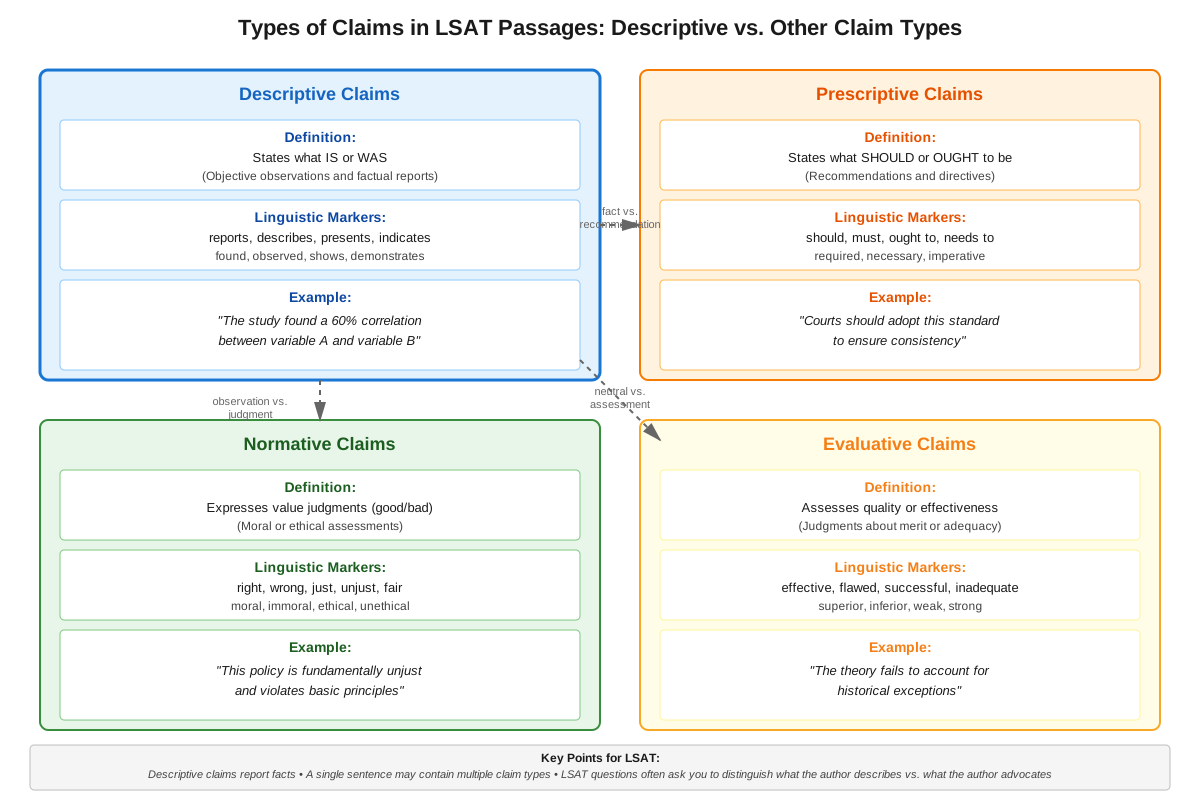
Understanding descriptive claims requires distinguishing them from other statement types that appear in LSAT passages:
| Claim Type | Function | Example | Key Markers |
|---|---|---|---|
| Descriptive | Reports what is/was/will be | "The court ruled in favor of the plaintiff in 1995." | Indicative verbs; specific facts; neutral presentation |
| Prescriptive | Advocates what should be done | "The court should adopt a stricter standard." | Should, must, ought to; recommendations |
| Normative | Expresses value judgments | "This ruling was unjust." | Good/bad, right/wrong, just/unjust |
| Evaluative | Assesses quality or significance | "This theory provides the most compelling explanation." | Comparative language; assessment terms |
| Analytical | Explains relationships or causes | "This ruling resulted from changing social attitudes." | Because, therefore, explains, causes |
The boundaries between these categories can blur. A statement like "This policy has failed to achieve its stated goals" contains both descriptive elements (reporting outcomes) and evaluative elements (characterizing those outcomes as "failure"). On the LSAT, context determines classification: if the author is primarily reporting information, treat it as descriptive; if primarily making a judgment, treat it as evaluative.
Structural Roles of Descriptive Claims
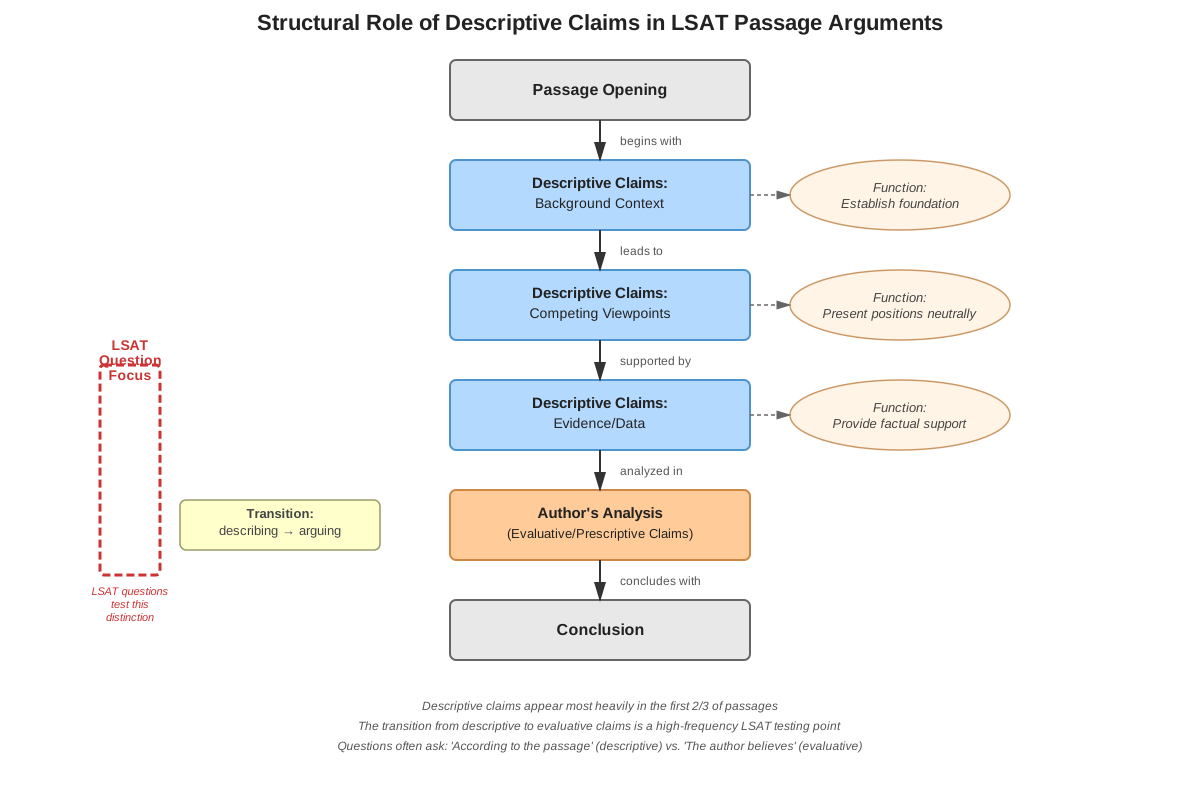
Descriptive claims serve multiple functions within passage architecture. First, they provide background context, establishing the historical, scientific, or theoretical landscape necessary for understanding the author's argument. For example, a passage about legal theory might begin with descriptive claims about how courts currently interpret a particular doctrine before the author argues for a different interpretation.
Second, descriptive claims present evidence supporting argumentative claims. An author arguing that a particular scientific theory is flawed might include descriptive claims about experimental results that contradict the theory's predictions. Here, the descriptive claims (what the experiments showed) support the evaluative claim (the theory is flawed).
Third, descriptive claims characterize others' viewpoints. LSAT passages frequently describe what various scholars, theorists, or schools of thought believe before the author analyzes or critiques these positions. Statements like "Smith argues that X" or "Traditional interpretations hold that Y" are descriptive claims about what others think, even though X or Y themselves might be evaluative claims.
Fourth, descriptive claims establish contrasts or comparisons. Authors might describe two different approaches, theories, or historical periods to set up an analysis of their relative merits. The descriptions themselves are descriptive claims, while the subsequent comparison involves evaluative or analytical claims.
Identifying Descriptive Claims in Complex Passages
In sophisticated LSAT passages, descriptive claims rarely appear in isolation. They interweave with argumentative, evaluative, and analytical content, requiring careful parsing. Several strategies aid identification:
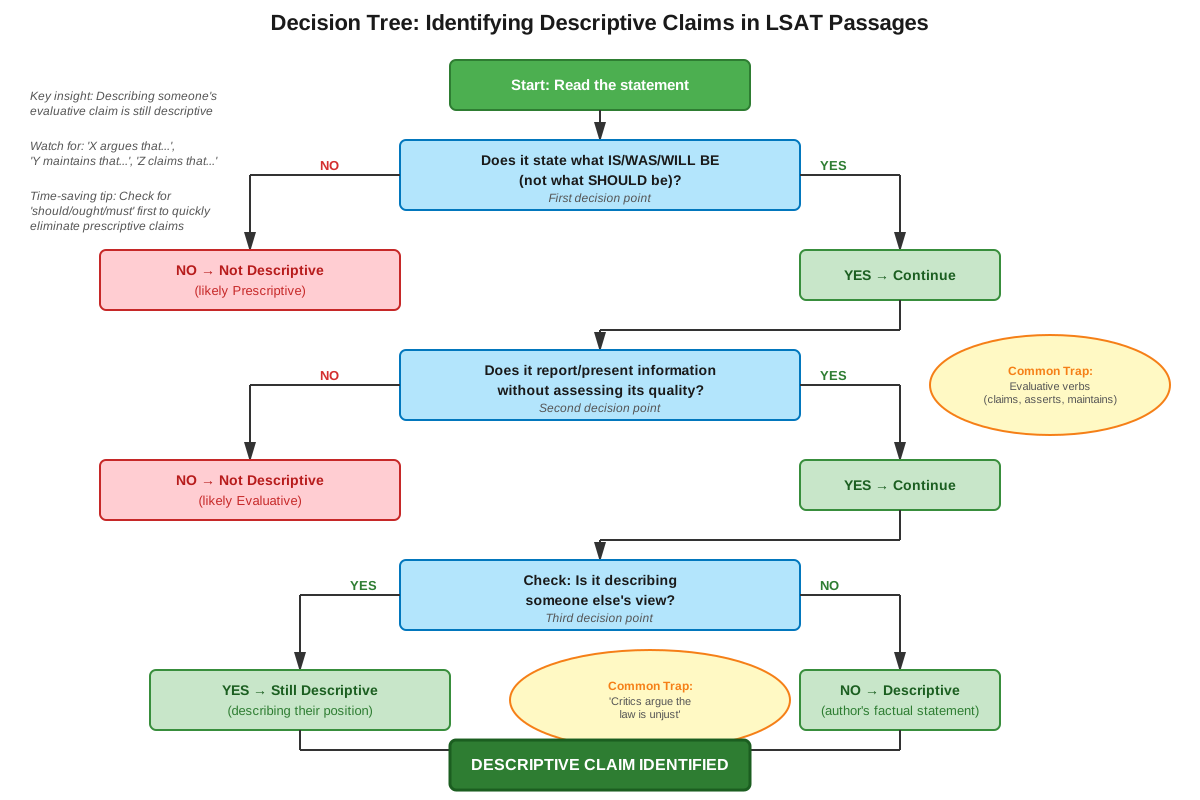
Verb analysis: Examine the main verb of each sentence. Verbs like "is," "was," "occurred," "found," "observed," "reported," and "demonstrated" typically signal descriptive claims. Verbs like "should," "must," "proves," "shows" (in the sense of demonstrates conclusively), and "requires" often signal prescriptive or analytical claims.
Attribution markers: Pay attention to phrases that attribute claims to others: "According to X," "Scholars have long believed," "The traditional view holds," "Research indicates." These markers often introduce descriptive claims about what others think or what evidence shows, even when the content being described is itself evaluative.
Contextual position: Descriptive claims frequently appear in passage openings (establishing context), in the middle of paragraphs (providing evidence), or when introducing a viewpoint that will later be analyzed. Evaluative and prescriptive claims more commonly appear in concluding positions or immediately after descriptive claims that provide their foundation.
Tone and language: Descriptive claims typically employ more neutral, technical, or objective language. Evaluative claims use language with positive or negative connotations: "merely," "unfortunately," "impressive," "flawed," "crucial," "trivial."
The Author's Voice vs. Reported Content
A critical distinction for LSAT success involves separating the author's own descriptive claims from descriptive claims about others' positions. Consider: "Johnson argues that the policy was ineffective." This sentence is the author's descriptive claim about Johnson's position. The author is describing what Johnson argues, not necessarily endorsing that argument. The content (that the policy was ineffective) is evaluative, but the author's act of reporting Johnson's position is descriptive.
This layering appears constantly in LSAT passages. An author might describe multiple competing theories (descriptive claims about what various scholars believe) before offering analysis (the author's own evaluative or analytical claims). Questions frequently test whether students can distinguish what the author believes from what the author reports others believing. Phrases like "the author mentions X" or "according to the passage" often point to descriptive claims, while "the author's primary purpose" or "the author would most likely agree" point to the author's own argumentative stance.
Concept Relationships
Descriptive claims form the foundation upon which more complex argumentative structures build. The relationship flows as follows: Descriptive claims (establishing facts and context) → Analytical claims (explaining relationships among those facts) → Evaluative claims (assessing significance or quality) → Prescriptive claims (recommending actions based on the evaluation).
Within a single passage, descriptive claims about multiple viewpoints create the landscape that the author then navigates through analysis and evaluation. For example: Descriptive claim about Theory A → Descriptive claim about Theory B → Analytical claim about how they differ → Evaluative claim about which is more persuasive → Prescriptive claim about how scholars should proceed.
The connection to viewpoints and argumentation is direct: identifying descriptive claims enables students to map whose viewpoint is being presented at any given moment. Is this the author's own observation, or a description of someone else's position? This distinction is prerequisite to understanding the passage's argumentative structure.
Descriptive claims also connect to inference questions. Valid inferences must be supported by what the passage actually states (descriptive claims) or necessarily follows from those statements. Recognizing what was explicitly described versus what was implied or argued helps students avoid incorrect inferences that go beyond the passage's descriptive foundation.
Quick check — test yourself on Descriptive claims in passages so far.
Try Flashcards →High-Yield Facts
⭐ Descriptive claims report what is, was, or will be the case without inherently advocating for change or expressing value judgments
⭐ Approximately 85-90% of LSAT Reading Comprehension passages contain questions requiring identification of descriptive claims
⭐ Statements like "According to the passage" and "The author mentions X" typically point to descriptive claims
⭐ Descriptive claims often use indicative mood verbs (is, was, occurred) rather than modal verbs (should, must, ought)
⭐ Authors frequently use descriptive claims to characterize others' viewpoints before offering their own analysis
- Descriptive claims can be disputed, biased, or selective while still functioning as descriptive rather than evaluative
- The phrase "X argues that Y" is a descriptive claim about X's position, even if Y itself is evaluative
- Descriptive claims typically appear in passage openings (context), middle sections (evidence), or when introducing viewpoints
- Neutral, technical language often signals descriptive claims, while emotionally charged language suggests evaluative claims
- Distinguishing the author's descriptive claims from descriptions of others' positions is crucial for author's perspective questions
- Descriptive claims provide the evidentiary foundation for analytical and evaluative claims that follow
- Questions asking what is "stated" or "mentioned" in the passage require identifying descriptive claims
Common Misconceptions
Misconception: All descriptive claims are objective facts that everyone would agree with. → Correction: Descriptive claims present information as factual, but they can be controversial, disputed, or reflect particular perspectives. The classification as "descriptive" refers to the claim's function (reporting rather than evaluating), not its universal truth or objectivity.
Misconception: If a sentence contains any evaluative language, it cannot be a descriptive claim. → Correction: Many sentences blend descriptive and evaluative elements. A statement like "The policy failed to reduce crime rates" contains the evaluative term "failed" but primarily describes an outcome. Context determines whether the overall function is descriptive or evaluative.
Misconception: Descriptive claims only appear at the beginning of passages to provide background. → Correction: While descriptive claims often establish context early in passages, they appear throughout—as evidence for arguments, as characterizations of competing viewpoints, and as specific examples supporting broader analytical points.
Misconception: When an author describes someone else's argument, the author endorses that argument. → Correction: Authors frequently describe positions they will later critique or contrast with alternatives. A descriptive claim about what someone argues does not indicate the author's agreement; it simply reports that person's position.
Misconception: Descriptive claims are less important than argumentative claims for LSAT questions. → Correction: Many high-frequency question types—including "according to the passage," "the author mentions X in order to," and detail questions—directly test comprehension of descriptive claims. Additionally, understanding descriptive claims is prerequisite to analyzing the arguments built upon them.
Misconception: Scientific or historical passages contain only descriptive claims since they deal with facts. → Correction: Even passages about science or history contain evaluative, analytical, and prescriptive claims. An author might describe historical events (descriptive) and then argue about their significance (evaluative) or explain their causes (analytical).
Worked Examples
Example 1: Identifying Descriptive Claims in a Legal Passage
Passage excerpt: "The Supreme Court's 1954 decision in Brown v. Board of Education declared that separate educational facilities are inherently unequal. Legal scholars have debated the decision's constitutional foundations for decades. Some argue that the Court relied primarily on sociological evidence rather than constitutional text. Others contend that the decision represented a natural evolution of equal protection doctrine. Critics maintain that the Court overstepped its proper role, while supporters celebrate it as a landmark achievement in civil rights."
Question: Which of the following is a descriptive claim made by the author?
Analysis: Let's examine each sentence:
- "The Supreme Court's 1954 decision in Brown v. Board of Education declared that separate educational facilities are inherently unequal." This is a descriptive claim—the author reports what the Court declared. The author is not evaluating whether the Court was correct, just describing what the decision said.
- "Legal scholars have debated the decision's constitutional foundations for decades." This is a descriptive claim about what scholars have done. The author describes an ongoing debate without taking a position in it.
- "Some argue that the Court relied primarily on sociological evidence rather than constitutional text." This is a descriptive claim about what some people argue. The author is characterizing a position, not endorsing it.
- "Others contend that the decision represented a natural evolution of equal protection doctrine." Another descriptive claim about what others believe.
- "Critics maintain that the Court overstepped its proper role, while supporters celebrate it as a landmark achievement in civil rights." This sentence contains descriptive claims about what critics maintain and what supporters celebrate. The author is describing two opposing viewpoints.
Key insight: This entire excerpt consists of descriptive claims. The author describes what the Court decided and what various scholars and commentators argue about that decision. The author has not yet offered any personal evaluation or analysis. This pattern is common in LSAT passages—authors often establish the landscape of debate through descriptive claims before offering their own analytical or evaluative perspective.
Example 2: Distinguishing Descriptive from Evaluative Claims
Passage excerpt: "Quantum mechanics revolutionized physics in the early twentieth century. The theory successfully predicted phenomena that classical mechanics could not explain, including the photoelectric effect and atomic spectra. However, the theory's probabilistic interpretation troubled many physicists, including Einstein, who famously objected that 'God does not play dice with the universe.' Despite these philosophical concerns, quantum mechanics has proven to be the most empirically successful theory in the history of science, with predictions confirmed to extraordinary precision. Nevertheless, the theory's implications for our understanding of reality remain deeply puzzling."
Question: Identify which claims are descriptive and which are evaluative.
Analysis:
- "Quantum mechanics revolutionized physics in the early twentieth century." This is evaluative—"revolutionized" expresses a value judgment about the theory's significance and impact.
- "The theory successfully predicted phenomena that classical mechanics could not explain, including the photoelectric effect and atomic spectra." This is primarily descriptive—it reports what the theory predicted. The word "successfully" adds a slight evaluative element, but the sentence's main function is describing what the theory accomplished.
- "However, the theory's probabilistic interpretation troubled many physicists, including Einstein, who famously objected that 'God does not play dice with the universe.'" This is descriptive—the author describes how physicists reacted and quotes Einstein's objection. The author is not saying whether their concerns were justified, just that they had them.
- "Despite these philosophical concerns, quantum mechanics has proven to be the most empirically successful theory in the history of science, with predictions confirmed to extraordinary precision." This blends descriptive and evaluative elements. "Most empirically successful theory in the history of science" is evaluative (making a comparative judgment), while "predictions confirmed to extraordinary precision" is more descriptive (reporting outcomes).
- "Nevertheless, the theory's implications for our understanding of reality remain deeply puzzling." This is evaluative—"deeply puzzling" expresses a judgment about the theory's philosophical implications.
Key insight: Real LSAT passages blend descriptive and evaluative claims, often within single sentences. The skill is recognizing the primary function of each statement. When answering "according to the passage" questions, focus on the descriptive elements—what is reported as fact. When answering questions about the author's attitude or purpose, focus on the evaluative elements—where the author makes judgments.
Exam Strategy
When approaching LSAT Reading Comprehension questions involving descriptive claims, employ this systematic process:
Step 1: During initial passage reading, mark or mentally note where the author shifts between describing others' views and expressing the author's own position. Phrases like "according to," "scholars argue," "the traditional view," and "research shows" signal descriptive claims about what others think or what evidence indicates.
Step 2: For "according to the passage" questions, return to the passage and locate the relevant section. These questions almost always require identifying descriptive claims—what the passage explicitly stated. Eliminate answer choices that:
- Introduce information not mentioned in the passage
- Make inferences beyond what was stated
- Confuse the author's view with views the author described
- Use evaluative language not present in the passage
Step 3: Watch for trigger words that signal descriptive claims:
- Temporal markers: "in 1995," "during the Renaissance," "recently"
- Attribution phrases: "Smith argues," "according to the theory," "critics contend"
- Reporting verbs: "found," "observed," "demonstrated," "reported," "showed"
- Neutral presentation: "the policy resulted in," "the court held that," "the data indicated"
Step 4: For author's purpose or attitude questions, distinguish between what the author describes and what the author evaluates. The author might describe a theory neutrally (descriptive claim) while later critiquing it (evaluative claim). The author's purpose in mentioning the theory might be to provide context for the critique, not to endorse the theory.
Step 5: Time allocation: Don't spend excessive time on straightforward descriptive claim questions. These are often among the more direct question types. If a question asks what the passage states and you can locate the relevant sentence, select the answer that most closely paraphrases that descriptive claim. Save time for more complex inference or application questions.
Process-of-elimination tip specific to descriptive claims: When answer choices seem similar, check whether they confuse:
- What the author states vs. what the author implies
- What the author believes vs. what the author reports others believing
- Descriptive claims vs. evaluative claims (e.g., "the policy reduced crime" vs. "the policy successfully reduced crime")
Exam Tip: If you're unsure whether a statement is descriptive or evaluative, ask: "Is the author primarily reporting information or making a judgment?" If reporting, it's descriptive; if judging, it's evaluative.
Memory Techniques
D.E.S.C.R.I.B.E. Mnemonic for identifying descriptive claims:
- Does it report what is/was/will be?
- Evidence or background being presented?
- Specific facts, dates, or details included?
- Characterizing others' views?
- Reporting verbs used (found, showed, observed)?
- Indicative mood (not should/must/ought)?
- Background context being established?
- Evaluative language absent or minimal?
Visualization strategy: Picture descriptive claims as the "stage setting" of a passage—they establish the scene, introduce the characters (various viewpoints), and present the props (evidence and facts). The author's evaluative and analytical claims are the "action" that happens on this stage. When reading, visualize yourself watching the stage being set before the performance begins.
The "Reporter Test": Ask yourself: "Could a neutral reporter write this sentence without expressing any opinion?" If yes, it's likely descriptive. If the sentence requires taking a stance or making a judgment, it's likely evaluative or prescriptive.
Acronym for claim types: D.P.N.E.A.
- Descriptive: what is
- Prescriptive: what should be
- Normative: what's good/bad
- Evaluative: what's better/worse
- Analytical: why/how
Summary
Descriptive claims in passages represent statements that report, characterize, or present information as factual without inherently advocating for change or expressing value judgments. These claims form the foundational layer of LSAT Reading Comprehension passages, providing context, evidence, and characterizations of various viewpoints upon which authors build their arguments. The ability to identify descriptive claims—and distinguish them from prescriptive, normative, evaluative, and analytical claims—is essential for accurately answering the majority of Reading Comprehension questions, particularly those asking what the passage states, what the author mentions, or what various scholars or theories hold. Descriptive claims typically employ indicative mood verbs, neutral language, and specific details, and they frequently appear when authors establish background, present evidence, or characterize others' positions. Mastering this skill requires careful attention to verb choice, attribution markers, contextual position, and the distinction between the author's own claims and the author's descriptions of others' claims—a distinction that test-makers exploit repeatedly in wrong answer choices.
Key Takeaways
- Descriptive claims report what is, was, or will be the case, forming the factual foundation of passages and arguments
- Identifying descriptive claims is essential for "according to the passage" questions, which appear in nearly every Reading Comprehension section
- The key distinction is between what the author describes (including descriptions of others' views) and what the author evaluates or advocates
- Descriptive claims use indicative verbs, neutral language, and specific details, while evaluative claims use judgment-laden language
- Authors frequently describe multiple viewpoints through descriptive claims before offering their own analytical or evaluative perspective
- Recognizing attribution markers ("Smith argues," "according to the theory") helps identify descriptive claims about others' positions
- Descriptive claims can be controversial or disputed while still functioning as descriptive rather than evaluative in their form and purpose
Related Topics
Evaluative and Normative Claims: Understanding how authors make value judgments and assess quality builds directly on the foundation of identifying descriptive claims. Mastering descriptive claims enables students to recognize when authors shift from reporting to evaluating.
Author's Tone and Attitude: Recognizing the author's perspective requires distinguishing between neutral descriptions and language that reveals the author's stance. This skill depends on first identifying which claims are purely descriptive.
Argument Structure and Reasoning: Mapping how premises support conclusions requires identifying which statements are descriptive (often premises) versus evaluative or prescriptive (often conclusions).
Multiple Viewpoints in Passages: LSAT passages frequently present several scholars' or schools' positions. Identifying descriptive claims about what each viewpoint holds is prerequisite to understanding how the author navigates among these positions.
Inference Questions: Valid inferences must be grounded in what the passage states. Recognizing descriptive claims provides the foundation from which proper inferences can be drawn.
Practice CTA
Now that you understand how to identify and work with descriptive claims in passages, it's time to apply these skills to actual LSAT-style questions. The practice questions and flashcards will reinforce your ability to distinguish descriptive from other claim types, recognize structural roles of descriptive claims, and accurately answer questions that test this high-yield concept. Remember: this skill appears in the vast majority of Reading Comprehension passages, making it one of the highest-return investments of your study time. Approach each practice question systematically, using the strategies outlined above, and you'll build the automaticity needed for test-day success.
Sign up free to keep reading
Create a free AnvayaPrep account to finish this LSAT guide on Descriptive claims in passages — plus flashcards and practice questions.