Overview
Evidence interpretation is a critical skill tested throughout the LSAT Reading Comprehension section, requiring test-takers to analyze how authors use evidence to support claims, challenge opposing views, or develop arguments within complex passages. This skill goes beyond simply identifying what evidence is presented; it demands understanding how that evidence functions within the broader argumentative structure, what conclusions it supports or undermines, and how different pieces of evidence relate to one another. On the LSAT, passages frequently present multiple viewpoints supported by various forms of evidence—empirical data, expert testimony, historical examples, analogies, and theoretical frameworks—and questions test whether students can accurately assess the role and strength of each piece of evidence.
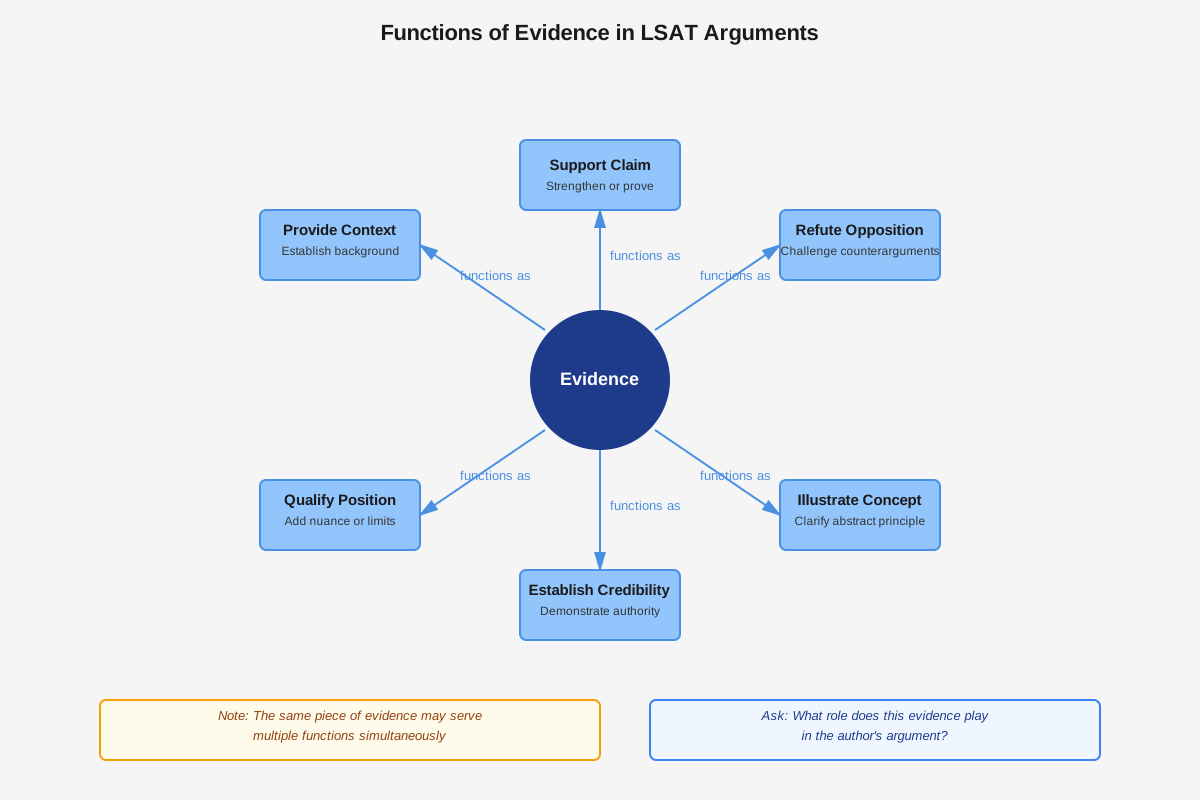
The ability to interpret evidence effectively is foundational to success in reading comprehension because LSAT passages are constructed around sophisticated arguments where evidence serves multiple rhetorical purposes. An author might introduce evidence to establish credibility, refute a counterargument, illustrate an abstract principle, or qualify a previously stated claim. Understanding these nuanced functions is essential for answering questions about author's purpose, passage structure, inference, and strengthening or weakening arguments. This skill directly connects to the broader domain of viewpoints and argumentation, as evidence interpretation enables students to distinguish between an author's own position and alternative perspectives presented in the passage.
Mastering LSAT evidence interpretation provides the analytical foundation for tackling the most challenging question types in Reading Comprehension. Questions may ask students to identify which piece of evidence best supports a particular claim, determine what additional evidence would strengthen an argument, recognize when evidence is used to illustrate rather than prove a point, or evaluate whether cited evidence actually supports the conclusion drawn from it. This topic integrates closely with understanding argument structure, recognizing logical relationships, and evaluating the strength of reasoning—skills that extend beyond Reading Comprehension into Logical Reasoning sections as well.
Learning Objectives
- [ ] Identify how Evidence interpretation appears in LSAT questions
- [ ] Explain the reasoning pattern behind Evidence interpretation
- [ ] Apply Evidence interpretation to solve LSAT-style problems accurately
- [ ] Distinguish between different types of evidence and their respective argumentative functions
- [ ] Evaluate the strength and relevance of evidence in supporting specific claims
- [ ] Recognize when evidence is being used to support, illustrate, qualify, or refute a position
- [ ] Analyze how multiple pieces of evidence work together to build a comprehensive argument
Prerequisites
- Basic argument structure recognition: Understanding premises, conclusions, and how claims are supported is essential because evidence interpretation requires identifying what role each piece of information plays in an argument.
- Ability to identify main ideas and supporting details: This foundational reading skill enables students to distinguish between primary claims and the evidence used to support them.
- Understanding of different viewpoints in passages: Since evidence often supports specific perspectives, recognizing whose view is being advanced helps determine the function of particular evidence.
- Familiarity with common LSAT question stems: Knowing how questions are phrased helps students recognize when evidence interpretation skills are being tested.
Why This Topic Matters
Evidence interpretation appears in approximately 30-40% of LSAT Reading Comprehension questions, making it one of the highest-yield skills for test preparation. Questions testing this skill appear across multiple question types, including Function questions ("The author mentions X in order to..."), Inference questions ("The passage suggests that the evidence supports which of the following..."), Strengthen/Weaken questions, and Application questions that require extending the passage's reasoning to new scenarios.
In real-world contexts, evidence interpretation is fundamental to legal reasoning, which is precisely why the LSAT emphasizes this skill. Attorneys must constantly evaluate whether evidence supports legal claims, distinguish between strong and weak evidence, recognize when evidence is being misapplied, and understand how different pieces of evidence combine to build or undermine a case. Law school coursework and legal practice both demand the ability to assess evidentiary support critically and precisely.
On the LSAT, evidence interpretation commonly appears when passages discuss scientific studies (evaluating whether data supports a hypothesis), historical arguments (assessing whether historical examples prove a broader claim), legal reasoning (determining whether precedents support a legal principle), or theoretical debates (analyzing whether evidence favors one theoretical framework over another). Passages in comparative reading formats frequently test whether students can recognize that the same evidence might support different conclusions depending on interpretive frameworks, or that authors use similar evidence for different argumentative purposes.
Core Concepts
Types of Evidence in LSAT Passages
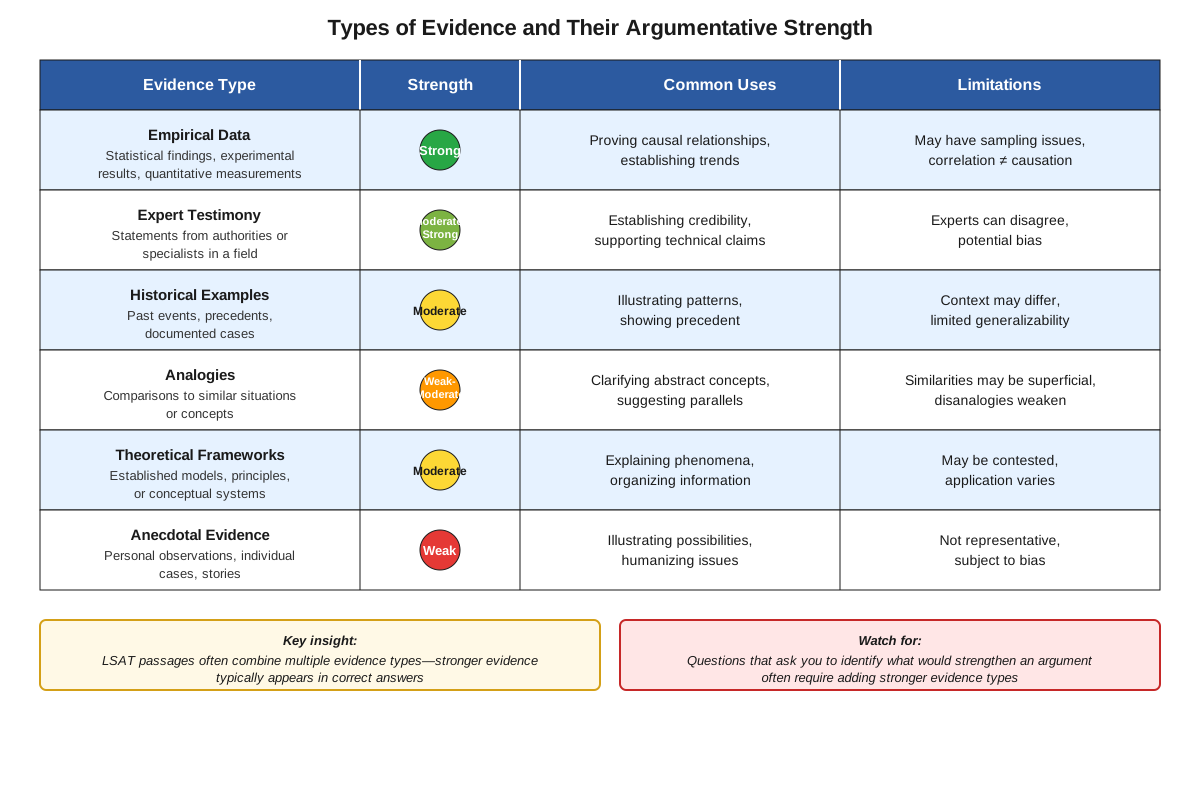
Evidence in LSAT Reading Comprehension passages takes multiple forms, each serving distinct argumentative functions. Empirical evidence includes experimental data, statistical findings, observational studies, and quantitative measurements. This type of evidence is often presented as objective support for scientific or social science claims. Testimonial evidence consists of expert opinions, eyewitness accounts, or authoritative statements that lend credibility to positions. Historical evidence draws on past events, precedents, or documented occurrences to support claims about patterns, causation, or principles. Analogical evidence uses comparisons between similar situations to suggest that what holds true in one case likely applies to another. Theoretical evidence involves logical reasoning, thought experiments, or deductive arguments that support claims through conceptual analysis rather than observation.
Understanding these categories helps test-takers recognize what kind of support an author is providing and evaluate its appropriateness for the claim being made. For instance, empirical evidence strongly supports factual claims about observable phenomena but may be less effective for normative claims about what should be done. Analogical evidence can illustrate principles effectively but may be vulnerable if the comparison breaks down in relevant ways.
Functions of Evidence in Arguments
Evidence serves multiple rhetorical and logical functions within LSAT passages. The supporting function is most straightforward: evidence directly backs up a claim by providing reasons to believe it's true. When an author states that "fossil records show a gradual transition between species," this evidence supports evolutionary theory. The illustrative function uses evidence not to prove a point but to clarify or make concrete an abstract principle. An author might describe a specific legal case not to prove a general principle but to help readers understand how that principle operates in practice.
The qualifying function involves evidence that limits or adds nuance to a claim. An author might present evidence showing that while a theory generally holds, certain conditions create exceptions. The refutational function uses evidence to challenge or undermine opposing viewpoints. When passages present multiple perspectives, authors often introduce evidence specifically to show weaknesses in alternative positions. The establishing credibility function involves evidence presented primarily to demonstrate the author's or a cited expert's authority on the subject, building trust before advancing more controversial claims.
| Evidence Function | Purpose | Example Signal Phrases |
|---|---|---|
| Supporting | Directly proves or substantiates a claim | "Studies demonstrate...", "This shows that..." |
| Illustrative | Clarifies or exemplifies an abstract point | "For example...", "Consider the case of..." |
| Qualifying | Adds nuance or limits scope of a claim | "However, in certain conditions...", "This applies primarily to..." |
| Refutational | Challenges or undermines opposing views | "Contrary to this view...", "This evidence contradicts..." |
| Credibility-establishing | Demonstrates expertise or authority | "Leading researchers agree...", "Extensive documentation reveals..." |
Evaluating Evidence Strength and Relevance
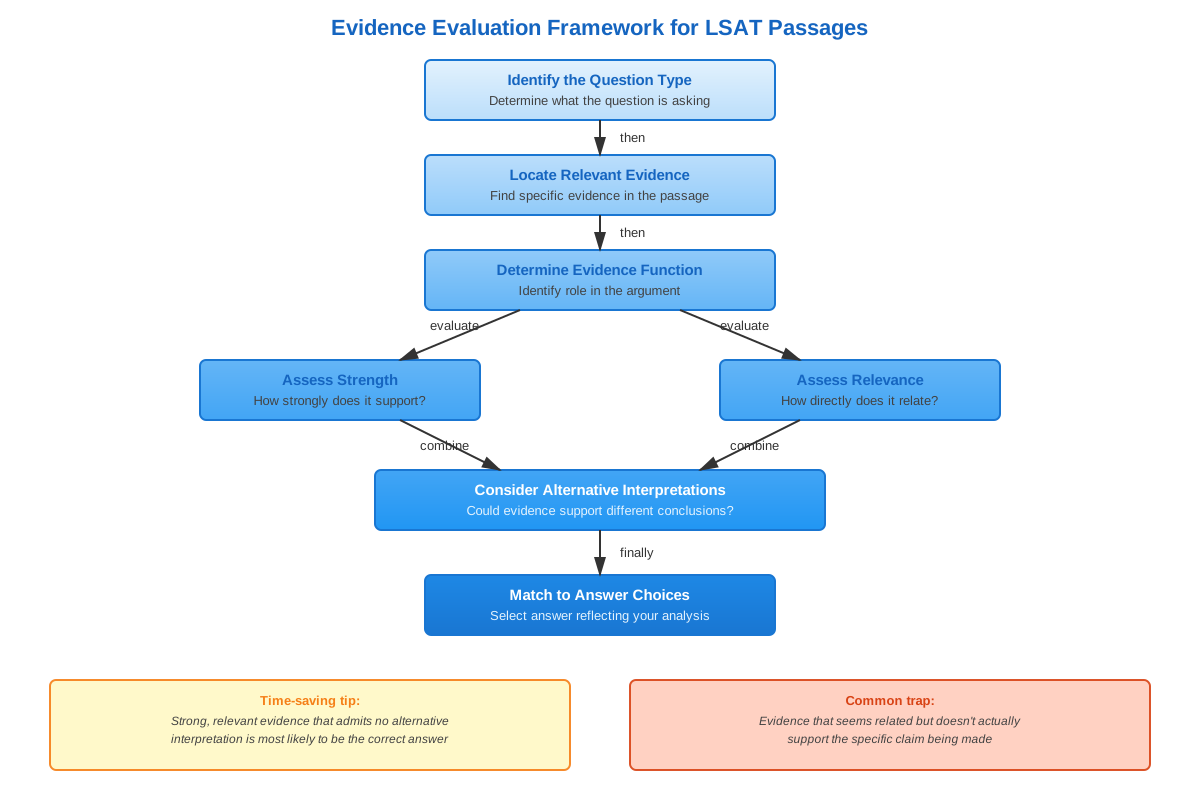
Not all evidence equally supports the claims it's meant to back up. Relevance refers to whether evidence actually connects to the claim in question. Evidence might be factually accurate but irrelevant if it addresses a different issue than the one at stake. For instance, evidence about the economic costs of a policy doesn't directly address questions about its ethical justification. LSAT passages often include evidence that seems related but doesn't actually support the specific conclusion drawn.
Sufficiency concerns whether evidence provides adequate support for a claim. A single anecdote might illustrate a possibility but insufficient to prove a general pattern. Multiple converging lines of evidence typically provide stronger support than a single source. Representativeness matters when evidence involves examples or samples—do they accurately reflect the broader population or phenomenon being discussed? A study of one demographic group may not support claims about all groups.
Directness distinguishes between evidence that directly establishes a claim versus evidence that requires additional inferential steps. Direct evidence for "the policy reduced crime" would be crime statistics before and after implementation. Indirect evidence might be that similar policies elsewhere reduced crime, requiring the inference that the same would occur here. LSAT questions frequently test whether students recognize these distinctions and don't overextend what evidence actually establishes.
Evidence Chains and Cumulative Support
Complex LSAT passages often present evidence chains where one piece of evidence supports an intermediate conclusion, which then serves as evidence for a further claim. Understanding these chains requires tracking how information flows through the argument. For example: Evidence A (fossil dating) supports Claim B (these species existed simultaneously) → Claim B serves as evidence for Claim C (they likely interacted) → Claim C supports Claim D (competition drove evolutionary changes).
Cumulative evidence involves multiple independent pieces of evidence that collectively support a conclusion more strongly than any single piece would alone. An author might present archaeological evidence, linguistic analysis, and genetic data that all point toward the same historical conclusion. LSAT questions may ask which piece of evidence is most critical, or what would happen if one piece were undermined—testing whether students understand how evidence works together.
Evidence Interpretation vs. Evidence Identification
A crucial distinction for LSAT success is between merely identifying that evidence exists and interpreting its role and significance. Evidence identification is the simpler skill of recognizing what information the passage presents as factual support. Evidence interpretation requires analyzing why that evidence appears, what it's meant to support, how effectively it supports that claim, and what assumptions connect the evidence to the conclusion.
For instance, a passage might state: "Researchers found that participants who meditated daily reported lower stress levels." Identifying this as evidence is straightforward. Interpreting it requires recognizing: (1) this is self-reported data, which may be less reliable than physiological measurements; (2) it shows correlation but doesn't establish causation; (3) it supports claims about perceived stress but not necessarily about actual physiological stress responses; (4) the author might be using this to support a claim about meditation's benefits or to illustrate why further research is needed, depending on context.
Context-Dependent Evidence Interpretation
The same evidence can support different conclusions depending on the interpretive framework applied. LSAT passages, particularly in comparative reading, often demonstrate how different authors interpret identical evidence differently based on their theoretical commitments or methodological approaches. A decline in a species' population might be interpreted as evidence of environmental degradation by one author, as evidence of natural population cycles by another, or as evidence of measurement error by a third.
Understanding context-dependent interpretation requires recognizing the assumptions, values, and frameworks that shape how evidence is understood. Questions testing this skill might ask how a different author would likely interpret evidence presented in the passage, or what additional information would be needed to determine which interpretation is correct. This connects directly to the broader theme of viewpoints and argumentation, as different viewpoints often arise from different ways of interpreting the same underlying evidence.
Concept Relationships
Evidence interpretation connects fundamentally to argument structure analysis: understanding how evidence functions requires first identifying the argument's conclusion and reasoning pattern. The skill builds directly on the ability to distinguish main ideas from supporting details, as evidence typically constitutes the supporting detail layer of passage organization.
Within the topic itself, concepts flow logically: Types of Evidence → Functions of Evidence → Evaluating Evidence Strength → Evidence Chains → Context-Dependent Interpretation. Understanding what kinds of evidence exist enables recognition of their different functions. Recognizing functions leads to evaluating whether evidence effectively serves those functions. This evaluation skill then extends to analyzing complex evidence chains and understanding how interpretive context shapes evidence assessment.
Evidence interpretation also connects forward to inference questions (what can be concluded from presented evidence?), application questions (how would the evidence-based reasoning apply to new scenarios?), and strengthen/weaken questions (what additional evidence would affect the argument?). Mastering evidence interpretation provides the foundation for these more complex question types.
The relationship to viewpoints and argumentation is bidirectional: understanding different viewpoints helps interpret evidence (recognizing which perspective evidence supports), while evidence interpretation helps distinguish viewpoints (different positions are often characterized by what evidence they emphasize or how they interpret shared evidence).
High-Yield Facts
⭐ Evidence interpretation questions appear in approximately 30-40% of LSAT Reading Comprehension questions, making it one of the most frequently tested skills.
⭐ The same piece of evidence can serve multiple functions simultaneously—supporting one claim while illustrating another and refuting a third.
⭐ LSAT passages frequently include evidence that seems relevant but doesn't actually support the specific conclusion the author draws from it.
⭐ Function questions ("The author mentions X in order to...") almost always test evidence interpretation skills.
⭐ Evidence that establishes correlation does not automatically establish causation—a distinction the LSAT frequently tests.
- Empirical evidence is strongest for factual claims about observable phenomena but may not support normative or evaluative claims.
- When multiple pieces of evidence support a conclusion, undermining one piece doesn't necessarily undermine the entire argument if other evidence remains strong.
- Analogical evidence is only as strong as the similarity between the compared situations in relevant respects.
- Expert testimony serves as evidence, but LSAT passages often include questions about whether the expert's credentials are relevant to the specific claim being made.
- Evidence presented early in a passage often establishes context or credibility, while evidence in later paragraphs typically supports the author's main argumentative claims.
- Qualifying evidence (showing exceptions or limitations) often appears after general claims and is frequently tested in inference questions.
- Historical evidence can establish that something occurred but requires additional reasoning to support claims about why it occurred or whether it will occur again.
Quick check — test yourself on Evidence interpretation so far.
Try Flashcards →Common Misconceptions
Misconception: All information presented in a passage serves as evidence for the author's main conclusion.
Correction: Passages include background information, alternative viewpoints, and contextual details that don't support the author's position. Some information may even contradict the author's view, presented specifically to be refuted.
Misconception: Stronger or more detailed evidence always indicates the author's primary claim.
Correction: Authors sometimes provide extensive evidence for preliminary or uncontroversial points while offering less evidence for their main claim, which may be more speculative or normative. The amount of evidence doesn't always correlate with argumentative importance.
Misconception: If evidence is factually accurate, it necessarily supports the conclusion drawn from it.
Correction: Evidence can be true but irrelevant, insufficient, or misapplied. The logical connection between evidence and conclusion matters as much as the evidence's accuracy.
Misconception: Evidence interpretation questions have subjective answers based on personal judgment.
Correction: LSAT evidence interpretation questions have objectively correct answers based on what the passage actually states and logically implies. The test rewards careful textual analysis, not personal opinion about what evidence should support.
Misconception: Evidence that supports a claim proves that claim is true.
Correction: Evidence can support a claim (make it more likely or provide reasons to believe it) without definitively proving it. The LSAT frequently tests the distinction between evidence that suggests, indicates, or supports versus evidence that proves or establishes.
Misconception: When an author cites evidence, they necessarily endorse the conclusion that evidence supports.
Correction: Authors often present evidence supporting views they ultimately reject, either to establish what others believe before critiquing those beliefs, or to show that even evidence favoring an opposing view isn't sufficient to establish that view.
Misconception: All evidence in a passage is equally important for answering questions.
Correction: Some evidence is central to the passage's main argument, while other evidence serves subsidiary functions like providing background, illustrating minor points, or addressing potential objections. Recognizing this hierarchy helps prioritize what to focus on.
Worked Examples
Example 1: Evaluating Evidence Function
Passage Excerpt: "Traditional economic theory predicts that increased minimum wages lead to unemployment. However, recent studies in several cities that raised minimum wages found no significant increase in unemployment rates. For instance, when Seattle raised its minimum wage to $15 per hour, employment in the restaurant industry—the sector most affected by minimum wage increases—actually grew by 2.3%. These findings have led some economists to reconsider the relationship between wages and employment."
Question: The author mentions the Seattle restaurant industry primarily in order to:
(A) Prove that traditional economic theory is incorrect
(B) Illustrate with a specific example the broader finding mentioned in the previous sentence
(C) Suggest that the restaurant industry is unique among employment sectors
(D) Demonstrate that minimum wage increases always benefit workers
(E) Establish that Seattle's economic conditions differ from other cities
Analysis:
First, identify what claim the Seattle evidence appears near: "recent studies in several cities...found no significant increase in unemployment rates." The Seattle example comes immediately after this general claim, introduced by "For instance," which is a classic signal phrase for illustration.
Next, evaluate each function the evidence might serve:
- Supporting function: Does it prove the general claim? No—it's one example among "several cities," so it contributes to but doesn't independently establish the broader finding.
- Illustrative function: Does it make concrete a general point? Yes—it provides specific numbers and a specific sector to exemplify the general finding.
- Refutational function: Does it challenge a view? Indirectly, it challenges traditional theory, but that's not its primary function in this immediate context.
Evaluate answer choices:
- (A) is too strong—one example doesn't "prove" a theory incorrect, and the passage says economists are "reconsidering," not that the theory is definitively wrong.
- (B) correctly identifies the illustrative function, matching the "For instance" signal and the relationship between the specific Seattle data and the general claim about "several cities."
- (C) misreads the passage—nothing suggests restaurants are unique; they're mentioned as "most affected," making them a relevant test case.
- (D) is too strong and too broad—the evidence shows employment grew, not that increases "always benefit workers."
- (E) introduces a comparison not made in the passage.
Answer: (B)
Connection to Learning Objectives: This example demonstrates identifying how evidence interpretation appears in LSAT questions (function questions), explaining the reasoning pattern (recognizing illustrative vs. supporting functions), and applying the skill to solve problems accurately.
Example 2: Evaluating Evidence Strength and Relevance
Passage Excerpt: "Critics argue that the new privacy regulations will stifle technological innovation. They point to the European Union's experience, where similar regulations led to a 15% decrease in venture capital investment in technology startups during the first year after implementation. However, this argument overlooks several crucial factors. First, the EU regulations were significantly more restrictive than the proposed measures. Second, the decrease in investment coincided with a broader economic downturn affecting all sectors, not just technology. Third, by the second year, technology investment had rebounded to pre-regulation levels, suggesting any initial effect was temporary."
Question: The author's response to critics' use of EU data as evidence can best be described as:
(A) Accepting the evidence but disputing its relevance to the current proposal
(B) Questioning the accuracy of the statistical data presented
(C) Arguing that the evidence, while relevant, is insufficient to support the critics' conclusion
(D) Demonstrating that the evidence actually supports the opposite conclusion
(E) Suggesting that economic factors are more important than regulatory factors
Analysis:
First, identify what the critics' evidence is meant to support: that new privacy regulations will stifle innovation. The EU example is offered as evidence for this claim.
Next, analyze how the author responds to this evidence:
- Does the author dispute the facts? No—the 15% decrease isn't challenged as inaccurate.
- Does the author question relevance? Yes—"the EU regulations were significantly more restrictive" suggests the EU case isn't comparable to the current proposal.
- Does the author question sufficiency? Yes—even if the EU data is accurate, the author provides alternative explanations (economic downturn) and additional context (rebound by year two) that undermine whether this evidence supports the conclusion.
Evaluate answer choices:
- (A) accurately captures the relevance challenge—the EU regulations being "more restrictive" means this evidence doesn't directly apply to "the proposed measures."
- (B) is incorrect—the author doesn't question whether the 15% figure is accurate.
- (C) is partially correct but misses the primary thrust—the author's first and strongest point is about relevance (different regulations), not just sufficiency.
- (D) is incorrect—the author doesn't claim the evidence supports the opposite view, just that it doesn't support the critics' view.
- (E) mischaracterizes the argument—the author mentions economic factors as an alternative explanation for the data, not as more important than regulations generally.
Answer: (A)
Connection to Learning Objectives: This example demonstrates explaining the reasoning pattern behind evidence interpretation (distinguishing relevance from accuracy from sufficiency), identifying how this appears in LSAT questions (questions about how authors respond to evidence), and applying these concepts to select the correct answer.
Exam Strategy
Approaching Evidence Interpretation Questions
When encountering questions about evidence, first locate the specific evidence mentioned in the question stem within the passage. Read at least one sentence before and after to understand context. Then ask three questions: (1) What claim does this evidence appear to support? (2) How does it support that claim—what's the logical connection? (3) What function does this evidence serve in the broader argument?
Trigger phrases that signal evidence interpretation questions include:
- "The author mentions X in order to..."
- "The author uses X as evidence for..."
- "The function of the reference to X is to..."
- "X is offered as support for which of the following..."
- "The author's use of X serves primarily to..."
- "Which of the following best describes the role of X..."
Process of Elimination Strategies
Eliminate answers that confuse evidence functions. If evidence clearly illustrates a point with a specific example, eliminate answers suggesting it "proves" or "establishes" a general principle. If evidence supports a limited claim, eliminate answers that extend it to broader claims not actually supported.
Watch for answers that accurately describe information in the passage but misidentify its function. An answer might correctly state what evidence shows but incorrectly describe why the author included it. Always verify that the answer addresses the specific question asked about the evidence's role or function.
Eliminate extreme answers when evidence provides partial or qualified support. Words like "proves," "establishes definitively," "demonstrates conclusively," or "always" often signal incorrect answers, as LSAT passages typically present evidence that supports claims without absolutely proving them.
Time Allocation
Evidence interpretation questions typically require 60-90 seconds. Spend 20-30 seconds locating and re-reading the relevant passage section with context, 20-30 seconds analyzing the evidence's function, and 20-30 seconds evaluating answer choices. If you find yourself spending more than 90 seconds, make your best judgment and move on—these questions test careful reading, not extended deliberation.
For passages with multiple evidence interpretation questions, consider annotating evidence functions during your initial read-through. Mark supporting evidence with "S," illustrative examples with "Ex," and refutational evidence with "R." This investment of 10-15 seconds during initial reading can save 20-30 seconds per question later.
Common Traps
Beware of answers that describe what evidence could support in general rather than what it actually supports in the passage's specific context. The LSAT tests careful reading of what's actually argued, not what could theoretically be argued with that evidence.
Watch for answers that confuse the author's view with opposing views presented in the passage. Evidence supporting a view the author ultimately rejects shouldn't be described as supporting the author's position. Track whose perspective each piece of evidence supports.
Memory Techniques
FIRES mnemonic for evidence functions:
- Function: What role does this evidence play?
- Illustrate or prove: Does it exemplify or establish?
- Relevance: Does it actually connect to the claim?
- Enough: Is it sufficient support?
- Source: Whose view does it support?
Visualization strategy: Picture evidence as building blocks in an argument structure. Supporting evidence forms the foundation directly under a claim. Illustrative evidence sits beside a claim, showing what it looks like in practice. Refutational evidence appears in opposition to alternative claims. This spatial visualization helps track how different pieces of evidence relate to various claims.
The "So What?" Test: When analyzing evidence, ask "So what does this show?" and "Why does the author include this?" These questions naturally lead to identifying the evidence's function and evaluating its strength.
CARES for evaluating evidence strength:
- Connection: Is there a logical link to the claim?
- Adequacy: Is it sufficient support?
- Representativeness: Does it accurately reflect the broader phenomenon?
- Exceptions: Are there limitations or qualifications?
- Source reliability: Is the evidence credible?
Summary
Evidence interpretation is a high-yield LSAT skill requiring students to analyze not just what evidence passages present but how that evidence functions within arguments. Success demands distinguishing between evidence types (empirical, testimonial, historical, analogical, theoretical), recognizing evidence functions (supporting, illustrating, qualifying, refuting, establishing credibility), and evaluating evidence strength through relevance, sufficiency, and directness. The LSAT tests whether students can identify what claims evidence actually supports, recognize when evidence is misapplied or insufficient, and understand how multiple pieces of evidence work together in complex arguments. Questions appear across multiple formats, particularly function questions asking why authors include specific evidence. Mastery requires moving beyond simple evidence identification to sophisticated interpretation that considers context, logical connections, and argumentative purpose. The skill connects fundamentally to understanding viewpoints and argumentation, as different perspectives often involve different interpretations of the same evidence. Students must practice distinguishing what evidence could theoretically support from what it actually supports in specific passage contexts, avoiding common traps like confusing illustration with proof or misidentifying whose position evidence supports.
Key Takeaways
- Evidence interpretation questions constitute 30-40% of Reading Comprehension questions, making this one of the highest-yield skills for LSAT preparation.
- The same evidence can serve multiple functions simultaneously—always consider context to determine the primary function being tested.
- Distinguish between evidence that illustrates (provides examples), supports (gives reasons to believe), and proves (definitively establishes)—the LSAT frequently tests these distinctions.
- Evidence strength depends on relevance (does it connect to the claim?), sufficiency (is it adequate support?), and directness (how many inferential steps are required?).
- Function questions with trigger phrases like "The author mentions X in order to..." almost always test evidence interpretation and require identifying the evidence's role in the argument.
- Track whose viewpoint each piece of evidence supports—passages often include evidence for positions the author ultimately rejects.
- Use the FIRES mnemonic (Function, Illustrate or prove, Relevance, Enough, Source) to systematically analyze evidence in passages and questions.
Related Topics
Argument Structure Analysis: Understanding how premises and conclusions relate provides the foundation for evidence interpretation, as evidence functions as premises supporting conclusions. Mastering evidence interpretation enables more sophisticated argument analysis.
Inference Questions: Evidence interpretation skills directly enable inference questions, which ask what can be concluded from presented evidence. Strong evidence interpretation helps distinguish warranted from unwarranted inferences.
Strengthen/Weaken Questions: These questions test understanding of what additional evidence would support or undermine arguments, building directly on evidence interpretation skills by requiring students to evaluate potential evidence.
Author's Purpose and Attitude: Recognizing how authors use evidence helps determine their purpose and attitude—whether they're advocating, critiquing, explaining, or remaining neutral.
Comparative Reading: This format frequently tests whether students recognize that different authors interpret the same evidence differently, requiring sophisticated evidence interpretation skills.
Practice CTA
Now that you've mastered the core concepts of evidence interpretation, it's time to apply these skills to authentic LSAT passages and questions. The practice questions and flashcards will reinforce your ability to quickly identify evidence functions, evaluate evidence strength, and select correct answers confidently. Remember: evidence interpretation is a skill that improves dramatically with deliberate practice. Each practice question you work through strengthens your ability to recognize patterns and avoid common traps. Approach the practice materials strategically, reviewing not just which answers are correct but why they're correct and why wrong answers are tempting. Your investment in mastering this high-yield topic will pay dividends across the entire Reading Comprehension section!
Sign up free to keep reading
Create a free AnvayaPrep account to finish this LSAT guide on Evidence interpretation — plus flashcards and practice questions.