Overview
Hypothesis evaluation is a critical reasoning skill tested extensively in LSAT Reading Comprehension passages, particularly within questions that assess viewpoints and argumentation. This topic requires test-takers to analyze how authors present, support, challenge, or modify explanatory theories throughout a passage. Unlike simple fact identification, hypothesis evaluation demands that students understand the logical structure underlying scientific reasoning, legal arguments, and theoretical debates—all common passage types on the LSAT.
The LSAT frequently presents passages where multiple competing hypotheses are discussed, evidence is marshaled for or against particular explanations, or an author critiques the methodology behind a proposed theory. Success on these questions requires recognizing the difference between a hypothesis and supporting evidence, understanding what types of evidence strengthen or weaken explanatory claims, and tracking how authors position themselves relative to various theoretical viewpoints. This skill bridges pure comprehension with analytical reasoning, making it one of the most intellectually demanding aspects of reading comprehension on the exam.
Mastering hypothesis evaluation connects directly to broader LSAT competencies in argument analysis, evidence assessment, and logical reasoning. This topic serves as a foundation for understanding author perspective questions, strengthening/weakening questions adapted to RC contexts, and inference questions that require understanding the logical implications of accepting or rejecting a particular explanatory framework. Students who excel at hypothesis evaluation demonstrate the sophisticated analytical thinking that law schools seek in successful applicants.
Learning Objectives
- [ ] Identify how hypothesis evaluation appears in LSAT questions
- [ ] Explain the reasoning pattern behind hypothesis evaluation
- [ ] Apply hypothesis evaluation to solve LSAT-style problems accurately
- [ ] Distinguish between hypotheses, predictions, and evidence in complex passages
- [ ] Evaluate the logical relationship between empirical findings and theoretical claims
- [ ] Recognize common patterns of hypothesis support and refutation in LSAT passages
Prerequisites
- Basic argument structure: Understanding premises, conclusions, and logical connections is essential because hypothesis evaluation builds on recognizing how evidence supports claims
- Author's purpose and tone: Recognizing whether an author advocates for, critiques, or neutrally presents ideas helps identify the evaluative stance toward hypotheses
- Evidence types: Familiarity with empirical data, expert testimony, analogies, and theoretical reasoning enables assessment of what counts as support for explanatory claims
- Causal reasoning fundamentals: Since many hypotheses propose causal relationships, understanding correlation versus causation is necessary for proper evaluation
Why This Topic Matters
Hypothesis evaluation appears in approximately 15-20% of LSAT Reading Comprehension questions, making it one of the highest-yield topics for score improvement. This skill is particularly prevalent in science passages (which appear in nearly every LSAT administration) and in passages discussing legal theory, historical explanations, or social science research. The LSAT tests this concept because evaluating competing explanations is fundamental to legal reasoning—attorneys must constantly assess which interpretation of facts best explains events, which legal theory applies to novel situations, and how evidence supports or undermines various claims.
In real-world legal practice, hypothesis evaluation manifests when lawyers construct case theories, evaluate expert testimony, assess the credibility of competing narratives, or argue about the proper interpretation of precedent. The cognitive skills tested through lsat hypothesis evaluation questions directly translate to the analytical demands of law school case analysis and professional legal reasoning.
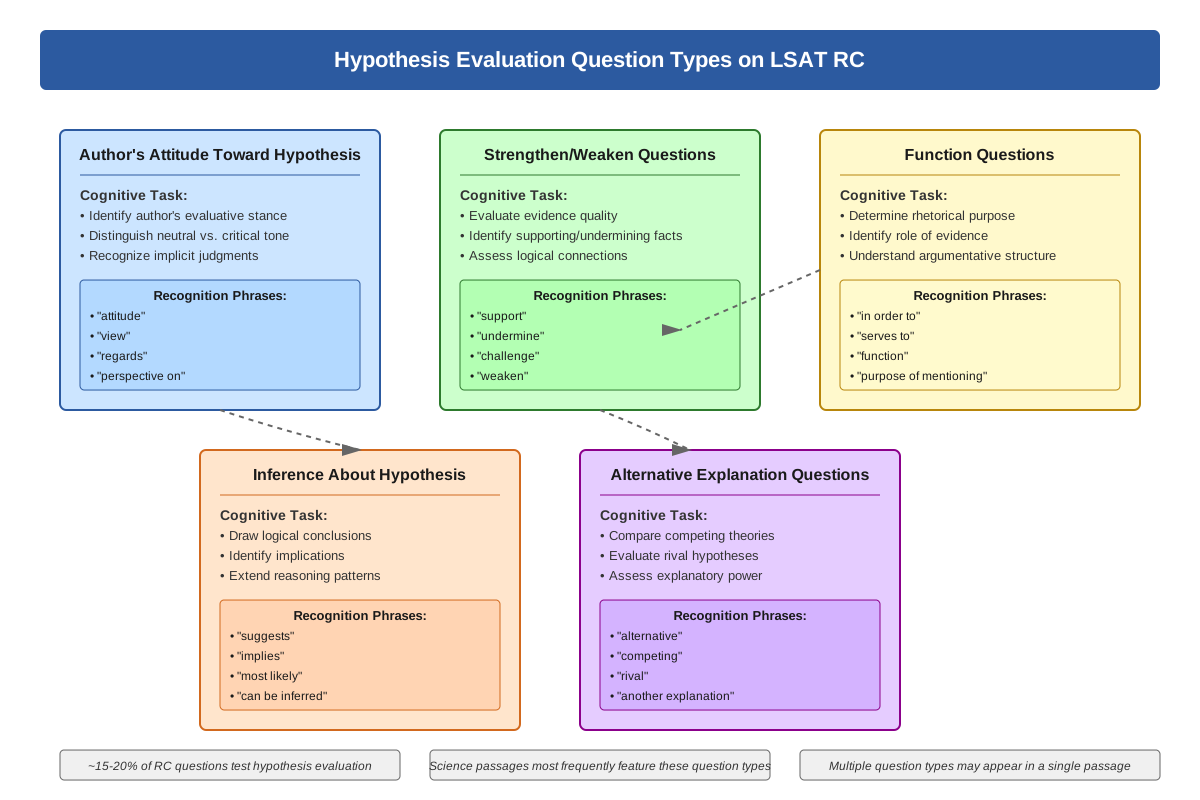
Common question stems that signal hypothesis evaluation include: "Which of the following, if true, would most strengthen the author's explanation?", "The passage suggests that the hypothesis would be most weakened by which finding?", "The author mentions X primarily to...", and "According to the passage, proponents of the theory would most likely respond to the criticism by..." These questions require understanding not just what a passage says, but how its logical architecture functions.
Core Concepts
What Constitutes a Hypothesis
A hypothesis is an explanatory claim that proposes a mechanism, cause, or theoretical framework to account for observed phenomena. In LSAT passages, hypotheses differ from mere descriptions or factual claims because they offer interpretive explanations that go beyond observable data. For example, "The dinosaurs went extinct 65 million years ago" is a factual claim, while "The dinosaurs went extinct due to an asteroid impact that caused catastrophic climate change" is a hypothesis that explains the extinction through a proposed causal mechanism.
LSAT passages typically present hypotheses in several contexts: scientific theories explaining natural phenomena, historical interpretations of events, legal theories about how laws should be interpreted, or social science explanations of human behavior. Recognizing when an author transitions from presenting facts to discussing explanatory frameworks is the first step in effective hypothesis evaluation.
The Structure of Hypothesis Evaluation
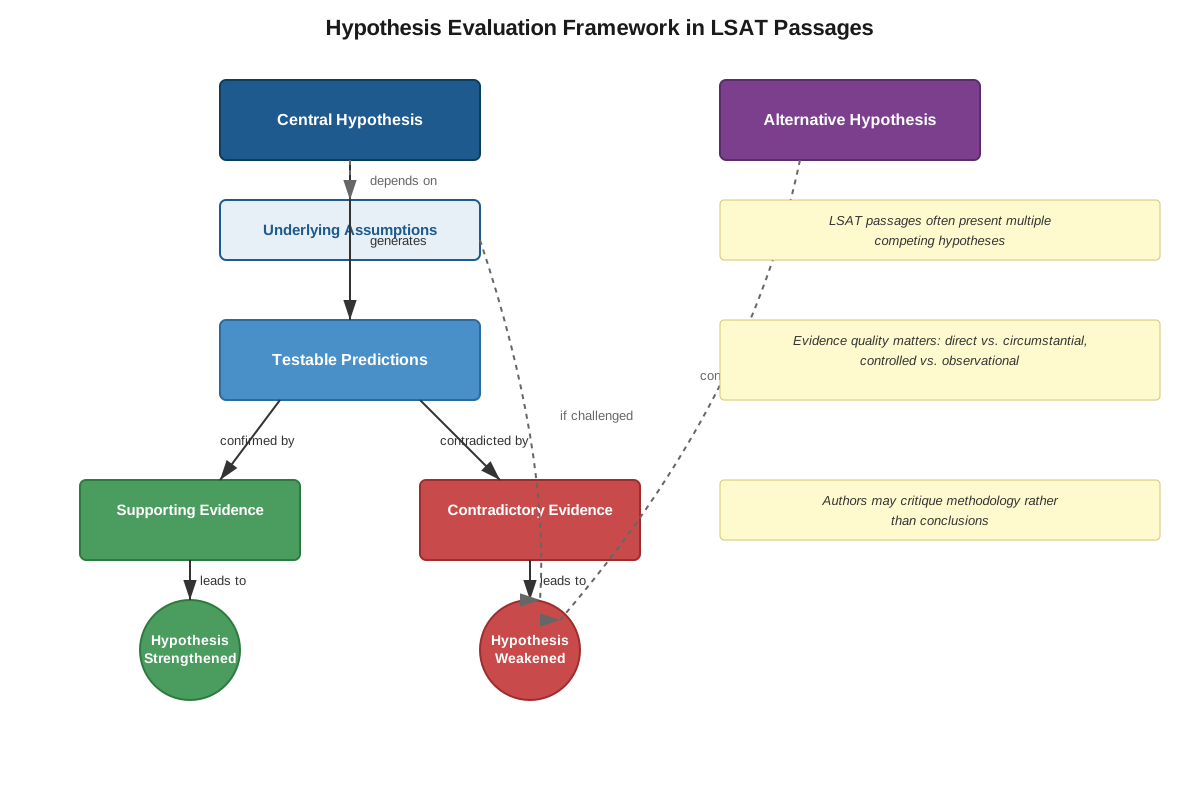
Hypothesis evaluation follows a predictable logical structure that the LSAT exploits in question design. This structure includes:
- Presentation of the phenomenon: The passage establishes what needs explaining (an observation, pattern, or puzzle)
- Introduction of hypothesis: One or more explanatory theories are proposed
- Evidence marshaling: Data, studies, examples, or logical arguments are presented
- Assessment: The hypothesis is evaluated as supported, challenged, modified, or compared to alternatives
- Implications: The passage may discuss what follows if the hypothesis is correct or incorrect
Understanding this structure allows test-takers to anticipate question types and locate relevant information efficiently. LSAT questions often ask about specific steps in this process—what evidence supports a claim, what would weaken it, or how the author positions the hypothesis relative to alternatives.
Types of Evidence in Hypothesis Evaluation
Different types of evidence carry different logical weight in supporting or challenging hypotheses:
| Evidence Type | Strength for Hypothesis | LSAT Testing Focus |
|---|---|---|
| Direct empirical confirmation | Strong support | Questions about what findings would strengthen claims |
| Elimination of alternatives | Moderate to strong support | Questions about competing explanations |
| Analogical reasoning | Weak to moderate support | Questions about the relevance of comparisons |
| Theoretical consistency | Weak support alone | Questions about internal logical coherence |
| Predictive success | Strong support | Questions about implications and future findings |
| Anomalous data | Weakens hypothesis | Questions about challenges and limitations |
The LSAT frequently tests whether students can distinguish between evidence that directly confirms a hypothesis versus evidence that merely fails to disconfirm it, or between evidence that eliminates alternatives versus evidence that positively supports a specific claim.
Strengthening vs. Weakening Hypotheses
In reading comprehension passages, understanding what strengthens or weakens a hypothesis requires recognizing several logical patterns:
Strengthening factors include:
- New evidence that matches predictions derived from the hypothesis
- Elimination of plausible alternative explanations
- Discovery of the proposed causal mechanism
- Successful replication of findings
- Resolution of apparent counterevidence
- Expert consensus supporting the explanation
Weakening factors include:
- Counterexamples that contradict predictions
- Alternative explanations that better fit the evidence
- Methodological flaws in supporting studies
- Failure to find predicted correlations
- Temporal or logical inconsistencies
- Presence of confounding variables
LSAT questions often present answer choices that superficially seem relevant but don't actually affect the logical strength of the hypothesis. Distinguishing genuine strengthening/weakening from irrelevant information is a key tested skill.
Author's Stance Toward Hypotheses
LSAT passages adopt various authorial positions toward hypotheses, and recognizing these stances is crucial for viewpoints and argumentation questions:
- Advocacy: The author argues for a particular hypothesis as correct
- Critique: The author identifies flaws or limitations in a hypothesis
- Neutral presentation: The author describes competing hypotheses without endorsing any
- Qualified support: The author finds a hypothesis partially correct or correct under specific conditions
- Historical description: The author traces how a hypothesis developed or changed over time
Questions frequently ask students to identify which statement best captures the author's attitude toward a hypothesis, requiring careful attention to qualifying language, tone markers, and the overall argumentative structure of the passage.
Competing Hypotheses and Comparative Evaluation
Many LSAT passages present multiple competing hypotheses and evaluate their relative merits. This comparative structure requires tracking:
- What phenomena each hypothesis explains well or poorly
- What evidence favors one hypothesis over another
- Whether hypotheses are mutually exclusive or potentially compatible
- How proponents of each hypothesis respond to challenges
- What additional evidence would help adjudicate between alternatives
Questions on comparative hypothesis evaluation often ask: "The author's discussion of X suggests that this hypothesis differs from Y primarily in...", "Proponents of Theory A would most likely criticize Theory B on the grounds that...", or "Which finding would support one hypothesis while undermining the other?"
Concept Relationships
The concepts within hypothesis evaluation form an interconnected logical framework. The structure of hypothesis evaluation provides the overall architecture within which other concepts operate. What constitutes a hypothesis must be understood before one can identify the types of evidence that support or challenge it. These evidence types directly determine the strengthening vs. weakening analysis that questions frequently test.
The author's stance toward hypotheses influences how evidence is presented and interpreted throughout a passage, affecting both the structure and the comparative evaluation of theories. When passages present competing hypotheses, all previous concepts come into play simultaneously—students must track multiple explanatory frameworks, evaluate different evidence types for each, understand the author's position on each hypothesis, and assess their relative strengths.
This topic connects to prerequisite knowledge through argument structure (hypotheses function as conclusions supported by evidence premises), author's purpose (the evaluative stance shapes passage organization), and causal reasoning (many hypotheses propose causal mechanisms). It also connects forward to advanced RC skills like inference-making (understanding what follows if a hypothesis is correct) and application questions (how a hypothesis would apply to new scenarios).
Relationship map: Phenomenon requiring explanation → Hypothesis proposed → Evidence types identified → Strengthening/weakening analysis → Author's evaluative stance → Comparative assessment of alternatives → Implications and predictions
High-Yield Facts
⭐ Hypothesis evaluation questions appear in 15-20% of LSAT Reading Comprehension questions, making them among the most frequently tested concepts
⭐ A hypothesis is an explanatory claim that goes beyond observable facts to propose mechanisms, causes, or theoretical frameworks
⭐ Evidence that eliminates alternative explanations provides stronger support than evidence that merely fails to contradict a hypothesis
⭐ The LSAT frequently tests the distinction between direct empirical confirmation and indirect support through elimination of alternatives
⭐ Author's qualifying language ("suggests," "may indicate," "appears to") signals a cautious or tentative stance toward a hypothesis
- Strengthening evidence typically includes new findings that match predictions derived from the hypothesis
- Weakening evidence often involves counterexamples, alternative explanations, or methodological flaws in supporting research
- Passages presenting competing hypotheses usually organize around comparative advantages and disadvantages of each theory
- Questions asking what would "most strengthen" or "most weaken" require selecting the answer with the greatest logical impact, not just any relevant information
- Temporal relationships matter: evidence must precede or coincide with the phenomenon being explained to support causal hypotheses
- Expert disagreement in a passage signals that hypothesis evaluation will be a central focus of questions
- The phrase "according to the passage" in a question stem requires textual support, while "the author would most likely agree" allows inference from the author's stance
Quick check — test yourself on Hypothesis evaluation so far.
Try Flashcards →Common Misconceptions
Misconception: Any new information related to a hypothesis strengthens it → Correction: Only information that increases the probability of the hypothesis being correct or eliminates alternatives actually strengthens it; merely related information may be logically irrelevant to the hypothesis's validity
Misconception: If evidence doesn't disprove a hypothesis, it supports it → Correction: Absence of disconfirming evidence is not the same as positive support; a hypothesis requires affirmative evidence that matches its predictions or confirms its proposed mechanisms
Misconception: The author's stance is always explicitly stated → Correction: Authors often signal their evaluative position through subtle qualifying language, organizational choices, and the selection of which evidence to emphasize rather than through direct statements
Misconception: All evidence types have equal weight in hypothesis evaluation → Correction: Direct empirical confirmation and elimination of alternatives provide stronger support than analogical reasoning or theoretical consistency alone; the LSAT tests recognition of these distinctions
Misconception: Competing hypotheses must be mutually exclusive → Correction: Some passages present hypotheses that could both be partially correct or that explain different aspects of a phenomenon; questions may test whether students recognize compatibility versus genuine contradiction
Misconception: Hypothesis evaluation only appears in science passages → Correction: While common in science passages, hypothesis evaluation also appears in passages about legal theory, historical interpretation, social science research, and humanities topics where competing explanatory frameworks are discussed
Worked Examples
Example 1: Scientific Hypothesis Evaluation
Passage excerpt: "For decades, scientists attributed the decline of amphibian populations worldwide to habitat loss. However, recent research has identified a fungal pathogen, Batrachochytrium dendrobatidis, in declining populations across diverse habitats, including pristine environments where habitat loss is minimal. The fungus disrupts amphibians' ability to absorb water and electrolytes through their skin, leading to cardiac arrest. Researchers have successfully induced population declines in controlled settings by introducing the pathogen to previously healthy populations, while populations treated with antifungal agents have shown recovery even in degraded habitats."
Question: Which of the following, if true, would most strengthen the hypothesis that the fungal pathogen is a primary cause of amphibian decline?
Answer choices:
A) The fungus has been present in some regions for centuries without causing declines
B) Genetic analysis reveals the pathogen recently underwent mutations increasing its virulence
C) Some amphibian species show natural resistance to the fungus
D) Habitat loss and the fungal pathogen often occur in the same locations
E) The fungus also infects reptiles but with less severe effects
Analysis: This question tests hypothesis evaluation by asking what would strengthen the causal claim that the fungus causes declines. Let's evaluate each choice:
- Choice A weakens the hypothesis by suggesting the fungus's presence doesn't always correlate with declines
- Choice B strengthens the hypothesis by explaining why the fungus would cause recent declines (increased virulence) and addressing the potential objection that the fungus existed previously without causing problems
- Choice C is neutral or slightly weakening because it shows the relationship isn't universal
- Choice D is neutral because co-occurrence doesn't establish which factor is causal
- Choice E is irrelevant to amphibian declines specifically
Correct answer: B. This choice strengthens the hypothesis by providing a mechanism (recent mutations) that explains both the timing of declines and why the fungus would be more problematic now than historically. This addresses a potential weakness in the hypothesis and adds explanatory power.
Connection to learning objectives: This example demonstrates identifying hypothesis evaluation in LSAT questions (the question explicitly asks about strengthening), explaining the reasoning pattern (causal hypothesis requires temporal correlation and mechanism), and applying the concept to solve problems accurately (eliminating irrelevant or weakening choices).
Example 2: Competing Hypotheses in Legal Theory
Passage excerpt: "Two competing theories explain how judges interpret ambiguous statutes. Textualists argue that judges should rely exclusively on the ordinary meaning of statutory language at the time of enactment, consulting dictionaries and grammatical conventions. Purposivists contend that judges should consider the statute's broader purpose and the problem legislators intended to address, even if this requires going beyond literal text. When the Supreme Court recently interpreted an environmental statute's phrase 'point source' to exclude agricultural runoff, textualists praised the decision for adhering to the term's conventional meaning, while purposivists criticized it for undermining the statute's goal of comprehensive water pollution control."
Question: The passage suggests that purposivists would most likely criticize the textualist approach on the grounds that it:
Answer choices:
A) Requires judges to have expertise in historical linguistics
B) May produce outcomes inconsistent with legislative intent
C) Relies too heavily on subjective judicial interpretation
D) Fails to provide predictable results in legal disputes
E) Ignores the evolution of language over time
Analysis: This question tests understanding of competing hypotheses and the author's stance toward different theoretical frameworks. The passage presents two legal interpretation theories and shows how they evaluate the same decision differently.
- Choice A is unsupported; the passage doesn't discuss linguistic expertise requirements
- Choice B correctly captures the purposivist criticism implicit in the passage: the textualist decision "undermined the statute's goal," meaning it produced an outcome inconsistent with what legislators intended
- Choice C contradicts the passage; purposivists are more likely to embrace interpretation beyond literal text, which textualists would call subjective
- Choice D is unsupported and arguably backwards; textualism claims to provide predictability
- Choice E is not mentioned as a purposivist concern in this passage
Correct answer: B. The passage shows purposivists criticizing the textualist decision specifically because it undermined legislative goals, revealing their core concern that textualism may produce results contrary to legislative intent.
Connection to learning objectives: This example shows hypothesis evaluation in a non-scientific context, demonstrates the reasoning pattern of comparative theory assessment, and requires applying understanding of how competing frameworks generate different evaluative conclusions.
Exam Strategy
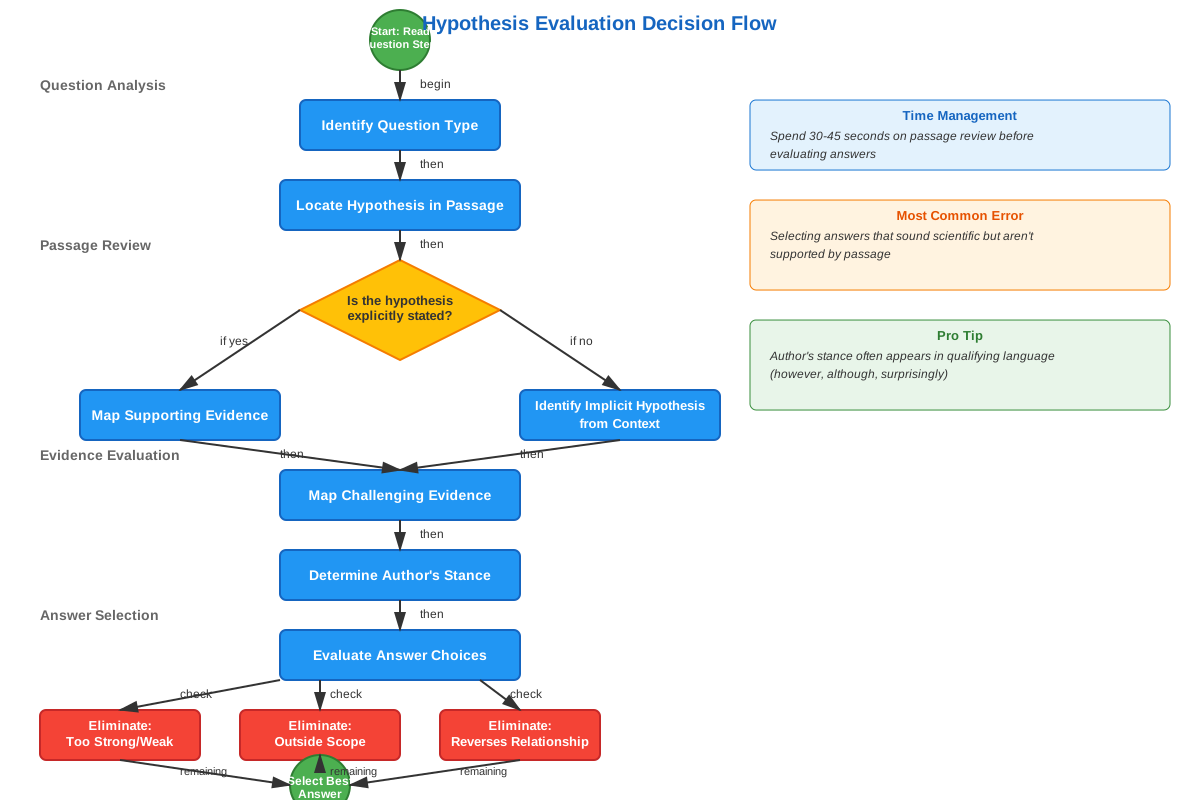
When approaching lsat hypothesis evaluation questions, employ this systematic process:
Step 1: Identify the hypothesis. As you read, mark sentences that propose explanations, theories, or causal mechanisms. Look for language like "explains," "accounts for," "is due to," "results from," or "theory suggests."
Step 2: Track the evidence. Note what evidence the passage presents for or against each hypothesis. Create a mental or physical map of support versus challenges.
Step 3: Determine the author's stance. Pay attention to qualifying language, organizational choices, and which objections the author raises or dismisses. The author's position often determines correct answers.
Step 4: Anticipate question types. Passages with hypothesis evaluation typically generate questions about strengthening/weakening, author's attitude, purpose of evidence, and comparative advantages of theories.
Exam Tip: When a question asks what would "most strengthen" or "most weaken" a hypothesis, eliminate answer choices that are merely relevant or related. The correct answer must have direct logical impact on the hypothesis's probability of being true.
Trigger words and phrases that signal hypothesis evaluation:
- "Hypothesis," "theory," "explanation," "account for"
- "Suggests," "indicates," "implies," "appears to"
- "Proponents argue," "critics contend," "some researchers believe"
- "Evidence supports," "findings challenge," "data contradicts"
- "Alternative explanation," "competing theory," "rival hypothesis"
- "Would strengthen," "would weaken," "would undermine," "would support"
Process of elimination tips:
- Eliminate answers that confuse correlation with causation
- Eliminate answers that address a different hypothesis than the one asked about
- Eliminate answers that are factually true but logically irrelevant to the hypothesis
- Eliminate answers that reverse strengthening and weakening
- Eliminate answers that mischaracterize the author's stance (too strong, too weak, or opposite)
Time allocation: Spend extra time during initial reading to understand the logical structure of hypothesis evaluation passages. This investment pays off because questions become easier to answer when you've mapped the argumentative architecture. Allocate 1-2 minutes for passage reading and 45-60 seconds per question.
Memory Techniques
SHRED mnemonic for what strengthens hypotheses:
- Supporting evidence that matches predictions
- Hypothesis explains more phenomena than alternatives
- Replication of findings in different contexts
- Elimination of competing explanations
- Discovery of proposed mechanism
WACKO mnemonic for what weakens hypotheses:
- Wrong predictions (hypothesis predicts X, but Y occurs)
- Alternative explanations that fit better
- Counterexamples to the hypothesis
- Known methodological flaws in supporting research
- Omissions (hypothesis fails to explain key phenomena)
Visualization strategy: Picture hypothesis evaluation as a courtroom trial. The hypothesis is the defendant's claim of innocence. Evidence is testimony and exhibits. Strengthening evidence is like a credible alibi witness. Weakening evidence is like forensic evidence contradicting the claim. The author is the judge evaluating the case's strength. This legal analogy helps because it mirrors the adversarial, evidence-based reasoning the LSAT tests.
Acronym for author stance: CANQ
- Critical (author identifies flaws)
- Advocating (author supports hypothesis)
- Neutral (author presents without judgment)
- Qualified (author offers conditional support)
Summary
Hypothesis evaluation is a high-yield LSAT Reading Comprehension skill that requires understanding how explanatory theories are presented, supported, challenged, and compared in passages. Success demands recognizing the distinction between hypotheses and evidence, evaluating what logically strengthens or weakens explanatory claims, and tracking authors' stances toward competing theoretical frameworks. The LSAT tests this concept across diverse passage types—scientific, legal, historical, and social science—making it essential for consistent performance. Students must master identifying hypothesis evaluation questions, understanding the logical structure of explanatory reasoning, distinguishing evidence types and their relative strength, and applying systematic strategies to strengthen/weaken questions. The cognitive skills tested through hypothesis evaluation—assessing explanatory adequacy, evaluating evidence quality, and comparing competing frameworks—directly parallel the analytical reasoning required in legal practice and law school, making this topic both practically significant and frequently tested on the exam.
Key Takeaways
- Hypothesis evaluation appears in 15-20% of LSAT RC questions and spans all passage types, making it one of the highest-yield topics for score improvement
- A hypothesis is an explanatory claim proposing mechanisms or causes, distinct from mere factual descriptions or observations
- Strengthening evidence includes findings that match predictions, elimination of alternatives, and discovery of proposed mechanisms; weakening evidence includes counterexamples, superior alternative explanations, and methodological flaws
- Author's stance toward hypotheses—advocacy, critique, neutrality, or qualified support—is often signaled through subtle qualifying language rather than explicit statements
- Competing hypothesis passages require tracking what each theory explains well, what evidence favors each, and how they differ in explanatory scope or mechanisms
- Effective exam strategy involves identifying hypotheses during initial reading, mapping evidence for and against each claim, and eliminating answer choices that are merely relevant rather than logically impactful
- The reasoning patterns tested in hypothesis evaluation—causal analysis, evidence assessment, and comparative theory evaluation—directly parallel legal reasoning skills
Related Topics
Argument Structure and Logical Reasoning: Mastering hypothesis evaluation provides a foundation for understanding how premises support conclusions in Logical Reasoning questions, particularly strengthen/weaken question types that appear in both RC and LR sections.
Author's Purpose and Perspective: Hypothesis evaluation connects to deeper analysis of why authors present certain evidence, how they position themselves relative to theories, and what argumentative goals shape passage organization.
Scientific Reasoning in LSAT Passages: Many hypothesis evaluation questions appear in science passages; developing comfort with scientific methodology, experimental design, and empirical reasoning enhances performance on this high-frequency passage type.
Causal Reasoning and Correlation: Since many hypotheses propose causal relationships, advanced study of causal logic—including confounding variables, necessary versus sufficient conditions, and temporal relationships—strengthens hypothesis evaluation skills.
Comparative Reading: The Comparative Reading passage format often presents competing perspectives or theories, making hypothesis evaluation skills directly applicable to analyzing how paired passages relate to each other.
Practice CTA
Now that you've mastered the conceptual framework of hypothesis evaluation, it's time to cement your understanding through active practice. Attempt the practice questions designed for this topic, focusing on applying the systematic strategies outlined in the Exam Strategy section. As you work through problems, consciously identify the hypothesis, map the evidence, determine the author's stance, and eliminate answers using the logical principles discussed. Use the flashcards to reinforce high-yield facts and trigger words until recognizing hypothesis evaluation patterns becomes automatic. Remember: hypothesis evaluation is one of the most frequently tested and highest-yield topics in LSAT Reading Comprehension—your investment in mastering this skill will directly translate to score improvement. Approach each practice question as an opportunity to refine your analytical reasoning and build the confidence needed for test day success.
Sign up free to keep reading
Create a free AnvayaPrep account to finish this LSAT guide on Hypothesis evaluation — plus flashcards and practice questions.