Overview
Identifying concessions is a critical analytical skill in LSAT reading comprehension that involves recognizing when an author acknowledges a point that appears to weaken their own argument or supports an opposing view. This sophisticated rhetorical technique appears frequently in LSAT passages, particularly in those dealing with viewpoints and argumentation, where authors must address counterarguments to strengthen their overall position. A concession typically takes the form of an acknowledgment that an opposing view has some merit, that certain evidence exists contrary to the author's thesis, or that limitations exist in the author's own argument—yet the author proceeds to argue their main point nonetheless.
Understanding concessions is essential for the LSAT because these rhetorical moves reveal the structure of complex arguments and the author's awareness of alternative perspectives. The LSAT frequently tests whether students can distinguish between what an author genuinely believes and what they merely acknowledge for rhetorical purposes. Passages in law, philosophy, social sciences, and natural sciences routinely employ concessions to demonstrate intellectual rigor and anticipate objections. Missing a concession can lead to fundamental misunderstandings about an author's actual position, causing students to select incorrect answers on questions about main point, author's attitude, or argumentative structure.
Within the broader landscape of reading comprehension, identifying concessions connects intimately with understanding argumentative structure, recognizing author's tone and attitude, distinguishing between claims and counterclaims, and analyzing how authors build persuasive cases. This skill serves as a foundation for more advanced analytical tasks, such as evaluating the strength of arguments, predicting how authors would respond to new evidence, and understanding the nuanced positions that characterize sophisticated academic and legal writing.
Learning Objectives
- [ ] Identify how identifying concessions appears in LSAT questions
- [ ] Explain the reasoning pattern behind identifying concessions
- [ ] Apply identifying concessions to solve LSAT-style problems accurately
- [ ] Distinguish between genuine concessions and statements that merely present opposing views without acknowledgment
- [ ] Recognize the linguistic markers and transitional phrases that signal concessions in complex passages
- [ ] Analyze how concessions function strategically within an author's overall argumentative framework
- [ ] Evaluate the scope and significance of concessions to determine their impact on the author's main thesis
Prerequisites
- Basic argument structure: Understanding premises, conclusions, and how claims support one another is essential because concessions function as specific components within larger argumentative frameworks.
- Author's purpose and tone: Recognizing whether an author is advocating, critiquing, or analyzing is necessary because concessions reveal the author's awareness of complexity and their rhetorical sophistication.
- Distinguishing fact from opinion: This foundational skill enables students to recognize when an author is acknowledging factual information versus expressing their own viewpoint.
- Understanding counterarguments: Familiarity with how opposing positions function in arguments helps students recognize when an author is addressing alternative perspectives.
Why This Topic Matters
In legal reasoning and academic discourse—the domains the LSAT prepares students for—acknowledging opposing viewpoints and potential weaknesses demonstrates intellectual honesty and strengthens arguments by preemptively addressing objections. Lawyers must anticipate counterarguments, and legal scholars must engage with competing interpretations of law and precedent. The ability to identify concessions translates directly to understanding how sophisticated arguments are constructed in legal briefs, judicial opinions, and scholarly articles.
On the LSAT, concessions appear in approximately 60-70% of reading comprehension passages, making this one of the most frequently tested rhetorical elements. Questions specifically targeting concessions typically appear as:
- Function questions: "The author mentions X in order to..." where the correct answer involves acknowledging a limitation or opposing point
- Attitude questions: "The author's attitude toward X can best be described as..." where recognizing a concession helps distinguish between qualified agreement and full endorsement
- Structure questions: "Which of the following best describes the organization of the passage?" where concessions mark transitions between presenting opposing views and advancing the author's position
- Inference questions: "The author would most likely agree with which of the following?" where understanding what the author concedes versus what they argue is crucial
Common manifestations in passages include authors acknowledging limitations in their own evidence, granting that opposing theories have explanatory power in certain contexts, admitting that their proposals face practical challenges, or recognizing that alternative interpretations are plausible before arguing for their preferred view.
Core Concepts
What Constitutes a Concession
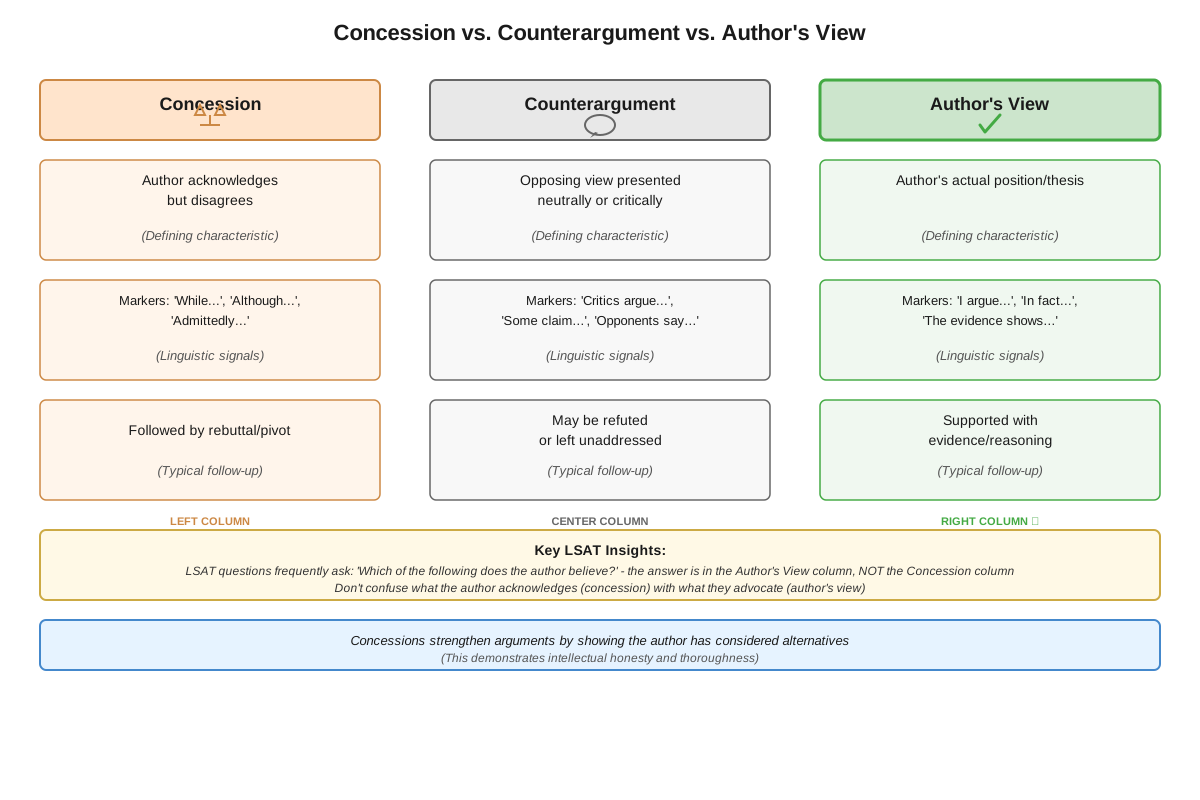
A concession is a rhetorical move in which an author explicitly acknowledges a point, fact, or argument that appears to undermine or complicate their own position, yet continues to maintain their overall thesis. The defining characteristic of a concession is this dual nature: the author grants something to an opposing view while ultimately preserving their main argument. This differs from simply presenting an opposing view neutrally; in a concession, the author accepts some validity in the opposing point.
Concessions serve multiple strategic purposes in argumentation. They demonstrate that the author has considered alternative perspectives, which enhances credibility. They preemptively address potential objections, making the argument more robust. They also allow authors to narrow their claims to defensible positions by acknowledging where their arguments have limitations.
Linguistic Markers of Concessions
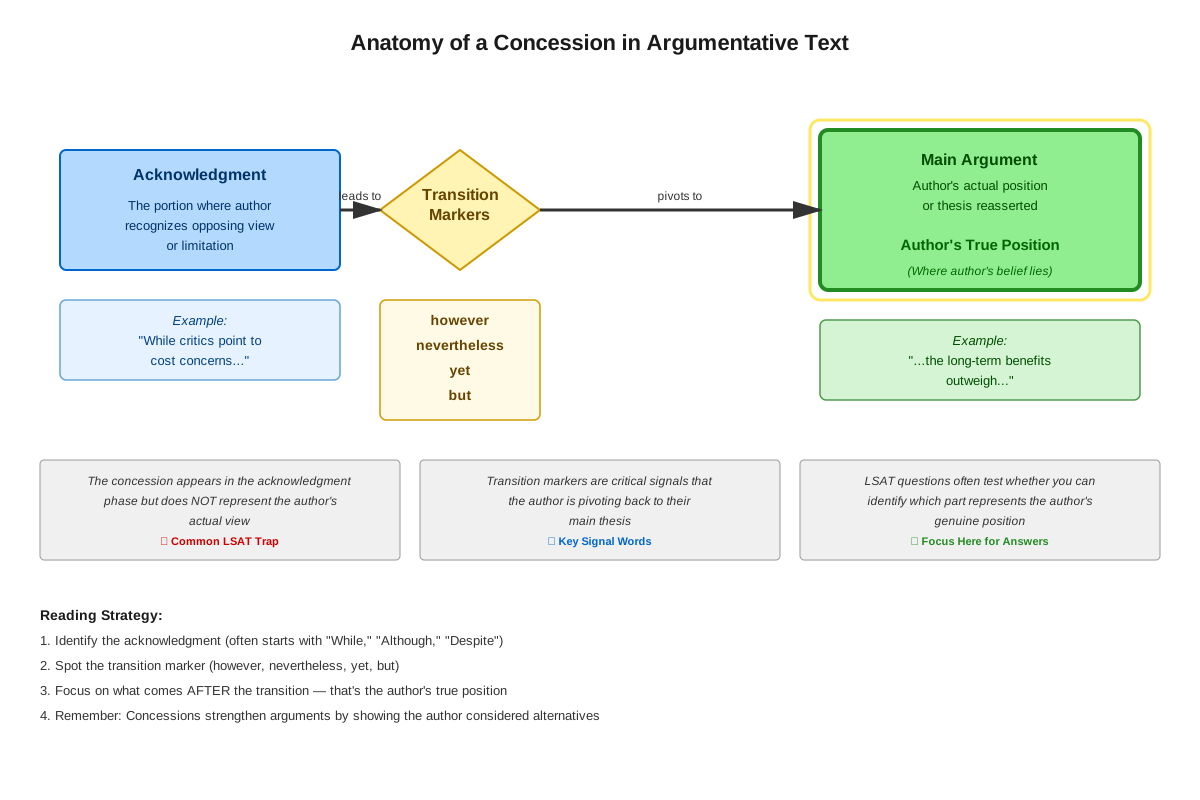
LSAT identifying concessions requires recognizing specific linguistic patterns that signal when an author is making a concession. These markers typically appear in two-part structures: the concession itself, followed by a contrast or continuation that reasserts the author's position.
Concession indicators include:
- "Although," "Though," "Even though," "While," "Whereas"
- "Admittedly," "Granted," "To be sure," "Certainly," "Indeed"
- "It is true that," "One must acknowledge that," "There is no denying that"
- "Despite," "In spite of," "Notwithstanding"
- "May," "Might," "Could" (when acknowledging possibilities)
Contrast markers that follow concessions include:
- "However," "Nevertheless," "Nonetheless," "Yet," "Still"
- "But," "Even so," "That said"
- "This does not mean," "This should not obscure the fact that"
The typical structure follows this pattern: [Concession marker] + [acknowledged point], [contrast marker] + [author's main argument].
Example: "Although the new policy may reduce costs in the short term, it nevertheless fails to address the underlying structural problems."
Types of Concessions
| Type | Description | Example Signal |
|---|---|---|
| Evidential Concession | Acknowledging that certain evidence exists that appears contrary to the author's position | "While some studies have shown X..." |
| Theoretical Concession | Granting that an opposing theory has explanatory power in certain contexts | "Though this interpretation accounts for certain phenomena..." |
| Practical Concession | Admitting that the author's proposal faces implementation challenges | "Admittedly, this approach would require significant resources..." |
| Scope Concession | Acknowledging limitations in the applicability of the author's claims | "This analysis applies primarily to X, and may not extend to Y..." |
| Historical Concession | Recognizing that past circumstances or previous beliefs differed from current understanding | "Historically, scholars believed X, and this view had some justification..." |
Concessions vs. Other Rhetorical Moves
Students must distinguish concessions from similar but distinct rhetorical patterns:
Concession vs. Neutral Presentation: When an author simply describes an opposing view without acknowledging its validity, this is not a concession. A concession involves the author granting some merit to the opposing point.
- Not a concession: "Critics argue that the policy is ineffective."
- Concession: "Critics are right to point out that the policy has shown limited results in certain contexts."
Concession vs. Refutation: A refutation presents an opposing view specifically to reject it entirely. A concession grants some validity before proceeding with the author's argument.
- Refutation: "Some claim X, but this view is entirely mistaken because..."
- Concession: "Some claim X, and this concern has merit, yet it does not undermine the fundamental case for..."
Concession vs. Qualification: A qualification narrows or specifies the author's own claim without acknowledging opposing views. A concession engages with contrary positions or evidence.
- Qualification: "This theory applies specifically to cases where conditions A and B are met."
- Concession: "While this theory faces challenges in explaining certain anomalies, it remains the most comprehensive framework available."
Strategic Function of Concessions in Arguments
Understanding why authors make concessions illuminates their argumentative strategy. Concessions typically serve to:
- Establish credibility: By acknowledging weaknesses or opposing points, authors demonstrate fairness and thorough consideration
- Preempt objections: Addressing counterarguments before critics raise them strengthens the overall case
- Narrow claims to defensible ground: Conceding certain points allows authors to focus on where their argument is strongest
- Create contrast: The concession sets up a rhetorical contrast that makes the author's main point more emphatic
- Show sophistication: Acknowledging complexity demonstrates that the author understands the issue's nuances
On the LSAT, recognizing the strategic function of a concession often determines the correct answer to function questions and helps students understand the passage's overall structure.
Scope and Significance of Concessions
Not all concessions carry equal weight in an argument. The LSAT tests whether students can evaluate how much a concession actually affects the author's main thesis. Key considerations include:
Minor concessions: Acknowledge peripheral points or limited exceptions that don't substantially affect the main argument. Authors often use phrases like "in some cases," "occasionally," or "to a limited extent."
Major concessions: Acknowledge significant challenges or substantial contrary evidence. These require the author to do more argumentative work to maintain their position. Look for phrases like "serious concern," "substantial evidence," or "significant challenge."
Conditional concessions: Grant validity to opposing points only under specific circumstances. These often include "if," "when," or "in contexts where."
Understanding the scope helps students answer questions about the author's degree of commitment to various claims and whether the author would agree with certain inferences.
Concept Relationships
The skill of identifying concessions connects to multiple aspects of reading comprehension and argumentative analysis. Identifying concessions → enables understanding of → argumentative structure, because concessions mark key transitions where authors shift from acknowledging opposing views to advancing their own position. This structural awareness helps students create accurate mental maps of complex passages.
Identifying concessions → informs → author's attitude and tone, because the presence and nature of concessions reveal whether an author takes an absolute or qualified position, whether they engage charitably with opposing views, and how confident they are in their claims. An author who makes substantial concessions typically exhibits a more measured, nuanced tone than one who makes no acknowledgments of contrary evidence.
Understanding counterarguments → prerequisite for → identifying concessions, because students must first recognize when opposing views are being presented before they can determine whether the author is merely describing these views or actually granting them some validity.
Identifying concessions → supports → making valid inferences, because knowing what an author has conceded helps determine what they would likely agree with in hypothetical scenarios. If an author concedes that their theory faces challenges in certain contexts, they would likely agree with statements acknowledging those limitations.
Distinguishing concessions from refutations → enables → accurate understanding of author's position, because mistaking a concession for a refutation (or vice versa) fundamentally misrepresents what the author believes and how strongly they hold their position.
High-Yield Facts
⭐ Concessions always involve the author acknowledging some validity in a point that appears contrary to their main argument, not merely describing opposing views.
⭐ The most common linguistic structure for concessions is: [Concession marker] + [acknowledged point] + [contrast marker] + [author's main argument].
⭐ Words like "although," "while," "admittedly," and "granted" are high-frequency concession markers on the LSAT.
⭐ A concession does not mean the author abandons their main thesis; it means they acknowledge complexity while maintaining their overall position.
⭐ Function questions about concessions typically have correct answers involving "acknowledge a limitation," "address a potential objection," or "demonstrate awareness of complexity."
- Concessions appear in approximately 60-70% of LSAT reading comprehension passages, making them one of the most frequently tested rhetorical elements.
- The scope of a concession (minor vs. major) affects how much it qualifies the author's main argument and is often tested in inference questions.
- Authors use concessions strategically to strengthen arguments by preemptively addressing counterarguments rather than ignoring them.
- Distinguishing between what an author concedes and what they argue is crucial for attitude questions and questions about the author's main point.
- Concessions often appear at transition points in passages, marking shifts from presenting background or opposing views to advancing the author's own position.
- The presence of concessions typically indicates a more nuanced, qualified argument rather than an absolute or extreme position.
- Conditional concessions (those that apply only in specific circumstances) are frequently tested in questions about the scope of the author's claims.
Quick check — test yourself on Identifying concessions so far.
Try Flashcards →Common Misconceptions
Misconception: If an author mentions an opposing view, they are making a concession to that view.
Correction: Merely describing or presenting an opposing view is not a concession. A concession requires the author to acknowledge some validity or merit in the opposing point, not just mention its existence. The author must grant something to the opposing side, typically signaled by words like "admittedly," "to be sure," or "it is true that."
Misconception: A concession weakens the author's argument and indicates uncertainty about their position.
Correction: Concessions actually strengthen arguments by demonstrating intellectual honesty and preemptively addressing objections. An author who makes concessions is showing awareness of complexity, not weakness in their position. The key is that after the concession, the author continues to maintain their main thesis, often with even greater force.
Misconception: All uses of "although" or "while" indicate concessions.
Correction: These words can introduce concessions, but they can also simply introduce contrasts or background information without the author granting validity to an opposing point. The critical element is whether the author acknowledges merit in something contrary to their position, not just the presence of certain transition words.
Misconception: If an author concedes a point, they would agree with that point in all contexts.
Correction: Concessions are often limited in scope. An author might concede that a theory faces challenges in certain specific contexts while maintaining that it remains valid overall. Understanding the scope and conditions of concessions is crucial for answering inference questions correctly.
Misconception: Concessions and refutations serve the same function in arguments.
Correction: These are opposite rhetorical moves. A refutation presents an opposing view specifically to reject it entirely, while a concession grants some validity to an opposing point before proceeding with the author's argument. Confusing these leads to fundamental misunderstandings of the author's position and attitude.
Worked Examples
Example 1: Identifying a Concession in Context
Passage excerpt: "While critics are correct that the proposed environmental regulations would impose significant costs on manufacturing industries, this economic burden must be weighed against the substantial public health benefits that would result from reduced air pollution. The short-term financial impact, though real, pales in comparison to the long-term costs of treating pollution-related illnesses."
Question: The author's primary purpose in mentioning the costs imposed on manufacturing industries is to:
(A) Argue that environmental regulations should be rejected
(B) Demonstrate that critics have misunderstood the economic impact
(C) Acknowledge a legitimate concern before arguing for the regulations anyway
(D) Suggest that manufacturing industries should bear all environmental costs
(E) Prove that economic considerations are irrelevant to environmental policy
Analysis:
Step 1: Identify the concession marker. The passage begins with "While critics are correct that..." This phrase contains both a concession marker ("While") and explicit acknowledgment of validity ("are correct that").
Step 2: Determine what is being conceded. The author grants that the regulations "would impose significant costs on manufacturing industries." This acknowledges a point that appears to argue against the author's position (supporting the regulations).
Step 3: Identify the contrast and main argument. The contrast marker "must be weighed against" signals the shift to the author's main point. The author then argues that despite these costs, the public health benefits justify the regulations.
Step 4: Evaluate the function. The author is not rejecting the regulations (eliminating A), not claiming critics misunderstood (eliminating B), not making an absolute claim about who should bear costs (eliminating D), and not dismissing economic considerations as irrelevant (eliminating E). The author is acknowledging a legitimate concern (the costs are "real") while maintaining their overall position in favor of the regulations.
Correct Answer: (C) Acknowledge a legitimate concern before arguing for the regulations anyway
This exemplifies the classic concession structure: granting validity to an opposing point while maintaining the overall thesis.
Example 2: Distinguishing Concession from Refutation
Passage excerpt: "Some legal scholars argue that the doctrine of precedent stifles judicial innovation and prevents the law from adapting to changing social conditions. However, this criticism fundamentally misunderstands the flexibility inherent in common law systems. While precedent provides stability and predictability—essential features of any functional legal system—judges retain substantial discretion to distinguish cases and adapt legal principles to new circumstances. The doctrine does not rigidly bind courts to outdated rules; rather, it provides a framework within which principled evolution can occur."
Question: The author's attitude toward the criticism that precedent stifles judicial innovation can best be described as:
(A) Complete agreement with the criticism's validity
(B) Acknowledgment that the criticism has merit in certain contexts
(C) Rejection of the criticism as based on a misunderstanding
(D) Uncertainty about whether the criticism is justified
(E) Qualified acceptance that precedent has some limiting effects
Analysis:
Step 1: Identify how the author treats the opposing view. The author states that the criticism "fundamentally misunderstands" the system. This is strong language indicating rejection, not concession.
Step 2: Look for concession markers and acknowledgments of validity. The passage does contain "While precedent provides stability and predictability," but this is not a concession to the critics' view. Instead, it's the author's own point about precedent's benefits.
Step 3: Distinguish between concession and refutation. The author does not grant that the criticism has merit; instead, they argue it is based on a misunderstanding. The author then provides their own explanation of how precedent actually works, contradicting the critics' characterization.
Step 4: Evaluate the author's attitude. The author is not agreeing (eliminating A), not acknowledging merit (eliminating B), not uncertain (eliminating D), and not accepting limiting effects (eliminating E). The author is rejecting the criticism as misguided.
Correct Answer: (C) Rejection of the criticism as based on a misunderstanding
This example demonstrates the importance of distinguishing refutations from concessions. The presence of an opposing view does not automatically mean the author is conceding anything to it.
Exam Strategy
Approaching Questions About Concessions
When encountering reading comprehension questions on the LSAT, use this systematic approach to identify and analyze concessions:
Step 1: Scan for concession markers as you read the passage initially. Flag sentences beginning with "although," "while," "admittedly," "granted," "to be sure," or similar phrases. These are high-probability locations for concessions.
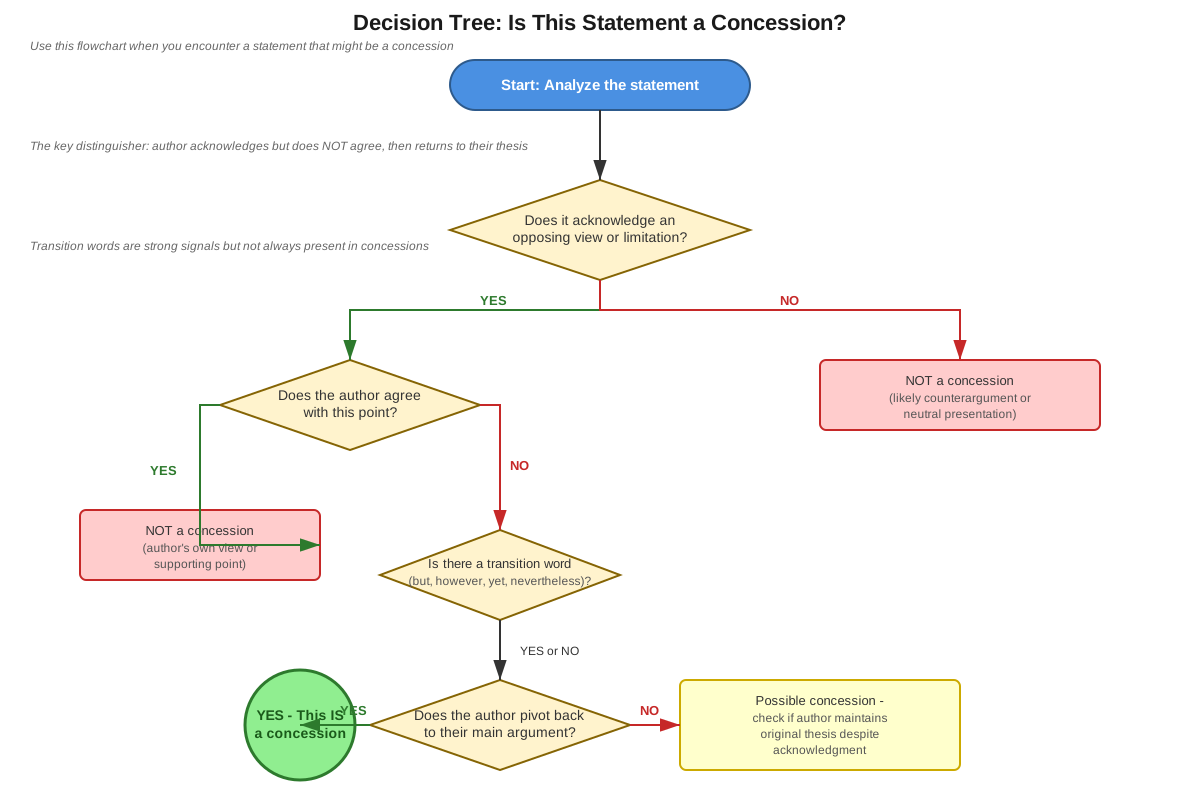
Step 2: Apply the validity test. Ask: "Is the author acknowledging that this point has some merit or validity?" If the author is merely describing an opposing view without granting it any validity, it's not a concession.
Step 3: Identify the contrast. Genuine concessions are almost always followed by contrast markers ("however," "nevertheless," "yet") that signal the author's main argument. If you don't see this two-part structure, reconsider whether you've identified a true concession.
Step 4: Evaluate the scope. Determine whether the concession is minor (limited exceptions) or major (significant challenges). This affects how much the concession qualifies the author's main thesis.
Trigger Words and Phrases
High-yield concession triggers: "although," "while," "even though," "admittedly," "granted," "to be sure," "it is true that," "one must acknowledge," "certainly," "indeed" (when acknowledging opposing points)
Contrast markers following concessions: "however," "nevertheless," "nonetheless," "yet," "still," "but," "even so," "that said"
Scope limiters in concessions: "in some cases," "to a limited extent," "in certain contexts," "occasionally," "under specific circumstances"
Process of Elimination Tips
For function questions about concessions:
- Eliminate answers suggesting the author fully agrees with or adopts the conceded point
- Eliminate answers suggesting the author completely rejects the conceded point
- Look for answers containing "acknowledge," "address," "recognize," or "grant"
- Correct answers often include qualifiers like "potential," "possible," or "apparent"
For attitude questions involving concessions:
- Eliminate extreme attitudes (complete agreement or total rejection) when concessions are present
- Look for qualified or nuanced attitudes: "measured approval," "qualified support," "cautious optimism"
- Concessions typically indicate attitudes like "respectful disagreement" rather than "dismissive rejection"
For inference questions related to concessions:
- The author would likely agree with statements that acknowledge what they've conceded
- The author would disagree with statements that extend concessions beyond their stated scope
- Pay attention to conditional language in both the concession and answer choices
Time Allocation
Identifying concessions should not require extra time if you develop the habit of flagging concession markers during your initial read-through. Spend approximately:
- 2-3 seconds per concession marker to note its presence during initial reading
- 10-15 seconds to analyze the concession's scope and function when a question specifically addresses it
- 5 seconds to verify whether a statement is a concession or refutation when eliminating answer choices
Memory Techniques
The GRANT Acronym
Remember what makes a true concession using GRANT:
- Gives validity to opposing point
- Recognizes contrary evidence or arguments
- Acknowledges limitations or challenges
- Nevertheless maintains main thesis
- Transitions with contrast markers
The Two-Part Structure Visualization
Visualize concessions as a seesaw or balance:
[Concession Side]          [Author's Position Side]
"Although X..."      →     "Nevertheless Y..."
   (lighter)                    (heavier)
The concession side is acknowledged but ultimately outweighed by the author's main argument. This visual helps remember that concessions don't overturn the author's position.
The "Yes, But" Technique
When you encounter a concession, mentally translate it to "Yes, but..." structure:
- "Yes, [conceded point is valid], but [author's main argument still holds]"
Example: "While the theory faces challenges" = "Yes, the theory faces challenges, but [it's still the best explanation]"
This translation makes the concession's function immediately clear.
Marker Word Categories
Group concession markers into memorable categories:
The "A-Team": Although, Admittedly, Albeit
The "W-Words": While, Whereas
The "Truth Tellers": To be sure, It is true that, There is no denying
The "G-Words": Granted, Given that
Creating these mental categories helps you quickly recognize concession markers during timed reading.
Summary
Identifying concessions is a fundamental skill for LSAT reading comprehension that requires recognizing when authors acknowledge points contrary to their main argument while ultimately maintaining their overall position. Concessions serve strategic functions in sophisticated arguments: they demonstrate intellectual honesty, preempt objections, and strengthen the author's case by showing awareness of complexity. The key to identifying concessions lies in recognizing their characteristic two-part structure—a concession marker followed by an acknowledged point, then a contrast marker followed by the author's main argument. Students must distinguish genuine concessions, where authors grant validity to opposing points, from mere descriptions of opposing views or outright refutations. Understanding the scope and significance of concessions enables accurate analysis of author's attitude, argumentative structure, and the degree of qualification in the author's claims. This skill appears in approximately 60-70% of LSAT passages and is tested through function questions, attitude questions, structure questions, and inference questions, making it one of the highest-yield topics in reading comprehension preparation.
Key Takeaways
- Concessions involve authors acknowledging validity in points contrary to their position while maintaining their overall thesis, not merely describing opposing views
- The characteristic structure is: [Concession marker] + [acknowledged point] + [contrast marker] + [author's main argument]
- High-frequency concession markers include "although," "while," "admittedly," "granted," and "to be sure"
- Concessions strengthen rather than weaken arguments by demonstrating awareness of complexity and preemptively addressing objections
- Distinguishing concessions from refutations is critical—concessions grant some validity, while refutations reject opposing views entirely
- The scope of concessions (minor vs. major, conditional vs. absolute) significantly affects how much they qualify the author's main claims
- Identifying concessions correctly is essential for answering function questions, attitude questions, and inference questions accurately on the LSAT
Related Topics
Identifying Counterarguments: Understanding how authors present and respond to opposing views builds directly on concession identification skills. While concessions involve granting validity to opposing points, counterargument analysis examines the full range of ways authors engage with contrary positions, including refutation and synthesis.
Author's Tone and Attitude: Recognizing concessions informs understanding of whether an author takes absolute or qualified positions, exhibits intellectual humility or certainty, and engages charitably or dismissively with opposing views. Mastering concessions enables more nuanced attitude analysis.
Argumentative Structure and Organization: Concessions often mark key transitions in passages, signaling shifts from presenting background or opposing views to advancing the author's position. Understanding concessions enhances ability to map complex argumentative structures.
Inference Questions and Author Agreement: Knowing what an author has conceded is crucial for determining what they would likely agree with in hypothetical scenarios, making concession identification essential for inference question success.
Qualifying Language and Scope: Concessions frequently involve scope limitations and qualifying language. Mastering concessions provides foundation for analyzing how authors narrow claims, specify conditions, and indicate degrees of certainty throughout passages.
Practice CTA
Now that you understand the critical skill of identifying concessions, it's time to apply this knowledge to actual LSAT-style passages and questions. The practice questions and flashcards will help you internalize the concession markers, practice distinguishing concessions from refutations, and develop the automatic recognition skills necessary for test-day success. Remember: identifying concessions appears in the majority of reading comprehension passages, making this one of the highest-yield skills you can master. Each practice question you complete strengthens your ability to recognize these crucial rhetorical moves quickly and accurately. Approach the practice materials with confidence—you now have the conceptual framework to excel at this essential LSAT skill.
Sign up free to keep reading
Create a free AnvayaPrep account to finish this LSAT guide on Identifying concessions — plus flashcards and practice questions.