Overview
Identifying objections is a critical skill within LSAT Reading Comprehension that requires students to recognize when an author or speaker presents a counterargument, criticism, or challenge to a previously stated viewpoint. This skill sits at the intersection of viewpoints and argumentation, demanding that test-takers not only track multiple perspectives within a passage but also understand the logical relationships between competing claims. On the LSAT, passages frequently present a main argument alongside objections raised by critics, alternative theories proposed by dissenting scholars, or limitations acknowledged by the original proponents themselves. The ability to distinguish between a primary position and its objections is fundamental to answering questions about passage structure, author's attitude, and argumentative purpose.
The LSAT tests this skill because legal reasoning inherently involves anticipating and addressing counterarguments. Attorneys must understand opposing counsel's objections, judges must weigh competing interpretations of law, and legal scholars must engage with criticism of their theories. When reading comprehension passages present scientific debates, historical controversies, or theoretical disagreements, the test-taker must identify which statements represent objections and which represent the positions being objected to. This distinction often determines the correct answer to questions about the passage's organization, the function of specific paragraphs, or the relationship between different viewpoints presented.
Mastering lsat identifying objections connects directly to broader skills in argument analysis, including recognizing premises and conclusions, understanding logical structure, and evaluating the strength of reasoning. This topic builds upon fundamental comprehension skills while preparing students for more advanced tasks like identifying the author's response to objections or determining which viewpoint the passage ultimately supports. Success with identifying objections enhances performance across all Reading Comprehension question types, particularly those asking about passage structure, author's purpose, and the function of specific textual elements.
Learning Objectives
- [ ] Identify how Identifying objections appears in LSAT questions
- [ ] Explain the reasoning pattern behind Identifying objections
- [ ] Apply Identifying objections to solve LSAT-style problems accurately
- [ ] Distinguish between primary arguments and objections to those arguments within complex passages
- [ ] Recognize common linguistic markers that signal the introduction of an objection
- [ ] Evaluate the relationship between an objection and the author's ultimate position on the topic
- [ ] Analyze how objections function structurally within argumentative passages
Prerequisites
- Basic argument structure: Understanding premises, conclusions, and claims is essential because objections target specific elements of arguments
- Multiple viewpoint tracking: The ability to follow different speakers or positions within a passage is necessary since objections represent alternative perspectives
- Passage organization awareness: Recognizing how passages are structured helps identify when the author transitions from presenting a view to presenting objections to that view
- Logical relationship comprehension: Understanding how ideas relate (support, contradict, qualify) enables recognition of objections as challenges to previously stated positions
Why This Topic Matters
In legal practice, identifying objections is not merely academic—it represents the core of adversarial legal reasoning. Attorneys must anticipate objections to their arguments, judges must consider objections to proposed interpretations, and legal scholars must address criticism to strengthen their theories. The LSAT tests this skill because it directly predicts success in law school case analysis, where students must track majority opinions, dissents, and various concurring viewpoints while understanding how each challenges or supports the others.
On the LSAT Reading Comprehension section, identifying objections appears with high frequency across all passage types. Approximately 60-70% of Reading Comprehension passages contain at least one objection to a main viewpoint, and roughly 25-30% of questions require students to recognize, understand, or apply knowledge about these objections. Questions may ask students to identify the function of a paragraph that presents an objection, determine what criticism has been raised against a theory, or recognize which statement represents a challenge to the author's position.
This topic commonly appears in passages discussing scientific theories (where alternative hypotheses challenge dominant explanations), legal or philosophical debates (where scholars critique each other's positions), historical interpretations (where revisionist historians object to traditional narratives), and literary criticism (where different schools of thought challenge competing interpretations). The LSAT particularly favors passages that present a theory in early paragraphs, introduce objections in middle paragraphs, and then either defend against those objections or acknowledge their validity in later paragraphs. Recognizing this pattern enables efficient passage mapping and accurate question answering.
Core Concepts
What Constitutes an Objection
An objection in LSAT Reading Comprehension is any statement, argument, or position that challenges, contradicts, questions, or limits a previously stated claim or viewpoint. Objections can take several forms: direct contradictions that assert the opposite of a claim, qualifications that limit the scope or applicability of a position, alternative explanations that compete with a proposed theory, or criticisms that identify flaws in reasoning or evidence. Understanding what counts as an objection requires recognizing that objections are fundamentally oppositional—they stand in some form of tension with another viewpoint in the passage.
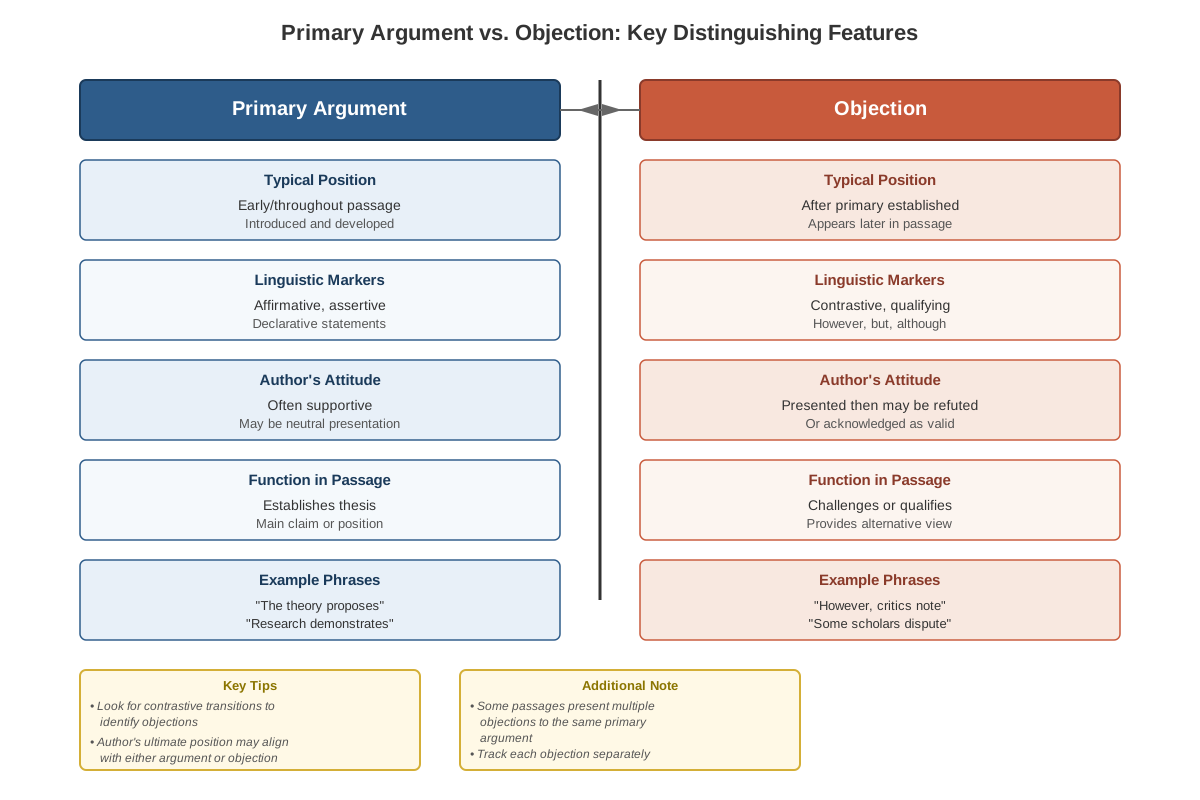
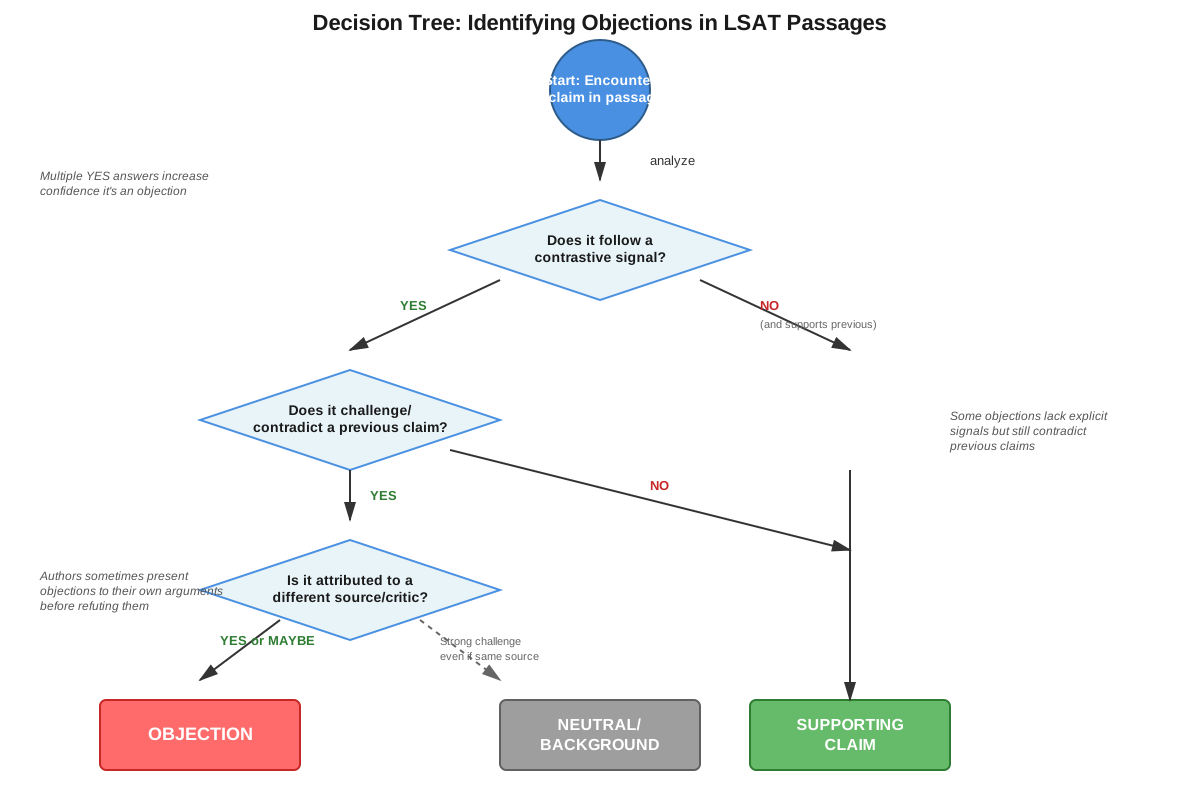
Objections differ from mere additional information or supporting details. When a passage states, "Smith argues X, and Jones provides further evidence for X," Jones is not objecting but supporting. However, when a passage states, "Smith argues X, but Jones contends that Y," Jones is presenting an objection. The key distinction lies in the logical relationship: objections create argumentative tension, while supporting statements create alignment.
Linguistic Markers of Objections
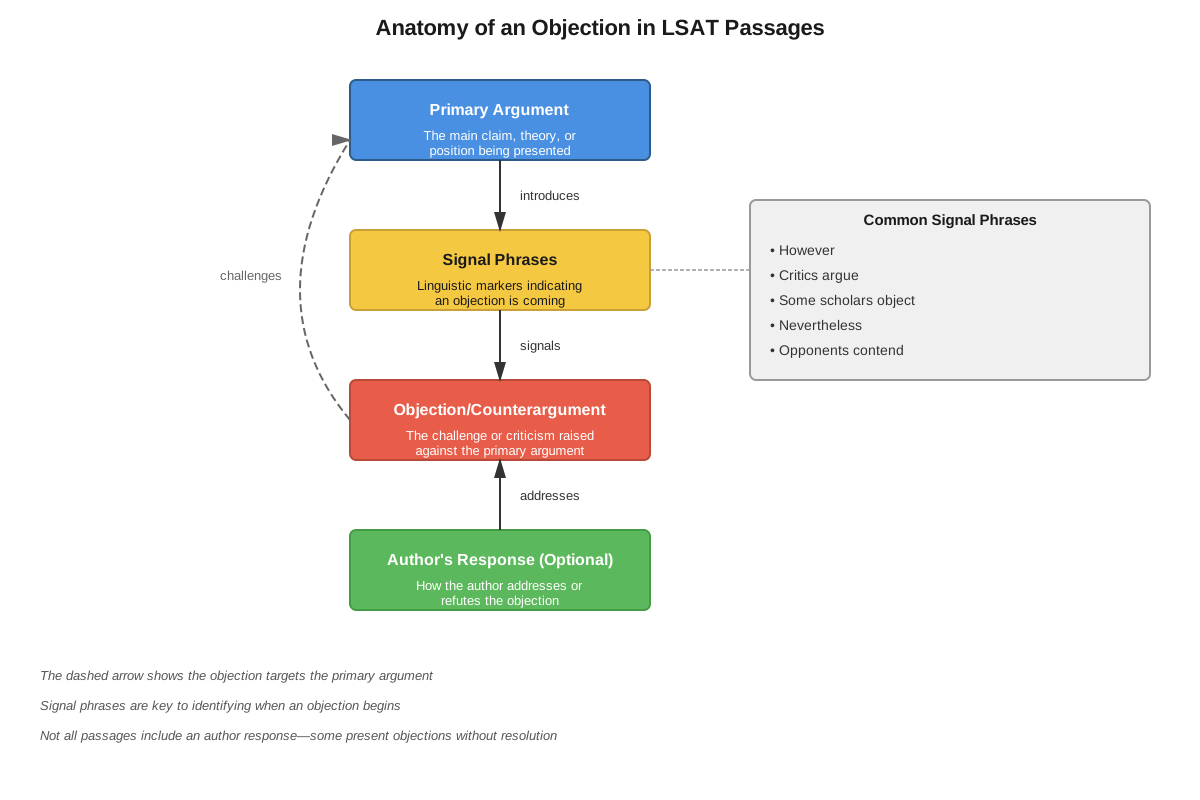
The LSAT uses predictable language patterns to signal objections. Contrast markers are the most common indicators, including words and phrases such as "however," "but," "yet," "nevertheless," "on the other hand," "in contrast," "conversely," and "despite this." When these markers appear, readers should immediately recognize that an objection or alternative viewpoint likely follows.
Attribution phrases also signal objections, particularly when they introduce critics or alternative perspectives: "critics argue," "opponents contend," "some scholars object," "an alternative view holds," "skeptics question," or "detractors claim." These phrases explicitly identify that what follows represents a challenge to a previously stated position.
Negative evaluation language can indicate objections, including terms like "problematic," "flawed," "inadequate," "fails to account for," "overlooks," "ignores," or "mistakenly assumes." This language signals that someone is identifying weaknesses in an argument or theory.
Types of Objections in LSAT Passages
LSAT passages present several distinct types of objections, each serving different argumentative functions:
Direct contradictions assert the opposite of a claim. If a passage states that Theory A claims X causes Y, a direct contradiction would assert that X does not cause Y or that Z causes Y instead. These objections are typically the easiest to identify because they explicitly negate the original claim.
Methodological objections challenge how evidence was gathered or how conclusions were reached, without necessarily disputing the conclusion itself. For example, critics might object that a study's sample size was too small, that alternative explanations weren't adequately ruled out, or that the researcher's assumptions were unjustified.
Scope limitations don't fully reject a claim but argue it applies more narrowly than originally stated. An objection might concede that a theory explains some cases but argue it fails to account for important exceptions or that it only applies under specific conditions.
Alternative explanations present competing theories that account for the same evidence differently. Rather than directly contradicting a claim, these objections offer a different interpretive framework that, if accepted, would undermine the original position.
Practical or ethical objections challenge not the truth of a claim but its implications, applications, or consequences. These objections might accept that something is theoretically possible but argue it's impractical, unethical, or undesirable.
Structural Positions of Objections
Understanding where objections typically appear in passage structure aids in efficient reading and passage mapping. The most common pattern presents a main theory or viewpoint in the first one or two paragraphs, introduces objections in the middle paragraphs, and then addresses those objections (either defending against them or acknowledging their validity) in the final paragraphs.
Some passages use a point-counterpoint structure where each paragraph alternates between a position and objections to it. Others employ a cumulative objection structure where multiple objections are presented sequentially, building a case against the main viewpoint. Recognizing these patterns helps predict where objections will appear and how they function in the overall argument.
Occasionally, passages present objections early and then introduce a theory as a response to those objections. This problem-solution structure frames the main viewpoint as addressing previously identified weaknesses in earlier theories. In such cases, the objections serve as motivation for the new approach rather than challenges to it.
The Author's Relationship to Objections
A critical aspect of identifying objections involves determining the author's stance toward them. The LSAT frequently tests whether students can distinguish between objections the author endorses, objections the author presents neutrally, and objections the author ultimately rejects.
Endorsed objections are those the author agrees with or presents as valid criticisms. Language like "as critics correctly note" or "a legitimate concern is" signals author agreement. When the author endorses an objection, it typically qualifies or limits the main viewpoint presented earlier in the passage.
Neutral presentation occurs when the author describes objections without indicating agreement or disagreement. Phrases like "some scholars argue" or "critics have raised concerns" without subsequent evaluation suggest neutral presentation. In these cases, the author is mapping the intellectual landscape rather than taking a position.
Rejected objections are those the author presents but then refutes or dismisses. Language like "however, this objection fails to consider" or "this criticism is misguided because" signals that the author is defending the main viewpoint against the objection. Recognizing rejected objections is crucial because they often appear in wrong answer choices—students who fail to notice the author's rejection may incorrectly select answers that treat these objections as valid.
Objections vs. Concessions
Students must distinguish between objections (challenges from external critics) and concessions (limitations acknowledged by proponents of a view). When a passage states, "While Smith's theory cannot explain every case, it accounts for the majority of observed phenomena," the first clause is a concession, not an objection. Smith (or the author describing Smith's view) is acknowledging a limitation while maintaining the theory's overall validity.
Concessions often use language like "admittedly," "granted," "while it is true that," or "although." They typically appear in the same sentence or paragraph as a defense of the main position, connected by words like "nevertheless" or "nonetheless." Objections, by contrast, are usually attributed to critics or alternative viewpoints and may occupy entire paragraphs dedicated to presenting challenges to the main view.
Concept Relationships
The skill of identifying objections builds directly upon the prerequisite ability to track multiple viewpoints within a passage. Once students can distinguish Speaker A's position from Speaker B's position, they can then determine whether B is objecting to A or supporting A. This relationship flows as: Basic viewpoint identification → Multiple viewpoint tracking → Identifying objections.
Within the topic itself, concepts connect hierarchically. Understanding what constitutes an objection (the foundational concept) enables recognition of linguistic markers (the practical signals). Recognizing linguistic markers facilitates identifying types of objections (the categorization framework). Understanding types of objections supports analyzing structural positions (where objections appear in passages). Finally, all these skills combine to enable determining the author's relationship to objections (the most sophisticated analytical task).
Identifying objections also connects forward to more advanced argumentation skills. Once students can identify objections, they can analyze how authors respond to objections, evaluate the strength of objections versus responses, and determine which viewpoint the passage ultimately supports. This progression flows: Identifying objections → Analyzing responses to objections → Evaluating competing viewpoints → Determining passage's ultimate position.
The relationship to broader Reading Comprehension skills is integrative. Identifying objections enhances passage structure comprehension (understanding how paragraphs function), improves author's purpose analysis (recognizing why certain viewpoints are included), and strengthens inference skills (determining what the author believes based on how objections are presented).
Quick check — test yourself on Identifying objections so far.
Try Flashcards →High-Yield Facts
- ⭐ Contrast markers ("however," "but," "yet," "nevertheless") are the most reliable signals that an objection follows
- ⭐ Approximately 25-30% of Reading Comprehension questions require identifying or understanding objections
- ⭐ The most common passage structure presents theory first, objections second, and response to objections third
- ⭐ Attribution phrases like "critics argue" or "opponents contend" explicitly signal objections from alternative viewpoints
- ⭐ Students must distinguish whether the author endorses, neutrally presents, or rejects each objection
- Objections can challenge claims directly, question methodology, limit scope, offer alternatives, or raise practical concerns
- Concessions (limitations acknowledged by proponents) differ from objections (challenges from critics)
- Negative evaluation language ("flawed," "inadequate," "fails to account for") often indicates objections
- Wrong answer choices frequently cite objections that the passage explicitly rejects
- Identifying objections is essential for questions about passage structure, paragraph function, and author's attitude
- Some passages present objections early as problems that the main theory solves
- Multiple objections may be presented sequentially to build a cumulative case against a viewpoint
Common Misconceptions
Misconception: Any disagreement or alternative view mentioned in a passage is an objection to the main argument.
Correction: Not all alternative views are objections. Some passages present multiple theories neutrally without any objecting to others. An objection specifically challenges or contradicts another stated position; merely presenting a different approach doesn't constitute an objection unless it's framed as opposing the first view.
Misconception: If an objection appears in the passage, the author must agree with it.
Correction: Authors frequently present objections they ultimately reject. The mere presence of an objection doesn't indicate author endorsement. Students must read carefully to determine whether the author defends against the objection, acknowledges its validity, or presents it neutrally without taking a position.
Misconception: Objections always appear in separate paragraphs from the views they challenge.
Correction: While objections often occupy distinct paragraphs, they can appear within the same paragraph as the view they challenge, particularly when introduced with contrast markers like "however" or "but." Students must track logical relationships within paragraphs, not just between them.
Misconception: The word "objection" must appear for something to count as an objection.
Correction: The LSAT rarely uses the word "objection" explicitly. Instead, objections are signaled through contrast markers, attribution phrases, and logical relationships. Students who wait for explicit labeling will miss most objections in passages.
Misconception: Concessions (limitations acknowledged by proponents) are the same as objections (challenges from critics).
Correction: Concessions and objections serve different rhetorical functions. A concession acknowledges a limitation while maintaining overall support for a position; an objection challenges the position itself. Confusing these leads to misunderstanding the author's stance and the passage's argumentative structure.
Misconception: All objections are equally important to the passage's main point.
Correction: Some objections are central to the passage's argument, while others are mentioned briefly and dismissed. Students must evaluate the amount of text devoted to each objection and how the author responds to determine which objections are most significant for answering questions.
Worked Examples
Example 1: Scientific Theory Passage
Passage excerpt: "The dominant theory of stellar formation holds that stars form when clouds of interstellar gas collapse under their own gravity. This process, according to the theory, takes approximately 10 million years. However, recent observations by astronomers have identified stars in regions where the surrounding gas clouds are only 2 million years old. Critics argue that this discrepancy undermines the gravitational collapse theory. Proponents of the theory respond that these observations may reflect measurement errors in dating the gas clouds, or that the stars may have migrated from older regions."
Question: The passage indicates that critics of the gravitational collapse theory base their objection primarily on which of the following?
Analysis:
First, identify the main theory: stars form through gravitational collapse over 10 million years.
Second, locate the objection marker: "However" signals a contrast, and "Critics argue" explicitly introduces an objection.
Third, determine what the objection is based on: The critics point to a discrepancy between the theory's timeline (10 million years) and observational evidence (stars in 2-million-year-old gas clouds).
Fourth, note the author's stance: The author presents the objection but then immediately presents the proponents' response, suggesting neutral presentation of a debate rather than endorsement of the objection.
Answer approach: The correct answer will identify the temporal discrepancy between theoretical predictions and observational evidence. Wrong answers might cite the proponents' response (measurement errors or star migration) as if these were the basis of the objection, when they're actually defenses against it.
Connection to learning objectives: This example demonstrates how identifying objections appears in LSAT questions (asking what objections are based on), illustrates the reasoning pattern (contrast marker followed by attribution phrase), and shows how to apply the skill to solve problems accurately (distinguishing the objection from responses to it).
Example 2: Legal Theory Passage
Passage excerpt: "Legal realists argue that judicial decisions are primarily determined by judges' personal values and policy preferences rather than by neutral application of legal rules. This view gained prominence in the early 20th century as a challenge to legal formalism. Nevertheless, critics of legal realism contend that the theory overstates judicial discretion. They point out that judges' decisions show remarkable consistency across different courts and time periods, suggesting that legal rules do constrain judicial behavior. Moreover, these critics note that legal realism cannot explain why judges write lengthy opinions justifying their decisions with reference to precedent and statutory text if they are simply following personal preferences."
Question: Which of the following best describes the relationship between the two views presented in the passage?
Analysis:
First, identify the main view: Legal realism claims judges decide based on personal values rather than neutral rules.
Second, locate objection markers: "Nevertheless" signals a contrast, and "critics of legal realism contend" explicitly introduces an objection.
Third, identify the objections: Critics raise two challenges: (1) judicial consistency across courts suggests rule-based constraint, and (2) judges' practice of writing rule-based justifications is inconsistent with pure preference-based decision-making.
Fourth, determine the objection type: These are methodological/evidential objections—they argue that observable judicial behavior contradicts what legal realism would predict.
Fifth, assess the author's stance: The author presents both views without indicating agreement with either, suggesting neutral presentation of a theoretical debate.
Answer approach: The correct answer will describe the second view as challenging or objecting to the first view, specifically by citing evidence that contradicts legal realism's predictions. Wrong answers might suggest the views are compatible, that the second view merely adds nuance to the first, or that the second view addresses a different topic entirely.
Connection to learning objectives: This example shows how objections appear in questions about viewpoint relationships, demonstrates the reasoning pattern of evidence-based objections, and illustrates how to distinguish between different types of objections (here, empirical challenges to a theoretical claim).
Exam Strategy
When approaching LSAT Reading Comprehension passages, implement a systematic strategy for identifying objections:
During initial reading, mark contrast words and attribution phrases in your passage map. Use symbols like "OBJ" or an arrow pointing backward to note when an objection appears. This creates a visual map of argumentative structure that facilitates quick reference when answering questions.
Create a viewpoint tracker as you read. Note the main position, then list objections beneath it. For each objection, mark whether the author endorses it (+), rejects it (-), or presents it neutrally (=). This tracker prevents confusion about which viewpoint is which and what the author believes.
Watch for trigger phrases that signal objections:
- Contrast: however, but, yet, nevertheless, nonetheless, on the other hand, conversely, in contrast, despite
- Attribution: critics argue, opponents contend, skeptics question, some scholars object, an alternative view, detractors claim
- Negative evaluation: problematic, flawed, inadequate, fails to, overlooks, ignores, mistakenly
Apply the "who says what" test to every claim. Ask: Is this the main theory, an objection to it, or a response to an objection? This three-part framework covers most argumentative structures in LSAT passages.
For questions asking about objections, use process of elimination strategically:
- Eliminate answers that describe the main view rather than objections to it
- Eliminate answers that cite the author's response to an objection as if it were the objection itself
- Eliminate answers that describe objections the passage explicitly rejects if the question asks what critics believe
- Eliminate answers that describe objections the author endorses if the question asks what the main theory's proponents would say
Time allocation: Spend extra time during initial reading to accurately identify objections and the author's stance toward them. This investment pays dividends by making questions faster to answer. Approximately 30-40% of your passage reading time should focus on tracking argumentative relationships, including objections.
For structure questions, objections are often the key to correct answers. Questions asking "What is the function of paragraph 3?" frequently have answers like "It presents objections to the theory described in paragraph 2." Recognizing objections makes these questions straightforward.
Memory Techniques
The CHANT mnemonic helps remember common objection markers:
- Contrast words (however, but, yet)
- However and its synonyms (nevertheless, nonetheless)
- Attribution phrases (critics argue, opponents contend)
- Negative evaluation (flawed, inadequate, fails to)
- Transitional phrases (on the other hand, conversely)
Visualize objections as arrows pointing backward at previous claims. When you see "however" or "critics argue," imagine an arrow shooting back at the previous paragraph's main idea. This spatial visualization helps track argumentative flow.
The "Three-Box Method" for complex passages:
- Box 1: Main theory/position
- Box 2: Objections to the main theory
- Box 3: Responses to objections (defenses or concessions)
Mentally place each paragraph's content into one of these three boxes as you read. This framework organizes even the most complex argumentative passages.
The "Plus-Minus-Equal" system for tracking author stance:
- Plus (+): Author endorses this objection
- Minus (-): Author rejects this objection
- Equal (=): Author presents neutrally
Mark each objection with one of these symbols to maintain clarity about the author's position.
Remember the phrase "Critics Challenge Claims" to recall that objections typically come from critics and challenge previously stated claims. This simple reminder helps distinguish objections from supporting evidence.
Summary
Identifying objections is a high-yield LSAT Reading Comprehension skill that requires recognizing when passages present challenges, criticisms, or alternative viewpoints to previously stated positions. Objections are signaled through contrast markers (however, but, yet), attribution phrases (critics argue, opponents contend), and negative evaluation language (flawed, inadequate, fails to). Students must distinguish between different types of objections—direct contradictions, methodological challenges, scope limitations, alternative explanations, and practical concerns—and determine whether the author endorses, rejects, or neutrally presents each objection. The most common passage structure presents a main theory, introduces objections to it, and then responds to those objections through defense or concession. Success requires tracking multiple viewpoints, understanding logical relationships between claims, and recognizing that objections differ from concessions (limitations acknowledged by proponents). Approximately 25-30% of Reading Comprehension questions test this skill through questions about passage structure, paragraph function, viewpoint relationships, and author's attitude. Mastering objection identification enables efficient passage mapping, accurate question answering, and deeper comprehension of argumentative structure.
Key Takeaways
- Contrast markers (however, but, yet, nevertheless) are the most reliable signals that an objection follows in the text
- Always determine whether the author endorses, rejects, or neutrally presents each objection—this distinction is frequently tested
- Objections challenge previously stated claims; they differ from supporting evidence and from concessions made by proponents
- The typical passage structure presents theory first, objections second, and responses to objections third
- Attribution phrases like "critics argue" or "opponents contend" explicitly identify objections from alternative viewpoints
- Wrong answer choices frequently cite objections that the passage explicitly rejects, so track the author's responses carefully
- Approximately 25-30% of Reading Comprehension questions require identifying or understanding objections, making this a high-yield topic
Related Topics
Author's Response to Objections: After identifying objections, the next skill involves analyzing how authors defend their positions, make concessions, or refute criticisms. This topic builds directly on objection identification and is essential for understanding passage conclusions.
Evaluating Argument Strength: Once students can identify objections, they can assess whether those objections successfully undermine the main argument or whether the responses adequately address them. This skill is crucial for Logical Reasoning as well as Reading Comprehension.
Passage Structure and Organization: Understanding how objections function within overall passage structure enables students to predict where information will appear and answer structure-based questions efficiently.
Multiple Viewpoint Analysis: While identifying objections focuses on challenges to positions, broader viewpoint analysis examines all perspectives in a passage, including complementary and independent views, not just oppositional ones.
Comparative Reading: The Comparative Reading passage format explicitly presents two texts that often object to or challenge each other, making objection identification skills essential for this question type.
Practice CTA
Now that you understand the principles and strategies for identifying objections in LSAT Reading Comprehension passages, it's time to apply these skills to actual practice questions. Work through the practice questions systematically, using the trigger words and structural patterns you've learned. Pay special attention to tracking the author's stance toward each objection—this distinction often separates correct from incorrect answers. Review the flashcards to reinforce the linguistic markers and objection types until recognizing them becomes automatic. Remember that identifying objections is a high-frequency, high-value skill on the LSAT; mastering it will significantly improve your Reading Comprehension performance and prepare you for the argumentative analysis central to legal reasoning. Your investment in practicing this skill will pay dividends across multiple question types and passage structures.
Sign up free to keep reading
Create a free AnvayaPrep account to finish this LSAT guide on Identifying objections — plus flashcards and practice questions.