Overview
Legal reasoning in passages represents one of the most sophisticated and frequently tested elements within LSAT reading comprehension sections. This topic requires students to analyze how legal arguments are constructed, how courts apply precedent, how statutes are interpreted, and how legal principles evolve through judicial reasoning. Unlike casual argumentation, legal reasoning follows specific patterns rooted in the common law tradition, statutory interpretation, and constitutional analysis. Understanding these patterns is essential because approximately one of the four reading comprehension passages on every LSAT is drawn from legal content, and these passages consistently challenge test-takers with questions about argument structure, reasoning methodology, and the application of legal principles.
The LSAT tests legal reasoning not to assess pre-existing legal knowledge, but to evaluate analytical skills that are fundamental to law school success. Students must identify how judges distinguish cases, how attorneys construct arguments from precedent, how statutory language is parsed and applied, and how competing legal theories are evaluated. These passages often present complex viewpoints and argumentation structures where multiple perspectives—dissenting opinions, majority holdings, scholarly critiques, or evolving doctrinal approaches—must be tracked simultaneously. The ability to navigate these multi-layered arguments while maintaining clarity about each position's logical foundation is precisely what separates high scorers from average performers.
Within the broader Reading Comprehension framework, legal reasoning passages serve as the most direct preparation for law school itself. They integrate skills from other passage types—scientific reasoning's attention to evidence, humanities passages' focus on interpretive frameworks, and social science passages' analysis of competing theories—but apply them within the distinctive constraints and conventions of legal discourse. Mastering this topic builds transferable skills in identifying implicit assumptions, recognizing the scope and limitations of principles, and understanding how specific facts determine the application of general rules.
Learning Objectives
- [ ] Identify how legal reasoning in passages appears in LSAT questions
- [ ] Explain the reasoning pattern behind legal reasoning in passages
- [ ] Apply legal reasoning in passages to solve LSAT-style problems accurately
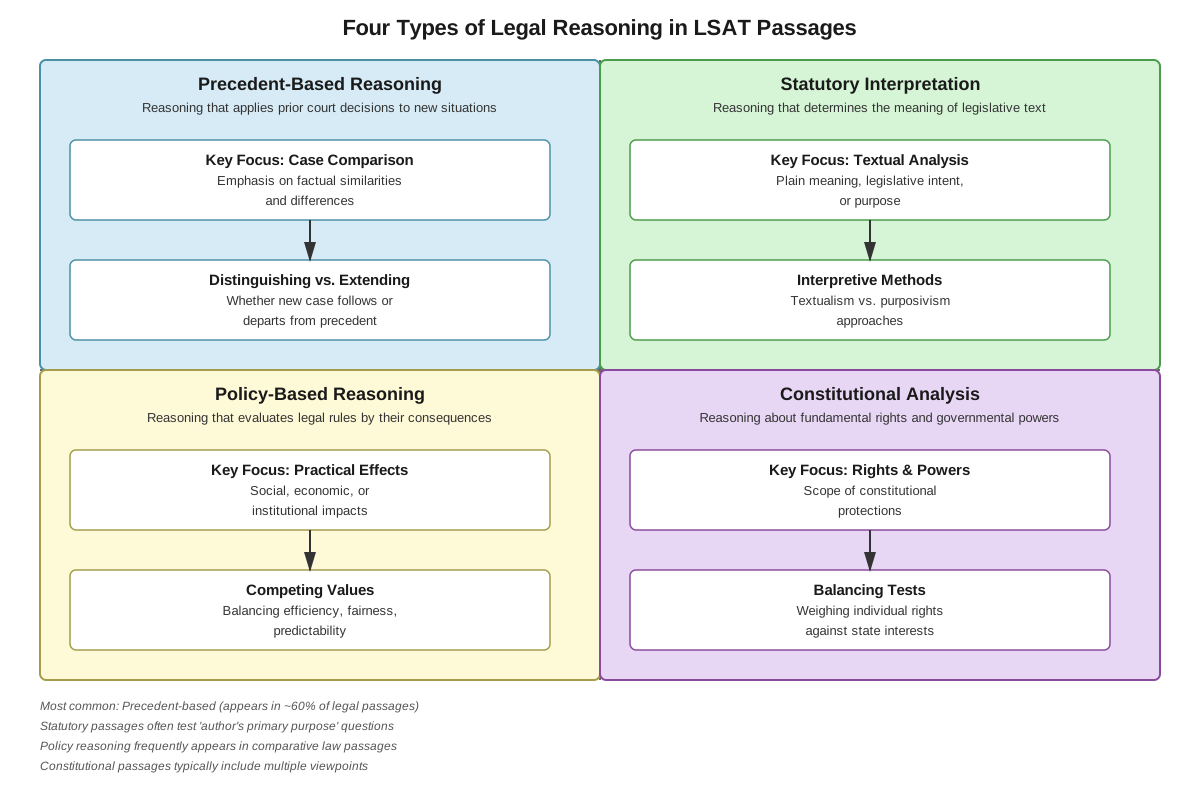
- [ ] Distinguish between different types of legal reasoning (precedent-based, statutory interpretation, policy-based, and constitutional analysis)
- [ ] Recognize the structural components of legal arguments including holdings, dicta, rationales, and limiting principles
- [ ] Evaluate how courts distinguish or extend precedents based on factual similarities and differences
- [ ] Analyze the relationship between general legal principles and their application to specific fact patterns
Prerequisites
- Basic argument structure recognition: Understanding premises, conclusions, and logical connections is essential because legal reasoning builds complex multi-layered arguments where each component must be tracked separately.
- Ability to identify main ideas and supporting details: Legal passages contain dense information where distinguishing between holdings (binding legal rules) and dicta (non-binding commentary) requires precise reading.
- Familiarity with comparative analysis: Legal reasoning constantly compares cases, statutes, and principles, requiring comfort with identifying similarities and differences across multiple examples.
- Understanding of author's purpose and tone: Recognizing whether a passage presents a neutral explanation, advocates for reform, or critiques existing doctrine shapes interpretation of every claim within it.
Why This Topic Matters
Legal reasoning passages appear with absolute consistency on the LSAT—every test includes at least one passage drawn from legal sources such as court opinions, law review articles, or discussions of legal theory. These passages typically generate 6-8 questions per test, representing approximately 15% of the entire Reading Comprehension score. The skills tested through legal reasoning passages directly predict success in law school, where students must brief cases, distinguish precedents, and construct arguments from legal authorities daily.
In real-world legal practice, the reasoning patterns tested on the LSAT form the foundation of legal analysis. Attorneys must identify controlling precedents, distinguish unfavorable cases, interpret ambiguous statutory language, and predict how courts will apply existing principles to novel situations. Judges must explain their reasoning in ways that respect precedent while addressing the unique facts before them. Legal scholars critique existing doctrines and propose new frameworks for understanding legal problems. Each of these activities requires the analytical skills that LSAT legal reasoning passages assess.
Common manifestations of this topic include passages discussing landmark Supreme Court decisions and their reasoning, articles analyzing how a particular legal doctrine has evolved over time, discussions of competing approaches to statutory interpretation (textualism versus purposivism), examinations of how courts balance competing policy considerations, and critiques of existing legal frameworks with proposals for reform. Questions frequently ask students to identify the court's reasoning, determine how a principle would apply to a new situation, recognize what would strengthen or weaken a legal argument, or understand why a court distinguished a prior case.
Core Concepts
The Structure of Legal Reasoning
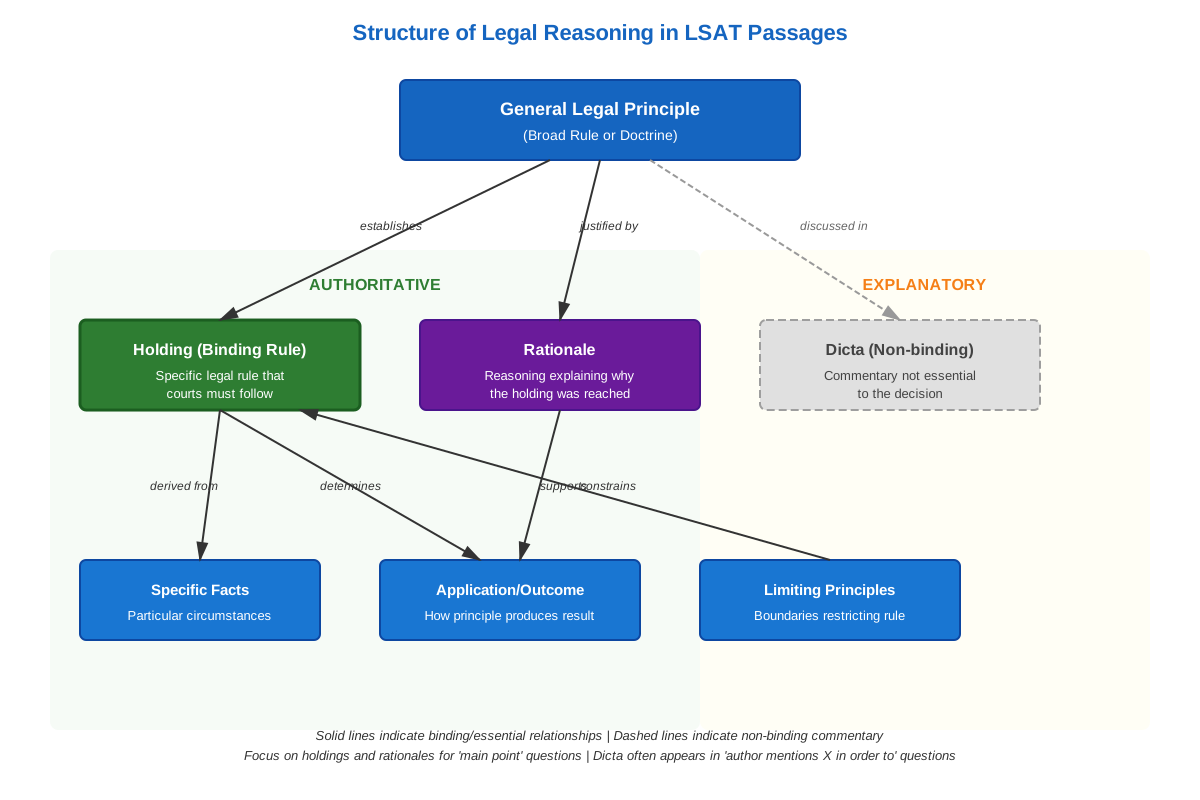
Legal reasoning in passages follows predictable structural patterns that differ from other forms of argumentation. At its foundation lies the rule-application framework: courts identify applicable legal rules (from statutes, constitutions, or prior cases), interpret those rules, apply them to specific facts, and reach conclusions. This structure appears consistently across legal passages, though the complexity varies. Understanding this framework allows test-takers to anticipate how arguments will develop and where key information will appear.
Legal passages typically present a holding—the binding legal rule that emerges from a case—which must be distinguished from dicta, which are judicial statements not essential to the decision. The LSAT frequently tests whether students can identify this distinction, as holdings create precedent while dicta do not. For example, if a court decides that a contract is enforceable because it was signed by both parties, statements about what might happen if only one party had signed constitute dicta, not holding.
Precedent-Based Reasoning
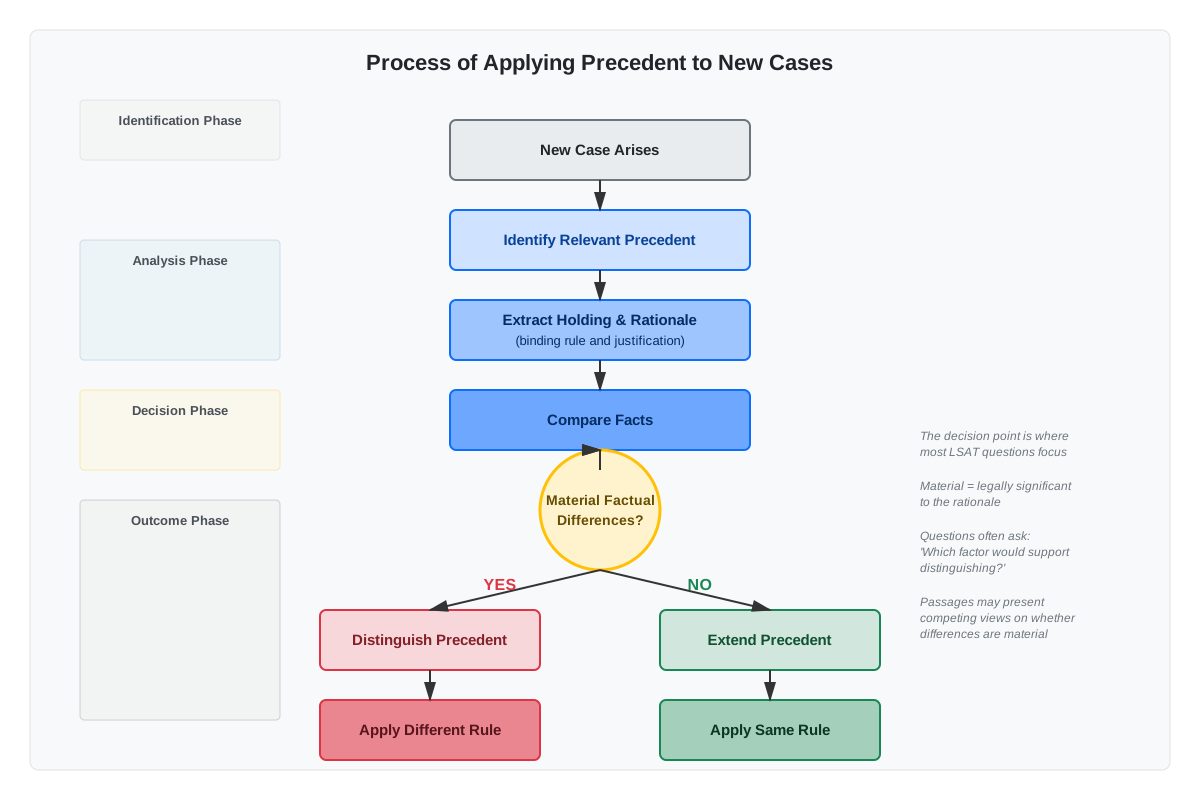
The doctrine of stare decisis (following precedent) forms the backbone of common law reasoning. Courts look to prior decisions addressing similar legal questions and apply the principles from those cases to new situations. Legal passages often describe how a court applies, distinguishes, or overrules precedent. Distinguishing occurs when a court identifies factual differences between the current case and a prior case that justify reaching a different conclusion. Extending precedent happens when a court applies a principle from earlier cases to a new context based on relevant similarities.
The LSAT tests understanding of precedential reasoning by presenting scenarios where students must determine whether a prior case controls a new situation. Key factors include identifying the material facts—those facts that were essential to the prior court's reasoning—and determining whether those facts are present in the new case. If material facts differ significantly, the precedent may not apply, and the court must distinguish the cases.
Statutory Interpretation
When passages involve statutory interpretation, they typically present competing approaches to determining legislative intent. Textualism focuses on the plain meaning of statutory language, arguing that courts should apply the words as written without reference to broader purposes. Purposivism looks beyond literal text to the statute's underlying goals and interprets ambiguous language to advance those purposes. Legislative history approaches examine committee reports, floor debates, and other contextual materials to determine what legislators intended.
LSAT passages often present situations where different interpretive methods yield different results, then ask students to identify which approach a court is using or what result would follow from applying a particular method. Understanding these frameworks requires recognizing the assumptions underlying each approach: textualists assume language has determinate meaning and that judicial restraint requires adherence to text, while purposivists assume that advancing legislative goals better serves democratic values even when it requires flexible interpretation.
Policy-Based Reasoning
Courts frequently justify decisions by reference to policy considerations—the practical consequences and social values that different rules would promote or undermine. Common policy considerations include promoting economic efficiency, protecting individual liberty, ensuring fairness, maintaining predictability in legal rules, and preventing fraud or abuse. Legal passages may describe how courts balance competing policies or how policy concerns influence the development of legal doctrine.
The LSAT tests policy reasoning by asking students to identify what policy justifies a particular rule, what consequences would follow from adopting an alternative approach, or how a court weighs competing policy considerations. Recognizing policy-based reasoning requires distinguishing between the formal legal rule and the practical justifications supporting it.
Constitutional Analysis
Passages involving constitutional reasoning present unique challenges because constitutional provisions are typically stated at high levels of generality ("due process," "equal protection," "freedom of speech"), requiring courts to develop frameworks for applying these principles to specific situations. Constitutional passages often describe multi-part tests that courts have developed, such as levels of scrutiny in equal protection analysis or the distinction between content-based and content-neutral speech regulations.
These passages frequently present competing theories of constitutional interpretation: originalism (interpreting provisions according to their original public meaning), living constitutionalism (adapting interpretation to contemporary values), and various intermediate approaches. Understanding constitutional reasoning requires tracking how abstract principles are operationalized through specific doctrinal tests and how courts justify their interpretive methodologies.
Analogical Reasoning in Legal Contexts
Analogical reasoning—arguing that similar cases should be decided similarly—pervades legal analysis. Courts identify relevant similarities and differences between cases, determining which features are legally significant. Legal passages often present a series of cases, asking students to predict how a court would decide a new case based on the pattern of prior decisions.
Effective analogical reasoning requires identifying the ratio decidendi—the principle or reason for the decision—rather than focusing on superficial factual similarities. Two cases involving car accidents might be decided differently if one involves negligence and the other involves intentional conduct, because the legal principles governing these situations differ fundamentally.
Concept Relationships
The core concepts within legal reasoning form an interconnected system where each element reinforces and depends upon others. Precedent-based reasoning serves as the foundation, establishing how courts use prior decisions to decide new cases. This foundation supports analogical reasoning, which provides the methodology for determining when precedents apply—by identifying relevant similarities and differences between cases. Both precedent and analogy interact with statutory interpretation when courts must determine whether a statute changes or codifies common law principles, requiring them to reconcile legislative text with judicial precedent.
Policy-based reasoning operates at a different level, providing justifications for why particular rules or interpretations should be adopted. Policy considerations influence how courts distinguish precedents (choosing to emphasize certain factual differences because they implicate important policy concerns), how they interpret statutes (selecting interpretations that advance desirable policies), and how they develop constitutional doctrine (crafting tests that balance competing constitutional values). The rule-application framework encompasses all these elements, providing the overall structure within which precedent, analogy, interpretation, and policy operate.
Constitutional analysis represents the most complex integration of these concepts, as constitutional cases typically involve precedent (prior constitutional decisions), interpretation (determining what constitutional text means), analogy (comparing the current situation to prior cases), and policy (balancing competing constitutional values and practical consequences). Understanding how these elements interact allows students to navigate even the most complex legal passages by recognizing which type of reasoning is operating at each point in the argument.
This topic builds directly on prerequisite knowledge of argument structure by adding the specific conventions and constraints of legal reasoning. While basic argumentation involves premises supporting conclusions, legal reasoning adds layers of authority (precedent, statutes, constitutional text) that constrain what arguments are available and how they must be constructed. The connection to viewpoints and argumentation becomes especially important in legal passages presenting dissenting opinions, scholarly critiques, or competing interpretive theories, where students must track multiple perspectives while understanding the legal reasoning underlying each position.
High-Yield Facts
⭐ Legal passages appear on every LSAT, typically as one of four reading comprehension passages, consistently generating 6-8 questions per test.
⭐ Holdings create binding precedent; dicta do not—courts must follow the holdings of prior cases but may disregard dicta, making this distinction crucial for predicting how precedent applies.
⭐ Material facts are those essential to a court's reasoning—when distinguishing precedents, courts focus on whether material facts differ, not whether any facts differ.
⭐ Textualism interprets statutes by their plain language; purposivism looks to underlying legislative goals—these competing approaches often yield different results for ambiguous statutory language.
⭐ Courts distinguish precedents by identifying relevant factual differences—this allows courts to reach different conclusions while maintaining respect for prior decisions.
- Policy considerations provide practical justifications for legal rules, addressing consequences and social values rather than formal legal authority.
- Constitutional interpretation involves competing theories (originalism versus living constitutionalism) that reflect different views about how abstract principles should be applied.
- Analogical reasoning requires identifying the ratio decidendi (reason for decision) rather than focusing on superficial factual similarities.
- The rule-application framework (identify rule → interpret rule → apply to facts → reach conclusion) structures most legal reasoning passages.
- Stare decisis (following precedent) creates stability in law but allows flexibility through distinguishing and extending precedents.
- Statutory interpretation questions often present scenarios where different interpretive methods yield different outcomes, testing understanding of each approach's logic.
- Legal passages frequently present multiple viewpoints (majority opinion, dissent, scholarly critique) requiring students to track distinct reasoning chains simultaneously.
Quick check — test yourself on Legal reasoning in passages so far.
Try Flashcards →Common Misconceptions
Misconception: Legal reasoning passages require pre-existing legal knowledge or familiarity with specific cases and doctrines.
Correction: The LSAT tests analytical reasoning skills, not legal knowledge. All necessary information appears in the passage itself. Students should focus on understanding the logical structure of arguments rather than trying to apply outside legal knowledge, which may actually interfere with comprehension if it conflicts with how the passage presents the material.
Misconception: When a court distinguishes a precedent, it is rejecting or overruling that precedent.
Correction: Distinguishing precedent means identifying relevant differences that justify reaching a different conclusion in the current case while still respecting the prior decision's authority. The precedent remains valid for cases with similar material facts. Overruling, by contrast, explicitly rejects a prior decision's reasoning and eliminates its precedential value.
Misconception: All statements in a judicial opinion carry equal legal weight and create binding precedent.
Correction: Only the holding—the legal rule necessary to decide the case—creates binding precedent. Dicta, including hypothetical discussions, alternative rationales not necessary to the decision, and broad philosophical statements, do not bind future courts. Identifying this distinction is frequently tested on the LSAT.
Misconception: Policy-based reasoning is separate from legal reasoning and represents judges imposing personal preferences.
Correction: Policy considerations are a legitimate component of legal reasoning, particularly when interpreting ambiguous provisions, choosing between competing precedents, or developing new legal rules. Courts explicitly discuss policy to justify their decisions and demonstrate that their reasoning advances recognized legal values rather than arbitrary preferences.
Misconception: Analogical reasoning in law simply means finding any factual similarities between cases.
Correction: Legal analogy requires identifying legally relevant similarities—those that implicate the same principles or policies underlying the precedent. Two cases might share many factual details but be legally distinguishable if the facts that mattered to the prior court's reasoning differ. Conversely, cases with different surface facts might be analogous if they share the same legally significant features.
Misconception: Statutory interpretation is straightforward—courts simply apply what the statute says.
Correction: Statutory language is often ambiguous, requiring courts to choose among competing interpretations. Different interpretive methodologies (textualism, purposivism, legislative history) reflect different theories about how to resolve ambiguity. The LSAT frequently tests understanding of how these approaches differ and what results each would produce.
Worked Examples
Example 1: Distinguishing Precedent
Passage Excerpt: "In Martinez v. State Bank, the court held that a bank could not enforce a loan agreement against a borrower who had signed the contract while intoxicated, reasoning that intoxication prevented the borrower from understanding the agreement's terms. The court emphasized that the borrower's intoxication was visible to the bank officer who witnessed the signature, noting that the borrower slurred words and had difficulty standing. In the present case, Chen v. First National, the bank argues that Martinez does not apply because Chen, though intoxicated when signing, showed no outward signs of impairment and conversed normally with bank personnel."
Question: Based on the passage, the bank's argument in Chen relies on which of the following distinctions?
Analysis:
Step 1: Identify the holding in Martinez—banks cannot enforce contracts signed by visibly intoxicated borrowers who could not understand the terms.
Step 2: Identify the material facts in Martinez—the borrower was intoxicated AND showed visible signs (slurred speech, difficulty standing) that the bank officer observed.
Step 3: Examine the facts in Chen—Chen was intoxicated but showed no outward signs of impairment.
Step 4: Determine what distinction the bank is drawing—Chen's intoxication was not visible to bank personnel, unlike Martinez's obvious impairment.
Step 5: Evaluate whether this distinction is legally relevant—the Martinez court emphasized the bank's knowledge of the impairment, suggesting that visible signs were material to the decision.
Answer: The bank argues that Martinez applies only when the borrower's intoxication is apparent to the lender, and since Chen showed no visible signs of impairment, the bank had no reason to question his capacity to contract. This distinction focuses on the material fact of the bank's knowledge, which was central to the Martinez court's reasoning.
Connection to Learning Objectives: This example demonstrates how to identify legal reasoning patterns (distinguishing precedent), explain the reasoning (focusing on material facts), and apply the concept to solve problems (determining whether the distinction is valid based on what facts mattered to the prior court).
Example 2: Statutory Interpretation Approaches
Passage Excerpt: "The Consumer Protection Act prohibits 'deceptive practices' in commercial transactions. Section 12(a) specifically lists examples including 'false advertising, bait-and-switch tactics, and pyramid schemes.' When the Federal Trade Commission sought to apply the Act to a company's failure to disclose known product defects, the company argued that the statute should be interpreted narrowly. The company's textualist argument emphasized that the listed examples all involve affirmative misrepresentations, not mere omissions. The FTC countered with a purposivist interpretation, arguing that the Act's goal of protecting consumers from deception encompasses material omissions that mislead purchasers just as effectively as false statements."
Question: The company's argument relies on which principle of statutory interpretation?
Analysis:
Step 1: Identify the interpretive question—does "deceptive practices" include omissions or only affirmative misrepresentations?
Step 2: Recognize the company's methodology—textualism, focusing on the plain meaning of listed examples.
Step 3: Identify the textual argument—all listed examples (false advertising, bait-and-switch, pyramid schemes) involve affirmative false statements, not omissions.
Step 4: Understand the interpretive principle—under the canon of ejusdem generis (of the same kind), general terms should be interpreted consistently with specific examples that accompany them.
Step 5: Contrast with the FTC's purposivist approach—looking beyond specific examples to the statute's broader goal of preventing consumer deception.
Answer: The company employs textualist reasoning, specifically the principle that general statutory terms should be interpreted in light of specific examples provided. Since all listed examples involve affirmative misrepresentations, the company argues that "deceptive practices" should be limited to similar conduct, excluding mere omissions. This approach prioritizes textual consistency over broader statutory purposes.
Connection to Learning Objectives: This example illustrates how to identify different types of legal reasoning (statutory interpretation), explain the reasoning pattern (textualism versus purposivism), and understand how interpretive methodology determines outcomes.
Exam Strategy
When approaching legal reasoning passages on the LSAT, begin by identifying the passage type immediately. Look for signals such as case names (italicized), references to courts or judges, statutory language, or discussions of legal doctrine. Once identified, activate your framework for legal reasoning: expect to see rules stated, applied to facts, and justified through precedent or policy.
Trigger words and phrases that signal important legal reasoning elements include: "the court held that" (introduces a holding), "the court noted that" or "the court observed that" (often introduces dicta), "distinguishing [case name]" (signals precedent analysis), "the statute provides" (introduces statutory text), "the legislative purpose" (signals purposivist interpretation), "the plain language" (signals textualist interpretation), "policy considerations include" (introduces policy-based reasoning), and "applying this principle" (signals rule application).
For questions asking about a court's reasoning, focus on the rationale—the explanation for why the court reached its conclusion—rather than just the conclusion itself. The LSAT frequently includes wrong answers that correctly state the outcome but mischaracterize the reasoning. Similarly, for questions about how a principle would apply to a new situation, identify the material facts that drove the original decision and determine whether those facts are present in the new scenario.
Process-of-elimination strategies specific to legal reasoning include: eliminating answers that confuse holdings with dicta, rejecting answers that misidentify which facts were material to a court's reasoning, excluding answers that attribute the wrong interpretive methodology to a court (e.g., saying a court used purposivism when it actually applied textualist reasoning), and removing answers that claim a court overruled precedent when it actually distinguished it.
Time allocation for legal passages should account for their density and complexity. Spend slightly more time on the initial read (4-5 minutes for a typical passage) to ensure you understand the argument structure, as this investment pays dividends when answering questions. Track multiple viewpoints carefully—if the passage presents a majority opinion and dissent, or a court's reasoning and a scholar's critique, note where each perspective begins and ends. For questions requiring application of principles to new situations, budget extra time to carefully compare facts, as these questions reward precision.
When facing questions about what would strengthen or weaken a legal argument, consider what assumptions underlie the reasoning. Legal arguments often assume that certain facts are material, that precedents are analogous, or that particular policies are important. Evidence challenging these assumptions weakens the argument; evidence supporting them strengthens it.
Memory Techniques
HARP for the components of legal reasoning:
- Holding (the binding legal rule)
- Analogy (comparing to precedent)
- Rationale (the reason for the decision)
- Policy (practical justifications)
TIDE for distinguishing precedent:
- Test whether facts are truly analogous
- Identify material facts from the prior case
- Determine if those facts are present in the current case
- Evaluate whether differences justify a different outcome
TRAP for statutory interpretation approaches:
- Textualism (plain language)
- Reasonable purpose (purposivism)
- Authority of legislative history
- Precedent interpreting the statute
Visualize legal reasoning as a building structure: precedents form the foundation (existing rules), statutory text provides the framework (explicit requirements), policy considerations are the architectural design (why the structure looks this way), and the specific case facts are the building materials (what's actually being constructed). This metaphor helps remember that all elements must work together—you can't build without a foundation (precedent), but the foundation alone doesn't determine what you build (facts matter).
For remembering the distinction between holdings and dicta, use the phrase "Holding is necessary; dicta is extra"—holdings are necessary to decide the case, while dicta are extra commentary.
Summary
Legal reasoning in passages represents a high-yield LSAT topic that appears consistently on every test, requiring students to analyze how courts apply precedent, interpret statutes, balance policy considerations, and construct legal arguments. The fundamental structure involves identifying applicable rules, interpreting those rules, applying them to specific facts, and reaching justified conclusions. Success requires distinguishing holdings from dicta, recognizing when courts distinguish or extend precedents based on material facts, understanding competing approaches to statutory interpretation (textualism versus purposivism), and identifying policy-based justifications for legal rules. Legal passages frequently present multiple viewpoints—majority and dissenting opinions, or scholarly critiques of existing doctrine—requiring careful tracking of distinct reasoning chains. The skills tested through legal reasoning passages directly predict law school success and form the foundation of legal practice. Mastery involves not memorizing legal rules but understanding the analytical patterns through which legal arguments are constructed and evaluated, enabling students to navigate any legal passage regardless of its specific subject matter.
Key Takeaways
- Legal reasoning passages appear on every LSAT and follow predictable structural patterns: identify rule → interpret rule → apply to facts → reach conclusion
- Holdings create binding precedent; dicta do not—this distinction is frequently tested and essential for understanding how precedent operates
- Courts distinguish precedents by identifying differences in material facts (those essential to the prior reasoning), not just any factual differences
- Statutory interpretation involves competing methodologies (textualism, purposivism, legislative history) that often yield different results for ambiguous language
- Policy-based reasoning provides practical justifications for legal rules, addressing consequences and social values alongside formal legal authority
- Analogical reasoning requires identifying legally relevant similarities (those implicating the same principles) rather than superficial factual parallels
- Success on legal reasoning questions depends on understanding analytical patterns, not pre-existing legal knowledge—all necessary information appears in the passage
Related Topics
Comparative Reading Passages: Legal reasoning skills transfer directly to comparative reading, where students must track how two authors approach the same legal question differently, comparing their reasoning methodologies and conclusions.
Argument Structure in Logical Reasoning: The rule-application framework from legal reasoning appears throughout Logical Reasoning questions, particularly in parallel reasoning and principle questions where students must apply general rules to specific situations.
Causal Reasoning in Reading Comprehension: Policy-based legal reasoning often involves causal claims about what consequences different rules will produce, connecting to broader skills in evaluating causal arguments across passage types.
Author's Purpose and Perspective: Legal passages presenting dissents, scholarly critiques, or competing interpretive theories require sophisticated analysis of multiple authors' purposes and how their perspectives shape their reasoning.
Mastering legal reasoning in passages builds transferable analytical skills that enhance performance across all LSAT sections while providing direct preparation for law school case analysis.
Practice CTA
Now that you understand the core concepts and strategies for legal reasoning in passages, it's time to apply this knowledge. Work through the practice questions systematically, identifying the type of legal reasoning in each passage, tracking holdings versus dicta, and recognizing when courts distinguish or extend precedents. Use the flashcards to reinforce key distinctions and terminology. Remember that legal reasoning skills develop through deliberate practice—each passage you analyze strengthens your ability to recognize patterns and apply analytical frameworks. Your investment in mastering this high-yield topic will pay dividends not only on test day but throughout your law school career.
Sign up free to keep reading
Create a free AnvayaPrep account to finish this LSAT guide on Legal reasoning in passages — plus flashcards and practice questions.