Overview
The modern view is a critical concept in LSAT reading comprehension that appears frequently in passages dealing with viewpoints and argumentation. In the context of the LSAT, the modern view represents a contemporary perspective, theory, or interpretation that typically contrasts with traditional, historical, or classical viewpoints. Understanding how to identify and analyze modern views is essential for success on the LSAT because approximately 60-70% of reading comprehension passages present some form of contrasting perspectives, with the modern view often serving as the primary focus or the author's preferred position.
The modern view functions as a rhetorical device that authors use to structure arguments, present new evidence, challenge established thinking, or propose alternative interpretations. On the LSAT, passages frequently present a historical context or traditional understanding in the opening paragraphs, then introduce a modern view that revises, refutes, or refines that earlier perspective. This structural pattern creates natural question opportunities about the relationship between viewpoints, the author's attitude toward different perspectives, and the logical support for competing claims.
Mastering the modern view concept connects directly to broader reading comprehension skills, including identifying main ideas, understanding passage structure, recognizing authorial tone and purpose, and evaluating the strength of arguments. The modern view often serves as the passage's central thesis or represents a significant turning point in the argument's development. Students who can quickly identify when a modern view is being introduced, understand its relationship to other perspectives in the passage, and recognize the evidence supporting it will significantly improve their performance on viewpoint-based questions, which constitute a substantial portion of LSAT reading comprehension items.
Learning Objectives
- [ ] Identify how Modern view appears in LSAT questions
- [ ] Explain the reasoning pattern behind Modern view
- [ ] Apply Modern view to solve LSAT-style problems accurately
- [ ] Distinguish between modern views and traditional/historical perspectives within passages
- [ ] Analyze the evidence and reasoning used to support modern views in argumentative texts
- [ ] Evaluate the author's attitude toward modern views versus competing perspectives
- [ ] Predict question types that commonly test understanding of modern views
Prerequisites
- Basic passage structure recognition: Understanding how LSAT passages are organized (introduction, body, conclusion) is essential because modern views typically appear at specific structural points within passages.
- Contrast signal words: Familiarity with transition words like "however," "recently," "in contrast," and "contemporary scholars argue" helps identify when a modern view is being introduced.
- Author's tone and purpose: Recognizing whether an author is neutral, supportive, or critical toward different viewpoints enables accurate interpretation of how modern views function within arguments.
- Evidence evaluation: The ability to distinguish between claims and supporting evidence is necessary to assess how modern views are justified in passages.
Why This Topic Matters
The modern view concept appears in approximately 40-50% of LSAT reading comprehension passages, making it one of the most frequently tested elements in the exam. This high frequency occurs because the LSAT tests critical reasoning skills, and contrasting viewpoints—particularly the tension between traditional and modern perspectives—provides an ideal framework for assessing analytical abilities. Questions about modern views test multiple competencies simultaneously: comprehension, analysis, synthesis, and evaluation.
In real-world applications, the ability to identify and evaluate modern views is fundamental to legal reasoning. Attorneys must constantly engage with evolving interpretations of law, distinguish between established precedent and contemporary legal theories, and argue for or against new applications of legal principles. The LSAT's emphasis on modern views reflects the practical reality that legal professionals must navigate between traditional doctrine and contemporary developments in jurisprudence.
On the exam, modern views appear across all four passage types: humanities, social sciences, natural sciences, and law. Common manifestations include: scientific passages presenting new research that challenges established theories; humanities passages discussing contemporary interpretations of historical events or artistic movements; social science passages introducing recent studies that revise understanding of human behavior; and law passages exploring modern applications of constitutional principles. Questions may ask students to identify the modern view's main claim, explain how it differs from traditional perspectives, evaluate the evidence supporting it, determine the author's attitude toward it, or predict how proponents of the modern view would respond to counterarguments.
Core Concepts
Definition and Characteristics of Modern View
The modern view in LSAT reading comprehension refers to a contemporary perspective, interpretation, theory, or approach that represents current thinking on a subject. The term "modern" is relative rather than absolute—it indicates recency compared to other viewpoints discussed in the passage, not necessarily cutting-edge contemporary thought. A modern view from the 1980s might be presented as "modern" when contrasted with theories from the 1950s.
Modern views typically share several distinguishing characteristics. First, they incorporate new evidence or data that was unavailable to earlier theorists. This might include recent archaeological discoveries, contemporary scientific studies, newly available historical documents, or current statistical analyses. Second, modern views often employ revised methodologies that differ from traditional approaches—for example, using interdisciplinary methods, applying new technologies, or utilizing different analytical frameworks. Third, modern views frequently challenge assumptions that underlie traditional perspectives, questioning premises that earlier thinkers took for granted.
Structural Patterns in Passages
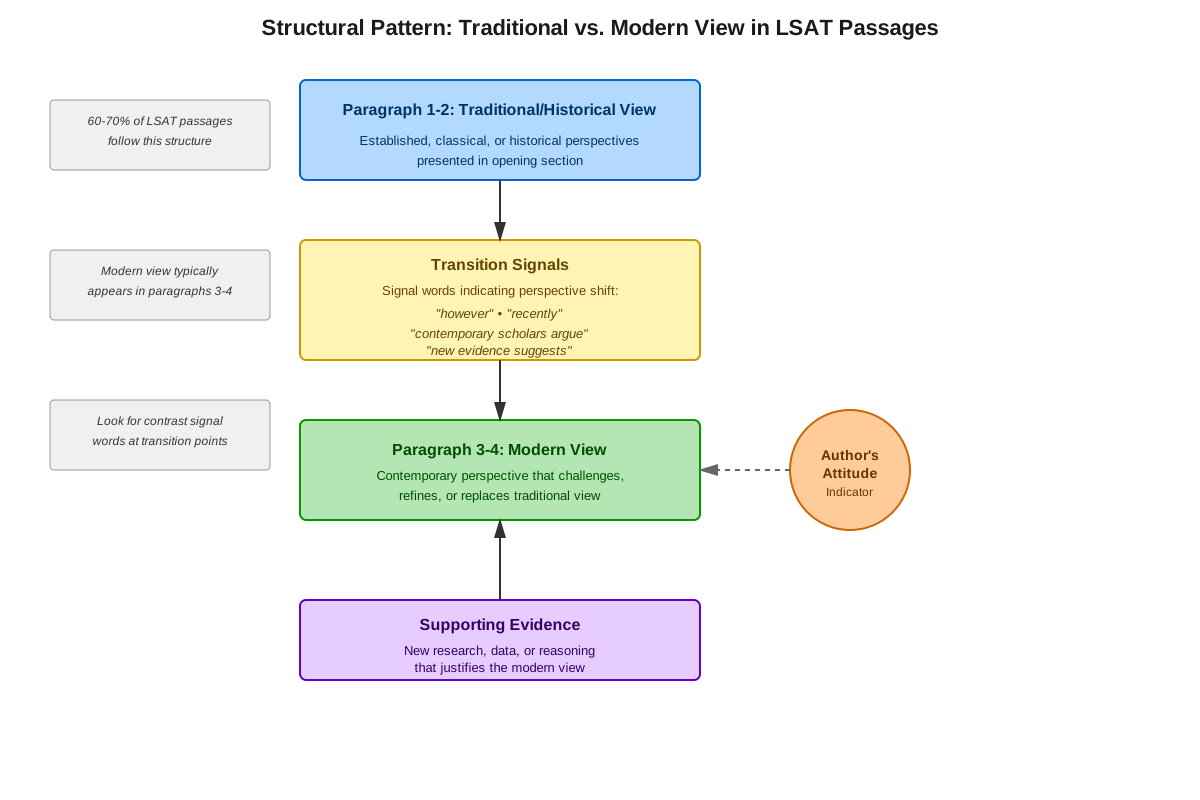
LSAT passages employ predictable structural patterns when presenting modern views. The most common pattern follows this sequence:
- Traditional view introduction (Paragraph 1): The passage opens by describing a long-held belief, classical theory, or historical interpretation
- Limitations or problems (Paragraph 1-2): The author identifies weaknesses, gaps, or challenges in the traditional view
- Modern view presentation (Paragraph 2-3): A contemporary perspective is introduced, often with signal phrases like "recent scholarship suggests," "contemporary researchers have found," or "a new interpretation proposes"
- Evidence and support (Paragraph 3-4): The passage provides data, examples, or reasoning that supports the modern view
- Implications or applications (Final paragraph): The author discusses the significance or consequences of adopting the modern view
Alternative patterns include: presenting multiple modern views that compete with each other; introducing a modern view early and then defending it against traditional objections; or presenting a modern view that synthesizes elements from competing traditional perspectives.
Signal Language for Modern Views
Recognizing transition markers that introduce modern views is crucial for efficient passage navigation. Common signal phrases include:
| Category | Signal Phrases |
|---|---|
| Temporal markers | "Recently," "In recent years," "Contemporary," "Current," "Modern," "Today" |
| Scholarly attribution | "New research suggests," "Recent studies show," "Contemporary scholars argue," "Modern theorists propose" |
| Contrast indicators | "However," "In contrast," "Challenging this view," "Revising earlier interpretations," "Departing from tradition" |
| Revision language | "Reinterpretation," "Reassessment," "Reconsideration," "Updated understanding," "Fresh perspective" |
Relationship Between Modern and Traditional Views
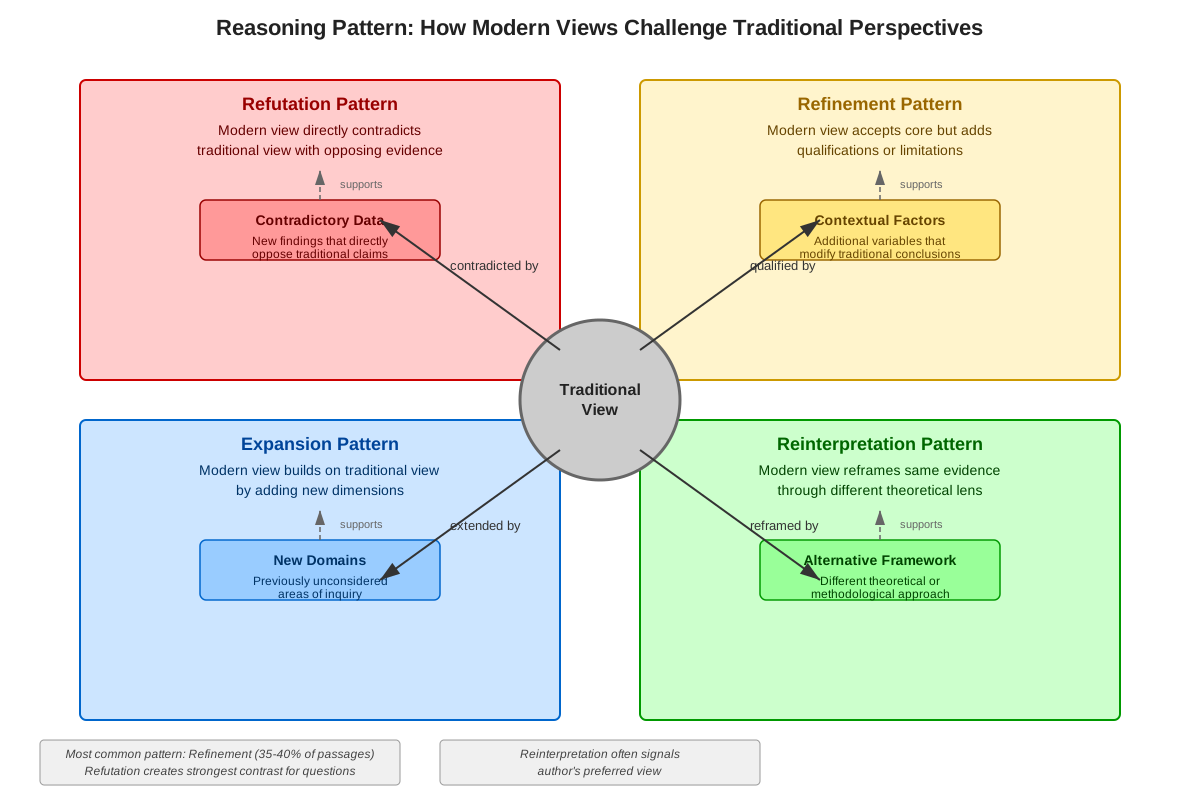
The relationship between modern and traditional views typically falls into one of four categories:
Complete refutation: The modern view directly contradicts the traditional view, arguing that the earlier perspective is fundamentally wrong. Evidence presented demonstrates that the traditional view's core claims are false or its reasoning is flawed.
Partial revision: The modern view accepts some elements of the traditional view while rejecting or modifying others. This nuanced relationship acknowledges the traditional view's contributions while correcting specific errors or updating outdated components.
Refinement or specification: The modern view doesn't reject the traditional view but rather makes it more precise, adds qualifications, or specifies conditions under which it applies. The traditional view is seen as broadly correct but insufficiently detailed.
Synthesis or integration: The modern view combines insights from multiple traditional perspectives, creating a more comprehensive understanding that incorporates elements from competing earlier theories.
Author's Attitude Toward Modern Views
Understanding the author's stance toward the modern view is essential for answering attitude and tone questions. Authors may adopt several positions:
- Advocacy: The author explicitly supports the modern view, presenting it as superior to alternatives and defending it against objections
- Neutral presentation: The author describes the modern view objectively without endorsing or criticizing it, leaving evaluation to the reader
- Qualified support: The author generally favors the modern view but acknowledges limitations, unanswered questions, or areas requiring further research
- Critical analysis: The author presents the modern view but raises concerns about its evidence, methodology, or conclusions
- Comparative evaluation: The author weighs the modern view against alternatives, discussing relative strengths and weaknesses
Evidence Types Supporting Modern Views
Modern views in LSAT passages are supported by various types of evidence:
Empirical data: Statistical studies, experimental results, observational data, or quantitative analyses that provide measurable support for claims.
New primary sources: Recently discovered documents, artifacts, recordings, or other original materials that were unavailable to earlier researchers.
Technological advances: New tools or techniques (carbon dating, DNA analysis, satellite imaging, computational modeling) that enable investigations impossible with earlier technology.
Interdisciplinary insights: Perspectives from other fields that illuminate the subject in new ways, such as applying economic analysis to historical questions or using neuroscience to understand psychological phenomena.
Logical reanalysis: Reexamination of existing evidence using different reasoning frameworks or identifying logical flaws in traditional arguments.
Concept Relationships
The modern view concept connects to multiple elements within reading comprehension and broader LSAT skills. Understanding these relationships creates a comprehensive framework for approaching passages.
Internal relationships: Within a passage, the modern view typically exists in a dialectical relationship with traditional views (thesis-antithesis structure). The modern view → responds to → limitations of traditional view. The evidence supporting modern view → strengthens → the author's main argument (when the author favors the modern view). The implications of modern view → lead to → new questions or research directions discussed in the conclusion.
Connection to passage structure: Modern view identification → enables → accurate passage mapping. Recognizing when the modern view is introduced → helps predict → upcoming content (evidence, examples, implications). Understanding the modern view's position → clarifies → the passage's organizational logic.
Relationship to question types: Modern view comprehension → directly supports → main idea questions, purpose questions, and structure questions. Analyzing modern view evidence → enables answering → strengthen/weaken questions and inference questions. Understanding author's attitude toward modern view → is essential for → tone and perspective questions.
Link to argumentation skills: Evaluating modern views → develops → critical reasoning abilities tested throughout the LSAT. Distinguishing between modern view claims and supporting evidence → parallels → premise-conclusion analysis in Logical Reasoning. Assessing the relationship between modern and traditional views → mirrors → evaluating competing arguments.
High-Yield Facts
⭐ Modern views appear in 40-50% of LSAT reading comprehension passages, making them one of the most frequently tested concepts.
⭐ Signal phrases like "recently," "contemporary scholars," and "new research" typically introduce modern views and serve as structural markers for passage navigation.
⭐ The modern view often appears in the second or third paragraph after the traditional view has been established in the opening.
⭐ Authors who present modern views typically provide specific evidence such as studies, data, or examples to support the contemporary perspective.
⭐ Questions about modern views frequently ask about the relationship between viewpoints rather than just the content of the modern view itself.
- Modern views may completely refute, partially revise, refine, or synthesize traditional perspectives—understanding which relationship exists is crucial for answering comparison questions.
- The author's attitude toward the modern view can range from strong advocacy to neutral presentation to critical evaluation—identifying this stance is essential for tone questions.
- Modern views are often supported by new evidence types unavailable to earlier theorists, such as technological advances or recently discovered sources.
- Passages may present multiple competing modern views rather than a single contemporary perspective contrasted with tradition.
- The implications or applications of modern views are frequently discussed in final paragraphs and often generate inference questions.
- Modern views in scientific passages typically involve new experimental data or revised theoretical frameworks.
- In humanities passages, modern views often represent reinterpretations of historical events, artistic movements, or cultural phenomena using contemporary analytical methods.
Quick check — test yourself on Modern view so far.
Try Flashcards →Common Misconceptions
Misconception: The modern view is always the author's preferred position.
Correction: Authors may present modern views neutrally or even critically. Some passages describe modern views that the author questions or argues against. Always look for explicit indicators of the author's attitude rather than assuming support for contemporary perspectives.
Misconception: "Modern" means cutting-edge or very recent.
Correction: In LSAT passages, "modern" is relative to other viewpoints discussed. A theory from the 1970s might be the "modern view" when contrasted with theories from the 1920s. The key is recency relative to other perspectives in the passage, not absolute contemporaneity.
Misconception: Modern views always completely reject traditional views.
Correction: Modern views frequently refine, qualify, or partially revise traditional perspectives rather than completely rejecting them. Many passages present modern views that acknowledge the value of traditional approaches while updating specific elements.
Misconception: The modern view is always introduced with explicit signal language.
Correction: While signal phrases are common, some passages introduce modern views more subtly through context, dates, or attribution to contemporary scholars without using words like "modern" or "recent." Recognizing structural patterns helps identify modern views even without explicit markers.
Misconception: There can only be one modern view per passage.
Correction: Some passages present multiple competing modern views, all of which represent contemporary perspectives that differ from traditional approaches. These passages often compare and contrast different current theories or interpretations.
Misconception: Modern views are always more complex than traditional views.
Correction: While modern views sometimes add nuance or complexity, they may also simplify earlier theories by eliminating unnecessary assumptions or providing more parsimonious explanations. Complexity is not inherently associated with modernity.
Misconception: Questions about modern views only ask about the content of the contemporary perspective.
Correction: Questions frequently focus on relationships between viewpoints, the evidence supporting modern views, the author's attitude toward different perspectives, or the implications of adopting the modern view. Understanding context and relationships is as important as understanding content.
Worked Examples
Example 1: Scientific Passage with Modern View
Passage excerpt: "For decades, paleontologists believed that the extinction of dinosaurs resulted from gradual climate change over millions of years. This traditional view emphasized long-term environmental shifts and declining food sources. However, recent geological evidence has led contemporary researchers to propose a different explanation. Analysis of sediment layers from 65 million years ago reveals high concentrations of iridium, an element rare on Earth but common in asteroids. This discovery, combined with the identification of a massive impact crater in the Yucatan Peninsula, supports the modern view that a catastrophic asteroid collision caused rapid environmental changes that led to dinosaur extinction within a relatively brief period."
Question: The author's primary purpose in the passage is to:
Analysis process:
- Identify the modern view: The modern view is the asteroid impact theory, introduced by "However, recent geological evidence" and "contemporary researchers."
- Identify the traditional view: The traditional view is gradual climate change, presented in the opening sentence.
- Determine the relationship: The modern view refutes the traditional view by proposing a completely different mechanism (catastrophic event vs. gradual change).
- Assess author's attitude: The author presents the modern view with supporting evidence (iridium, crater) without explicit criticism, suggesting neutral-to-supportive presentation.
- Determine passage purpose: The passage structure moves from traditional to modern view with supporting evidence, indicating the purpose is to present the contemporary perspective and its evidential basis.
Answer approach: The correct answer will describe presenting or explaining a modern theory that challenges an earlier view, supported by recent evidence. Incorrect answers might suggest the author is criticizing the modern view, reconciling both views, or focusing primarily on the traditional perspective.
Example 2: Humanities Passage with Qualified Modern View
Passage excerpt: "Art historians traditionally interpreted Renaissance paintings as purely aesthetic achievements, focusing on technical innovations in perspective and composition. This approach emphasized formal qualities while largely ignoring social and political contexts. Contemporary art historians have developed a more nuanced interpretation that considers Renaissance art as embedded in complex networks of patronage, power, and ideology. While not dismissing the importance of aesthetic analysis, modern scholars argue that understanding who commissioned artworks, for what purposes, and within what political circumstances is essential for complete interpretation. For example, recent research on Botticelli's works reveals how Medici family patronage influenced not only subject selection but also symbolic content that reinforced the family's political legitimacy."
Question: According to the passage, the modern view of Renaissance art differs from the traditional view primarily in that the modern view:
Analysis process:
- Identify traditional view: Focus on aesthetic and technical qualities in isolation from context.
- Identify modern view: Considers art within social, political, and patronage contexts while maintaining attention to aesthetic elements.
- Determine relationship type: This is a refinement/expansion rather than complete refutation—the modern view "not dismissing" aesthetic analysis but adding contextual dimensions.
- Note the qualification: The phrase "while not dismissing" indicates the modern view incorporates rather than rejects traditional concerns.
- Identify supporting evidence: The Botticelli example demonstrates how patronage analysis reveals additional layers of meaning.
Answer approach: The correct answer will indicate that the modern view adds contextual analysis to aesthetic analysis rather than replacing it. Incorrect answers might suggest complete rejection of aesthetic concerns, focus solely on political interpretation, or mischaracterize the relationship as synthesis of competing modern views.
Exam Strategy
Approaching Modern View Questions
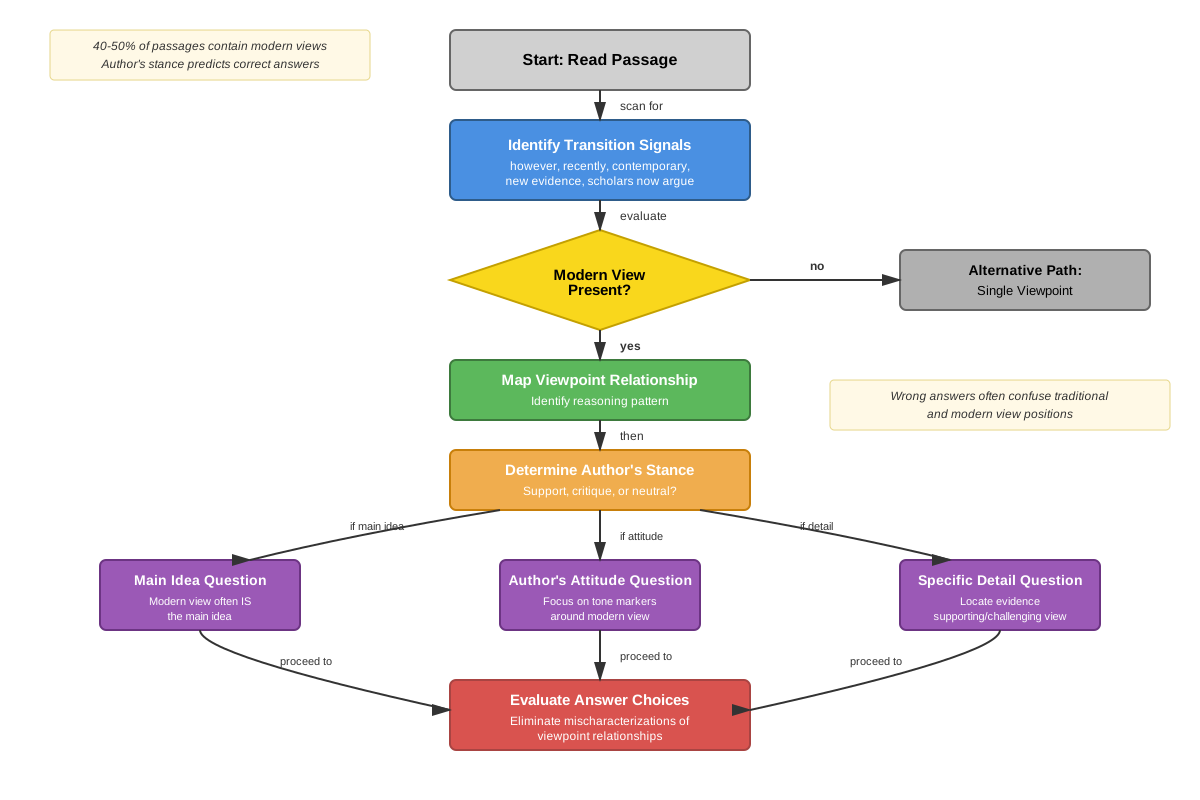
When encountering a passage that presents modern and traditional views, follow this systematic approach:
Step 1: Map the passage structure (30-45 seconds)
- Quickly identify where the traditional view is presented (usually paragraph 1)
- Mark where the modern view is introduced (look for signal language)
- Note the evidence supporting each view
- Identify the author's attitude indicators
Step 2: Characterize the relationship (15 seconds)
- Determine whether the modern view refutes, revises, refines, or synthesizes
- This relationship will be tested in multiple questions
Step 3: Note evidence types (ongoing while reading)
- What new evidence supports the modern view?
- How does this evidence differ from what was available to traditional theorists?
Trigger Words and Phrases
High-yield trigger phrases that signal modern view introduction: - "Recent research/studies/evidence" - "Contemporary scholars/researchers/theorists" - "However" or "In contrast" followed by temporal markers - "New interpretation/understanding/approach" - "Challenging/revising/reconsidering earlier views" - Specific recent dates (especially when contrasted with earlier dates)
Process of Elimination Tips
When answering questions about modern views:
Eliminate answers that:
- Confuse which view is modern and which is traditional
- Mischaracterize the relationship between views (e.g., claiming complete refutation when the passage shows refinement)
- Attribute the wrong attitude to the author
- Cite evidence that supports the traditional rather than modern view
- Go beyond what the passage states about the modern view's implications
Favor answers that:
- Accurately reflect the specific relationship between viewpoints described in the passage
- Match the author's tone (neutral, supportive, critical) toward the modern view
- Connect the modern view to evidence explicitly mentioned in the passage
- Use language consistent with the passage's characterization
Time Allocation
For passages with prominent modern/traditional view structures:
- Initial reading: 3-3.5 minutes (standard pace, but mark view transitions clearly)
- Question answering: Slightly faster than average because the clear structure makes locating relevant information easier
- Main idea/primary purpose questions: These should be quick (30-45 seconds) because the modern view often IS the main idea
- Relationship questions: Allow 45-60 seconds to carefully verify the specific relationship described
- Attitude questions: 30-45 seconds, focusing on explicit indicators rather than assumptions
Memory Techniques
MODERN Acronym for Identifying Modern Views
Markers: Look for temporal and contrast signal words
Opposition: Identify what the modern view opposes or revises
Data: Note what new evidence supports the modern view
Evidence type: Recognize whether it's empirical, technological, or methodological
Relationship: Characterize how modern and traditional views relate
Nuance: Determine if the modern view is qualified or absolute
Visualization Strategy
Picture passages with viewpoint contrasts as a timeline with branching paths:
PAST ←―――――――――――――――――――――――→ PRESENT
     Traditional View              Modern View
     (established path)            (new direction)
            ↓                           ↓
     [Old Evidence]              [New Evidence]
     [Old Methods]               [New Methods]
This mental image helps remember that modern views represent temporal progression and methodological evolution.
The Four R's of Modern View Relationships
Refute: Modern view says traditional view is wrong
Revise: Modern view corrects parts of traditional view
Refine: Modern view adds precision to traditional view
Reconcile: Modern view synthesizes competing traditional views
Remembering these four categories helps quickly classify the relationship when reading.
Signal Phrase Clusters
Group signal phrases into memorable categories:
TIME cluster: recently, contemporary, current, modern, today, in recent years
SCHOLAR cluster: researchers argue, scholars suggest, theorists propose, experts contend
CONTRAST cluster: however, in contrast, challenging, departing from, unlike earlier views
REVISION cluster: reinterpretation, reassessment, new understanding, updated view
Summary
The modern view is a foundational concept in LSAT reading comprehension that appears in approximately half of all passages. It represents a contemporary perspective that contrasts with traditional, historical, or classical viewpoints, typically introduced in the second or third paragraph after the traditional view has been established. Modern views are characterized by new evidence, revised methodologies, or challenges to earlier assumptions. They relate to traditional views through refutation, revision, refinement, or synthesis. Recognizing signal language like "recent research," "contemporary scholars," and "however" enables efficient identification of when modern views are introduced. Understanding the specific relationship between modern and traditional views, the evidence supporting each perspective, and the author's attitude toward different viewpoints is essential for answering the majority of questions on passages with viewpoint structures. Success requires mapping passage structure to identify where views are presented, characterizing the relationship between perspectives, noting evidence types, and carefully matching answer choices to the passage's specific characterizations rather than making assumptions about what "modern" implies.
Key Takeaways
- Modern views appear in 40-50% of LSAT reading comprehension passages and generate multiple question types, making them high-yield for exam preparation
- Signal phrases like "recent research," "contemporary scholars," and "however" typically introduce modern views and serve as crucial structural markers
- The relationship between modern and traditional views (refutation, revision, refinement, or synthesis) is frequently tested and must be characterized precisely
- Modern views are not always the author's preferred position—carefully assess attitude indicators rather than assuming support for contemporary perspectives
- Evidence supporting modern views typically involves new data, revised methodologies, or technological advances unavailable to earlier theorists
- Questions about modern views often focus on relationships between viewpoints, evidence evaluation, and author's attitude rather than just content
- Efficient passage mapping that identifies where traditional and modern views appear enables faster, more accurate question answering
Related Topics
Traditional Views and Historical Perspectives: Understanding how LSAT passages present historical or classical viewpoints provides the necessary context for recognizing modern views. Mastering modern view identification naturally leads to deeper study of how traditional perspectives are characterized and the rhetorical purposes they serve in passage structure.
Author's Tone and Attitude: Since determining the author's stance toward modern versus traditional views is crucial, studying tone and attitude analysis techniques complements modern view mastery. This includes recognizing subtle indicators of support, criticism, or neutrality.
Evidence and Support in Arguments: Modern views are distinguished partly by their evidential basis, so studying how LSAT passages present and evaluate different types of evidence (empirical, logical, testimonial) deepens understanding of what makes modern views persuasive or questionable.
Comparative Passage Analysis: The Comparative Reading section explicitly presents contrasting viewpoints, often including modern versus traditional perspectives. Skills developed through modern view analysis directly transfer to comparative passage questions.
Strengthen and Weaken Questions: Understanding what evidence supports modern views enables prediction of what additional evidence would strengthen or weaken these perspectives, a skill tested in both Reading Comprehension and Logical Reasoning sections.
Practice CTA
Now that you've mastered the conceptual framework for identifying and analyzing modern views in LSAT reading comprehension, it's time to apply these skills to authentic practice materials. Work through the practice questions and flashcards designed specifically for this topic, paying special attention to passages that present contrasting viewpoints. As you practice, actively apply the MODERN acronym, identify signal phrases, and characterize relationships between perspectives before looking at questions. Remember that mastery comes through repeated application—each passage you analyze strengthens your ability to quickly recognize patterns and efficiently answer questions. Your investment in understanding modern views will pay dividends across multiple question types and passage topics throughout the LSAT. Approach practice with confidence, knowing you now have a systematic framework for tackling one of the exam's most frequently tested concepts.
Sign up free to keep reading
Create a free AnvayaPrep account to finish this LSAT guide on Modern view — plus flashcards and practice questions.