Overview
Multiple scholars passages represent one of the most sophisticated and frequently tested structures in LSAT Reading Comprehension. These passages present the perspectives, theories, or arguments of two or more academic experts, researchers, or thinkers who may agree, disagree, or build upon each other's work. Understanding how to navigate these multi-perspective texts is essential for success on the LSAT, as they test your ability to track distinct viewpoints, identify relationships between arguments, and recognize how scholars respond to or modify each other's positions.
The lsat multiple scholars question type challenges test-takers to maintain clarity about who said what, why they said it, and how their positions relate to one another. This requires sophisticated reading skills that go beyond simple comprehension—you must actively map the intellectual landscape of the passage, noting points of agreement, disagreement, and nuance. These passages often appear in the humanities and social sciences sections, where scholarly debate is common, and they typically generate questions about author attribution, comparative analysis, and the logical structure of academic discourse.
Within the broader framework of viewpoints and argumentation, multiple scholars passages serve as a bridge between single-viewpoint analysis and complex comparative reasoning. They build upon your ability to identify an author's main point and supporting evidence while adding the layer of tracking multiple, sometimes conflicting, intellectual positions. Mastering this topic strengthens your overall reading comprehension skills and prepares you for the nuanced analytical thinking required throughout the LSAT, particularly in the Logical Reasoning section where understanding how arguments interact is paramount.
Learning Objectives
- [ ] Identify how Multiple scholars appears in LSAT questions
- [ ] Explain the reasoning pattern behind Multiple scholars
- [ ] Apply Multiple scholars to solve LSAT-style problems accurately
- [ ] Distinguish between different types of scholarly relationships (agreement, disagreement, modification, extension)
- [ ] Track attribution accurately across complex passages with three or more viewpoints
- [ ] Recognize signal words and phrases that indicate shifts between scholarly perspectives
- [ ] Evaluate how later scholars respond to or build upon earlier scholars' work
- [ ] Synthesize information from multiple viewpoints to answer comparative questions
Prerequisites
- Basic passage structure recognition: Understanding how LSAT passages are organized with main ideas, supporting details, and conclusions is essential because multiple scholars passages layer additional complexity onto these fundamental structures.
- Author's purpose and tone identification: Recognizing why an author presents information and their attitude toward it provides the foundation for understanding why multiple scholarly viewpoints are being presented and how they relate.
- Argument structure analysis: The ability to identify premises, conclusions, and reasoning patterns is necessary because each scholar's position functions as a mini-argument within the larger passage.
- Basic logical relationships: Understanding concepts like support, opposition, and qualification helps track how scholars' ideas interact with one another.
Why This Topic Matters
Multiple scholars passages appear with remarkable frequency on the LSAT, typically constituting 20-30% of all Reading Comprehension passages. The LSAT consistently includes at least one passage per test that explicitly presents multiple academic perspectives, and many other passages implicitly reference scholarly debates or contrasting theories. This high frequency makes mastering this topic non-negotiable for achieving a competitive score.
In real-world applications, the ability to track and evaluate multiple expert perspectives is fundamental to legal practice. Attorneys must regularly synthesize competing expert testimonies, reconcile conflicting case law interpretations, and understand how legal scholars have debated various doctrines. The LSAT tests this skill because it directly predicts success in law school, where students must navigate complex academic debates in constitutional law, jurisprudence, and legal theory.
On the exam, multiple scholars passages generate specific question types with predictable patterns. You'll encounter questions asking you to identify which scholar holds a particular view, determine points of agreement or disagreement between scholars, recognize how one scholar would respond to another's argument, and understand the chronological or logical development of ideas across multiple thinkers. These passages also frequently generate "EXCEPT" questions that require you to track what each scholar did or did not claim. The complexity of tracking multiple viewpoints makes these passages particularly time-consuming, but understanding their structure allows for efficient and accurate navigation.
Core Concepts
Structure of Multiple Scholars Passages
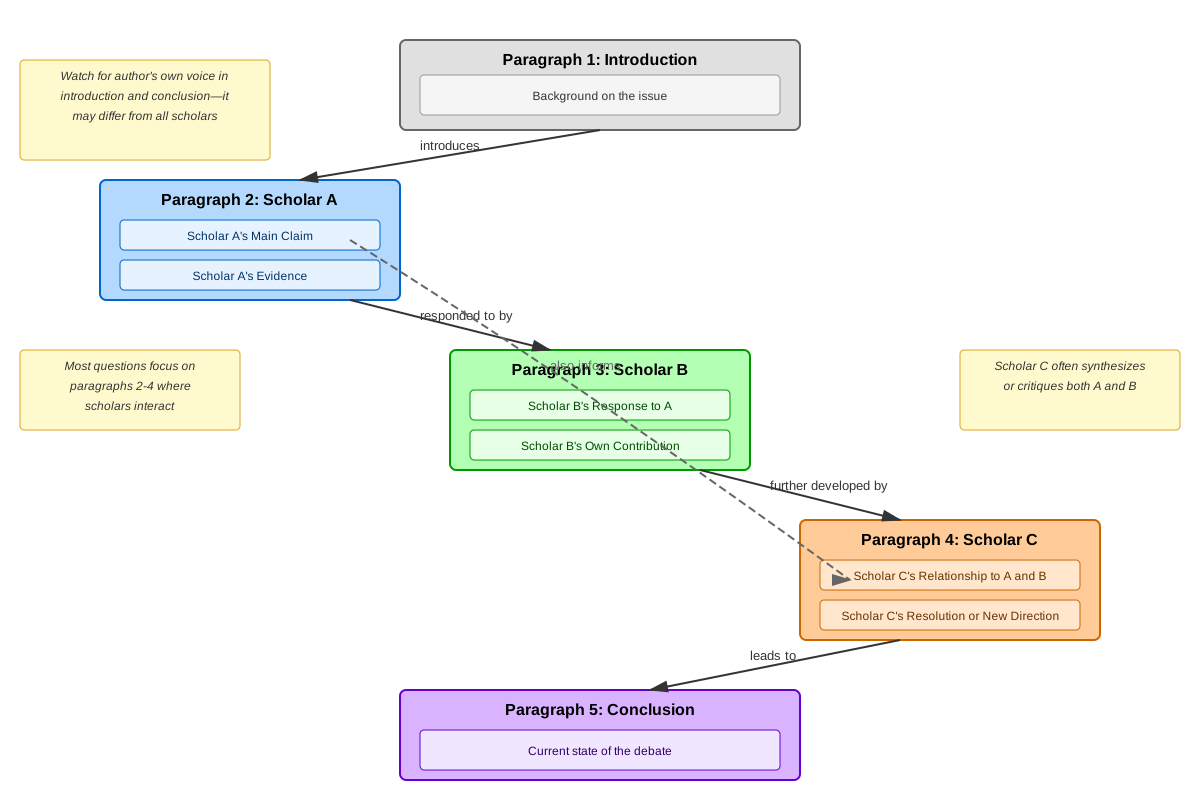
Multiple scholars passages follow several common organizational patterns. The most frequent structure presents scholars chronologically, introducing an earlier thinker's theory, then showing how subsequent scholars responded, modified, or challenged that theory. Another common pattern presents scholars thematically, grouping those who share similar positions before contrasting them with opposing viewpoints. Less frequently, passages may organize scholars by the specific aspect of a phenomenon they studied, showing how different experts examined different facets of the same issue.
The passage typically begins by establishing context—introducing the general topic or problem that scholars have addressed. This opening may present a puzzle, phenomenon, or question that has generated scholarly interest. The passage then introduces the first scholar's position, usually with clear attribution markers like "According to Smith" or "Jones argues that." Subsequent paragraphs introduce additional scholars, often using transition words that signal the relationship between viewpoints.
Types of Scholarly Relationships
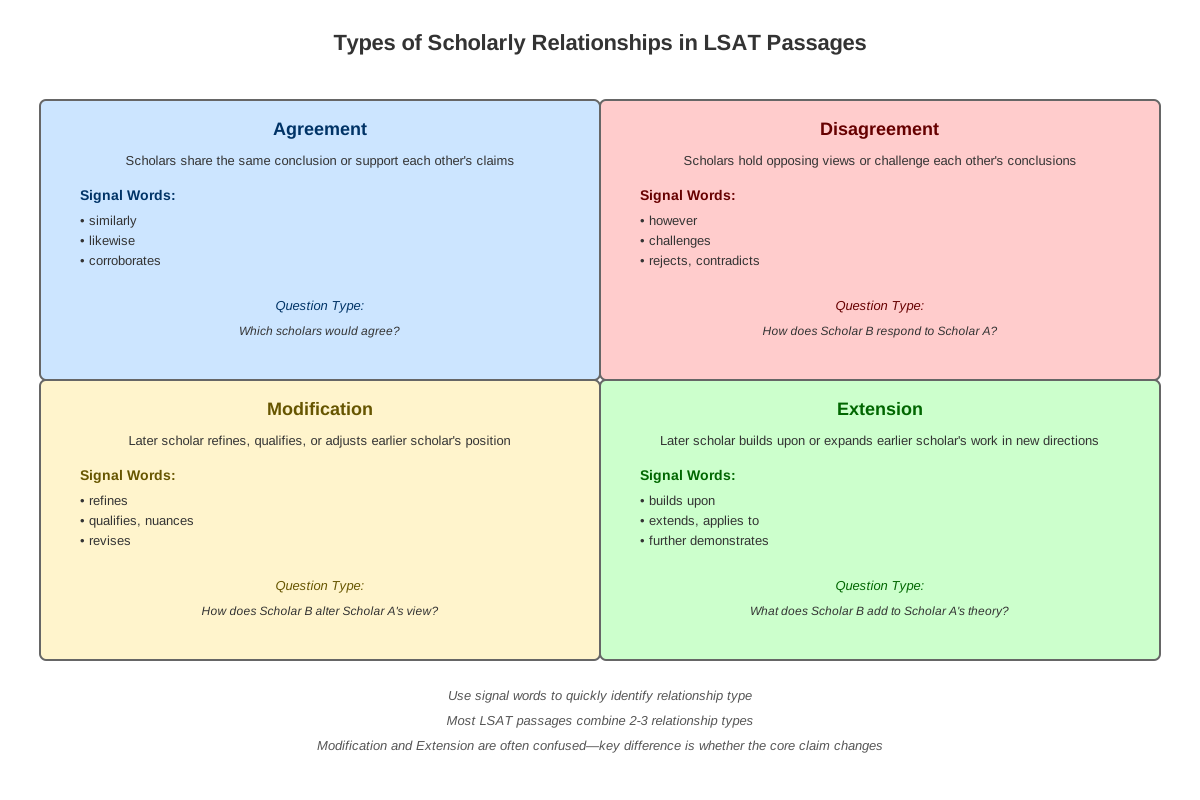
Understanding the relationships between scholars is crucial for answering questions accurately. These relationships fall into several categories:
Agreement and Extension: One scholar accepts another's basic premise but extends the analysis further, applies it to new contexts, or provides additional supporting evidence. Signal phrases include "building on," "expanding," "further demonstrating," and "similarly."
Disagreement and Opposition: One scholar directly challenges another's conclusions, methodology, or assumptions. Look for phrases like "however," "in contrast," "challenges," "refutes," and "disputes."
Modification and Refinement: A scholar accepts parts of another's theory while rejecting or revising other parts. This nuanced relationship often uses phrases like "while accepting X, Scholar B questions Y," "partially agrees," or "qualifies the claim."
Synthesis and Integration: A scholar combines elements from multiple previous theories to create a new framework. Watch for "reconciles," "integrates," "synthesizes," or "combines insights from."
| Relationship Type | Signal Words | Question Implications |
|---|---|---|
| Agreement/Extension | "Similarly," "building on," "further" | Questions about shared assumptions or complementary evidence |
| Disagreement/Opposition | "However," "challenges," "refutes" | Questions about points of conflict or contrasting conclusions |
| Modification/Refinement | "While," "qualifies," "partially" | Questions requiring nuanced understanding of partial agreement |
| Synthesis/Integration | "Reconciles," "combines," "integrates" | Questions about how theories complement each other |
Attribution Tracking
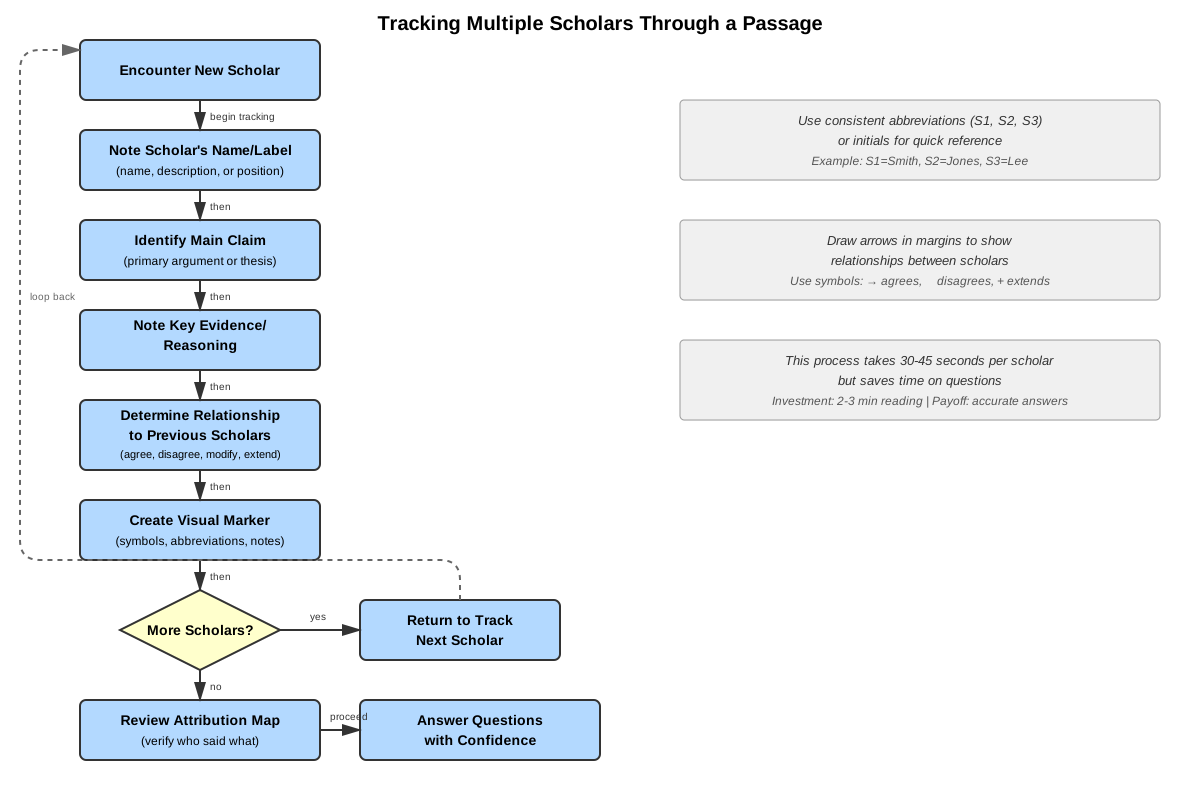
The most critical skill for multiple scholars passages is maintaining clear attribution—knowing exactly which scholar made which claim. The LSAT deliberately creates attribution challenges by:
- Introducing multiple scholars in quick succession, sometimes within a single paragraph
- Using pronouns ("he," "she," "they") that require tracking back to the referent
- Presenting one scholar's characterization of another's view, creating nested attributions
- Discussing scholars' shared assumptions before distinguishing their differences
- Referencing scholars by last name only after initial introduction, requiring memory of who is who
Successful test-takers develop a mental or physical tracking system. Many high-scorers briefly note in the margin which scholar appears in each paragraph (e.g., "S1" for Scholar 1, "S2" for Scholar 2). Others underline or circle scholar names and draw arrows showing relationships. The specific method matters less than having a consistent system.
The Passage Author's Role
In multiple scholars passages, distinguish between the passage author (the person writing the LSAT passage) and the scholars being discussed. The passage author may:
- Present scholars neutrally without endorsing any position
- Favor one scholar's view over others (indicated by evaluative language)
- Critique all presented scholars from an independent perspective
- Use the scholarly debate to illustrate a larger point
Questions often ask about the passage author's purpose in presenting multiple scholars or the author's attitude toward the debate. The passage author's perspective is typically revealed through word choice, the amount of space devoted to each scholar, and explicit evaluative statements.
Chronological vs. Logical Development
Some multiple scholars passages emphasize chronological development—how understanding of a topic evolved over time. These passages often discuss how earlier scholars lacked certain evidence or operated under assumptions later proven incorrect. Other passages emphasize logical development—how different scholars approached the same problem from different angles, regardless of when they worked.
Chronological passages often generate questions about what enabled later scholars to advance beyond earlier ones (new evidence, new methods, changed assumptions). Logical passages more often generate questions about the relative strengths and weaknesses of different approaches or about which scholar's method would be most appropriate for a particular situation.
Common Question Types
Multiple scholars passages generate predictable question types:
- Attribution questions: "Which of the following does Scholar X claim?" or "The passage indicates that Scholar Y believes..."
- Comparison questions: "Scholar X and Scholar Y would be most likely to agree about which of the following?"
- Response questions: "How would Scholar X most likely respond to Scholar Y's claim that...?"
- Relationship questions: "The relationship between Scholar X's theory and Scholar Y's theory is most analogous to..."
- Author's purpose questions: "The author mentions Scholar Z primarily in order to..."
Concept Relationships
The concepts within multiple scholars passages form an interconnected system. Attribution tracking serves as the foundation—without knowing who said what, you cannot understand scholarly relationships. These relationships, in turn, determine the passage structure, as authors organize content to highlight agreements, disagreements, or developments. The passage author's role overlays this structure, providing an interpretive framework that may guide readers toward particular conclusions about the scholarly debate.
This topic connects directly to prerequisite knowledge of argument structure because each scholar's position functions as an argument with premises and conclusions. Understanding author's purpose from earlier study helps identify why the passage author chose to present these particular scholars in this particular order. The skill of tracking viewpoints and argumentation extends naturally from single-viewpoint passages to the more complex multi-viewpoint structure.
Multiple scholars passages also connect forward to other LSAT skills. The attribution tracking practiced here strengthens your ability to handle complex Logical Reasoning questions with multiple speakers or nested arguments. The comparative analysis required mirrors the parallel reasoning questions in Logical Reasoning. The synthesis of multiple perspectives prepares you for law school case analysis, where you must reconcile multiple judicial opinions.
Relationship Map:
Topic/Problem → Scholar 1's Position → Scholar 2's Response (agreement/disagreement/modification) → Scholar 3's Synthesis or Alternative → Passage Author's Evaluation → Question Types Testing Attribution and Relationships
High-Yield Facts
⭐ Multiple scholars passages appear in approximately 25% of all LSAT Reading Comprehension sections, making them one of the most frequent passage types.
⭐ Attribution questions are the most common question type for multiple scholars passages, appearing in roughly 60% of question sets accompanying these passages.
⭐ The LSAT rarely presents scholars who completely agree—there is almost always some point of disagreement, modification, or different emphasis, even when scholars share basic assumptions.
⭐ Signal words indicating scholarly relationships (however, similarly, building on, challenges) are among the most important words in these passages and should be noted or underlined.
⭐ The scholar discussed most extensively is not necessarily the one the passage author favors—length of discussion may indicate historical importance or complexity rather than correctness.
- Passages typically present 2-4 distinct scholarly perspectives; more than four becomes rare due to space constraints.
- Chronological organization (earlier scholars → later scholars) is more common than thematic organization in LSAT passages.
- Questions asking how one scholar would respond to another's claim require understanding both scholars' underlying assumptions, not just their explicit statements.
- The passage author's own view, when present, typically appears in the final paragraph or in evaluative language scattered throughout.
- "EXCEPT" questions are particularly common with multiple scholars passages because they test comprehensive tracking of all scholars' positions.
- Nested attribution (Scholar X claims that Scholar Y believes...) appears in approximately 40% of multiple scholars passages and is a frequent source of errors.
- Comparative questions often hinge on subtle distinctions—scholars may agree on a conclusion but disagree on the reasoning, or vice versa.
Quick check — test yourself on Multiple scholars so far.
Try Flashcards →Common Misconceptions
Misconception: If scholars are presented in chronological order, later scholars must be correct and earlier scholars must be wrong.
Correction: Chronological presentation doesn't imply correctness. Later scholars may have more evidence or refined methods, but the passage may present them as still incomplete or even as having overcorrected earlier errors. The passage author's evaluation, not the chronology, indicates which view is favored.
Misconception: When two scholars disagree, the passage author must favor one over the other.
Correction: Many multiple scholars passages present debates neutrally, without the passage author endorsing any position. The author may simply be illustrating the complexity of an issue or showing how scholarly understanding has evolved. Look for explicit evaluative language before assuming the author takes a side.
Misconception: If a scholar is mentioned briefly, their view is less important for answering questions.
Correction: Brief mentions can be just as important as lengthy discussions. A scholar mentioned in one sentence may be the subject of a specific question, and their view may represent an important contrast to more extensively discussed positions. Track all scholars regardless of space devoted to them.
Misconception: Scholars who share some assumptions must agree on their conclusions.
Correction: Scholars frequently share basic assumptions or starting points but reach different conclusions based on different evidence, methods, or reasoning. Questions often test whether you can distinguish shared assumptions from divergent conclusions.
Misconception: The passage author's purpose is always to resolve the scholarly debate.
Correction: The passage author may present a debate to illustrate ongoing uncertainty, to show the evolution of thought, to demonstrate the complexity of an issue, or to critique all presented positions from an independent standpoint. Resolution is only one possible purpose among many.
Worked Examples
Example 1: Tracking Attribution in a Complex Passage
Passage excerpt: "Historian Martinez argues that the 1848 revolution failed primarily due to inadequate coordination among revolutionary groups. Building on Martinez's analysis, Chen demonstrates that communication barriers between urban and rural revolutionaries prevented unified action. However, Thompson challenges both scholars, contending that external military intervention, not internal coordination problems, determined the revolution's outcome. While acknowledging Thompson's point about military factors, Rodriguez qualifies this view, arguing that internal divisions made revolutionary forces vulnerable to external intervention in the first place."
Question: According to the passage, which of the following scholars would be most likely to agree that internal factors played a significant role in the revolution's failure?
Step 1 - Identify what the question asks: We need to find scholars who believe internal factors (not external ones) were significant.
Step 2 - Track each scholar's position:
- Martinez: Internal factor (coordination problems) was primary cause
- Chen: Internal factor (communication barriers) prevented success—agrees with and extends Martinez
- Thompson: External factor (military intervention) was determinative—challenges the internal factor emphasis
- Rodriguez: Internal factors (divisions) made external intervention effective—synthesizes internal and external
Step 3 - Evaluate each scholar against the question:
- Martinez: Clearly emphasizes internal factors ✓
- Chen: Clearly emphasizes internal factors ✓
- Thompson: Explicitly challenges internal factor emphasis ✗
- Rodriguez: Acknowledges both but argues internal factors created vulnerability ✓
Step 4 - Select the answer: Martinez, Chen, and Rodriguez all agree internal factors played a significant role, though Rodriguez also acknowledges external factors. Thompson is the only scholar who would not agree with this statement.
Connection to learning objectives: This example demonstrates how to identify scholarly positions (Objective 1), recognize the reasoning pattern of agreement, disagreement, and synthesis (Objective 2), and apply this understanding to answer attribution questions accurately (Objective 3).
Example 2: Analyzing Scholarly Relationships
Passage excerpt: "Linguist Yamamoto proposed that language acquisition in children follows a universal sequence determined by innate cognitive structures. Expanding this framework, Peterson identified specific stages in this sequence and correlated them with neurological development. Contrasting with this nativist approach, Williams argued that language acquisition is primarily shaped by social interaction and cultural context, with no universal sequence. Recently, O'Brien has attempted to reconcile these perspectives, suggesting that innate structures provide a general framework that is then shaped and specified by social and cultural factors."
Question: The relationship between O'Brien's view and the views of the other scholars mentioned is most analogous to which of the following?
Step 1 - Identify the relationships:
- Yamamoto: Proposes innate structures determine acquisition
- Peterson: Extends Yamamoto's view with specific details
- Williams: Opposes Yamamoto and Peterson, emphasizing social factors
- O'Brien: Synthesizes both camps—accepts innate structures but adds social shaping
Step 2 - Characterize O'Brien's approach: O'Brien doesn't fully agree with either side but takes elements from both. This is a synthesis or integration approach that acknowledges partial truth in opposing positions.
Step 3 - Look for answer choices that match this pattern: The correct answer would describe someone who takes elements from two opposing views to create a middle position or integrated framework.
Step 4 - Recognize the pattern: This is a modification/synthesis relationship where O'Brien accepts the basic premise of one side (innate structures exist) while incorporating the emphasis of the other side (social factors matter).
Connection to learning objectives: This example shows how to explain the reasoning pattern behind scholarly relationships (Objective 2), distinguish between different types of relationships (Objective 4), and evaluate how scholars respond to or build upon each other's work (Objective 7).
Exam Strategy
When approaching multiple scholars passages, implement a systematic strategy that maximizes accuracy while managing time effectively.
Initial Reading Strategy: During your first read-through, focus on creating a mental map of the scholarly landscape. Note in the margin or mentally register which scholar appears in each paragraph. Don't try to memorize every detail—instead, understand the general position of each scholar and how they relate to one another. Pay special attention to the first sentence of each paragraph, as it often signals whose view is being discussed.
Trigger Words to Watch: Certain phrases signal critical information about scholarly relationships. Underline or mentally note these markers:
- Agreement: "similarly," "likewise," "building on," "extending," "corroborating"
- Disagreement: "however," "in contrast," "challenges," "disputes," "refutes," "questions"
- Modification: "while," "although," "qualifies," "refines," "partially accepts"
- Causation: "because," "therefore," "consequently," "as a result"
- Attribution: "according to," "argues that," "claims," "believes," "contends"
Question Approach: For attribution questions, return to the passage and locate the specific scholar mentioned. Read the sentence containing their name plus the surrounding context. Don't rely on memory alone—the LSAT deliberately includes trap answers that attribute claims to the wrong scholar. For comparison questions, locate both scholars' positions before evaluating answer choices. For response questions ("How would Scholar X respond to Scholar Y?"), identify Scholar X's underlying assumptions and reasoning pattern, not just their explicit claims.
Process of Elimination: Wrong answers in multiple scholars questions typically fall into predictable categories:
- Misattribution: Assigning one scholar's view to another
- Overgeneralization: Claiming scholars agree on more than they actually do
- Undergeneralization: Missing points of agreement that exist
- Distortion: Slightly misrepresenting a scholar's position
- Out of scope: Introducing claims no scholar made
Eliminate answers that commit these errors before selecting your answer.
Time Allocation: Multiple scholars passages typically require 4-5 minutes for the initial read and 5-6 minutes for questions, totaling 9-11 minutes. This is slightly longer than single-viewpoint passages due to the complexity of tracking multiple perspectives. If you find yourself spending more than 90 seconds on a single question, mark it and return after completing easier questions in the set.
Exam Tip: Create a simple notation system for tracking scholars. Many high-scorers use "S1," "S2," "S3" in the margins or underline each scholar's name in a different pattern. The specific system matters less than consistency—use the same approach on every practice passage so it becomes automatic on test day.
Memory Techniques
SCAR Method for Scholarly Relationships:
- Similarity (agreement/extension)
- Contrast (disagreement/opposition)
- Adjustment (modification/refinement)
- Reconciliation (synthesis/integration)
This acronym helps you quickly categorize the relationship between any two scholars.
The Attribution Anchor: When reading, visualize each scholar as standing in a specific physical location. Scholar 1 on the left, Scholar 2 in the middle, Scholar 3 on the right. As you read their positions, mentally "place" each claim with the appropriate scholar in their location. This spatial memory technique helps prevent misattribution.
The Timeline Technique: For chronologically organized passages, draw a simple timeline in the margin with each scholar's name and a 2-3 word summary of their position. This visual representation helps you quickly reference who came first and how views evolved.
The Relationship Matrix: For passages with 3+ scholars, quickly sketch a simple grid showing how each scholar relates to the others:
        S1      S2      S3
S1      --      agrees  modifies
S2      agrees  --      opposes
S3      modifies opposes --
This takes 30 seconds but prevents confusion when answering comparative questions.
The "Who Said What" Chant: After reading the passage, quickly mentally rehearse: "Scholar 1 said X, Scholar 2 said Y, Scholar 3 said Z." This active recall immediately after reading strengthens retention for the questions ahead.
Summary
Multiple scholars passages present two or more academic perspectives on a topic, requiring test-takers to track attribution, understand scholarly relationships, and synthesize information across viewpoints. These passages appear frequently on the LSAT and generate predictable question types focused on attribution, comparison, and scholarly response. Success requires systematic tracking of who said what, recognition of signal words indicating relationships between scholars, and careful distinction between the passage author's view and the scholars' views. The four main types of scholarly relationships—agreement/extension, disagreement/opposition, modification/refinement, and synthesis/integration—provide a framework for understanding how scholars interact. Effective strategy involves creating a tracking system during the initial read, returning to the passage for attribution questions rather than relying on memory, and recognizing common wrong answer patterns like misattribution and distortion. Mastering this topic strengthens overall reading comprehension skills and prepares students for the complex multi-perspective analysis required throughout the LSAT and in legal education.
Key Takeaways
- Multiple scholars passages appear in approximately 25% of Reading Comprehension sections and generate highly predictable question types focused on attribution and comparison
- The four main scholarly relationships (agreement, disagreement, modification, synthesis) can be identified through specific signal words that should be noted during the initial read
- Attribution tracking is the foundational skill—create a consistent system for noting which scholar appears in each paragraph and return to the passage to verify attributions when answering questions
- Distinguish between the passage author's perspective and the scholars' perspectives; the author may present views neutrally, favor one position, or critique all positions
- Wrong answers typically involve misattribution, overgeneralization, undergeneralization, distortion, or out-of-scope claims—recognizing these patterns accelerates elimination
- Chronological organization doesn't imply that later scholars are correct; evaluate each position based on the passage author's explicit or implicit evaluation
- Scholars who share assumptions may still reach different conclusions, and scholars who disagree on conclusions may share underlying premises—questions often test these nuanced distinctions
Related Topics
Comparative Reading Passages: LSAT Reading Comprehension includes paired passages that present two different perspectives on a topic, which builds directly on multiple scholars skills but with a different structural format. Mastering multiple scholars passages provides the foundation for efficiently handling these paired passages.
Author's Attitude and Tone: Understanding how passage authors signal their evaluation of scholarly positions requires sophisticated analysis of tone and word choice. This topic deepens your ability to distinguish neutral presentation from evaluative commentary.
Argument Structure in Complex Texts: Each scholar's position functions as a mini-argument with premises and conclusions. Advanced study of argument structure helps you identify the logical relationships between scholarly positions more quickly.
Logical Reasoning - Point at Issue Questions: These questions ask you to identify the specific point of disagreement between two speakers, which directly parallels the skill of identifying disagreement between scholars in Reading Comprehension.
Synthesis and Integration Skills: Advanced passages may present three or more scholars whose views must be synthesized to answer questions. Developing these higher-order thinking skills prepares you for the most challenging Reading Comprehension questions.
Practice CTA
Now that you understand the structure and strategy for multiple scholars passages, it's time to apply these concepts to actual LSAT questions. Complete the practice questions associated with this topic, focusing on implementing your attribution tracking system and identifying scholarly relationships using the signal words you've learned. As you work through practice passages, time yourself to ensure you're meeting the 9-11 minute target for these passages. Review the flashcards to reinforce your recognition of signal words and relationship types. Remember: multiple scholars passages are highly predictable once you understand their structure—consistent practice with these strategies will transform them from challenging to manageable, giving you a significant advantage on test day. Each practice passage you complete strengthens your pattern recognition and builds the confidence needed for peak performance.
Sign up free to keep reading
Create a free AnvayaPrep account to finish this LSAT guide on Multiple scholars — plus flashcards and practice questions.