Overview
Point at issue questions represent a critical question type within the LSAT's Logical Reasoning sections, appearing consistently across multiple test administrations. These questions present two speakers who disagree about something, and the test-taker must identify the precise point of disagreement between them. Unlike other question types that focus on strengthening, weakening, or identifying flaws in a single argument, point at issue questions require careful analysis of two distinct positions to determine where they genuinely conflict.
Mastering this question type is essential for LSAT success because it tests fundamental skills in argument analysis, reading comprehension, and logical precision. These questions assess whether students can distinguish between what speakers explicitly commit to versus what they merely imply or leave unstated. The ability to identify exact points of disagreement demonstrates sophisticated reasoning skills that law schools value highly, as legal practice frequently involves pinpointing the precise issues in dispute between parties.
Within the broader landscape of Logical Reasoning, point at issue questions connect closely to argument structure analysis, assumption identification, and inference questions. They require understanding not just what each speaker says, but what logical commitments follow from their statements. This question type bridges pure comprehension skills with analytical reasoning, making it an excellent diagnostic tool for overall logical reasoning proficiency. Students who excel at these questions typically demonstrate strong performance across other Logical Reasoning question types because they've developed the precision and careful reading habits that all LSAT questions reward.
Learning Objectives
- [ ] Identify how Point at issue questions appears in LSAT questions
- [ ] Explain the reasoning pattern behind Point at issue questions
- [ ] Apply Point at issue questions to solve LSAT-style problems accurately
- [ ] Distinguish between genuine disagreements and mere differences in emphasis or scope
- [ ] Evaluate answer choices using the "commitment test" to verify both speakers take opposing positions
- [ ] Recognize common trap answers that only one speaker addresses or that both speakers would accept
Prerequisites
- Basic argument structure: Understanding premises, conclusions, and how claims relate to one another is essential because point at issue questions require identifying what each speaker is arguing.
- Conditional reasoning fundamentals: Recognizing if-then relationships helps determine what speakers are committed to beyond their explicit statements.
- Reading comprehension skills: The ability to parse complex sentences and identify main claims versus supporting details enables accurate identification of each speaker's position.
- Understanding of logical commitment: Recognizing what a speaker must believe based on their stated position is crucial for determining genuine points of disagreement.
Why This Topic Matters
Point at issue and disagreement questions appear with remarkable consistency on the LSAT, typically comprising 2-4 questions per test across both Logical Reasoning sections. This represents approximately 4-8% of all Logical Reasoning questions, making them a reliable component of every test administration. Their predictable appearance and learnable patterns make them high-value targets for score improvement.
In real-world legal practice, identifying the precise point at issue between parties is fundamental to case analysis, negotiation, and litigation. Attorneys must constantly distinguish between areas of agreement and disagreement, focusing their arguments on the actual disputes rather than peripheral matters. Law schools value this skill because it demonstrates the analytical precision necessary for legal reasoning.
On the LSAT, these questions commonly appear in several formats. The most frequent presentation involves two speakers (often named individuals like "Alex" and "Barbara") who make statements about a topic, followed by a question asking what they disagree about. Less commonly, the question might ask what they agree about, or what point one speaker's argument overlooks that the other emphasizes. The passages typically range from 3-6 sentences total, with each speaker contributing 1-3 sentences. The subject matter spans diverse topics from science and philosophy to everyday situations and policy debates, ensuring that no specialized knowledge provides an advantage.
Core Concepts
Defining Point at Issue Questions
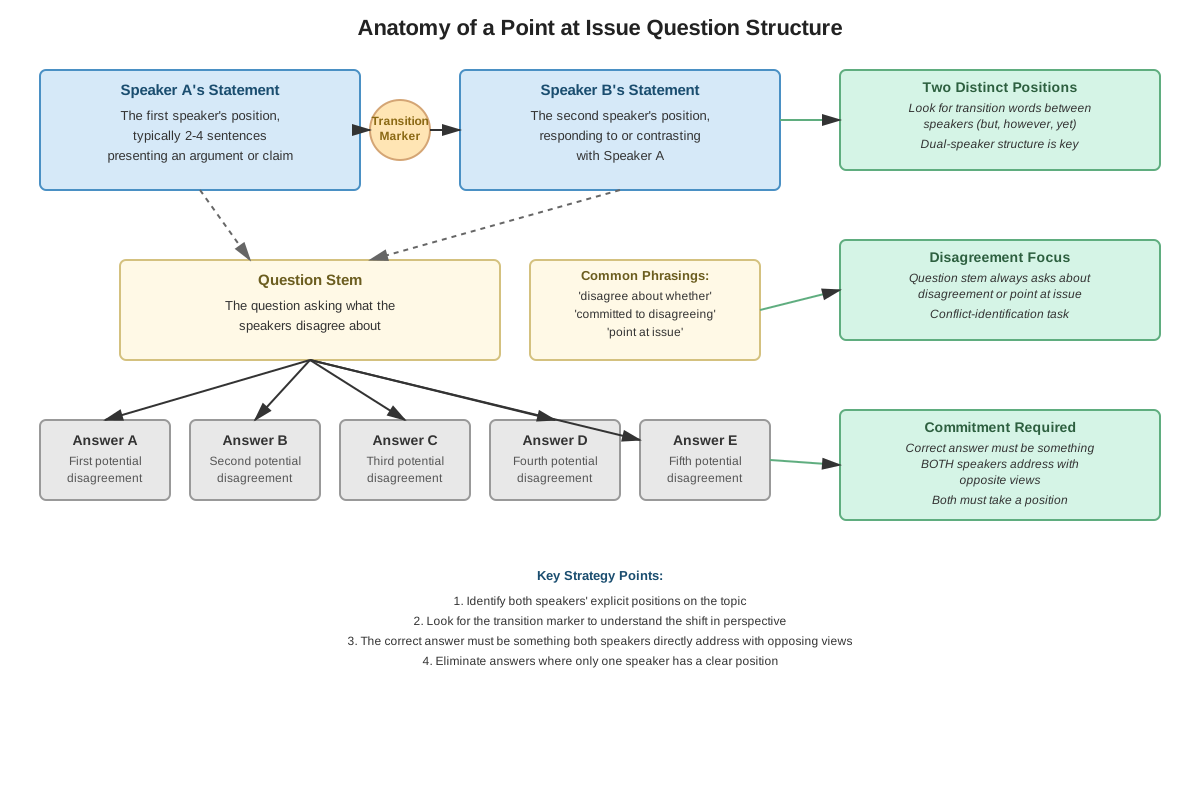
LSAT point at issue questions ask test-takers to identify the specific proposition about which two speakers hold opposing views. The correct answer must satisfy a crucial two-part test: Speaker A must be committed to one position on the proposition, while Speaker B must be committed to the opposite position. This requirement distinguishes genuine disagreements from situations where speakers merely discuss different aspects of a topic or where one speaker remains neutral on a claim the other makes.
The question stems for this type typically include phrases like:
- "The dialogue provides the most support for the claim that Maria and John disagree about whether..."
- "On the basis of their statements, Chen and Davis are committed to disagreeing about which one of the following?"
- "The statements above provide the most support for holding that Rebecca and Thomas disagree about..."
The Commitment Test
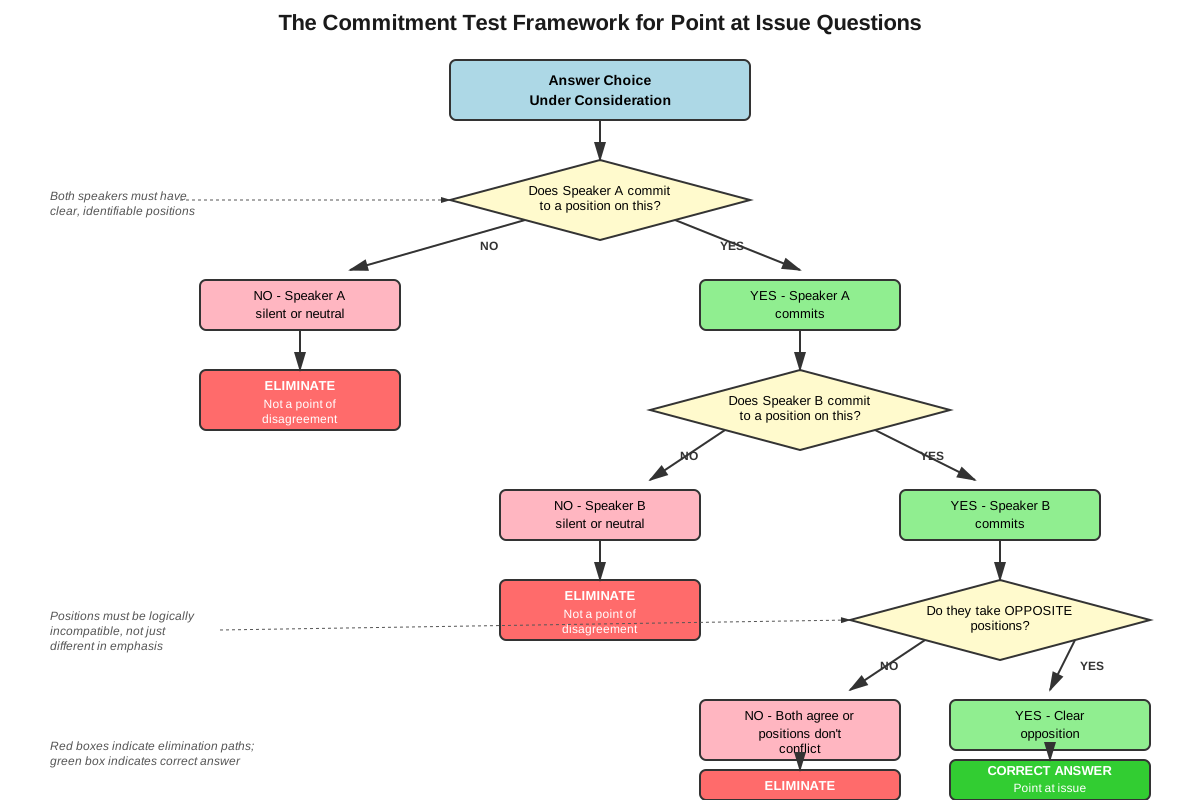
The commitment test serves as the primary tool for evaluating answer choices in point at issue questions. For an answer choice to be correct, both of the following conditions must be met:
- Speaker A must be committed to either affirming or denying the proposition in the answer choice
- Speaker B must be committed to the opposite position (if A affirms, B must deny; if A denies, B must affirm)
A speaker is "committed to" a position when their stated argument logically requires them to accept that position. This commitment can be explicit (directly stated) or implicit (necessarily following from what they stated). However, the commitment must be definite—if a speaker could reasonably hold either position based on their statement, they are not committed to either side of the disagreement.
Types of Disagreement
Point at issue questions test several distinct types of disagreement:
| Disagreement Type | Description | Example |
|---|---|---|
| Factual disagreement | Speakers dispute what is actually true | Whether a policy increased employment |
| Causal disagreement | Speakers dispute what causes what | Whether X causes Y or Z causes Y |
| Evaluative disagreement | Speakers dispute whether something is good/bad, right/wrong | Whether a decision was justified |
| Predictive disagreement | Speakers dispute what will happen | Whether a trend will continue |
| Definitional disagreement | Speakers dispute how to categorize or define something | Whether something counts as art |
| Prescriptive disagreement | Speakers dispute what should be done | Whether a policy should be adopted |
Scope and Precision in Disagreements
The scope of each speaker's claim critically determines what they disagree about. A common trap in point at issue questions involves answer choices that are too broad or too narrow relative to what the speakers actually address.
For example, if Speaker A argues "Most modern art lacks technical skill" and Speaker B argues "Many modern artists demonstrate exceptional technical skill," they disagree about whether many/most modern artists have technical skill. However, they do not necessarily disagree about whether all modern art lacks technical skill, nor about whether some modern art demonstrates skill. The precise scope matters.
Similarly, speakers may discuss related but distinct concepts. If Speaker A discusses whether a policy is effective and Speaker B discusses whether it is ethical, they are not disagreeing about the same thing—they're addressing different dimensions of evaluation.
Implicit Commitments and Logical Consequences
Understanding what speakers are implicitly committed to requires recognizing logical relationships. If Speaker A states "All effective teachers are patient," Speaker A is committed to the claim that "No impatient person is an effective teacher" (the contrapositive). However, Speaker A is NOT committed to claims like "All patient people are effective teachers" (invalid converse) or "Most teachers are patient" (unwarranted generalization).
Common logical relationships that create implicit commitments include:
- Contrapositives: If committed to "If A then B," also committed to "If not B then not A"
- Necessary conditions: If committed to "X is necessary for Y," also committed to "Without X, no Y"
- Sufficient conditions: If committed to "X is sufficient for Y," also committed to "Whenever X, then Y"
- Causal claims: If committed to "X causes Y," typically committed to "Without X, Y would not occur" (though this can be nuanced)
What Does NOT Constitute Disagreement
Several situations appear to involve disagreement but fail the commitment test:
Different topics: If Speaker A discusses economic effects and Speaker B discusses environmental effects of the same policy, they may not disagree about anything—they're simply addressing different aspects.
Different scopes: If Speaker A makes a claim about "some" instances and Speaker B makes a claim about "most" instances, they might both be correct without disagreeing.
Unstated positions: If Speaker A takes a clear position but Speaker B never addresses that specific issue (even if discussing related matters), there's no disagreement on that point.
Differences in emphasis: Speakers may emphasize different factors or considerations without actually disagreeing about any factual or evaluative claim.
Concept Relationships
The concepts within point at issue questions form an interconnected analytical framework. The commitment test serves as the foundational tool that enables identification of genuine disagreements. This test requires understanding implicit commitments, which in turn depends on recognizing logical relationships like contrapositives and necessary/sufficient conditions.
The relationship flows as follows: Understanding types of disagreement → helps identify what kind of claim to look for → which guides application of the commitment test → while maintaining awareness of scope and precision → to avoid trap answers involving non-disagreements.
This topic connects to prerequisite knowledge of argument structure because identifying each speaker's conclusion and reasoning is the first step in determining their commitments. It relates to conditional reasoning because many implicit commitments arise from conditional statements. The skills developed here transfer directly to inference questions (identifying what must be true based on statements) and assumption questions (identifying unstated commitments), making point at issue questions excellent practice for multiple question types.
Point at issue questions also prepare students for method of reasoning questions by requiring careful attention to what speakers actually argue versus what they merely mention or imply. The precision required here builds habits that improve performance across all Logical Reasoning question types.
High-Yield Facts
⭐ The correct answer must be something both speakers are committed to, with opposing positions—if only one speaker addresses it, it cannot be the point at issue.
⭐ A speaker is "committed to" a claim if their stated position logically requires accepting that claim, even if they never explicitly mention it.
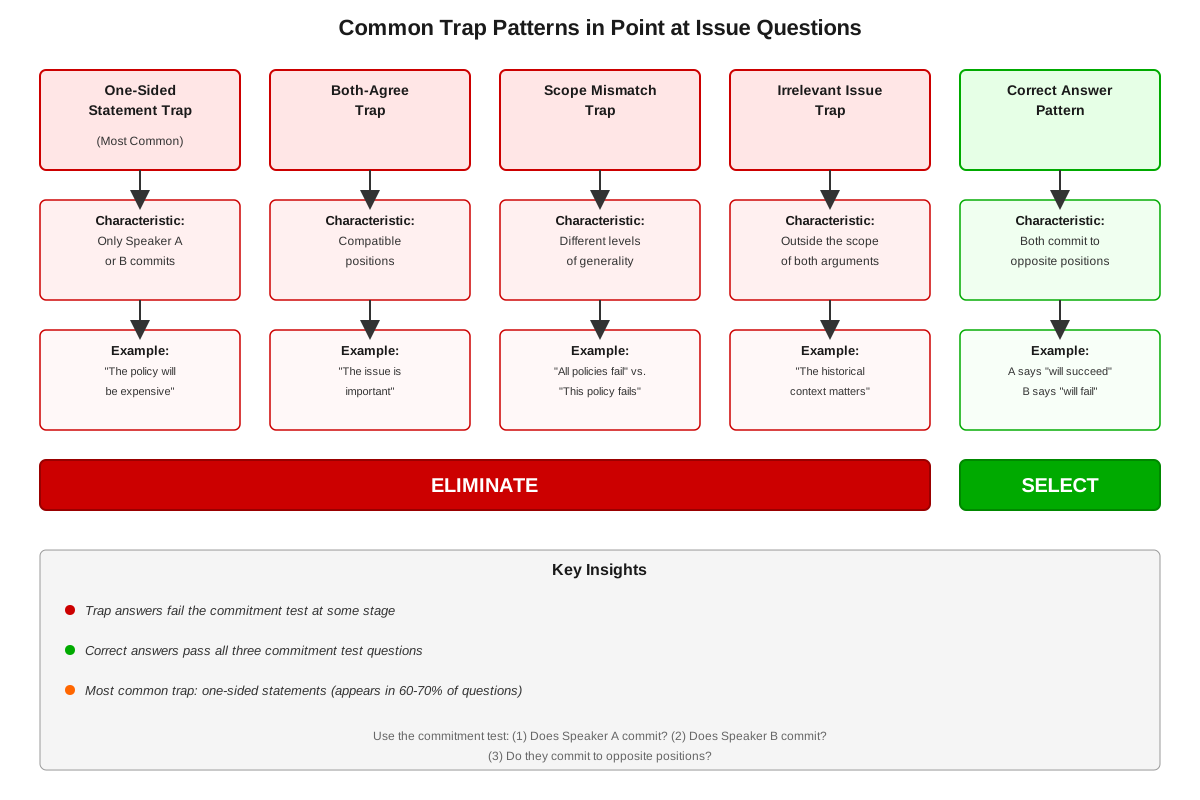
⭐ The most common trap answers involve claims that only one speaker addresses while the other remains silent or neutral on that specific point.
⭐ Scope matters critically—if speakers discuss "some" versus "most" or "this case" versus "all cases," they may not actually disagree.
⭐ Both speakers must take a definite position (yes or no, true or false) on the exact same proposition for it to be the point at issue.
- Point at issue questions typically appear 2-4 times per LSAT, making them a reliable question type to master.
- The commitment test works both ways: you can eliminate wrong answers by showing either speaker is NOT committed to a position on that claim.
- Speakers can disagree about causes, effects, evaluations, predictions, or facts—recognizing the type of disagreement helps identify the correct answer.
- If an answer choice uses different terminology than the passage, verify that the concept is genuinely equivalent, not just related.
- Agreement questions (asking what speakers agree about) use the same analytical framework but require both speakers to be committed to the SAME position.
- Speakers may use different evidence or reasoning to support their positions, but the disagreement is about their conclusions, not their evidence.
- Extreme language in answer choices ("all," "none," "always," "never") often signals wrong answers unless both speakers use equally extreme language.
- The correct answer often paraphrases or abstracts the disagreement rather than quoting directly from the passage.
Quick check — test yourself on Point at issue questions so far.
Try Flashcards →Common Misconceptions
Misconception: If two speakers discuss the same topic, they must disagree about something related to that topic.
Correction: Speakers can discuss the same general topic while making compatible claims about different aspects. Genuine disagreement requires opposing positions on the same specific proposition, not merely related subjects.
Misconception: If Speaker A makes a claim and Speaker B doesn't mention it, they disagree about that claim.
Correction: Disagreement requires both speakers to be committed to opposing positions. Silence or failure to address a claim does not constitute disagreement—Speaker B might agree, disagree, or have no position on claims they don't address.
Misconception: The point at issue must be explicitly stated by both speakers.
Correction: While speakers' explicit statements provide evidence of their commitments, the point at issue may be an implicit logical consequence of their positions. What matters is what they are committed to, not only what they explicitly say.
Misconception: If speakers use different evidence or reasoning, that difference is the point at issue.
Correction: The point at issue concerns what speakers conclude or believe, not how they arrive at those conclusions. Different reasoning paths can lead to the same conclusion (no disagreement) or the same evidence can support different conclusions (genuine disagreement).
Misconception: Stronger or more extreme versions of a speaker's claim represent their commitment.
Correction: Speakers are only committed to what their statements actually support. If Speaker A says "many X are Y," they are NOT committed to "most X are Y" or "all X are Y"—these stronger claims go beyond their stated position.
Misconception: Point at issue questions are primarily about reading comprehension rather than logical analysis.
Correction: While comprehension is necessary, these questions fundamentally test logical reasoning—specifically, the ability to identify logical commitments and recognize when two positions genuinely conflict. Surface-level reading often leads to trap answers.
Worked Examples
Example 1: Factual Disagreement
Passage:
Keisha: The new traffic light at the intersection of Main and Oak has significantly reduced accidents. Before its installation, there were an average of three accidents per month at that intersection. Since installation six months ago, there has been only one accident per month.
Marcus: The reduction in accidents at Main and Oak is not due to the traffic light. The city also increased police patrols in that area six months ago, and increased enforcement is well-known to reduce accidents.
Question: Keisha and Marcus disagree about whether:
(A) the traffic light at Main and Oak should have been installed
(B) increased police patrols reduce traffic accidents
(C) the traffic light caused the reduction in accidents at Main and Oak
(D) there were three accidents per month before the traffic light was installed
(E) traffic lights are generally effective at reducing accidents
Analysis:
Let's apply the commitment test to each answer choice:
(A) Should the light have been installed?
- Keisha: Not committed—she observes a correlation but doesn't make a prescriptive claim about whether installation was justified
- Marcus: Not committed—he disputes causation but doesn't argue against the installation
- Result: Neither speaker takes a position on this normative question. ELIMINATE
(B) Do increased police patrols reduce accidents?
- Keisha: Not committed—she never mentions police patrols
- Marcus: Committed to YES—he states this explicitly
- Result: Only one speaker is committed. ELIMINATE
(C) Did the traffic light cause the reduction?
- Keisha: Committed to YES—she states the light "has significantly reduced accidents," indicating causation
- Marcus: Committed to NO—he explicitly states "the reduction in accidents...is not due to the traffic light"
- Result: Both speakers are committed to opposite positions on the same proposition. CORRECT
(D) Were there three accidents per month before installation?
- Keisha: Committed to YES—she states this as fact
- Marcus: Not committed—he doesn't dispute the accident statistics, only the cause of the reduction
- Result: No disagreement on this factual claim. ELIMINATE
(E) Are traffic lights generally effective?
- Keisha: Not committed—she only discusses this specific intersection
- Marcus: Not committed—he only disputes causation in this specific case
- Result: Neither speaker addresses traffic lights in general. ELIMINATE
Answer: (C)
This example illustrates a causal disagreement—both speakers accept the same facts (accident reduction occurred) but disagree about what caused those facts. Notice how answer choices (B) and (D) are trap answers that only one speaker addresses.
Example 2: Evaluative Disagreement with Scope Issues
Passage:
Dr. Alvarez: The university's decision to eliminate funding for the debate team was unjustified. Debate teaches critical thinking skills that are valuable across all disciplines, and the team has won numerous regional competitions, bringing recognition to the university.
Dr. Bennett: The decision was financially necessary. The university faces a significant budget shortfall, and debate team funding could not be maintained without cutting essential academic programs. When resources are limited, difficult choices must be made.
Question: The dialogue most strongly supports the claim that Dr. Alvarez and Dr. Bennett disagree about whether:
(A) debate teaches valuable critical thinking skills
(B) the university faces a budget shortfall
(C) the debate team has won regional competitions
(D) the decision to eliminate debate team funding was justified
(E) difficult choices must be made when resources are limited
Analysis:
(A) Does debate teach valuable critical thinking skills?
- Dr. Alvarez: Committed to YES—explicitly states this
- Dr. Bennett: Not committed—never addresses the educational value of debate
- Result: Only Alvarez takes a position. ELIMINATE
(B) Does the university face a budget shortfall?
- Dr. Alvarez: Not committed—doesn't address the financial situation
- Dr. Bennett: Committed to YES—states this as fact
- Result: Only Bennett takes a position. ELIMINATE
(C) Has the debate team won regional competitions?
- Dr. Alvarez: Committed to YES—states this as fact
- Dr. Bennett: Not committed—doesn't address team performance
- Result: Only Alvarez takes a position. ELIMINATE
(D) Was the decision justified?
- Dr. Alvarez: Committed to NO—explicitly states the decision "was unjustified"
- Dr. Bennett: Committed to YES—states the decision "was financially necessary" and defends it as appropriate given constraints
- Result: Both speakers take opposite positions on whether the decision was justified. CORRECT
(E) Must difficult choices be made when resources are limited?
- Dr. Alvarez: Not committed—doesn't address this general principle
- Dr. Bennett: Committed to YES—explicitly states this
- Result: Only Bennett takes a position on this general claim. ELIMINATE
Answer: (D)
This example demonstrates an evaluative disagreement about whether a decision was justified. Notice that the speakers agree on various facts (or at least don't dispute them) but reach opposite evaluative conclusions. The trap answers present claims that only one speaker addresses, even though both speakers discuss related topics. This illustrates why careful application of the commitment test is essential—surface-level reading might suggest they disagree about multiple things, but only answer (D) satisfies both parts of the test.
Exam Strategy
Systematic Approach to Point at Issue Questions
Step 1: Identify the question type by looking for key phrases like "disagree about whether," "committed to disagreeing about," or "dialogue provides support for the claim that X and Y disagree."
Step 2: Read Speaker A's statement and identify their main conclusion and key claims. Note what they are definitely committed to.
Step 3: Read Speaker B's statement and identify their main conclusion and key claims. Note what they are definitely committed to.
Step 4: Predict the disagreement before looking at answer choices. Ask yourself: "What specific claim does A accept that B rejects, or vice versa?"
Step 5: Evaluate each answer choice using the commitment test:
- Can you point to evidence that Speaker A is committed to one side?
- Can you point to evidence that Speaker B is committed to the opposite side?
- If the answer to either question is no, eliminate that choice.
Trigger Words and Phrases
Watch for these question stem variations:
- "disagree about whether"
- "committed to disagreeing about"
- "dialogue provides the most support for the claim that [speakers] disagree"
- "on the basis of their statements, [speakers] disagree over"
In the passage, pay attention to:
- Evaluative language: "should," "justified," "appropriate," "wrong" (signals evaluative disagreements)
- Causal language: "causes," "leads to," "results in," "due to" (signals causal disagreements)
- Quantifiers: "all," "most," "many," "some" (critical for scope)
- Certainty markers: "definitely," "probably," "might," "could" (affects strength of commitment)
Process of Elimination Tips
Eliminate answer choices where:
- Only one speaker addresses the claim (most common trap)
- Both speakers would likely agree with the claim
- The scope is wrong (answer discusses "all" when speakers discuss "some")
- The topic is related but not identical to what speakers discuss
- The claim is too extreme or too weak relative to speakers' actual commitments
Keep answer choices where:
- You can point to specific text showing each speaker's opposing commitment
- The scope matches what both speakers actually address
- The claim captures the central tension between the positions
Time Allocation
Point at issue questions typically require 60-90 seconds:
- 15-20 seconds: Read and understand both speakers' positions
- 10-15 seconds: Predict the disagreement
- 30-50 seconds: Evaluate answer choices using the commitment test
If you find yourself spending more than 90 seconds, you may be overthinking. Return to the basic commitment test: for each answer choice, can you point to where each speaker commits to opposite positions? If not, eliminate and move on.
Exam Tip: The correct answer often abstracts or paraphrases the disagreement rather than quoting directly. Don't eliminate an answer just because it uses different words—verify whether it captures the same logical relationship.
Memory Techniques
The "BOTH-OPPOSITE" Mnemonic
For the commitment test, remember BOTH-OPPOSITE:
- Both speakers must be committed
- Opposite positions required
- Test each answer choice
- Highlight evidence in passage
One speaker only? Eliminate
Paraphrase may be correct
Precise scope matters
Obvious disagreement may be trap
Silence ≠ disagreement
Implicit commitments count
Topic similarity ≠ disagreement
Extreme language? Check carefully
Visualization Strategy
Picture two arrows pointing in opposite directions when you find the correct answer. If you can't visualize both arrows (both speakers committed) pointing opposite ways (disagreeing), it's not the right answer.
The "Point and Counterpoint" Technique
As you read, physically point to or underline each speaker's main claim. Then ask: "Does the second speaker's claim directly contradict the first?" If not, look for what implicit commitment would create the contradiction.
Summary
Point at issue questions test the ability to identify precise points of disagreement between two speakers, requiring careful analysis of what each speaker is logically committed to based on their statements. The fundamental skill is applying the commitment test: the correct answer must be a proposition that Speaker A is committed to affirming (or denying) while Speaker B is committed to the opposite position. Common traps include answer choices that only one speaker addresses, claims that are related but not identical to what speakers discuss, and scope mismatches where the answer choice is broader or narrower than speakers' actual commitments. Success requires distinguishing between explicit statements and implicit logical commitments, recognizing that speakers can discuss the same topic without genuinely disagreeing, and maintaining precision about scope and strength of claims. These questions appear reliably on every LSAT and reward systematic application of the commitment test combined with careful reading that identifies exactly what each speaker argues.
Key Takeaways
- The commitment test is essential: Both speakers must be committed to opposite positions on the same proposition for it to be the point at issue
- Silence is not disagreement: If only one speaker addresses a claim, there is no disagreement about that claim, regardless of how important it seems
- Scope precision matters: "Some," "many," "most," and "all" create different commitments—speakers discussing different scopes may not actually disagree
- Implicit commitments count: Speakers are committed to logical consequences of their stated positions, not just their explicit claims
- Predict before evaluating: Identifying the likely disagreement before reading answer choices improves accuracy and speed
- Related topics ≠ disagreement: Speakers can discuss related aspects of a subject without taking opposing positions on any specific claim
- The correct answer often paraphrases: Don't expect direct quotations—look for answers that capture the logical relationship between positions
Related Topics
Inference Questions: Point at issue questions build skills in identifying logical commitments that transfer directly to inference questions, where you must determine what must be true based on stated information. Mastering what speakers are committed to prepares you for identifying valid inferences.
Assumption Questions: Understanding implicit commitments in point at issue questions develops the ability to identify unstated assumptions in arguments, as both require recognizing what must be true beyond explicit statements.
Method of Reasoning Questions: The careful attention to what speakers actually argue (versus what they mention or imply) that point at issue questions require strengthens performance on method of reasoning questions, which ask how arguments are structured.
Parallel Reasoning Questions: The logical precision developed through point at issue questions—distinguishing between similar but distinct claims—is essential for parallel reasoning questions that require matching argument structures.
Agreement Questions: These are the mirror image of point at issue questions, asking what speakers agree about rather than disagree about, using the same analytical framework but requiring both speakers to be committed to the same position.
Practice CTA
Now that you understand the framework for analyzing point at issue questions, it's time to apply these concepts to actual LSAT-style problems. The practice questions will challenge you to identify genuine disagreements, avoid common traps, and apply the commitment test systematically. Each question you practice strengthens your ability to read with precision and identify logical relationships—skills that improve performance across all Logical Reasoning question types. Approach the practice questions methodically, using the strategies outlined in this guide, and review your reasoning process for both correct and incorrect answers. The flashcards will help reinforce the key concepts and common patterns. Consistent practice with these high-yield questions will build the confidence and accuracy needed for test day success.
Sign up free to keep reading
Create a free AnvayaPrep account to finish this LSAT guide on Point at issue questions — plus flashcards and practice questions.