Overview
Normative claims in passages represent one of the most critical analytical skills tested in LSAT Reading Comprehension. These claims express judgments about what should be, what ought to happen, or what is right or wrong, rather than simply describing what is. Understanding how to identify and analyze normative claims is essential because LSAT passages frequently present arguments that blend factual descriptions with value judgments, and test-takers must distinguish between these different types of statements to answer questions accurately.
The LSAT consistently tests the ability to recognize when an author moves from descriptive statements (which report facts or observations) to prescriptive statements (which advocate for particular actions or evaluations). This skill is fundamental to reading comprehension because it requires understanding not just what an author says, but how they construct their argument and what role different claims play within that structure. Questions about normative claims often ask test-takers to identify the author's position, recognize assumptions underlying recommendations, or distinguish between evidence and conclusions.
Within the broader framework of viewpoints and argumentation, normative claims serve as the backbone of persuasive passages. They reveal an author's values, priorities, and ultimate goals. Mastering this topic connects directly to understanding argument structure, identifying main points, recognizing rhetorical strategies, and evaluating the strength of reasoning—all high-frequency question types on the LSAT. The ability to spot normative language and understand its function within a passage is not merely an isolated skill but a gateway to comprehending the entire argumentative landscape that LSAT passages present.
Learning Objectives
- [ ] Identify how normative claims in passages appears in LSAT questions
- [ ] Explain the reasoning pattern behind normative claims in passages
- [ ] Apply normative claims in passages to solve LSAT-style problems accurately
- [ ] Distinguish between normative and descriptive claims within complex passages
- [ ] Recognize the linguistic markers and trigger words that signal normative statements
- [ ] Analyze how normative claims function within an author's overall argumentative strategy
- [ ] Evaluate the relationship between normative claims and the evidence used to support them
Prerequisites
- Basic argument structure: Understanding premises and conclusions is necessary because normative claims often function as conclusions that prescriptive arguments build toward.
- Distinction between fact and opinion: Recognizing the difference between objective statements and subjective judgments provides the foundation for identifying normative versus descriptive claims.
- Author's purpose and tone: Familiarity with identifying an author's attitude helps recognize when they shift from neutral reporting to advocacy.
- Logical reasoning fundamentals: Understanding how claims support one another is essential for seeing how normative claims fit within argumentative frameworks.
Why This Topic Matters
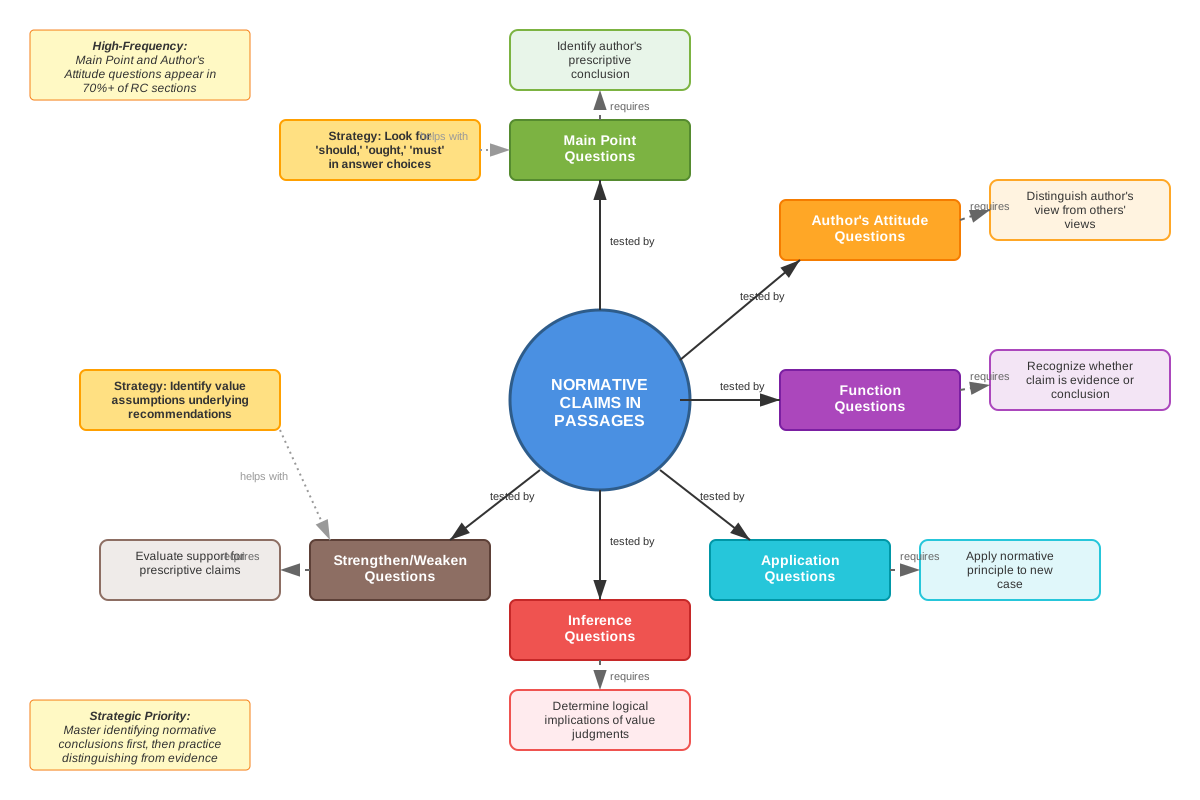
Normative claims appear in approximately 60-70% of LSAT Reading Comprehension passages, making this one of the most frequently tested concepts. The LSAT uses passages from law, humanities, social sciences, and natural sciences, and across all these domains, authors regularly make prescriptive arguments about policy, methodology, interpretation, or ethical considerations. Questions specifically targeting normative claims typically appear as:
- Main point questions: "Which one of the following most accurately expresses the main point of the passage?"
- Author's attitude questions: "The author's stance regarding X can most accurately be described as..."
- Function questions: "The author mentions X primarily in order to..."
- Application questions: "Based on the passage, the author would most likely agree with which of the following?"
In real-world contexts, the ability to identify normative claims is fundamental to legal reasoning. Lawyers must distinguish between what the law is (descriptive) and what the law should be (normative). They must recognize when judges are interpreting existing statutes versus advocating for legal reform. This skill extends beyond law to any field requiring critical analysis of arguments—policy analysis, ethical reasoning, academic discourse, and professional decision-making.
The LSAT specifically tests this skill because law school requires constant engagement with normative reasoning. Legal scholarship debates what rules should govern society, judicial opinions explain why certain outcomes are just, and legal advocates argue for particular interpretations or reforms. Students who cannot identify and analyze normative claims will struggle with the fundamental nature of legal discourse.
Core Concepts
Defining Normative Claims
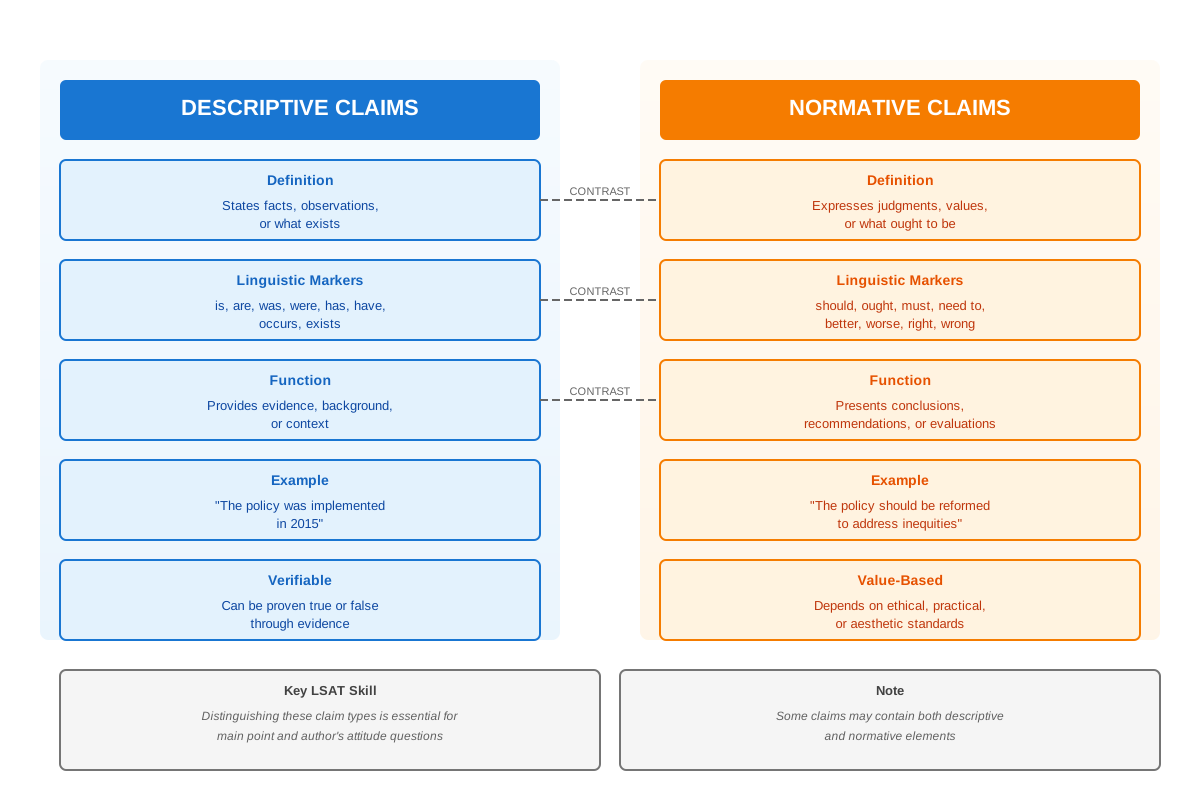
A normative claim is a statement that expresses a value judgment, prescription, or evaluation about what should be the case, what ought to happen, or what is desirable, right, wrong, good, or bad. Unlike descriptive claims, which report facts or observations about the world as it is, normative claims make arguments about how the world should be or how people should act.
Consider these contrasting examples:
- Descriptive: "The current tax rate is 25%."
- Normative: "The tax rate should be increased to fund public education."
The first statement can be verified through objective evidence; the second expresses a value judgment about what policy would be preferable. LSAT normative claims in passages often appear less obviously, embedded within complex arguments where authors blend factual reporting with evaluative commentary.
Types of Normative Claims
Normative claims on the LSAT typically fall into several categories:
| Type | Description | Example Signal Words |
|---|---|---|
| Prescriptive | Recommends specific actions or policies | should, must, ought to, need to |
| Evaluative | Judges something as good/bad, right/wrong | better, worse, preferable, problematic |
| Obligatory | Expresses duties or responsibilities | obligated, required, responsible for |
| Prohibitive | Argues against certain actions | should not, must avoid, inappropriate |
| Aspirational | Describes ideal states or goals | ideal, optimal, best approach |
Linguistic Markers of Normative Claims
Recognizing normative claims requires attention to specific linguistic patterns. Modal verbs like "should," "must," "ought," and "need to" are the most obvious indicators. However, LSAT passages often use more subtle markers:
- Comparative evaluations: "more effective," "less problematic," "superior to"
- Necessity language: "it is essential that," "requires," "demands"
- Value-laden adjectives: "unjust," "beneficial," "harmful," "appropriate"
- Imperative constructions: "we must recognize," "scholars should consider"
- Conditional recommendations: "if we want X, we should do Y"
Normative Claims vs. Descriptive Claims
The distinction between normative and descriptive claims is central to viewpoints and argumentation analysis. Descriptive claims report observable facts, empirical findings, historical events, or current states of affairs. They can theoretically be verified or falsified through evidence. Normative claims, by contrast, rest on values, principles, or goals that cannot be proven true or false in the same way.
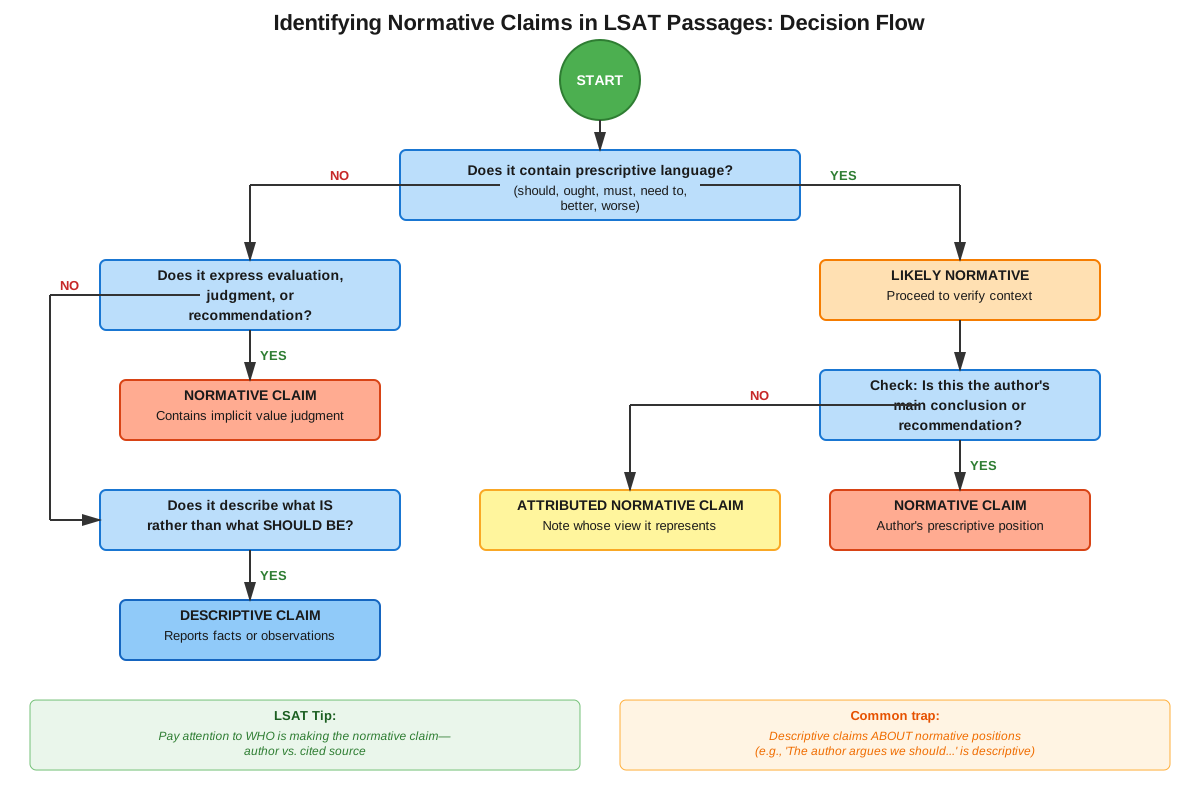
Critical distinction: A claim can describe someone else's normative position without itself being normative. For example: "The author argues that universities should prioritize research over teaching" is a descriptive claim about a normative position. The actual normative claim is: "Universities should prioritize research over teaching."
Function of Normative Claims in Arguments
In LSAT passages, normative claims typically serve specific argumentative functions:
- Main conclusions: The ultimate point the author wants readers to accept
- Intermediate conclusions: Steps in reasoning that lead to the main normative claim
- Evaluative frameworks: Standards by which the author judges other positions
- Policy recommendations: Specific actions the author advocates
- Critiques: Negative evaluations of existing practices or theories
Understanding these functions helps answer questions about passage structure and author's purpose.
The Is-Ought Gap
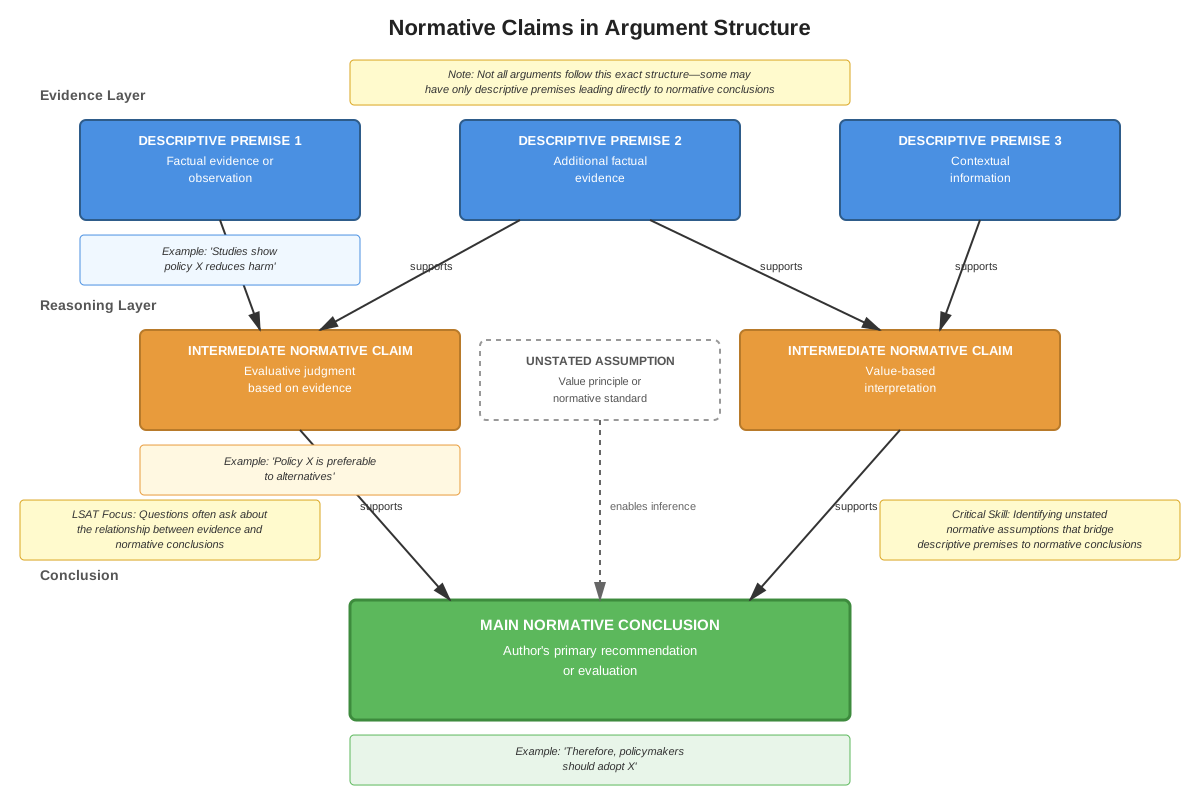
A sophisticated concept that appears in LSAT passages is the is-ought gap (also called Hume's Law). This philosophical principle states that one cannot logically derive normative conclusions solely from descriptive premises. In other words, facts alone cannot tell us what we should do without some underlying value judgment.
LSAT passages sometimes present arguments that attempt to bridge this gap, and questions may test whether students recognize when an author has made an implicit normative assumption. For example:
- Premise: "This policy would reduce unemployment by 3%." (descriptive)
- Conclusion: "Therefore, we should implement this policy." (normative)
- Hidden assumption: "We should implement policies that reduce unemployment." (normative)
Context-Dependent Normative Claims
Some statements appear normative but are actually descriptive within specific contexts. Legal passages frequently contain this complexity:
- "According to the statute, employers must provide notice" (descriptive—reporting what the law requires)
- "The law should require employers to provide notice" (normative—advocating for a legal standard)
LSAT test-takers must pay careful attention to whether the author is reporting existing rules, standards, or positions versus advocating for particular positions.
Concept Relationships
The ability to identify normative claims connects directly to multiple other Reading Comprehension skills. Normative claims → serve as → main conclusions in argumentative passages. Understanding what the author prescribes or evaluates is often the key to identifying the passage's primary purpose.
Normative claims → reveal → author's viewpoint and tone. When an author makes prescriptive statements, they necessarily reveal their values and priorities, which helps answer attitude questions.
Descriptive claims → provide evidence for → normative claims. Authors typically support their prescriptive conclusions with factual premises, creating an argumentative structure where empirical observations justify value judgments.
Normative claims → rest upon → underlying assumptions. Every prescriptive argument assumes certain values or principles, and LSAT questions frequently test whether students can identify these implicit normative premises.
Comparative passages → often contrast → different normative positions. When two passages present different viewpoints, they typically differ in their normative claims about what should be done or what is valuable.
This topic also connects to prerequisite knowledge: understanding argument structure enables recognition of where normative claims function within reasoning chains; distinguishing fact from opinion provides the foundation for separating descriptive from normative statements.
High-Yield Facts
⭐ Normative claims express what should be, ought to be, or is desirable, rather than what is.
⭐ Modal verbs (should, must, ought) are the most reliable linguistic markers of normative claims.
⭐ The main point of an argumentative passage is typically a normative claim.
⭐ Descriptive claims about someone else's normative position are not themselves normative.
⭐ Normative claims cannot be proven true or false through empirical evidence alone—they rest on values.
- Comparative evaluations (better, worse, preferable) often signal normative judgments.
- Authors may embed normative claims within seemingly neutral language by using value-laden adjectives.
- The is-ought gap means that normative conclusions require at least one normative premise.
- Legal passages frequently describe existing normative standards (laws, rules) without endorsing them.
- Questions asking about the author's "primary purpose" or "main point" typically require identifying the central normative claim.
- Normative claims can be conditional: "If we value X, we should do Y."
- The strength of a normative argument depends on both the truth of descriptive premises and the acceptability of underlying values.
- Authors sometimes present normative claims as questions: "Should we not prioritize environmental protection?"
- Recognizing when an author shifts from description to prescription is key to understanding passage structure.
- Normative claims about methodology ("researchers should use method X") are common in science passages.
Quick check — test yourself on Normative claims in passages so far.
Try Flashcards →Common Misconceptions
Misconception: Any statement containing "should" or "must" is a normative claim. → Correction: These words can describe existing obligations or requirements without advocating for them. "According to the regulation, companies must report emissions" describes an existing rule (descriptive), while "Companies should be required to report emissions" advocates for a policy (normative).
Misconception: Normative claims are always explicitly stated with obvious signal words. → Correction: Authors often express normative positions through subtle language like "unfortunately," "problematic," "beneficial," or "the better approach." The LSAT tests the ability to recognize implicit normative judgments.
Misconception: Descriptive and normative claims are always clearly separated in passages. → Correction: LSAT passages frequently blend descriptive and normative statements within the same sentence or paragraph. Authors move fluidly between reporting facts and making evaluations, requiring careful analysis to distinguish claim types.
Misconception: All opinions are normative claims. → Correction: Opinions can be descriptive (predictions, interpretations of evidence, explanations of causation) or normative (evaluations, prescriptions). "The policy will likely fail" is a descriptive opinion; "The policy should be abandoned" is normative.
Misconception: If a passage presents multiple viewpoints, the author doesn't make normative claims. → Correction: Authors often present others' positions descriptively while making their own normative judgments about which position is correct or preferable. The author's normative stance may be implicit in how they frame or evaluate different viewpoints.
Misconception: Normative claims are less important than factual information in passages. → Correction: On the LSAT, identifying the author's normative position is often the key to answering main point, primary purpose, and author's attitude questions—some of the highest-frequency question types.
Worked Examples
Example 1: Identifying Normative Claims in a Legal Passage
Passage excerpt: "The current interpretation of the statute allows corporations to avoid liability through subsidiary structures. This loophole has enabled companies to externalize environmental costs onto communities. Legal scholars have documented numerous cases where this interpretation has led to significant harm. Courts should adopt a broader reading of the statute that holds parent corporations accountable for subsidiary actions. Such an interpretation would align with the statute's original purpose of protecting public welfare."
Question: Which of the following best describes the author's main point?
Analysis:
- Identify descriptive claims:
- "The current interpretation allows corporations to avoid liability" (describes existing legal situation)
- "Legal scholars have documented numerous cases" (reports empirical findings)
- These provide factual context and evidence.
- Identify normative claims:
- "Courts should adopt a broader reading" (prescriptive—recommends action)
- "This loophole has enabled companies to externalize costs" (evaluative—"loophole" carries negative judgment)
- The phrase "should adopt" is the clearest normative marker.
- Determine the main normative claim: The sentence "Courts should adopt a broader reading of the statute that holds parent corporations accountable" is the central prescriptive statement. Everything else either describes the current problematic situation (providing reasons for change) or explains why this recommendation is justified.
- Function analysis: The descriptive claims about the current interpretation and its consequences serve as premises supporting the normative conclusion about what courts should do.
Answer approach: The correct answer will capture the prescriptive recommendation about judicial interpretation, not merely describe the current situation or report the documented harms.
Example 2: Distinguishing Normative from Descriptive in a Science Passage
Passage excerpt: "Traditional peer review processes require anonymous evaluation of submitted manuscripts. Proponents argue this anonymity prevents bias based on author reputation or institutional affiliation. However, recent studies show that double-blind review does not significantly reduce publication bias compared to single-blind methods. Despite this evidence, many journals continue to mandate double-blind review. A more effective approach would be to implement open review, where reviewer identities are disclosed. This transparency would increase reviewer accountability and improve the quality of critical feedback."
Question: The author's attitude toward double-blind review can most accurately be described as:
Analysis:
- Separate descriptive reporting from author's position:
- "Traditional peer review processes require..." (describes current practice)
- "Proponents argue..." (reports others' normative position—descriptive of their view)
- "Recent studies show..." (reports empirical findings)
- "Many journals continue to mandate..." (describes current practice)
- Identify author's normative claims:
- "Despite this evidence" (signals author's judgment that the practice is unjustified)
- "A more effective approach would be..." (evaluative comparison + prescription)
- "This transparency would increase accountability and improve quality" (evaluative—"improve" signals positive judgment)
- Analyze the normative reasoning pattern:
- The author presents evidence that double-blind review is ineffective (descriptive premise)
- The author evaluates this as problematic ("despite this evidence")
- The author prescribes an alternative (open review)
- The author evaluates this alternative positively (more effective, would improve)
- Determine author's attitude: The author views double-blind review as less effective than alternatives and advocates for change—this is critical or skeptical, not neutral or supportive.
Answer approach: The correct answer will reflect the author's negative evaluation of double-blind review and advocacy for an alternative, not merely report that different methods exist.
Exam Strategy
Systematic Approach to Normative Claim Questions
- Read actively for signal words: As you read the passage, mark or mentally note modal verbs (should, must, ought), evaluative language (better, problematic, beneficial), and prescriptive statements.
- Distinguish author's voice from reported views: Pay careful attention to attribution. "Critics argue that X should happen" is different from "X should happen." The first reports a normative position; the second states one.
- Identify the main normative claim early: In argumentative passages, the author's central prescriptive statement is usually the main point. Finding it helps orient your understanding of the entire passage structure.
- Map the argument structure: Note which claims are descriptive premises (evidence) and which are normative conclusions. This helps answer questions about the author's reasoning.
Trigger Words and Phrases
High-yield normative indicators: should, must, ought to, need to, required, necessary, essential, imperative, better, worse, preferable, ideal, appropriate, inappropriate, justified, unjustified, beneficial, harmful, problematic
Subtle normative markers: unfortunately, merely, only, simply (when used dismissively), the real issue, what matters, the key question, fails to, neglects, overlooks
Evaluative comparisons: more effective, less adequate, superior, inferior, the best approach, a better alternative
Process of Elimination Tips
When answering questions about normative claims:
- Eliminate answers that only describe facts: If the question asks for the author's main point or recommendation, eliminate choices that merely report information without prescribing or evaluating.
- Eliminate answers that misattribute normative claims: If the passage says "Some scholars argue X should happen," an answer stating "The author believes X should happen" is incorrect unless the author explicitly endorses this view.
- Eliminate answers that confuse descriptive and normative: An answer that treats a factual claim as the author's prescription, or vice versa, is incorrect.
- Look for answers that match the passage's normative language: If the passage says something "should" happen, the correct answer will likely use similar prescriptive language rather than merely describing what "is" the case.
Time Allocation
Normative claim questions are typically medium difficulty and should take 45-60 seconds once you've read the passage. If you've actively identified normative claims during your initial reading, these questions become much faster. Don't spend excessive time re-reading; instead, use your mental map of where prescriptive statements appeared in the passage.
Memory Techniques
The SHOULD Mnemonic
Signal words (should, must, ought)
How things ought to be (not how they are)
Opinions about right/wrong, good/bad
Underlying values (what the claim assumes)
Language that evaluates or prescribes
Distinct from descriptive facts
Visualization Strategy
Picture a two-lane road:
- The "IS" lane contains descriptive claims (facts, observations, current states)
- The "OUGHT" lane contains normative claims (prescriptions, evaluations, recommendations)
As you read, mentally place each claim in its appropriate lane. When claims cross from the IS lane to the OUGHT lane, that's where the author's argument moves from evidence to conclusion.
The Three-Question Test
When uncertain whether a claim is normative, ask:
- Can this be proven true/false with evidence alone? (If no → likely normative)
- Does this tell us what should be or what is? (Should be → normative)
- Does this rest on values or just facts? (Values → normative)
Acronym for Normative Functions
PRICE - the roles normative claims play:
- Prescribe actions
- Recommend policies
- Identify ideals
- Critique existing practices
- Evaluate alternatives
Summary
Normative claims in passages represent statements about what should be, ought to happen, or is desirable, valuable, or right, as opposed to descriptive claims that report what is. Mastering the identification and analysis of normative claims is essential for LSAT Reading Comprehension because these claims typically function as the main points of argumentative passages and reveal the author's ultimate position. Signal words like "should," "must," and "ought" are reliable markers, but normative judgments also appear through evaluative language, comparative assessments, and value-laden terminology. The LSAT tests this skill through main point questions, author's attitude questions, and application questions that require understanding what the author advocates or evaluates positively or negatively. Success requires distinguishing the author's own normative claims from descriptive reports of others' positions, recognizing the relationship between descriptive premises and normative conclusions, and understanding how normative claims function within overall argument structure. This skill connects directly to understanding viewpoints and argumentation patterns that appear throughout LSAT Reading Comprehension passages.
Key Takeaways
- Normative claims express prescriptions, evaluations, or judgments about what should be, not descriptions of what is
- Modal verbs (should, must, ought) and evaluative language (better, problematic, beneficial) are primary indicators of normative statements
- The main point of argumentative passages is typically a normative claim that the author wants readers to accept
- Distinguish between the author's own normative position and descriptive reports of others' normative views
- Normative claims rest on underlying values and cannot be proven true or false through empirical evidence alone
- Recognizing when authors shift from descriptive premises to normative conclusions is key to understanding argument structure
- Questions about author's purpose, main point, and attitude typically require identifying the central normative claim
Related Topics
Argument Structure and Reasoning Patterns: Understanding how premises support conclusions builds directly on the ability to distinguish descriptive evidence from normative conclusions. Mastering normative claims enables deeper analysis of how authors construct persuasive arguments.
Author's Tone and Attitude: Identifying normative claims is essential for determining whether an author is neutral, critical, supportive, or advocating for change. The evaluative language in normative statements reveals the author's stance.
Comparative Passages: Many comparative passage sets present contrasting normative positions on the same issue. Understanding normative claims enables analysis of how different authors' prescriptions or evaluations differ.
Assumption Questions: Normative arguments rest on underlying value assumptions. Recognizing normative claims helps identify the implicit normative premises that bridge descriptive evidence to prescriptive conclusions.
Application and Inference Questions: These questions often ask what the author would recommend in new situations, requiring understanding of the author's normative principles and how they would apply beyond the passage's specific examples.
Practice CTA
Now that you understand how to identify and analyze normative claims in passages, it's time to apply these skills to actual LSAT questions. Work through the practice questions and flashcards to reinforce your ability to distinguish normative from descriptive claims, recognize signal words in context, and understand how normative statements function within arguments. Each practice question you complete strengthens your pattern recognition and builds the automatic identification skills that lead to faster, more accurate performance on test day. The difference between a good score and a great score often comes down to mastering exactly this kind of analytical skill—so invest the time to practice deliberately and review your reasoning process.
Sign up free to keep reading
Create a free AnvayaPrep account to finish this LSAT guide on Normative claims in passages — plus flashcards and practice questions.