Overview
Policy reasoning in passages represents a critical analytical skill tested extensively throughout the LSAT Reading Comprehension section. This reasoning pattern involves identifying, analyzing, and evaluating arguments that advocate for specific courses of action, governmental regulations, institutional reforms, or societal changes. Unlike purely descriptive or explanatory passages, policy-oriented texts present normative claims—assertions about what should be done rather than merely what is. The LSAT frequently features passages from law reviews, public policy journals, and opinion pieces that employ this reasoning structure, making it essential for test-takers to recognize the distinctive features of policy arguments and understand how authors build support for their recommendations.
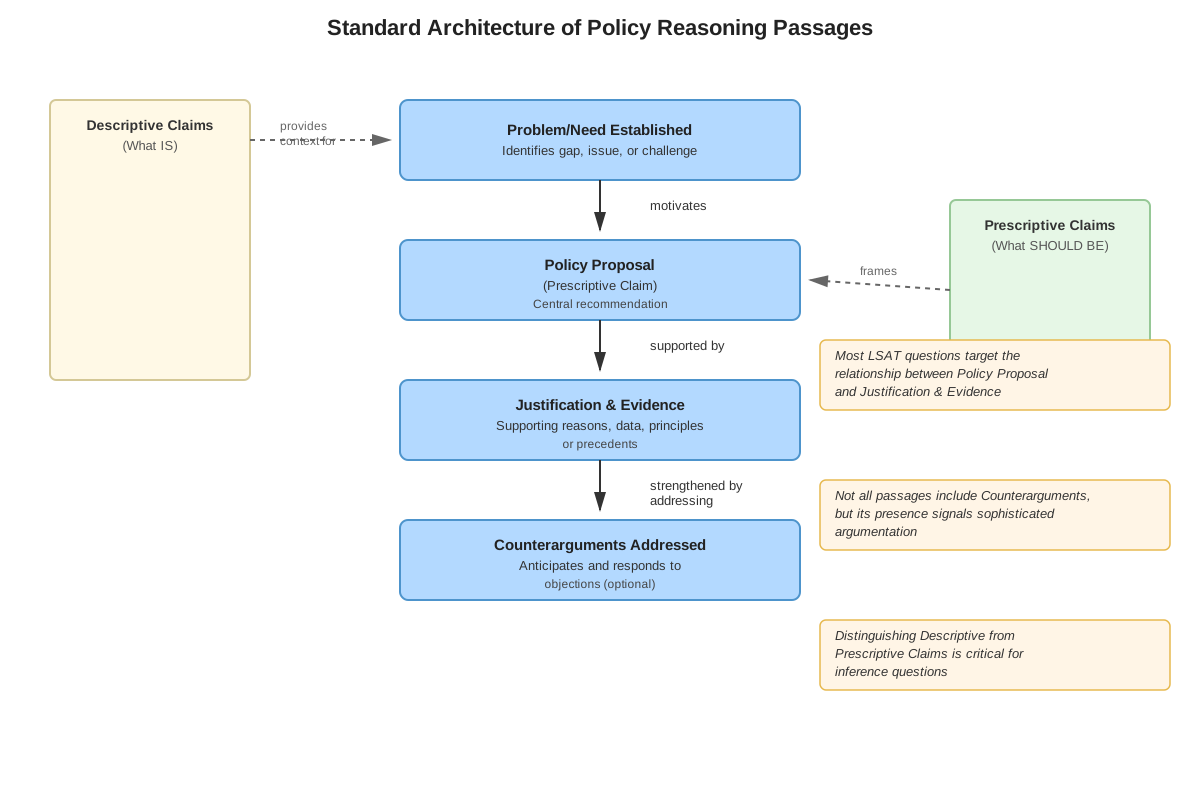
The ability to analyze lsat policy reasoning in passages directly impacts performance across multiple question types within reading comprehension. Test-takers must identify the policy being advocated, trace the logical structure supporting that recommendation, evaluate the strength of evidence presented, and recognize potential objections or limitations. Policy reasoning passages typically follow a predictable architecture: establishing a problem or need, proposing a solution or course of action, providing justification through evidence or principles, and sometimes addressing counterarguments. Understanding this framework allows students to navigate complex passages efficiently and anticipate the types of questions that will follow.
Within the broader context of viewpoints and argumentation, policy reasoning represents a specific application of argumentative structures where the conclusion is prescriptive rather than descriptive. This topic connects directly to skills in identifying author's purpose, distinguishing between claims and evidence, recognizing assumptions, and evaluating logical relationships. Mastery of policy reasoning enhances overall comprehension abilities while providing a systematic approach to one of the most common passage types on the LSAT. The analytical framework developed here transfers seamlessly to other argumentative contexts, making this topic foundational for achieving competitive scores on the Reading Comprehension section.
Learning Objectives
- [ ] Identify how policy reasoning in passages appears in LSAT questions
- [ ] Explain the reasoning pattern behind policy reasoning in passages
- [ ] Apply policy reasoning in passages to solve LSAT-style problems accurately
- [ ] Distinguish between descriptive claims and prescriptive policy recommendations within passages
- [ ] Analyze the relationship between stated problems and proposed policy solutions
- [ ] Evaluate the sufficiency and relevance of evidence used to support policy recommendations
- [ ] Recognize common structural patterns in policy-oriented passages and predict question types
Prerequisites
- Basic argument structure: Understanding premises, conclusions, and logical connections is essential because policy reasoning builds upon fundamental argumentative frameworks
- Distinction between facts and opinions: Recognizing objective statements versus subjective claims enables identification of normative policy recommendations
- Reading for main purpose: Ability to identify author's primary intent provides the foundation for recognizing when a passage advocates for specific action
- Evidence evaluation: Basic skills in assessing the strength and relevance of supporting information are necessary for analyzing policy justifications
- Comparative reasoning: Understanding how authors contrast alternatives helps in recognizing why one policy is advocated over others
Why This Topic Matters
Policy reasoning appears with remarkable frequency on the LSAT, typically featuring in 1-2 passages per Reading Comprehension section. These passages draw from diverse sources including legal scholarship, social science research, environmental policy debates, economic proposals, and judicial reform discussions. The LSAT favors policy reasoning passages because they test multiple competencies simultaneously: comprehension of complex arguments, evaluation of evidence, recognition of assumptions, and analysis of logical structure—all skills essential for legal practice.
In legal education and professional practice, attorneys constantly engage with policy reasoning. Legislative analysis, regulatory interpretation, appellate advocacy, and legal scholarship all require the ability to construct, evaluate, and critique policy arguments. Law students analyze judicial opinions that weigh competing policy considerations, draft memoranda recommending specific courses of action, and participate in debates about legal reform. The LSAT's emphasis on policy reasoning directly reflects the analytical demands of legal training.
Common manifestations of this topic include passages discussing proposed changes to legal procedures, arguments for environmental regulations, debates about educational reform, recommendations for economic policy adjustments, and proposals for addressing social issues through institutional change. Questions typically probe understanding of the policy's rationale, the relationship between evidence and recommendation, potential objections, underlying assumptions, and the logical structure of the argument. Recognition of these patterns enables strategic reading and efficient question-answering.
Core Concepts
Structure of Policy Arguments
Policy reasoning in passages follows a distinctive logical architecture that distinguishes it from purely descriptive or explanatory texts. The fundamental structure consists of four core components: problem identification, policy recommendation, justification, and often consideration of alternatives or objections. The problem identification establishes the need for action by describing an undesirable current state, harmful trend, or unrealized opportunity. This component answers the question "Why should anything change?" and provides the motivational foundation for the entire argument.
The policy recommendation itself—the prescriptive claim—constitutes the argument's conclusion. This recommendation typically takes the form of "X should be done," "Y ought to be implemented," or "Z must be changed." The prescriptive nature distinguishes policy reasoning from causal analysis or historical description. Test-takers must recognize that the author is not merely explaining what happens or predicting what will happen, but advocating for what should happen.
Justification provides the logical bridge between problem and solution. Authors employ various justification strategies: demonstrating that the policy will solve the identified problem (consequentialist reasoning), showing that the policy aligns with important principles or values (deontological reasoning), or arguing that the policy has succeeded in analogous situations (precedential reasoning). Understanding which justification strategy an author employs helps predict question types and evaluate argument strength.
Types of Policy Reasoning
| Reasoning Type | Characteristics | Example Context |
|---|---|---|
| Consequentialist | Justifies policy based on predicted outcomes and effects | "Implementing this regulation will reduce pollution by 30%" |
| Principled/Rights-Based | Justifies policy based on moral principles, rights, or values | "This policy should be adopted because it protects fundamental privacy rights" |
| Precedential | Justifies policy based on success in similar contexts | "Since this approach worked in comparable jurisdictions, it should be implemented here" |
| Comparative | Justifies policy by showing it's superior to alternatives | "Among available options, this policy best balances competing interests" |
| Corrective | Justifies policy as remedy for identified injustice or inefficiency | "This reform addresses systemic inequities in the current system" |
Evidence in Policy Arguments
The relationship between evidence and policy recommendations represents a critical analytical focus on the LSAT. Authors marshal various evidence types to support their prescriptive claims: empirical data demonstrating problem severity, research studies showing policy effectiveness, expert testimony supporting feasibility, theoretical models predicting outcomes, and historical examples illustrating success or failure of similar approaches.
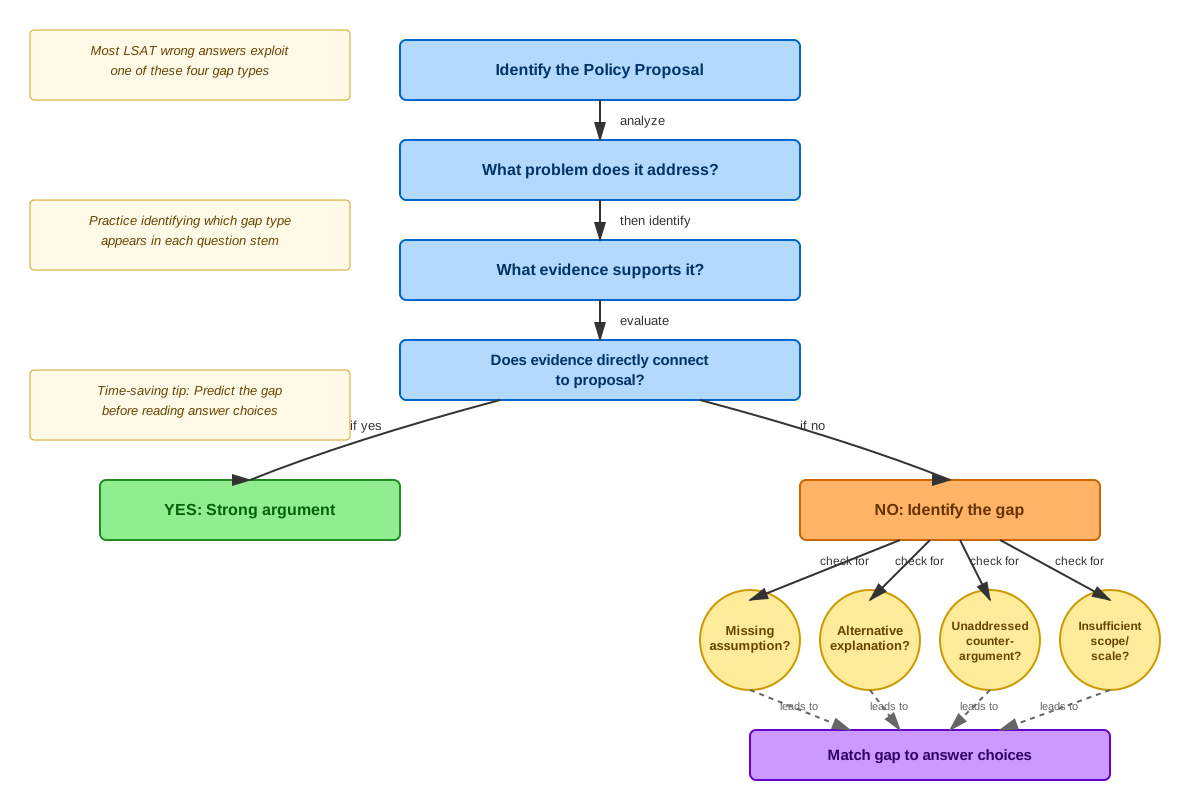
Test-takers must evaluate whether evidence actually supports the policy recommendation. Common logical gaps include: evidence showing a problem exists but not demonstrating the proposed solution would address it; evidence from contexts too dissimilar to support generalization; evidence about correlation being used to support causal claims; or evidence addressing only some aspects of a multi-faceted policy. Questions frequently test whether students recognize these evidential weaknesses.
Assumptions in Policy Reasoning
Every policy argument rests on assumptions—unstated premises necessary for the reasoning to work. Common assumption categories include: feasibility assumptions (the policy can actually be implemented), effectiveness assumptions (the policy will produce intended effects), value assumptions (the goals pursued are worthwhile), priority assumptions (this problem deserves attention over others), and absence-of-negative-consequences assumptions (the policy won't create worse problems).
Identifying assumptions is crucial because LSAT questions often ask what the argument "depends on," what would "strengthen" or "weaken" the argument, or what the author "assumes to be true." An argument assuming that enforcement mechanisms exist becomes vulnerable if that assumption is challenged. An argument assuming public cooperation becomes stronger if evidence of community support is provided.
Counterarguments and Objections
Sophisticated policy reasoning passages frequently acknowledge potential objections or alternative viewpoints. Authors may address counterarguments through several strategies: conceding minor points while maintaining the core recommendation, providing evidence that undermines the objection, arguing that benefits outweigh acknowledged costs, or showing that alternatives face even greater problems.
The presence and treatment of counterarguments significantly affects argument strength. An author who anticipates and addresses major objections constructs a more robust case than one who ignores obvious concerns. LSAT questions often test whether students recognize which objections the author has addressed versus which remain unaddressed, or whether the author's response to an objection is logically adequate.
Scope and Qualification
Policy recommendations vary in scope—from narrow, specific proposals to broad, sweeping reforms. Authors may qualify their recommendations with conditions, limitations, or contextual boundaries. Understanding scope is essential because questions often test whether students recognize what the author actually advocates versus what they might seem to advocate.
A recommendation that "in urban areas with adequate public transportation, cities should implement congestion pricing" is more limited than "cities should implement congestion pricing." The qualifications matter for evaluating the argument's strength, identifying what evidence is relevant, and determining what would strengthen or weaken the position. Test-takers must read carefully to capture these nuances.
Concept Relationships
The components of policy reasoning form an interconnected logical chain: Problem Identification → establishes need for → Policy Recommendation → supported by → Justification → which relies on → Evidence → and depends on → Assumptions → while addressing → Counterarguments → all bounded by → Scope and Qualifications.
This topic connects to prerequisite knowledge of basic argument structure by applying those foundational concepts to a specific argumentative context. The skills of identifying conclusions and premises transfer directly, with the added complexity that policy conclusions are prescriptive. Evidence evaluation skills from general reading comprehension become more nuanced when assessing whether evidence supports a normative claim rather than a descriptive one.
Policy reasoning also relates to other viewpoints and argumentation topics. When passages present multiple perspectives on a policy issue, students must track which viewpoint each argument supports, how different authors respond to each other's positions, and what assumptions distinguish competing recommendations. The analytical framework for policy reasoning provides tools for comparing and contrasting these viewpoints systematically.
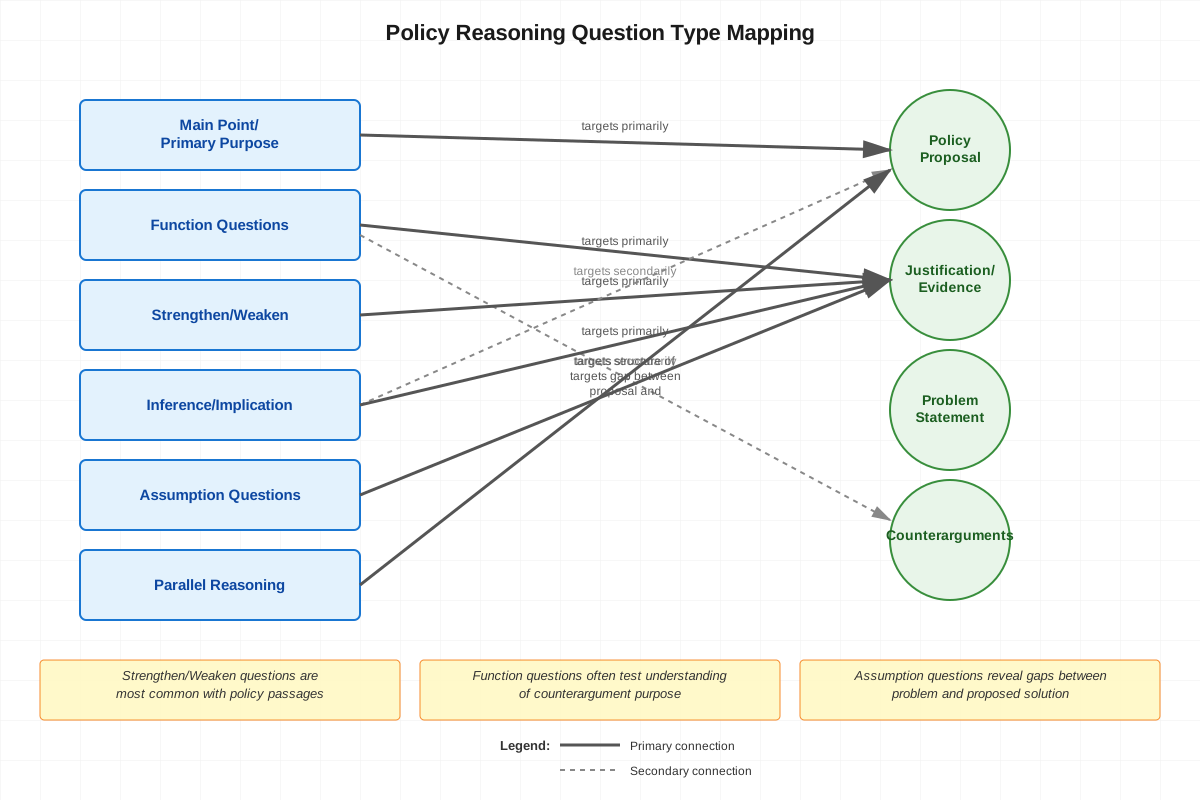
Understanding policy reasoning enhances performance on inference questions (what follows from the policy recommendation?), strengthening/weakening questions (what evidence would support or undermine the argument?), assumption questions (what must be true for the reasoning to work?), and author's purpose questions (why did the author present this information?). The conceptual relationships within policy reasoning thus extend to question-answering strategies across the Reading Comprehension section.
High-Yield Facts
⭐ Policy reasoning passages always contain a prescriptive claim—a recommendation about what should be done—distinguishing them from purely descriptive or explanatory passages
⭐ The strength of a policy argument depends on the logical connection between the identified problem and the proposed solution, not merely on whether a problem exists
⭐ Evidence showing that a problem is serious does not automatically support any particular solution; the evidence must specifically support the proposed policy
⭐ Most policy arguments rest on feasibility assumptions—unstated premises that the recommended action can actually be implemented
⭐ When authors acknowledge counterarguments, questions often test whether the response adequately addresses the objection
- Policy recommendations may be justified through consequences (outcomes), principles (values/rights), precedent (past success), or comparative advantage (better than alternatives)
- Scope qualifications significantly affect what evidence is relevant and what claims can be inferred from the argument
- Authors may present multiple policy options before advocating for one, requiring careful tracking of which position is ultimately endorsed
- Questions about what would "strengthen" a policy argument typically require evidence that confirms an assumption or provides additional support for the problem-solution connection
- Questions about what would "weaken" a policy argument often introduce evidence of negative consequences, implementation barriers, or successful alternatives
- The relationship between different viewpoints in a passage often centers on disagreement about problem severity, solution effectiveness, or value priorities
- Policy reasoning passages frequently appear in comparative law contexts, discussing how different jurisdictions address similar issues
- Authors may use hypothetical scenarios or thought experiments to support policy recommendations, requiring evaluation of the analogy's strength
- The absence of discussion about implementation costs, enforcement mechanisms, or potential side effects may represent a logical gap in the argument
- Temporal scope matters: policies recommended for current circumstances may rest on assumptions about conditions that could change
Quick check — test yourself on Policy reasoning in passages so far.
Try Flashcards →Common Misconceptions
Misconception: If a passage describes a serious problem, any proposed solution must be reasonable → Correction: Problem severity does not automatically validate a particular solution. The policy recommendation must be logically connected to the problem through evidence and reasoning. A passage might establish that traffic congestion is severe without providing adequate support for a specific congestion-reduction policy.
Misconception: Policy reasoning is the same as causal reasoning → Correction: While policy arguments often involve causal claims (this policy will cause that outcome), policy reasoning is fundamentally prescriptive (advocating what should be done) rather than merely explanatory (describing what causes what). A passage might explain what causes a problem without recommending any policy response.
Misconception: Evidence that a policy worked elsewhere guarantees it will work in the discussed context → Correction: Precedential reasoning depends on relevant similarity between contexts. LSAT passages often include policy arguments based on other jurisdictions' experiences, but questions test whether students recognize that differences in context might undermine the analogy.
Misconception: If an author mentions a counterargument, they must agree with it → Correction: Authors frequently raise objections specifically to refute them. Recognizing whether the author endorses, refutes, or merely acknowledges a viewpoint is crucial. Signal phrases like "critics argue" or "some contend" typically introduce positions the author will challenge.
Misconception: The longest or most detailed part of a passage contains the main policy recommendation → Correction: Authors may spend considerable space establishing a problem or discussing background before stating their recommendation. The policy recommendation might appear late in the passage or be stated briefly, with most text devoted to justification.
Misconception: All policy arguments are equally strong if they have evidence → Correction: Evidence quality, relevance, and sufficiency vary dramatically. An argument supported by rigorous empirical studies is stronger than one supported by anecdotal examples. An argument with evidence directly addressing the policy's likely effects is stronger than one with evidence only about problem severity.
Misconception: Authors who acknowledge limitations in their proposed policy are weakening their own argument → Correction: Acknowledging limitations often strengthens an argument by demonstrating intellectual honesty and realistic expectations. The question is whether the acknowledged limitations are fatal to the recommendation or merely indicate that the policy is imperfect but still worthwhile.
Worked Examples
Example 1: Environmental Policy Passage
Passage Excerpt: "Urban air quality has deteriorated significantly over the past decade, with particulate matter concentrations exceeding safe levels in 15 major cities. Studies demonstrate that vehicle emissions account for approximately 60% of this pollution. Several European cities have successfully reduced air pollution by implementing congestion pricing—charging fees for vehicles entering central urban zones during peak hours. London's congestion pricing program reduced traffic volume by 30% and particulate matter by 25% within two years. Given these results, major American cities should adopt similar congestion pricing schemes to address their air quality problems."
Question: The argument depends on assuming which of the following?
Analysis Process:
- Identify the policy recommendation: "Major American cities should adopt congestion pricing schemes"
- Identify the problem: Urban air quality deterioration due to vehicle emissions
- Identify the justification strategy: Precedential reasoning (London's success) combined with consequentialist reasoning (will reduce pollution)
- Identify the logical gap: The argument moves from London's success to a recommendation for American cities. This leap assumes relevant similarity between contexts.
- Articulate the assumption: The argument assumes that conditions in American cities are sufficiently similar to London that the policy would produce comparable results. Differences in public transportation availability, urban density, driving culture, or enforcement capacity could undermine the analogy.
Answer approach: Look for an answer choice stating that American cities share relevant characteristics with London, or that differences between contexts won't prevent the policy from working. An assumption question answer, when negated, should seriously weaken the argument.
Example 2: Criminal Justice Reform Passage
Passage Excerpt: "The current bail system perpetuates inequality by detaining defendants who cannot afford bail while releasing wealthier defendants charged with similar offenses. Pretrial detention causes job loss, housing instability, and family disruption, making defendants more likely to accept unfavorable plea bargains regardless of guilt. New Jersey reformed its bail system in 2017, replacing cash bail with risk assessment algorithms that evaluate flight risk and danger to the community. Within one year, the pretrial detention population decreased by 44% while court appearance rates remained stable and crime rates did not increase. These results demonstrate that risk-based assessment systems should replace cash bail nationwide."
Question: Which of the following, if true, would most weaken the argument?
Analysis Process:
- Identify the policy recommendation: Replace cash bail with risk assessment algorithms nationwide
- Identify the problem: Current bail system creates inequality and harmful consequences for poor defendants
- Identify the evidence: New Jersey's successful implementation with positive outcomes
- Identify assumptions:
- The New Jersey results are generalizable to other jurisdictions
- The positive outcomes will persist over time
- No significant negative consequences exist beyond those measured
- The risk assessment algorithms are fair and accurate
- Consider what would weaken: Evidence that New Jersey is atypical, that the algorithms have serious flaws, that negative consequences emerged, or that the measured outcomes don't capture important problems
Answer approach: Look for answer choices introducing evidence of: implementation problems in other jurisdictions, bias in risk assessment algorithms, negative consequences not mentioned in the passage, or relevant differences between New Jersey and other states that would prevent generalization.
Strong weakener example: "Studies show that the risk assessment algorithms used in New Jersey systematically overestimate flight risk for certain demographic groups, leading to discriminatory detention patterns."
This weakens the argument by suggesting the proposed solution may perpetuate a different form of inequality, undermining the policy's justification.
Exam Strategy
When approaching policy reasoning passages on the LSAT, begin by identifying the prescriptive claim—the specific recommendation the author advocates. Underline or mark this claim, as it serves as the logical anchor for the entire passage. Many students waste time by not clearly distinguishing between problem description and policy recommendation, leading to confusion about what the author actually argues.
Trigger words and phrases signaling policy recommendations include: "should," "ought to," "must," "it is necessary that," "requires," "calls for," "recommends," "the solution is," "the best approach," and "policy makers need to." These linguistic markers indicate the shift from description to prescription. Conversely, phrases like "has caused," "results from," "explains why," and "is due to" typically introduce causal analysis rather than policy advocacy.
As you read, actively map the argument structure using margin notes:
- P = Problem identification
- R = Recommendation (policy claim)
- E = Evidence supporting the recommendation
- C = Counterargument or alternative view
- A = Author's response to counterargument
This structural mapping enables rapid reference when answering questions and helps distinguish between what the author believes versus what others argue.
For assumption questions, focus on the logical gap between problem and solution. Ask: "What must be true for this policy to work as intended?" Common assumption categories include feasibility (can it be done?), effectiveness (will it solve the problem?), and absence of negative consequences (won't it create worse problems?).
For strengthen/weaken questions, evaluate whether new information affects the problem-solution connection. Evidence that the problem is worse than stated doesn't necessarily strengthen the argument for a particular solution. Evidence that the solution worked elsewhere strengthens the argument only if contexts are relevantly similar.
For inference questions, stay within the scope of what the author actually recommends. Don't assume the author supports broader applications or related policies not explicitly endorsed. Pay attention to qualifications and limitations in the recommendation.
Time allocation: Spend approximately 3-4 minutes reading a policy reasoning passage, ensuring you clearly identify the recommendation and its justification. This upfront investment pays dividends by making questions answerable more quickly. Don't rush the initial read only to waste time re-reading when answering questions.
Process of elimination: Eliminate answer choices that confuse problem description with policy recommendation, that attribute positions to the author that belong to others mentioned in the passage, or that extend the recommendation beyond its stated scope. Be especially wary of answer choices that seem thematically related but don't actually address what the question asks.
Exam Tip: If a passage discusses multiple policy options before endorsing one, questions will likely test whether you can distinguish which policy the author ultimately supports versus which are merely described or rejected.
Memory Techniques
PREJA - Remember the five core components of policy reasoning:
- Problem identification
- Recommendation (the policy claim)
- Evidence and justification
- Justification strategy (consequentialist, principled, precedential, comparative)
- Assumptions underlying the argument
The "Should Test" - Visualize policy reasoning passages as having an invisible "should" statement that distinguishes them from descriptive passages. If you can identify a clear "X should do Y" claim, you're dealing with policy reasoning.
The Three Questions Framework - For any policy argument, mentally answer:
- What problem does the author identify?
- What solution does the author recommend?
- Why does the author think the solution will work?
This framework ensures you've captured the essential logical structure.
CAFE - Remember the four main justification strategies:
- Consequentialist (based on outcomes)
- Analogical/precedential (based on similar cases)
- Fundamental principles (based on rights/values)
- Elimination (better than alternatives)
The Assumption Bridge - Visualize assumptions as a bridge connecting the problem (one riverbank) to the solution (the other riverbank). If the bridge has gaps (unstated assumptions), the argument is vulnerable. This mental image helps identify what the argument depends on.
Summary
Policy reasoning in passages represents a high-frequency, high-importance topic on the LSAT Reading Comprehension section, requiring students to identify, analyze, and evaluate arguments that advocate for specific courses of action. These passages follow a predictable structure: establishing a problem, proposing a solution, providing justification through evidence or principles, and often addressing counterarguments. Success requires distinguishing prescriptive claims from descriptive statements, evaluating the logical connection between problems and proposed solutions, identifying unstated assumptions, and assessing evidence quality and relevance. The LSAT tests policy reasoning through multiple question types including assumption identification, strengthening/weakening arguments, making inferences, and determining author's purpose. Mastery involves recognizing the four main justification strategies (consequentialist, principled, precedential, and comparative), understanding how scope qualifications affect argument strength, and evaluating whether evidence actually supports the specific policy recommended rather than merely establishing that a problem exists. Strategic reading involves mapping argument structure, identifying the prescriptive claim early, and tracking the relationship between evidence and recommendation to answer questions efficiently and accurately.
Key Takeaways
- Policy reasoning passages contain prescriptive claims (what should be done) distinguished from descriptive passages (what is or what causes what)
- The strength of policy arguments depends on the logical connection between identified problems and proposed solutions, not merely on problem severity
- Evidence must specifically support the recommended policy; evidence showing a problem exists doesn't automatically validate any particular solution
- Most policy arguments rest on assumptions about feasibility, effectiveness, and absence of negative consequences that questions frequently test
- Justification strategies (consequentialist, principled, precedential, comparative) provide frameworks for understanding how authors support recommendations
- Scope qualifications and contextual limitations significantly affect what can be inferred and what evidence is relevant
- Questions testing policy reasoning often focus on assumptions, strengthening/weakening factors, and the adequacy of responses to counterarguments
Related Topics
Causal Reasoning in Passages - Understanding how authors establish cause-and-effect relationships provides essential background for policy reasoning, since policy arguments often claim that implementing a recommendation will cause desired outcomes. Mastering policy reasoning enables more sophisticated analysis of whether causal claims adequately support prescriptive conclusions.
Comparative Analysis in Reading Comprehension - Many policy passages compare different approaches, jurisdictions, or time periods. Skills in tracking multiple viewpoints and evaluating comparative claims directly enhance policy reasoning analysis.
Assumption Identification Across Question Types - While this guide addresses assumptions within policy reasoning passages, the broader skill of identifying unstated premises applies across all LSAT sections. Mastery here strengthens performance in Logical Reasoning as well.
Evidence Evaluation and Sufficiency - The ability to assess whether evidence adequately supports conclusions represents a transferable skill applicable to all argumentative passages, not just those involving policy recommendations.
Author's Purpose and Tone - Understanding why authors present information and how their attitude toward the subject matter affects argument construction complements policy reasoning analysis, particularly when passages present multiple viewpoints on policy issues.
Practice CTA
Now that you've mastered the conceptual framework for analyzing policy reasoning in passages, it's time to apply these skills to authentic LSAT-style questions. The practice questions and flashcards will reinforce your ability to quickly identify policy recommendations, map argument structure, recognize assumptions, and evaluate evidence—all under timed conditions. Remember that policy reasoning appears frequently on the LSAT, making your investment in practice highly efficient for score improvement. Approach each practice question by first identifying the prescriptive claim, then mapping the problem-solution connection, and finally evaluating the logical relationships before examining answer choices. Your systematic approach to policy reasoning will translate directly into points on test day. Begin practicing now to solidify these high-yield skills!
Sign up free to keep reading
Create a free AnvayaPrep account to finish this LSAT guide on Policy reasoning in passages — plus flashcards and practice questions.