Overview
The traditional view is a fundamental concept in LSAT reading comprehension that appears consistently across passages, particularly in those dealing with viewpoints and argumentation. In LSAT passages, the traditional view represents an established, conventional, or historically accepted perspective on a topic that the passage typically introduces early before presenting alternative viewpoints, critiques, or new evidence. Understanding how to identify and analyze the traditional view is essential because LSAT passages frequently structure their arguments around challenging, modifying, or supporting these established positions.
The traditional view serves as a rhetorical anchor point in LSAT passages. Authors often present a traditional view to establish context, demonstrate the evolution of thought on a subject, or set up a contrast with newer theories or evidence. This pattern appears across all subject areas tested in LSAT reading comprehension—from law and humanities to natural sciences and social sciences. Recognizing the traditional view allows test-takers to map the passage's argumentative structure, predict where the author's own position might diverge from convention, and accurately answer questions about the passage's organization and purpose.
Within the broader framework of reading comprehension, the traditional view concept connects directly to understanding author's purpose, passage structure, and comparative reasoning. It forms the foundation for analyzing how arguments develop and how different perspectives interact within a single passage. Mastering this concept enables students to quickly identify the passage's organizational framework, distinguish between multiple viewpoints, and understand the relationships between different claims—all critical skills for achieving a high LSAT score.
Learning Objectives
- [ ] Identify how Traditional view appears in LSAT questions
- [ ] Explain the reasoning pattern behind Traditional view
- [ ] Apply Traditional view to solve LSAT-style problems accurately
- [ ] Distinguish between traditional views and alternative perspectives within complex passages
- [ ] Analyze how authors use traditional views to structure their arguments
- [ ] Predict question types that will focus on traditional view identification
- [ ] Evaluate the relationship between traditional views and the author's own position
Prerequisites
- Basic passage structure recognition: Understanding how LSAT passages organize information into introduction, body, and conclusion is necessary to locate where traditional views typically appear.
- Vocabulary comprehension: Familiarity with academic language and the ability to parse complex sentences enables recognition of phrases that signal traditional views.
- Comparative reasoning skills: The ability to distinguish between different viewpoints is essential since traditional views are often contrasted with alternative perspectives.
- Argument identification: Recognizing claims, evidence, and conclusions helps students understand how traditional views function within the passage's overall argument.
Why This Topic Matters
The traditional view concept appears in approximately 60-70% of LSAT reading comprehension passages, making it one of the most frequently tested elements in the exam. This high frequency stems from the LSAT's emphasis on analytical reasoning and the ability to understand how arguments develop and evolve. Legal reasoning itself often involves understanding established precedents (traditional views) and how they apply to new situations or face challenges from changing circumstances.
In real-world legal practice, attorneys must constantly engage with established legal doctrines, precedents, and conventional interpretations before arguing for new applications or challenging existing frameworks. The LSAT tests this skill by presenting passages where traditional views serve as the baseline against which new evidence, theories, or arguments are measured. Understanding traditional views prepares future law students for the kind of analytical work they'll perform throughout their legal careers.
On the LSAT, traditional view questions appear in multiple formats: main point questions often require understanding how the passage relates to traditional views; organization questions frequently ask about the function of paragraphs that present traditional views; and inference questions may test whether students understand the implications of challenging or supporting traditional perspectives. Additionally, comparative reading passages—where two passages address the same topic—often feature one passage presenting a traditional view while the other offers an alternative, making this concept doubly important for those question sets.
Core Concepts
Definition and Characteristics of Traditional View
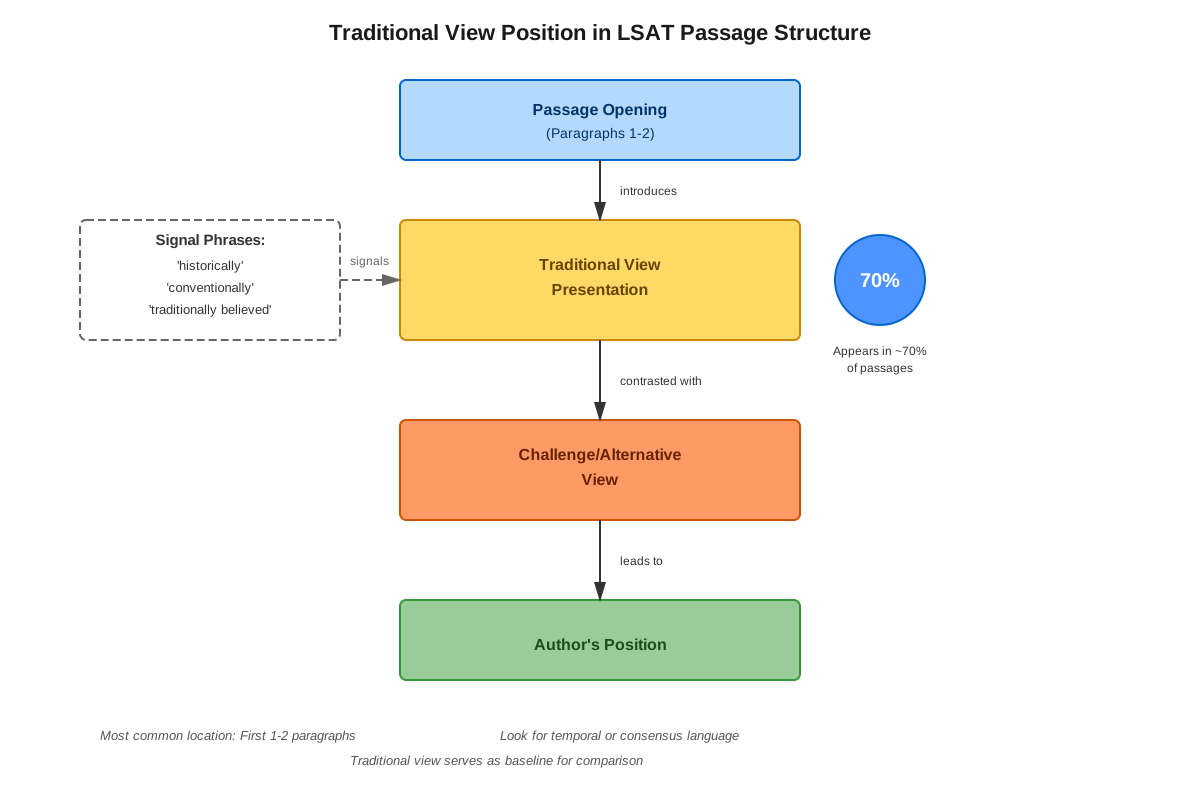
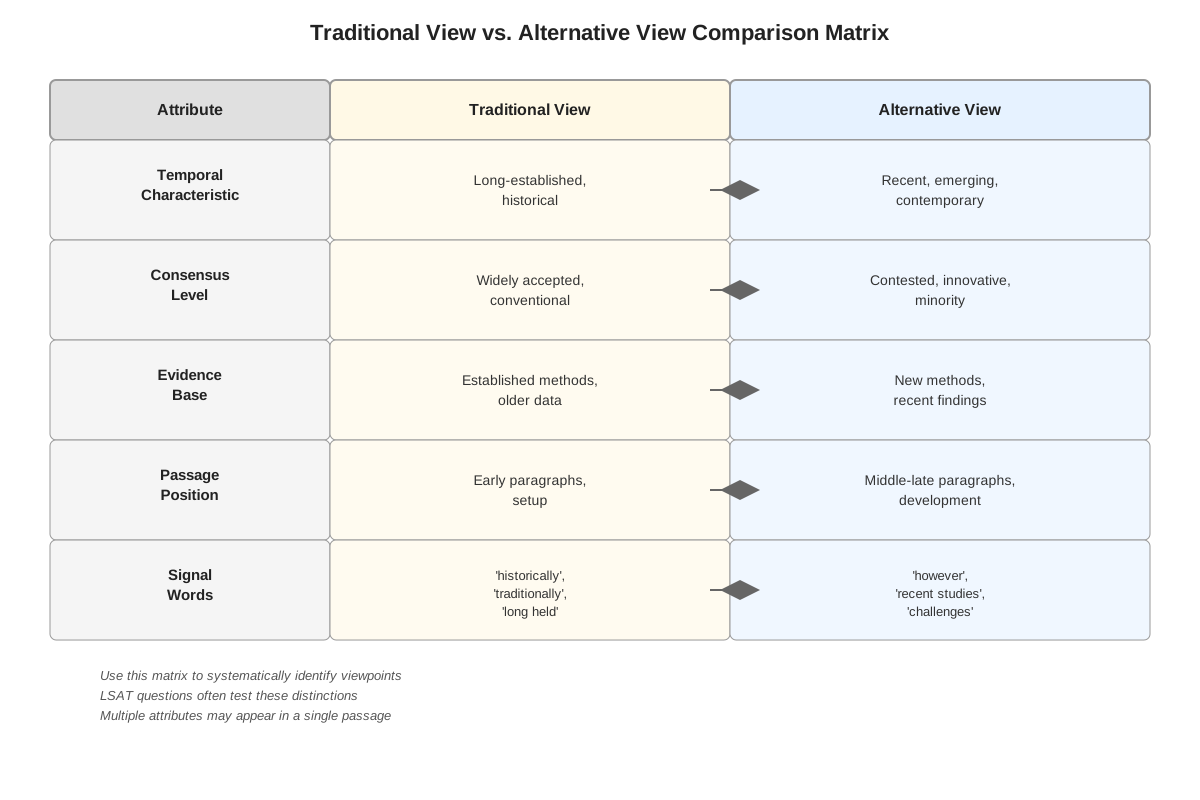
The traditional view in LSAT reading comprehension refers to an established, widely accepted, or historically dominant perspective on a topic that the passage presents, usually to provide context or to serve as a point of comparison. Traditional views possess several identifying characteristics: they represent consensus thinking within a field, they have typically existed for an extended period, they are often attributed to "scholars," "experts," or "conventional wisdom" rather than specific individuals, and they frequently appear in the opening paragraphs of passages.
Traditional views are not inherently correct or incorrect—they simply represent what has been generally accepted. The LSAT tests whether students can identify these views and understand their function within the passage's argumentative structure, not whether students agree with them. A traditional view might be supported, challenged, modified, or completely overturned by the passage's subsequent content.
Structural Placement and Signaling Language
LSAT passages typically introduce traditional views in predictable locations and with recognizable language patterns. Most commonly, traditional views appear in the first or second paragraph, establishing the intellectual landscape before the passage introduces new research, alternative theories, or critical analysis. Understanding these patterns allows test-takers to quickly map the passage's structure.
Common signal phrases that indicate a traditional view include:
- "Traditionally, scholars have believed..."
- "The conventional view holds that..."
- "For decades, experts have maintained..."
- "The standard interpretation suggests..."
- "Historically, it was thought that..."
- "The prevailing theory states..."
- "Long-standing assumptions about..."
- "The orthodox position maintains..."
These phrases serve as textual markers that alert careful readers to the presence of a traditional view. However, not all traditional views are explicitly labeled—sometimes the passage simply presents information in a matter-of-fact way in early paragraphs, and only later context reveals that this was the traditional view being set up for contrast or challenge.
Functional Roles in Passage Structure
Traditional views serve multiple rhetorical functions in LSAT passages, and understanding these functions is crucial for answering structure and purpose questions. The primary functional roles include:
Establishing Context: The traditional view provides background information that helps readers understand why new research or alternative perspectives matter. Without understanding what was previously believed, readers cannot appreciate the significance of new developments.
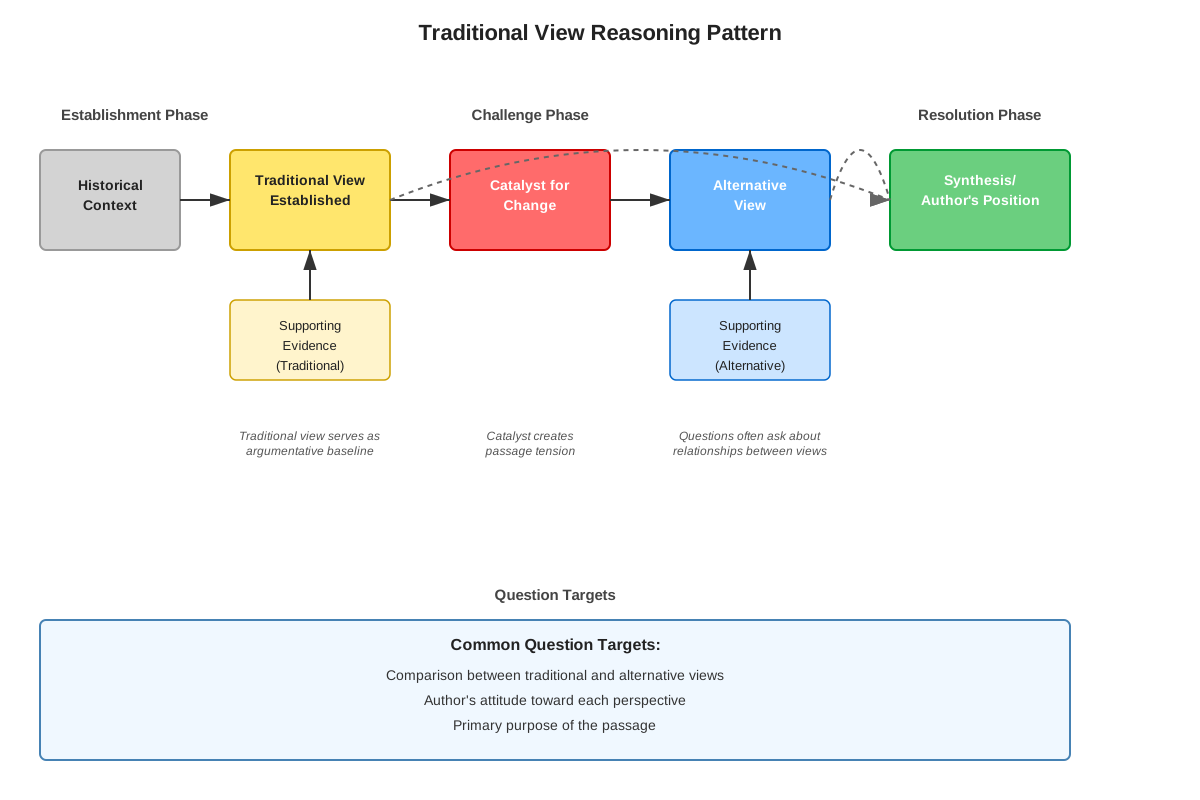
Creating Contrast: Many LSAT passages follow a "traditional view → challenge/alternative" structure. The traditional view serves as the "before" picture that makes the "after" picture meaningful. This contrast structure is particularly common in science passages discussing paradigm shifts or new discoveries.
Supporting the Author's Argument: Sometimes authors present traditional views not to challenge them but to reinforce them with additional evidence or to defend them against recent criticism. In these cases, the traditional view aligns with the author's own position.
Demonstrating Evolution of Thought: Passages may trace how thinking on a topic has evolved, presenting the traditional view as one stage in an intellectual progression rather than as something to be entirely rejected.
Relationship to Author's Perspective
A critical analytical skill involves determining the author's attitude toward the traditional view presented. The LSAT frequently tests this relationship through tone and attitude questions. Authors may adopt several stances:
| Author's Stance | Indicators | Example Language |
|---|---|---|
| Supportive | Positive language, additional evidence provided | "This traditional understanding is further confirmed by..." |
| Critical | Negative language, counterevidence presented | "However, this conventional view fails to account for..." |
| Neutral/Descriptive | Objective presentation without evaluation | "Scholars have traditionally held that..." |
| Modifying | Partial agreement with qualifications | "While the traditional view correctly identifies X, it overlooks Y..." |
| Completely Rejecting | Strong negative language, alternative proposed | "This long-held belief is fundamentally mistaken..." |
Determining the author's relationship to the traditional view often provides the key to answering main point questions, as the author's primary purpose frequently involves either defending or challenging the traditional perspective.
Traditional View in Comparative Passages
Comparative reading passages—where two shorter passages address related topics—often explicitly structure themselves around traditional versus alternative views. Passage A might present or defend a traditional view, while Passage B offers a critique or alternative. Questions on these paired passages frequently ask students to identify points of agreement or disagreement, which requires precise understanding of each passage's relationship to the traditional view.
In comparative passages, the traditional view serves as the common ground that allows meaningful comparison. Even when both passages challenge a traditional view, they may do so in different ways or for different reasons, and understanding these nuances is essential for answering comparison questions correctly.
Concept Relationships
The traditional view concept connects to multiple other elements of LSAT reading comprehension in a hierarchical and functional network. At the foundational level, understanding traditional views depends on passage structure recognition—students must identify where different types of information appear and how paragraphs relate to one another. This structural awareness enables the identification of traditional views, which typically occupy specific positions within passages.
Once identified, the traditional view concept feeds directly into viewpoint analysis, allowing students to distinguish between multiple perspectives within a passage. The relationship flows: Traditional View → Alternative Views → Author's Position → Overall Argument Structure. Each element builds on the previous one, with the traditional view serving as the baseline reference point.
The traditional view also connects laterally to tone and attitude analysis. Understanding how an author presents a traditional view (objectively, critically, supportively) reveals the author's purpose and helps answer inference questions about the author's likely agreement or disagreement with various statements.
Furthermore, traditional views relate to evidence evaluation within passages. When passages present evidence, that evidence either supports the traditional view, challenges it, or modifies it. Recognizing this relationship helps students understand the function of specific details and examples, which is frequently tested through "function" or "purpose" questions.
The concept map flows as follows:
Passage Structure Recognition → Traditional View Identification → Viewpoint Differentiation → Author's Attitude Analysis → Argument Structure Understanding → Question Answering Accuracy
High-Yield Facts
⭐ Traditional views appear in 60-70% of LSAT reading comprehension passages, making them one of the most frequently tested concepts.
⭐ Traditional views typically appear in the first or second paragraph of passages, serving to establish context before alternative views are introduced.
⭐ Signal phrases like "traditionally," "conventionally," "historically," and "long-standing" indicate the presence of a traditional view.
⭐ The author's attitude toward the traditional view (supportive, critical, neutral, or modifying) is frequently tested and often reveals the passage's main point.
⭐ Traditional views are not inherently wrong—they may be supported, challenged, modified, or used as context depending on the passage's purpose.
- Traditional views are often attributed to groups ("scholars," "experts," "researchers") rather than named individuals, indicating consensus thinking.
- Passages following a "problem-solution" structure often present the traditional view as the "problem" that new research or thinking addresses.
- Comparative passages frequently structure themselves around one passage presenting a traditional view and another offering an alternative perspective.
- Questions asking about "the primary purpose" or "main point" often hinge on understanding the passage's relationship to the traditional view.
- Traditional views may be implicit rather than explicitly labeled, requiring readers to infer from context that earlier material represents conventional thinking.
- The transition from traditional view to alternative view often occurs with contrast words like "however," "but," "yet," "recently," or "new evidence suggests."
- Understanding the traditional view is essential for answering "organization" questions that ask about the function of specific paragraphs.
Quick check — test yourself on Traditional view so far.
Try Flashcards →Common Misconceptions
Misconception: Traditional views are always wrong or outdated, and the passage will always argue against them.
Correction: Traditional views may be correct, partially correct, or incorrect. Many passages support traditional views with new evidence or defend them against recent challenges. The LSAT tests analytical ability, not a bias toward novelty.
Misconception: The traditional view is always explicitly labeled with phrases like "the traditional view is..."
Correction: While signal phrases are common, traditional views may be presented implicitly. Sometimes the passage simply states information in early paragraphs, and only later context (when alternatives are introduced) reveals that the earlier material represented the traditional view.
Misconception: The author's view and the traditional view are the same thing.
Correction: These are distinct concepts. The traditional view is what has been generally accepted; the author's view is the position the author takes in the passage. These may align or conflict, and determining their relationship is often the key to answering questions correctly.
Misconception: Traditional views only appear in humanities or social science passages.
Correction: Traditional views appear across all passage types, including natural sciences and law. Scientific paradigms, legal precedents, and historical interpretations all represent traditional views that passages may discuss.
Misconception: If a passage mentions a traditional view, it must be the main focus of the passage.
Correction: Traditional views often serve as context or background rather than the main focus. The passage's primary concern might be the alternative view, new evidence, or a synthesis of multiple perspectives, with the traditional view serving only as a reference point.
Misconception: Traditional views are presented in neutral, objective language while alternative views receive evaluative language.
Correction: The language used to present traditional views varies depending on the author's attitude. An author critical of the traditional view might present it with skeptical language, while an author supporting it might use positive, affirming language.
Worked Examples
Example 1: Identifying Traditional View and Author's Attitude
Passage Excerpt:
"For most of the twentieth century, legal scholars maintained that judicial interpretation should focus exclusively on the text of statutes, with judges avoiding consideration of legislative history or policy implications. This textualist approach, championed by numerous jurists, held that democratic legitimacy required strict adherence to the words chosen by elected legislators. However, recent scholarship has demonstrated that this rigid approach often produces absurd results that contradict the legislature's clear intent. By examining legislative debates and committee reports, judges can better serve the law's purpose while respecting democratic principles."
Analysis Process:
Step 1: Identify the traditional view. The first two sentences present what "legal scholars maintained" for "most of the twentieth century"—this temporal and attribution language signals a traditional view. The traditional view is: judicial interpretation should focus exclusively on statutory text, avoiding legislative history or policy considerations.
Step 2: Identify signal language. "For most of the twentieth century" and "maintained" indicate established, historical thinking. "This textualist approach" labels the traditional view for easy reference.
Step 3: Locate the transition. "However" in the third sentence signals a shift from the traditional view to an alternative or critique.
Step 4: Determine the author's attitude. The author uses negative language about the traditional view ("rigid approach," "absurd results") and positive language about the alternative ("better serve," "respecting democratic principles"). The author is critical of the traditional view and supportive of considering legislative history.
Step 5: Predict question types. This passage structure would likely generate questions about: (1) the main point (challenging the traditional textualist approach), (2) the author's attitude toward textualism (critical), (3) the function of the first two sentences (presenting a view the author will challenge), and (4) what the author would likely agree with (judges should consider legislative history).
Connection to Learning Objectives: This example demonstrates how to identify traditional views through signal language, explain the reasoning pattern (traditional view → critique → alternative), and apply this understanding to predict and answer LSAT questions.
Example 2: Traditional View in a Science Passage
Passage Excerpt:
"Paleontologists have long assumed that the extinction of dinosaurs resulted from a single catastrophic event—specifically, an asteroid impact that occurred 66 million years ago. This impact hypothesis, supported by the discovery of iridium-rich sediment layers worldwide, became the dominant explanation for the Cretaceous-Paleogene extinction event. The theory's elegance and the dramatic nature of its proposed mechanism made it appealing to both scientists and the public. Recent analysis of fossil records, however, reveals a more complex picture. Dinosaur diversity had been declining for several million years before the impact, suggesting that multiple environmental stressors, including volcanic activity and climate change, contributed to their demise. The asteroid impact may have been the final blow to already vulnerable populations rather than the sole cause of extinction."
Analysis Process:
Step 1: Identify the traditional view. "Paleontologists have long assumed" signals established thinking. The traditional view is: dinosaur extinction resulted from a single catastrophic asteroid impact.
Step 2: Note supporting details for the traditional view. The passage mentions the iridium evidence and describes why the theory became dominant (elegance, dramatic mechanism). Understanding what supports the traditional view helps answer questions about why it was accepted.
Step 3: Identify the challenge. "Recent analysis" and "however" signal the introduction of evidence challenging the traditional view. The alternative view is: multiple environmental stressors over time, with the asteroid as a contributing factor rather than sole cause.
Step 4: Determine the author's stance. The author presents the traditional view neutrally but gives more space and detail to the alternative view, suggesting the author finds the complex, multi-factor explanation more accurate. The language "more complex picture" and "reveals" suggests the author views the new evidence as providing better understanding.
Step 5: Anticipate questions. Likely questions include: (1) Which statement best describes the passage's organization? (Answer: presents a traditional theory, then introduces evidence for a more complex explanation), (2) The author's attitude toward the single-impact hypothesis is best described as: (Answer: respectfully skeptical or qualified), (3) The passage suggests which of the following about dinosaur extinction? (Answer: multiple factors contributed over time).
Connection to Learning Objectives: This example shows how traditional views appear in science passages, how authors use evidence to challenge traditional views while acknowledging their historical validity, and how understanding this structure enables accurate question answering.
Exam Strategy
When approaching LSAT reading comprehension passages, implement a systematic strategy for identifying and analyzing traditional views:
Initial Read-Through Strategy: During the first read, mark any language indicating established, historical, or conventional thinking. Circle words like "traditionally," "long-held," "conventional," "historically," or "for decades." Note where these appear—typically in the first two paragraphs. This active marking creates a mental map of the passage's structure.
Trigger Words and Phrases: Beyond the obvious signals, watch for subtle indicators of traditional views:
- Temporal phrases: "until recently," "for years," "since the field's inception"
- Attribution to groups: "scholars have believed," "experts maintain," "the consensus view"
- Passive constructions: "it has been thought that," "it was assumed"
- References to "standard," "orthodox," "established," or "prevailing" views
Structural Analysis: After identifying a traditional view, immediately ask: "What is the author doing with this view?" The answer falls into predictable categories: supporting, challenging, modifying, or using as context. This determination guides your understanding of the passage's main point and the author's purpose.
Process of Elimination for Traditional View Questions: When questions ask about the traditional view specifically:
- Eliminate answers that describe the author's view rather than the traditional view
- Eliminate answers that describe alternative views presented later in the passage
- Eliminate answers that mix elements from different viewpoints
- Choose answers that match the language and scope of the traditional view as presented
Time Allocation: Don't spend excessive time on traditional view paragraphs during the initial read. These paragraphs provide context but often aren't where the passage's main argument develops. Spend more time on paragraphs that present alternatives, evidence, or the author's own analysis. However, ensure you understand the traditional view well enough to distinguish it from other perspectives.
Question Prediction: After reading, predict which questions will focus on the traditional view. Common question stems include:
- "According to the passage, the traditional view holds that..."
- "The author mentions the conventional interpretation in order to..."
- "Which of the following best describes the relationship between the view described in paragraph 1 and the author's own position?"
Comparative Passage Strategy: In comparative passages, quickly determine whether each passage supports, challenges, or modifies the traditional view. This relationship often provides the key to answering comparison questions. Create a simple mental chart: Passage A's relationship to traditional view vs. Passage B's relationship to traditional view.
Memory Techniques
T-R-A-D-I-T-I-O-N-A-L Mnemonic for identifying traditional views:
- Temporal language (historically, for decades)
- Reference to groups (scholars, experts)
- Appears early (first or second paragraph)
- Describes consensus thinking
- Introduces context for what follows
- Typically followed by "however" or "but"
- Implicit or explicit presentation
- Often attributed to unnamed sources
- Neutral or evaluative language depending on author's stance
- Anchor point for passage structure
- Leads to alternative views or supporting evidence
Visual Memory Strategy: Picture a traditional view as the "foundation" of a building. The passage constructs its argument on this foundation—either building upward (supporting the traditional view), renovating (modifying it), or demolishing and rebuilding (replacing it with an alternative). This visual metaphor helps remember that traditional views serve as the starting point for the passage's argumentative structure.
The "Three Questions" Technique: When you identify a traditional view, immediately ask and mentally answer three questions:
- What is the traditional view? (Content)
- Who holds it? (Attribution—scholars, experts, conventional wisdom)
- How does the author treat it? (Support, challenge, modify, contextualize)
These three questions capture the essential information needed to answer most traditional view questions.
Contrast Word Alert: Train yourself to heighten attention when reading contrast words (however, but, yet, nevertheless, recently). These words often signal the transition from traditional view to alternative view. Think of them as "pivot points" in the passage's structure.
Summary
The traditional view represents one of the most important structural elements in LSAT reading comprehension passages, appearing in the majority of passages across all subject areas. It refers to established, conventional, or historically accepted perspectives that passages present—typically in opening paragraphs—to provide context, create contrast, or establish a baseline for discussion. Successful LSAT test-takers must identify traditional views through signal language (temporal phrases, group attributions, words like "traditionally" or "conventionally"), understand their functional role in passage structure, and determine the author's attitude toward them (supportive, critical, neutral, or modifying). The traditional view often serves as the anchor point for the passage's argumentative structure, with subsequent paragraphs presenting alternatives, evidence, or analysis that relates back to this established perspective. Mastering this concept enables students to quickly map passage organization, predict question types, distinguish between multiple viewpoints, and accurately answer questions about main point, author's purpose, and passage structure—all critical skills for achieving a high LSAT reading comprehension score.
Key Takeaways
- Traditional views appear in 60-70% of LSAT passages and typically occupy the first or second paragraph, serving as context or contrast for subsequent discussion
- Signal phrases like "traditionally," "historically," "conventionally," and "long-held" indicate traditional views, though they may also be presented implicitly
- The author's attitude toward the traditional view (supportive, critical, neutral, modifying) often reveals the passage's main point and is frequently tested
- Traditional views are not inherently wrong—passages may support, challenge, modify, or simply contextualize them depending on the author's purpose
- Understanding the traditional view enables accurate answering of questions about passage organization, author's purpose, viewpoint comparison, and main point
- The transition from traditional view to alternative view typically occurs with contrast words like "however," "but," or "recent evidence suggests"
- Distinguishing between the traditional view, alternative views, and the author's own position is essential for avoiding wrong answers that confuse these distinct perspectives
Related Topics
Alternative and Emerging Views: After mastering traditional views, students should study how LSAT passages present alternative perspectives, new theories, and emerging evidence that challenge or modify established thinking. This topic builds directly on traditional view analysis by examining the "other side" of the viewpoint comparison.
Author's Perspective and Tone: Understanding how authors position themselves relative to the views they present (including traditional views) is essential for answering attitude and tone questions. This topic deepens the analysis of the author's relationship to traditional views.
Passage Structure and Organization: Traditional views function as one element within larger organizational patterns. Studying common LSAT passage structures (problem-solution, chronological development, compare-contrast) shows how traditional views fit into these frameworks.
Comparative Reading Strategies: Since comparative passages often structure themselves around traditional versus alternative views, mastering traditional view identification enables more sophisticated analysis of how paired passages relate to each other and to common reference points.
Practice CTA
Now that you understand how traditional views function in LSAT reading comprehension passages, it's time to apply this knowledge through active practice. Attempt the practice questions associated with this topic, focusing on identifying traditional views quickly, determining the author's attitude toward them, and distinguishing them from alternative perspectives. Use the flashcards to reinforce signal language and common patterns. Remember: recognizing traditional views is a skill that improves dramatically with deliberate practice. Each passage you analyze strengthens your ability to map argumentative structure quickly and accurately—a skill that will serve you throughout the LSAT and in law school itself. You're building the analytical foundation for legal reasoning, one passage at a time.
Sign up free to keep reading
Create a free AnvayaPrep account to finish this LSAT guide on Traditional view — plus flashcards and practice questions.