Overview
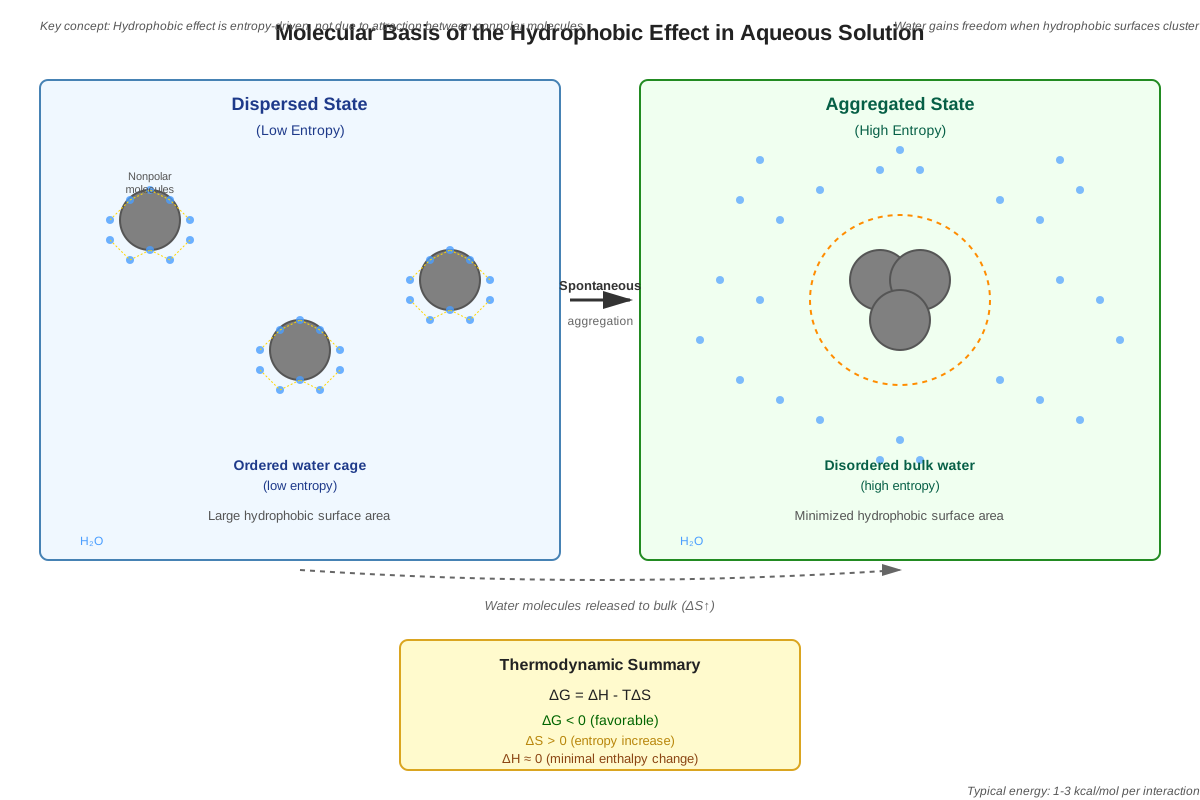
Hydrophobic interactions represent one of the most fundamental forces governing the structure and function of biological macromolecules, particularly proteins. In Biochemistry, these interactions describe the tendency of nonpolar molecules or molecular regions to aggregate together in aqueous environments, effectively minimizing their contact with water molecules. Despite the name suggesting an attractive force between hydrophobic molecules, the driving force is actually entropic—water molecules gain freedom when hydrophobic surfaces cluster together, releasing structured water molecules back into bulk solution.
For the MCAT, understanding hydrophobic interactions is absolutely critical because they underpin protein folding, membrane structure, enzyme active site formation, and ligand-receptor binding. Questions involving Amino Acids and Proteins frequently test whether students can predict how hydrophobic amino acid residues will position themselves within a protein's three-dimensional structure, typically buried in the interior away from the aqueous cytoplasm or extracellular fluid. The MCAT expects students to recognize that hydrophobic interactions, while individually weak (approximately 1-3 kcal/mol per interaction), collectively provide substantial stabilization energy when numerous nonpolar residues cluster together.
Within the broader context of Biochemistry MCAT content, hydrophobic interactions connect intimately with hydrogen bonding, ionic interactions, van der Waals forces, and disulfide bonds—the complete set of noncovalent interactions that determine biomolecular structure. Mastery of this topic enables students to predict protein behavior under varying conditions, understand membrane permeability principles, explain drug-target interactions, and analyze experimental data involving protein denaturation or folding. This topic appears not only in dedicated biochemistry passages but also in biology passages discussing cell membranes, organic chemistry passages exploring solubility, and even general chemistry passages addressing entropy and thermodynamics.
Learning Objectives
- [ ] Define hydrophobic interactions using accurate Biochemistry terminology
- [ ] Explain why hydrophobic interactions matter for the MCAT
- [ ] Apply hydrophobic interactions to exam-style questions
- [ ] Identify common mistakes related to hydrophobic interactions
- [ ] Connect hydrophobic interactions to related Biochemistry concepts
- [ ] Predict the location of hydrophobic amino acid residues in folded protein structures
- [ ] Calculate or estimate the relative contribution of hydrophobic interactions to protein stability
- [ ] Distinguish between hydrophobic interactions and other noncovalent forces in biological systems
- [ ] Analyze experimental scenarios involving disruption or enhancement of hydrophobic interactions
Prerequisites
- Polarity and electronegativity: Understanding molecular polarity is essential because hydrophobic interactions specifically involve nonpolar molecules or regions that cannot form favorable interactions with polar water molecules
- Thermodynamics basics (entropy and enthalpy): The hydrophobic effect is entropy-driven, requiring familiarity with ΔG = ΔH - TΔS and the concept that entropy increases drive spontaneous processes
- Amino acid structure and classification: Students must know which amino acids are hydrophobic (nonpolar) versus hydrophilic to predict their behavior in aqueous environments
- Protein structure levels: Understanding primary, secondary, tertiary, and quaternary structure provides context for where hydrophobic interactions exert their stabilizing effects
- Intermolecular forces: Distinguishing hydrophobic interactions from hydrogen bonds, ionic interactions, and van der Waals forces prevents conceptual confusion
Why This Topic Matters
Clinical and Real-World Significance
Hydrophobic interactions govern countless biological processes with direct clinical relevance. Protein misfolding diseases like Alzheimer's, Parkinson's, and prion diseases often involve aberrant hydrophobic interactions that cause proteins to aggregate inappropriately. Drug design heavily relies on hydrophobic interactions—many pharmaceutical compounds contain hydrophobic regions specifically engineered to bind within hydrophobic pockets of target proteins. Membrane proteins, which constitute approximately 30% of the human proteome and serve as targets for over 50% of modern drugs, depend on hydrophobic interactions to anchor themselves within lipid bilayers.
MCAT Exam Statistics and Question Types
Hydrophobic interactions appear in approximately 15-20% of biochemistry passages on the MCAT, making this a high-yield topic. Questions typically present in three formats: (1) discrete questions asking students to predict amino acid locations in proteins, (2) passage-based questions requiring interpretation of protein stability experiments, and (3) integrated questions connecting protein structure to function. The AAMC frequently tests this concept alongside protein denaturation, enzyme kinetics, and membrane transport mechanisms.
Common Exam Passage Contexts
Expect to encounter hydrophobic interactions in passages describing: protein crystallography studies showing buried hydrophobic cores; detergent effects on membrane proteins; mutations replacing hydrophobic residues with charged residues and their functional consequences; lipid raft formation in cell membranes; and drug-binding studies showing hydrophobic complementarity between ligands and binding pockets. Experimental passages often present data on protein stability measured by techniques like circular dichroism or differential scanning calorimetry, requiring students to interpret how hydrophobic interactions contribute to thermal stability.
Core Concepts
The Hydrophobic Effect: Thermodynamic Foundation
The hydrophobic effect describes the thermodynamically favorable process by which nonpolar molecules or molecular regions aggregate in aqueous solution. Contrary to intuition, this is not primarily due to attraction between hydrophobic molecules themselves, but rather due to the entropic cost of organizing water molecules around nonpolar surfaces. When a hydrophobic molecule dissolves in water, surrounding water molecules form ordered "cages" or clathrate structures to maximize hydrogen bonding among themselves while accommodating the nonpolar solute. This ordering decreases entropy (ΔS < 0), making the process thermodynamically unfavorable.
When hydrophobic molecules cluster together, they minimize their total surface area exposed to water, releasing structured water molecules back into bulk solution where they gain translational and rotational freedom. This entropy increase (ΔS > 0) provides the driving force for hydrophobic aggregation. The process is characterized by:
- Positive entropy change (ΔS > 0): Water molecules gain disorder
- Small or slightly positive enthalpy change (ΔH ≈ 0 or slightly positive): Breaking water-water hydrogen bonds requires energy, but this is partially offset by van der Waals interactions between hydrophobic surfaces
- Negative free energy change (ΔG < 0): The large positive TΔS term dominates, making the process spontaneous at physiological temperatures
Hydrophobic Amino Acids and Protein Structure
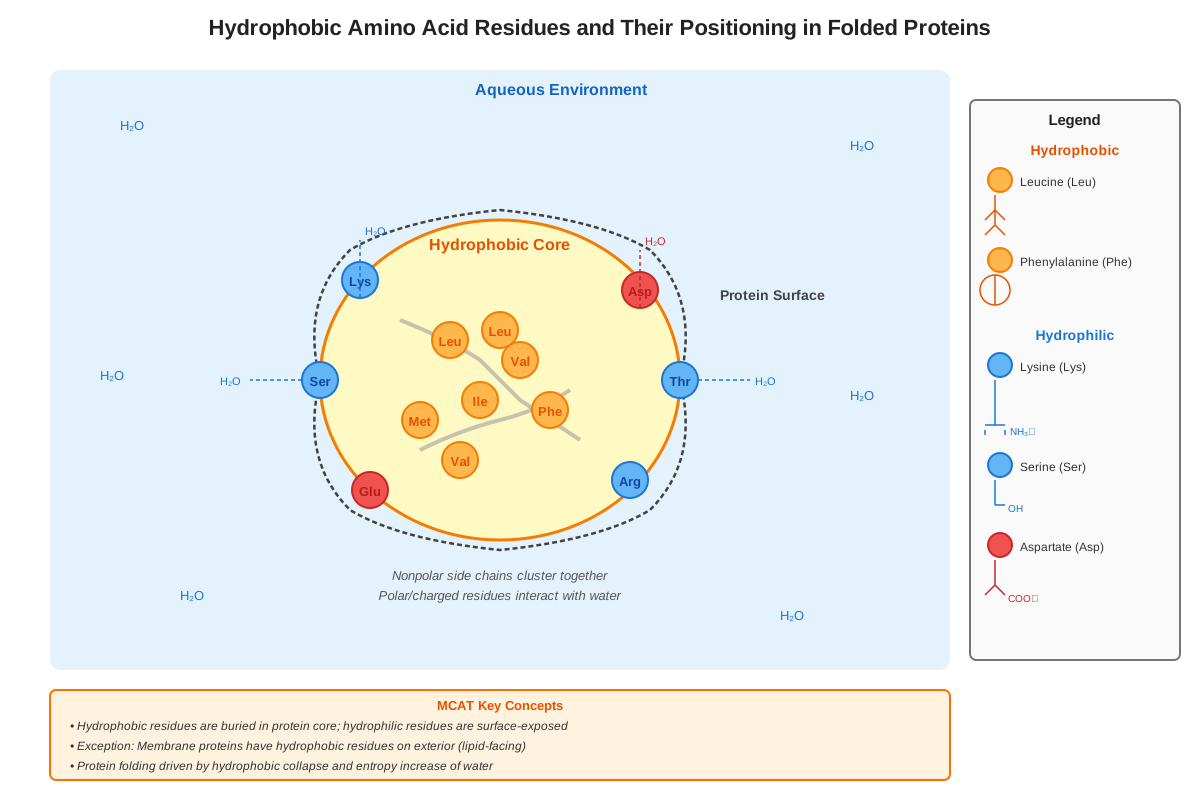
In Amino Acids and Proteins, nine amino acids are classified as hydrophobic based on their nonpolar side chains: glycine, alanine, valine, leucine, isoleucine, proline, phenylalanine, tryptophan, and methionine. These residues preferentially locate in protein interiors, away from aqueous environments. The hydrophobic core of globular proteins typically contains 50-70% of these nonpolar residues, creating a densely packed interior that excludes water molecules.
| Amino Acid | Side Chain Character | Typical Location | Contribution to Hydrophobic Effect |
|---|---|---|---|
| Glycine | Smallest, H atom | Variable | Minimal (high flexibility) |
| Alanine | Small methyl group | Interior | Moderate |
| Valine | Branched aliphatic | Interior | Strong |
| Leucine | Branched aliphatic | Interior | Strong |
| Isoleucine | Branched aliphatic | Interior | Strong |
| Proline | Cyclic structure | Turns, interior | Moderate (structural constraint) |
| Phenylalanine | Aromatic ring | Interior | Very strong |
| Tryptophan | Large aromatic | Interior/interface | Very strong |
| Methionine | Sulfur-containing | Interior | Moderate |
The burial of hydrophobic residues during protein folding releases approximately 1-3 kcal/mol per residue, and with dozens to hundreds of hydrophobic residues in a typical protein, the cumulative stabilization energy becomes substantial (often 50-150 kcal/mol total).
Hydrophobic Interactions in Membrane Structure
Biological membranes exemplify hydrophobic interactions on a cellular scale. The lipid bilayer forms spontaneously when amphipathic phospholipids encounter aqueous environments—their hydrophobic fatty acid tails cluster together to exclude water, while hydrophilic head groups face the aqueous phases. This self-assembly process is entirely driven by the hydrophobic effect, requiring no enzymatic catalysis or energy input beyond thermal motion.
Integral membrane proteins contain hydrophobic transmembrane domains, typically composed of α-helices or β-barrels with hydrophobic amino acids on their exterior surfaces. These hydrophobic surfaces interact favorably with the lipid acyl chains, anchoring the protein within the membrane. The hydrophobic thickness of the membrane (approximately 30 Å for the hydrocarbon core) must match the hydrophobic length of transmembrane segments—a principle called hydrophobic matching that influences protein-lipid interactions and membrane protein function.
Distinguishing Hydrophobic Interactions from Other Forces
Understanding what hydrophobic interactions are NOT is crucial for MCAT success:
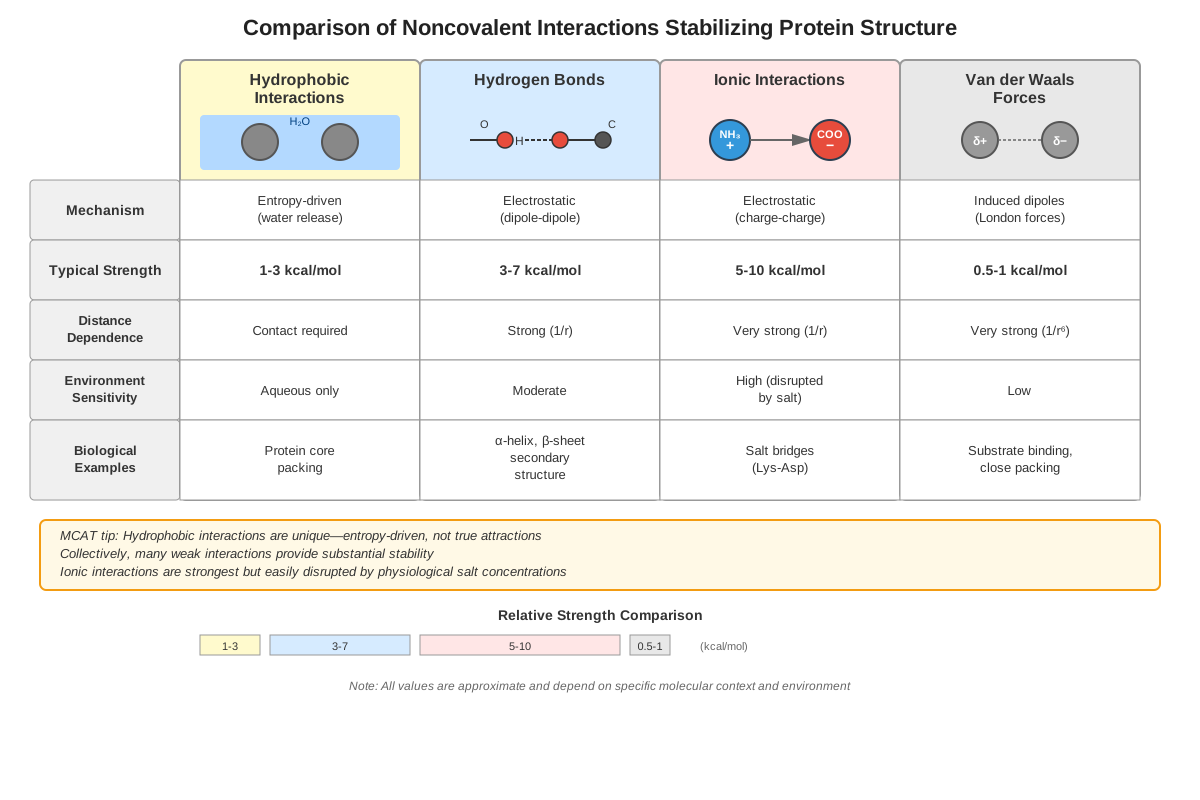
Hydrophobic interactions vs. van der Waals forces: While hydrophobic surfaces that cluster together do experience weak van der Waals attractions (London dispersion forces), the primary driving force is entropic (water release), not enthalpic (direct attraction). Van der Waals forces contribute only about 0.5-1 kcal/mol per interaction.
Hydrophobic interactions vs. hydrogen bonds: Hydrogen bonds are directional, enthalpically favorable interactions between hydrogen bond donors and acceptors. Hydrophobic interactions involve nonpolar groups that cannot form hydrogen bonds, and the driving force is entropic rather than enthalpic.
Hydrophobic interactions vs. ionic interactions: Ionic interactions (salt bridges) occur between charged residues and are primarily enthalpic, involving electrostatic attraction. They are much stronger in nonpolar environments (where the dielectric constant is low) than in water.
Temperature Dependence and the Hydrophobic Effect
The hydrophobic effect exhibits unusual temperature dependence. At low temperatures, the entropic penalty of organizing water around hydrophobic surfaces is relatively small because water molecules are already somewhat ordered. As temperature increases, the entropic cost of constraining water molecules increases, strengthening the hydrophobic effect. However, at very high temperatures, proteins denature because the increased thermal motion overcomes the stabilizing forces, including hydrophobic interactions.
This temperature dependence explains why:
- Proteins are generally more stable at moderate temperatures (25-40°C)
- Cold denaturation can occur at very low temperatures where the hydrophobic effect weakens
- Heat denaturation occurs at high temperatures when entropy of the unfolded chain dominates
Quantitative Aspects: Transfer Free Energy
The strength of hydrophobic interactions can be quantified using transfer free energy (ΔG_transfer), which measures the free energy change when a molecule moves from a nonpolar solvent to water. For hydrophobic amino acid side chains, typical values range from +0.5 to +4 kcal/mol, with larger, more hydrophobic residues showing more positive (unfavorable) transfer energies. These values predict the energetic cost of exposing hydrophobic residues to water, explaining why proteins fold to bury these residues internally.
Concept Relationships
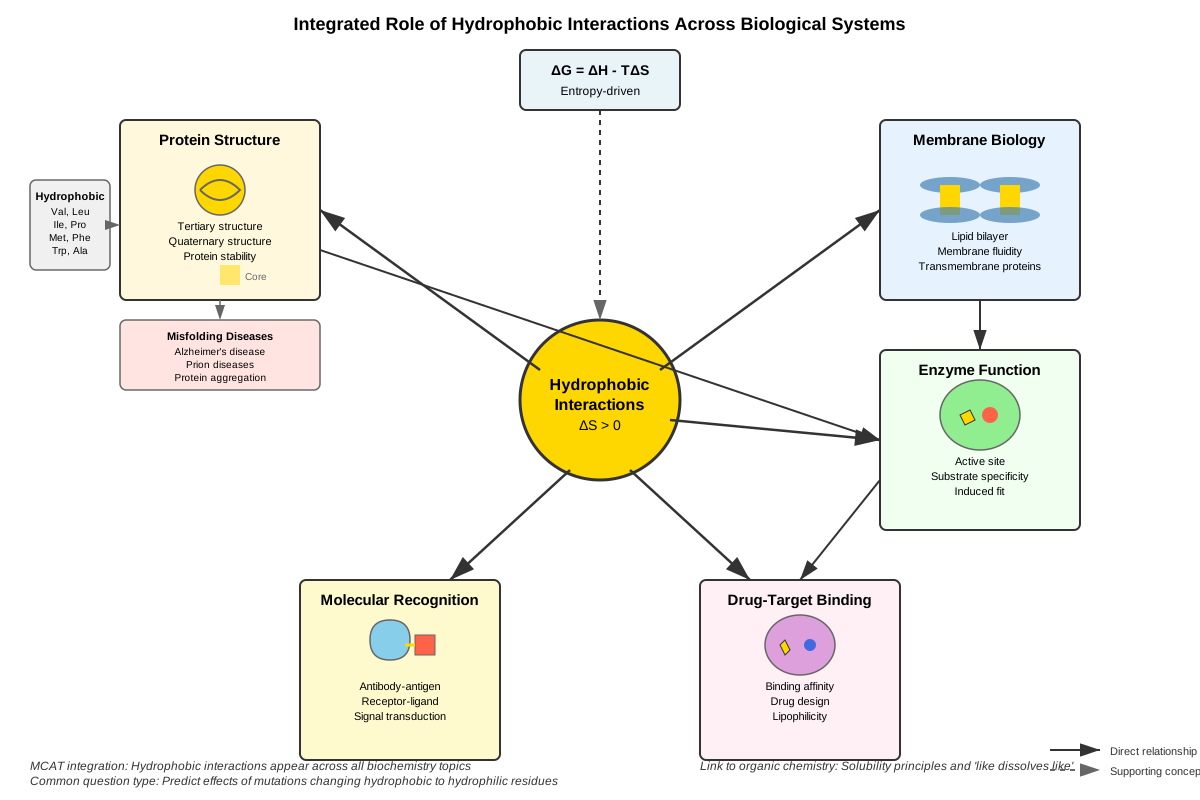
The concepts within hydrophobic interactions form an interconnected network. The thermodynamic foundation (entropy-driven aggregation) → explains → protein folding behavior (burial of hydrophobic residues) → which determines → protein stability and function (active site formation, substrate binding). Similarly, the hydrophobic effect → drives → membrane self-assembly → which enables → compartmentalization and selective permeability in cells.
Hydrophobic interactions connect to prerequisite topics: amino acid properties determine which residues participate in hydrophobic interactions → thermodynamic principles explain why these interactions occur → protein structure levels show where these interactions manifest (primarily tertiary and quaternary structure). The topic also connects forward to enzyme mechanisms (hydrophobic substrate binding), protein-protein interactions (hydrophobic interfaces), and drug design (hydrophobic pharmacophores).
Within the broader biochemistry curriculum, hydrophobic interactions link to: protein denaturation (disruption of hydrophobic core), enzyme kinetics (substrate binding often involves hydrophobic complementarity), membrane transport (hydrophobic molecules cross membranes easily), and signal transduction (membrane protein clustering driven by hydrophobic interactions).
High-Yield Facts
⭐ The hydrophobic effect is entropy-driven, not enthalpy-driven—water molecules gain freedom when hydrophobic surfaces aggregate, providing the thermodynamic driving force (ΔS > 0, TΔS dominates ΔG).
⭐ Hydrophobic amino acids (Val, Leu, Ile, Phe, Trp, Met) preferentially locate in protein interiors, buried away from aqueous environments, while hydrophilic residues locate on protein surfaces.
⭐ The hydrophobic core of proteins is densely packed with minimal water penetration, contributing 50-150 kcal/mol of stabilization energy to folded protein structures.
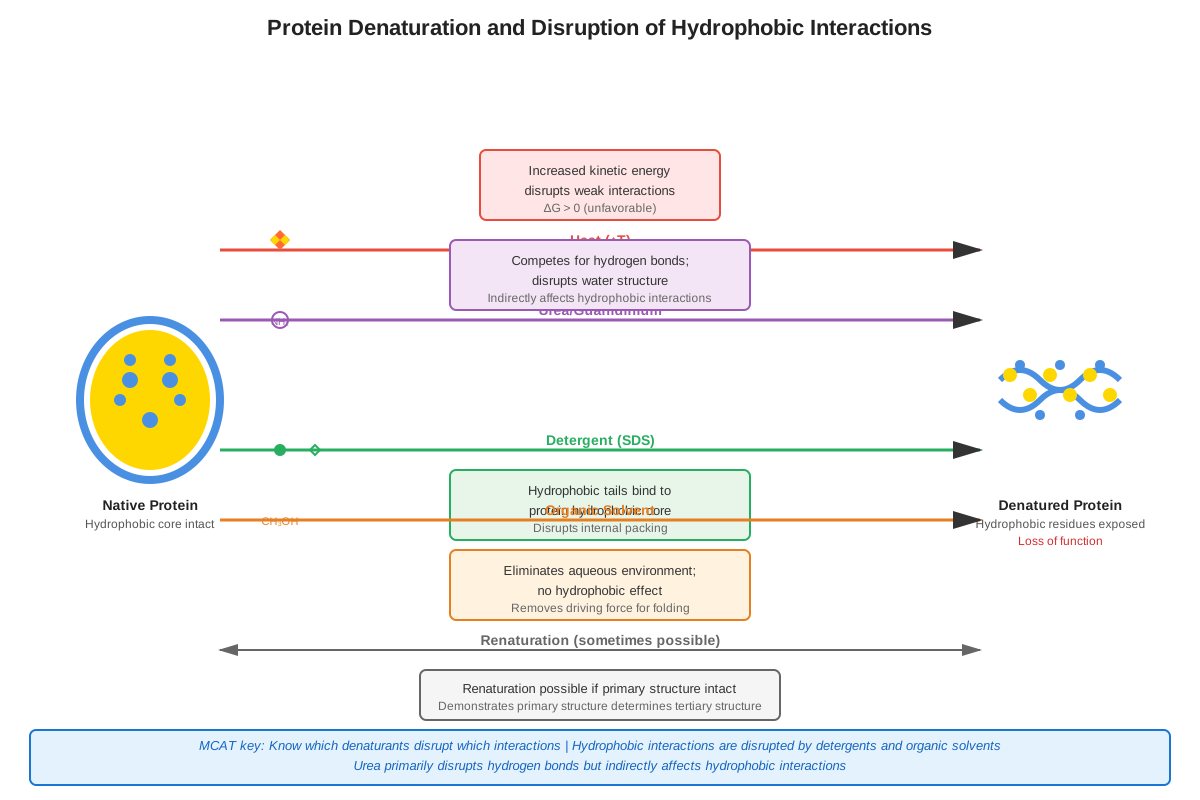
⭐ Detergents and organic solvents disrupt hydrophobic interactions by providing alternative nonpolar environments, leading to protein denaturation or membrane solubilization.
⭐ Membrane lipid bilayers form spontaneously due to the hydrophobic effect, with fatty acid tails clustering to exclude water and polar head groups facing aqueous phases.
- Hydrophobic interactions strengthen with increasing temperature (up to the denaturation point) because the entropic penalty of organizing water increases.
- The hydrophobic effect contributes approximately 1-3 kcal/mol per buried hydrophobic residue, making it weaker per interaction than hydrogen bonds (3-7 kcal/mol) or ionic interactions (5-10 kcal/mol in proteins).
- Mutations replacing buried hydrophobic residues with charged residues typically destabilize proteins by 3-8 kcal/mol, often causing misfolding or aggregation.
- Amphipathic α-helices contain hydrophobic residues on one face and hydrophilic residues on the opposite face, allowing them to interact with both membrane lipids and aqueous environments.
- Protein-protein interfaces typically bury 1000-2000 Ų of hydrophobic surface area, contributing significantly to binding affinity through the hydrophobic effect.
- Hydrophobic interactions are non-directional and non-saturable, unlike hydrogen bonds which require specific geometric arrangements.
- The "hydrophobic moment" quantifies the amphipathicity of helical segments, predicting their membrane-binding or membrane-spanning potential.
Quick check — test yourself on Hydrophobic interactions so far.
Try Flashcards →Common Misconceptions
Misconception: Hydrophobic molecules are repelled by water through some active force.
Correction: There is no repulsive force between water and hydrophobic molecules. Instead, water molecules preferentially interact with each other through hydrogen bonding, and the entropic cost of organizing around hydrophobic surfaces makes their dissolution unfavorable. The apparent "repulsion" is actually water's preference for self-interaction.
Misconception: Hydrophobic interactions are a type of bond like hydrogen bonds or ionic bonds.
Correction: Hydrophobic interactions are not bonds in the traditional sense—they don't involve direct attractive forces between hydrophobic molecules. They are entropy-driven phenomena resulting from water's behavior. The term "interaction" rather than "bond" reflects this distinction.
Misconception: All nonpolar amino acids are equally hydrophobic and contribute equally to protein stability.
Correction: Hydrophobic amino acids vary significantly in their hydrophobicity. Phenylalanine, tryptophan, and isoleucine are highly hydrophobic (ΔG_transfer > +3 kcal/mol), while glycine and alanine are weakly hydrophobic. Larger hydrophobic residues contribute more to protein stability when buried.
Misconception: Hydrophobic interactions are strongest at low temperatures.
Correction: The hydrophobic effect actually strengthens with increasing temperature (within the physiological range) because the entropic penalty of organizing water molecules increases. This is why proteins can undergo cold denaturation at very low temperatures where the hydrophobic effect weakens.
Misconception: The interior of proteins is completely dry with zero water molecules.
Correction: While protein cores are predominantly hydrophobic and exclude most water, small numbers of water molecules (typically 0.1-0.3 water molecules per residue) can be found in protein interiors, often participating in hydrogen bonding networks or filling small cavities. However, the core is much less hydrated than the surface.
Misconception: Hydrophobic interactions only matter for protein folding and have no role in protein function.
Correction: Hydrophobic interactions are crucial for protein function, not just folding. Enzyme active sites often contain hydrophobic pockets that bind nonpolar substrates, protein-protein interactions frequently involve hydrophobic interfaces, and allosteric regulation can involve changes in hydrophobic interactions. Drug binding typically exploits hydrophobic complementarity.
Worked Examples
Example 1: Predicting Mutation Effects on Protein Stability
Question: A researcher mutates a leucine residue at position 45 (Leu45) in the core of a globular protein to glutamic acid (Glu). The wild-type protein has a melting temperature (Tm) of 55°C. Predict the effect of this mutation on protein stability and explain your reasoning using principles of hydrophobic interactions.
Solution:
Step 1: Identify the nature of the amino acid change.
- Leucine is a hydrophobic amino acid with a branched aliphatic side chain
- Glutamic acid is a charged, hydrophilic amino acid with a carboxyl group (pKa ≈ 4.2)
- This represents a hydrophobic → charged substitution
Step 2: Consider the location (protein core).
- The protein core is a hydrophobic environment with minimal water
- Hydrophobic residues are strongly favored in this location
- Charged residues are strongly disfavored in the core because:
- They cannot be solvated by water (energetically costly)
- They cannot form favorable ionic interactions without counter-ions
- They disrupt the densely packed hydrophobic core
Step 3: Predict the thermodynamic consequences.
- Burying a charged residue costs approximately 5-10 kcal/mol of unfavorable energy
- Loss of hydrophobic interactions from leucine burial: approximately -2 to -3 kcal/mol
- Net destabilization: approximately 7-13 kcal/mol
Step 4: Predict the phenotype.
- The mutant protein will be significantly destabilized
- Tm will decrease substantially (likely by 10-20°C or more)
- The protein may misfold, aggregate, or be rapidly degraded
- If the protein folds at all, it may adopt an altered structure with the glutamic acid exposed to solvent
Answer: The Leu45Glu mutation will severely destabilize the protein, decreasing its Tm by 10-20°C or more. This occurs because replacing a hydrophobic leucine with charged glutamic acid in the protein core eliminates favorable hydrophobic interactions and introduces a highly unfavorable buried charge. The mutant protein will likely misfold or aggregate.
Connection to Learning Objectives: This example demonstrates application of hydrophobic interaction principles to predict experimental outcomes (LO: Apply to exam-style questions) and connects protein stability to amino acid properties (LO: Connect to related concepts).
Example 2: Analyzing Detergent Effects on Membrane Proteins
Question: An experiment examines the effect of sodium dodecyl sulfate (SDS), an anionic detergent, on a transmembrane protein. In the presence of SDS, the protein loses its native structure and migrates as a linear chain during gel electrophoresis. Explain the molecular mechanism by which SDS disrupts the protein structure, focusing on hydrophobic interactions.
Solution:
Step 1: Understand the structure of SDS and membrane proteins.
- SDS is an amphipathic molecule with a 12-carbon hydrophobic tail and a charged sulfate head group
- Transmembrane proteins contain hydrophobic α-helices or β-barrels that span the lipid bilayer
- These hydrophobic transmembrane domains are stabilized by interactions with membrane lipid tails
Step 2: Identify the native hydrophobic interactions.
- In the membrane, hydrophobic amino acids on the protein exterior interact favorably with lipid acyl chains
- The protein's hydrophobic transmembrane segments are shielded from water
- Protein-lipid hydrophobic interactions stabilize the native membrane-embedded state
Step 3: Explain SDS mechanism of action.
- SDS molecules bind to hydrophobic regions of the protein through their hydrophobic tails
- The charged sulfate head groups face outward toward the aqueous solution
- This creates a protein-detergent complex where hydrophobic protein surfaces are now shielded by detergent rather than lipids
Step 4: Describe the consequences.
- The protein-detergent complex is soluble in aqueous solution (detergent head groups interact with water)
- Native protein-protein and protein-lipid hydrophobic interactions are disrupted
- The protein unfolds because its hydrophobic residues are now satisfied by detergent interactions rather than by burial in the protein core or membrane
- The uniform negative charge from SDS causes the protein to adopt an extended conformation
Step 5: Connect to thermodynamics.
- SDS provides an alternative hydrophobic environment, changing the thermodynamic balance
- The free energy of the unfolded, detergent-coated state becomes more favorable than the folded state
- ΔG_folding becomes positive (unfavorable), driving denaturation
Answer: SDS disrupts the membrane protein by providing an alternative hydrophobic environment. The detergent's hydrophobic tails bind to hydrophobic regions of the protein (transmembrane domains and buried hydrophobic residues), while its charged head groups face the aqueous solution, solubilizing the protein. This disrupts native hydrophobic interactions that stabilize the folded, membrane-embedded structure, causing denaturation. The protein unfolds into a linear, detergent-coated chain that migrates based on molecular weight during electrophoresis.
Connection to Learning Objectives: This example illustrates how disrupting hydrophobic interactions affects protein structure (LO: Define and explain), demonstrates application to experimental scenarios (LO: Apply to exam-style questions), and connects to membrane protein biochemistry (LO: Connect to related concepts).
Exam Strategy
Approaching MCAT Questions on Hydrophobic Interactions
Step 1: Identify the question type
- Structure prediction: "Where would amino acid X most likely be located?"
- Stability analysis: "How would mutation Y affect protein stability?"
- Mechanism questions: "What drives the formation of lipid bilayers?"
- Experimental interpretation: "Why does treatment Z denature the protein?"
Step 2: Activate relevant principles
- Hydrophobic residues prefer nonpolar environments (protein cores, membrane interiors)
- The hydrophobic effect is entropy-driven (water release)
- Disrupting hydrophobic interactions destabilizes structures
- Hydrophobic interactions are non-directional and cumulative
Step 3: Eliminate wrong answers
- Eliminate options suggesting hydrophobic residues prefer aqueous environments
- Eliminate options confusing hydrophobic interactions with covalent bonds
- Eliminate options suggesting enthalpy drives the hydrophobic effect
- Eliminate options that ignore the location context (membrane vs. aqueous)
Trigger Words and Phrases
Watch for these high-yield terms that signal hydrophobic interaction content:
- "Nonpolar residues," "hydrophobic core," "buried residues"
- "Protein interior," "membrane-spanning," "lipid bilayer"
- "Detergent," "organic solvent," "denaturation"
- "Amphipathic," "hydrophobic face," "hydrophobic moment"
- "Protein stability," "folding," "aggregation"
- "Entropy-driven," "water release," "hydrophobic effect"
Process of Elimination Tips
For structure prediction questions: If a question asks where a hydrophobic amino acid would be located, immediately eliminate options placing it on the protein surface exposed to water or in the active site if the substrate is polar.
For stability questions: If a mutation introduces a charged residue into a hydrophobic core, the protein will be destabilized—eliminate options suggesting increased stability or no effect.
For mechanism questions: If asked what drives lipid bilayer formation, eliminate options emphasizing enthalpy or covalent bonding—the correct answer will involve entropy and the hydrophobic effect.
Time Allocation Advice
Hydrophobic interaction questions typically require 60-90 seconds:
- 15-20 seconds: Read and identify the question type
- 20-30 seconds: Analyze the scenario (amino acid properties, location, conditions)
- 20-30 seconds: Apply principles and predict the outcome
- 10-15 seconds: Eliminate wrong answers and select the best option
Exam Tip: When facing a complex passage about protein structure, quickly scan for information about amino acid composition and location. Questions will often test whether you can predict which residues are buried (hydrophobic) versus exposed (hydrophilic). This pattern appears in 60-70% of protein structure passages.
Memory Techniques
Mnemonic for Hydrophobic Amino Acids
"FAMILY VIP" captures the nine hydrophobic amino acids:
- Fenylalanine
- Alanine
- Methionine
- Isoleucine
- Leucine
- Y (tYrosine - borderline, often at interfaces)
- Valine
- I (already used, represents the importance of branched chains)
- Proline
Alternative: "GAVLIMFPW" (Gly, Ala, Val, Leu, Ile, Met, Phe, Pro, Trp) - pronounce as "GAV-LIM-FPW"
Visualization Strategy: The Oil Drop Model
Visualize a protein as an "oil drop in water":
- The core is like oil—hydrophobic residues cluster together, excluding water
- The surface is like a detergent layer—hydrophilic residues interact with surrounding water
- This mental model helps predict: buried residues (in the oil), surface residues (in the detergent layer), and the consequences of mutations (putting a charged residue in oil is highly unfavorable)
Thermodynamic Memory Aid
"Entropy Expels": Remember that entropy (not enthalpy) expels water from hydrophobic surfaces, driving aggregation. The hydrophobic effect is all about water gaining freedom (positive ΔS), not about attraction between hydrophobic molecules.
Acronym for Hydrophobic Interaction Properties
"WENDS" captures key properties:
- Water release drives the effect
- Entropy-driven (ΔS > 0)
- Non-directional interactions
- Destabilized by detergents/denaturants
- Strengthens with temperature (in physiological range)
Summary
Hydrophobic interactions represent entropy-driven phenomena where nonpolar molecules or molecular regions aggregate in aqueous environments to minimize water contact. The driving force is not attraction between hydrophobic surfaces but rather the release of ordered water molecules back into bulk solution, increasing system entropy. In proteins, hydrophobic amino acids (Val, Leu, Ile, Phe, Trp, Met, and others) preferentially locate in the interior, creating a densely packed hydrophobic core that contributes 50-150 kcal/mol of stabilization energy. These interactions are crucial for protein folding, membrane bilayer formation, protein-protein interactions, and enzyme-substrate binding. Unlike hydrogen bonds or ionic interactions, hydrophobic interactions are non-directional and strengthen with increasing temperature within the physiological range. Disruption of hydrophobic interactions through detergents, organic solvents, or destabilizing mutations leads to protein denaturation or membrane solubilization. For MCAT success, students must predict amino acid locations based on hydrophobicity, explain stability changes from mutations, and understand the thermodynamic basis (ΔS > 0, TΔS dominates) of the hydrophobic effect.
Key Takeaways
- Hydrophobic interactions are entropy-driven: Water molecules gain freedom when hydrophobic surfaces aggregate, providing the thermodynamic driving force (ΔG < 0 due to large positive TΔS)
- Hydrophobic amino acids bury in protein interiors: Val, Leu, Ile, Phe, Trp, and Met preferentially locate away from aqueous environments, creating a densely packed hydrophobic core
- The hydrophobic effect drives membrane self-assembly: Lipid bilayers form spontaneously as fatty acid tails cluster to exclude water while polar head groups face aqueous phases
- Disrupting hydrophobic interactions destabilizes proteins: Detergents, organic solvents, and mutations introducing charged residues into hydrophobic cores cause denaturation
- Hydrophobic interactions differ from other forces: They are non-directional, entropy-driven, and involve no direct attraction between hydrophobic molecules, unlike hydrogen bonds or ionic interactions
- Temperature dependence is unusual: The hydrophobic effect strengthens with increasing temperature (up to denaturation) because the entropic penalty of organizing water increases
- Cumulative effects are substantial: Individual hydrophobic interactions contribute 1-3 kcal/mol, but dozens to hundreds of buried residues provide 50-150 kcal/mol total stabilization
Related Topics
Protein Denaturation and Refolding: Understanding hydrophobic interactions enables comprehension of how proteins lose structure under denaturing conditions (heat, pH extremes, chaotropic agents) and how some proteins can spontaneously refold when conditions normalize. Mastery of hydrophobic interactions is prerequisite to understanding denaturation mechanisms.
Enzyme-Substrate Binding and Specificity: Many enzyme active sites contain hydrophobic pockets that bind nonpolar substrates through hydrophobic interactions. Understanding these interactions explains substrate specificity and competitive inhibition mechanisms.
Membrane Transport and Permeability: The hydrophobic core of lipid bilayers creates a permeability barrier based on hydrophobic interactions. Mastering this topic enables prediction of which molecules cross membranes easily (hydrophobic) versus requiring transporters (hydrophilic).
Protein-Protein Interactions and Quaternary Structure: Subunit interfaces in multi-subunit proteins typically involve extensive hydrophobic contacts. Understanding hydrophobic interactions explains how quaternary structures assemble and remain stable.
Drug Design and Pharmacology: Pharmaceutical compounds often contain hydrophobic regions designed to bind within hydrophobic pockets of target proteins. This topic connects directly to medicinal chemistry and rational drug design principles.
Practice CTA
Now that you've mastered the fundamental principles of hydrophobic interactions, it's time to reinforce your understanding through active practice. Attempt the practice questions and flashcards associated with this topic to test your ability to apply these concepts under exam conditions. Focus especially on predicting amino acid locations, analyzing mutation effects, and explaining experimental observations involving protein stability or membrane structure. Remember: understanding the entropy-driven nature of the hydrophobic effect distinguishes high-scoring students from those who merely memorize facts. Each practice question you complete strengthens your ability to think like a biochemist and approach MCAT passages with confidence. You've built a strong foundation—now apply it!
Sign up free to keep reading
Create a free AnvayaPrep account to finish this MCAT guide on Hydrophobic interactions — plus flashcards and practice questions.