Overview
Anomers represent a fundamental concept in carbohydrate chemistry that appears regularly on the MCAT, particularly in Biochemistry passages involving sugar metabolism, glycosidic bond formation, and structural analysis of biological molecules. Anomers are stereoisomers of cyclic monosaccharides that differ only in the configuration at the anomeric carbon—the carbon atom that was the carbonyl carbon in the open-chain form of the sugar. When a linear monosaccharide cyclizes to form a ring structure, the carbonyl carbon becomes a new chiral center, creating two possible configurations designated as α (alpha) and β (beta) anomers.
Understanding anomers is essential for MCAT success because carbohydrates constitute one of the four major biomolecule classes tested extensively on the exam. The ability to recognize, distinguish, and predict the behavior of anomers connects directly to questions about disaccharide formation, polysaccharide structure (such as starch versus cellulose), enzyme specificity, and the mechanisms of glycosidic bond formation. The MCAT frequently presents passage-based questions requiring students to interpret Haworth projections, Fischer projections, or chair conformations of cyclic sugars and identify anomeric relationships.
Within the broader context of Biochemistry, anomers bridge organic chemistry principles (stereochemistry, ring formation, nucleophilic addition) with biological function. The distinction between α and β anomers determines critical biological properties: α-1,4-glycosidic linkages create digestible starches, while β-1,4-linkages produce indigestible cellulose. This single stereochemical difference at the anomeric carbon has profound nutritional and structural implications. Mastering anomers provides the foundation for understanding more complex topics including mutarotation, reducing sugars, glycoprotein formation, and the specificity of carbohydrate-processing enzymes.
Learning Objectives
- [ ] Define anomers using accurate Biochemistry terminology, including the anomeric carbon and α/β designation
- [ ] Explain why anomers matter for the MCAT, including their appearance in passages and discrete questions
- [ ] Apply anomers concepts to exam-style questions involving sugar structure identification and glycosidic bond analysis
- [ ] Identify common mistakes related to anomers, particularly in stereochemical assignments and structural drawings
- [ ] Connect anomers to related Biochemistry concepts including mutarotation, reducing sugars, and polysaccharide structure
- [ ] Distinguish between anomers and epimers in carbohydrate stereochemistry
- [ ] Predict the relative stability of α versus β anomers in different monosaccharides
- [ ] Analyze Haworth projections and chair conformations to identify anomeric configuration
- [ ] Explain the mechanism of hemiacetal and hemiketal formation that generates anomers
Prerequisites
- Carbonyl chemistry: Understanding aldehydes and ketones is essential because anomers form when the carbonyl group of a monosaccharide reacts with a hydroxyl group to create a cyclic hemiacetal or hemiketal
- Stereochemistry fundamentals: Knowledge of chiral centers, R/S configuration, and stereoisomer types (enantiomers, diastereomers) provides the framework for understanding how anomers relate to other stereoisomers
- Fischer and Haworth projections: Familiarity with these representational systems is necessary to visualize and interconvert between linear and cyclic sugar structures
- Monosaccharide structure: Basic knowledge of glucose, fructose, and other simple sugars in their open-chain forms establishes the starting point for cyclization reactions
- Nucleophilic addition mechanisms: Understanding how nucleophiles attack carbonyl carbons explains the intramolecular reaction that forms the cyclic structure and creates the anomeric carbon
Why This Topic Matters
Clinical and Real-World Significance: The α/β anomeric distinction has profound biological consequences. Human digestive enzymes possess strict specificity for anomeric configuration—α-amylase cleaves α-1,4-glycosidic bonds in starch but cannot hydrolyze β-1,4-bonds in cellulose, explaining why humans can digest potatoes but not wood despite both being glucose polymers. This specificity extends to drug design, where pharmaceutical compounds often incorporate specific anomeric configurations to enhance bioavailability or target particular metabolic pathways. Blood type antigens depend on specific glycosidic linkages involving defined anomeric configurations, making this concept relevant to immunology and transfusion medicine.
MCAT Exam Statistics: Carbohydrate questions appear in approximately 8-12% of Biochemistry passages on the MCAT, with anomers specifically tested in 3-5% of all Biochemistry questions. The topic appears most frequently in passage-based questions (60% of anomer questions) rather than discrete items, often embedded within broader discussions of metabolism, enzyme specificity, or structural biology. Questions typically require students to identify anomeric configuration from structural representations, predict products of glycosidic bond formation, or explain differences in polysaccharide properties based on anomeric linkages.
Common Exam Presentations: The MCAT presents anomers through multiple formats: (1) Haworth projections requiring identification of α versus β configuration, (2) passages describing enzyme specificity for particular anomeric forms, (3) experimental data showing mutarotation and equilibrium between anomers, (4) comparison questions contrasting starch and cellulose structure, and (5) mechanism-based questions about hemiacetal formation. Passages may include NMR data, optical rotation measurements, or enzymatic digestion experiments that indirectly test anomer knowledge. Recognition of these presentation styles enables efficient question analysis and accurate response selection.
Core Concepts
Definition and Formation of Anomers
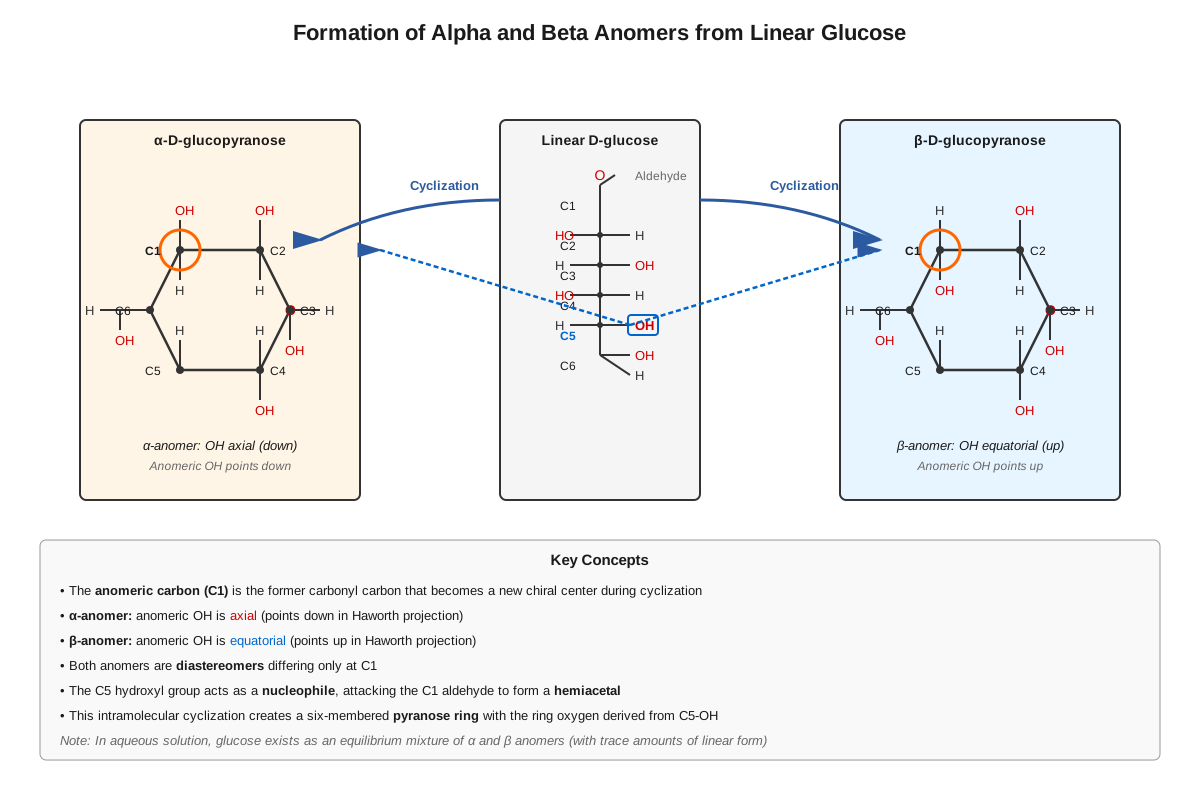
Anomers are a specific type of stereoisomer—specifically, diastereomers—that differ only in configuration at the anomeric carbon. The anomeric carbon is the carbon atom that becomes a new stereogenic center when a monosaccharide cyclizes from its open-chain form. In aldoses (aldehyde-containing sugars like glucose), the anomeric carbon is C-1; in ketoses (ketone-containing sugars like fructose), it is typically C-2.
The formation of anomers occurs through intramolecular hemiacetal formation (in aldoses) or hemiketal formation (in ketoses). When a linear monosaccharide exists in solution, the hydroxyl group on C-5 (in six-membered pyranose rings) or C-4 (in five-membered furanose rings) acts as a nucleophile, attacking the electrophilic carbonyl carbon. This nucleophilic addition creates a cyclic structure and converts the planar, achiral carbonyl carbon into a tetrahedral, chiral center—the anomeric carbon.
Because the nucleophilic attack can occur from either face of the planar carbonyl group, two stereoisomeric products form: the α-anomer and the β-anomer. The designation depends on the relative orientation of the hydroxyl group at the anomeric carbon compared to the reference group (the CH₂OH group that determines D/L configuration). In D-sugars drawn as Haworth projections, the β-anomer has the anomeric hydroxyl group on the same side as the CH₂OH group (both "up" in D-glucose), while the α-anomer has it on the opposite side.
Alpha versus Beta Configuration
The distinction between α and β anomers follows specific stereochemical rules that students must master for MCAT success:
| Feature | α-Anomer | β-Anomer |
|---|---|---|
| Haworth projection (D-sugars) | Anomeric -OH points DOWN | Anomeric -OH points UP |
| Relationship to CH₂OH | Opposite side (trans) | Same side (cis) |
| Chair conformation preference | Often axial -OH | Often equatorial -OH |
| Stability in glucose | Less stable (~36% at equilibrium) | More stable (~64% at equilibrium) |
| Optical rotation (glucose) | +112° | +19° |
For D-glucose, the most commonly tested monosaccharide, β-D-glucose predominates at equilibrium because the anomeric hydroxyl group occupies the more favorable equatorial position in the chair conformation, minimizing steric interactions. This preference is called the anomeric effect when the axial position is actually favored due to electronic factors, though in glucose, sterics dominate.
The α/β designation is independent of optical rotation direction (+/- or d/l). Students often confuse these systems, but they describe different properties: α/β describes stereochemical configuration at the anomeric carbon, while +/- describes the direction of plane-polarized light rotation, a physical property measured experimentally.
The Anomeric Carbon and Its Unique Properties
The anomeric carbon possesses distinctive chemical properties that distinguish it from other carbons in the sugar ring:
- Dual functionality: It is simultaneously part of a hemiacetal (or hemiketal) and an ether linkage, making it more reactive than other ring carbons
- Reducing capability: When the anomeric carbon has a free hydroxyl group (not involved in a glycosidic bond), the sugar can open to reveal the reactive carbonyl, making it a reducing sugar
- Glycosidic bond formation: The anomeric hydroxyl is the site where glycosidic bonds form during disaccharide and polysaccharide synthesis
- Mutarotation: The anomeric carbon can interconvert between α and β forms through ring opening and reclosing, a process called mutarotation
The reactivity of the anomeric carbon stems from the electron-withdrawing effect of two oxygen atoms attached to it (one in the ring, one as the hydroxyl group). This makes the anomeric hydroxyl more acidic than other sugar hydroxyls and more susceptible to substitution reactions.
Mutarotation: Dynamic Equilibrium Between Anomers
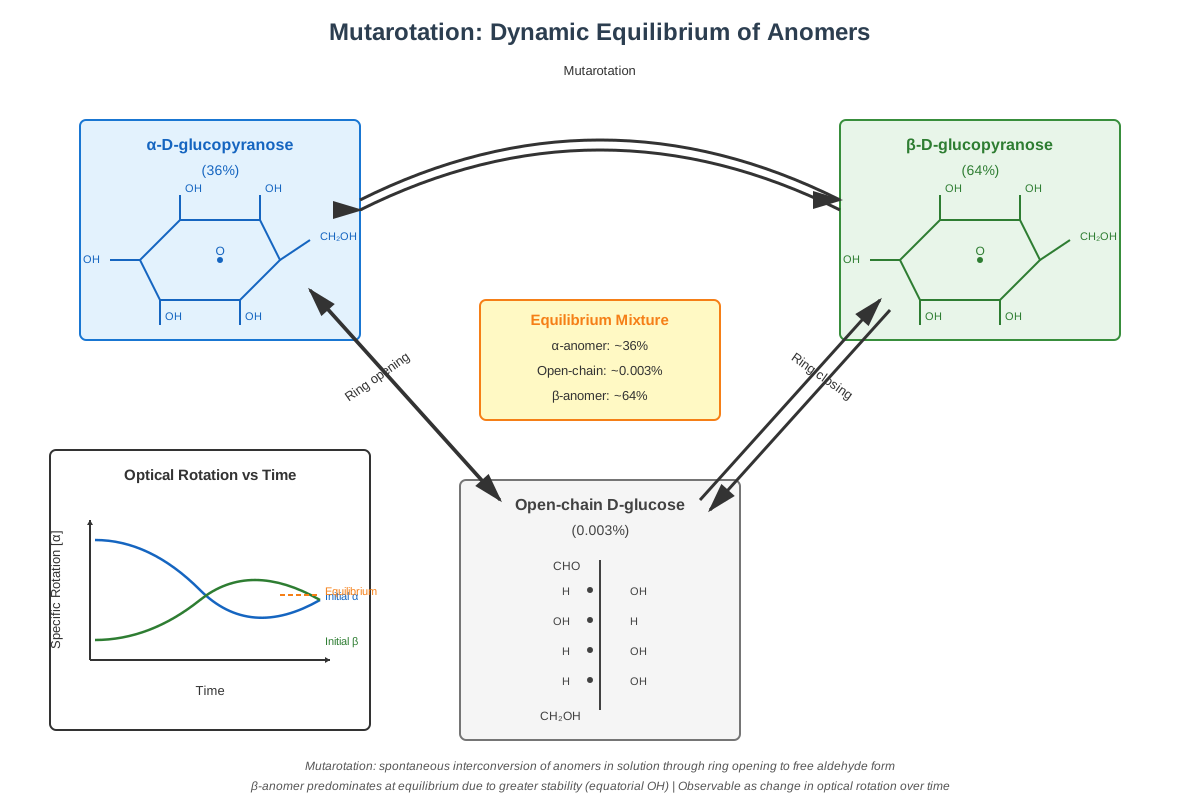
Mutarotation is the spontaneous interconversion between α and β anomers in solution, proceeding through the open-chain form as an intermediate. When pure α-D-glucose dissolves in water, its specific rotation gradually changes from +112° to +52.7°, the equilibrium value. Similarly, pure β-D-glucose (specific rotation +19°) also reaches +52.7° at equilibrium. This equilibrium mixture contains approximately 36% α-anomer, 64% β-anomer, and less than 0.1% open-chain form.
The mechanism of mutarotation involves:
- Ring opening: The hemiacetal breaks, regenerating the carbonyl group
- Free rotation: The open-chain form allows rotation around C-C bonds
- Ring closing: The C-5 hydroxyl attacks the carbonyl from either face
- Anomer formation: Attack from one face produces α, from the other produces β
Mutarotation is catalyzed by both acids and bases. Acids protonate the ring oxygen, facilitating ring opening, while bases deprotonate the anomeric hydroxyl, also promoting ring opening. At physiological pH, mutarotation occurs relatively slowly (hours to reach equilibrium), but enzymes called mutarotases catalyze this process in biological systems when rapid interconversion is needed.
Anomers in Glycosidic Bond Formation
When the anomeric hydroxyl group reacts with another hydroxyl group (from another sugar or an alcohol), a glycosidic bond forms, creating an acetal (or ketal) rather than a hemiacetal. This reaction "locks" the anomeric configuration—the α or β designation becomes fixed and mutarotation can no longer occur at that position.
Glycosidic bonds are named according to:
- The anomeric configuration (α or β)
- The carbon number of the anomeric carbon
- The carbon number of the accepting hydroxyl
For example, maltose contains an α-1,4-glycosidic bond (α-anomer of first glucose, linking C-1 to C-4 of second glucose), while cellobiose contains a β-1,4-glycosidic bond. This single stereochemical difference creates dramatically different biological properties: maltose is digestible by human enzymes, while cellobiose (the repeating unit of cellulose) is not.
Biological Significance: Starch versus Cellulose
The most high-yield biological application of anomer chemistry is the structural difference between starch and cellulose:
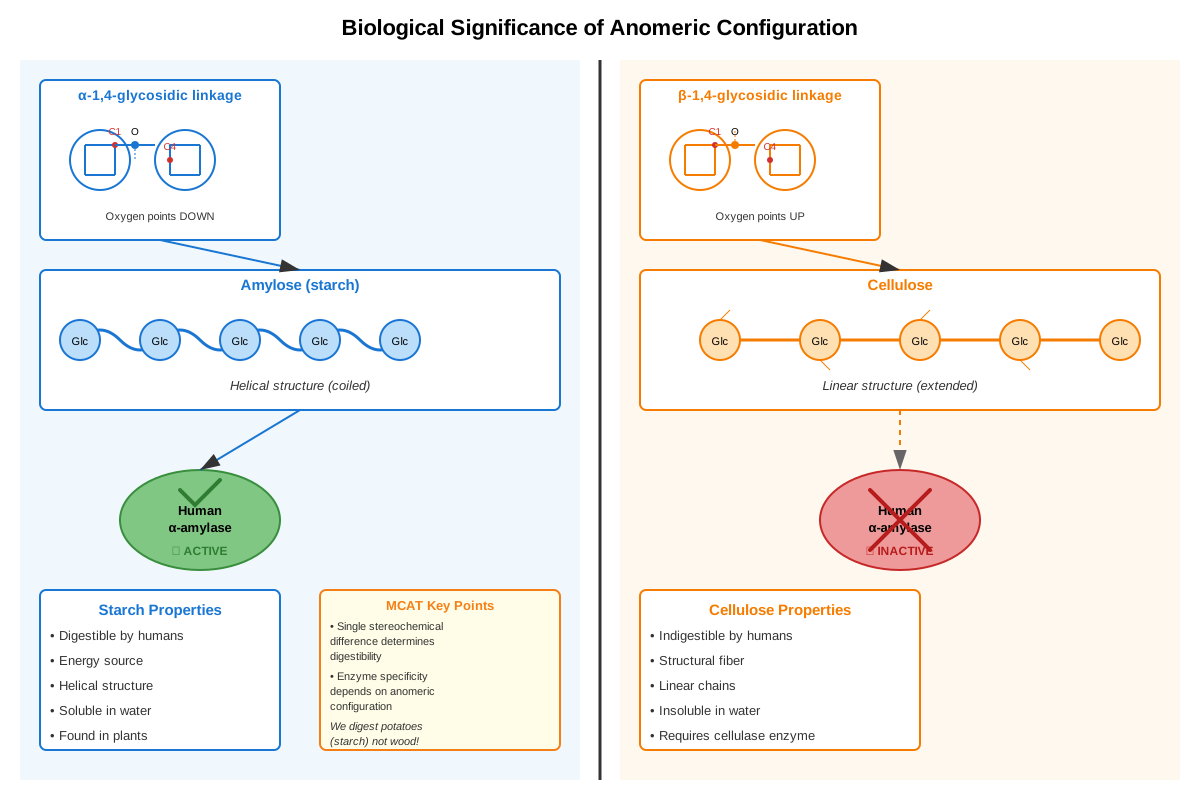
Starch (α-1,4 and α-1,6-glycosidic bonds):
- Digestible by human α-amylase and α-glucosidase
- Forms helical structures that pack efficiently for energy storage
- Includes amylose (linear, α-1,4 only) and amylopectin (branched, α-1,4 and α-1,6)
- Serves as the primary energy storage polysaccharide in plants
Cellulose (β-1,4-glycosidic bonds):
- Indigestible by humans (lack β-glucosidase/cellulase)
- Forms linear chains that hydrogen bond into rigid fibers
- Provides structural support in plant cell walls
- Most abundant organic compound on Earth
This difference illustrates enzyme specificity: the active site geometry of α-amylase complements the three-dimensional shape of α-glycosidic bonds but cannot accommodate β-linkages. This specificity extends throughout metabolism—enzymes that synthesize or break down carbohydrates show strict preference for particular anomeric configurations.
Anomers versus Other Stereoisomers
Understanding how anomers relate to other types of stereoisomers prevents common MCAT errors:
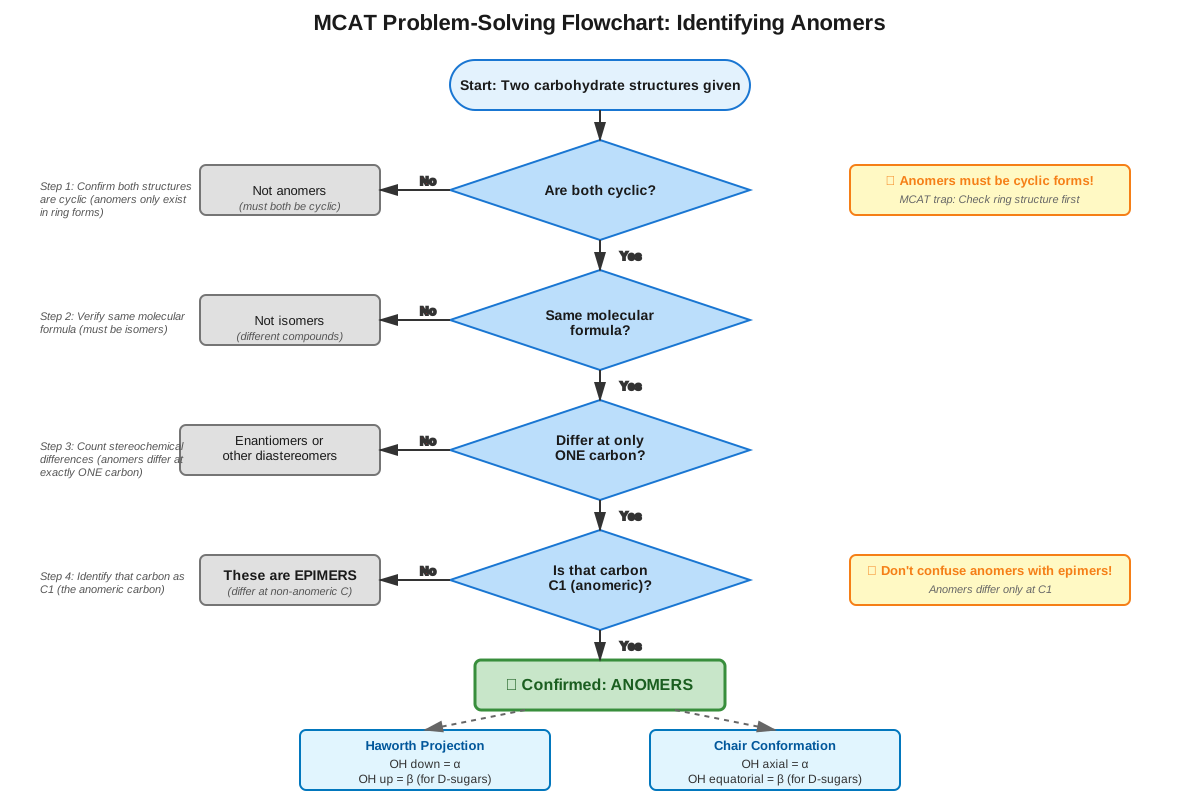
- Anomers: Differ only at the anomeric carbon; always diastereomers; interconvert through mutarotation
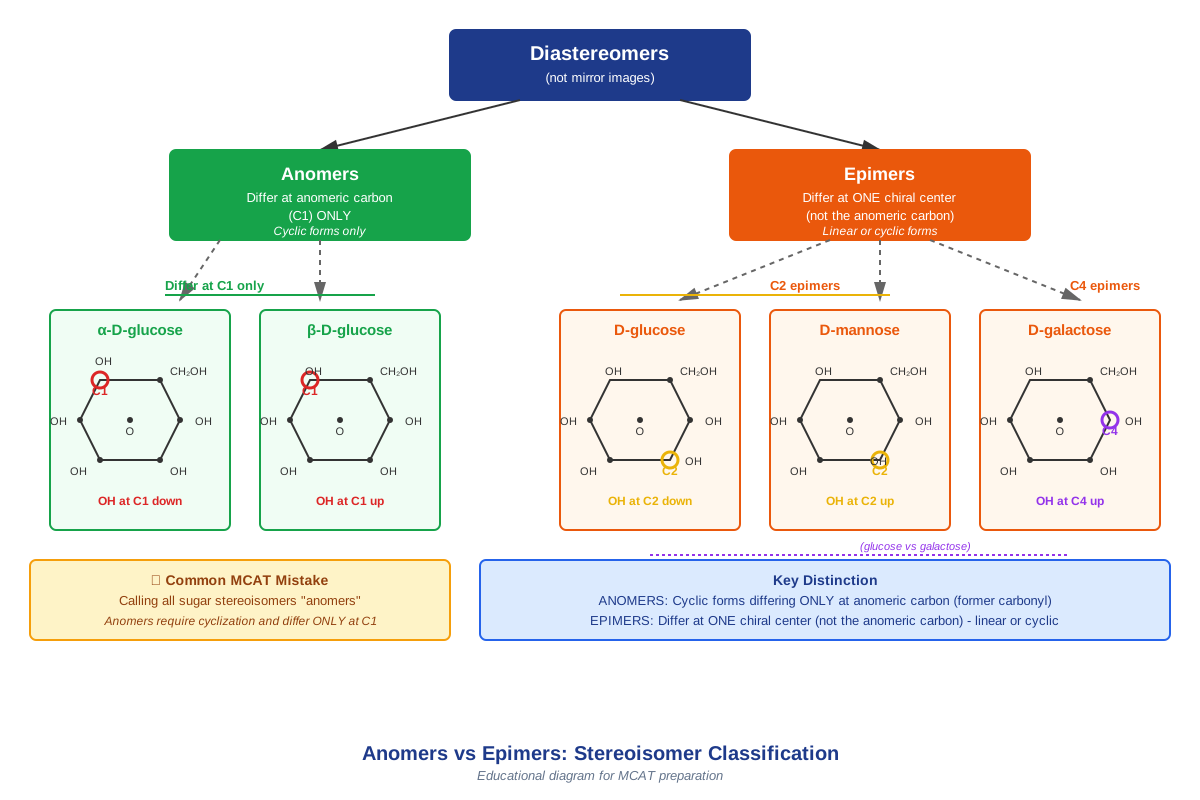
- Epimers: Differ at any single chiral center (not necessarily the anomeric carbon); glucose and galactose are C-4 epimers; do NOT interconvert spontaneously
- Enantiomers: Mirror images; D-glucose and L-glucose are enantiomers; differ at all chiral centers
- Diastereomers: Stereoisomers that are not mirror images; anomers are a subset of diastereomers
The key distinction: anomers are specifically diastereomers that differ at the anomeric carbon and can interconvert through mutarotation, while epimers differ at other carbons and require enzymatic epimerization to interconvert.
Concept Relationships
The concept of anomers sits at the intersection of multiple biochemical principles, creating a web of interconnected ideas essential for MCAT mastery. Carbonyl chemistry provides the mechanistic foundation → hemiacetal formation creates the cyclic structure → anomeric carbon generation produces two stereoisomers → α and β anomers with distinct properties → mutarotation establishes dynamic equilibrium → glycosidic bond formation locks configuration → polysaccharide structure determines biological function.
Anomers connect directly to stereochemistry concepts: they represent a specific type of diastereomer, requiring understanding of chiral centers, configuration assignment, and three-dimensional molecular visualization. The relationship between Fischer projections (open-chain) and Haworth projections (cyclic) demands facility with representational interconversion, a skill tested across organic chemistry and biochemistry questions.
The concept extends to enzyme specificity: the lock-and-key model of enzyme-substrate interaction explains why α-amylase cleaves α-glycosidic bonds but not β-bonds. This connects to metabolism, where specific enzymes (glucokinase, hexokinase) phosphorylate glucose at C-6, but the anomeric configuration at C-1 affects reaction rates and enzyme affinity.
Reducing sugars represent another critical connection: sugars with free anomeric carbons (capable of mutarotation) can reduce Benedict's or Fehling's reagent, while sugars with glycosidic bonds at both anomeric carbons (like sucrose) cannot. This links anomers to laboratory techniques and analytical chemistry.
Finally, anomers connect to biological structure and function: the α-versus-β distinction determines whether a polysaccharide serves energy storage (starch, glycogen) or structural support (cellulose, chitin). This relationship extends to nutrition (digestibility), materials science (fiber properties), and evolution (why ruminants can digest cellulose while humans cannot).
High-Yield Facts
⭐ Anomers are diastereomers that differ only in configuration at the anomeric carbon, the carbon that was the carbonyl carbon in the open-chain form of the sugar.
⭐ In D-sugars shown as Haworth projections, the β-anomer has the anomeric -OH pointing UP (same side as the CH₂OH group), while the α-anomer has it pointing DOWN.
⭐ Mutarotation is the spontaneous interconversion between α and β anomers through the open-chain form, reaching equilibrium with approximately 36% α and 64% β for glucose.
⭐ Starch contains α-1,4-glycosidic bonds and is digestible by humans, while cellulose contains β-1,4-glycosidic bonds and is indigestible by humans due to lack of cellulase enzyme.
⭐ The anomeric carbon is the only carbon in a cyclic sugar that is part of a hemiacetal (or hemiketal), making it more reactive than other ring carbons.
- β-D-glucose is more stable than α-D-glucose because the anomeric hydroxyl occupies the equatorial position in the chair conformation, minimizing steric strain.
- Glycosidic bond formation at the anomeric carbon creates an acetal, preventing mutarotation and "locking" the anomeric configuration.
- Reducing sugars have a free anomeric carbon (free hemiacetal) that can open to reveal the reactive carbonyl group, allowing them to reduce Benedict's reagent.
- The anomeric effect sometimes causes the axial position to be favored at the anomeric carbon due to orbital overlap between the ring oxygen lone pair and the σ* orbital of the C-O bond.
- Maltose (α-1,4-linked glucose dimer) is a reducing sugar because one anomeric carbon remains free, while sucrose (α-1,β-2-linked glucose-fructose) is non-reducing because both anomeric carbons are involved in the glycosidic bond.
- Enzymes that process carbohydrates (glycosidases, glycosyltransferases) show strict specificity for α or β anomeric configuration, explaining metabolic pathway selectivity.
- The specific rotation of pure α-D-glucose (+112°) and pure β-D-glucose (+19°) both change to the equilibrium value (+52.7°) through mutarotation in aqueous solution.
Quick check — test yourself on Anomers so far.
Try Flashcards →Common Misconceptions
Misconception: Anomers are the same as enantiomers because they are stereoisomers of each other.
Correction: Anomers are diastereomers, not enantiomers. They differ at only one stereogenic center (the anomeric carbon) while having the same configuration at all other chiral centers. Enantiomers are mirror images that differ at all chiral centers. α-D-glucose and β-D-glucose are anomers (diastereomers), while D-glucose and L-glucose are enantiomers.
Misconception: The α designation means the anomeric hydroxyl is axial, and β means it is equatorial.
Correction: The α/β designation refers to the relative position of the anomeric hydroxyl compared to the reference CH₂OH group in the Haworth projection, not to axial/equatorial positions in chair conformations. In D-sugars, α means the -OH is trans to the CH₂OH (down in Haworth), and β means cis (up in Haworth). For β-D-glucose, the β-hydroxyl happens to be equatorial, but this is not the definition of β.
Misconception: Mutarotation changes a sugar from D to L configuration.
Correction: Mutarotation only interconverts α and β anomers; it does not change the D/L designation, which depends on the configuration at the highest-numbered chiral center (C-5 in glucose). D-glucose undergoes mutarotation between α-D-glucose and β-D-glucose, never producing L-glucose. Converting D to L would require inverting all chiral centers, which does not occur spontaneously.
Misconception: All cyclic sugars can undergo mutarotation.
Correction: Only sugars with a free anomeric carbon (free hemiacetal or hemiketal) can undergo mutarotation. When the anomeric carbon is involved in a glycosidic bond (forming an acetal), the ring cannot open, and mutarotation cannot occur. Glucose can mutarotate, but the glucose residues in the middle of a starch chain cannot because their anomeric carbons are locked in glycosidic bonds.
Misconception: The anomeric carbon is always C-1 in all monosaccharides.
Correction: The anomeric carbon is C-1 in aldoses (aldehyde-containing sugars like glucose, galactose, mannose) but is typically C-2 in ketoses (ketone-containing sugars like fructose). The anomeric carbon is whichever carbon was the carbonyl carbon in the open-chain form. In fructose, C-2 is the anomeric carbon because fructose is a ketose with the carbonyl at C-2.
Misconception: α-anomers are always less stable than β-anomers.
Correction: While β-D-glucose is more stable than α-D-glucose (due to the equatorial position of the β-hydroxyl), this is not universal. The relative stability depends on the specific sugar and solvent. In some sugars, the anomeric effect (electronic stabilization of the axial position) can make the α-anomer more stable. Stability also varies between aqueous and non-aqueous solvents.
Misconception: Anomers have different molecular formulas.
Correction: Anomers are stereoisomers with identical molecular formulas and connectivity—they differ only in three-dimensional spatial arrangement at the anomeric carbon. Both α-D-glucose and β-D-glucose have the formula C₆H₁₂O₆ with the same bonding pattern, differing only in the configuration of the anomeric hydroxyl group.
Worked Examples
Example 1: Identifying Anomeric Configuration from Haworth Projection
Question: A student is shown a Haworth projection of a D-aldohexose with the following features: the CH₂OH group points upward from C-5, and the hydroxyl group on C-1 also points upward. Is this the α or β anomer? If this sugar is dissolved in water and allowed to reach equilibrium, what will happen to the optical rotation?
Solution:
Step 1: Identify the reference group and anomeric hydroxyl position.
- The CH₂OH group points UP (this is the reference for D-sugars)
- The C-1 hydroxyl (anomeric hydroxyl) also points UP
- When both point in the same direction, this is the β-anomer
Step 2: Apply the rule for D-sugars in Haworth projections.
- In D-sugars: β-anomer has anomeric -OH on the SAME side as CH₂OH (both up)
- In D-sugars: α-anomer has anomeric -OH on the OPPOSITE side from CH₂OH (down when CH₂OH is up)
- Therefore, this is β-D-glucose (or another β-D-aldohexose)
Step 3: Predict the behavior in solution.
- Pure β-D-glucose has a specific rotation of +19°
- In aqueous solution, mutarotation occurs: β ⇌ open-chain ⇌ α
- At equilibrium: ~64% β-anomer, ~36% α-anomer
- The equilibrium specific rotation is +52.7°
- Therefore, the optical rotation will increase from +19° to +52.7°
Step 4: Explain the mechanism.
- The hemiacetal at C-1 opens, revealing the aldehyde
- The C-5 hydroxyl can attack from either face of the planar carbonyl
- Attack from one face regenerates β-anomer, from the other produces α-anomer
- The process continues until equilibrium is established
Answer: This is the β-anomer. When dissolved in water, mutarotation will occur, and the optical rotation will increase from +19° (pure β) to +52.7° (equilibrium mixture of α and β).
MCAT Connection: This question type appears frequently in passage-based questions where students must interpret structural diagrams and predict chemical behavior. The key is recognizing that the β-anomer has the anomeric -OH on the same side as the reference CH₂OH group in D-sugars.
Example 2: Comparing Polysaccharide Digestibility
Question: Two polysaccharides, A and B, are both composed entirely of glucose monomers. Polysaccharide A is completely digested by human salivary and pancreatic enzymes, while Polysaccharide B passes through the human digestive system unchanged. Chemical analysis reveals that A contains glycosidic bonds between C-1 of one glucose and C-4 of the next, while B also contains bonds between C-1 and C-4. Explain the structural difference between A and B, and describe why this difference affects digestibility.
Solution:
Step 1: Identify what the question is really asking.
- Both polysaccharides have 1,4-glycosidic bonds
- One is digestible, one is not
- The difference must be in the anomeric configuration (α versus β)
Step 2: Determine the anomeric configuration of each polysaccharide.
- Polysaccharide A is digestible → must contain α-1,4-glycosidic bonds → this is starch (amylose)
- Polysaccharide B is indigestible → must contain β-1,4-glycosidic bonds → this is cellulose
- The only structural difference is the configuration at the anomeric carbon (C-1)
Step 3: Explain the enzyme specificity.
- Humans produce α-amylase (in saliva and pancreas) and α-glucosidase (in intestinal brush border)
- These enzymes have active sites shaped to accommodate α-glycosidic bonds
- The three-dimensional shape of α-linkages fits the enzyme active site
- Humans do NOT produce β-glucosidase (cellulase)
- The β-linkage creates a different three-dimensional structure that doesn't fit human enzyme active sites
Step 4: Describe the structural consequences.
- In α-1,4-linkages (starch), glucose units are oriented in the same direction, creating a helical structure
- In β-1,4-linkages (cellulose), glucose units alternate orientation (flip 180°), creating linear chains
- Linear cellulose chains hydrogen bond extensively, forming rigid, crystalline fibers
- This structural difference reflects the different biological functions: energy storage (starch) versus structural support (cellulose)
Step 5: Connect to broader biological concepts.
- Some organisms (termites, ruminants) harbor symbiotic bacteria that produce cellulase
- These organisms can digest cellulose and extract energy from it
- Humans benefit from cellulose as dietary fiber, which aids digestion despite not being digested itself
- This illustrates the principle that enzyme specificity depends on precise three-dimensional complementarity
Answer: Polysaccharide A contains α-1,4-glycosidic bonds (starch), while Polysaccharide B contains β-1,4-glycosidic bonds (cellulose). This single stereochemical difference at the anomeric carbon creates different three-dimensional structures. Human digestive enzymes (α-amylase, α-glucosidase) are specific for α-glycosidic bonds and cannot cleave β-glycosidic bonds due to the different spatial arrangement, making cellulose indigestible despite being composed of the same glucose monomers as starch.
MCAT Connection: This question format—comparing two similar molecules with different biological properties—is extremely common on the MCAT. The exam tests whether students can connect molecular structure (anomeric configuration) to biological function (digestibility) through the principle of enzyme specificity. Watch for passages describing polysaccharides, enzyme assays, or nutritional studies that indirectly test anomer knowledge.
Exam Strategy
Approaching MCAT Questions on Anomers:
- Identify the question type: Determine whether the question asks about structure identification, property prediction, or biological function. Structure questions require careful analysis of projections; property questions focus on mutarotation and reducing sugar behavior; function questions emphasize enzyme specificity and polysaccharide roles.
- Use the reference group method: When analyzing Haworth projections of D-sugars, immediately locate the CH₂OH group. If the anomeric -OH points the same direction, it's β; if opposite, it's α. This simple rule eliminates confusion and works for all D-aldohexoses.
- Check for locked versus free anomeric carbons: If a question mentions reducing sugars, mutarotation, or Benedict's test, determine whether the anomeric carbon is free (hemiacetal) or involved in a glycosidic bond (acetal). Free anomeric carbons can mutarotate and reduce; locked ones cannot.
Trigger Words and Phrases:
- "Mutarotation" → Think: α ⇌ β interconversion through open-chain form; optical rotation changes to equilibrium value
- "Reducing sugar" → Think: free anomeric carbon; can open to reveal carbonyl; positive Benedict's test
- "Glycosidic bond" → Think: acetal formation; locks anomeric configuration; prevents mutarotation
- "α-1,4-linkage" → Think: starch, glycogen; digestible; helical structure
- "β-1,4-linkage" → Think: cellulose; indigestible by humans; linear, rigid structure
- "Anomeric carbon" → Think: C-1 in aldoses, C-2 in ketoses; site of hemiacetal; most reactive carbon
- "Equilibrium mixture" → Think: mutarotation has occurred; ~36% α, ~64% β for glucose
Process-of-Elimination Tips:
- If an answer choice claims anomers are enantiomers, eliminate it immediately—anomers are always diastereomers
- If a question asks about mutarotation and an answer suggests D/L interconversion, eliminate it—mutarotation only affects α/β
- If comparing starch and cellulose, eliminate any answer that attributes the difference to monosaccharide composition—both are pure glucose polymers; the difference is anomeric configuration
- For questions about enzyme specificity, eliminate answers suggesting enzymes can process both α and β linkages—carbohydrate-processing enzymes are highly specific for anomeric configuration
Time Allocation Advice:
Anomer questions typically require 60-90 seconds for discrete items and 90-120 seconds for passage-based questions. Spend the first 15-20 seconds carefully analyzing any structural diagrams—rushing through projection interpretation causes most errors. If a question involves multiple steps (identify structure, predict behavior, explain mechanism), budget 30 seconds per step. For passage-based questions, check whether the passage provides relevant information about enzyme specificity or experimental conditions that might affect anomer equilibrium.
Memory Techniques
Mnemonic for α versus β in D-sugars (Haworth projections):
"β is Buddy with CH₂OH" → The β-anomer has its anomeric -OH on the same side as the CH₂OH group (they're "buddies" pointing the same direction). The α-anomer is "anti-social" and points away.
Mnemonic for Starch versus Cellulose:
"Alpha Ate, Beta Built" → Alpha linkages (starch) are Ate/digested by humans; Beta linkages (cellulose) Built structures and are indigestible.
Visualization Strategy for Mutarotation:
Picture a door (the hemiacetal ring) that can swing open to reveal a room (the open-chain form with the carbonyl). When the door closes, it can latch from either side (α or β). The door constantly opens and closes until it reaches an equilibrium where it spends 64% of time latched one way (β) and 36% the other way (α).
Acronym for Anomeric Carbon Properties:
"HARM" → Hemiacetal location, Anomalous reactivity, Reducing capability, Mutarotation site
Memory Aid for Glycosidic Bond Nomenclature:
Think of a phone number: α-1,4 means "calling from α-anomer at position 1 to position 4." The first number is always the anomeric carbon, the second is the accepting hydroxyl position.
Visualization for Chair Conformation Stability:
Imagine β-D-glucose as a person sitting comfortably in a chair with their arms (the anomeric -OH) resting on the armrests (equatorial position). The α-anomer has their arms awkwardly sticking up (axial position), which is less comfortable. This explains why β is more stable in glucose.
Summary
Anomers represent a critical concept in carbohydrate biochemistry, defined as diastereomers that differ only in configuration at the anomeric carbon—the carbon that was the carbonyl in the open-chain form of a monosaccharide. When linear sugars cyclize through intramolecular hemiacetal or hemiketal formation, the carbonyl carbon becomes a new chiral center, creating α and β anomers. In D-sugars shown as Haworth projections, the β-anomer has the anomeric hydroxyl on the same side as the reference CH₂OH group, while the α-anomer has it on the opposite side. These anomers interconvert through mutarotation, a process involving ring opening to the carbonyl form and reclosing, establishing an equilibrium mixture (approximately 36% α and 64% β for glucose). The anomeric carbon's unique reactivity stems from its hemiacetal nature, making it the site of glycosidic bond formation. When glycosidic bonds form, the anomeric configuration becomes locked, preventing further mutarotation. The biological significance of anomeric configuration is profound: α-1,4-glycosidic bonds create digestible starch, while β-1,4-bonds produce indigestible cellulose, demonstrating how a single stereochemical difference determines whether a polysaccharide serves energy storage or structural support. Understanding anomers requires integrating stereochemistry, organic mechanisms, and biological function—skills tested extensively on the MCAT through structure identification, property prediction, and enzyme specificity questions.
Key Takeaways
- Anomers are diastereomers differing only at the anomeric carbon, which is C-1 in aldoses and C-2 in ketoses—the carbon that was the carbonyl in the open-chain form
- In D-sugars (Haworth projections), β-anomer = anomeric -OH same side as CH₂OH; α-anomer = opposite side, providing a simple rule for structure identification
- Mutarotation is the spontaneous α ⇌ β interconversion through the open-chain form, reaching equilibrium at ~36% α and ~64% β for glucose, with corresponding optical rotation changes
- Glycosidic bond formation locks the anomeric configuration, converting the hemiacetal to an acetal and preventing mutarotation at that position
- The α versus β distinction determines polysaccharide function: α-1,4-linkages create digestible starch (energy storage), while β-1,4-linkages create indigestible cellulose (structural support)
- Enzyme specificity for anomeric configuration explains metabolic selectivity: human α-amylase cleaves α-glycosidic bonds but not β-bonds due to active site geometry
- Reducing sugars have free anomeric carbons (hemiacetals) that can open to reveal reactive carbonyls, while non-reducing sugars have both anomeric carbons locked in glycosidic bonds
Related Topics
Epimers and Diastereomers: While anomers differ at the anomeric carbon, epimers differ at any other single chiral center. Understanding the distinction between glucose/galactose (C-4 epimers) and α-glucose/β-glucose (anomers) clarifies stereoisomer classification. Mastering anomers provides the foundation for analyzing all carbohydrate stereoisomers.
Glycosidic Bond Formation and Hydrolysis: The mechanism of acetal formation from hemiacetals explains how monosaccharides link to form disaccharides and polysaccharides. This topic extends anomer knowledge to polymer synthesis and the specificity of glycosidases in metabolism.
Monosaccharide Metabolism: Glucose phosphorylation by hexokinase and glucokinase, the first step of glycolysis, occurs at C-6 but is influenced by anomeric configuration at C-1. Understanding anomers connects to metabolic pathway regulation and enzyme kinetics.
Polysaccharide Structure and Function: Detailed study of starch (amylose and amylopectin), glycogen, cellulose, and chitin builds on anomer knowledge. The biological roles of these polymers—energy storage versus structural support—depend entirely on anomeric configuration in glycosidic linkages.
Carbohydrate Analysis Techniques: Benedict's test, Fehling's test, and other reducing sugar assays detect free anomeric carbons. NMR spectroscopy distinguishes α and β anomers through chemical shift differences. These analytical methods connect anomers to laboratory techniques and experimental design questions on the MCAT.
Practice CTA
Now that you've mastered the core concepts of anomers, it's time to reinforce your understanding through active practice. Test your knowledge with MCAT-style practice questions that challenge you to identify anomeric configurations, predict mutarotation behavior, and explain the biological significance of α versus β linkages. Use flashcards to drill the key distinctions between anomers, epimers, and other stereoisomers until recognition becomes automatic. Remember: understanding anomers isn't just about memorizing definitions—it's about connecting molecular structure to biological function, a skill that will serve you throughout the Biochemistry section of the MCAT. The difference between a good score and a great score often comes down to mastering medium-difficulty topics like this one. You've got this!
Sign up free to keep reading
Create a free AnvayaPrep account to finish this MCAT guide on Anomers — plus flashcards and practice questions.