Overview
kcat, also known as the turnover number, is one of the most fundamental kinetic parameters in Enzymes and Biochemistry. It represents the maximum number of substrate molecules that a single enzyme active site can convert to product per unit time when the enzyme is fully saturated with substrate. Understanding kcat is essential for evaluating enzyme efficiency, comparing different enzymes, and predicting how enzymes will behave under various physiological conditions. This parameter provides insight into the catalytic power of an enzyme independent of substrate concentration, making it a cornerstone concept for MCAT success.
For the MCAT, kcat appears frequently in both passage-based and discrete questions within the Biochemistry and Biological Sciences sections. The exam tests not only the definition and calculation of kcat, but also its application to experimental scenarios, enzyme comparisons, and physiological contexts. Students must understand how kcat relates to other enzyme kinetic parameters such as Km, Vmax, and kcat/Km (catalytic efficiency), as these relationships form the basis for analyzing enzyme function in complex biological systems. The ability to interpret graphs, tables, and experimental data involving kcat distinguishes high-scoring students from those who merely memorize definitions.
Within the broader landscape of Biochemistry, kcat connects enzyme kinetics to metabolism, regulation, and cellular energetics. It bridges the gap between molecular-level enzyme mechanisms and system-level metabolic flux. Understanding kcat enables students to predict how mutations, inhibitors, or environmental changes affect enzyme function—a skill repeatedly tested on the MCAT through passage analysis and critical reasoning questions.
Learning Objectives
- [ ] Define kcat using accurate Biochemistry terminology
- [ ] Explain why kcat matters for the MCAT
- [ ] Apply kcat to exam-style questions
- [ ] Identify common mistakes related to kcat
- [ ] Connect kcat to related Biochemistry concepts
- [ ] Calculate kcat from experimental data including Vmax and enzyme concentration
- [ ] Compare enzyme efficiency using kcat and kcat/Km ratios
- [ ] Predict the effects of mutations and environmental conditions on kcat values
Prerequisites
- Enzyme structure and function: Understanding active sites, substrate binding, and the enzyme-substrate complex is essential because kcat describes events occurring after substrate binding
- Michaelis-Menten kinetics: The mathematical framework that defines Vmax and Km provides the foundation for understanding where kcat fits in enzyme kinetics
- Basic chemical kinetics: Familiarity with reaction rates and rate constants enables comprehension of kcat as a first-order rate constant
- Molarity and concentration calculations: Required for converting between Vmax and kcat using enzyme concentration
- Graph interpretation: Essential for extracting kinetic parameters from Lineweaver-Burk plots and Michaelis-Menten curves
Why This Topic Matters
Clinical and Real-World Significance: Enzyme turnover numbers directly impact drug design, metabolic disease diagnosis, and therapeutic interventions. For example, carbonic anhydrase has one of the highest kcat values known (approximately 10^6 s^-1), enabling rapid CO2 hydration in red blood cells—a process critical for respiration. Conversely, enzymes with low kcat values may become metabolic bottlenecks, and genetic mutations that reduce kcat can cause metabolic disorders. Pharmaceutical companies routinely measure kcat when developing enzyme inhibitors, as drugs must account for the natural turnover rate to achieve therapeutic efficacy.
MCAT Exam Statistics: Analysis of released MCAT materials reveals that enzyme kinetics questions appear in approximately 15-20% of Biochemistry passages. Within these questions, kcat specifically appears in roughly 40% of enzyme kinetics problems, either directly (requiring calculation or interpretation) or indirectly (through catalytic efficiency or comparison questions). The MCAT particularly favors questions that require students to integrate multiple kinetic parameters, such as determining which enzyme is more efficient by comparing kcat/Km values or predicting how a mutation affects kcat versus Km.
Common Exam Presentations: The MCAT presents kcat through several recurring formats: (1) data tables showing kinetic parameters for wild-type versus mutant enzymes, requiring comparison and interpretation; (2) experimental passages describing enzyme purification where students must calculate kcat from Vmax and total enzyme concentration; (3) graphs showing reaction velocity versus time at saturating substrate concentrations; (4) questions about rate-limiting steps in metabolic pathways where kcat determines flux; and (5) inhibitor studies where students must distinguish whether a compound affects kcat (non-competitive inhibition) or Km (competitive inhibition).
Core Concepts
Definition and Mathematical Relationship
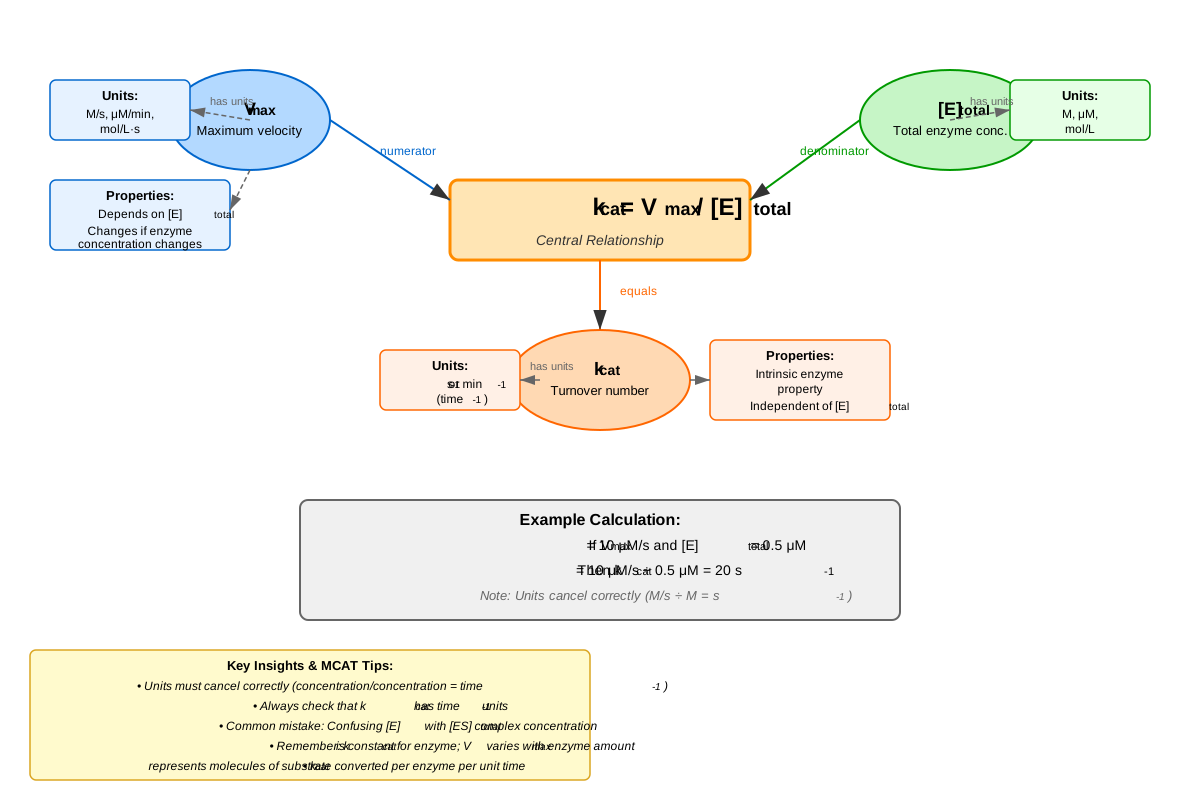
kcat (the turnover number) is defined as the number of substrate molecules converted to product per enzyme molecule (or per active site) per unit time when the enzyme is fully saturated with substrate. Mathematically, kcat is expressed as:
kcat = Vmax / [E]totalWhere:
- Vmax is the maximum reaction velocity (typically in M/s or μM/s)
- [E]total is the total enzyme concentration (in M or μM)
- kcat has units of reciprocal time (s^-1 or min^-1)
This relationship reveals that kcat is an intensive property of the enzyme itself—it depends only on the enzyme's catalytic mechanism, not on how much enzyme is present. Two identical enzymes will have the same kcat regardless of concentration, but different Vmax values proportional to their concentrations.
At the molecular level, kcat represents the first-order rate constant for the conversion of the enzyme-substrate complex (ES) to enzyme plus product (E + P). In the simplest Michaelis-Menten mechanism:
E + S ⇌ ES → E + PThe kcat corresponds to the rate constant for the ES → E + P step. When multiple steps follow ES formation, kcat reflects the rate-limiting step in the catalytic cycle.
Physical Interpretation and Biological Significance
The turnover number provides intuitive insight into enzyme efficiency. A kcat of 1000 s^-1 means that when fully saturated with substrate, each enzyme active site converts 1000 substrate molecules to product every second. This parameter varies enormously across enzymes:
| Enzyme | kcat (s^-1) | Biological Context |
|---|---|---|
| Carbonic anhydrase | ~10^6 | Rapid CO2/HCO3- interconversion in blood |
| Catalase | ~10^6 | Hydrogen peroxide detoxification |
| Acetylcholinesterase | ~10^4 | Neurotransmitter breakdown at synapses |
| DNA polymerase | ~10^2 | DNA replication with proofreading |
| Lysozyme | ~0.5 | Bacterial cell wall hydrolysis |
Enzymes with high kcat values typically catalyze reactions that must occur rapidly for physiological function, such as gas exchange or neurotransmission. Lower kcat values often indicate enzymes where accuracy matters more than speed (DNA polymerase) or where regulation is important (metabolic control points).
Relationship to Vmax and Enzyme Concentration
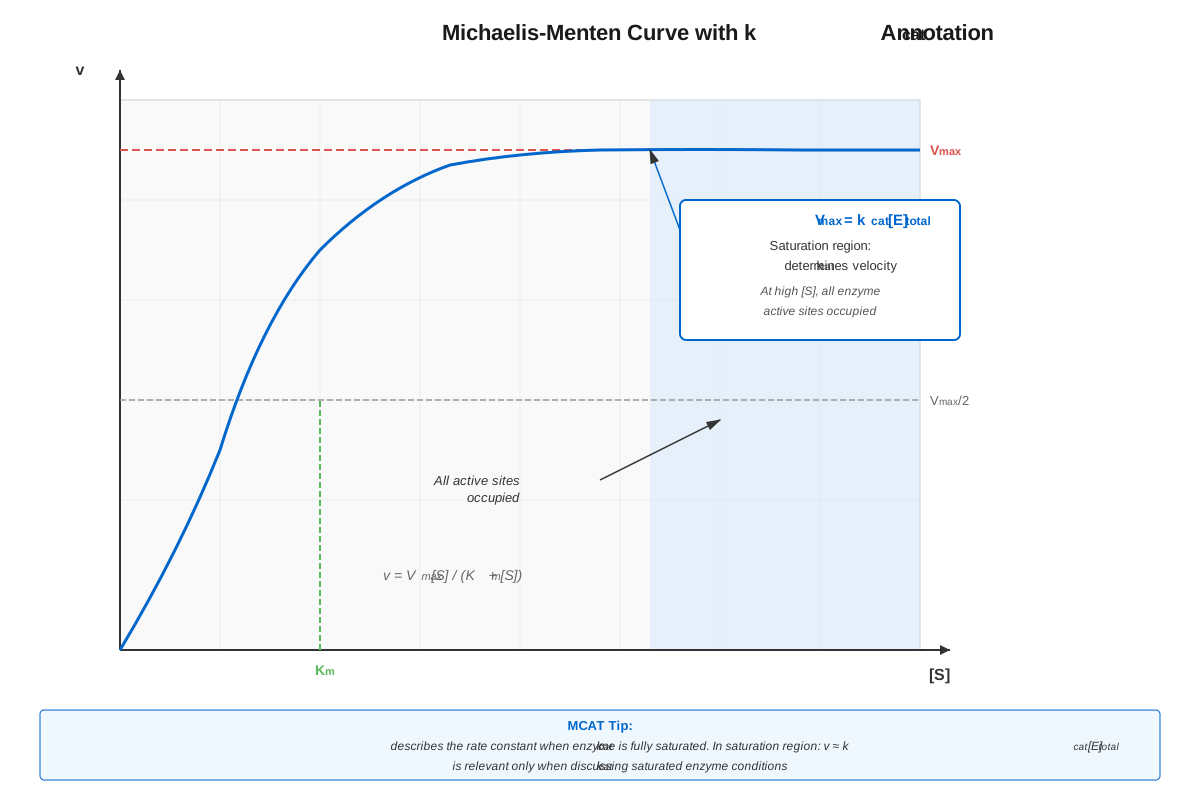
Understanding the connection between Vmax, kcat, and enzyme concentration is crucial for MCAT problem-solving. Vmax is an extensive property—it increases proportionally with enzyme concentration:
Vmax = kcat × [E]totalThis relationship has several important implications:
- Doubling enzyme concentration doubles Vmax but does not change kcat
- kcat can be calculated from experimental data if both Vmax and [E]total are known
- Comparing Vmax values between experiments requires knowing enzyme concentrations
- kcat allows fair comparison between different enzymes regardless of the amount used in experiments
For MCAT passages presenting enzyme purification or characterization data, students often must extract [E]total from protein concentration measurements and molecular weight information, then calculate kcat from the reported Vmax.
Catalytic Efficiency: kcat/Km
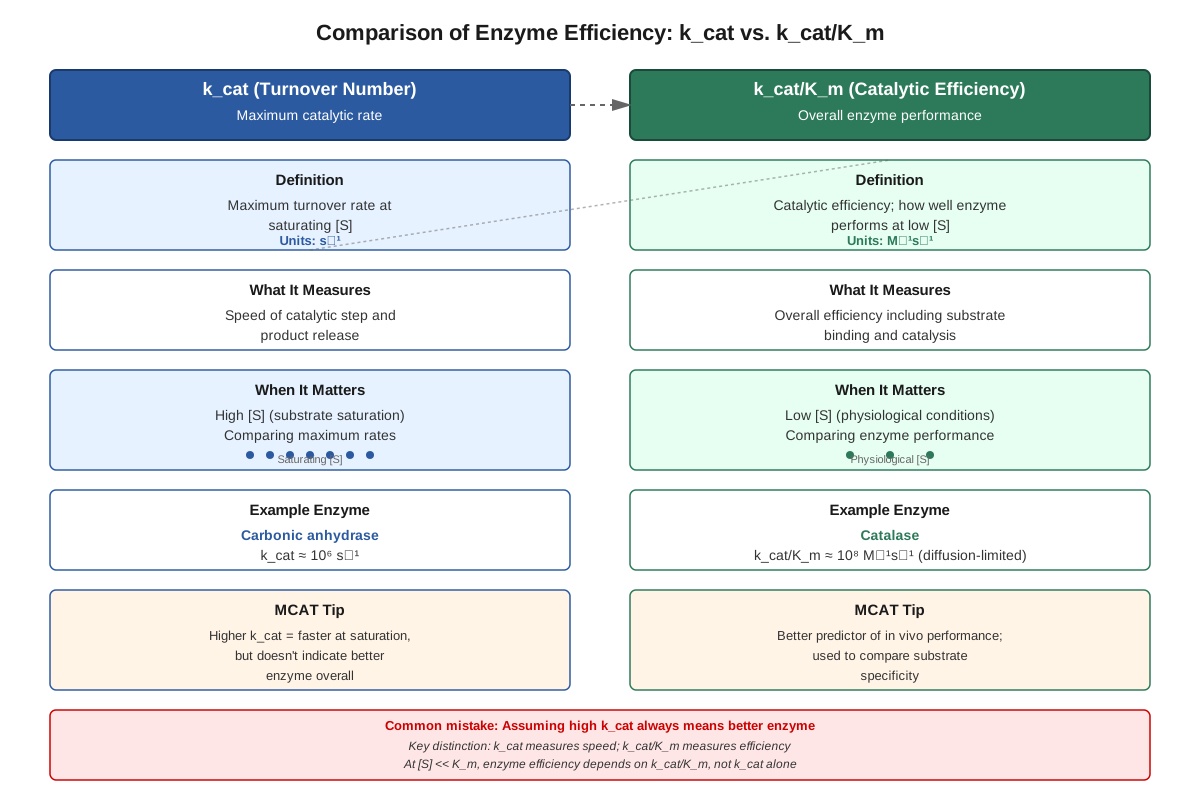
While kcat alone describes enzyme performance at saturating substrate concentrations, the ratio kcat/Km (catalytic efficiency) describes overall enzyme effectiveness under physiological conditions where substrate is often not saturating. This ratio has units of M^-1·s^-1 and represents the apparent second-order rate constant for the reaction of enzyme with substrate.
The catalytic efficiency integrates two aspects of enzyme function:
- kcat: how fast the enzyme works when substrate-bound
- Km: how well the enzyme binds substrate
An enzyme can be highly efficient through either a very high kcat (fast catalysis) or a very low Km (tight substrate binding), or both. The theoretical maximum for kcat/Km is approximately 10^8 to 10^9 M^-1·s^-1, limited by the diffusion rate at which enzyme and substrate can encounter each other. Enzymes approaching this limit are called "catalytically perfect" or "diffusion-limited."
Factors Affecting kcat
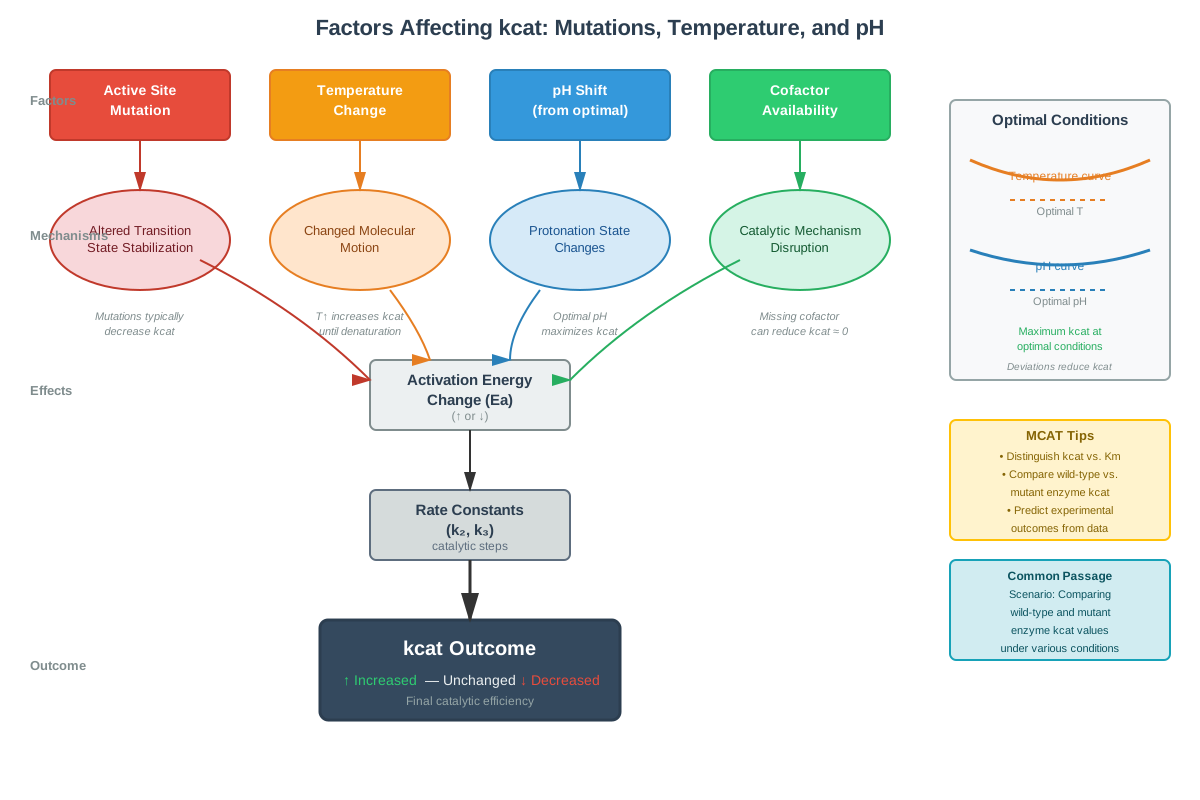
Several factors can alter an enzyme's turnover number:
- Temperature: Increasing temperature generally increases kcat by providing more thermal energy for the catalytic mechanism, until denaturation occurs
- pH: Changes in pH can protonate or deprotonate catalytic residues, altering kcat by affecting the chemical mechanism
- Mutations: Amino acid substitutions in the active site or catalytic residues can dramatically reduce kcat without necessarily affecting substrate binding (Km)
- Cofactors and coenzymes: Absence of required cofactors can reduce kcat to near zero
- Non-competitive inhibitors: These bind enzyme and reduce kcat without affecting Km, decreasing Vmax proportionally
Understanding which factors affect kcat versus Km is essential for interpreting MCAT experimental passages about enzyme characterization and inhibition studies.
Experimental Determination
On the MCAT, students may encounter passages describing how kcat is experimentally determined. The standard approach involves:
- Measure initial reaction velocities at various substrate concentrations
- Generate a Michaelis-Menten plot (velocity vs. [S]) or Lineweaver-Burk plot (1/v vs. 1/[S])
- Extract Vmax from the plateau of the Michaelis-Menten curve or the y-intercept of the Lineweaver-Burk plot
- Determine total enzyme concentration through protein quantification methods
- Calculate kcat using kcat = Vmax/[E]total
The accuracy of kcat determination depends critically on achieving true substrate saturation (typically [S] >> Km) and knowing the precise enzyme concentration, including accounting for the fraction of active enzyme in the preparation.
Concept Relationships
The kcat parameter sits at the center of a network of interconnected enzyme kinetics concepts. Understanding these relationships enables comprehensive MCAT problem-solving:
kcat → derives from → Vmax and [E]total: The turnover number is calculated by normalizing the maximum velocity to the amount of enzyme present, converting an extensive property (Vmax) into an intensive property (kcat) that characterizes the enzyme itself.
kcat → combines with → Km → to yield → catalytic efficiency (kcat/Km): While kcat describes saturated enzyme performance, the ratio kcat/Km describes overall enzyme effectiveness across all substrate concentrations, particularly relevant for physiological conditions.
kcat → affected by → enzyme mechanism and rate-limiting steps: The turnover number reflects the slowest step in the catalytic cycle after substrate binding, connecting kinetic parameters to molecular mechanisms.
kcat → distinguished from → Km: These parameters respond differently to perturbations—competitive inhibitors and substrate analogs affect Km but not kcat, while non-competitive inhibitors and active-site mutations often affect kcat but not Km.
kcat → relates to → metabolic flux: In metabolic pathways, the enzyme with the lowest kcat (when not saturated) often determines pathway flux, making it a potential regulatory point.
kcat → connects to → enzyme evolution: Natural selection optimizes kcat/Km for physiologically relevant substrates, with some enzymes reaching diffusion-limited perfection.
kcat → informs → drug design: Pharmaceutical development targets enzymes by considering both kcat (how fast the enzyme naturally works) and how inhibitors affect this parameter.
Quick check — test yourself on kcat so far.
Try Flashcards →High-Yield Facts
⭐ kcat = Vmax/[E]total and has units of reciprocal time (s^-1), representing substrate molecules converted per enzyme molecule per second at saturation
⭐ kcat is an intensive property of the enzyme that does not change with enzyme concentration, unlike Vmax which is extensive
⭐ kcat/Km (catalytic efficiency) is the best overall measure of enzyme performance, with theoretical maximum ~10^8-10^9 M^-1·s^-1 (diffusion limit)
⭐ Non-competitive inhibitors decrease kcat (and thus Vmax) without affecting Km, while competitive inhibitors affect Km but not kcat
⭐ Active site mutations typically reduce kcat more than Km, as they disrupt catalysis rather than substrate binding
- Carbonic anhydrase and catalase have among the highest known kcat values (~10^6 s^-1), approaching catalytic perfection
- When [S] >> Km, the reaction velocity approaches Vmax = kcat[E]total, making the reaction zero-order in substrate
- The reciprocal of kcat (1/kcat) represents the minimum time required for one catalytic cycle
- Enzymes with high kcat values often have evolved mechanisms that stabilize transition states or use strain/distortion
- Temperature increases kcat until thermal denaturation occurs, following Arrhenius kinetics in the stable range
Common Misconceptions
Misconception: kcat and Vmax are the same thing and can be used interchangeably.
Correction: kcat and Vmax are related but distinct. Vmax depends on enzyme concentration (extensive property) while kcat does not (intensive property). Vmax = kcat × [E]total, so they are only numerically equal when [E]total = 1 M, which never occurs physiologically.
Misconception: A higher kcat always means a more efficient enzyme.
Correction: Enzyme efficiency is best measured by kcat/Km, not kcat alone. An enzyme with high kcat but also high Km may be less efficient than one with moderate kcat but very low Km, especially at physiological substrate concentrations below saturation.
Misconception: Competitive inhibitors reduce kcat because they slow down the reaction.
Correction: Competitive inhibitors increase the apparent Km but do not affect kcat. They compete for substrate binding but once substrate binds, the catalytic rate constant remains unchanged. Only non-competitive inhibitors reduce kcat.
Misconception: kcat represents the rate of the entire reaction from free enzyme and substrate to product.
Correction: kcat specifically represents the rate constant for conversion of the ES complex to product, not the overall reaction. The overall rate depends on both substrate binding (related to Km) and catalysis (kcat).
Misconception: Doubling the substrate concentration doubles kcat.
Correction: kcat is independent of substrate concentration—it is a property of the enzyme itself. Substrate concentration affects reaction velocity (v) but not the turnover number. At saturation, further increasing [S] does not increase velocity because kcat limits the rate.
Misconception: All enzymes in a metabolic pathway should have similar kcat values for optimal function.
Correction: Metabolic pathways often have enzymes with widely varying kcat values. Rate-limiting enzymes (regulatory points) may have lower kcat values, while enzymes catalyzing reversible equilibrium steps may have higher kcat values. The pathway flux depends on the complex interplay of all enzyme kinetic parameters and substrate concentrations.
Worked Examples
Example 1: Calculating kcat from Experimental Data
Problem: Researchers purify an enzyme and determine its molecular weight to be 50,000 g/mol. They prepare a solution containing 0.5 mg of enzyme per mL and measure Vmax = 2.5 μM/s. Calculate the kcat for this enzyme.
Solution:
Step 1: Convert enzyme concentration to molarity
- Enzyme concentration = 0.5 mg/mL = 0.5 g/L
- Molar concentration = (0.5 g/L) / (50,000 g/mol) = 1.0 × 10^-5 M = 10 μM
Step 2: Apply the kcat equation
- kcat = Vmax / [E]total
- kcat = (2.5 μM/s) / (10 μM)
- kcat = 0.25 s^-1
Step 3: Interpret the result
This enzyme has a relatively low turnover number of 0.25 s^-1, meaning each active site converts one substrate molecule to product every 4 seconds when saturated. This might indicate a complex catalytic mechanism or suggest the enzyme is regulatory rather than designed for high flux.
MCAT Connection: This problem type appears frequently in passage-based questions where students must extract information from multiple sources (protein characterization data and kinetic measurements) and integrate them to calculate kinetic parameters. The key is recognizing that enzyme concentration must be in the same units as Vmax for the calculation to work correctly.
Example 2: Comparing Enzyme Efficiency
Problem: Two enzymes catalyze the same reaction. Enzyme A has kcat = 1000 s^-1 and Km = 10 mM. Enzyme B has kcat = 100 s^-1 and Km = 0.01 mM. The physiological substrate concentration is 0.1 mM. Which enzyme is more efficient under physiological conditions?
Solution:
Step 1: Calculate catalytic efficiency (kcat/Km) for both enzymes
- Enzyme A: kcat/Km = 1000 s^-1 / 10 mM = 100 mM^-1·s^-1 = 1.0 × 10^5 M^-1·s^-1
- Enzyme B: kcat/Km = 100 s^-1 / 0.01 mM = 10,000 mM^-1·s^-1 = 1.0 × 10^7 M^-1·s^-1
Step 2: Compare catalytic efficiencies
Enzyme B has a catalytic efficiency 100-fold higher than Enzyme A.
Step 3: Consider physiological substrate concentration
At [S] = 0.1 mM:
- For Enzyme A: [S] << Km (0.1 mM << 10 mM), so the enzyme is far from saturated
- For Enzyme B: [S] >> Km (0.1 mM >> 0.01 mM), so the enzyme is nearly saturated
Step 4: Conclusion
Enzyme B is more efficient under physiological conditions despite having a 10-fold lower kcat. The much lower Km means Enzyme B effectively captures and processes substrate even at low concentrations, while Enzyme A requires much higher substrate concentrations to approach its maximum rate.
MCAT Connection: This example demonstrates why kcat/Km is the superior measure of enzyme efficiency for physiological conditions. The MCAT frequently tests whether students can move beyond simple parameter comparison to consider the biological context. Questions may ask which enzyme would be favored by natural selection, which would be a better drug target, or which mutation would be more deleterious.
Exam Strategy
Approaching MCAT Questions on kcat:
- Identify what the question is really asking: Does it want kcat itself, catalytic efficiency (kcat/Km), or a comparison between enzymes? Many students lose points by calculating the wrong parameter.
- Check units carefully: kcat should always have units of reciprocal time (s^-1 or min^-1). If your calculation yields different units, you've made an error. Vmax has concentration/time units, requiring division by enzyme concentration to get kcat.
- Watch for enzyme concentration tricks: The MCAT may give enzyme concentration in mg/mL, μg/mL, or other units, requiring conversion to molarity using molecular weight. Always convert to matching units before calculating.
- Distinguish kcat from Km effects: When analyzing inhibitors or mutations, ask whether the change affects substrate binding (Km) or catalytic turnover (kcat). Competitive inhibition and substrate analogs affect Km; non-competitive inhibition and active-site mutations affect kcat.
Trigger Words and Phrases:
- "Turnover number" = kcat
- "Catalytic efficiency" = kcat/Km
- "At saturating substrate concentrations" = conditions where v ≈ Vmax = kcat[E]total
- "Per enzyme molecule" or "per active site" = signals kcat rather than Vmax
- "Maximum number of substrate molecules converted" = definition of kcat
- "Non-competitive inhibitor" = affects kcat (reduces Vmax) but not Km
- "Rate-limiting step" = the step that determines kcat in multi-step mechanisms
Process of Elimination Tips:
- Eliminate answer choices with wrong units (kcat must be time^-1)
- Eliminate choices suggesting kcat changes with substrate concentration (it doesn't)
- Eliminate choices confusing kcat with Km (they respond oppositely to different perturbations)
- For comparison questions, eliminate choices that ignore physiological substrate concentrations when comparing enzyme efficiency
- When a passage describes enzyme purification, eliminate answers that use Vmax without normalizing to enzyme concentration
Time Allocation:
For calculation questions involving kcat, budget 60-90 seconds. The calculations are straightforward but require careful unit conversion. For conceptual questions about kcat versus Km or inhibitor effects, budget 30-45 seconds—these test understanding rather than calculation. For passage-based questions requiring integration of multiple kinetic parameters, budget up to 2 minutes to extract data from tables or graphs and perform calculations.
Memory Techniques
Mnemonic for kcat Definition: "Katalytic Conversions At Total saturation" - reminds you that kcat describes catalytic events when enzyme is fully saturated with substrate.
Mnemonic for kcat = Vmax/[E]: "Very Efficient Kinetics" (VEK) - the letters V, E, K remind you of the relationship Vmax, [E]total, and kcat, with kcat resulting from dividing V by E.
Visualization Strategy: Picture an enzyme as a factory assembly line. kcat is the maximum speed of the assembly line itself (items processed per minute per workstation), while Vmax is the total factory output (which depends on both line speed AND number of workstations). Adding more workstations (enzyme) increases total output (Vmax) but doesn't change the line speed (kcat).
Acronym for Factors Affecting kcat: "TEMP"
- Temperature (increases kcat until denaturation)
- Enzyme mutations (especially active site changes)
- Mechanism alterations (cofactor availability)
- PH changes (affecting catalytic residues)
Conceptual Anchor: Remember that kcat has units of s^-1 (reciprocal seconds). The reciprocal of kcat (1/kcat) gives the time for one catalytic cycle. If kcat = 100 s^-1, then 1/kcat = 0.01 s = 10 milliseconds per cycle. This reciprocal relationship helps check whether calculated values make biological sense.
Comparison Memory Aid: "Kcat for Katalysis, Km for Katching substrate" - helps remember that kcat describes the catalytic step while Km describes substrate binding affinity.
Summary
The turnover number (kcat) represents the maximum number of substrate molecules converted to product per enzyme active site per unit time at substrate saturation, calculated as Vmax divided by total enzyme concentration. This intensive property characterizes enzyme catalytic power independent of enzyme amount, with units of reciprocal time (s^-1). Understanding kcat is essential for MCAT success because it appears in approximately 40% of enzyme kinetics questions, often requiring calculation from experimental data or comparison between enzymes. The catalytic efficiency (kcat/Km) combines turnover number with substrate affinity to provide the best overall measure of enzyme performance under physiological conditions. Non-competitive inhibitors reduce kcat without affecting Km, while competitive inhibitors show the opposite pattern—a distinction frequently tested on the MCAT. Students must master unit conversions, distinguish kcat from related parameters like Vmax and Km, and apply these concepts to experimental passages involving enzyme characterization, inhibition studies, and metabolic pathway analysis.
Key Takeaways
- kcat = Vmax/[E]total with units of s^-1, representing substrate molecules converted per enzyme per second at saturation
- kcat is intensive (independent of enzyme concentration) while Vmax is extensive (proportional to enzyme concentration)
- Catalytic efficiency (kcat/Km) provides the best overall measure of enzyme performance, especially at physiological substrate concentrations
- Non-competitive inhibitors decrease kcat (and Vmax) without changing Km; competitive inhibitors affect Km but not kcat
- Active site mutations typically reduce kcat more than Km, as catalysis is more sensitive than binding to structural changes
- kcat values span six orders of magnitude across different enzymes, from ~0.5 s^-1 (lysozyme) to ~10^6 s^-1 (carbonic anhydrase)
- Always check units when calculating kcat—the answer must have units of reciprocal time for the calculation to be correct
Related Topics
Michaelis-Menten Kinetics: The mathematical framework describing enzyme kinetics provides the foundation for understanding kcat, Km, and Vmax relationships. Mastering kcat enables deeper comprehension of the Michaelis-Menten equation and its graphical representations.
Enzyme Inhibition: Understanding how competitive, non-competitive, and uncompetitive inhibitors differentially affect kcat and Km is essential for drug design and metabolic regulation questions on the MCAT.
Lineweaver-Burk Plots: These double-reciprocal plots allow experimental determination of kinetic parameters including Vmax (from which kcat is calculated) and Km, appearing frequently in MCAT passages.
Metabolic Pathway Regulation: The kcat values of enzymes in metabolic pathways determine flux rates and identify rate-limiting steps, connecting enzyme kinetics to broader metabolic concepts.
Enzyme Evolution and Catalytic Perfection: Some enzymes have evolved kcat/Km values approaching the diffusion limit (~10^8-10^9 M^-1·s^-1), representing the theoretical maximum efficiency—a concept that bridges biochemistry and evolutionary biology.
Allosteric Regulation: Allosteric effectors can alter kcat by changing enzyme conformation, providing a mechanism for metabolic regulation beyond simple competitive inhibition.
Practice CTA
Now that you've mastered the core concepts of kcat and its role in enzyme kinetics, it's time to solidify your understanding through active practice. Work through the practice questions and flashcards to test your ability to calculate kcat from experimental data, compare enzyme efficiencies, and distinguish kcat effects from Km effects in inhibition scenarios. These practice materials mirror actual MCAT question formats and difficulty levels, helping you build the speed and accuracy needed for test day success. Remember: understanding the concepts is the first step, but applying them under timed conditions is what translates knowledge into points. You've got this—let's put your kcat mastery to work!
Sign up free to keep reading
Create a free AnvayaPrep account to finish this MCAT guide on kcat — plus flashcards and practice questions.