Overview
Lineweaver-Burk plots represent one of the most powerful graphical tools in enzyme kinetics, transforming the hyperbolic Michaelis-Menten equation into a linear format that simplifies the determination of critical kinetic parameters. This double-reciprocal plot, which graphs 1/V₀ (the reciprocal of initial velocity) against 1/[S] (the reciprocal of substrate concentration), converts the curved Michaelis-Menten relationship into a straight line with easily interpretable intercepts and slope. For MCAT preparation, mastering Lineweaver-Burk plots is essential because these graphs appear frequently in both discrete questions and passage-based items, particularly when distinguishing between competitive, noncompetitive, uncompetitive, and mixed enzyme inhibition patterns.
The significance of Lineweaver-Burk plots in Biochemistry extends beyond simple parameter determination. These plots provide immediate visual discrimination between different types of enzyme inhibition—a high-yield topic that appears consistently on the MCAT. While the Michaelis-Menten curve shows subtle differences between inhibitor types, the Lineweaver-Burk transformation magnifies these differences into distinct, recognizable patterns of line intersections. Understanding how inhibitors alter the x-intercept (-1/Km), y-intercept (1/Vmax), and slope (Km/Vmax) enables rapid identification of inhibition mechanisms, a skill that directly translates to correct answers on exam day.
Within the broader context of Enzymes and enzyme kinetics, Lineweaver-Burk analysis connects fundamental concepts of substrate binding, catalytic efficiency, and regulatory mechanisms. This topic bridges quantitative analysis with qualitative understanding, requiring students to integrate mathematical relationships with biological principles. The ability to interpret these plots demonstrates mastery of enzyme behavior under various conditions, making it a cornerstone concept for the Biochemistry section of the MCAT and a frequent testing point in passages involving experimental enzyme studies.
Learning Objectives
- [ ] Define Lineweaver-Burk plots using accurate Biochemistry terminology
- [ ] Explain why Lineweaver-Burk plots matter for the MCAT
- [ ] Apply Lineweaver-Burk plots to exam-style questions
- [ ] Identify common mistakes related to Lineweaver-Burk plots
- [ ] Connect Lineweaver-Burk plots to related Biochemistry concepts
- [ ] Derive the Lineweaver-Burk equation from the Michaelis-Menten equation and interpret each component
- [ ] Distinguish between competitive, noncompetitive, uncompetitive, and mixed inhibition patterns using Lineweaver-Burk plots
- [ ] Calculate Km and Vmax values from Lineweaver-Burk plot intercepts with precision
- [ ] Predict how changes in enzyme concentration, substrate availability, or inhibitor presence will alter plot characteristics
Prerequisites
- Michaelis-Menten kinetics: Understanding the hyperbolic relationship between substrate concentration and reaction velocity is essential because the Lineweaver-Burk plot is a mathematical transformation of this equation
- Enzyme structure and function: Knowledge of active sites, substrate binding, and catalytic mechanisms provides the biological context for interpreting kinetic parameters
- Basic algebra and graphing: Facility with reciprocals, linear equations (y = mx + b), and coordinate interpretation enables manipulation and analysis of the double-reciprocal plot
- Enzyme inhibition types: Familiarity with how different inhibitors interact with enzymes (competitive, noncompetitive, uncompetitive) is necessary to recognize their distinct signatures on Lineweaver-Burk plots
- Km and Vmax definitions: Clear understanding that Km represents substrate concentration at half-maximal velocity and Vmax represents maximum reaction velocity forms the foundation for interpreting plot intercepts
Why This Topic Matters
Lineweaver-Burk plots appear with remarkable frequency on the MCAT, particularly in Biochemistry passages that present experimental data on enzyme kinetics. According to analysis of recent MCAT administrations, enzyme kinetics questions—including those requiring interpretation of Lineweaver-Burk plots—constitute approximately 8-12% of the Biochemistry/Biological Foundations section. These questions typically appear in two formats: discrete questions asking students to identify inhibition types from plot patterns, and passage-based questions requiring interpretation of experimental results presented as double-reciprocal plots.
In clinical and research contexts, Lineweaver-Burk analysis remains relevant for drug development and understanding pharmacological mechanisms. Many therapeutic agents function as enzyme inhibitors, and determining the type of inhibition guides dosing strategies and predicts drug interactions. For example, competitive inhibitors can be overcome by increasing substrate concentration, while noncompetitive inhibitors cannot—a distinction with direct clinical implications. Pharmaceutical researchers use these plots to characterize potential drug candidates and optimize their inhibitory properties.
The MCAT frequently embeds Lineweaver-Burk plots within experimental passages describing enzyme purification, characterization studies, or inhibitor screening. Students must rapidly identify which lines represent control conditions versus inhibited conditions, determine what type of inhibition is occurring, and sometimes calculate kinetic parameters from the graph. The ability to extract this information quickly and accurately often determines success on these high-value passage questions. Additionally, the MCAT may present scenarios where students must predict how a plot would change under specified conditions, testing conceptual understanding rather than mere pattern recognition.
Core Concepts
The Lineweaver-Burk Equation
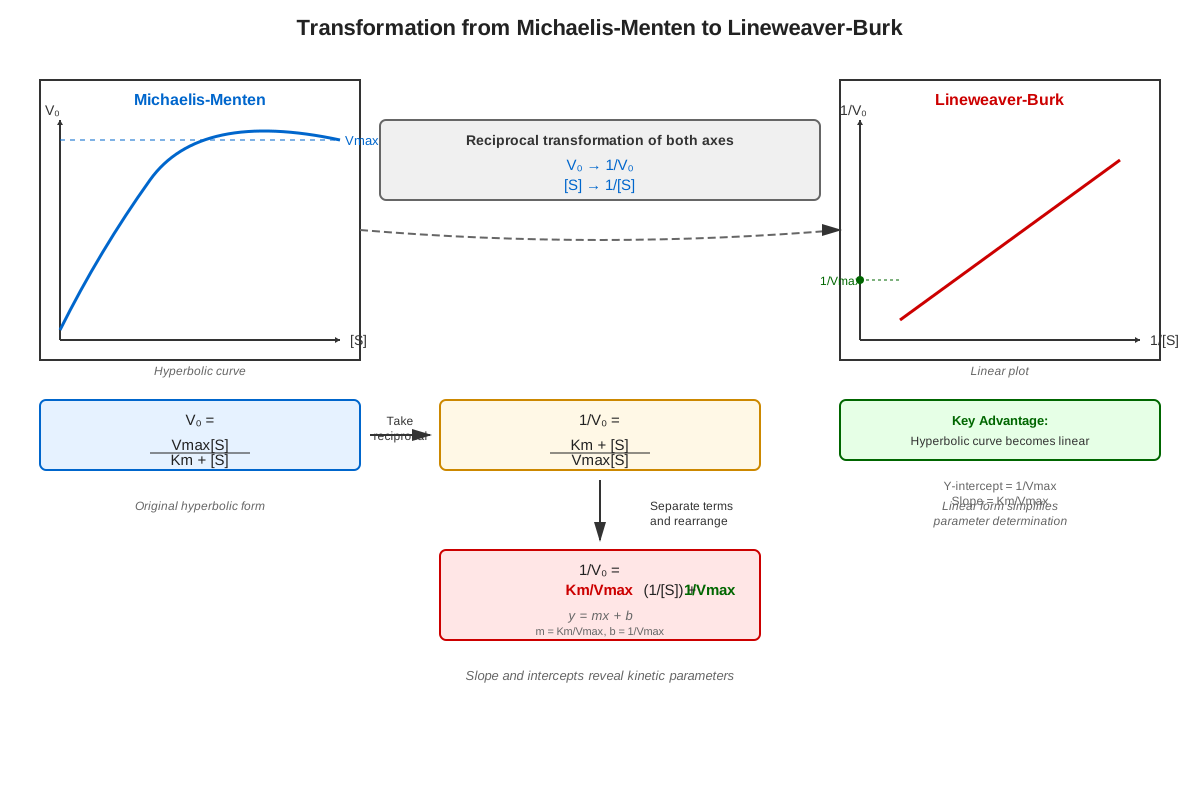
The Lineweaver-Burk plot, also known as the double-reciprocal plot, derives directly from the Michaelis-Menten equation through mathematical transformation. Starting with the Michaelis-Menten equation:
V₀ = (Vmax[S]) / (Km + [S])Taking the reciprocal of both sides yields:
1/V₀ = (Km + [S]) / (Vmax[S])Separating terms:
1/V₀ = Km/(Vmax[S]) + [S]/(Vmax[S])Simplifying:
1/V₀ = (Km/Vmax)(1/[S]) + 1/VmaxThis equation takes the form of a linear equation y = mx + b, where:
- y = 1/V₀ (plotted on the vertical axis)
- x = 1/[S] (plotted on the horizontal axis)
- m = Km/Vmax (slope of the line)
- b = 1/Vmax (y-intercept)
The x-intercept occurs when y = 0, which solving algebraically gives x = -1/Km.
Interpreting the Three Key Features
Every Lineweaver-Burk plot contains three critical features that encode complete information about enzyme kinetics:
Y-intercept (1/Vmax): Where the line crosses the vertical axis when 1/[S] = 0 (theoretically infinite substrate concentration). This intercept directly reveals the maximum velocity of the enzyme. A higher y-intercept indicates a lower Vmax, while a lower y-intercept indicates a higher Vmax. This inverse relationship often confuses students but follows logically from the reciprocal transformation.
X-intercept (-1/Km): Where the line crosses the horizontal axis when 1/V₀ = 0 (theoretically infinite velocity). This intercept reveals the Michaelis constant, though with a negative sign. An x-intercept closer to the origin (less negative) indicates higher Km (lower substrate affinity), while an x-intercept farther from the origin (more negative) indicates lower Km (higher substrate affinity).
Slope (Km/Vmax): The steepness of the line represents the ratio of Km to Vmax, a parameter related to catalytic efficiency. Steeper slopes indicate less efficient enzymes (high Km relative to Vmax), while shallower slopes indicate more efficient enzymes.
Competitive Inhibition Pattern
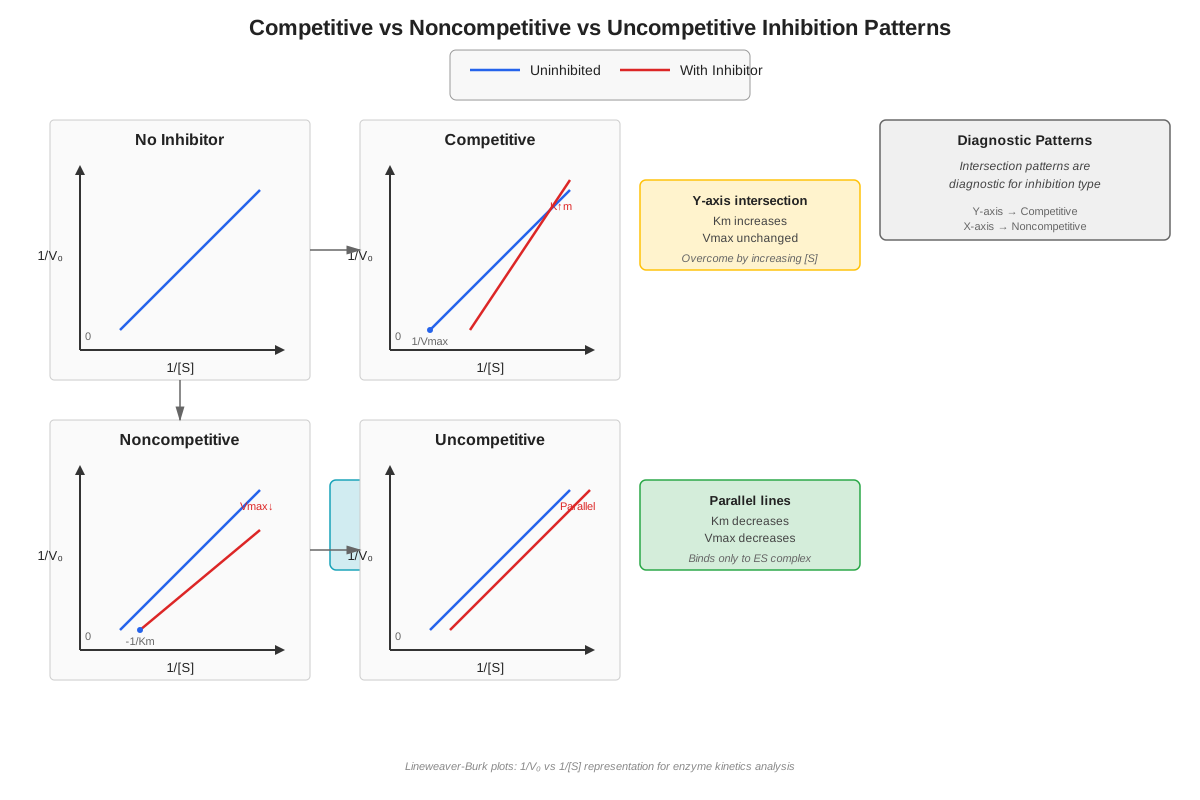
Competitive inhibition occurs when an inhibitor competes with substrate for binding to the enzyme's active site. On a Lineweaver-Burk plot, competitive inhibition produces a characteristic pattern:
- Y-intercept remains unchanged: Since competitive inhibitors can be overcome by saturating substrate concentrations, Vmax remains the same
- X-intercept shifts toward the origin: The apparent Km increases (Km,app), reflecting decreased substrate affinity in the presence of inhibitor
- Slope increases: The line becomes steeper due to the increased Km/Vmax ratio
- Lines intersect on the y-axis: Control and inhibited lines meet at the y-intercept
This pattern makes intuitive sense: at infinite substrate concentration (y-intercept), the competitive inhibitor is completely displaced, so the enzyme achieves the same Vmax. However, at lower substrate concentrations, the inhibitor competes effectively, requiring more substrate to reach half-maximal velocity (increased Km).
Noncompetitive Inhibition Pattern
Noncompetitive inhibition occurs when an inhibitor binds to a site distinct from the active site, affecting catalytic efficiency regardless of substrate concentration. The Lineweaver-Burk signature includes:
- Y-intercept shifts upward: Vmax decreases (Vmax,app) because some enzyme molecules are inactivated regardless of substrate concentration
- X-intercept remains unchanged: Km stays the same because substrate binding affinity is unaffected
- Slope increases: The line becomes steeper due to the decreased Vmax while Km remains constant
- Lines intersect on the x-axis: Control and inhibited lines meet at the x-intercept
This pattern reflects the mechanism: the inhibitor doesn't compete for substrate binding (Km unchanged) but reduces the fraction of active enzyme molecules (Vmax decreased). Even at saturating substrate concentrations, the inhibitor-bound enzyme cannot achieve full catalytic activity.
Uncompetitive Inhibition Pattern
Uncompetitive inhibition represents a unique mechanism where the inhibitor binds only to the enzyme-substrate complex, not to free enzyme. This produces a distinctive Lineweaver-Burk pattern:
- Y-intercept shifts upward: Vmax decreases because the inhibitor traps enzyme-substrate complexes in an inactive form
- X-intercept shifts away from the origin: Km decreases (appears to increase substrate affinity) because the inhibitor removes ES complex from equilibrium, driving more substrate binding
- Slope remains unchanged: Both Km and Vmax decrease proportionally, maintaining the same Km/Vmax ratio
- Lines are parallel: Control and inhibited lines never intersect, running parallel to each other
This counterintuitive pattern—where apparent substrate affinity increases despite inhibition—results from Le Chatelier's principle: removing ES complex by inhibitor binding shifts equilibrium toward more ES formation.
Mixed Inhibition Pattern
Mixed inhibition occurs when an inhibitor can bind to both free enzyme and enzyme-substrate complex, but with different affinities for each form. The Lineweaver-Burk characteristics vary depending on relative binding preferences:
- Y-intercept shifts upward: Vmax always decreases because the inhibitor can bind ES complex
- X-intercept may shift either direction: Km can increase or decrease depending on whether the inhibitor prefers free enzyme or ES complex
- Slope changes: The magnitude and direction depend on the specific binding preferences
- Lines intersect above or below the x-axis: Unlike the other inhibition types, the intersection point is not on an axis
Mixed inhibition represents the most general case, with competitive and noncompetitive inhibition as special cases where the inhibitor binds exclusively to E or equally to E and ES, respectively.
Practical Applications and Limitations
While Lineweaver-Burk plots offer clear visual discrimination between inhibition types, they possess inherent limitations that researchers must consider. The double-reciprocal transformation compresses data at high substrate concentrations (low 1/[S] values) and expands data at low substrate concentrations (high 1/[S] values), potentially distorting error distribution. Small errors in measuring low velocities become magnified when converted to reciprocals, affecting the accuracy of extrapolated intercepts.
Alternative linearization methods, such as Eadie-Hofstee plots and Hanes-Woolf plots, address some of these statistical limitations. However, for MCAT purposes, Lineweaver-Burk plots remain the standard representation, and students must master their interpretation regardless of these technical considerations.
| Inhibition Type | Y-intercept (1/Vmax) | X-intercept (-1/Km) | Slope (Km/Vmax) | Lines Intersect |
|---|---|---|---|---|
| Competitive | Unchanged | Shifts right (toward origin) | Increases | On y-axis |
| Noncompetitive | Shifts up | Unchanged | Increases | On x-axis |
| Uncompetitive | Shifts up | Shifts left (away from origin) | Unchanged | Parallel (no intersection) |
| Mixed | Shifts up | Shifts either direction | Changes | Above or below x-axis |
Concept Relationships
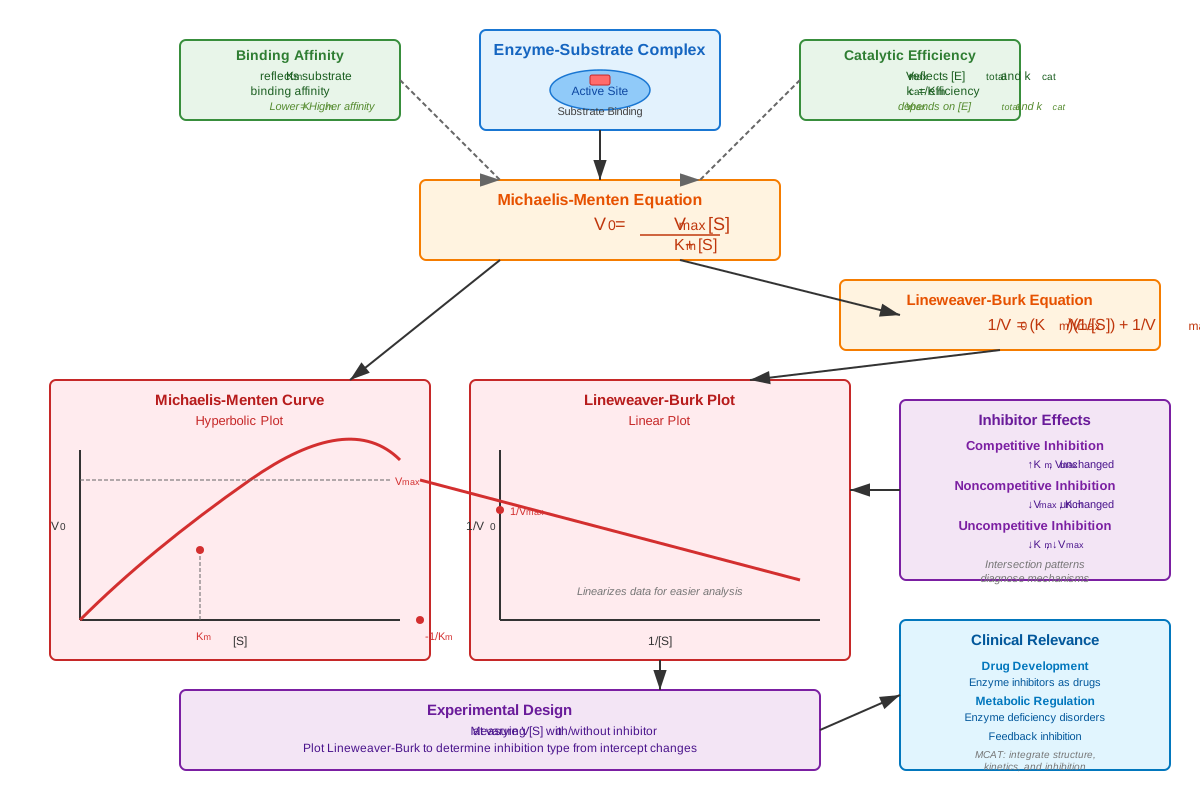
The Lineweaver-Burk plot serves as a bridge between fundamental enzyme kinetics and practical experimental analysis. The transformation begins with the Michaelis-Menten equation, which describes the hyperbolic relationship between substrate concentration and reaction velocity. This equation itself derives from assumptions about enzyme-substrate complex formation and the steady-state approximation, connecting to deeper concepts of binding equilibria and reaction mechanisms.
The mathematical transformation from Michaelis-Menten to Lineweaver-Burk (taking reciprocals) → creates a linear relationship → enabling easier determination of Km and Vmax → which are fundamental parameters describing enzyme efficiency and substrate affinity. These parameters connect directly to enzyme structure: Km reflects active site geometry and substrate binding interactions, while Vmax depends on the catalytic mechanism and the concentration of enzyme molecules.
Lineweaver-Burk analysis becomes particularly powerful when examining enzyme inhibition. The plot patterns for different inhibitor types → reveal the molecular mechanism of inhibition → which connects to drug design and pharmacology. Competitive inhibitors structurally resemble substrates (connecting to molecular recognition), noncompetitive inhibitors induce conformational changes (connecting to allosteric regulation), and uncompetitive inhibitors stabilize the ES complex (connecting to transition state theory).
The concept also relates to experimental design in biochemistry: generating a Lineweaver-Burk plot requires measuring initial velocities at multiple substrate concentrations → which connects to principles of enzyme assays and spectrophotometry → and requires understanding of reaction progress curves to ensure measurements occur in the linear, initial phase of the reaction.
Finally, Lineweaver-Burk analysis connects forward to more complex topics: cooperative binding (which produces non-linear Lineweaver-Burk plots), multi-substrate reactions (which require more complex kinetic analysis), and metabolic regulation (where understanding inhibition patterns helps predict cellular responses to regulatory molecules).
Quick check — test yourself on Lineweaver Burk plots so far.
Try Flashcards →High-Yield Facts
⭐ The y-intercept of a Lineweaver-Burk plot equals 1/Vmax, and the x-intercept equals -1/Km—these relationships enable direct calculation of kinetic parameters from the graph.
⭐ Competitive inhibition produces lines that intersect on the y-axis because Vmax remains unchanged while apparent Km increases.
⭐ Noncompetitive inhibition produces lines that intersect on the x-axis because Km remains unchanged while Vmax decreases.
⭐ Uncompetitive inhibition produces parallel lines because both Km and Vmax decrease proportionally, maintaining constant slope.
⭐ The slope of a Lineweaver-Burk plot equals Km/Vmax, representing the ratio of these two fundamental kinetic parameters.
- A steeper slope on a Lineweaver-Burk plot indicates either higher Km (lower substrate affinity) or lower Vmax (reduced catalytic efficiency), or both.
- Increasing enzyme concentration does not change the Lineweaver-Burk plot's x-intercept (Km is unchanged) but lowers the y-intercept (Vmax increases proportionally).
- The Lineweaver-Burk transformation magnifies experimental error at low substrate concentrations, making the left portion of the plot less reliable.
- Mixed inhibition can be distinguished from other types by lines intersecting above or below the x-axis rather than on an axis.
- When comparing multiple Lineweaver-Burk plots, the line with the lowest y-intercept represents the condition with the highest Vmax, and the line with the most negative x-intercept represents the condition with the lowest Km (highest substrate affinity).
Common Misconceptions
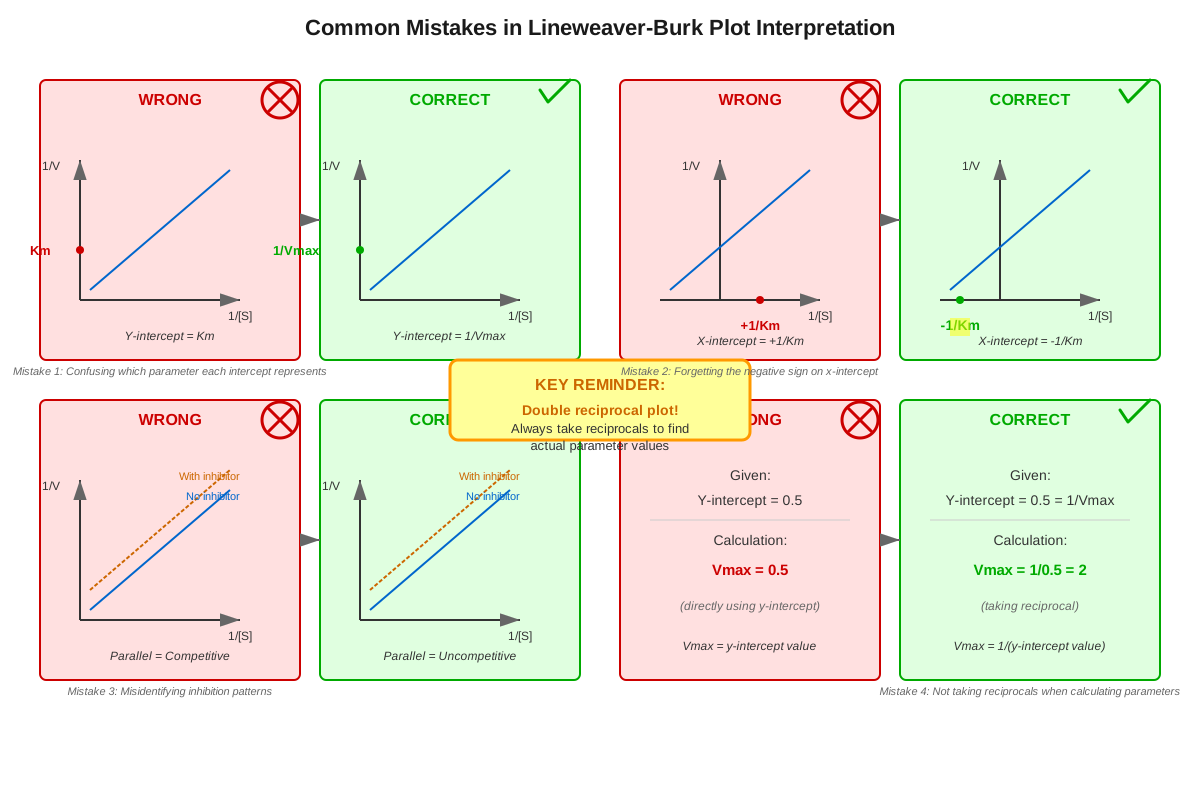
Misconception: A higher y-intercept on a Lineweaver-Burk plot means higher Vmax.
Correction: The y-intercept equals 1/Vmax, so a higher y-intercept actually indicates a lower Vmax due to the inverse relationship. This reciprocal transformation reverses the intuitive interpretation—always remember to mentally "flip" the values when reading intercepts.
Misconception: Competitive inhibitors decrease Vmax because they prevent substrate binding.
Correction: Competitive inhibitors do not change Vmax; they only increase apparent Km. At sufficiently high substrate concentrations, the substrate outcompetes the inhibitor for active site binding, allowing the enzyme to achieve the same maximum velocity. The y-intercept remaining constant on a Lineweaver-Burk plot confirms this principle.
Misconception: All enzyme inhibitors make Lineweaver-Burk lines steeper.
Correction: While competitive and noncompetitive inhibitors increase slope, uncompetitive inhibitors maintain the same slope as the uninhibited enzyme, producing parallel lines. The slope only increases when Km increases or Vmax decreases disproportionately; in uncompetitive inhibition, both parameters decrease proportionally.
Misconception: The x-intercept of a Lineweaver-Burk plot equals Km.
Correction: The x-intercept equals -1/Km, not Km itself. This negative reciprocal relationship means that higher Km values produce x-intercepts closer to the origin (less negative), while lower Km values produce x-intercepts farther from the origin (more negative). Students must remember both the negative sign and the reciprocal.
Misconception: Lineweaver-Burk plots can only be used to analyze inhibition; they don't provide information about uninhibited enzymes.
Correction: Lineweaver-Burk plots are valuable for determining Km and Vmax of any enzyme, inhibited or not. A single line from an uninhibited enzyme provides complete kinetic characterization through its intercepts and slope. The plots are particularly useful for comparing inhibited versus uninhibited conditions, but they serve as a general tool for enzyme kinetic analysis.
Misconception: If two lines on a Lineweaver-Burk plot intersect, one must represent an inhibited enzyme.
Correction: Lines can intersect when comparing different enzymes, different pH conditions, different temperatures, or different cofactor concentrations—not just inhibited versus uninhibited states. The intersection pattern helps identify the type of change occurring, but doesn't automatically indicate inhibition. Context from the experimental setup determines the interpretation.
Worked Examples
Example 1: Identifying Inhibition Type from Plot Characteristics
Question: An enzyme is studied in the presence and absence of compound X. The Lineweaver-Burk plot shows that compound X causes the y-intercept to increase from 0.02 min/μM to 0.04 min/μM, while the x-intercept remains constant at -0.5 μM⁻¹. What type of inhibitor is compound X, and what are the Km and Vmax values in the absence of inhibitor?
Solution:
Step 1: Identify the inhibition pattern from intercept changes.
- Y-intercept increases (1/Vmax increases, so Vmax decreases)
- X-intercept unchanged (Km remains constant)
- This pattern is characteristic of noncompetitive inhibition
Step 2: Calculate Vmax without inhibitor.
- Y-intercept = 1/Vmax = 0.02 min/μM
- Vmax = 1/0.02 = 50 μM/min
Step 3: Calculate Km (same with or without inhibitor in noncompetitive inhibition).
- X-intercept = -1/Km = -0.5 μM⁻¹
- -1/Km = -0.5
- Km = 1/0.5 = 2 μM
Step 4: Verify the answer makes biological sense.
- Noncompetitive inhibitors bind to a site other than the active site, reducing the effective enzyme concentration without affecting substrate binding affinity
- The unchanged Km confirms substrate binding is unaffected
- The decreased Vmax (from 50 to 25 μM/min, calculated from the new y-intercept) confirms reduced catalytic efficiency
Answer: Compound X is a noncompetitive inhibitor. Without inhibitor, Km = 2 μM and Vmax = 50 μM/min.
Example 2: Predicting Plot Changes from Experimental Modifications
Question: A researcher generates a Lineweaver-Burk plot for an enzyme under standard conditions. She then performs three modifications: (A) doubles the enzyme concentration, (B) adds a competitive inhibitor, and (C) adds an uncompetitive inhibitor. For each modification, predict how the plot will change compared to the original, specifically addressing the x-intercept, y-intercept, and slope.
Solution:
Modification A: Doubling enzyme concentration
Step 1: Determine effect on Vmax.
- Vmax is directly proportional to enzyme concentration
- Doubling [E] doubles Vmax
Step 2: Determine effect on Km.
- Km is an intrinsic property of the enzyme-substrate interaction
- Changing enzyme concentration does not affect Km
Step 3: Predict intercept changes.
- Y-intercept = 1/Vmax: if Vmax doubles, 1/Vmax is halved → y-intercept decreases (shifts down)
- X-intercept = -1/Km: Km unchanged → x-intercept unchanged
- Slope = Km/Vmax: Km unchanged, Vmax doubled → slope is halved (line becomes less steep)
Modification B: Adding competitive inhibitor
Step 1: Recall competitive inhibition mechanism.
- Inhibitor competes for active site
- Vmax unchanged (can be overcome by high [S])
- Apparent Km increases (Km,app)
Step 2: Predict intercept changes.
- Y-intercept = 1/Vmax: Vmax unchanged → y-intercept unchanged
- X-intercept = -1/Km,app: Km,app increases → 1/Km,app decreases → -1/Km,app becomes less negative → x-intercept shifts right (toward origin)
- Slope = Km,app/Vmax: Km,app increases, Vmax unchanged → slope increases (line becomes steeper)
- Lines intersect on y-axis
Modification C: Adding uncompetitive inhibitor
Step 1: Recall uncompetitive inhibition mechanism.
- Inhibitor binds only to ES complex
- Both Vmax and Km decrease proportionally
Step 2: Predict intercept changes.
- Y-intercept = 1/Vmax: Vmax decreases → 1/Vmax increases → y-intercept shifts up
- X-intercept = -1/Km: Km decreases → 1/Km increases → -1/Km becomes more negative → x-intercept shifts left (away from origin)
- Slope = Km/Vmax: both decrease proportionally → slope unchanged
- Lines are parallel
Answer Summary:
- (A) Doubling enzyme: y-intercept decreases, x-intercept unchanged, slope decreases
- (B) Competitive inhibitor: y-intercept unchanged, x-intercept shifts right, slope increases, intersects on y-axis
- (C) Uncompetitive inhibitor: y-intercept increases, x-intercept shifts left, slope unchanged, lines parallel
Exam Strategy
When approaching MCAT questions involving Lineweaver-Burk plots, implement a systematic strategy that maximizes accuracy while minimizing time expenditure. First, immediately identify what the question is asking: Are you determining inhibition type? Calculating kinetic parameters? Predicting how a plot will change? This initial categorization guides your approach.
Trigger words and phrases that signal Lineweaver-Burk questions include: "double-reciprocal plot," "1/V versus 1/[S]," "lines intersect," "x-intercept," "y-intercept," and any mention of comparing enzyme behavior under different conditions. When you see these phrases, immediately recall the three key features: y-intercept = 1/Vmax, x-intercept = -1/Km, slope = Km/Vmax.
For inhibition identification questions, use the intersection pattern as your primary discriminator:
- Lines intersect on y-axis → competitive inhibition
- Lines intersect on x-axis → noncompetitive inhibition
- Lines are parallel → uncompetitive inhibition
- Lines intersect above or below x-axis → mixed inhibition
This hierarchy allows rapid elimination of answer choices. If the question shows or describes parallel lines, immediately eliminate any answer choice mentioning competitive or noncompetitive inhibition.
Process-of-elimination strategy: When calculating parameters from intercepts, eliminate answer choices that violate the reciprocal relationship. If a y-intercept is 0.05 and an answer choice states Vmax = 0.05, eliminate it immediately—the correct answer must be 1/0.05 = 20. Similarly, if an x-intercept is -0.25 and an answer choice states Km = -0.25, eliminate it—Km must be positive (1/0.25 = 4).
For time management, allocate approximately 60-90 seconds for discrete Lineweaver-Burk questions and up to 2 minutes for passage-based questions requiring plot interpretation. If a question asks you to calculate multiple parameters, consider whether you can eliminate answer choices after calculating just one parameter, potentially saving time. Many MCAT questions are designed so that calculating the y-intercept alone eliminates three of four answer choices.
Common trap answers include: (1) forgetting the negative sign in the x-intercept, (2) forgetting to take the reciprocal of intercept values, (3) confusing which axis corresponds to which parameter, and (4) misidentifying inhibition type by focusing on slope alone rather than intersection pattern. Always verify your answer by checking whether it makes biological sense—Km and Vmax should be positive values, and inhibitors should not increase Vmax.
Exam Tip: If a passage presents experimental data as a table of [S] and V₀ values, you typically don't need to mentally construct the entire Lineweaver-Burk plot. Focus on the extreme values: the highest [S] (lowest 1/[S]) determines the y-intercept region, while the lowest [S] (highest 1/[S]) determines the slope. This selective analysis saves time.
Memory Techniques
Mnemonic for Inhibition Patterns - "CONY":
- Competitive: Crosses on Coordinate (y-axis)
- Noncompetitive: Nails the x-axis (intersects on x-axis)
- Uncompetitive: Uniform slope (parallel lines)
- MiXed: X marks the spot (intersects off both axes)
Visualization Strategy for Intercepts:
Picture a Lineweaver-Burk plot as a "V-K coordinate system":
- Vertical axis (y) = Vmax information (1/Vmax)
- Horizontal axis (x) = Km information (-1/Km)
The similar sounds (V-Vmax, horizontal-Km) create an auditory association that reinforces which axis corresponds to which parameter.
Reciprocal Reminder - "Flip It":
Whenever you read an intercept value, physically or mentally write "FLIP" next to it to remind yourself to take the reciprocal before stating the parameter value. For example:
- Y-intercept = 0.02 → FLIP → Vmax = 50
- X-intercept = -0.5 → FLIP → Km = 2 (remember to drop the negative)
Competitive Inhibition Memory Aid - "Competition Raises the Bar":
Competitive inhibitors raise the apparent Km (substrate must work harder to compete), which means the x-intercept moves toward the origin (becomes less negative, "raising" toward zero). The phrase "raises the bar" helps remember that Km increases.
Slope Interpretation - "Steep = Inefficient":
Since slope = Km/Vmax, a steeper slope means either high Km (poor substrate affinity) or low Vmax (slow catalysis), or both—all indicators of inefficiency. This simple association helps interpret relative enzyme performance from plot appearance.
Parallel Lines Paradox:
For uncompetitive inhibition, remember the counterintuitive fact that "parallel lines never meet, and Km never increases." This paradoxical pairing (inhibition that decreases Km) helps distinguish uncompetitive from other types. The parallel lines visually represent this unique behavior.
Summary
Lineweaver-Burk plots transform the hyperbolic Michaelis-Menten relationship into a linear format by plotting 1/V₀ versus 1/[S], creating a powerful analytical tool for enzyme kinetics. The three critical features—y-intercept (1/Vmax), x-intercept (-1/Km), and slope (Km/Vmax)—encode complete information about enzyme efficiency and substrate affinity. For MCAT success, students must master the characteristic patterns of enzyme inhibition: competitive inhibitors produce lines intersecting on the y-axis (unchanged Vmax, increased Km), noncompetitive inhibitors produce lines intersecting on the x-axis (decreased Vmax, unchanged Km), uncompetitive inhibitors produce parallel lines (both parameters decrease proportionally), and mixed inhibitors produce lines intersecting off both axes. The ability to rapidly identify these patterns, calculate kinetic parameters from intercepts, and predict how experimental modifications will alter plot characteristics represents essential competency for the Biochemistry section. Understanding the reciprocal relationships—where higher intercept values indicate lower parameter values—prevents common calculation errors. Lineweaver-Burk analysis bridges quantitative enzyme kinetics with qualitative mechanistic understanding, making it a cornerstone concept that appears frequently in both discrete questions and experimental passages on the MCAT.
Key Takeaways
- The Lineweaver-Burk plot graphs 1/V₀ versus 1/[S], with y-intercept = 1/Vmax, x-intercept = -1/Km, and slope = Km/Vmax—memorize these relationships for rapid parameter determination
- Competitive inhibition: lines intersect on y-axis (Vmax unchanged, Km increases); noncompetitive inhibition: lines intersect on x-axis (Vmax decreases, Km unchanged); uncompetitive inhibition: parallel lines (both decrease proportionally)
- The reciprocal transformation means higher intercept values correspond to lower parameter values—a higher y-intercept indicates lower Vmax, not higher
- Intersection patterns provide the fastest method for identifying inhibition type on the MCAT, allowing immediate elimination of incorrect answer choices
- Changes in enzyme concentration alter Vmax (and thus y-intercept) but never affect Km (x-intercept remains constant)
- Always verify calculated parameters make biological sense: Km and Vmax must be positive, and inhibitors should not increase Vmax
- The double-reciprocal transformation magnifies differences between inhibition types, making Lineweaver-Burk plots superior to Michaelis-Menten curves for distinguishing inhibitor mechanisms
Related Topics
Michaelis-Menten Kinetics: The foundation from which Lineweaver-Burk plots derive; mastering the hyperbolic relationship and its assumptions enables deeper understanding of why the linear transformation works and what it reveals.
Eadie-Hofstee and Hanes-Woolf Plots: Alternative linearization methods that address statistical limitations of Lineweaver-Burk plots; understanding these alternatives provides perspective on the strengths and weaknesses of different analytical approaches.
Allosteric Regulation and Cooperativity: Enzymes exhibiting cooperative binding produce non-linear Lineweaver-Burk plots; exploring this topic extends kinetic analysis to more complex regulatory mechanisms.
Enzyme Assay Design: Practical considerations for generating the experimental data that populate Lineweaver-Burk plots; understanding assay methodology connects theoretical kinetics to laboratory practice.
Drug-Enzyme Interactions: Pharmacological applications of inhibition analysis; many therapeutic agents function as enzyme inhibitors, and Lineweaver-Burk analysis guides drug development and dosing strategies.
Metabolic Control Analysis: How enzyme kinetics and inhibition patterns influence metabolic pathway regulation; this systems-level perspective shows how individual enzyme properties affect cellular metabolism.
Practice CTA
Now that you've mastered the theoretical foundations and practical applications of Lineweaver-Burk plots, it's time to cement your understanding through active practice. Challenge yourself with the accompanying practice questions that simulate real MCAT scenarios, including both discrete questions and passage-based items requiring plot interpretation. Use the flashcards to drill the key relationships—y-intercept, x-intercept, slope, and inhibition patterns—until recognition becomes automatic. Remember, the MCAT rewards not just knowledge but rapid, accurate application under time pressure. Each practice question you complete builds the pattern recognition and analytical speed that translates directly to points on test day. You've invested the time to understand this high-yield topic; now invest the effort to master it through deliberate practice. Your future score will reflect the work you put in today.
Sign up free to keep reading
Create a free AnvayaPrep account to finish this MCAT guide on Lineweaver Burk plots — plus flashcards and practice questions.