Overview
Michaelis Menten kinetics represents one of the most fundamental frameworks in Biochemistry for understanding how enzymes catalyze reactions. This mathematical model describes the relationship between substrate concentration and the rate of enzyme-catalyzed reactions, providing quantitative insights into enzyme behavior that are essential for both basic science understanding and clinical applications. The Michaelis-Menten equation elegantly captures the hyperbolic relationship between substrate availability and reaction velocity, allowing scientists and clinicians to predict enzyme behavior under varying physiological conditions.
For the MCAT, Michaelis Menten kinetics is a high-yield topic that appears frequently in both passage-based and discrete questions within the Biological and Biochemical Foundations of Living Systems section. The exam tests not only the ability to recall the Michaelis-Menten equation but also to interpret graphical data, analyze enzyme inhibition patterns, and apply kinetic principles to experimental scenarios. Questions often integrate this topic with metabolism, regulation, and pharmacology, making it a critical bridge concept that connects multiple areas of biochemistry.
Understanding Michaelis-Menten kinetics provides the foundation for comprehending enzyme regulation, drug design, metabolic control, and disease mechanisms. This topic directly relates to enzyme inhibition, allosteric regulation, cooperative binding, and metabolic pathway analysis—all of which are testable concepts on the MCAT. Mastery of this material enables students to approach complex biochemical scenarios with confidence and analytical precision.
Learning Objectives
- [ ] Define Michaelis Menten kinetics using accurate Biochemistry terminology
- [ ] Explain why Michaelis Menten kinetics matters for the MCAT
- [ ] Apply Michaelis Menten kinetics to exam-style questions
- [ ] Identify common mistakes related to Michaelis Menten kinetics
- [ ] Connect Michaelis Menten kinetics to related Biochemistry concepts
- [ ] Derive and interpret the Michaelis-Menten equation from first principles
- [ ] Analyze Lineweaver-Burk plots to determine kinetic parameters and inhibition types
- [ ] Calculate Vmax, Km, and kcat from experimental data and predict enzyme efficiency
Prerequisites
- Basic enzyme structure and function: Understanding active sites, substrate binding, and catalytic mechanisms is essential for comprehending how kinetic parameters reflect molecular interactions
- Chemical kinetics fundamentals: Knowledge of reaction rates, rate constants, and equilibrium concepts provides the mathematical foundation for enzyme kinetics
- Graph interpretation skills: Ability to analyze hyperbolic and linear plots is crucial for extracting kinetic parameters from experimental data
- Algebra and basic calculus: Mathematical manipulation of equations and understanding of asymptotic behavior enables derivation and application of kinetic formulas
Why This Topic Matters
Clinical and Real-World Significance
Michaelis-Menten kinetics forms the theoretical basis for understanding drug metabolism, enzyme deficiency diseases, and pharmacological interventions. Clinicians use kinetic parameters to predict drug clearance rates, design dosing regimens, and understand genetic variations in enzyme function. For example, variations in Km values for drug-metabolizing enzymes like cytochrome P450 isoforms directly impact individual responses to medications. Enzyme kinetics also explains why certain genetic disorders manifest only under specific dietary conditions—when substrate concentrations exceed or fall below critical Km values.
MCAT Examination Statistics
This topic appears in approximately 15-20% of biochemistry questions on the MCAT, making it one of the highest-yield subjects within enzyme biology. Questions typically present experimental data in graphical or tabular form, requiring students to identify kinetic parameters, distinguish inhibition types, or predict the effects of mutations on enzyme function. The MCAT frequently integrates Michaelis-Menten kinetics with passage-based scenarios involving metabolic diseases, drug development, or enzyme purification studies.
Common Exam Presentations
Passages often describe novel enzymes with experimental velocity versus substrate concentration data, asking students to determine Km and Vmax values. Questions may present Lineweaver-Burk plots with different inhibitors and require identification of inhibition mechanisms. Discrete questions commonly test the relationship between kinetic parameters and enzyme efficiency, or ask students to predict how mutations affecting substrate binding would alter Km values. The exam also tests understanding of assumptions underlying the Michaelis-Menten model and when the model breaks down.
Core Concepts
The Michaelis-Menten Equation
The Michaelis-Menten equation mathematically describes the rate of enzyme-catalyzed reactions as a function of substrate concentration:
v = (Vmax × [S]) / (Km + [S])Where:
- v = initial reaction velocity (rate)
- Vmax = maximum velocity when enzyme is saturated with substrate
- [S] = substrate concentration
- Km = Michaelis constant (substrate concentration at half-maximal velocity)
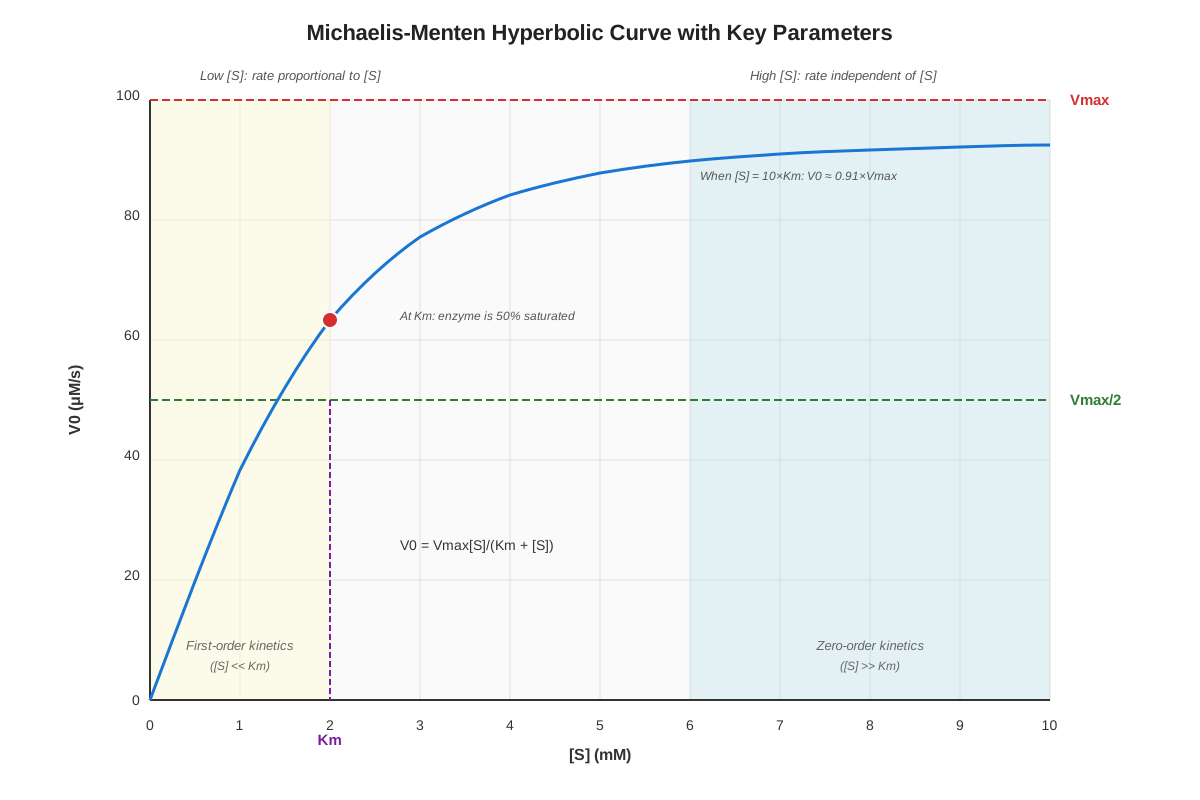
This equation produces a hyperbolic curve when v is plotted against [S], reflecting the saturation kinetics characteristic of enzyme-catalyzed reactions. At low substrate concentrations ([S] << Km), the reaction follows first-order kinetics with respect to substrate. At high substrate concentrations ([S] >> Km), the reaction approaches zero-order kinetics, becoming independent of substrate concentration as the enzyme becomes saturated.
Derivation and Underlying Assumptions
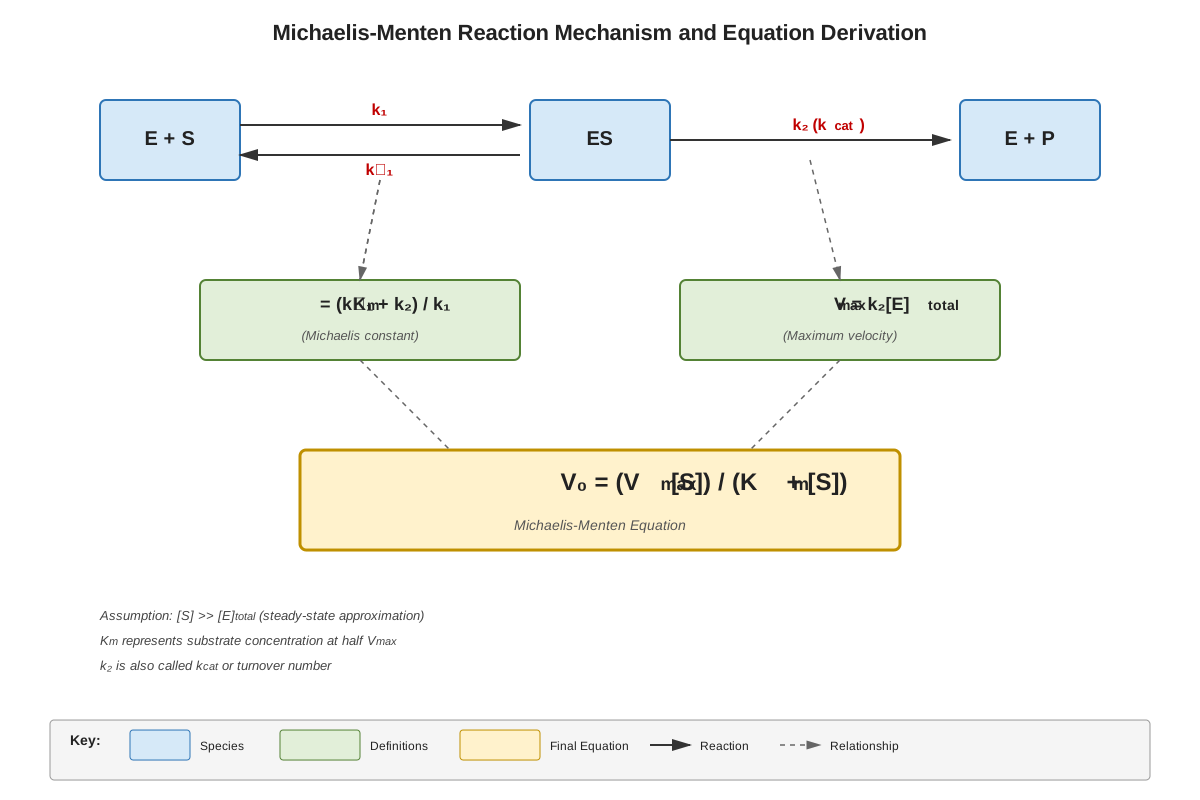
The Michaelis-Menten model assumes a simple two-step mechanism:
E + S ⇌ ES → E + PWhere E represents enzyme, S represents substrate, ES represents the enzyme-substrate complex, and P represents product. The model makes several critical assumptions:
- Steady-state assumption: The concentration of ES remains constant during the initial phase of the reaction
- Initial velocity conditions: Product concentration is negligible, preventing reverse reactions
- Free enzyme assumption: Total enzyme concentration is much less than substrate concentration
- Single substrate: The model applies to reactions with one substrate (though extensions exist for multiple substrates)
The steady-state approximation states that the rate of ES formation equals the rate of ES breakdown, allowing mathematical simplification that yields the Michaelis-Menten equation. This approach, developed by Briggs and Haldane, differs from the original Michaelis-Menten equilibrium assumption but produces the same final equation.
Kinetic Parameters: Vmax and Km
Vmax represents the theoretical maximum velocity achieved when all enzyme active sites are occupied by substrate. This parameter reflects the catalytic capacity of the enzyme and depends on:
- Total enzyme concentration ([E]total)
- The turnover number (kcat)
- The relationship: Vmax = kcat × [E]total
Km (the Michaelis constant) equals the substrate concentration at which the reaction velocity reaches half of Vmax. This parameter provides insight into enzyme-substrate affinity:
- Low Km (typically μM range): High affinity; enzyme efficiently binds substrate even at low concentrations
- High Km (typically mM range): Low affinity; requires higher substrate concentrations for effective catalysis
Importantly, Km is NOT a direct measure of binding affinity (which would be Kd, the dissociation constant), but rather a complex parameter that includes both binding and catalytic rate constants. However, when the catalytic step is much slower than substrate dissociation, Km approximates Kd.
Catalytic Efficiency and Turnover Number
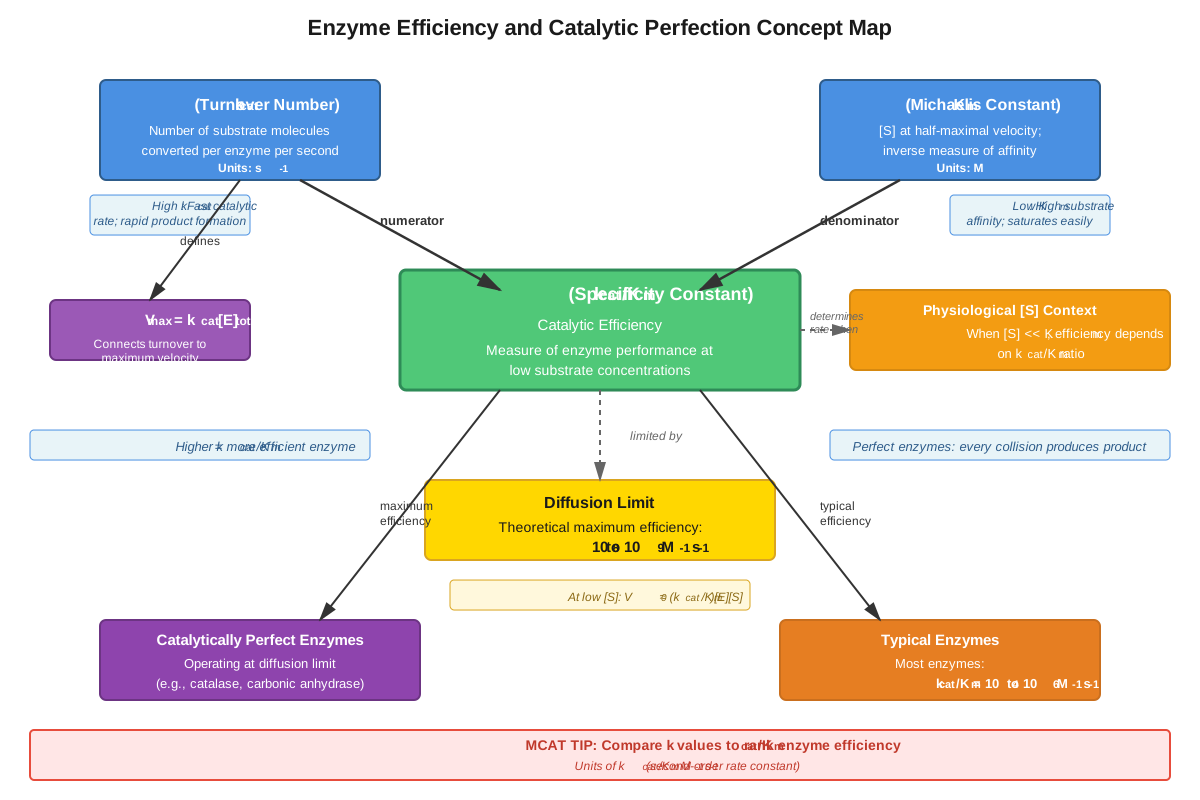
The turnover number (kcat) represents the number of substrate molecules converted to product per enzyme molecule per unit time when the enzyme is fully saturated. This parameter directly reflects the catalytic speed:
kcat = Vmax / [E]totalThe catalytic efficiency combines both binding and catalytic properties:
Catalytic efficiency = kcat / KmThis ratio indicates how efficiently an enzyme converts substrate to product at low substrate concentrations. Enzymes with high catalytic efficiency (approaching the diffusion limit of 10^8 to 10^9 M^-1s^-1) are termed "catalytically perfect" because they convert substrate to product nearly every time a collision occurs.
Graphical Analysis: Michaelis-Menten Plot
The standard Michaelis-Menten plot displays velocity (y-axis) versus substrate concentration (x-axis), producing a rectangular hyperbola. Key features include:
- Initial slope: Reflects kcat/Km (catalytic efficiency)
- Asymptote: Approaches Vmax at high [S]
- Half-maximal point: Occurs at [S] = Km
While intuitive, this plot makes precise determination of Vmax difficult because the curve approaches the asymptote gradually. This limitation led to the development of linearization methods.
Lineweaver-Burk Plot (Double Reciprocal Plot)
The Lineweaver-Burk plot linearizes the Michaelis-Menten equation by taking reciprocals:
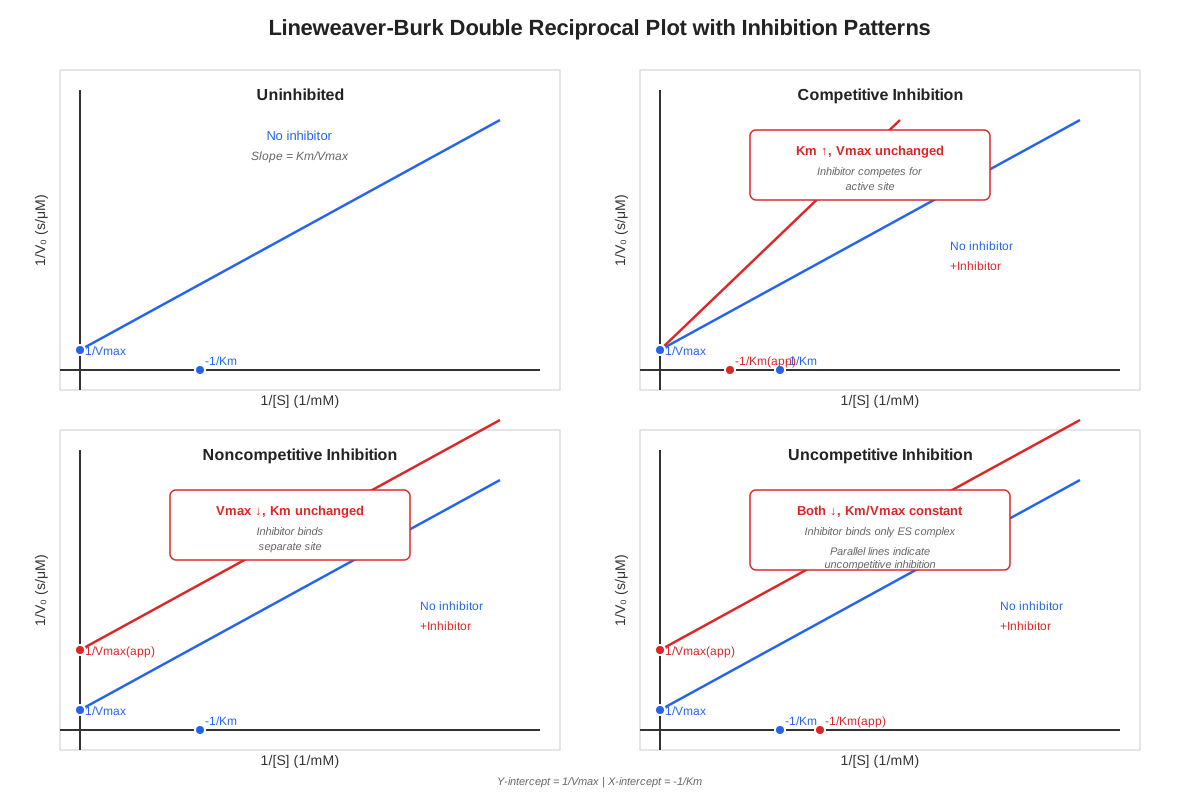
1/v = (Km/Vmax) × (1/[S]) + 1/VmaxThis transformation produces a straight line with:
- y-intercept = 1/Vmax
- x-intercept = -1/Km
- slope = Km/Vmax
The Lineweaver-Burk plot facilitates determination of kinetic parameters and is particularly valuable for analyzing enzyme inhibition patterns. However, it disproportionately weights data points at low substrate concentrations (where experimental error is typically highest), potentially introducing inaccuracies.
Enzyme Inhibition Patterns
Understanding how inhibitors affect kinetic parameters is crucial for MCAT success:
| Inhibition Type | Effect on Vmax | Effect on Km | Lineweaver-Burk Pattern |
|---|---|---|---|
| Competitive | Unchanged | Increased (apparent) | Lines intersect on y-axis |
| Noncompetitive | Decreased | Unchanged | Lines intersect on x-axis |
| Uncompetitive | Decreased | Decreased | Parallel lines |
| Mixed | Decreased | Increased or decreased | Lines intersect above or below x-axis |
Competitive inhibitors bind to the active site, competing directly with substrate. High substrate concentrations can overcome this inhibition, so Vmax remains unchanged while Km increases (reflecting decreased apparent affinity).
Noncompetitive inhibitors bind to a site distinct from the active site and affect enzyme function regardless of substrate binding. These inhibitors decrease Vmax but leave Km unchanged because substrate binding affinity is unaffected.
Uncompetitive inhibitors bind only to the ES complex, stabilizing it and preventing product formation. Both Vmax and Km decrease proportionally, producing parallel lines on Lineweaver-Burk plots.
Physiological Significance of Km
The Km value provides insight into enzyme function under physiological conditions:
- Enzymes with Km values near physiological substrate concentrations are poised for regulation; small changes in substrate availability significantly affect reaction velocity
- Enzymes with Km << physiological [S] operate near Vmax constantly, making them less responsive to substrate fluctuations
- Enzymes with Km >> physiological [S] show nearly linear responses to substrate changes, functioning as sensitive metabolic sensors
For example, hexokinase (low Km for glucose) efficiently phosphorylates glucose even at low concentrations, while glucokinase (high Km for glucose) acts as a glucose sensor in pancreatic β-cells, increasing activity only when blood glucose rises.
Concept Relationships
The Michaelis-Menten equation emerges from fundamental principles of chemical kinetics, specifically the steady-state approximation applied to enzyme-substrate complex formation. This mathematical framework → enables quantitative analysis of enzyme behavior → which provides the foundation for understanding enzyme inhibition mechanisms.
Kinetic parameters (Km and Vmax) → directly connect to molecular properties of enzymes → including active site structure, substrate binding affinity, and catalytic mechanism. Changes in these parameters → reflect mutations, post-translational modifications, or inhibitor binding → allowing prediction of functional consequences.
The Lineweaver-Burk transformation → linearizes the hyperbolic Michaelis-Menten relationship → facilitating graphical determination of kinetic parameters and inhibition patterns. Different inhibition types → produce characteristic patterns on Lineweaver-Burk plots → enabling experimental identification of inhibitor mechanisms.
Michaelis-Menten kinetics → integrates with metabolic pathway analysis → because enzyme kinetic properties determine flux through pathways. Enzymes with low Km values → act as efficient catalysts at low substrate concentrations → while enzymes with high Km values → function as metabolic sensors responsive to substrate availability.
Understanding catalytic efficiency (kcat/Km) → connects enzyme kinetics to evolutionary optimization → as natural selection favors enzymes with high efficiency for rate-limiting steps. This concept → extends to drug design → where inhibitors targeting enzymes with high catalytic efficiency can effectively modulate metabolic pathways.
High-Yield Facts
⭐ The Michaelis-Menten equation is v = (Vmax × [S]) / (Km + [S]), producing a hyperbolic curve when velocity is plotted against substrate concentration
⭐ Km equals the substrate concentration at which reaction velocity reaches exactly half of Vmax (v = Vmax/2)
⭐ Competitive inhibition increases Km (apparent) but does not change Vmax; lines intersect on the y-axis of Lineweaver-Burk plots
⭐ Noncompetitive inhibition decreases Vmax but does not change Km; lines intersect on the x-axis of Lineweaver-Burk plots
⭐ Uncompetitive inhibition decreases both Vmax and Km proportionally, producing parallel lines on Lineweaver-Burk plots
- The turnover number (kcat) equals Vmax divided by total enzyme concentration and represents substrate molecules converted per enzyme per second
- Catalytic efficiency (kcat/Km) indicates how effectively an enzyme converts substrate to product at low substrate concentrations
- At low substrate concentrations ([S] << Km), the reaction follows first-order kinetics with respect to substrate
- At high substrate concentrations ([S] >> Km), the reaction follows zero-order kinetics, becoming independent of substrate concentration
- The Lineweaver-Burk plot has y-intercept = 1/Vmax, x-intercept = -1/Km, and slope = Km/Vmax
- Enzymes with Km values near physiological substrate concentrations are most responsive to regulatory control
- The steady-state assumption states that ES complex concentration remains constant during initial velocity measurements
- Lower Km values indicate higher substrate affinity (enzyme efficiently binds substrate at low concentrations)
- Mixed inhibition affects both Vmax and Km, with lines intersecting above or below the x-axis on Lineweaver-Burk plots
- Catalytically perfect enzymes have kcat/Km values approaching the diffusion limit (10^8 to 10^9 M^-1s^-1)
Quick check — test yourself on Michaelis Menten kinetics so far.
Try Flashcards →Common Misconceptions
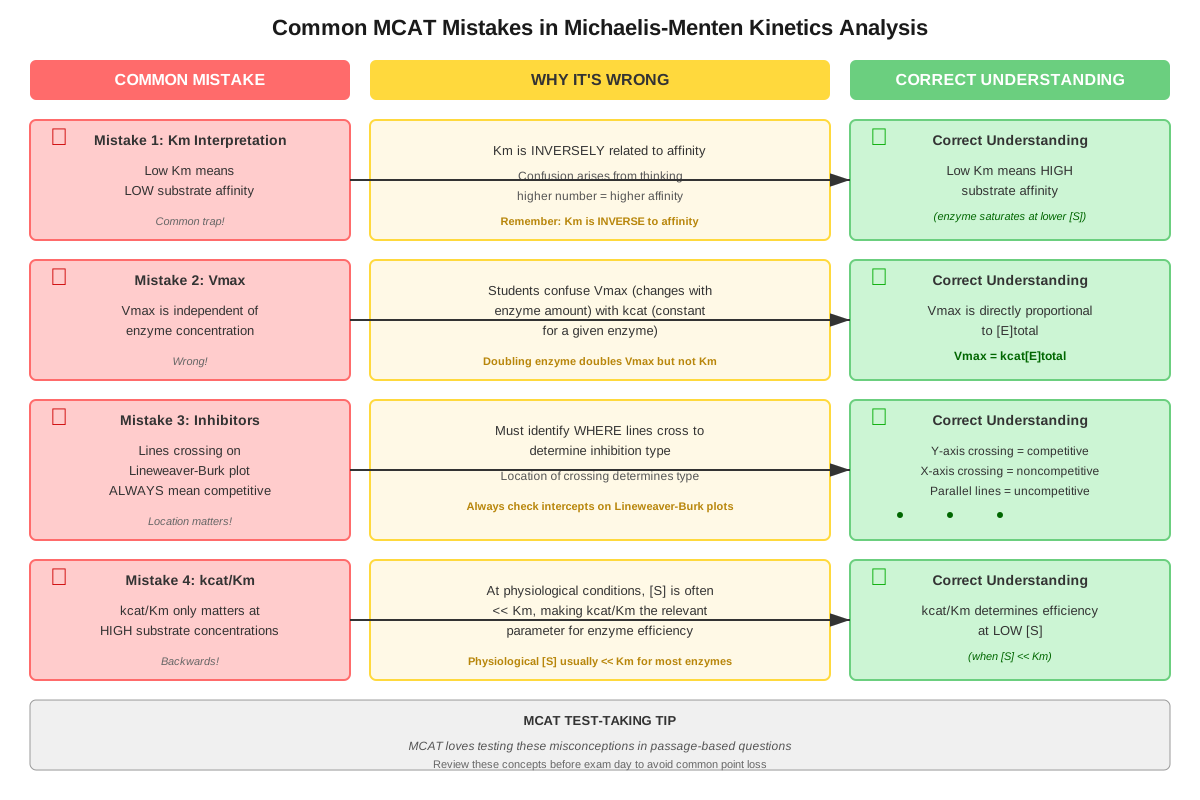
Misconception: Km directly measures the binding affinity between enzyme and substrate → Correction: Km is a complex parameter that includes both binding and catalytic rate constants. While it approximates the dissociation constant (Kd) when the catalytic step is rate-limiting, Km generally reflects both how well substrate binds and how quickly the ES complex proceeds to product. Lower Km indicates higher apparent affinity, but this is not purely a binding phenomenon.
Misconception: Competitive inhibitors permanently prevent substrate binding → Correction: Competitive inhibitors reversibly bind to the active site and can be displaced by sufficiently high substrate concentrations. This is why Vmax remains unchanged in competitive inhibition—given enough substrate, the enzyme can still achieve maximum velocity. The inhibition is surmountable, reflected in the increased apparent Km.
Misconception: Vmax depends on substrate concentration → Correction: Vmax is independent of substrate concentration and represents the theoretical maximum velocity when all enzyme molecules are saturated with substrate. Vmax depends only on total enzyme concentration and the turnover number (kcat). Increasing substrate concentration increases velocity toward Vmax but cannot increase Vmax itself.
Misconception: All enzymes follow Michaelis-Menten kinetics → Correction: The Michaelis-Menten model applies only to enzymes showing hyperbolic saturation kinetics. Allosteric enzymes display sigmoidal (S-shaped) kinetics due to cooperative binding and do not follow the Michaelis-Menten equation. These enzymes require different mathematical models, such as the Hill equation.
Misconception: On a Lineweaver-Burk plot, the y-intercept represents Vmax → Correction: The y-intercept equals 1/Vmax, not Vmax itself. This is a critical distinction when interpreting double-reciprocal plots. Similarly, the x-intercept equals -1/Km, not -Km. Students must remember that both axes represent reciprocals of the original parameters.
Misconception: Noncompetitive inhibitors bind to the active site → Correction: Noncompetitive inhibitors bind to a location distinct from the active site (an allosteric site) and can bind to either free enzyme or the ES complex with equal affinity. This is why substrate concentration cannot overcome noncompetitive inhibition and why Km remains unchanged while Vmax decreases.
Misconception: Higher Vmax always means a better enzyme → Correction: Enzyme quality depends on context and physiological role. While high Vmax indicates high catalytic capacity, catalytic efficiency (kcat/Km) better reflects overall enzyme performance, especially at physiological substrate concentrations. An enzyme with moderate Vmax but very low Km may be more effective than one with high Vmax but high Km.
Misconception: The Michaelis-Menten equation applies throughout the entire reaction time course → Correction: The equation describes initial velocity conditions, where product concentration is negligible and the steady-state assumption holds. As product accumulates, reverse reactions become significant, and the simple Michaelis-Menten model no longer accurately describes reaction kinetics.
Worked Examples
Example 1: Calculating Kinetic Parameters from Experimental Data
Problem: An enzyme is studied at various substrate concentrations, yielding the following data:
| [S] (mM) | v (μmol/min) |
|---|---|
| 0.5 | 1.0 |
| 1.0 | 1.5 |
| 2.0 | 2.0 |
| 5.0 | 2.5 |
| 10.0 | 2.7 |
Estimate Vmax and Km for this enzyme.
Solution:
Step 1: Identify Vmax by examining the data at high substrate concentrations. As [S] increases, velocity approaches an asymptote. At [S] = 10.0 mM, v = 2.7 μmol/min, and the rate of increase is slowing. Vmax appears to be approximately 3.0 μmol/min (the velocity is approaching but not quite reaching this value).
Step 2: Determine Km using the definition that Km is the substrate concentration at which v = Vmax/2. If Vmax ≈ 3.0 μmol/min, then v at Km should be approximately 1.5 μmol/min.
Step 3: From the table, v = 1.5 μmol/min occurs at [S] = 1.0 mM. Therefore, Km ≈ 1.0 mM.
Step 4: Verify using the Michaelis-Menten equation. At [S] = 2.0 mM:
v = (3.0 × 2.0) / (1.0 + 2.0) = 6.0 / 3.0 = 2.0 μmol/minThis matches the experimental value, confirming our estimates.
Key Learning Point: This problem demonstrates how to extract kinetic parameters from experimental data by recognizing that Vmax is approached at high [S] and Km is the [S] at half-maximal velocity. On the MCAT, you may need to estimate these values from graphs or tables without performing complex calculations.
Example 2: Analyzing Inhibition from Lineweaver-Burk Plots
Problem: An enzyme is studied in the presence and absence of an inhibitor. The Lineweaver-Burk plot shows that both the uninhibited and inhibited lines intersect on the y-axis, but the inhibited line has a steeper slope. What type of inhibition is occurring, and what are the effects on Km and Vmax?
Solution:
Step 1: Recall that the y-intercept of a Lineweaver-Burk plot equals 1/Vmax. If both lines intersect on the y-axis, they share the same y-intercept, meaning 1/Vmax is identical for both conditions.
Step 2: If 1/Vmax is unchanged, then Vmax itself is unchanged. This eliminates noncompetitive and uncompetitive inhibition, both of which decrease Vmax.
Step 3: The steeper slope for the inhibited line indicates an increase in Km/Vmax. Since Vmax is unchanged, Km must have increased.
Step 4: Increased Km with unchanged Vmax is the hallmark of competitive inhibition. The inhibitor competes with substrate for the active site, increasing the apparent Km (requiring more substrate to reach half-maximal velocity) but not affecting the maximum velocity achievable at saturating substrate concentrations.
Step 5: Recall that the x-intercept equals -1/Km. With increased Km, the magnitude of the x-intercept decreases (the line crosses the x-axis closer to the origin), consistent with competitive inhibition.
Answer: This is competitive inhibition. Vmax remains unchanged, while Km increases (apparent Km is higher in the presence of inhibitor).
Key Learning Point: Lineweaver-Burk plots provide a powerful visual method for identifying inhibition types. The intersection pattern immediately reveals the inhibition mechanism: y-axis intersection = competitive, x-axis intersection = noncompetitive, parallel lines = uncompetitive. This pattern recognition is essential for rapid MCAT question analysis.
Example 3: Predicting Effects of Mutations on Kinetic Parameters
Problem: A mutation in an enzyme's active site reduces substrate binding affinity by 50% but does not affect the catalytic rate constant (kcat). How will this mutation affect Km, Vmax, and catalytic efficiency?
Solution:
Step 1: Analyze the effect on Km. Since Km reflects substrate binding affinity (among other factors), reduced binding affinity will increase Km. If binding affinity decreases by 50%, Km will approximately double (Km is inversely related to affinity).
Step 2: Analyze the effect on Vmax. Vmax = kcat × [E]total. The problem states that kcat is unchanged, and the total enzyme concentration is presumably unchanged. Therefore, Vmax remains constant.
Step 3: Analyze the effect on catalytic efficiency. Catalytic efficiency = kcat/Km. Since kcat is unchanged but Km has doubled, catalytic efficiency will decrease by approximately 50% (it will be half the original value).
Step 4: Interpret the physiological significance. The mutant enzyme can still achieve the same maximum velocity when saturated with substrate, but it requires higher substrate concentrations to do so. At physiological substrate concentrations (which are often near or below Km), the mutant enzyme will be significantly less effective than the wild-type enzyme.
Answer: Km increases (approximately doubles), Vmax remains unchanged, and catalytic efficiency decreases (approximately halves). The enzyme becomes less efficient at low substrate concentrations but retains full catalytic capacity at saturating substrate levels.
Key Learning Point: This problem illustrates how molecular changes (mutations affecting binding) translate into kinetic parameter changes. Understanding these relationships allows prediction of functional consequences from structural information, a common MCAT question type that integrates biochemistry with molecular biology.
Exam Strategy
Approaching MCAT Questions on Michaelis-Menten Kinetics
For graph-based questions: First identify the plot type (Michaelis-Menten hyperbola vs. Lineweaver-Burk linear plot). On Michaelis-Menten plots, locate where velocity reaches half the asymptotic maximum—this gives Km. On Lineweaver-Burk plots, immediately identify intercepts: y-intercept = 1/Vmax, x-intercept = -1/Km.
For inhibition questions: Draw a quick mental or scratch-paper Lineweaver-Burk plot. Determine whether Vmax changes (does the y-intercept change?) and whether Km changes (does the x-intercept change?). Use the intersection pattern to identify inhibition type: y-axis = competitive, x-axis = noncompetitive, parallel = uncompetitive.
For calculation questions: Recognize that the MCAT rarely requires complex calculations. Most problems test conceptual understanding or require simple substitutions into the Michaelis-Menten equation. If [S] = Km, then v = Vmax/2 automatically—no calculation needed. If [S] >> Km, then v ≈ Vmax. If [S] << Km, then v is approximately proportional to [S].
Trigger Words and Phrases
- "Initial velocity" or "initial rate": Confirms that Michaelis-Menten assumptions apply (product concentration negligible)
- "Saturating substrate concentration": Indicates [S] >> Km, so v ≈ Vmax
- "Half-maximal velocity": Directly indicates [S] = Km
- "Competitive with substrate": Signals competitive inhibition (Km increases, Vmax unchanged)
- "Allosteric site" or "non-active site binding": Suggests noncompetitive or uncompetitive inhibition
- "Cannot be overcome by substrate": Indicates noncompetitive inhibition
- "Parallel lines": Immediately identifies uncompetitive inhibition on Lineweaver-Burk plots
Process-of-Elimination Tips
When analyzing inhibition patterns, eliminate answer choices systematically:
- If Vmax changes, eliminate competitive inhibition
- If Km changes, eliminate pure noncompetitive inhibition
- If lines are not parallel on Lineweaver-Burk plots, eliminate uncompetitive inhibition
- If lines intersect on an axis, eliminate mixed inhibition
For questions about enzyme efficiency or physiological relevance:
- Eliminate choices suggesting that high Km always means poor enzyme function (context matters)
- Eliminate choices confusing Km with Kd (dissociation constant)
- Eliminate choices suggesting Vmax depends on substrate concentration
Time Allocation Advice
Michaelis-Menten questions typically require 60-90 seconds for discrete questions and 90-120 seconds for passage-based questions. Spend the first 15-20 seconds identifying the question type (graph interpretation, inhibition pattern, calculation, or conceptual). For graph questions, extract key parameters immediately rather than analyzing every data point. For inhibition questions, sketch a quick Lineweaver-Burk plot if not provided—this 10-second investment saves time by making the answer obvious.
Memory Techniques
Mnemonic for Lineweaver-Burk Intercepts
"Y-axis is Very max, X-axis is Km"
- Y-intercept = 1/Vmax
- X-intercept = -1/Km
Mnemonic for Inhibition Patterns
"CONY" (Competitive, nOncompetitive, uNcompetitive, Y-axis)
- Competitive: lines meet on Y-axis (y-intercept unchanged, Vmax unchanged)
- nOncompetitive: lines meet Off the y-axis, on x-axis (Km unchanged)
- uNcompetitive: lines are Never meeting (parallel)
Visualization Strategy for Km
Picture Km as a "half-full" marker. When substrate concentration reaches Km, the enzyme is "half-full" of activity (at half-maximal velocity). Lower Km means the enzyme reaches this half-full point at lower substrate concentrations—it's more easily satisfied, indicating higher affinity.
Acronym for Michaelis-Menten Assumptions
"SIFS" - Steady-state, Initial velocity, Free enzyme, Single substrate
- Steady-state: ES concentration constant
- Initial velocity: Product concentration negligible
- Free enzyme: [E]total << [S]
- Single substrate: One substrate binding event
Competitive Inhibition Memory Aid
"Competitive inhibitors are SORE"
- Subtrate can overcome them
- Only Km changes (increases)
- Reversible binding
- Enzyme active site is the target
Summary
Michaelis-Menten kinetics provides the quantitative framework for understanding enzyme-catalyzed reactions, describing the hyperbolic relationship between substrate concentration and reaction velocity through the equation v = (Vmax × [S]) / (Km + [S]). The two key parameters—Vmax (maximum velocity at substrate saturation) and Km (substrate concentration at half-maximal velocity)—reveal both the catalytic capacity and substrate affinity of enzymes. The Lineweaver-Burk double-reciprocal plot linearizes this relationship, facilitating determination of kinetic parameters and identification of inhibition patterns through characteristic line intersections. Competitive inhibition increases Km without affecting Vmax (lines intersect on y-axis), noncompetitive inhibition decreases Vmax without affecting Km (lines intersect on x-axis), and uncompetitive inhibition decreases both parameters proportionally (parallel lines). Understanding these principles enables prediction of enzyme behavior under varying conditions, analysis of experimental data, and interpretation of how mutations or inhibitors affect enzyme function—all critical skills for MCAT success.
Key Takeaways
- The Michaelis-Menten equation (v = Vmax[S]/(Km + [S])) describes hyperbolic enzyme saturation kinetics, with Km representing the substrate concentration at half-maximal velocity
- Vmax reflects catalytic capacity (dependent on enzyme concentration and kcat), while Km indicates apparent substrate affinity (lower Km = higher affinity)
- Lineweaver-Burk plots linearize kinetic data with y-intercept = 1/Vmax and x-intercept = -1/Km, enabling easy parameter determination and inhibition analysis
- Competitive inhibition (increases Km, unchanged Vmax) produces lines intersecting on the y-axis; noncompetitive inhibition (unchanged Km, decreased Vmax) produces lines intersecting on the x-axis; uncompetitive inhibition (both decreased) produces parallel lines
- Catalytic efficiency (kcat/Km) indicates overall enzyme effectiveness, particularly at low substrate concentrations typical of physiological conditions
- The steady-state assumption and initial velocity conditions are critical prerequisites for applying the Michaelis-Menten model
- Enzymes with Km values near physiological substrate concentrations are most responsive to metabolic regulation and substrate availability changes
Related Topics
Enzyme Inhibition and Regulation: Building on Michaelis-Menten kinetics, this topic explores reversible and irreversible inhibition mechanisms, allosteric regulation, and covalent modification. Mastering kinetic principles enables understanding of how cells control metabolic flux through enzyme regulation.
Allosteric Enzymes and Cooperativity: These enzymes display sigmoidal rather than hyperbolic kinetics and require the Hill equation instead of the Michaelis-Menten equation. Understanding the limitations of Michaelis-Menten kinetics prepares students for more complex regulatory enzymes.
Metabolic Pathway Analysis: Kinetic parameters determine which enzymes control pathway flux. Enzymes with high Km values relative to substrate availability often represent regulatory points, while those with low Km values operate near Vmax and maintain steady flux.
Pharmacokinetics and Drug Metabolism: Drug clearance follows Michaelis-Menten kinetics when metabolizing enzymes become saturated. Understanding Km and Vmax for drug-metabolizing enzymes predicts dose-response relationships and drug-drug interactions.
Enzyme Assays and Experimental Design: Practical application of Michaelis-Menten principles to experimental scenarios, including how to design experiments to determine kinetic parameters and identify inhibitor mechanisms.
Practice CTA
Now that you've mastered the theoretical foundations of Michaelis-Menten kinetics, it's time to solidify your understanding through active practice. Work through the practice questions to test your ability to analyze graphs, identify inhibition patterns, and apply kinetic principles to experimental scenarios. Use the flashcards to reinforce key equations, definitions, and high-yield facts until you can recall them instantly. Remember: understanding the concepts is essential, but MCAT success requires rapid, accurate application under time pressure. The more you practice interpreting Lineweaver-Burk plots and analyzing kinetic data, the more confident and efficient you'll become on test day. You've built a strong foundation—now strengthen it through deliberate practice!
Sign up free to keep reading
Create a free AnvayaPrep account to finish this MCAT guide on Michaelis Menten kinetics — plus flashcards and practice questions.