Overview
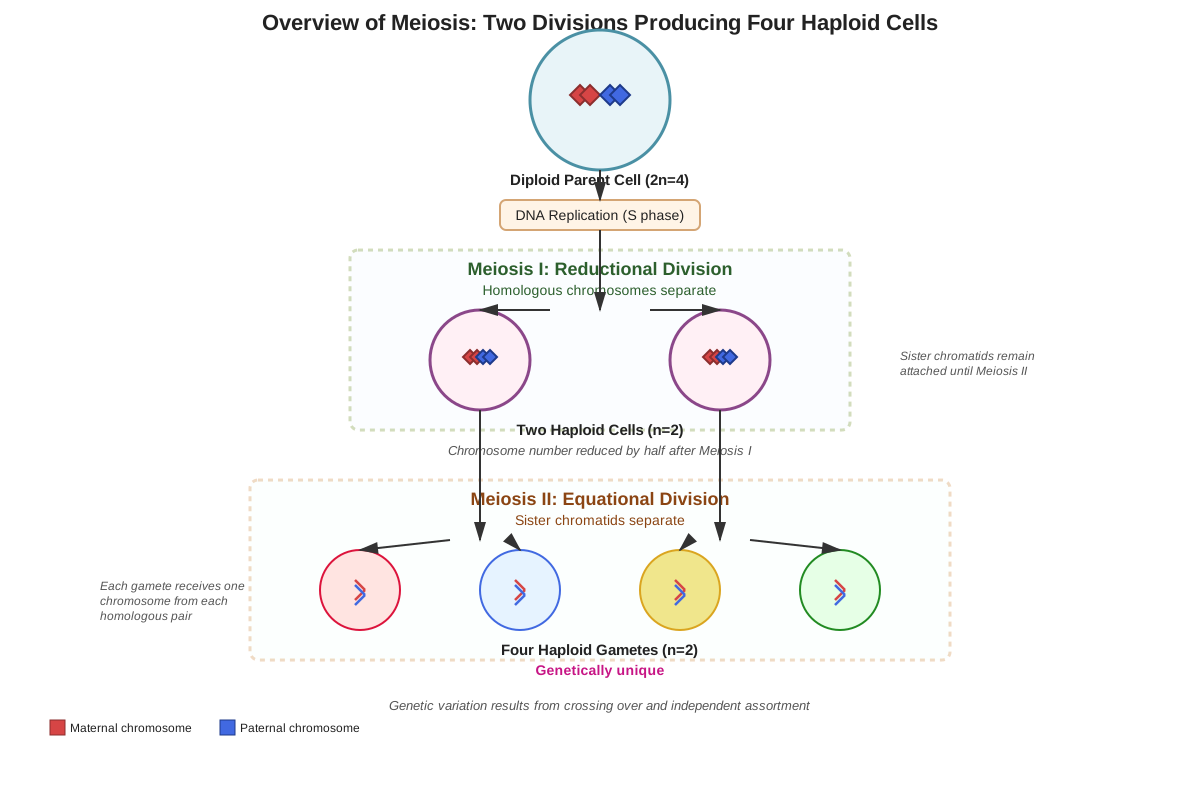
Meiosis is a specialized type of cell division that produces four genetically unique haploid daughter cells from a single diploid parent cell. This process is fundamental to sexual reproduction and genetic diversity in eukaryotic organisms. Unlike mitosis, which produces identical diploid cells for growth and repair, meiosis reduces the chromosome number by half and introduces genetic variation through crossing over and independent assortment. Understanding meiosis is essential for mastering genetics, inheritance patterns, and evolutionary biology—all high-yield topics on the MCAT.
For the MCAT, meiosis appears frequently in both the Biology and Biochemistry sections, particularly within questions addressing Cell Biology, genetics, and reproduction. Test-makers favor questions that require students to distinguish between meiosis and mitosis, identify stages of meiotic division, predict outcomes of chromosomal abnormalities, and apply principles of genetic recombination. The topic integrates seamlessly with Mendelian genetics, population genetics, and molecular biology, making it a cornerstone concept that connects multiple testable domains.
The big-picture significance of meiosis extends beyond cell division mechanics. It explains how genetic variation arises within populations, provides the mechanistic basis for inheritance patterns, and accounts for chromosomal disorders that appear in clinical vignettes. Mastery of meiosis Biology enables students to tackle complex passage-based questions that integrate cellular processes with organismal reproduction, evolutionary fitness, and disease etiology—all common themes on the MCAT.
Learning Objectives
- [ ] Define Meiosis using accurate Biology terminology
- [ ] Explain why Meiosis matters for the MCAT
- [ ] Apply Meiosis to exam-style questions
- [ ] Identify common mistakes related to Meiosis
- [ ] Connect Meiosis to related Biology concepts
- [ ] Compare and contrast meiosis I and meiosis II at the chromosomal level
- [ ] Predict the genetic consequences of nondisjunction events during different meiotic stages
- [ ] Calculate the number of possible gamete combinations resulting from independent assortment and crossing over
Prerequisites
- Mitosis and the cell cycle: Understanding the standard cell division process provides the comparative framework necessary to appreciate how meiosis differs in chromosome behavior and outcomes
- DNA structure and replication: Knowledge of DNA organization, sister chromatids, and homologous chromosomes is essential for tracking genetic material through meiotic divisions
- Basic genetics terminology: Familiarity with terms like diploid, haploid, allele, gene, and chromosome enables precise discussion of meiotic events
- Mendelian inheritance: Understanding how traits are inherited provides context for why meiosis must reduce chromosome number and generate variation
Why This Topic Matters
Meiosis has profound clinical and real-world significance. Errors in meiotic division cause chromosomal abnormalities such as Down syndrome (trisomy 21), Turner syndrome (monosomy X), and Klinefelter syndrome (XXY), which frequently appear in MCAT clinical vignettes. Understanding meiotic mechanisms explains infertility, miscarriage rates, and the maternal age effect on aneuploidy risk. Additionally, meiosis underlies genetic counseling scenarios, cancer biology (where cells may inappropriately enter meiotic-like states), and evolutionary adaptations that depend on genetic recombination.
On the MCAT, meiosis appears in approximately 3-5% of Biology questions, with representation across discrete questions, passage-based items, and integrated problems combining genetics with cell biology. Questions typically test stage identification (recognizing prophase I versus prophase II), understanding crossing over and recombination frequency, predicting gamete genotypes, and analyzing pedigrees that depend on meiotic segregation. The topic also appears in research passages describing experimental manipulations of gametogenesis or studies of chromosomal behavior.
Common exam presentations include diagrams showing cells at various meiotic stages requiring identification, pedigree analysis requiring application of segregation principles, calculations of recombination frequency from genetic crosses, and clinical scenarios describing chromosomal disorders. Passages may present novel organisms or experimental systems, testing whether students can apply meiotic principles beyond memorized human examples.
Core Concepts
Definition and Purpose of Meiosis
Meiosis is a reductional cell division process consisting of two successive nuclear divisions (meiosis I and meiosis II) following a single round of DNA replication, ultimately producing four haploid cells from one diploid parent cell. The term derives from the Greek word meaning "lessening," referring to the reduction in chromosome number. In humans, meiosis occurs exclusively in germ cells within the gonads (testes and ovaries) to produce gametes—sperm and eggs—that contain 23 chromosomes rather than the somatic cell complement of 46.
The primary purposes of meiosis are twofold: (1) reducing chromosome number from diploid (2n) to haploid (n) so that fertilization restores the diploid state without doubling chromosome number each generation, and (2) generating genetic diversity through crossing over (recombination) and independent assortment of chromosomes. This genetic variation provides the raw material for natural selection and evolutionary adaptation.
Meiosis I: The Reductional Division
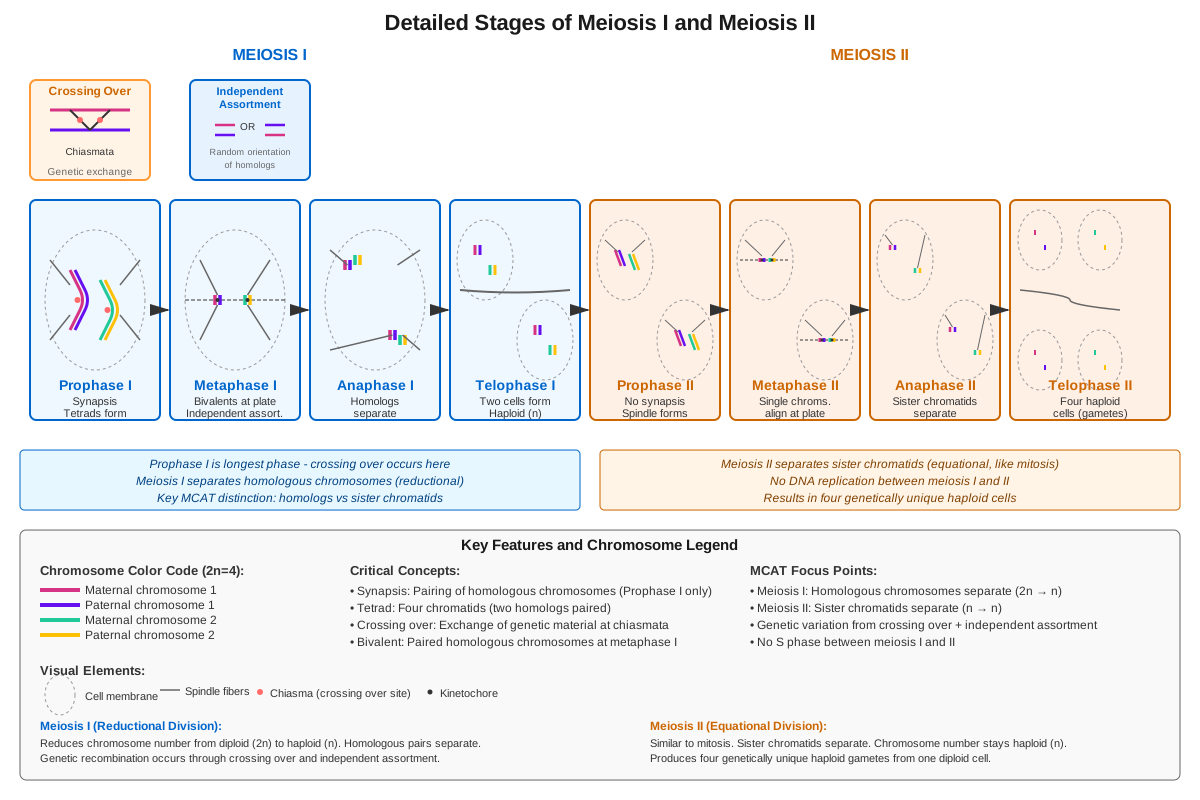
Meiosis I separates homologous chromosomes and is termed the reductional division because it reduces chromosome number from diploid to haploid. This division consists of four phases: prophase I, metaphase I, anaphase I, and telophase I.
Prophase I is the longest and most complex meiotic stage, subdivided into five substages:
- Leptotene: Chromosomes condense and become visible as thin threads
- Zygotene: Homologous chromosomes pair precisely in a process called synapsis, forming structures called bivalents or tetrads (four chromatids total)
- Pachytene: Crossing over (recombination) occurs between non-sister chromatids of homologous chromosomes via the synaptonemal complex, a protein structure that holds homologs together
- Diplotene: The synaptonemal complex disassembles, but homologs remain connected at chiasmata (singular: chiasma)—the physical manifestations of crossing over points
- Diakinesis: Chromosomes condense maximally, chiasmata move toward chromosome ends (terminalization), and the nuclear envelope breaks down
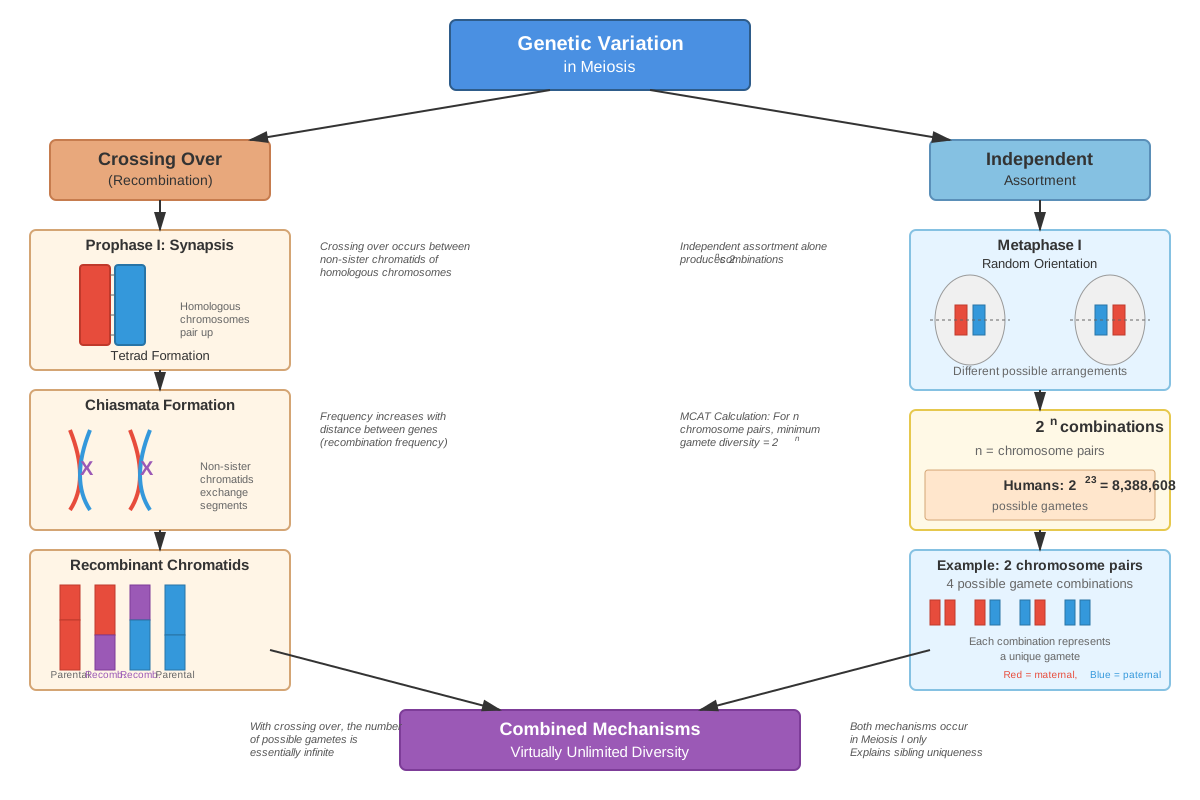
During metaphase I, bivalents align at the metaphorical equator (metaphase plate) with homologous chromosomes oriented toward opposite poles. Crucially, the orientation of each bivalent is random—this is independent assortment, which generates 2^n possible gamete combinations (where n = haploid number). In humans, this yields 2^23 = approximately 8.4 million possible combinations from independent assortment alone.
Anaphase I features separation of homologous chromosomes (not sister chromatids) toward opposite poles. Each chromosome still consists of two sister chromatids joined at the centromere. This differs fundamentally from mitotic anaphase, where sister chromatids separate.
Telophase I and cytokinesis produce two haploid cells, each containing one member of each homologous pair. Importantly, these chromosomes are still duplicated (consisting of two sister chromatids). Some organisms skip telophase I and proceed directly to meiosis II without nuclear envelope reformation or significant decondensation.
Meiosis II: The Equational Division
Meiosis II resembles mitosis and is called the equational division because it separates sister chromatids without further reducing chromosome number. No DNA replication occurs between meiosis I and meiosis II—a critical distinction from the cell cycle preceding mitosis.
Prophase II involves chromosome condensation (if decondensation occurred) and spindle apparatus formation. Metaphase II features alignment of chromosomes (each still consisting of two sister chromatids) at the metaphase plate. Anaphase II separates sister chromatids, which move to opposite poles as individual chromosomes. Telophase II and cytokinesis produce four haploid cells, each containing unreplicated chromosomes (one chromatid per chromosome).
Comparison of Meiosis and Mitosis
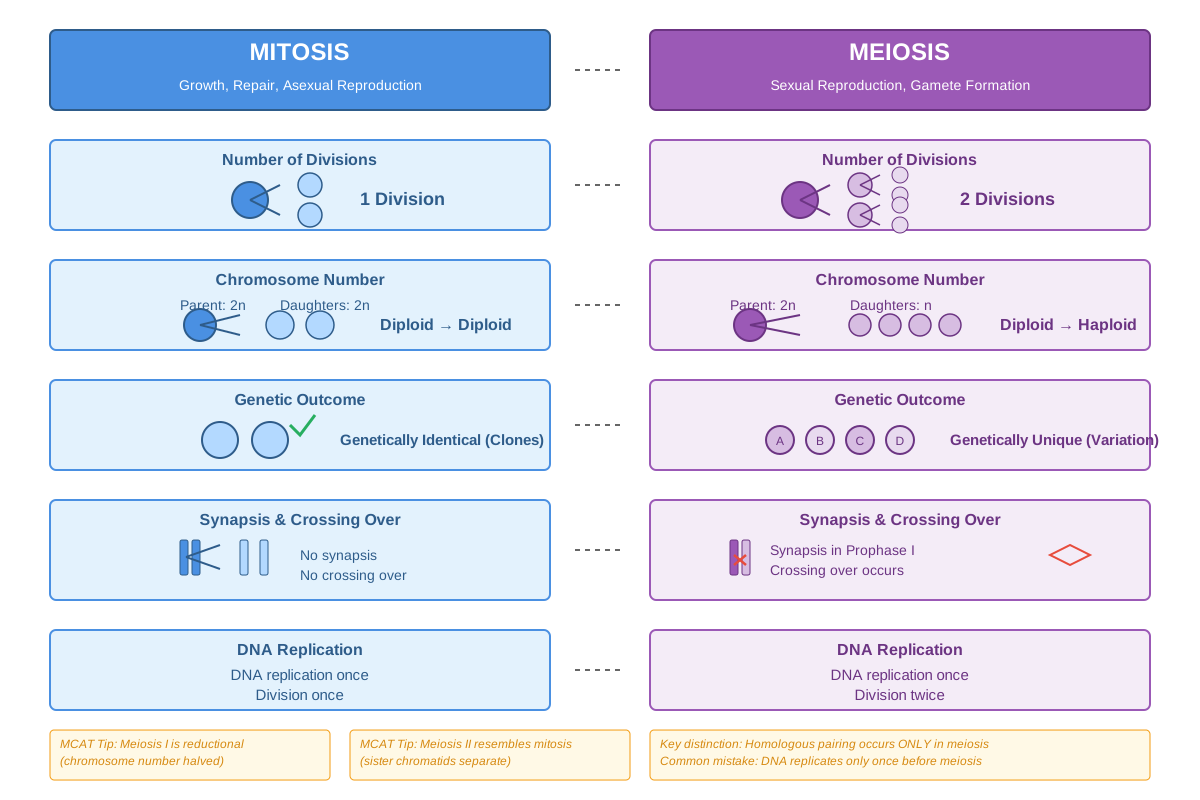
| Feature | Mitosis | Meiosis |
|---|---|---|
| Number of divisions | One | Two (meiosis I and II) |
| DNA replication | Once, before division | Once, before meiosis I |
| Daughter cells produced | Two | Four |
| Chromosome number | Diploid → diploid (2n → 2n) | Diploid → haploid (2n → n) |
| Genetic identity | Identical to parent | Genetically unique |
| Synapsis occurs | No | Yes (prophase I) |
| Crossing over | No | Yes (prophase I) |
| Homologs separate | No | Yes (anaphase I) |
| Sister chromatids separate | Anaphase | Anaphase II |
| Function | Growth, repair, asexual reproduction | Sexual reproduction (gamete formation) |
Genetic Recombination and Variation
Crossing over (genetic recombination) occurs during pachytene of prophase I when non-sister chromatids of homologous chromosomes exchange equivalent segments of DNA. The molecular mechanism involves double-strand DNA breaks, strand invasion, and resolution of Holliday junctions—processes mediated by enzymes including SPO11, RAD51, and resolvases. Each bivalent typically experiences 1-3 crossover events, with at least one required for proper chromosome segregation.
The frequency of recombination between two genetic loci depends on their physical distance: loci farther apart have higher recombination frequencies because more chromosomal space allows more opportunities for crossover events. One map unit (centimorgan) equals a 1% recombination frequency. Genes on different chromosomes assort independently (50% recombination frequency), while linked genes on the same chromosome show recombination frequencies less than 50%.
Independent assortment of homologous chromosomes during metaphase I provides additional variation. Combined with crossing over, the total number of genetically distinct gametes possible from a single human individual exceeds 70 trillion (2^23 from independent assortment × multiple crossover combinations).
Regulation and Checkpoints
Meiotic progression is regulated by checkpoints ensuring proper chromosome pairing, recombination, and segregation. The pachytene checkpoint monitors synapsis completion and recombination initiation. The spindle assembly checkpoint (SAC) prevents anaphase onset until all chromosomes are properly attached to spindle microtubules. Failure of these checkpoints can result in nondisjunction—the failure of chromosomes to separate properly.
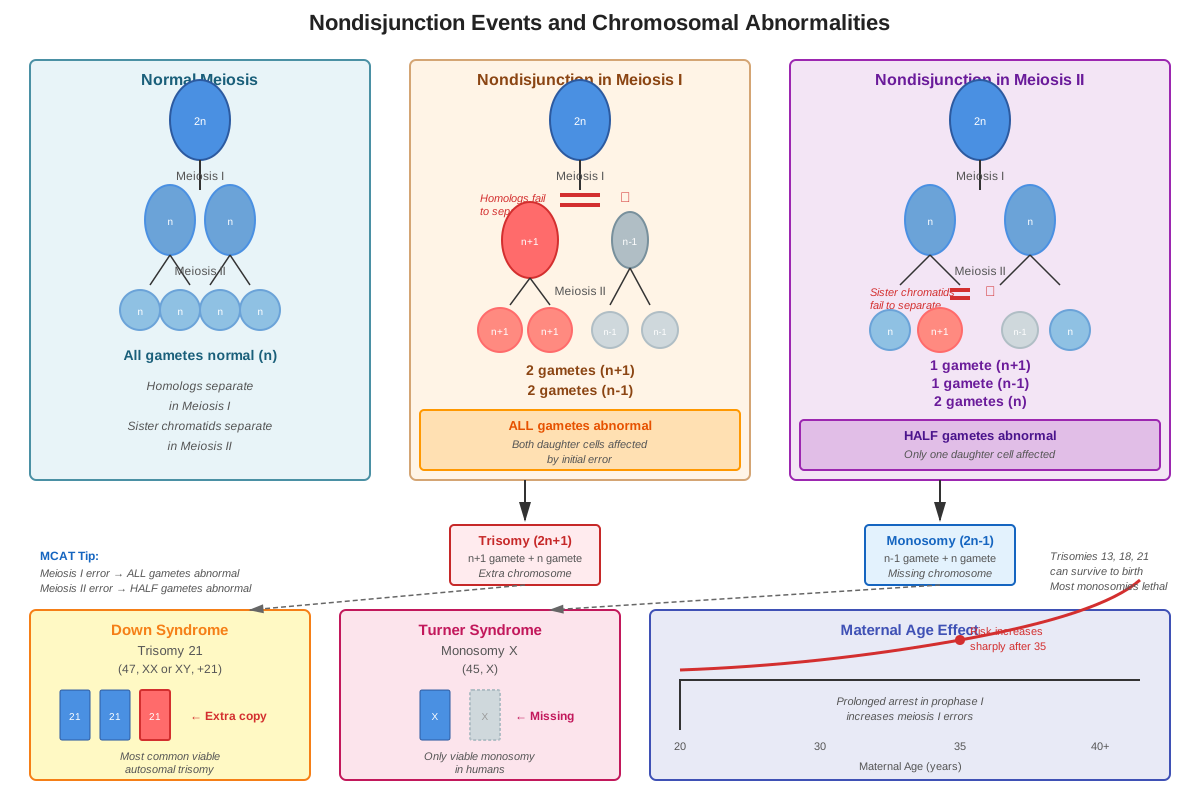
Nondisjunction can occur during meiosis I (homologous chromosomes fail to separate) or meiosis II (sister chromatids fail to separate), producing gametes with abnormal chromosome numbers. Fertilization involving aneuploid gametes results in conditions like trisomy (three copies of a chromosome) or monosomy (one copy). Maternal age strongly correlates with nondisjunction frequency, particularly for meiosis I errors, due to prolonged arrest of oocytes in prophase I from fetal development until ovulation.
Concept Relationships
The concepts within meiosis form an integrated network. DNA replication preceding meiosis I creates sister chromatids → synapsis during prophase I brings homologous chromosomes together → crossing over generates recombinant chromatids → independent assortment at metaphase I randomizes chromosome distribution → separation of homologs at anaphase I reduces chromosome number → meiosis II separates sister chromatids → four genetically unique haploid gametes result.
Meiosis connects to prerequisite topics through its dependence on DNA structure (understanding what crosses over), mitosis (providing the comparative framework), and cell cycle regulation (checkpoints and cyclins). It enables progression to Mendelian genetics (explaining segregation and independent assortment laws), population genetics (providing variation for Hardy-Weinberg equilibrium), and molecular genetics (recombination mapping and linkage analysis).
The relationship to chromosomal abnormalities creates a bridge to clinical medicine: nondisjunction in meiosis → aneuploidy → genetic disorders. Understanding gametogenesis differences between males (spermatogenesis produces four functional sperm) and females (oogenesis produces one functional egg and polar bodies) connects meiosis to reproductive biology and explains sex-specific patterns of chromosomal disorders.
Quick check — test yourself on Meiosis so far.
Try Flashcards →High-Yield Facts
- ⭐ Meiosis consists of one DNA replication followed by two cell divisions, producing four haploid cells from one diploid cell
- ⭐ Crossing over occurs during prophase I between non-sister chromatids of homologous chromosomes, generating genetic recombination
- ⭐ Homologous chromosomes separate during anaphase I; sister chromatids separate during anaphase II
- ⭐ Independent assortment during metaphase I generates 2^n possible chromosome combinations (8.4 million in humans)
- ⭐ Nondisjunction during meiosis I produces gametes with n+1 and n-1 chromosomes; nondisjunction during meiosis II produces two normal and two abnormal gametes
- Synapsis and tetrad formation are unique to meiosis I and do not occur in mitosis
- The synaptonemal complex is the protein structure that holds homologous chromosomes together during crossing over
- Chiasmata are the visible evidence of crossing over and help hold homologs together until anaphase I
- Recombination frequency between two loci is proportional to their distance apart on a chromosome (1% recombination = 1 map unit)
- Maternal age effect increases nondisjunction risk because oocytes arrest in prophase I from fetal development until ovulation (potentially decades)
- Meiosis II resembles mitosis but occurs without an intervening S phase (no DNA replication)
- At least one crossover per chromosome pair is typically required for proper segregation during meiosis I
Common Misconceptions
Misconception: Meiosis produces two daughter cells like mitosis.
Correction: Meiosis produces four daughter cells through two successive divisions (meiosis I and meiosis II), while mitosis produces two daughter cells through one division.
Misconception: Sister chromatids separate during meiosis I.
Correction: Homologous chromosomes separate during meiosis I (anaphase I), while sister chromatids remain attached at the centromere until anaphase II. This is the fundamental difference between the reductional (meiosis I) and equational (meiosis II) divisions.
Misconception: Crossing over occurs between sister chromatids.
Correction: Crossing over occurs between non-sister chromatids of homologous chromosomes. Sister chromatids are genetically identical (barring mutations), so exchange between them would not generate genetic variation. Recombination between non-sister chromatids creates new allele combinations.
Misconception: DNA replication occurs between meiosis I and meiosis II.
Correction: No DNA replication occurs between meiosis I and meiosis II. Cells enter meiosis II with chromosomes still consisting of two sister chromatids from the original S phase before meiosis I. This is why meiosis II is equational rather than reductional.
Misconception: Independent assortment and crossing over are the same process.
Correction: Independent assortment refers to the random orientation of homologous chromosome pairs at metaphase I, determining which member of each pair goes to which daughter cell. Crossing over is the physical exchange of DNA segments between non-sister chromatids during prophase I. Both generate variation but through distinct mechanisms at different stages.
Misconception: All nondisjunction events produce the same gamete outcomes.
Correction: Nondisjunction during meiosis I (homologs fail to separate) produces two gametes with n+1 chromosomes and two with n-1 chromosomes. Nondisjunction during meiosis II (sister chromatids fail to separate) produces one n+1 gamete, one n-1 gamete, and two normal n gametes. The timing matters for predicting outcomes.
Worked Examples
Example 1: Identifying Meiotic Stages
Question: A cell is observed with 23 structures aligned at the cell's equator. Each structure consists of two homologous chromosomes, with each chromosome containing two sister chromatids. Spindle fibers attach to the centromeres. What stage of meiosis is this cell in?
Solution:
Step 1: Identify key features. The cell has 23 structures (indicating human cells, n=23), and each structure contains homologous chromosomes paired together. This pairing indicates synapsis has occurred.
Step 2: Determine if this is meiosis I or II. The presence of homologous chromosomes paired together (bivalents/tetrads) indicates meiosis I, since homologs separate during meiosis I and are not present together in meiosis II.
Step 3: Identify the specific phase. The structures are aligned at the equator (metaphase plate), and spindle fibers are attached. This describes metaphase I, when bivalents align at the metaphase plate before homologs separate.
Step 4: Verify. At metaphase I, we expect: (1) bivalents at the metaphase plate ✓, (2) each chromosome consisting of two sister chromatids ✓, (3) spindle attachment to centromeres ✓, (4) 23 bivalents in humans ✓.
Answer: The cell is in metaphase I of meiosis.
Connection to learning objectives: This example applies meiosis knowledge to identify stages based on chromosomal configuration, a common MCAT question type.
Example 2: Predicting Nondisjunction Outcomes
Question: During oogenesis in a human female, nondisjunction of chromosome 21 occurs during meiosis I. If one of the resulting eggs is fertilized by a normal sperm, what are the possible chromosome 21 configurations in the resulting zygote?
Solution:
Step 1: Understand meiosis I nondisjunction. When homologous chromosomes fail to separate during anaphase I, one daughter cell receives both homologs (n+1 for that chromosome) and the other receives neither (n-1 for that chromosome).
Step 2: Determine gamete outcomes. For chromosome 21 specifically:
- Two eggs will have two copies of chromosome 21 (24 total chromosomes)
- Two eggs will have zero copies of chromosome 21 (22 total chromosomes)
Step 3: Consider fertilization with normal sperm. A normal sperm contributes one copy of chromosome 21.
- Egg with 2 copies + sperm with 1 copy = zygote with 3 copies (trisomy 21)
- Egg with 0 copies + sperm with 1 copy = zygote with 1 copy (monosomy 21)
Step 4: Evaluate viability. Trisomy 21 results in Down syndrome (viable). Monosomy 21 is lethal and results in early miscarriage.
Step 5: Note the distinction. If nondisjunction had occurred during meiosis II instead, only one of four eggs would be affected (n+1), one would be n-1, and two would be normal (n). The question specifically states meiosis I, so all four eggs are abnormal.
Answer: The possible zygote configurations are trisomy 21 (Down syndrome) or monosomy 21 (lethal). All eggs produced from this meiotic division are abnormal because nondisjunction occurred during meiosis I.
Connection to learning objectives: This example demonstrates application of meiotic principles to predict genetic outcomes and connects to clinical scenarios commonly tested on the MCAT.
Exam Strategy
When approaching MCAT questions on meiosis, first identify whether the question asks about meiosis I or meiosis II—this distinction is crucial since homologs separate in I and sister chromatids separate in II. Look for trigger words: "homologous chromosomes," "bivalents," "tetrads," and "crossing over" indicate meiosis I, while "sister chromatids separating" without mention of homologs suggests meiosis II.
For stage identification questions, count chromosomes and chromatids systematically. In prophase I through metaphase I, homologs are paired (bivalents visible). After anaphase I, homologs are separated but chromosomes still consist of two sister chromatids. After anaphase II, each chromosome is a single chromatid. Drawing quick diagrams helps track chromosome behavior.
When questions involve genetic outcomes or recombination, remember that crossing over occurs only during prophase I and only between non-sister chromatids. If a question asks about variation, consider both independent assortment (2^n combinations) and crossing over (additional variation). For linkage problems, closer genes have lower recombination frequencies.
Process-of-elimination strategies: eliminate answer choices that confuse mitosis with meiosis (watch for "two identical daughter cells"), that place crossing over in meiosis II or between sister chromatids, or that suggest DNA replication between meiosis I and II. Be suspicious of answers that don't account for the reduction in chromosome number or that ignore the difference between homologs and sister chromatids.
Time allocation: Most meiosis questions can be answered in 60-90 seconds. If a question requires detailed tracking of multiple chromosomes through both divisions, budget up to 2 minutes. Don't get bogged down drawing elaborate diagrams—simple representations of chromosome number and configuration suffice.
Memory Techniques
PMAT mnemonic works for both meiosis I and II: Prophase, Metaphase, Anaphase, Telophase. Add subscripts (PMAT₁ then PMAT₂) to remember the sequence.
For prophase I substages, remember "Lazy Zebras Prefer Drinking Diet": Leptotene, Zygotene, Pachytene, Diplotene, Diakinesis. Associate each with its key event: Zebras = synapsis (pairing), Pachytene = crossing over (think "packed" with genetic exchange).
"Homologs Apart in One, Sisters Split in Two" reminds you that homologous chromosomes separate in meiosis I (one) and sister chromatids separate in meiosis II (two).
Visualize crossing over as two people (non-sister chromatids) shaking hands and exchanging gifts (DNA segments), while two identical twins (sister chromatids) don't exchange anything because they already have the same gifts.
For nondisjunction timing: "Meiosis I = All Abnormal, Meiosis II = Half Abnormal". If nondisjunction occurs in meiosis I, all four resulting gametes are abnormal (two n+1, two n-1). If it occurs in meiosis II, only two of four are abnormal (one n+1, one n-1, two normal).
Remember 2^23 ≈ 8 million possible gamete combinations from independent assortment alone by thinking "8 million ways to be unique" for human reproduction.
Summary
Meiosis is the specialized cell division process that produces four genetically unique haploid gametes from a single diploid parent cell through two successive divisions following one round of DNA replication. Meiosis I, the reductional division, separates homologous chromosomes after synapsis and crossing over during prophase I generate genetic recombination. Independent assortment at metaphase I further increases variation by randomly distributing maternal and paternal chromosomes. Meiosis II, the equational division, separates sister chromatids similarly to mitosis but without intervening DNA replication. The combination of crossing over and independent assortment produces tremendous genetic diversity—over 70 trillion possible unique gametes in humans. Errors in meiotic chromosome segregation (nondisjunction) cause aneuploidy conditions like Down syndrome, with maternal age significantly increasing risk. Understanding the precise chromosomal behavior at each meiotic stage, the mechanisms generating variation, and the consequences of meiotic errors is essential for MCAT success in genetics, cell biology, and clinical reasoning questions.
Key Takeaways
- Meiosis produces four haploid cells through one DNA replication and two divisions (meiosis I and II), reducing chromosome number and generating genetic diversity
- Crossing over during prophase I between non-sister chromatids of homologous chromosomes creates recombinant chromosomes with new allele combinations
- Homologous chromosomes separate during anaphase I (reductional division); sister chromatids separate during anaphase II (equational division)
- Independent assortment at metaphase I generates 2^n possible chromosome combinations; combined with crossing over, this produces immense genetic variation
- Nondisjunction timing determines outcomes: meiosis I errors affect all four gametes, while meiosis II errors affect only two of four gametes
- Meiosis differs fundamentally from mitosis in chromosome number reduction, genetic variation generation, and the occurrence of synapsis and crossing over
- Understanding meiotic mechanisms is essential for predicting inheritance patterns, explaining chromosomal disorders, and analyzing genetic crosses on the MCAT
Related Topics
Mendelian Genetics: Meiosis provides the cellular mechanism underlying Mendel's laws of segregation and independent assortment, explaining how alleles separate and assort during gamete formation.
Chromosomal Abnormalities: Understanding meiotic nondisjunction enables analysis of aneuploidies (Down syndrome, Turner syndrome, Klinefelter syndrome) and their clinical presentations.
Genetic Linkage and Mapping: Recombination frequencies from crossing over during meiosis allow construction of genetic maps and determination of gene order on chromosomes.
Gametogenesis: Spermatogenesis and oogenesis apply meiotic principles to specific reproductive contexts, explaining sex-specific differences in gamete production and chromosomal disorder patterns.
Population Genetics: Meiotic variation generation provides the genetic diversity necessary for Hardy-Weinberg equilibrium calculations and evolutionary change.
Practice CTA
Now that you've mastered the core concepts of meiosis, reinforce your understanding by attempting practice questions and reviewing flashcards focused on stage identification, genetic outcomes, and clinical applications. Active retrieval through practice is the most effective way to solidify this high-yield MCAT topic. Challenge yourself with passage-based questions that integrate meiosis with genetics and reproduction—this mirrors the integrative thinking the MCAT demands. You've built a strong foundation; now apply it to achieve mastery!
Sign up free to keep reading
Create a free AnvayaPrep account to finish this MCAT guide on Meiosis — plus flashcards and practice questions.