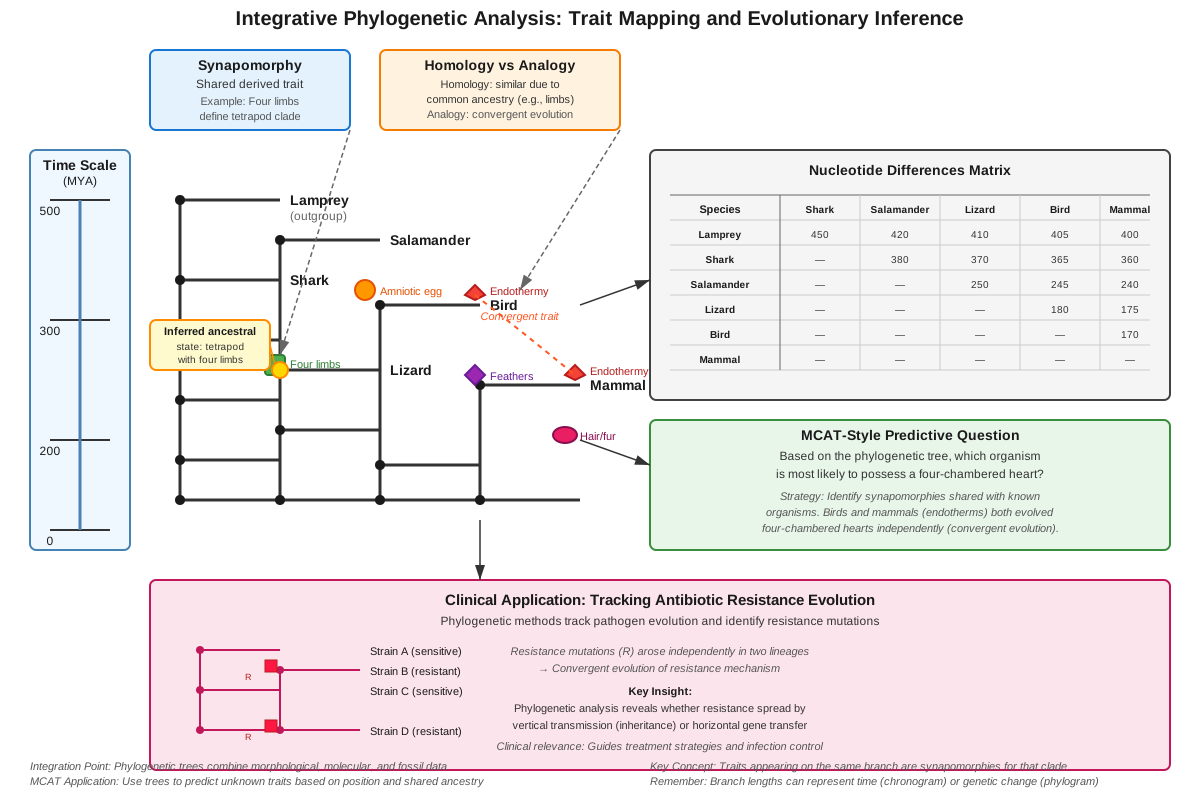
Overview
Phylogenetic trees are visual representations of evolutionary relationships among organisms, genes, or proteins based on similarities and differences in their physical or genetic characteristics. These branching diagrams, also called evolutionary trees or cladograms, serve as fundamental tools in Biology for understanding how species have diverged from common ancestors over time. For the MCAT, phylogenetic trees represent a critical intersection of evolutionary biology, genetics, and data interpretation skills that frequently appear in both passage-based and discrete questions.
Understanding phylogenetic trees is essential for the MCAT because they test multiple competencies simultaneously: the ability to interpret complex visual data, apply evolutionary principles, and make logical inferences about biological relationships. The MCAT regularly presents phylogenetic trees in passages related to Molecular Biology and Genetics, requiring students to extract information about ancestral relationships, evolutionary timing, and trait acquisition. These questions assess not just memorization but the higher-order thinking skills that medical schools value—pattern recognition, data synthesis, and evidence-based reasoning.
Within the broader context of Biology, phylogenetic trees connect foundational concepts in evolution, taxonomy, comparative anatomy, and molecular genetics. They provide a framework for understanding biodiversity, tracking disease evolution, predicting protein function based on homology, and even informing medical decisions about drug resistance patterns. Mastery of phylogenetic tree interpretation enables students to approach MCAT questions involving speciation, natural selection, genetic drift, and comparative genomics with confidence and precision.
Learning Objectives
- [ ] Define phylogenetic trees using accurate Biology terminology
- [ ] Explain why phylogenetic trees matter for the MCAT
- [ ] Apply phylogenetic trees to exam-style questions
- [ ] Identify common mistakes related to phylogenetic trees
- [ ] Connect phylogenetic trees to related Biology concepts
- [ ] Interpret branch points (nodes) and determine the most recent common ancestor between organisms
- [ ] Distinguish between monophyletic, paraphyletic, and polyphyletic groups
- [ ] Analyze phylogenetic trees to determine the relative timing of evolutionary events
- [ ] Use phylogenetic trees to make predictions about shared characteristics among organisms
Prerequisites
- Basic evolutionary theory: Understanding natural selection, common descent, and speciation provides the conceptual foundation for why phylogenetic relationships exist
- Mendelian genetics and inheritance: Knowledge of how traits are passed through generations helps explain how evolutionary changes accumulate over time
- DNA structure and molecular biology fundamentals: Phylogenetic trees often rely on genetic sequence comparisons, requiring familiarity with nucleotides, genes, and mutations
- Taxonomy basics: Understanding hierarchical classification (domain, kingdom, phylum, class, order, family, genus, species) contextualizes where organisms fit in the tree of life
- Reading graphs and data interpretation: Phylogenetic trees are visual data representations requiring general graph literacy skills
Why This Topic Matters
Phylogenetic trees have profound clinical and research significance in modern medicine. Epidemiologists use phylogenetic analysis to track disease outbreaks, tracing the origin and spread of pathogens like influenza, HIV, and SARS-CoV-2. Understanding evolutionary relationships helps predict which animal viruses might jump to humans, informing pandemic preparedness. In oncology, phylogenetic methods track tumor evolution, revealing how cancer cells develop drug resistance through branching evolutionary pathways. Antibiotic resistance patterns in bacteria follow phylogenetic principles, guiding treatment decisions and public health policy.
On the MCAT, phylogenetic trees appear with moderate frequency, typically 1-3 questions per exam. They most commonly appear in Biology passages within the Biological and Biochemical Foundations of Living Systems section, though they occasionally surface in psychology passages discussing human evolution or behavioral adaptations. Questions range from straightforward interpretation (identifying common ancestors) to complex application (predicting trait presence based on tree topology). The MCAT favors questions that integrate phylogenetic interpretation with other concepts like Hardy-Weinberg equilibrium, molecular clocks, or comparative anatomy.
Common exam presentations include: passages describing new species discoveries with accompanying phylogenetic trees requiring relationship determination; molecular biology passages showing gene family evolution with trees based on sequence similarity; and ecology passages depicting species diversification with trees illustrating adaptive radiation. The MCAT particularly favors questions asking students to identify which organisms share the most recent common ancestor, determine the sequence of trait acquisition, or recognize when tree topology supports or contradicts specific evolutionary hypotheses.
Core Concepts
Structure and Components of Phylogenetic Trees
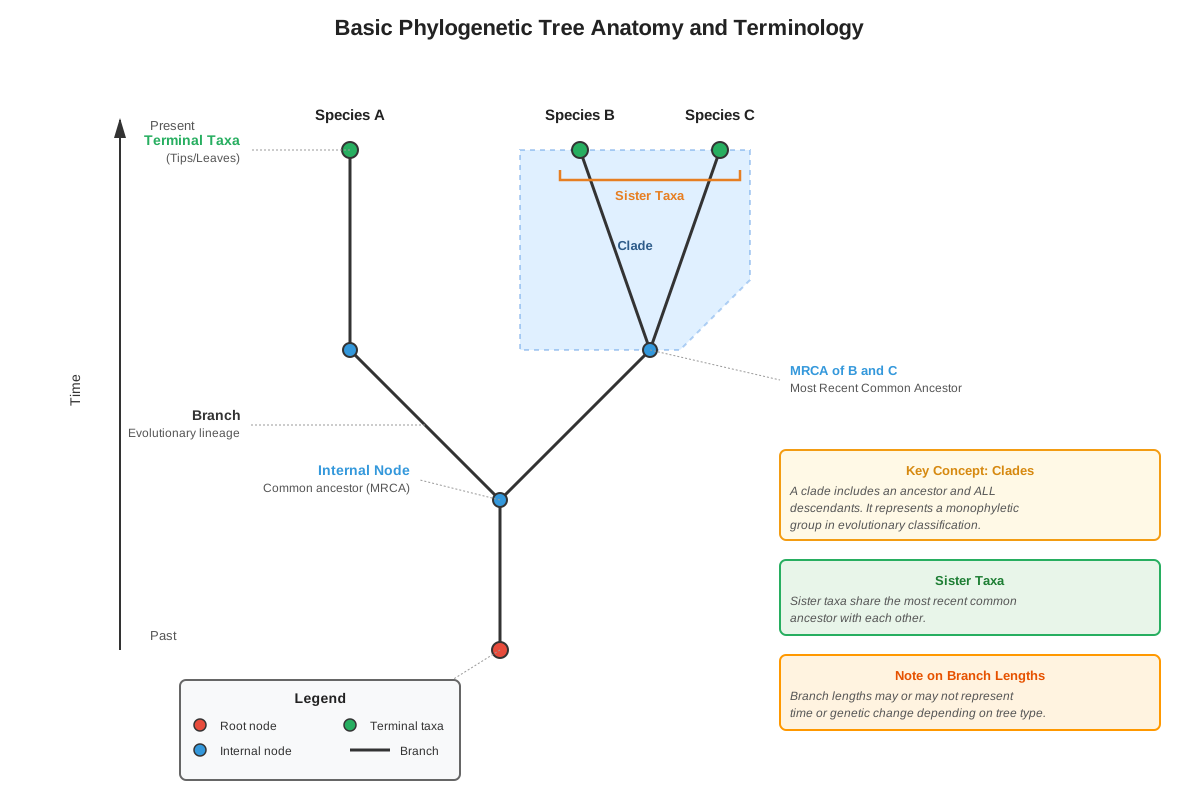
A phylogenetic tree consists of several key structural elements that convey evolutionary information. Branches (also called lineages) represent evolutionary lineages over time, with each branch depicting a population or species. Nodes (also called branch points or divergence points) represent common ancestors where one lineage split into two or more descendant lineages. The root represents the most ancient common ancestor of all organisms on the tree, though some trees are unrooted and show relationships without specifying the ancestral direction.
Tips (also called terminal nodes or leaves) represent the taxa being compared—these may be modern species, extinct organisms, genes, or proteins depending on the tree's purpose. The topology refers to the branching pattern itself, which conveys relationship information independent of branch lengths. Some phylogenetic trees include branch lengths that represent evolutionary distance, either in terms of time (chronograms) or amount of genetic change (phylograms). Trees without meaningful branch lengths are called cladograms and show only relationship patterns.
Reading and Interpreting Phylogenetic Trees
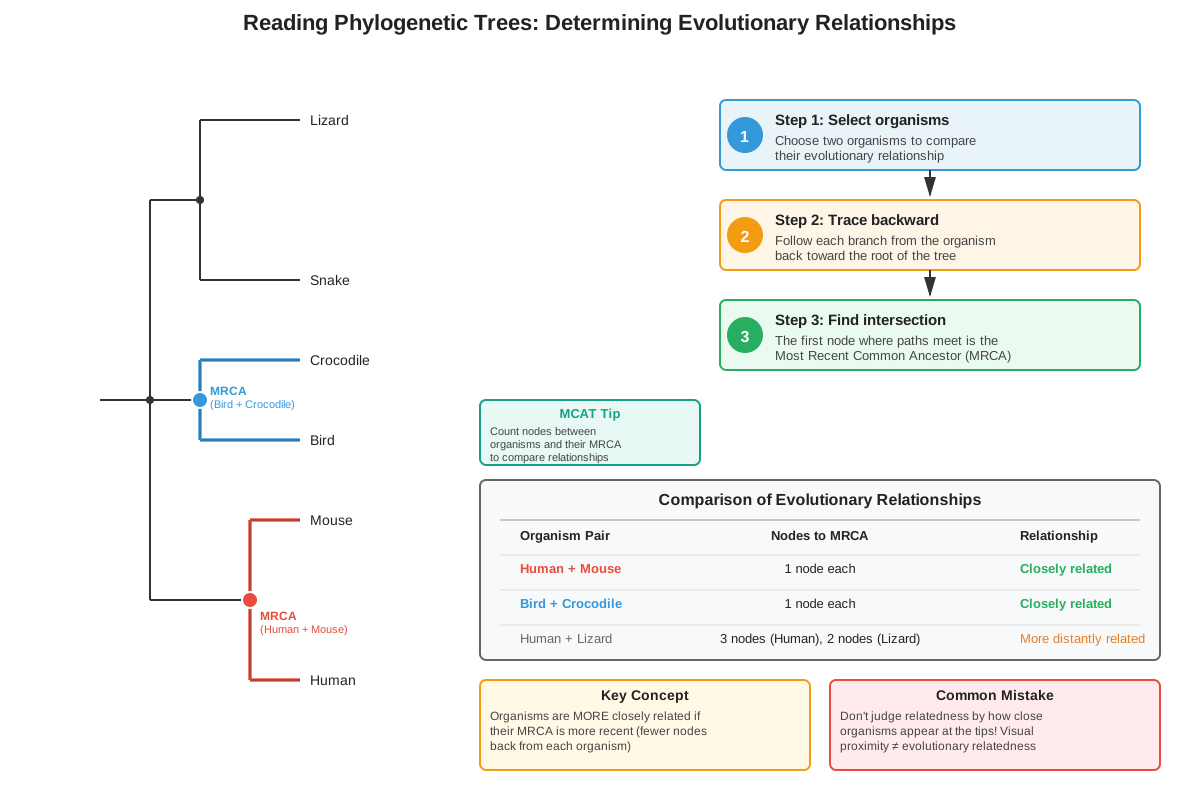
The fundamental principle of phylogenetic tree interpretation is that organisms sharing a more recent common ancestor are more closely related than those sharing only a distant ancestor. To determine relatedness, trace back from two organisms along their branches until reaching the first node they share—this node represents their most recent common ancestor (MRCA). The fewer nodes between two organisms and their MRCA, the more closely related they are.
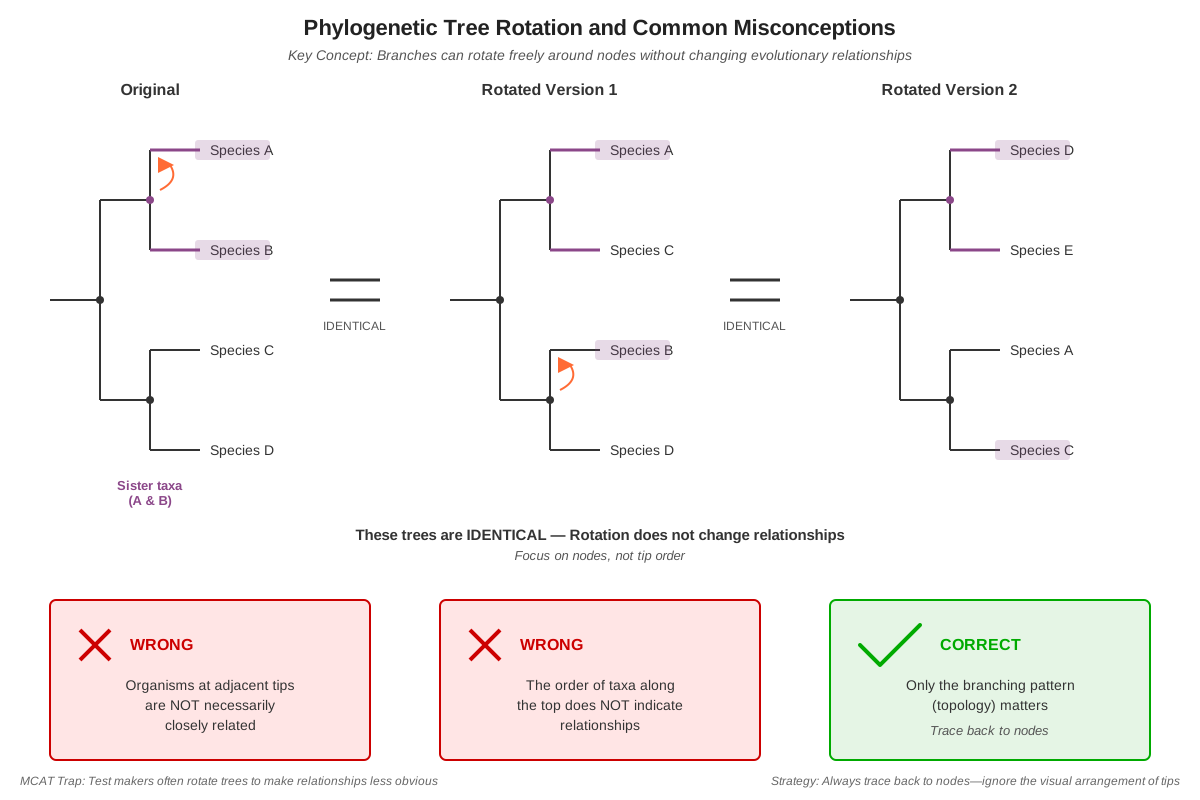
Importantly, the horizontal spacing of taxa at the tips has no evolutionary meaning in most trees—only the branching pattern matters. Two organisms adjacent on the page are not necessarily more closely related than organisms far apart horizontally. Trees can be rotated around any node without changing the evolutionary relationships depicted. This means multiple visual arrangements can represent identical evolutionary relationships.
| Tree Feature | What It Shows | What It Doesn't Show |
|---|---|---|
| Branching pattern (topology) | Evolutionary relationships | Degree of similarity |
| Nodes | Common ancestors | Actual ancestral species |
| Branch lengths (when scaled) | Time or genetic change | Rate of evolution (unless specified) |
| Tip positions | Taxa being compared | Geographic location |
| Root position | Direction of time | Absolute age (unless calibrated) |
Monophyletic, Paraphyletic, and Polyphyletic Groups
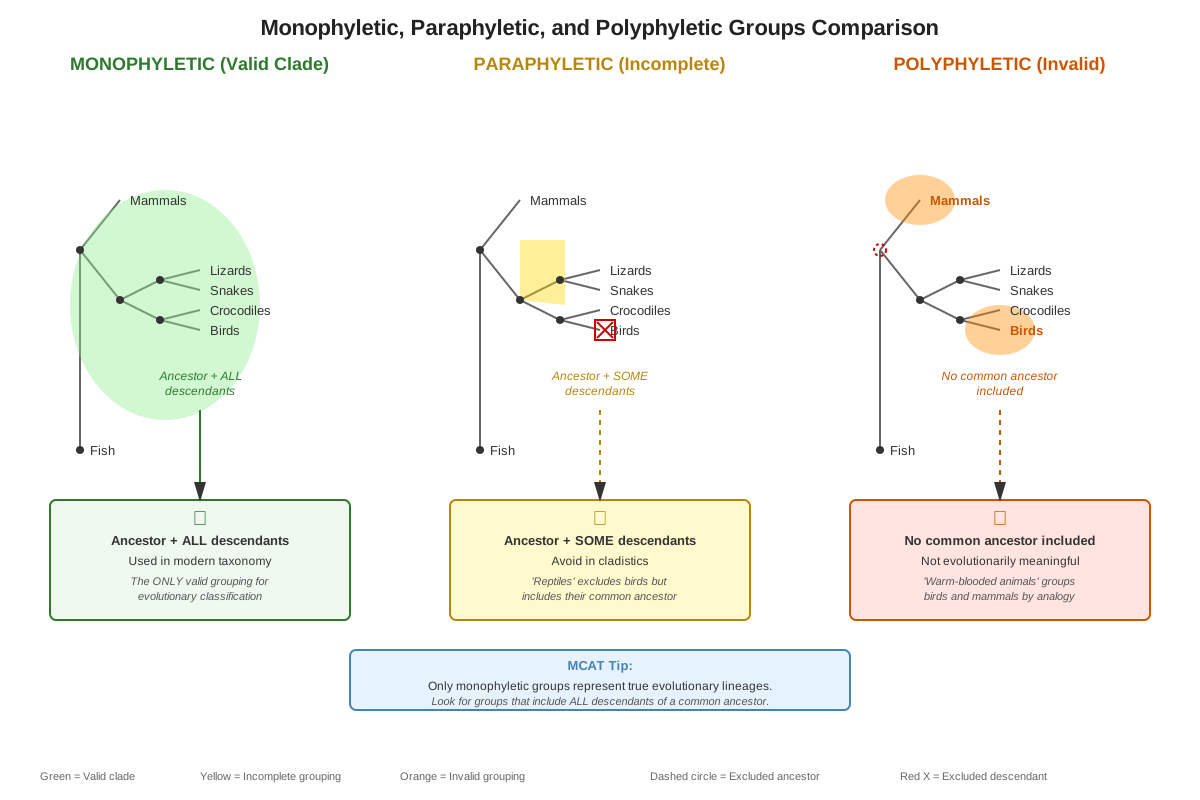
Understanding different types of taxonomic groups is crucial for interpreting phylogenetic trees correctly. A monophyletic group (or clade) includes an ancestral species and all of its descendants—nothing more, nothing less. Monophyletic groups represent natural evolutionary units and are the only groups considered valid in modern phylogenetic classification. For example, mammals form a monophyletic group because the category includes the common ancestor of all mammals and every descendant of that ancestor.
A paraphyletic group includes an ancestral species and some but not all of its descendants. The traditional group "reptiles" is paraphyletic because it excludes birds, even though birds descended from the same ancestor as crocodiles, lizards, and snakes. Paraphyletic groups are considered artificial because they don't reflect complete evolutionary history.
A polyphyletic group includes organisms from different evolutionary lineages that don't share an immediate common ancestor exclusive to the group. These groups are based on convergent evolution rather than shared ancestry. For example, grouping bats and birds together as "flying vertebrates" creates a polyphyletic group because their flight evolved independently, and their most recent common ancestor didn't fly and also gave rise to many non-flying descendants.
Derived and Ancestral Characteristics
Phylogenetic trees are constructed based on characteristics (traits) that organisms possess. An ancestral characteristic (or plesiomorphy) is a trait inherited from a distant ancestor and shared broadly across many groups. For example, having a vertebral column is ancestral for mammals because this trait was present in the ancient ancestor of all vertebrates. In contrast, a derived characteristic (or apomorphy) is a trait that evolved more recently and is present in some but not all descendants of a common ancestor.
Shared derived characteristics (synapomorphies) are particularly important because they define monophyletic groups. For instance, the presence of hair and mammary glands are shared derived characteristics that unite all mammals. When constructing phylogenetic trees, systematists look for synapomorphies because these indicate true evolutionary relationships rather than superficial similarities from convergent evolution.
The concept of ancestral versus derived is relative—a trait may be derived at one level of analysis but ancestral at another. Four limbs are a derived characteristic distinguishing tetrapods from fish, but four limbs are an ancestral characteristic when comparing mammals, reptiles, and amphibians because their common ancestor already possessed this trait.
Molecular Clocks and Evolutionary Timing
Some phylogenetic trees incorporate the concept of a molecular clock, which assumes that genetic mutations accumulate at a relatively constant rate over time. If this assumption holds, the number of genetic differences between two organisms can estimate how long ago they diverged from their common ancestor. Branch lengths in these trees represent time, with longer branches indicating more time since divergence.
However, molecular clocks are not perfectly regular. Mutation rates vary among different genes, different lineages, and different time periods. Generation time affects molecular clock rates—organisms with shorter generations accumulate mutations faster. Environmental factors, population size, and selection pressure also influence mutation accumulation rates. Despite these limitations, calibrated molecular clocks (adjusted using fossil evidence or known divergence dates) provide valuable estimates of evolutionary timing.
Constructing Phylogenetic Trees
While the MCAT rarely asks students to construct trees from scratch, understanding the logic behind tree construction aids interpretation. Phylogenetic trees can be built using morphological data (physical characteristics like bone structure, organ systems, or developmental patterns) or molecular data (DNA sequences, protein sequences, or chromosomal arrangements). Modern phylogenetics heavily relies on molecular data because genetic sequences provide abundant, quantifiable characters.
The principle of parsimony (also called Occam's razor in phylogenetics) suggests that the best phylogenetic tree is the one requiring the fewest evolutionary changes to explain the observed data. If two trees could explain the same set of characteristics, the tree with fewer required mutations, trait gains, or trait losses is preferred. However, parsimony doesn't always reflect reality—evolution doesn't necessarily take the simplest path.
Maximum likelihood and Bayesian methods are statistical approaches that evaluate which tree topology is most probable given the observed data and a model of evolutionary change. These methods are more sophisticated than parsimony and can account for different rates of evolution and complex patterns of change.
Concept Relationships
The concepts within phylogenetic tree analysis form an interconnected framework. The structural components (branches, nodes, tips) → provide the visual language for → representing evolutionary relationships → which are determined by → shared derived characteristics (synapomorphies) → that define → monophyletic groups (clades) → which represent → natural evolutionary units. Understanding ancestral versus derived traits → enables proper interpretation of → branching patterns → which reveal → the sequence of trait acquisition during evolution.
Phylogenetic trees connect to prerequisite evolutionary concepts through common descent—the tree structure itself is a visual representation of Darwin's principle that all life shares ancestry. The branching pattern reflects speciation events, connecting to concepts of reproductive isolation, allopatric and sympatric speciation, and population genetics. Molecular phylogenetics directly applies DNA structure and molecular biology knowledge, as genetic sequence comparisons form the basis for most modern trees.
The relationship to broader Molecular Biology and Genetics topics is substantial. Phylogenetic analysis informs understanding of gene families and gene duplication events, showing how genes evolve new functions. Comparative genomics uses phylogenetic frameworks to identify conserved sequences that likely have important functions. Understanding protein evolution through phylogenetic trees helps predict protein structure and function for newly discovered genes based on homology to characterized proteins.
Quick check — test yourself on Phylogenetic trees so far.
Try Flashcards →High-Yield Facts
⭐ Organisms that share a more recent common ancestor (closer node) are more closely related than organisms sharing only a distant common ancestor
⭐ The branching pattern (topology) conveys evolutionary relationships; horizontal spacing of taxa at the tips has no evolutionary meaning
⭐ A monophyletic group (clade) includes an ancestor and ALL of its descendants; this is the only valid grouping in modern phylogenetics
⭐ Shared derived characteristics (synapomorphies) define monophyletic groups and indicate true evolutionary relationships
⭐ Trees can be rotated around any node without changing the evolutionary relationships depicted
- A paraphyletic group includes an ancestor and some but not all descendants; a polyphyletic group includes organisms from different lineages without their common ancestor
- The root of a phylogenetic tree represents the most ancient common ancestor of all organisms shown
- Branch lengths may represent time (chronogram), genetic change (phylogram), or nothing (cladogram)—always check the tree legend
- Molecular clocks estimate divergence times based on genetic differences, assuming relatively constant mutation rates
- Convergent evolution produces similar traits in distantly related organisms and can mislead phylogenetic analysis if only superficial similarities are considered
Common Misconceptions
Misconception: Organisms positioned next to each other at the tips of a phylogenetic tree are more closely related than organisms positioned far apart horizontally.
Correction: Horizontal spacing has no evolutionary meaning. Only the branching pattern matters. To determine relatedness, trace back to find the most recent common ancestor (the closest shared node), not the physical proximity on the page.
Misconception: The organisms shown at the tips of the tree evolved from each other in a linear sequence.
Correction: Modern organisms did not evolve from other modern organisms. All organisms at the tips are contemporary endpoints of evolution. They share common ancestors (represented by nodes), but none of the tip organisms are ancestral to the others.
Misconception: Evolution proceeds in a straight line toward increasing complexity or "advancement."
Correction: Phylogenetic trees show branching, not ladders. Evolution has no inherent direction toward complexity. Some lineages become more complex while others become simpler. All modern organisms are equally "evolved" in the sense that they've all been evolving for the same amount of time since life's origin.
Misconception: A longer branch always means more evolutionary time has passed.
Correction: Branch length meaning depends on the tree type. In cladograms, branch lengths are arbitrary and meaningless. In phylograms, longer branches indicate more genetic change, which may or may not correlate with time. Only in chronograms (time-calibrated trees) do branch lengths directly represent time.
Misconception: Nodes represent actual ancestral species that we could find in the fossil record.
Correction: Nodes represent hypothetical common ancestors—populations that existed at the divergence point. The actual ancestral species is rarely known precisely. Fossils might be close relatives of the ancestor but are unlikely to be the exact ancestral population.
Misconception: If a trait appears in two organisms on a phylogenetic tree, they must have inherited it from their common ancestor.
Correction: Traits can arise through convergent evolution, where similar features evolve independently in different lineages facing similar environmental pressures. To determine if a trait is homologous (inherited from a common ancestor) or analogous (convergently evolved), examine whether the trait is present in the common ancestor and intervening lineages.
Worked Examples
Example 1: Determining Evolutionary Relationships
Question: A phylogenetic tree shows five species: A, B, C, D, and E. Species A and B share a node at position 1. This clade (A+B) shares a node with species C at position 2. Species D and E share a node at position 3. Finally, the (A+B+C) clade shares a node with the (D+E) clade at position 4 (the root). Which two species are most closely related, and which species is most distantly related to species A?
Solution:
Step 1: Identify the most closely related species by finding which pair shares the most recent common ancestor (closest node).
- Species A and B share node 1, which is the most recent divergence shown
- Species D and E share node 3
- All other pairings require tracing back further to nodes 2 or 4
Answer to part 1: Species A and B are most closely related because they share the most recent common ancestor (node 1).
Step 2: Determine which species is most distantly related to species A by finding which requires tracing back to the most ancient node.
- A to B: trace to node 1
- A to C: trace to node 2
- A to D: trace to node 4 (the root)
- A to E: trace to node 4 (the root)
Answer to part 2: Species D and E are equally distantly related to species A because they share only the root (node 4) as a common ancestor, which is the most ancient divergence point on this tree.
Key reasoning: This question tests the fundamental principle that relatedness is determined by the most recent common ancestor. The physical arrangement on the page is irrelevant—only the branching pattern matters. Students must trace back along branches to find shared nodes.
Example 2: Identifying Monophyletic Groups
Question: A phylogenetic tree shows the following relationships: ((Lizards, Snakes), (Crocodiles, Birds)). A student proposes grouping Lizards, Snakes, and Crocodiles together as "Reptiles" while excluding Birds. Is this a monophyletic group? Why or why not? What would constitute a monophyletic group in this tree?
Solution:
Step 1: Recall the definition of a monophyletic group—it must include an ancestor and ALL of its descendants.
Step 2: Identify the common ancestor of Lizards, Snakes, and Crocodiles.
- Lizards and Snakes share a recent common ancestor (node 1)
- This (Lizards+Snakes) clade shares a common ancestor with Crocodiles at node 2
- Node 2 is also the common ancestor of Birds (since Birds and Crocodiles share a more recent common ancestor than either shares with the Lizards+Snakes clade)
Step 3: Determine if the proposed group includes all descendants of the identified ancestor.
- The common ancestor at node 2 gave rise to: Lizards, Snakes, Crocodiles, AND Birds
- The proposed "Reptiles" group excludes Birds
- Therefore, this is NOT a monophyletic group—it's paraphyletic
Answer: The proposed "Reptiles" group is paraphyletic, not monophyletic, because it excludes Birds even though Birds descended from the same common ancestor as the included groups. To form a monophyletic group, the student would need to either: (1) include Birds with Lizards, Snakes, and Crocodiles, or (2) create a smaller group like just (Lizards + Snakes) or just (Crocodiles + Birds).
Key reasoning: This example illustrates why traditional taxonomic groups sometimes conflict with phylogenetic classification. The MCAT frequently tests whether students can identify valid clades versus artificial groupings. The critical insight is that you cannot arbitrarily exclude descendants when defining evolutionary groups.
Exam Strategy
When approaching phylogenetic trees on the MCAT, first orient yourself to the tree structure before reading the question. Identify the root (if present), count the number of taxa, and note whether branch lengths appear meaningful or arbitrary. Check for a scale bar or legend indicating what branch lengths represent. This 10-second investment prevents misinterpretation.
Trigger words that signal phylogenetic tree questions include: "most closely related," "common ancestor," "diverged," "monophyletic," "clade," "derived characteristic," "ancestral trait," and "evolutionary relationship." When you see these phrases, immediately focus on nodes and branching patterns rather than tip positions or branch lengths (unless the question specifically asks about timing or genetic distance).
For relationship questions, use the trace-back method: place your finger on each organism in question and trace back along branches until the paths meet at a node—this is the most recent common ancestor. The organism pair requiring the fewest nodes to reach a common ancestor is most closely related. For questions about trait evolution, identify where on the tree the trait first appears (which branch or node) to determine which organisms inherited it.
Process-of-elimination strategies are particularly effective for phylogenetic tree questions. If a question asks which organisms share a specific trait, eliminate any answer choices that include organisms branching off before the trait evolved (before the node where the trait appears). If asked about monophyletic groups, immediately eliminate any answer choices that exclude some descendants of a common ancestor or include organisms from separate lineages.
Time allocation: Most phylogenetic tree questions can be answered in 60-90 seconds once you understand the tree structure. Don't spend excessive time trying to memorize the entire tree—focus on the specific relationships the question asks about. If a passage includes a complex tree, expect 2-3 questions about it, making the initial time investment in understanding the tree worthwhile.
Exam Tip: If you can rotate the tree in your mind or on scratch paper, do so. Sometimes reorienting the tree makes relationships more obvious. Remember: rotation around nodes doesn't change evolutionary relationships.
Memory Techniques
Mnemonic for group types: "Monkeys Play Piano" = Monophyletic (all descendants), Paraphyletic (partial descendants), Polyphyletic (separate lineages)
Mnemonic for monophyletic groups: "ALL or NOTHING" - A monophyletic group includes an ancestor and ALL descendants, or it's NOTHING (not monophyletic)
Visualization strategy: Think of a phylogenetic tree as a family tree. Nodes are parents/grandparents, branches are family lines, and tips are living relatives. You wouldn't say two cousins are closely related just because they sit next to each other at a reunion—you'd determine relatedness by finding their most recent common grandparent. Apply the same logic to phylogenetic trees.
Acronym for tree components: "BRNTS" = Branches, Root, Nodes, Tips, Synapomorphies (shared derived characteristics)
Memory aid for branch length interpretation: "Chronograms show Clock time, Phylograms show Physical changes (genetic), Cladograms show Connections only"
Conceptual anchor: When confused about relationships, remember: "Nodes are ancestors, tips are descendants, branches are lineages." This simple framework helps reconstruct the logic of any phylogenetic tree.
Summary
Phylogenetic trees are branching diagrams representing evolutionary relationships among organisms, genes, or proteins based on shared ancestry. The fundamental principle is that organisms sharing a more recent common ancestor (represented by nodes closer to the tips) are more closely related than those sharing only distant ancestors. Tree topology—the branching pattern—conveys relationship information, while horizontal spacing of taxa is evolutionarily meaningless. Monophyletic groups (clades) include an ancestor and all descendants, representing natural evolutionary units defined by shared derived characteristics (synapomorphies). Paraphyletic groups exclude some descendants, while polyphyletic groups artificially combine organisms from separate lineages. Branch lengths may represent time, genetic change, or nothing depending on tree type. For the MCAT, success requires tracing back to common ancestors to determine relatedness, identifying valid clades, distinguishing ancestral from derived traits, and avoiding common misinterpretations about tree structure. Phylogenetic trees integrate evolutionary theory, genetics, and data interpretation skills, making them high-yield topics that connect to broader concepts in molecular biology, comparative anatomy, and systematics.
Key Takeaways
- Evolutionary relationships are determined by finding the most recent common ancestor (closest shared node), not by horizontal proximity of organisms on the tree
- Monophyletic groups (clades) include an ancestor and ALL descendants; these are the only valid evolutionary groupings in modern phylogenetics
- Shared derived characteristics (synapomorphies) define clades and indicate true evolutionary relationships rather than superficial similarities
- Trees can be rotated around any node without changing evolutionary relationships; multiple visual arrangements can represent identical phylogenies
- Branch length meaning varies: chronograms show time, phylograms show genetic change, and cladograms show only relationships
- Nodes represent hypothetical common ancestors, not actual species that can be identified in the fossil record
- The MCAT tests phylogenetic tree interpretation through relationship questions, trait evolution questions, and clade identification questions
Related Topics
Speciation and reproductive isolation: Understanding how new species form provides the biological mechanism behind the branching events shown in phylogenetic trees. Mastering phylogenetic trees enables deeper comprehension of speciation patterns like adaptive radiation.
Hardy-Weinberg equilibrium and population genetics: Phylogenetic divergence occurs through changes in allele frequencies over time. Understanding population genetics principles explains the microevolutionary processes underlying the macroevolutionary patterns shown in trees.
Comparative anatomy and homologous structures: Phylogenetic trees are often constructed using anatomical data. Understanding homology versus analogy is essential for interpreting which similarities reflect shared ancestry versus convergent evolution.
Molecular evolution and gene families: Many modern phylogenetic trees use DNA or protein sequences. Understanding how genes duplicate and diverge enables interpretation of molecular phylogenies and gene family evolution.
Taxonomy and classification systems: Phylogenetic trees form the basis of modern biological classification. Mastering tree interpretation enables understanding of how organisms are grouped into domains, kingdoms, phyla, and other taxonomic ranks.
Practice CTA
Now that you've mastered the fundamentals of phylogenetic trees, reinforce your understanding by attempting practice questions and flashcards. Focus on questions requiring you to trace common ancestors, identify monophyletic groups, and determine trait evolution sequences. The more trees you interpret, the more intuitive the patterns become. Remember: phylogenetic tree questions reward systematic thinking and careful attention to branching patterns. You've built a strong foundation—now apply it to achieve mastery and confidence on test day!
Sign up free to keep reading
Create a free AnvayaPrep account to finish this MCAT guide on Phylogenetic trees — plus flashcards and practice questions.