Overview
Active reading is a strategic, engaged approach to reading comprehension that transforms passive text consumption into an interactive cognitive process. Rather than simply allowing words to pass through the mind, active reading involves deliberate mental engagement with the material through questioning, predicting, summarizing, and evaluating the author's arguments as they unfold. This skill forms the foundation of success on the Critical Analysis and Reasoning Skills (CARS) section of the MCAT, where students must rapidly comprehend, analyze, and evaluate complex passages from humanities and social sciences disciplines under strict time constraints.
For the MCAT, active reading is not merely helpful—it is essential. The CARS section presents nine passages with 5-7 questions each, covering topics ranging from philosophy and ethics to cultural studies and art criticism. These passages are deliberately dense, often featuring sophisticated vocabulary, complex sentence structures, and nuanced arguments that require more than surface-level comprehension. Students who approach these passages passively often find themselves rereading multiple times, losing precious minutes, and still failing to grasp the author's main argument or the logical structure of the passage. Active reading techniques enable test-takers to extract maximum information on the first read, build a mental map of the passage's organization, and anticipate question types before even looking at them.
Within the broader framework of CARS Skills, active reading serves as the foundational competency upon which all other critical analysis abilities rest. Without effective active reading, students cannot accurately identify assumptions, evaluate evidence, assess logical reasoning, or recognize rhetorical strategies—all higher-order skills tested extensively on the MCAT. Active reading creates the cognitive scaffolding that supports rapid comprehension, retention, and application of passage content to answer questions efficiently and accurately.
Learning Objectives
- [ ] Define Active reading using accurate Critical Analysis and Reasoning Skills terminology
- [ ] Explain why Active reading matters for the MCAT
- [ ] Apply Active reading to exam-style questions
- [ ] Identify common mistakes related to Active reading
- [ ] Connect Active reading to related Critical Analysis and Reasoning Skills concepts
- [ ] Demonstrate the ability to annotate MCAT passages effectively using active reading strategies
- [ ] Distinguish between main ideas and supporting details while reading under timed conditions
- [ ] Evaluate the effectiveness of different active reading techniques for various passage types
Prerequisites
- Basic reading comprehension: Understanding literal meaning of college-level texts is necessary before applying strategic reading techniques
- Familiarity with passage structure: Recognizing introductions, body paragraphs, and conclusions helps organize information during active reading
- Time management fundamentals: Understanding the MCAT's time constraints (approximately 10 minutes per passage) provides context for why efficient reading strategies matter
- Vocabulary at college level: A strong vocabulary foundation allows focus on argument structure rather than individual word meanings
Why This Topic Matters
Active reading directly impacts performance on one of the most challenging MCAT sections. The CARS section accounts for 25% of the total MCAT score, and unlike the science sections, it cannot be improved through simple content memorization. Students must develop genuine reading comprehension and analytical skills, making active reading the single most important skill for CARS success.
Statistically, the CARS section shows the widest score distribution among test-takers, with many high-performing science students struggling to achieve competitive scores. Research on MCAT performance indicates that students who employ systematic active reading strategies score an average of 2-3 points higher on the CARS section compared to those who read passively. Given that medical school admissions are highly competitive and often use CARS scores as a screening criterion, this difference can be decisive.
On the exam itself, active reading appears not as a directly tested concept but as the underlying skill required to answer every single CARS question. Questions testing main idea, author's purpose, tone, inference, application, and strengthening/weakening arguments all depend on accurate comprehension achieved through active reading. Passages frequently contain 6-8 paragraphs with complex arguments that build progressively, requiring readers to track the logical flow, identify shifts in perspective, and recognize how evidence supports claims—all tasks that active reading facilitates.
Beyond the MCAT, active reading skills translate directly to medical school success, where students must rapidly comprehend and synthesize vast amounts of complex information from textbooks, research articles, and clinical guidelines. The ability to read strategically, extract key information efficiently, and retain critical details serves physicians throughout their careers.
Core Concepts
Definition and Components of Active Reading
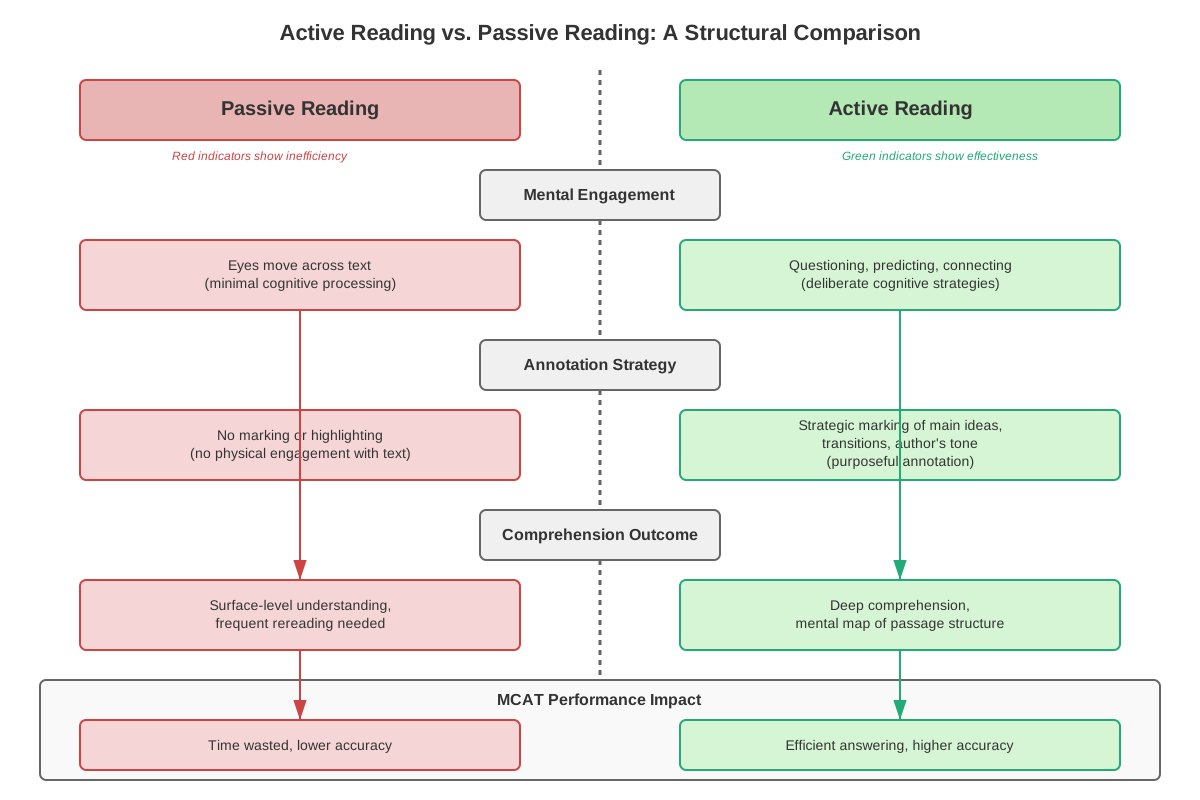
Active reading is a multifaceted cognitive process involving deliberate engagement with text through mental questioning, prediction, summarization, and evaluation. Unlike passive reading, where the reader's eyes move across words without deep processing, active reading requires the reader to maintain an ongoing internal dialogue with the text, constantly asking "What is the author's point?" "How does this evidence support the claim?" and "Why is this information included?"
The core components of active reading for MCAT CARS include:
- Previewing: Quickly scanning the passage to identify topic, structure, and approximate length before deep reading
- Questioning: Generating questions about the content before and during reading
- Annotating: Making brief mental or physical notes about key ideas, transitions, and argument structure
- Summarizing: Condensing each paragraph's main point into a single phrase or sentence
- Connecting: Linking new information to previously read content within the passage
- Evaluating: Assessing the strength of arguments and the author's reasoning
The Active Reading Process for MCAT Passages
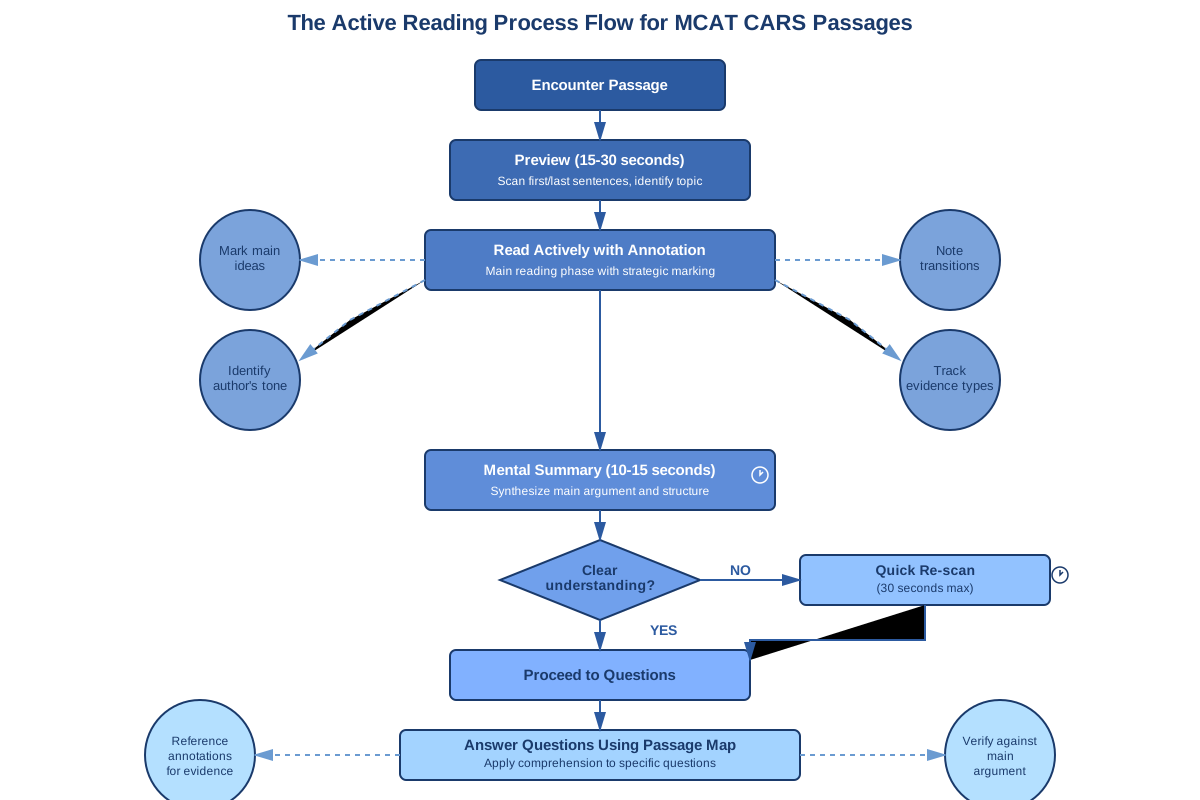
The systematic application of active reading to MCAT passages follows a specific sequence designed to maximize comprehension while minimizing time expenditure:
Step 1: Initial Preview (15-20 seconds)
Quickly scan the passage to identify the general topic, approximate length, and any obvious structural features like contrasting viewpoints or chronological organization. This preview activates relevant background knowledge and sets expectations.
Step 2: Strategic First Read (4-5 minutes)
Read through the passage once at a steady pace, focusing on understanding the main argument and overall structure rather than memorizing details. During this read:
- Identify the author's main thesis or central claim
- Note the purpose of each paragraph (introduction, evidence, counterargument, conclusion)
- Track shifts in perspective or topic
- Recognize the author's tone and attitude toward the subject
Step 3: Mental Mapping (ongoing during reading)
Build a cognitive map of where information is located. Rather than memorizing specific facts, remember that "paragraph 3 discussed the historical context" or "the counterargument appeared in paragraph 5." This spatial memory allows efficient reference back to the passage when answering questions.
Step 4: Post-Reading Synthesis (10-15 seconds)
After completing the passage, take a brief moment to articulate the main point and overall structure. This consolidation step strengthens retention and provides a framework for approaching questions.
Annotation Strategies for Active Reading
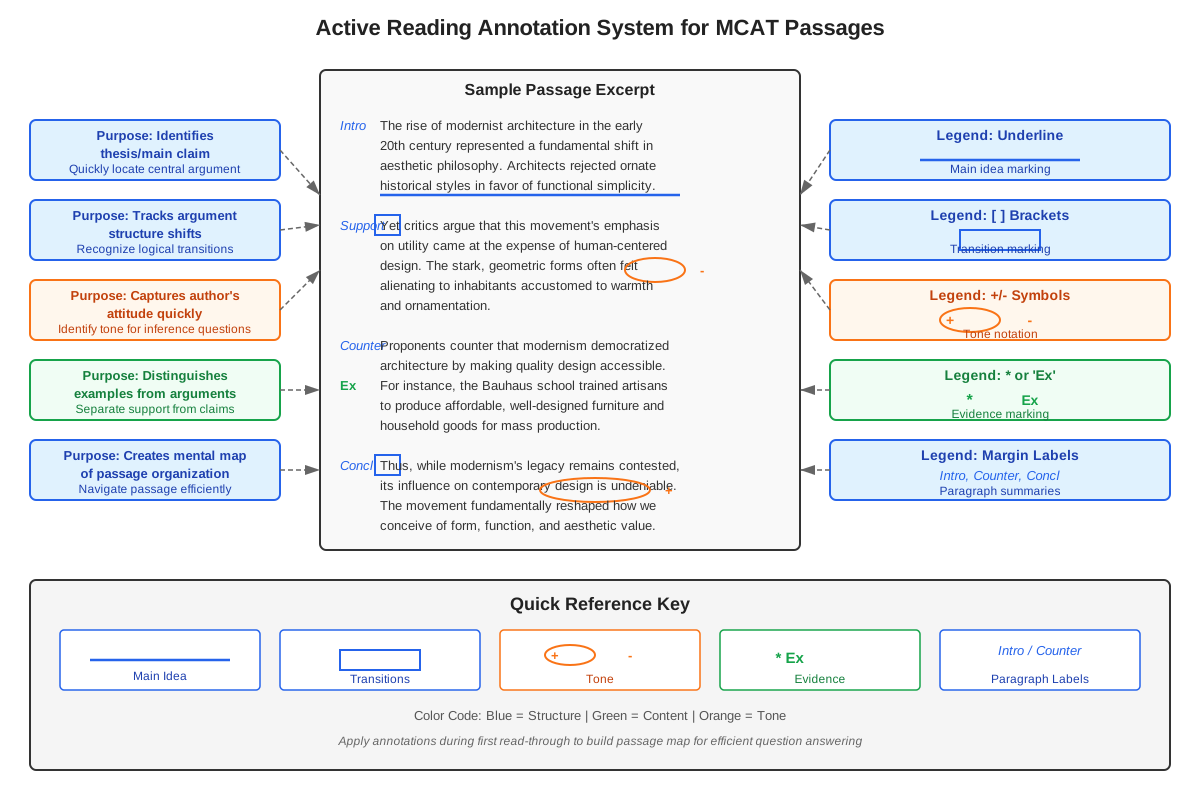
While the MCAT does not allow physical annotation of passages, mental annotation—and strategic highlighting when available on the digital interface—serves as a powerful active reading tool. Effective annotation focuses on structure and argument rather than content details.
What to Annotate:
- Main thesis or central claim
- Topic sentences of each paragraph
- Transition words indicating logical relationships (however, therefore, moreover)
- Shifts in perspective or introduction of counterarguments
- Strong opinion words revealing author's attitude
- Conclusions or summary statements
What NOT to Annotate:
- Specific facts, dates, or names (these can be referenced if needed)
- Examples or illustrations (unless they serve as the primary evidence)
- Descriptive details that support but don't constitute main ideas
- Technical terminology that doesn't affect argument structure
Distinguishing Main Ideas from Supporting Details
A critical active reading skill involves rapidly differentiating between main ideas and supporting details—a distinction that determines correct answers on many MCAT questions.
| Feature | Main Ideas | Supporting Details |
|---|---|---|
| Location | Often in topic sentences or concluding sentences | Middle of paragraphs, following main claims |
| Function | State the author's argument or position | Provide evidence, examples, or elaboration |
| Scope | Broad, encompassing | Specific, narrow |
| Question relevance | Directly answer "main idea" and "purpose" questions | Relevant for detail and inference questions |
| Frequency | 1-2 per paragraph | Multiple per paragraph |
Tracking Argument Structure
MCAT passages typically follow recognizable argument structures that active readers can identify and leverage:
Thesis-Support Structure: Author states a position and provides supporting evidence
- Paragraph 1: Introduction and thesis
- Paragraphs 2-4: Supporting evidence and examples
- Paragraph 5: Conclusion or implications
Compare-Contrast Structure: Author examines two or more perspectives, theories, or phenomena
- Paragraph 1: Introduction of topic
- Paragraphs 2-3: First perspective/theory
- Paragraphs 4-5: Second perspective/theory
- Paragraph 6: Author's evaluation or synthesis
Problem-Solution Structure: Author identifies an issue and proposes or evaluates solutions
- Paragraphs 1-2: Problem description and significance
- Paragraphs 3-5: Proposed solutions or approaches
- Paragraph 6: Evaluation of solutions
Chronological/Historical Structure: Author traces development of ideas or events over time
- Organized by time periods or developmental stages
- Often includes cause-effect relationships between periods
Recognizing these structures during active reading allows prediction of what information will appear next and helps organize information mentally.
Maintaining Focus and Engagement
Active reading requires sustained mental effort, which can be challenging during a lengthy exam. Strategies for maintaining engagement include:
- Internal questioning: Constantly ask "Why did the author include this?" and "How does this relate to the main point?"
- Prediction: Anticipate what the author will discuss next based on logical flow
- Paraphrasing: Mentally restate complex sentences in simpler language
- Emotional neutrality: Recognize personal reactions to content but don't let them interfere with understanding the author's actual position
- Purpose awareness: Remember that the goal is understanding the author's argument, not agreeing or disagreeing with it
Concept Relationships
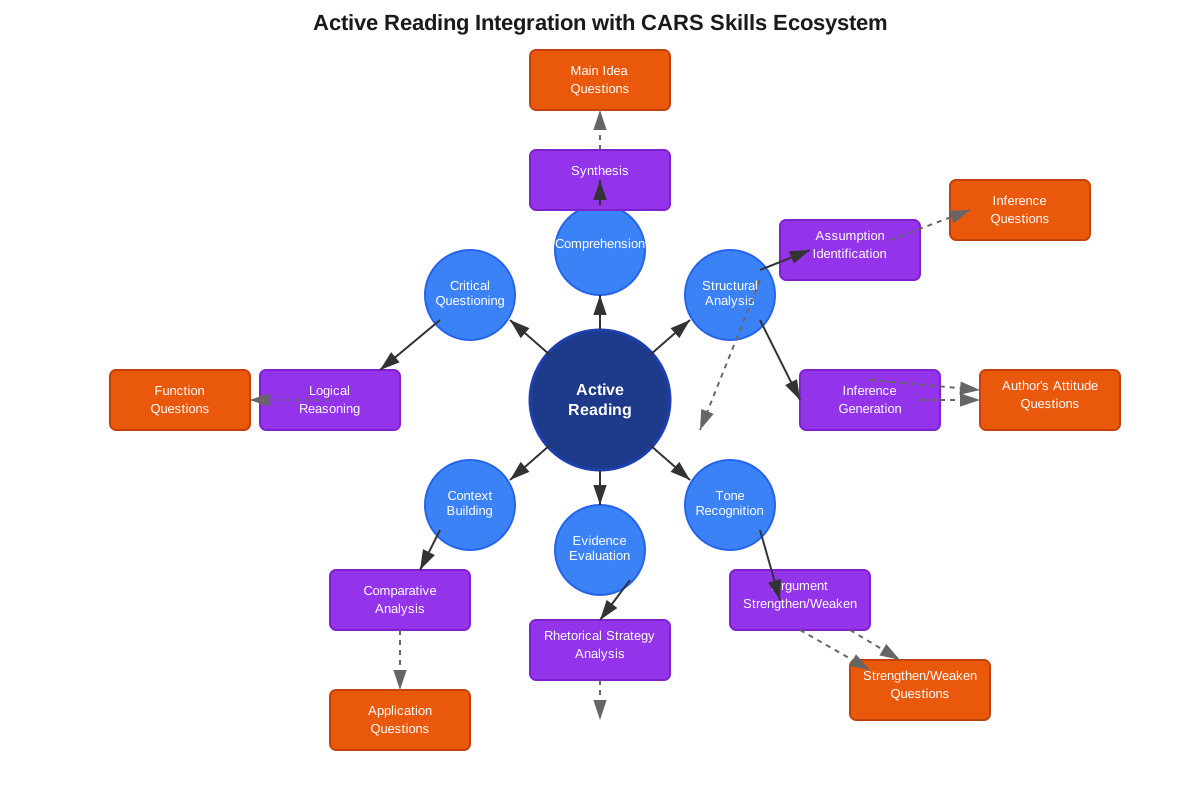
Active reading serves as the foundational skill that enables all other Critical Analysis and Reasoning Skills competencies. The relationship can be mapped as follows:
Active Reading → enables → Comprehension of Main Ideas → enables → Identification of Author's Purpose and Tone
Active Reading → enables → Tracking Argument Structure → enables → Evaluation of Evidence and Logic
Active Reading → enables → Mental Mapping of Passage Organization → enables → Efficient Question Answering
Within the topic itself, the various components of active reading work synergistically. Previewing activates relevant schema that facilitates comprehension during the strategic first read. Annotation (mental or physical) reinforces the mental mapping process, which in turn supports post-reading synthesis. Distinguishing main ideas from details depends on understanding argument structure, which requires tracking logical relationships through transition words and paragraph organization.
Active reading also connects to time management strategies in CARS. By investing 4-5 minutes in a thorough, active first read, students actually save time overall by reducing the need for rereading and enabling faster, more accurate question answering. This relationship—spending more time initially to save time later—is counterintuitive but critical for MCAT success.
The skill also relates to metacognition, as effective active readers constantly monitor their own comprehension, recognizing when understanding breaks down and employing fix-up strategies like rereading a sentence or paraphrasing a complex idea.
High-Yield Facts
⭐ Active reading on the MCAT should take 4-5 minutes per passage, with the goal of understanding main ideas and structure rather than memorizing details
⭐ The most important sentence in each paragraph is typically the topic sentence, which usually appears at the beginning or end
⭐ Transition words (however, therefore, moreover, nevertheless) signal logical relationships and are critical markers for active readers
⭐ Mental mapping—remembering where information is located rather than what it specifically says—enables efficient reference back to the passage
⭐ The author's main thesis typically appears in the first or last paragraph, though it may be implicit rather than explicitly stated
- Annotation should focus on structure and argument, not content details or examples
- Active readers distinguish between what the author believes and what the author reports that others believe
- Recognizing passage structure (thesis-support, compare-contrast, problem-solution, chronological) helps predict content and organize information
- Questions about main idea, purpose, and tone can often be answered without referring back to the passage if active reading was effective
- Passive reading often leads to the "word trance" phenomenon where eyes move across text without comprehension, requiring time-consuming rereading
Quick check — test yourself on Active reading so far.
Try Flashcards →Common Misconceptions
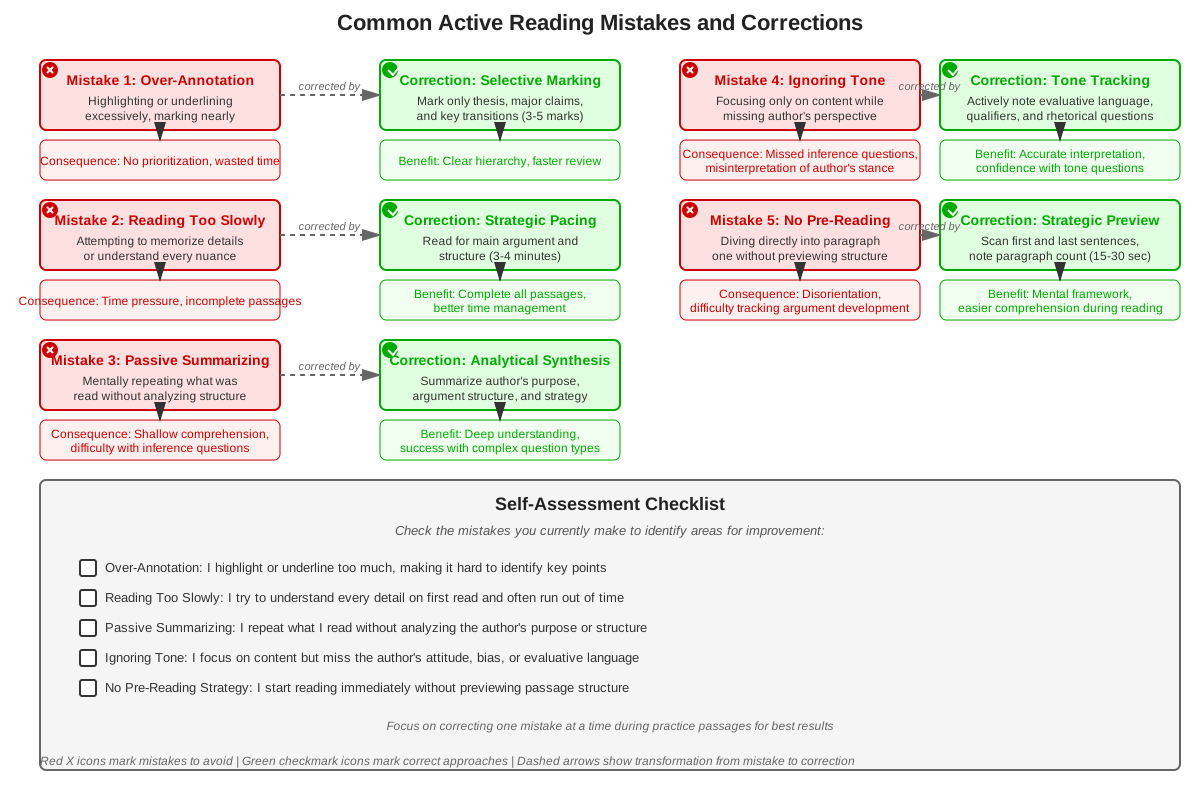
Misconception: Active reading means reading slowly and carefully, analyzing every sentence in detail.
Correction: Active reading on the MCAT requires reading at a steady, moderate pace while focusing on main ideas and structure. Over-analysis of individual sentences wastes time and obscures the big picture. The goal is strategic engagement, not exhaustive analysis.
Misconception: Highlighting or annotating everything important ensures nothing is missed.
Correction: Over-annotation is counterproductive and indicates passive rather than active reading. If most of the passage is highlighted, nothing stands out. Effective annotation is selective, marking only structural elements and main ideas—typically 10-15% of the passage.
Misconception: Active reading means agreeing or disagreeing with the author's argument while reading.
Correction: Active reading requires understanding the author's position, not evaluating its merit based on personal beliefs. MCAT questions test comprehension of what the author argues, not whether the argument is correct. Personal reactions should be noted but set aside.
Misconception: Memorizing details during the first read is essential for answering questions.
Correction: Attempting to memorize specific facts, dates, names, or examples during the initial read overloads working memory and interferes with comprehension of main ideas. Details can be referenced when needed; understanding structure and main arguments cannot be easily reconstructed.
Misconception: Rereading passages multiple times is necessary for full comprehension.
Correction: While strategic rereading of specific sentences or paragraphs when answering questions is appropriate, reading the entire passage multiple times indicates ineffective active reading. A single, focused active read should provide sufficient comprehension for most questions.
Misconception: Active reading techniques are only useful for difficult or unfamiliar passages.
Correction: Active reading should be applied consistently to all MCAT passages regardless of difficulty or familiarity with the topic. Even seemingly straightforward passages contain nuances and structural elements that active reading helps identify.
Worked Examples
Example 1: Applying Active Reading to a Philosophy Passage
Passage Excerpt (abbreviated):
"The utilitarian calculus, as developed by Jeremy Bentham, proposes that moral actions are those that maximize overall happiness or pleasure. This seemingly straightforward principle, however, encounters significant difficulties when applied to real-world ethical dilemmas. Consider the classic trolley problem: a runaway trolley threatens to kill five people, but you can divert it to kill one person instead. Utilitarian logic suggests diverting the trolley, as five lives outweigh one. Yet many people find this conclusion morally troubling, suggesting that our ethical intuitions extend beyond simple numerical calculations.
Critics of utilitarianism, particularly those in the deontological tradition, argue that certain actions are inherently wrong regardless of their consequences. Immanuel Kant's categorical imperative, for instance, holds that we should never treat people merely as means to an end. From this perspective, deliberately causing one person's death—even to save five—violates that person's fundamental dignity and autonomy..."
Active Reading Process:
Preview (5 seconds): Philosophy passage about ethical theories, approximately 6 paragraphs, discussing utilitarianism and its critics.
Strategic First Read with Mental Annotation:
- Paragraph 1 main point: Utilitarianism (maximize happiness) has problems in practice
- Example provided: trolley problem illustrates the difficulty
- Paragraph 2 main point: Critics (deontologists) say some actions are inherently wrong
- Kant's view introduced as alternative perspective
- Author's tone: Analytical, presenting multiple perspectives without strong advocacy
Mental Map:
- Utilitarianism definition and problem: Paragraph 1
- Deontological criticism: Paragraph 2
- (Anticipate: Further paragraphs likely elaborate on this debate or present author's synthesis)
Post-Reading Synthesis: "This passage examines the limitations of utilitarian ethics through the trolley problem and contrasts it with deontological approaches like Kant's categorical imperative. The author presents both perspectives analytically."
Application to Questions:
If asked "The author's primary purpose is to...", the active reading process reveals the answer is likely "examine competing ethical frameworks" rather than "advocate for utilitarianism" or "prove deontology is superior."
If asked about the trolley problem's function, the mental map indicates it serves as an example illustrating utilitarianism's practical difficulties, not as the passage's main focus.
Example 2: Tracking Argument Structure in a Social Sciences Passage
Passage Excerpt (abbreviated):
"Recent scholarship has challenged the traditional narrative of the Industrial Revolution as a period of unambiguous economic progress. While GDP and production metrics certainly increased dramatically, historians now emphasize the significant social costs borne by working-class populations. Factory workers endured dangerous conditions, long hours, and wages that barely sustained subsistence living. Child labor was widespread, and urban overcrowding led to public health crises.
However, some economists argue that this revisionist view overlooks important nuances. Real wages, they contend, did eventually rise for most workers, and the Industrial Revolution ultimately created the economic foundation for modern prosperity. Moreover, pre-industrial agricultural life was itself characterized by hardship, uncertainty, and limited opportunity. The question, then, is not whether the Industrial Revolution caused suffering—it clearly did—but whether it represented an improvement over the alternatives available at the time..."
Active Reading Process:
Structure Recognition: This is a compare-contrast structure presenting two perspectives on the Industrial Revolution's impact.
Paragraph 1 Analysis:
- Main idea: Recent historians emphasize social costs of Industrial Revolution
- Supporting details: dangerous conditions, long hours, low wages, child labor, health crises
- Author's stance: Reporting this view, not yet endorsing it (note "historians now emphasize")
Paragraph 2 Analysis:
- Transition word "However" signals shift to contrasting perspective
- Main idea: Some economists defend the Industrial Revolution despite its costs
- Key argument: Wages rose, created foundation for prosperity, pre-industrial life was also hard
- Author's stance: Still reporting, but the phrase "important nuances" suggests some sympathy for this view
Structural Prediction: Given this compare-contrast setup, subsequent paragraphs likely either:
- Provide more evidence for each perspective
- Present the author's synthesis or evaluation
- Introduce additional perspectives
Mental Map:
- Revisionist/critical view: Paragraph 1
- Economist defense: Paragraph 2
- (Likely synthesis or evaluation: Later paragraphs)
Application to Questions:
If asked "Which statement would economists mentioned in paragraph 2 most likely agree with?", active reading of that paragraph's main argument (Industrial Revolution was ultimately beneficial despite costs) guides the answer selection.
If asked about the author's tone, the active reading process reveals it as "balanced" or "analytical" rather than "critical" or "defensive," since the author presents both perspectives without strong advocacy.
Exam Strategy
Approaching CARS Questions with Active Reading
The active reading process directly informs question-answering strategy. After completing an active read, approach questions in this order:
- Main idea and purpose questions first: These draw on your overall comprehension and don't require referencing specific passage details. Your post-reading synthesis should enable quick, confident answers.
- Inference and application questions second: These require understanding of the author's logic and argument structure, which active reading establishes.
- Detail questions last: These require referencing specific passage content, which your mental map makes efficient.
Trigger Words and Phrases
Active readers should be especially alert to these linguistic markers:
Opinion indicators (reveal author's stance):
- "Unfortunately," "fortunately," "clearly," "obviously"
- "Surprisingly," "remarkably," "notably"
- "Should," "must," "ought to"
Contrast markers (signal opposing views or complications):
- "However," "nevertheless," "yet," "although"
- "On the other hand," "conversely," "in contrast"
- "Despite," "while," "whereas"
Support markers (indicate evidence or elaboration):
- "For example," "for instance," "specifically"
- "Moreover," "furthermore," "additionally"
- "Because," "since," "therefore," "thus"
Qualification markers (indicate nuance or limitation):
- "Some," "many," "often," "typically"
- "May," "might," "could," "possibly"
- "To some extent," "in part," "partially"
Process of Elimination Tips
When active reading has been effective but a question remains challenging:
- Eliminate answers that contradict the main idea: Even if a detail seems correct, answers that conflict with the passage's overall argument are wrong.
- Eliminate extreme answers: MCAT passages rarely take absolute positions. Answers with "always," "never," "all," or "none" are usually incorrect.
- Eliminate answers that introduce outside information: The correct answer must be supported by passage content, not external knowledge.
- Eliminate answers that confuse details: Wrong answers often combine elements from different parts of the passage in ways the author never connected.
Time Allocation
Effective active reading follows this timing:
- Preview: 15-20 seconds
- Strategic first read: 4-5 minutes
- Post-reading synthesis: 10-15 seconds
- Question answering: 5-6 minutes (approximately 1 minute per question)
- Total per passage: 10 minutes
If active reading takes longer than 5 minutes, the approach is too detailed. If it takes less than 4 minutes, engagement is likely insufficient for effective comprehension.
Memory Techniques
The "MAPS" Mnemonic for Active Reading
Main idea - Identify the central thesis or argument
Argument structure - Recognize how the passage is organized
Purpose - Determine why the author wrote this passage
Support - Note the types of evidence used
The "3 P's" of Each Paragraph
When reading each paragraph, identify:
- Point: What is the main idea of this paragraph?
- Purpose: Why did the author include this paragraph?
- Position: Where does this fit in the overall argument?
Visualization Strategy: The Mental Outline
Visualize the passage as a hierarchical outline:
Main Thesis
├── Supporting Point 1 (Paragraph 2)
│   └── Evidence/Examples
├── Supporting Point 2 (Paragraph 3)
│   └── Evidence/Examples
├── Counterargument (Paragraph 4)
│   └── Author's Response (Paragraph 5)
└── Conclusion (Paragraph 6)
This mental image helps organize information spatially and facilitates efficient reference during question answering.
The "Author's Voice" Technique
Imagine the author speaking directly to you, explaining their argument. This personalization increases engagement and helps distinguish the author's views from those they report. Ask yourself: "If I met this author at a conference, what would they say their article is about?"
Summary
Active reading represents the foundational skill for MCAT CARS success, transforming passive text consumption into strategic, engaged comprehension. This approach involves deliberate mental processes including previewing, questioning, annotating, summarizing, connecting, and evaluating while reading. For the MCAT specifically, active reading means investing 4-5 minutes in a focused first read that prioritizes understanding main ideas and argument structure over memorizing details. Effective active readers build mental maps of passage organization, distinguish main ideas from supporting details, track logical relationships through transition words, and recognize common passage structures like thesis-support, compare-contrast, and problem-solution formats. This strategic engagement enables efficient question answering by providing a comprehensive understanding of the author's argument, purpose, and tone without requiring time-consuming rereading. The skill connects directly to all other CARS competencies and, when mastered, typically improves CARS scores by 2-3 points while reducing overall time pressure.
Key Takeaways
- Active reading is a strategic, engaged approach that involves questioning, predicting, summarizing, and evaluating while reading, not passive word recognition
- The optimal active reading process for MCAT passages takes 4-5 minutes and focuses on main ideas and structure rather than detail memorization
- Mental mapping—remembering where information is located—enables efficient reference back to passages when answering questions
- Transition words (however, therefore, moreover) are critical markers that signal logical relationships and argument structure
- Effective annotation is selective, marking only structural elements and main ideas (approximately 10-15% of passage content)
- Distinguishing between what the author believes and what the author reports others believe is essential for accurate comprehension
- Active reading directly enables success on all CARS question types, from main idea to inference to application questions
Related Topics
Identifying Main Ideas and Supporting Details: Building on active reading skills, this topic focuses specifically on distinguishing between central arguments and evidence, a critical skill for main idea questions.
Author's Purpose and Tone: Active reading provides the foundation for determining why an author wrote a passage and their attitude toward the subject, enabling success on purpose and tone questions.
Argument Structure and Logic: Understanding how authors construct and support arguments extends active reading skills into evaluation of reasoning quality and logical relationships.
Inference and Application Questions: These question types require the deep comprehension that active reading provides, asking students to extend passage content to new situations.
Time Management in CARS: Effective active reading is the cornerstone of efficient time management, as it reduces rereading and enables faster question answering.
Practice CTA
Now that you understand the principles and strategies of active reading, it's time to apply these skills to actual MCAT-style passages. The practice questions and flashcards associated with this topic will help you develop the automaticity and confidence needed for test day success. Remember: active reading is a skill that improves with deliberate practice. Each passage you read actively strengthens your ability to comprehend complex arguments quickly and accurately. Approach your practice with the same strategic engagement you'll use on exam day, and you'll see measurable improvement in both speed and accuracy. You've built the foundation—now it's time to construct the skills that will carry you to your target CARS score!
Sign up free to keep reading
Create a free AnvayaPrep account to finish this MCAT guide on Active reading — plus flashcards and practice questions.