Overview
Application questions represent one of the most challenging and frequently tested question types within the Critical Analysis and Reasoning Skills (CARS) section of the MCAT. Unlike straightforward comprehension questions that ask students to recall information directly stated in the passage, application questions require test-takers to extend the author's arguments, principles, or reasoning to novel scenarios, contexts, or examples not explicitly discussed in the original text. These questions assess a student's ability to understand the underlying logic of an argument deeply enough to predict how that reasoning would apply to entirely new situations.
Mastering Application questions MCAT strategies is essential because these questions constitute approximately 30-40% of all CARS questions, making them second only to comprehension questions in frequency. The CARS Skills tested through application questions mirror the critical thinking abilities required in medical practice: physicians must constantly apply established principles to unique patient presentations, extrapolate research findings to clinical scenarios, and predict outcomes based on theoretical frameworks. Application questions bridge the gap between passive reading comprehension and active analytical reasoning, demanding that students not merely understand what an author says, but grasp why they say it and how their logic extends beyond the immediate text.
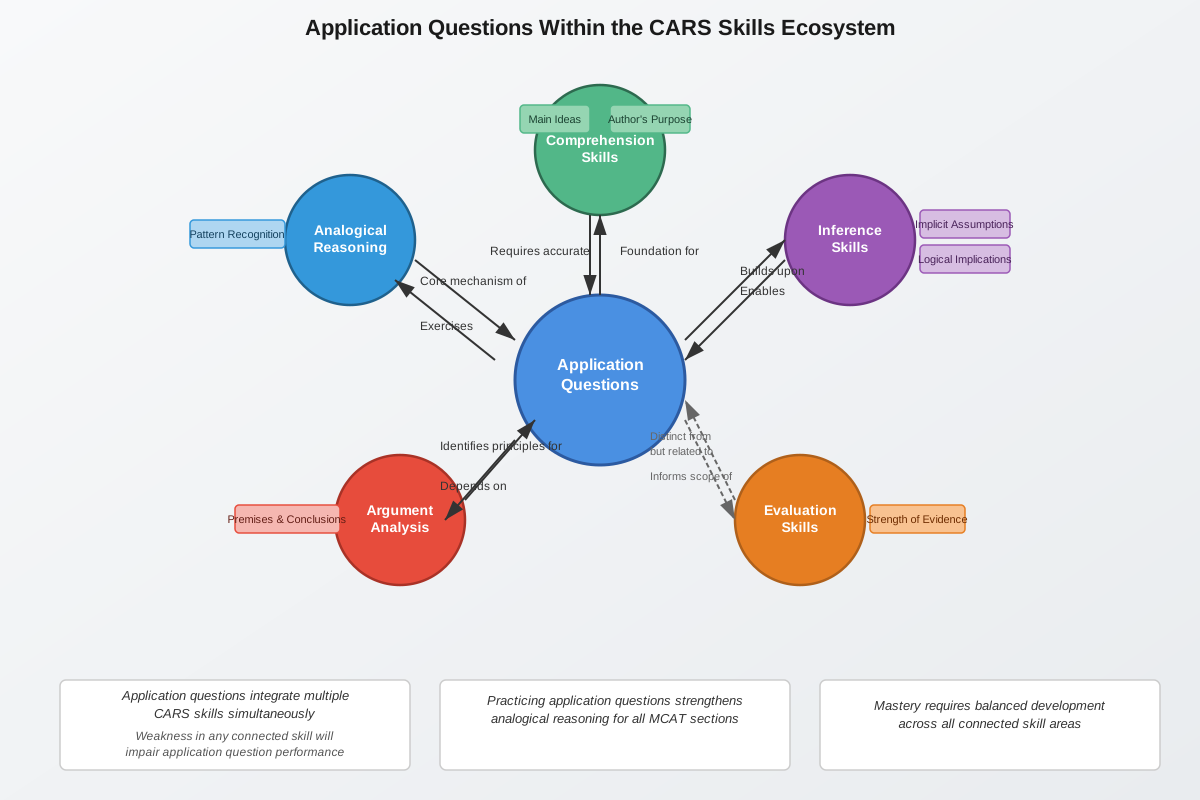
Within the broader framework of Critical Analysis and Reasoning Skills, application questions sit at the intersection of comprehension and evaluation. Students must first accurately understand the passage's main arguments and supporting evidence (comprehension), then manipulate these ideas by applying them to new contexts (application), which often requires evaluating the strength and scope of the author's reasoning (evaluation). This interconnected skill set makes application questions an excellent diagnostic tool for overall CARS proficiency and a critical area for focused practice.
Learning Objectives
- [ ] Define Application questions using accurate Critical Analysis and Reasoning Skills terminology
- [ ] Explain why Application questions matters for the MCAT
- [ ] Apply Application questions to exam-style questions
- [ ] Identify common mistakes related to Application questions
- [ ] Connect Application questions to related Critical Analysis and Reasoning Skills concepts
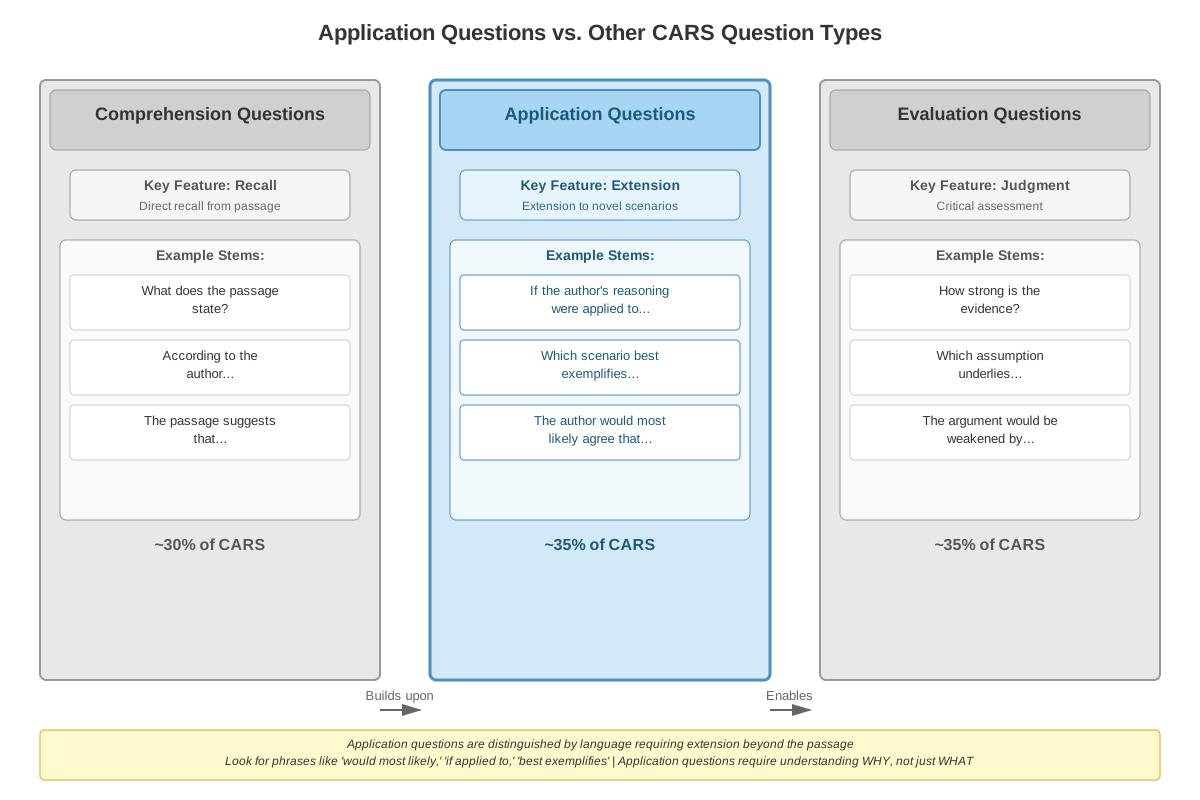
- [ ] Distinguish between application questions and other CARS question types based on question stem language
- [ ] Evaluate answer choices for application questions by assessing logical consistency with passage principles
- [ ] Construct a systematic approach for identifying the core principle that must be applied to novel scenarios
Prerequisites
- Basic reading comprehension skills: Ability to identify main ideas, supporting details, and author's purpose is essential because application questions build upon accurate passage understanding
- Understanding of argument structure: Recognition of premises, conclusions, and logical relationships enables identification of principles that can be applied to new contexts
- Familiarity with CARS passage types: Knowledge of humanities and social sciences passage characteristics helps predict the kinds of principles likely to be tested through application
- Basic logical reasoning: Understanding of if-then relationships and analogical reasoning provides the foundation for extending passage logic to novel scenarios
Why This Topic Matters
Application questions represent a critical bridge between academic test-taking and real-world medical reasoning. In clinical practice, physicians constantly encounter situations requiring them to apply established medical principles to unique patient presentations. A doctor who understands the mechanism of action for a medication must apply that knowledge to predict drug interactions, side effects in special populations, or efficacy in off-label uses. Similarly, application questions on the MCAT assess whether students can take an author's theoretical framework, philosophical position, or analytical approach and extend it to scenarios the author never explicitly discussed.
From an exam statistics perspective, application questions appear in approximately 8-12 questions per CARS section (out of 53 total questions), making them the second most common question type after comprehension questions. These questions typically carry medium to high difficulty ratings and serve as key discriminators between average and high-scoring test-takers. Students who score in the 90th percentile or above typically answer 85-90% of application questions correctly, while those in the 50th percentile answer only 60-65% correctly.
On the MCAT, application questions commonly appear in several recognizable formats: asking how an author would respond to a new scenario, predicting what example the author would use to support their argument, determining which new situation best exemplifies a principle from the passage, or identifying how the author's reasoning would apply to a different field or context. Passages discussing theoretical frameworks, philosophical positions, historical analyses, or social science methodologies are particularly likely to generate application questions because these topics naturally lend themselves to extension beyond the specific examples provided.
Core Concepts
Definition and Characteristics of Application Questions
Application questions are CARS question types that require test-takers to take information, arguments, principles, or reasoning patterns from the passage and apply them to new scenarios, examples, or contexts not explicitly discussed in the original text. These questions test whether students understand concepts deeply enough to recognize how they would manifest in different situations. The defining characteristic is the presence of novel information in either the question stem or answer choices—information that does not appear in the passage but must be evaluated using passage principles.
Application questions differ fundamentally from comprehension questions (which ask about information stated or paraphrased from the passage) and reasoning questions (which ask about the logical structure or assumptions within the passage itself). The key distinguishing feature is the extension beyond the passage: application questions always introduce new elements that students must evaluate through the lens of passage content.
Question Stem Identification
Recognizing application questions quickly allows for appropriate strategic approaches. Common question stem formats include:
- "Based on the passage, the author would most likely agree with which of the following statements about [new topic]?"
- "Which of the following scenarios best exemplifies the principle described in paragraph 3?"
- "If the author's reasoning were applied to [new context], which outcome would be most consistent with the passage?"
- "The author would most likely use which of the following as an example of [passage concept]?"
- "Which of the following new findings would most strengthen/weaken the author's position?"
- "How would the author most likely respond to [new argument or scenario]?"
The presence of phrases like "most likely," "would probably," "best exemplifies," "consistent with," and "if applied to" signals that students must extrapolate from passage content rather than simply locate information.
The Application Process: A Systematic Approach
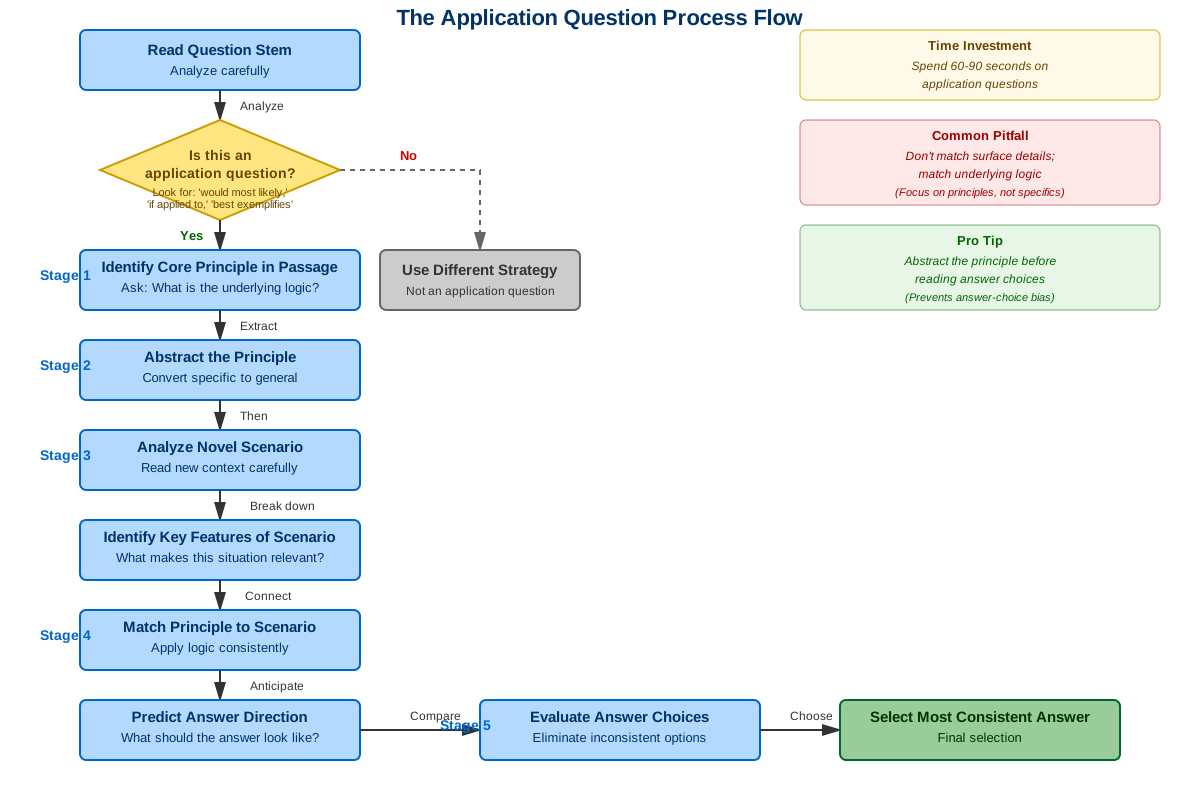
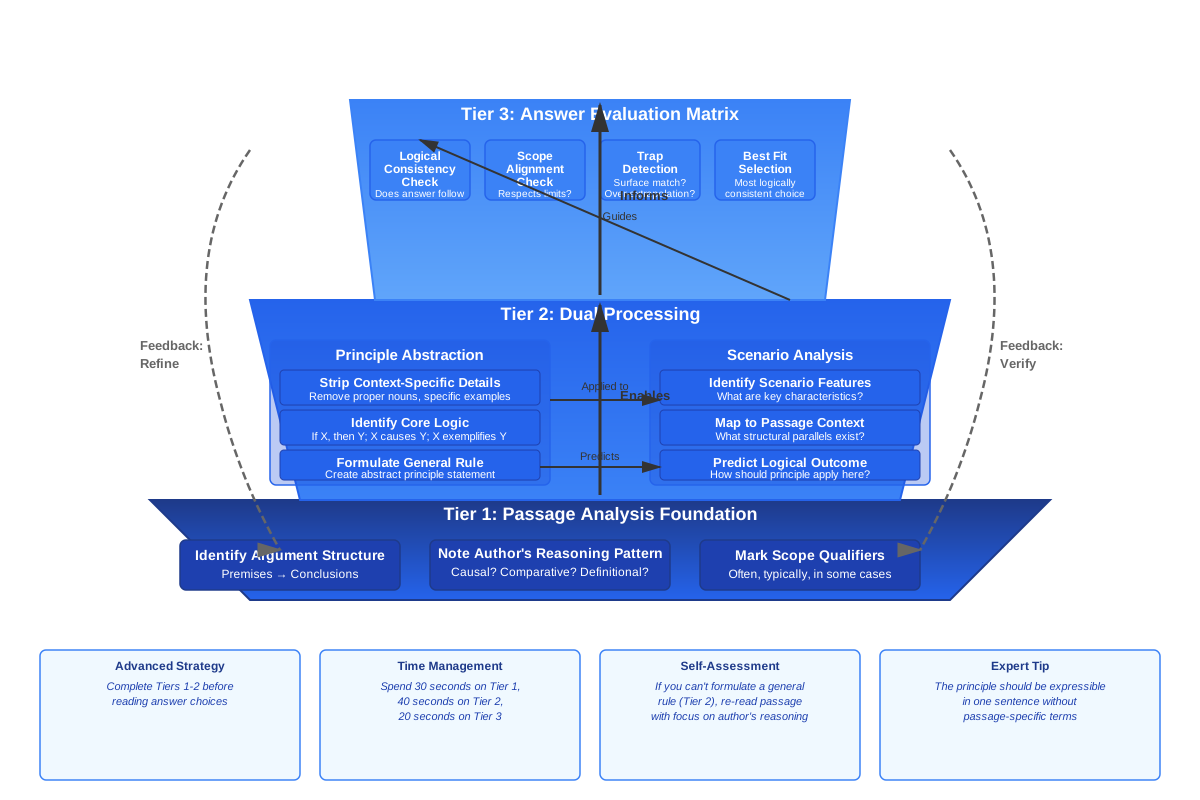
Successfully answering application questions requires a structured four-step process:
- Identify the relevant passage principle: Determine which specific argument, claim, reasoning pattern, or theoretical framework from the passage is being tested. This often requires returning to specific paragraphs referenced in the question stem.
- Abstract the principle to its essential components: Strip away the specific examples and context from the passage to identify the underlying logic or core principle. For instance, if a passage argues that "Renaissance artists gained patronage by aligning their work with religious themes," the abstract principle might be "creators gain support by aligning their work with dominant cultural values."
- Evaluate the new scenario: Carefully read the novel scenario, example, or context presented in the question stem or answer choices, identifying its key features and how they relate to the abstracted principle.
- Match principle to scenario: Determine which answer choice demonstrates the same underlying logic, reasoning pattern, or principle as the passage, even though the specific content differs.
Types of Application Questions
| Application Type | Description | Example Question Format |
|---|---|---|
| Scenario Extension | Presents a new situation and asks how passage reasoning applies | "If the author's theory were applied to modern social media, which prediction would be most consistent?" |
| Example Generation | Asks which new example would best illustrate a passage concept | "Which of the following would the author most likely cite as an example of cultural hegemony?" |
| Principle Identification | Presents multiple scenarios and asks which best exemplifies a passage principle | "Which scenario best demonstrates the concept of 'adaptive preference formation' discussed in the passage?" |
| Author Response | Asks how the author would react to new information or arguments | "How would the author most likely respond to critics who argue that [new position]?" |
| Cross-Domain Application | Requires applying passage reasoning to a completely different field | "The author's analysis of literary modernism would most support which view of contemporary architecture?" |
Scope and Limitations in Application
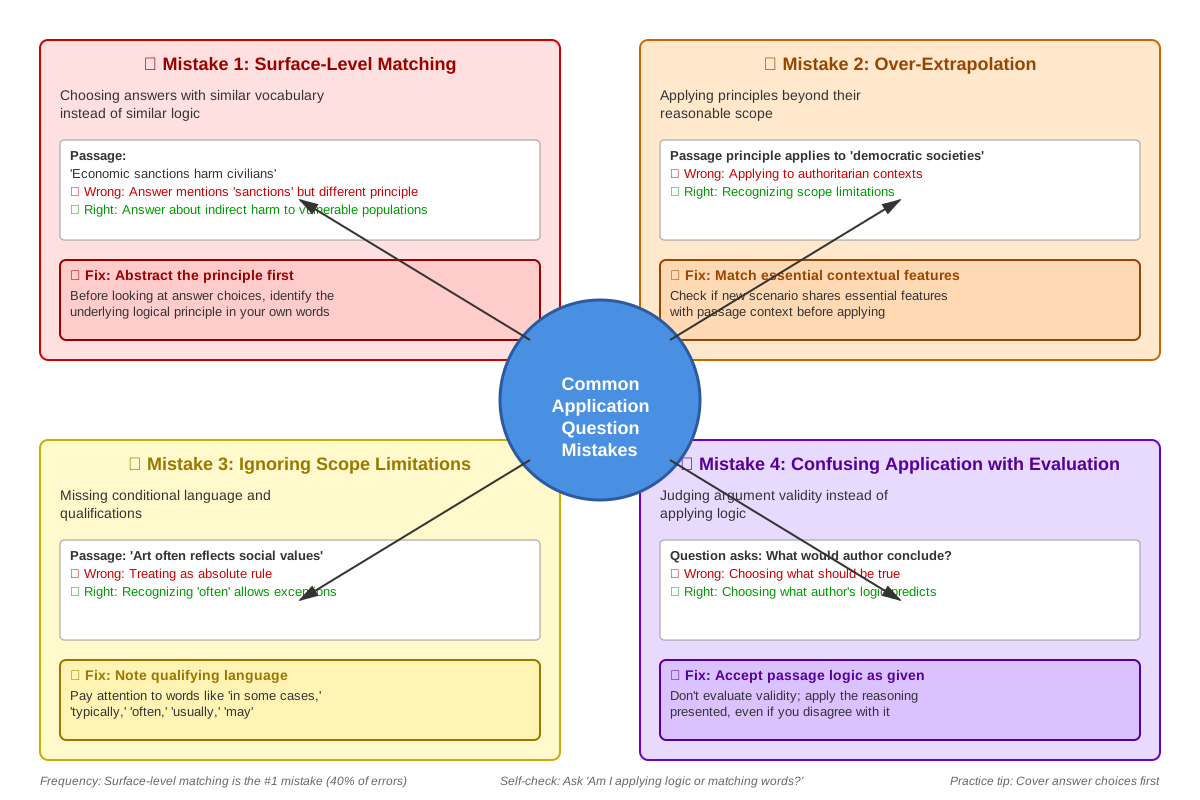
A critical skill for application questions involves understanding the scope of the author's claims—recognizing both what the passage principles can and cannot support. Strong wrong answers often present scenarios that superficially resemble passage content but actually violate the boundaries of the author's reasoning. Students must distinguish between:
- Valid extensions: New scenarios that genuinely share the same underlying logic or principle as passage arguments
- Overgeneralizations: Applications that extend the author's reasoning beyond its appropriate scope
- Superficial matches: Scenarios that use similar vocabulary or topics but don't actually align with passage logic
- Contradictory applications: Scenarios that actually oppose passage principles despite seeming related
For example, if a passage argues that "economic incentives drove European colonial expansion in Africa," a valid application might involve economic motivations for other historical expansions. An overgeneralization would claim that "all human behavior is economically motivated." A superficial match might mention colonialism but in a context where economic incentives weren't the driving factor.
Distinguishing Application from Other Question Types
Understanding what application questions are NOT helps clarify their unique characteristics:
- Not Comprehension: Application questions never ask what the passage explicitly stated; they always introduce new elements
- Not Inference: While both require going beyond explicit text, inference questions ask about implicit passage content, while application questions introduce entirely new scenarios
- Not Reasoning Within: Application questions don't ask about the passage's internal logic structure; they ask how that logic applies externally
- Not Evaluation: While application may require some evaluation, the primary task is extending passage logic, not critiquing it
Concept Relationships
Application questions exist within a hierarchical relationship to other CARS skills. At the foundation lies reading comprehension, which provides the accurate understanding of passage content necessary for any higher-order task. Building on comprehension, inference skills allow students to identify implicit claims and assumptions within the passage itself. Application questions then extend this reasoning one step further by requiring students to take these understood and inferred principles and project them onto entirely new contexts.
The relationship flows as follows: Accurate Comprehension → Inference of Implicit Principles → Abstraction of Core Logic → Application to Novel Scenarios. Each step depends on the previous one; students cannot successfully apply passage reasoning if they haven't first accurately comprehended it, identified its underlying principles, and abstracted those principles from their specific context.
Application questions also connect closely to evaluation questions because both require critical analysis of arguments. However, while evaluation questions ask students to assess the strength, validity, or assumptions of passage arguments, application questions assume the passage reasoning is valid and ask how it would extend to new situations. In practice, strong application question performance often requires brief evaluation of whether a new scenario truly aligns with passage logic.
Within the broader MCAT, application questions in CARS parallel the application of scientific principles tested in the science sections. Just as CARS application questions might ask how a philosophical principle applies to a new ethical dilemma, science passages might ask how a biological mechanism would function in a novel organism. This parallel reinforces that the MCAT consistently values the ability to extend learned principles to new contexts across all sections.
High-Yield Facts
⭐ Application questions constitute approximately 30-40% of all CARS questions, making them the second most common question type after comprehension questions.
⭐ The defining feature of application questions is the introduction of novel information (scenarios, examples, or contexts) not discussed in the passage that must be evaluated using passage principles.
⭐ Question stems containing phrases like "most likely," "would probably," "best exemplifies," "consistent with," or "if applied to" typically signal application questions.
⭐ The most common error on application questions is selecting answers that use passage vocabulary but don't actually align with passage logic—superficial matching rather than logical consistency.
⭐ Successfully answering application questions requires abstracting passage principles from their specific context to identify the underlying logic that can be applied elsewhere.
- Application questions test deeper understanding than comprehension questions because they require recognizing not just what the author says, but why they say it and how their reasoning extends.
- Strong wrong answers on application questions often present overgeneralizations that extend passage reasoning beyond its appropriate scope.
- Passages discussing theoretical frameworks, philosophical positions, or analytical methodologies are most likely to generate application questions.
- The correct answer to an application question must maintain logical consistency with passage principles even when the specific content differs completely.
- Time-efficient application question strategy involves identifying the specific passage paragraph or principle being tested before evaluating answer choices.
- Application questions frequently appear in the middle-to-end of a question set, after comprehension questions establish basic passage understanding.
- Recognizing the boundaries of an author's claims (what they do and don't argue) is essential for avoiding overgeneralization errors on application questions.
Quick check — test yourself on Application questions so far.
Try Flashcards →Common Misconceptions
Misconception: Application questions ask about information that can be found somewhere in the passage if you look carefully enough.
Correction: Application questions always introduce genuinely new information not discussed in the passage. The task is not to find where the passage discusses this new scenario, but to determine how passage principles would apply to it. If you can locate the answer directly in the passage, it's a comprehension question, not an application question.
Misconception: The correct answer to an application question will use similar vocabulary and terminology as the passage.
Correction: Correct answers often use completely different vocabulary and discuss entirely different topics than the passage. What matters is logical consistency and alignment of underlying principles, not surface-level similarity. In fact, wrong answers frequently use passage vocabulary as a trap to create superficial matches.
Misconception: Application questions require you to agree with the author's position or assume it's correct.
Correction: Application questions ask you to understand and extend the author's reasoning, regardless of whether that reasoning is actually sound. You're not evaluating whether the author is right; you're determining how their logic would apply if it were accepted as valid. This is a crucial distinction that prevents personal bias from interfering with answer selection.
Misconception: If an answer choice mentions a topic related to the passage, it's probably correct for an application question.
Correction: Topical relatedness is insufficient for application questions. An answer might discuss the same general subject as the passage but apply completely different reasoning or principles. The correct answer must demonstrate the same underlying logic or reasoning pattern, even if the specific topic differs entirely.
Misconception: Application questions are just harder comprehension questions.
Correction: Application questions represent a fundamentally different cognitive task than comprehension questions. Comprehension tests whether you understood what was stated; application tests whether you can manipulate and extend that understanding to new contexts. This requires abstraction, analogical reasoning, and logical projection—skills beyond simple reading comprehension.
Worked Examples
Worked Example 1: Philosophical Principle Application
Passage Summary: A passage discusses the philosopher John Rawls's concept of the "veil of ignorance," which argues that just social policies are those that people would choose if they didn't know what position they would occupy in society. The passage explains that this thought experiment removes self-interest bias by forcing people to consider all possible positions they might hold.
Question: Based on the passage, which of the following scenarios best exemplifies the principle underlying Rawls's veil of ignorance?
A) A wealthy CEO donates to charity to improve their public image
B) Jury members are not told the defendant's socioeconomic status before deliberating
C) A teacher grades assignments without knowing which student submitted each one
D) A politician supports policies that benefit their own constituents
Step 1 - Identify the relevant principle: The passage discusses how the veil of ignorance removes bias by preventing people from knowing their own position, forcing impartial decision-making.
Step 2 - Abstract the principle: The core logic is: "Removing knowledge of one's own position/interest → eliminates bias → produces fairer decisions." The essential components are: (1) decision-making situation, (2) removal of information about personal stake, (3) resulting in more impartial judgment.
Step 3 - Evaluate each scenario:
- Choice A: The CEO knows their position (wealthy) and acts from self-interest (public image), directly contradicting the principle
- Choice B: Jury members have information removed (socioeconomic status), but they already know they're jury members, not defendants, so they still know their position
- Choice C: The teacher has information removed (student identity) that would reveal their relationship to each student, preventing favoritism based on personal knowledge
- Choice D: The politician explicitly acts based on knowing their position (representative of specific constituents), contradicting the principle
Step 4 - Match principle to scenario: Choice C best exemplifies the principle because the teacher's ignorance of student identity prevents bias based on personal relationships, just as the veil of ignorance prevents bias based on social position. The teacher must grade each assignment as if they could be grading their own work, parallel to how Rawls's citizens must choose policies as if they could occupy any social position.
Correct Answer: C
Connection to Learning Objectives: This example demonstrates applying passage principles to novel scenarios by abstracting the core logic (removing position-knowledge to eliminate bias) and identifying which new situation shares that same underlying structure.
Worked Example 2: Historical Analysis Extension
Passage Summary: A passage analyzes how Renaissance artists gained financial support by aligning their artistic innovations with the religious and political interests of wealthy patrons. The author argues that artistic creativity flourished not despite but because of these constraints, as artists found innovative ways to satisfy patron demands while advancing their artistic vision.
Question: The author's analysis would most support which of the following claims about contemporary independent filmmakers?
A) Filmmakers who reject commercial considerations produce the most innovative work
B) Filmmakers who secure corporate sponsorship necessarily compromise their artistic vision
C) Filmmakers might achieve creative breakthroughs while working within commercial constraints
D) Filmmakers should prioritize artistic purity over financial sustainability
Step 1 - Identify the relevant principle: The passage argues that constraints from patrons didn't limit creativity but actually enabled it through a productive tension between patron demands and artistic innovation.
Step 2 - Abstract the principle: The core logic is: "External constraints (patron/commercial demands) + artist's need to satisfy those constraints = creative innovation through finding novel solutions." This contradicts the common assumption that constraints limit creativity; instead, it suggests constraints can stimulate creativity.
Step 3 - Evaluate each scenario:
- Choice A: Suggests rejecting constraints produces innovation—directly contradicts the passage principle that constraints enabled innovation
- Choice B: Claims commercial support necessarily compromises vision—contradicts the passage argument that artists advanced their vision while satisfying patrons
- Choice C: Suggests creative breakthroughs can occur within commercial constraints—directly parallels the passage argument about Renaissance artists
- Choice D: Prioritizes artistic purity over financial considerations—contradicts the passage's positive view of the patron-artist relationship
Step 4 - Match principle to scenario: Choice C applies the same logic to a new context (contemporary filmmakers vs. Renaissance artists). Just as Renaissance artists achieved innovation while satisfying patron demands, contemporary filmmakers might achieve creative breakthroughs while working within commercial constraints. Both scenarios share the underlying principle that external constraints can enable rather than prevent creative innovation.
Correct Answer: C
Connection to Learning Objectives: This example shows how to identify common mistakes (choosing answers that contradict passage logic despite topical relevance) and demonstrates connecting application questions to broader CARS concepts (recognizing argument structure and authorial perspective).
Exam Strategy
When approaching application questions on the MCAT, implement this strategic framework:
Pre-Answer Analysis (15-20 seconds):
- Identify that you're facing an application question by recognizing trigger phrases ("most likely," "best exemplifies," "if applied to")
- Locate the specific passage content being tested—often indicated by paragraph references or quoted concepts
- Before looking at answer choices, articulate the core principle in your own words: "The author's main point here is that [principle]"
Answer Choice Evaluation (30-40 seconds):
- Eliminate answers that contradict passage principles, even if they seem topically related
- Eliminate answers that overgeneralize beyond the scope of passage claims
- Eliminate answers that provide superficial matches (same vocabulary) without logical consistency
- Select the answer that demonstrates the same underlying logic, even if the specific content differs completely
Exam Tip: For application questions, wrong answers often sound more "passage-like" than correct answers because they use passage vocabulary as a trap. Train yourself to prioritize logical consistency over superficial similarity.
Trigger Words and Phrases to Watch:
- "Most likely" or "probably" → signals prediction based on passage logic
- "Best exemplifies" or "best illustrates" → requires matching new examples to passage principles
- "Consistent with" or "in line with" → demands logical alignment, not topical similarity
- "If applied to" or "in the context of" → explicitly signals extension to new domain
- "The author would agree/disagree" → requires predicting author's position on new issues
Process of Elimination Tips:
- Immediately eliminate answers that directly contradict passage claims
- Be suspicious of answers that seem too extreme or absolute unless the passage itself was extreme
- Watch for answers that confuse correlation with causation or reverse cause-and-effect relationships from the passage
- Eliminate answers that introduce entirely new reasoning not based on passage logic
Time Allocation:
Application questions typically require 60-90 seconds each—slightly longer than comprehension questions but similar to reasoning questions. If you find yourself spending more than 90 seconds, you likely haven't clearly identified the core principle being tested. Return to the passage, re-read the relevant section, and articulate the principle before re-evaluating answer choices.
Memory Techniques
APPLE Mnemonic for Application Question Approach:
- Abstract the principle from passage context
- Pinpoint the specific passage content being tested
- Predict what kind of answer would logically fit
- Logical consistency matters more than topical similarity
- Eliminate contradictions and overgeneralizations first
Visualization Strategy: Picture the passage principle as a template or pattern. The specific passage examples are like puzzle pieces that fit this template. Application questions show you new puzzle pieces (scenarios) and ask which ones fit the same template. The pieces might look completely different (different colors, images) but must have the same shape (logical structure) to fit.
The "Different Content, Same Logic" Mantra: Before selecting an answer on application questions, repeat: "Different content, same logic." This reminds you that correct answers often discuss completely different topics than the passage but must demonstrate identical underlying reasoning.
Scope Boundary Technique: When reading passages, mentally draw a boundary around the author's claims. Ask yourself: "What does the author actually argue?" and "What would be going too far?" This prepares you to recognize overgeneralizations in application question answer choices.
Summary
Application questions represent a critical CARS question type that tests whether students understand passage content deeply enough to extend it to novel scenarios. These questions, comprising 30-40% of CARS questions, require a four-step process: identifying the relevant passage principle, abstracting that principle from its specific context, evaluating the new scenario presented, and matching the principle to the scenario based on logical consistency rather than superficial similarity. Success requires distinguishing between valid extensions of passage logic and common traps including overgeneralizations, superficial matches using passage vocabulary, and scenarios that actually contradict passage principles. The key insight is that correct answers demonstrate the same underlying reasoning pattern as the passage even when discussing completely different topics, while wrong answers often use passage terminology without maintaining logical consistency. Mastering application questions develops critical thinking skills essential both for MCAT success and for medical practice, where physicians constantly apply established principles to unique patient presentations.
Key Takeaways
- Application questions always introduce novel information not discussed in the passage and ask how passage principles would apply to these new scenarios
- The correct answer demonstrates logical consistency with passage reasoning, not superficial similarity in vocabulary or topic
- Success requires abstracting passage principles from their specific context to identify underlying logic that can be applied elsewhere
- Common errors include selecting answers that use passage vocabulary without logical alignment, overgeneralizing beyond passage scope, and confusing topical relatedness with logical consistency
- Application questions test deeper understanding than comprehension questions and serve as strong discriminators between average and high-scoring test-takers
- Strategic approach involves identifying the specific principle being tested before evaluating answer choices, then eliminating contradictions and overgeneralizations
- The phrase "different content, same logic" captures the essence of correct answers on application questions
Related Topics
Inference Questions in CARS: While application questions extend passage logic to new external scenarios, inference questions ask about implicit claims within the passage itself. Mastering application questions builds the analytical skills needed for complex inference questions.
Reasoning Within the Text Questions: These questions ask about the logical structure and relationships within passage arguments. Understanding argument structure through reasoning questions provides the foundation for identifying which principles can be applied in application questions.
Evaluation Questions: These questions ask students to assess the strength, validity, or assumptions of passage arguments. The critical analysis skills developed through evaluation questions complement application question skills by helping students understand the scope and limitations of passage claims.
Strengthen/Weaken Questions: These questions present new information and ask whether it supports or undermines passage arguments. They represent a hybrid between application and evaluation, requiring students to apply passage logic while assessing argument strength.
Main Idea and Author's Purpose: Understanding the author's overall argument and purpose provides the framework for determining which principles are central enough to be tested through application questions versus peripheral details.
Practice CTA
Now that you've mastered the conceptual framework for application questions, it's time to put these strategies into practice. Attempt the practice questions and flashcards associated with this topic, focusing on implementing the four-step application process: identify the principle, abstract the logic, evaluate the scenario, and match based on logical consistency. Remember that application questions reward deep understanding over superficial recognition—each practice question you work through strengthens your ability to think like a physician, extending established principles to novel situations. Your performance on application questions directly correlates with overall CARS success, so invest the time to develop these critical skills. You've got this!
Sign up free to keep reading
Create a free AnvayaPrep account to finish this MCAT guide on Application questions — plus flashcards and practice questions.