Overview
Inference questions represent one of the most frequently tested question types in the Critical Analysis and Reasoning Skills (CARS) section of the MCAT, accounting for approximately 30-40% of all CARS questions. These questions require test-takers to extend beyond what is explicitly stated in the passage to determine what must be true, what is likely true, or what the author would probably agree with based on the information provided. Unlike retrieval questions that ask for information directly stated in the text, inference questions MCAT challenges demand that students synthesize passage content, recognize implicit assumptions, and draw logical conclusions that follow necessarily or reasonably from the author's arguments.
Mastering inference questions Critical Analysis and Reasoning Skills is essential because these questions assess the higher-order thinking skills that medical schools value: the ability to read between the lines, understand unstated implications, and apply reasoning to novel situations. In clinical practice, physicians must constantly make inferences from patient presentations, laboratory data, and medical literature—skills that directly parallel the cognitive demands of CARS inference questions. The MCAT uses these questions to identify candidates who can move beyond surface-level comprehension to demonstrate genuine analytical reasoning.
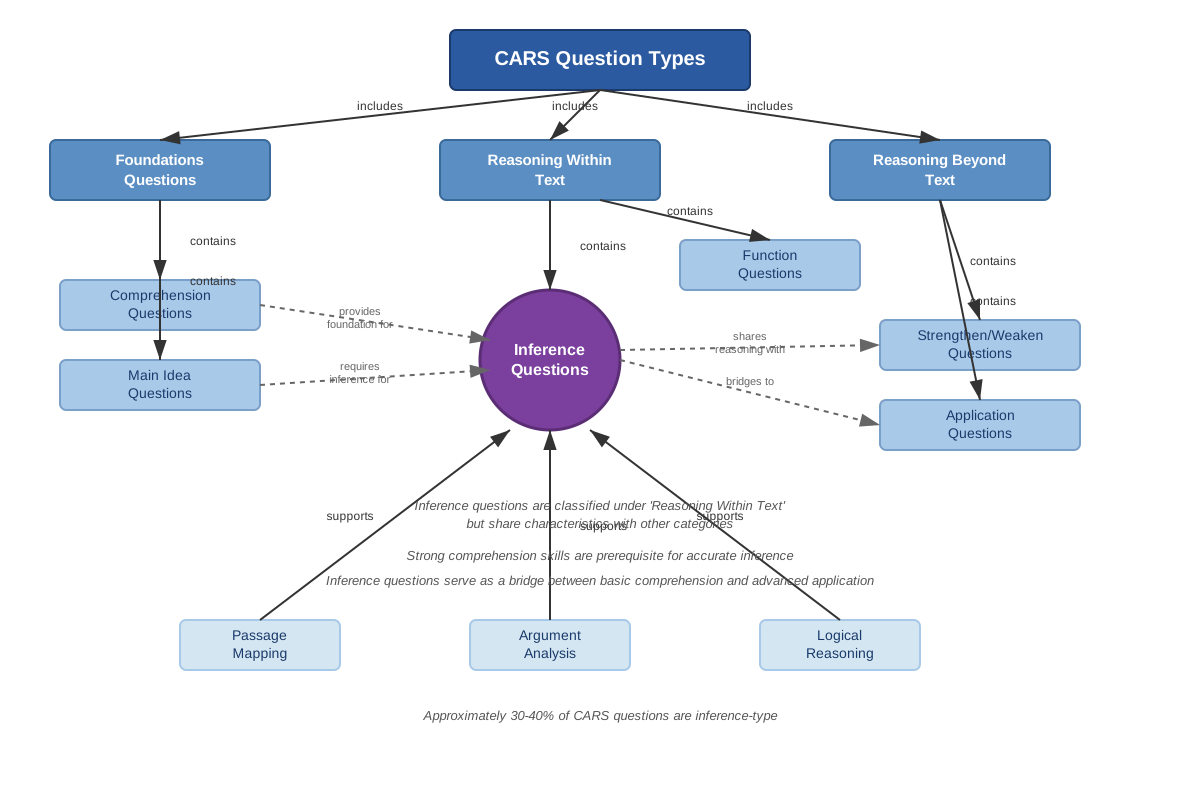
Within the broader framework of CARS Skills, inference questions connect intimately with other question types and reasoning abilities. They build upon foundational comprehension skills while serving as a bridge to application and evaluation questions. Strong performance on inference questions requires integration of passage mapping, argument analysis, and logical reasoning—making this topic central to overall CARS success. Students who excel at inference questions typically demonstrate superior passage retention, nuanced understanding of authorial tone and purpose, and disciplined adherence to textual evidence rather than outside knowledge.
Learning Objectives
- [ ] Define Inference questions using accurate Critical Analysis and Reasoning Skills terminology
- [ ] Explain why Inference questions matters for the MCAT
- [ ] Apply Inference questions to exam-style questions
- [ ] Identify common mistakes related to Inference questions
- [ ] Connect Inference questions to related Critical Analysis and Reasoning Skills concepts
- [ ] Distinguish between valid inferences and unsupported assumptions
- [ ] Evaluate answer choices using the "must be true" versus "could be true" standard
- [ ] Recognize the spectrum of inference strength from necessary conclusions to reasonable possibilities
- [ ] Apply systematic elimination strategies specific to inference question formats
Prerequisites
- Basic reading comprehension: Understanding literal meaning of text is foundational before attempting to infer unstated implications
- Argument structure recognition: Identifying premises, conclusions, and supporting evidence enables recognition of what logically follows
- Passage mapping skills: Creating mental or written outlines helps track information needed to support inferences
- Understanding of question stems: Recognizing different CARS question types prevents confusion between inference and other question categories
- Logical reasoning fundamentals: Basic understanding of valid versus invalid reasoning patterns supports evaluation of inference strength
Why This Topic Matters
In clinical medicine, physicians constantly make inferences from incomplete information. A patient presents with symptoms, and the physician must infer possible diagnoses, predict treatment responses, and anticipate complications—all based on limited data combined with medical knowledge. Similarly, reading medical literature requires inferring implications of research findings, understanding unstated assumptions in study designs, and drawing conclusions about clinical applicability. The cognitive skills tested by inference questions directly translate to these essential medical competencies.
On the MCAT, inference questions appear with remarkable frequency, comprising roughly 30-40% of CARS questions across all passages. These questions typically appear 1-2 times per passage and are distributed across humanities and social sciences topics. The AAMC consistently includes inference questions because they effectively discriminate between students who merely comprehend surface content and those who can engage in sophisticated analytical reasoning. Performance on inference questions strongly correlates with overall CARS scores and predicts success in medical school coursework that requires critical thinking.
Inference questions appear in several characteristic formats on the MCAT. Passages may present historical arguments, philosophical positions, social science theories, or literary analyses, and inference questions will ask what the author would likely agree with, what can be reasonably concluded, or what is most supported by the passage. These questions often include stems like "The author would most likely agree that...", "Based on the passage, it is reasonable to conclude...", or "The passage most strongly suggests that...". Recognizing these patterns enables efficient question identification and appropriate strategic approaches.
Core Concepts
Definition and Characteristics of Inference Questions
Inference questions are CARS question types that require test-takers to determine what must be true, is likely true, or reasonably follows from passage content without being explicitly stated. The defining characteristic of inference questions is that the correct answer, while not directly mentioned in the text, is strongly supported by—and logically follows from—the information provided. These questions test the ability to "read between the lines" while remaining strictly grounded in textual evidence.
Inference questions differ fundamentally from retrieval questions (which ask for explicitly stated information) and application questions (which ask how passage concepts apply to new scenarios). The key distinction lies in the relationship between passage content and answer: inference questions require logical extension of stated information to unstated but supported conclusions. The correct answer to an inference question should feel like a natural, almost inevitable consequence of what the author has written, even though the author never directly articulated that specific point.
The Inference Spectrum: Strength and Support
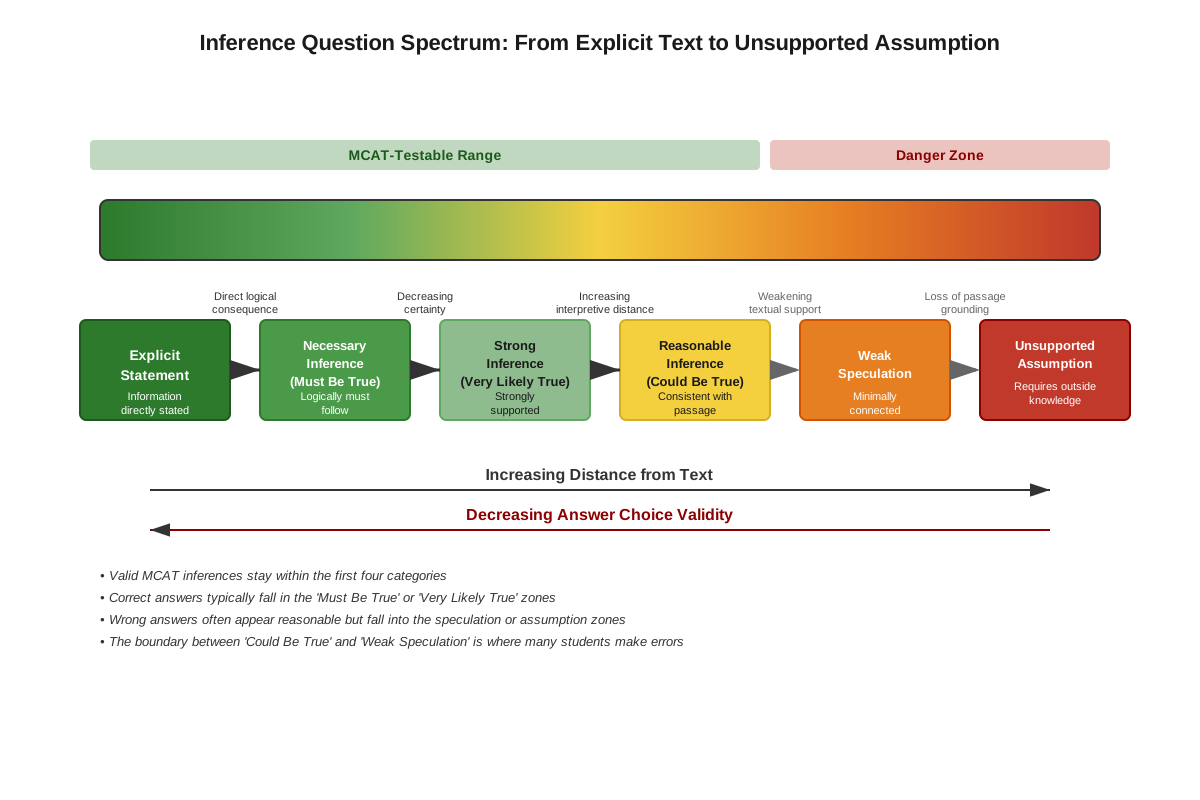
Not all inferences are created equal. Understanding the inference spectrum is crucial for MCAT success. At one end lie necessary inferences—conclusions that absolutely must be true given the passage content. These represent the strongest form of inference, where denying the inference would create a logical contradiction with passage statements. In the middle of the spectrum are reasonable inferences—conclusions that are well-supported and likely true based on passage content, though not absolutely required. At the far end are possible inferences—statements that could be true but lack sufficient passage support.
MCAT inference questions typically target the necessary-to-reasonable range of this spectrum. The correct answer will be strongly supported by passage evidence, while incorrect answers often represent possible but unsupported claims, or statements that go too far beyond what the passage justifies. Recognizing where an answer choice falls on this spectrum is essential for accurate answer selection.
| Inference Type | Characteristics | Passage Relationship | MCAT Frequency |
|---|---|---|---|
| Necessary | Must be true; denial contradicts passage | Logically required by stated information | Moderate |
| Reasonable | Likely true; well-supported by passage | Strongly suggested by multiple passage elements | High |
| Possible | Could be true; minimal passage support | Consistent with but not supported by passage | Wrong answers |
| Unsupported | No passage evidence | Contradicts or ignores passage content | Wrong answers |
Common Inference Question Stems
Recognizing inference question stems enables rapid question identification and appropriate strategic deployment. Common stems include:
- "The author would most likely agree that..."
- "Based on the passage, it is reasonable to conclude..."
- "The passage most strongly suggests that..."
- "It can be inferred from the passage that..."
- "The author's argument implies that..."
- "Which of the following is most supported by the passage?"
- "The passage indicates that..."
- "The author would probably respond to X by..."
Each stem variation carries subtle differences in inference strength required. "Most strongly suggests" typically requires very strong textual support, while "would probably" allows for slightly more interpretive flexibility. However, all inference questions share the requirement that answers must be grounded in passage evidence rather than outside knowledge or speculation.
The Textual Evidence Requirement
The cardinal rule of inference questions is that every correct inference must have clear textual support. This means that for any inference question, a test-taker should be able to point to specific passage sentences or paragraphs that support the answer choice. The support may come from a single passage location or may require synthesizing information from multiple paragraphs, but it must be present and identifiable.
This textual evidence requirement distinguishes valid inferences from speculation. Many wrong answers on inference questions are statements that could be true in the real world or that seem reasonable based on outside knowledge, but lack specific passage support. The MCAT tests reading comprehension and reasoning about what the author has written, not general knowledge or personal opinions about the topic.
Types of Inferences Tested
The MCAT tests several distinct types of inferences, each requiring slightly different reasoning approaches:
Logical consequence inferences ask what must follow from stated premises. If the passage states "All effective policies require public support" and "Policy X lacks public support," the logical inference is that Policy X will not be effective.
Authorial belief inferences ask what the author would likely agree with based on positions taken in the passage. These require understanding the author's perspective, tone, and argumentative commitments.
Implication inferences ask what is suggested or implied by passage statements. If an author describes a theory as "once dominant but now largely abandoned," the implication is that the theory has lost credibility or been superseded.
Comparative inferences ask about relationships between concepts, often requiring synthesis of information from different passage sections. These might ask which of two approaches the author would favor, or how concepts relate to each other.
Predictive inferences ask what the author would likely think about a scenario or claim not directly discussed in the passage, based on positions and reasoning patterns established in the text.
The Role of Passage Mapping in Inference Questions
Effective passage mapping—creating a mental or written outline of passage structure and key points—significantly enhances inference question performance. A good passage map enables rapid location of relevant information when answering inference questions and helps identify connections between different passage sections that support inferences.
For inference questions specifically, passage maps should capture not just what the author says, but the author's tone, purpose, and argumentative direction. Noting whether the author supports or criticizes ideas, identifies problems or solutions, and emphasizes certain concepts over others provides the foundation for valid inferences about authorial beliefs and implications.
Concept Relationships
Inference questions exist within an interconnected web of CARS skills and question types. At the foundational level, basic comprehension enables understanding of what the passage explicitly states, which serves as the raw material for inferences. Without accurate comprehension, valid inference becomes impossible—students may draw conclusions from misunderstood premises.
Passage mapping → supports → Inference questions by organizing information in ways that reveal connections and implications. A well-constructed passage map makes the evidence needed to support inferences immediately accessible and helps identify relationships between concepts that might not be obvious from linear reading alone.
Argument analysis → enables → Inference questions because recognizing how authors construct arguments reveals what they assume, what they prioritize, and what logically follows from their positions. Understanding that an author uses certain evidence to support a claim helps identify what else the author would likely accept as true.
Inference questions → connect to → Application questions as both require extending passage content beyond what is explicitly stated. However, inference questions stay closer to the passage, asking what follows from stated information, while application questions ask how passage concepts would apply to entirely new scenarios.
Tone and purpose recognition → informs → Inference questions about authorial beliefs. Understanding whether an author is critical, supportive, ambivalent, or analytical toward a topic guides predictions about what the author would agree with or how they would respond to related claims.
The relationship between textual evidence and inference strength is direct and proportional: stronger, more explicit textual support enables stronger, more confident inferences. This relationship underlies the strategic approach of always grounding inferences in identifiable passage content.
High-Yield Facts
⭐ Inference questions comprise approximately 30-40% of all CARS questions, making them the most or second-most common question type
⭐ The correct answer to an inference question must have clear, identifiable textual support, even though it is not explicitly stated
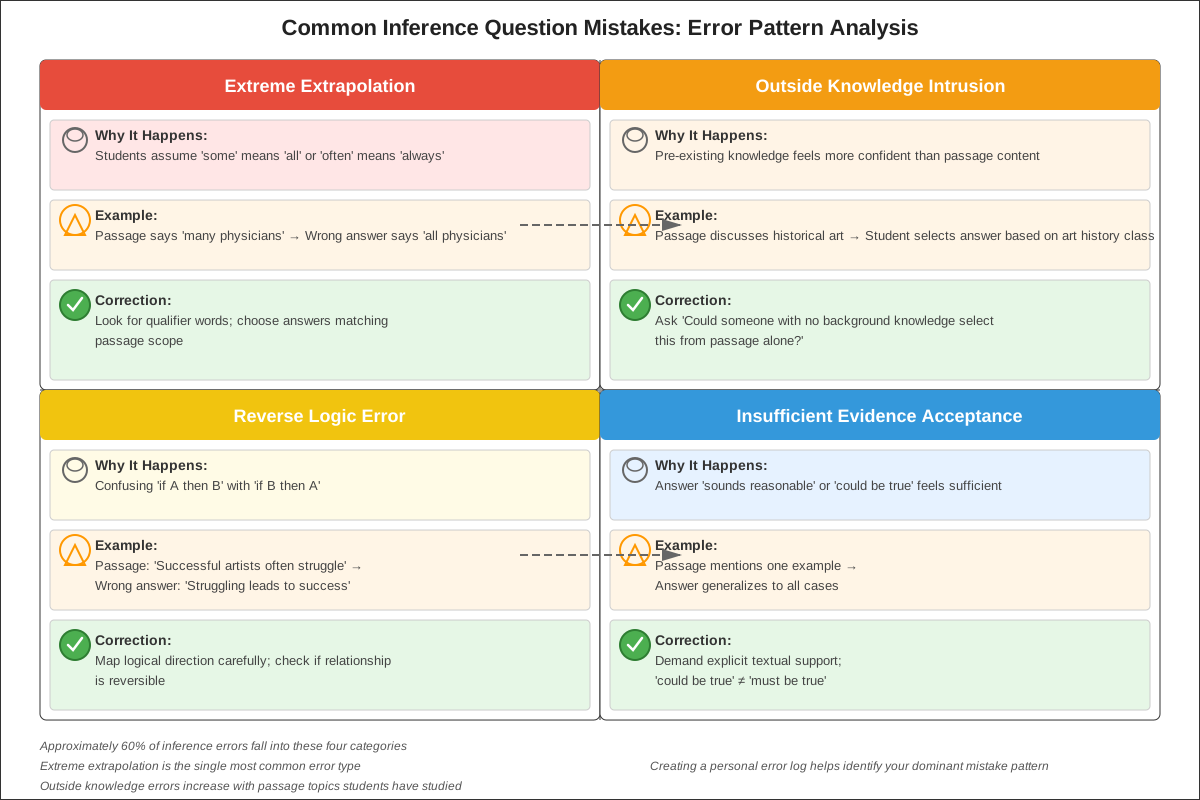
⭐ Wrong answers often represent statements that could be true but lack sufficient passage support
⭐ "Most likely" and "most strongly suggests" stems require very strong textual evidence, not mere possibility
⭐ Extreme language in answer choices (always, never, only, must) is often wrong unless the passage uses equally strong language
- Inference questions test reasoning about what the author has written, not outside knowledge about the topic
- Valid inferences can be drawn from a single passage location or by synthesizing multiple passage elements
- The author's tone and purpose provide crucial context for inferring authorial beliefs and likely responses
- Necessary inferences (must be true) are stronger than reasonable inferences (likely true), which are stronger than possible inferences (could be true)
- Passage mapping significantly improves inference question accuracy by organizing information and revealing connections
- Inference questions often include wrong answers that contradict passage content or go too far beyond what is supported
- The ability to distinguish between what is stated, what is implied, and what is merely possible is essential for inference question success
Quick check — test yourself on Inference questions so far.
Try Flashcards →Common Misconceptions
Misconception: Inference questions ask for educated guesses or speculation about the topic.
Correction: Inference questions require logical conclusions firmly grounded in passage evidence. The correct answer must be supported by specific textual content, not general knowledge or speculation. Every inference should be defensible by pointing to passage sentences that support it.
Misconception: If an answer choice could be true in the real world, it's a valid inference.
Correction: Real-world truth is irrelevant to CARS inference questions. An answer choice must be supported by the specific passage content, regardless of whether it's true in reality. Many wrong answers are factually accurate statements that simply lack passage support.
Misconception: Inference questions ask for information not in the passage, so outside knowledge is appropriate.
Correction: While inference questions ask for conclusions not explicitly stated, these conclusions must be derived from passage content alone. Outside knowledge should never be used to select answers. The inference must follow from what the author has written, not from what the test-taker knows about the topic.
Misconception: Extreme answer choices (using "always," "never," "only") are always wrong.
Correction: While extreme language often signals wrong answers, it's not an absolute rule. If the passage itself uses strong, definitive language or makes categorical claims, an answer choice with extreme language may be correct. The key is whether the passage supports the strength of the claim.
Misconception: Inference questions are subjective and depend on interpretation.
Correction: Inference questions have objectively correct answers based on passage content. While they require reasoning beyond explicit statements, this reasoning must follow logical principles and be grounded in textual evidence. The MCAT designs inference questions to have one clearly best answer that is more strongly supported than alternatives.
Misconception: Longer answer choices are more likely to be correct because they provide more detail.
Correction: Answer length is not a reliable indicator of correctness. Wrong answers are often lengthy because they include additional unsupported claims or unnecessary qualifications. The correct answer may be concise or detailed—what matters is passage support, not length.
Misconception: If the passage discusses a topic, any statement about that topic is a valid inference.
Correction: Merely discussing a topic doesn't support all possible statements about it. The specific content, context, and argumentative direction matter. An author might discuss a theory to criticize it, so inferring that the author supports the theory would be incorrect despite the topic being discussed.
Worked Examples
Example 1: Authorial Belief Inference
Passage excerpt: "The traditional view that artistic genius emerges fully formed, independent of social context, has been thoroughly discredited by recent scholarship. Studies of Renaissance masters reveal extensive workshop collaboration, with apprentices contributing significantly to works attributed to single artists. Moreover, the very concept of individual artistic ownership is a modern invention; Renaissance artists viewed their work as craft production, not personal expression. These findings challenge romantic notions of the isolated creative genius."
Question: Based on the passage, the author would most likely agree with which of the following?
A) Renaissance art is superior to modern art because it involved collaboration
B) The concept of artistic genius should be understood in social and historical context
C) Individual artists never made significant contributions to Renaissance artworks
D) Modern notions of artistic ownership are more accurate than Renaissance views
Worked Solution:
Step 1: Identify the question type. The stem "the author would most likely agree with" signals an authorial belief inference question.
Step 2: Determine the author's main position. The author argues that traditional views of isolated artistic genius are wrong and that social/historical context matters. The author emphasizes that Renaissance art involved collaboration and that concepts of artistic ownership are historically contingent.
Step 3: Evaluate each answer choice against passage support:
Choice A: The passage discusses collaboration but never compares Renaissance and modern art quality. This introduces an unsupported value judgment. Eliminate.
Choice B: This directly aligns with the author's argument. The passage shows that understanding artistic genius requires considering social context (workshop collaboration) and historical context (changing concepts of ownership). The author's entire argument supports contextualizing artistic genius. Strong candidate.
Choice C: This is too extreme. The passage says apprentices "contributed significantly," not that individual artists "never made significant contributions." The author challenges the idea of fully independent genius, not the existence of individual contributions. Eliminate.
Choice D: The passage presents Renaissance and modern views as different, not as one being more accurate than the other. The author's point is that concepts are historically contingent, not that modern views are superior. Eliminate.
Step 4: Select the answer with strongest passage support. Choice B is correct because it captures the author's central argument that artistic genius must be understood contextually, which is supported by both the explicit statement about discrediting decontextualized views and the evidence about collaboration and historical concepts.
Learning objective connection: This example demonstrates applying inference questions to exam-style questions and distinguishing valid inferences (B) from unsupported assumptions (A, D) and extreme claims (C).
Example 2: Logical Consequence Inference
Passage excerpt: "Effective public health interventions require not only scientific validity but also community acceptance. Interventions that ignore local cultural practices, even when scientifically sound, typically fail to achieve their goals. The fluoridation of water supplies illustrates this principle: despite overwhelming evidence of dental health benefits, fluoridation programs have failed in communities where they were implemented without adequate public consultation and education. Conversely, vaccination programs that incorporate community leaders and respect local concerns have achieved high participation rates even in initially skeptical populations."
Question: It can be reasonably inferred from the passage that:
A) Scientific validity is less important than community acceptance for public health interventions
B) Fluoridation programs are scientifically invalid
C) A scientifically valid intervention may fail without community acceptance
D) Vaccination programs are always more successful than fluoridation programs
Worked Solution:
Step 1: Identify question type. "It can be reasonably inferred" signals a standard inference question requiring a conclusion supported by passage content.
Step 2: Identify key passage claims:
- Effective interventions require both scientific validity AND community acceptance
- Scientifically sound interventions can fail without community acceptance
- Examples support this principle (fluoridation failure, vaccination success)
Step 3: Evaluate answer choices:
Choice A: The passage says interventions require BOTH factors, not that one is less important than the other. The author emphasizes the necessity of both, not a hierarchy. Eliminate.
Choice B: The passage explicitly states fluoridation has "overwhelming evidence of dental health benefits," confirming scientific validity. This contradicts passage content. Eliminate.
Choice C: This directly follows from the passage's main argument. The author states that scientifically sound interventions "typically fail" without community acceptance and provides fluoridation as a specific example. This is a logical consequence of stated premises. Strong candidate.
Choice D: The passage provides one example of each, not a general comparison of all programs. The success of vaccination programs in the example is attributed to community engagement, not to vaccination being inherently superior to fluoridation. Eliminate.
Step 4: Confirm textual support. Choice C is directly supported by the sentence "Interventions that ignore local cultural practices, even when scientifically sound, typically fail to achieve their goals" and the fluoridation example. Choice C is correct.
Learning objective connection: This example demonstrates identifying logical consequences that follow necessarily from stated premises and avoiding wrong answers that misrepresent passage relationships (A), contradict passage content (B), or overgeneralize from limited examples (D).
Exam Strategy
Systematic Approach to Inference Questions
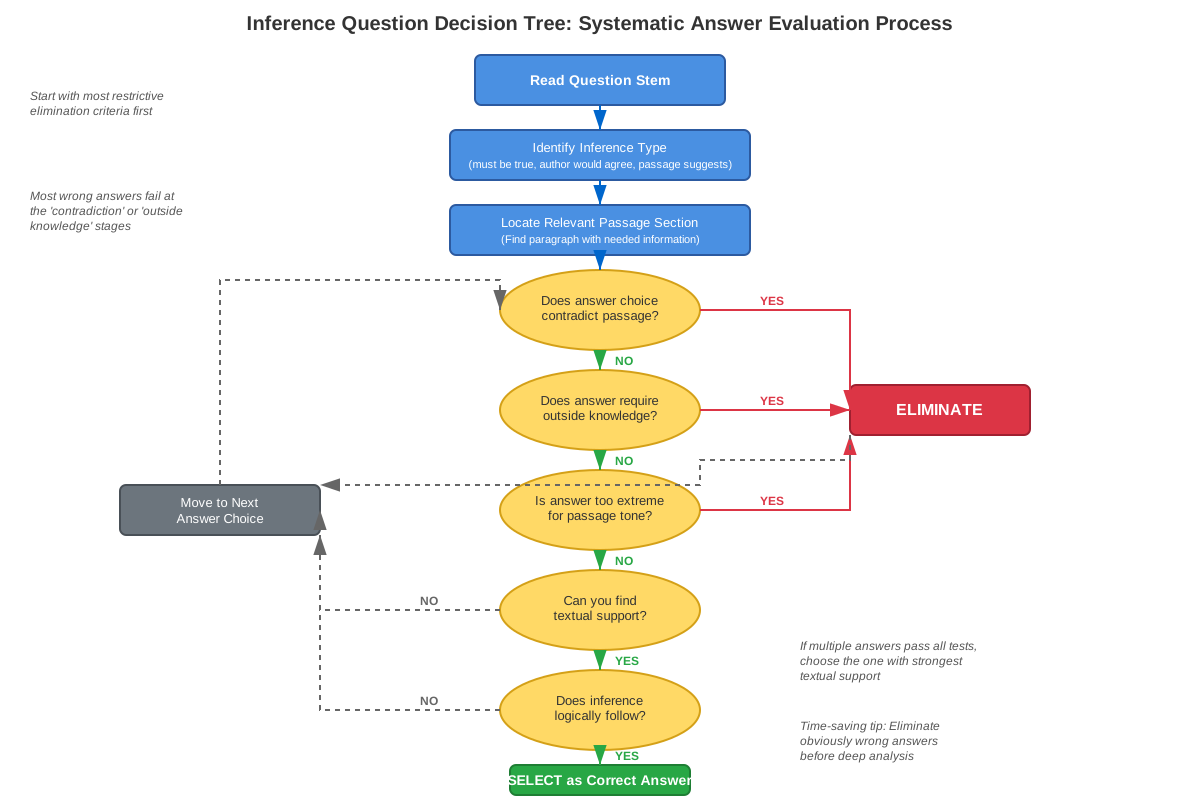
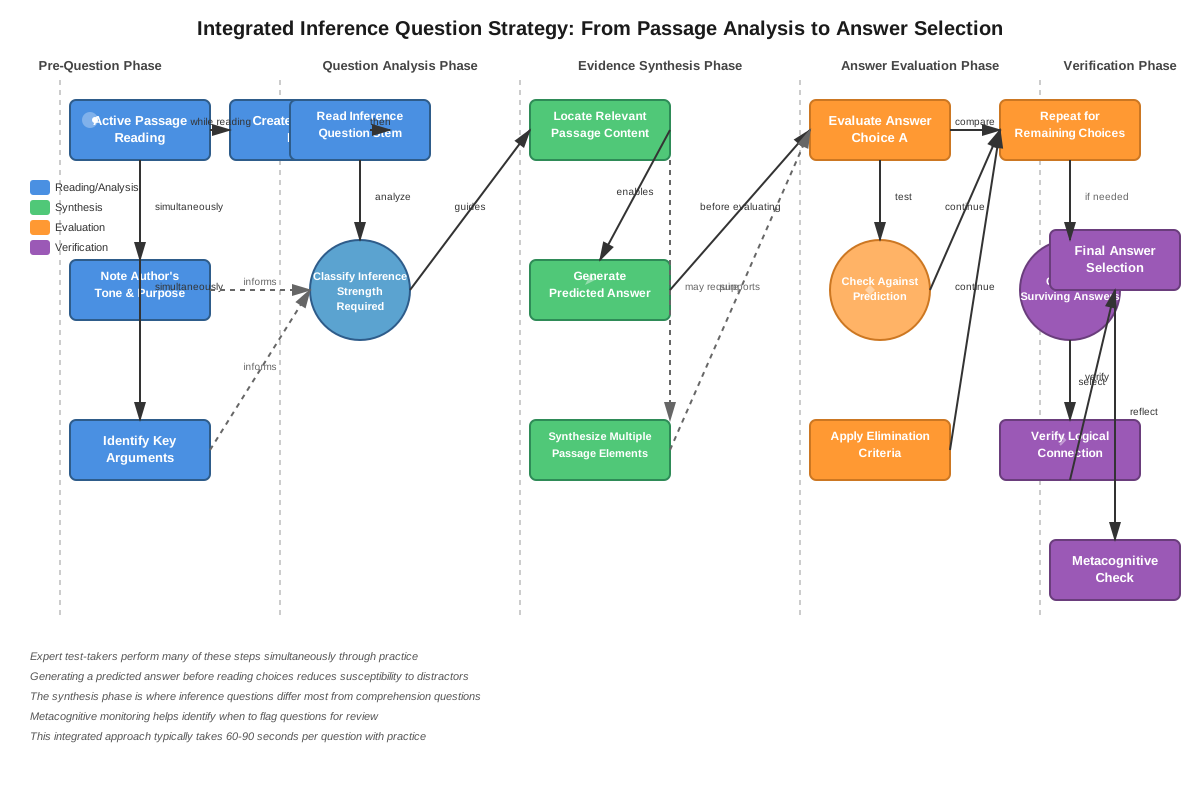
Step 1: Identify the question type by recognizing inference stems ("most likely agree," "reasonable to conclude," "suggests that"). This triggers the appropriate strategic mindset: seeking conclusions supported by but not explicitly stated in the passage.
Step 2: Return to the passage before evaluating answer choices. For inference questions with specific content references, locate the relevant passage section. For broader inference questions about authorial beliefs, consider the passage's overall argument and tone.
Step 3: Predict the answer when possible. Based on passage content, formulate what a correct inference might look like. This prediction serves as a benchmark for evaluating answer choices and prevents being swayed by attractive but unsupported options.
Step 4: Evaluate each answer choice by asking: "Can I point to specific passage content that supports this?" If the answer is no or requires significant speculation, eliminate the choice.
Step 5: Apply the "must be true" or "strongly supported" standard depending on the question stem. For "must be true" questions, the correct answer should be undeniable given passage content. For "most likely" or "suggests" questions, the correct answer should be the most strongly supported option, even if not absolutely required.
Trigger Words and Phrases
Question stem triggers that signal inference questions:
- "Most likely agree/believe/accept"
- "Reasonable to conclude/infer"
- "Suggests/implies that"
- "Most supported by"
- "Author would probably"
- "Passage indicates"
Answer choice red flags that often signal wrong answers:
- Extreme language (always, never, only, must) without corresponding passage support
- Content not discussed in the passage
- Statements that reverse or contradict passage claims
- Overgeneralizations from limited passage examples
- Value judgments not made by the author
Answer choice green flags that often signal correct answers:
- Qualified language (often, typically, may, suggests) matching passage tone
- Synthesis of multiple passage elements
- Logical extensions of stated claims
- Consistency with authorial tone and purpose
Process of Elimination Strategies
Eliminate answers that contradict passage content first. These are objectively wrong and easiest to identify. If the passage says X and an answer choice says not-X, eliminate immediately.
Eliminate answers with no passage support second. Ask "Where in the passage is this supported?" If no specific location comes to mind, the answer likely lacks support.
Eliminate answers that go too far third. These answers may start with supported claims but extend beyond what the passage justifies. Watch for answers that take a passage example and overgeneralize it, or that make stronger claims than the passage supports.
Choose between remaining answers by comparing strength of textual support. The correct answer will have more direct, explicit, or comprehensive passage support than alternatives.
Time Allocation
Inference questions typically require 60-90 seconds each. This includes time to:
- Identify the question type (5-10 seconds)
- Return to relevant passage content (15-20 seconds)
- Evaluate answer choices (30-45 seconds)
- Confirm the selection (10-15 seconds)
If an inference question requires more than 90 seconds, consider flagging it and returning after completing other questions. Some inference questions, particularly those requiring synthesis of multiple passage sections, are inherently more time-consuming and may be better attempted after securing points from faster questions.
Exam Tip: The most common mistake on inference questions is selecting answers that could be true but lack passage support. Always ground your answer selection in specific textual evidence, not plausibility or outside knowledge.
Memory Techniques
The GRIPS Mnemonic for Inference Questions
G - Grounded: Every inference must be grounded in specific passage content
R - Reasonable: The correct answer represents a reasonable extension, not a speculative leap
I - Identifiable: You should be able to identify exactly where the passage supports the inference
P - Passage-based: Use passage content only, never outside knowledge
S - Supported: The correct answer has stronger support than alternatives
The Inference Strength Ladder Visualization
Visualize a ladder with three rungs:
- Top rung: Necessary inferences (must be true)
- Middle rung: Reasonable inferences (likely true, well-supported)
- Bottom rung: Possible inferences (could be true, minimal support)
MCAT correct answers live on the top two rungs. Wrong answers often fall to the bottom rung or below (unsupported). When evaluating answer choices, mentally place each on this ladder based on passage support.
The "Point to It" Technique
For every inference question, practice the "point to it" technique: before selecting an answer, mentally (or physically during practice) point to the passage location(s) that support it. If you cannot point to specific supporting content, the answer is likely wrong. This technique prevents selection of plausible-sounding but unsupported answers.
The Author's Voice Technique
For authorial belief inferences, imagine the author sitting beside you. Would the author nod in agreement with the answer choice based on what they've written? This personalization helps evaluate whether inferences align with the author's demonstrated positions and tone.
The SCAN Acronym for Wrong Answer Elimination
S - Stated: If it's explicitly stated, it's not an inference (might be a retrieval question answer)
C - Contradicts: If it contradicts the passage, eliminate immediately
A - Assumes: If it requires assumptions not supported by the passage, eliminate
N - Not discussed: If the passage doesn't address the topic, eliminate
Summary
Inference questions represent a critical MCAT CARS question type that tests the ability to draw logical conclusions from passage content without relying on explicit statements. Success requires understanding that valid inferences must be firmly grounded in textual evidence while extending beyond what is directly stated. The inference spectrum ranges from necessary conclusions that must be true to reasonable conclusions that are well-supported to possible statements that lack sufficient support. MCAT inference questions target the necessary-to-reasonable range, requiring test-takers to identify answers with strong passage support while avoiding plausible but unsupported alternatives. Effective strategies include systematic passage mapping, careful identification of textual evidence, evaluation of inference strength, and disciplined elimination of answers that contradict passage content, lack support, or extend too far beyond what is justified. The cardinal rule remains constant: every correct inference must have identifiable passage support, and the correct answer will always be more strongly supported than alternatives. Mastering inference questions requires practice distinguishing between what is stated, what is implied, and what is merely possible, while maintaining strict adherence to passage-based reasoning rather than outside knowledge or speculation.
Key Takeaways
- Inference questions comprise 30-40% of CARS questions and require conclusions that are supported by but not explicitly stated in the passage
- Every correct inference must have clear, identifiable textual support—the ability to point to specific passage content that supports an answer is essential
- The inference spectrum ranges from necessary (must be true) to reasonable (well-supported) to possible (could be true), with MCAT correct answers in the necessary-to-reasonable range
- Common wrong answers include statements that contradict the passage, lack passage support, or extend too far beyond what is justified
- Systematic strategies include passage mapping, predicting answers before evaluating choices, and applying the "must be true" or "strongly supported" standard
- Extreme language in answer choices (always, never, only) is often wrong unless the passage uses equally strong language
- Success requires distinguishing between passage-supported inferences and plausible-sounding claims based on outside knowledge or speculation
Related Topics
Retrieval Questions: Understanding the distinction between retrieval questions (asking for explicitly stated information) and inference questions (asking for implied conclusions) is essential for applying appropriate strategies to each question type. Mastering inference questions builds on retrieval skills by adding the reasoning layer.
Application Questions: These questions ask how passage concepts would apply to new scenarios not discussed in the text. While both application and inference questions require extending beyond explicit statements, application questions move further from the passage content, making inference questions an intermediate step in developing this skill.
Strengthen/Weaken Questions: These questions ask which new information would strengthen or weaken passage arguments. Success requires understanding what the passage implies and assumes—skills directly developed through inference question practice.
Passage Mapping and Annotation: Effective passage mapping creates the foundation for successful inference questions by organizing information and revealing connections. Advanced inference skills motivate more sophisticated mapping techniques that capture not just content but implications and authorial positions.
Logical Reasoning Fundamentals: Understanding valid versus invalid reasoning patterns, recognizing assumptions, and evaluating argument strength underlie inference question success and connect CARS skills to broader critical thinking abilities tested throughout the MCAT.
Practice CTA
Now that you've mastered the core concepts and strategies for inference questions, it's time to put your knowledge into practice. Attempt the practice questions and flashcards designed specifically for this topic. Remember that inference question mastery develops through deliberate practice—each question you work through strengthens your ability to distinguish valid inferences from unsupported claims and builds the pattern recognition that enables efficient, accurate performance on test day. Focus on identifying textual support for every answer you select, and review wrong answers to understand why they lacked sufficient passage support. Your investment in mastering inference questions will pay dividends throughout the CARS section and beyond, as these reasoning skills transfer to every aspect of medical education and practice. You've got this!
Sign up free to keep reading
Create a free AnvayaPrep account to finish this MCAT guide on Inference questions — plus flashcards and practice questions.