Overview
Assumption identification is a foundational skill within the Critical Analysis and Reasoning Skills (CARS) section of the MCAT that requires students to recognize unstated premises that must be true for an argument to hold. Unlike explicit statements that authors directly present, assumptions are the invisible bridges connecting evidence to conclusions—the logical gaps that authors expect readers to fill automatically. Mastering this skill enables test-takers to dissect complex arguments, evaluate their validity, and identify vulnerabilities in reasoning that frequently appear in MCAT passages drawn from humanities, social sciences, and philosophy.
The MCAT dedicates substantial attention to assumption identification because medical practice demands the ability to recognize unstated premises in clinical reasoning, research interpretation, and ethical decision-making. Physicians must constantly evaluate whether conclusions follow logically from evidence or whether hidden assumptions compromise the validity of diagnostic reasoning, treatment recommendations, or research findings. On the CARS section, assumption identification questions typically ask students to determine what must be true for an author's argument to work, what the author takes for granted, or which statement the argument depends upon.
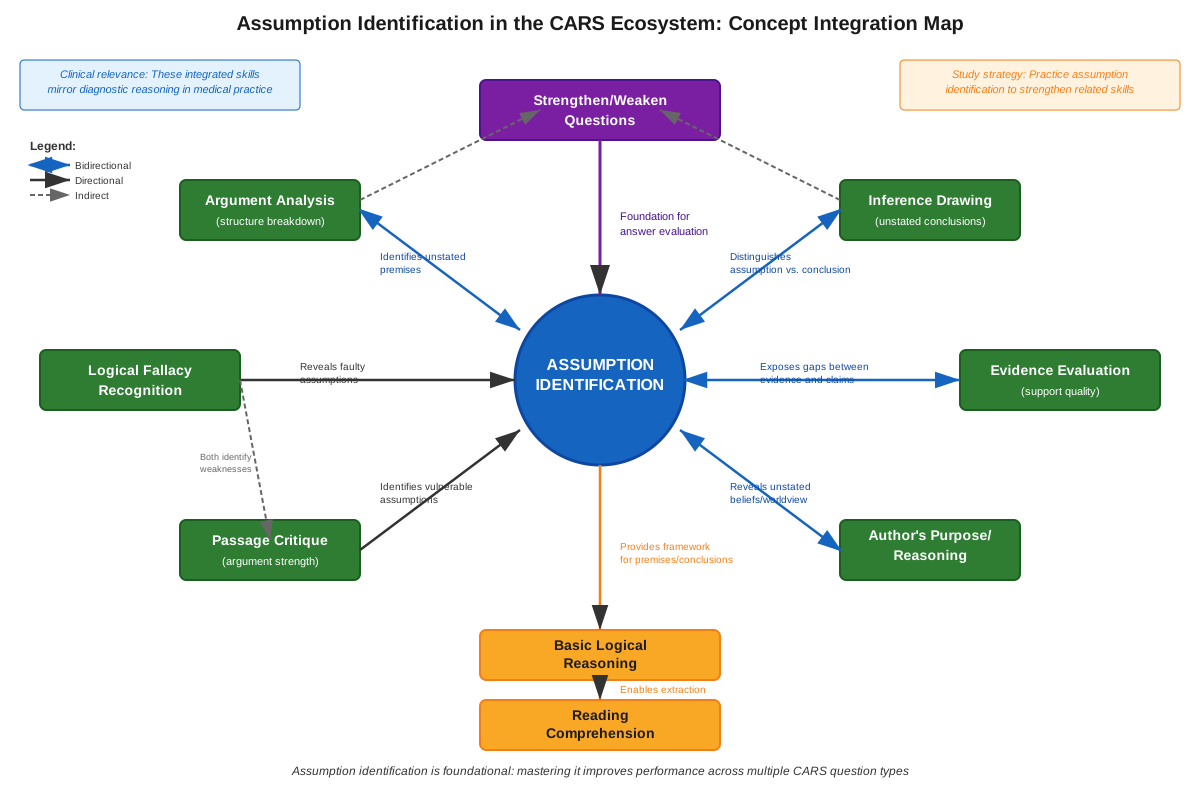
Within the broader framework of CARS Skills, assumption identification connects intimately with argument analysis, inference drawing, and logical reasoning. It serves as the foundation for evaluating argument strength, recognizing logical fallacies, and understanding how authors construct persuasive discourse. Students who excel at identifying assumptions can more effectively tackle questions about argument structure, author reasoning, and passage critique—skills that collectively account for a significant portion of CARS questions and directly translate to the analytical demands of medical education and practice.
Learning Objectives
- [ ] Define assumption identification using accurate Critical Analysis and Reasoning Skills terminology
- [ ] Explain why assumption identification matters for the MCAT
- [ ] Apply assumption identification to exam-style questions
- [ ] Identify common mistakes related to assumption identification
- [ ] Connect assumption identification to related Critical Analysis and Reasoning Skills concepts
- [ ] Distinguish between necessary assumptions and sufficient assumptions in complex arguments
- [ ] Evaluate the strength of arguments by assessing the reasonableness of their underlying assumptions
- [ ] Recognize the difference between assumptions, inferences, and explicit statements in MCAT passages
Prerequisites
- Basic logical reasoning: Understanding of premises, conclusions, and argument structure is essential because assumptions function as unstated premises that bridge evidence to conclusions
- Reading comprehension fundamentals: Ability to identify main ideas, supporting details, and author's purpose provides the foundation for recognizing what authors leave unsaid
- Familiarity with CARS passage types: Knowledge of humanities and social science discourse conventions helps anticipate where assumptions typically appear in argumentative writing
- Understanding of inference: Distinguishing between what is stated and what can be concluded prepares students to identify what must be assumed for arguments to succeed
Why This Topic Matters
In clinical practice, physicians constantly evaluate arguments from colleagues, research literature, and diagnostic reasoning chains. A cardiologist recommending a specific intervention assumes certain patient characteristics, risk factors, and treatment responses. A researcher concluding that a drug is effective assumes the study population represents the target demographic and that confounding variables were adequately controlled. Medical professionals who cannot identify these unstated premises risk accepting flawed reasoning, implementing inappropriate treatments, or misinterpreting evidence—potentially compromising patient care.
On the MCAT, assumption identification appears in approximately 15-20% of CARS questions, making it a medium-to-high yield topic that directly impacts scores. These questions typically present as "Which of the following is an assumption upon which the argument depends?" or "The author's reasoning requires which of the following to be true?" The AAMC consistently includes 2-4 assumption identification questions per CARS section, often embedded within passages discussing philosophical arguments, social policy debates, or historical analyses where authors build complex reasoning chains with multiple unstated premises.
Assumption identification questions appear most frequently in passages featuring: argumentative discourse where authors advocate for specific positions; comparative analyses where authors evaluate competing theories or approaches; causal reasoning where authors explain why phenomena occur; and prescriptive recommendations where authors suggest courses of action. Recognizing these passage types helps students anticipate when assumption identification skills will be tested and approach reading with heightened attention to logical gaps between evidence and conclusions.
Core Concepts
Defining Assumptions in CARS Context
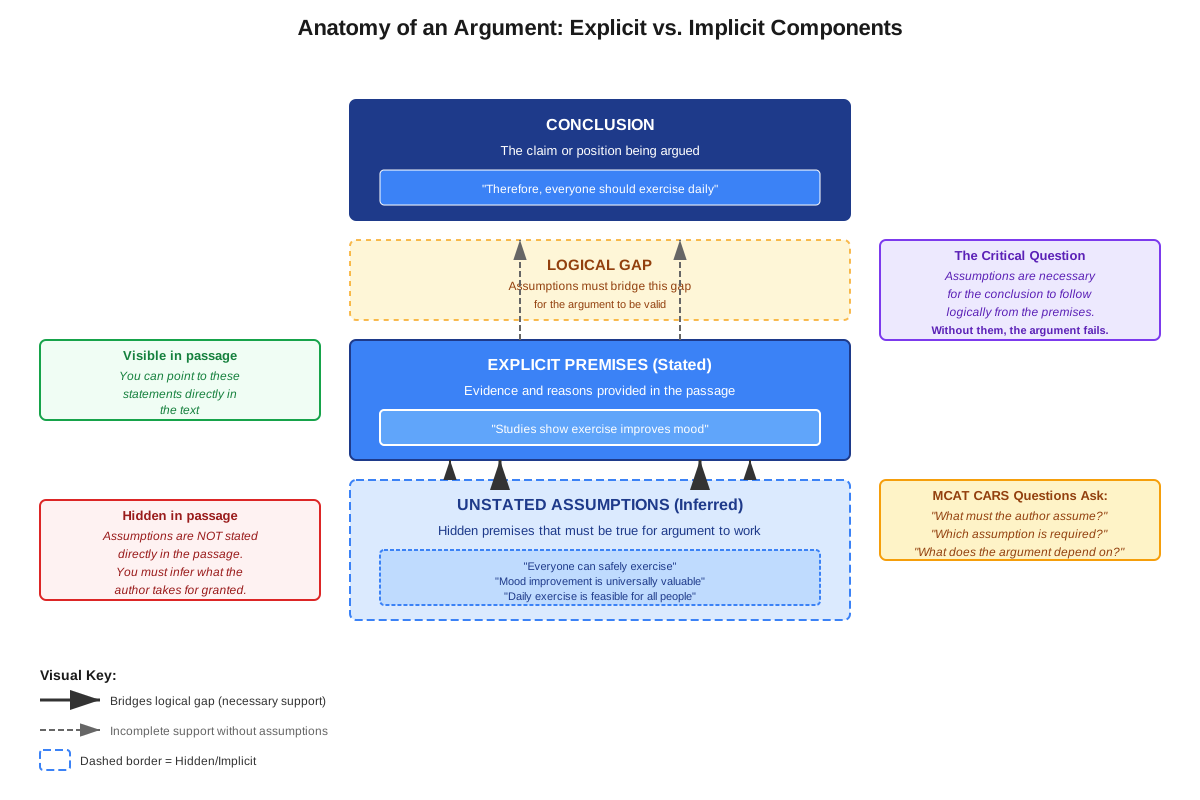
An assumption is an unstated premise that must be true for an argument's conclusion to follow logically from its stated evidence. Assumptions represent the invisible logical connective tissue linking what an author explicitly states to what they conclude. Unlike inferences (which readers draw from stated information) or implications (which follow from stated premises), assumptions are prerequisites for argument validity—if an assumption proves false, the argument collapses regardless of how strong the explicit evidence appears.
Assumption identification specifically refers to the analytical process of recognizing these unstated premises by examining the logical gap between evidence and conclusion, then determining what must be true to bridge that gap. This skill requires reverse-engineering arguments: starting with the conclusion, examining the stated premises, and identifying what additional information the author must believe true but has not explicitly stated.
Types of Assumptions
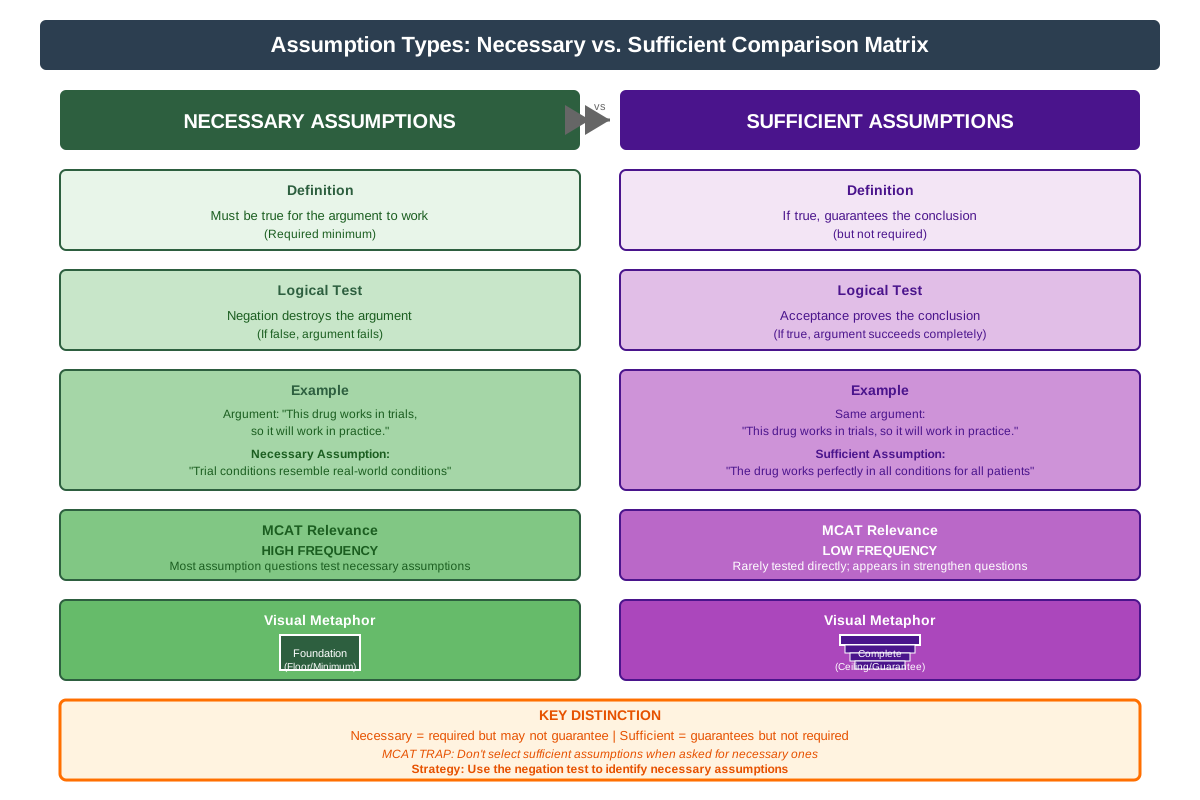
Necessary assumptions represent the minimum requirements for an argument to function—if a necessary assumption is false, the argument definitively fails. For example, if an author argues "We should increase funding for public transportation because it reduces traffic congestion," a necessary assumption is that increased funding will actually lead to improved or expanded public transportation services. Without this assumption, the causal chain breaks completely.
Sufficient assumptions, by contrast, guarantee the argument's conclusion if true, but the argument might succeed through other pathways even if the sufficient assumption is false. These assumptions are stronger than necessary—they provide more than the minimum required for the argument to work. On the MCAT, questions overwhelmingly focus on necessary assumptions because they test the ability to identify logical vulnerabilities.
The Assumption Identification Process
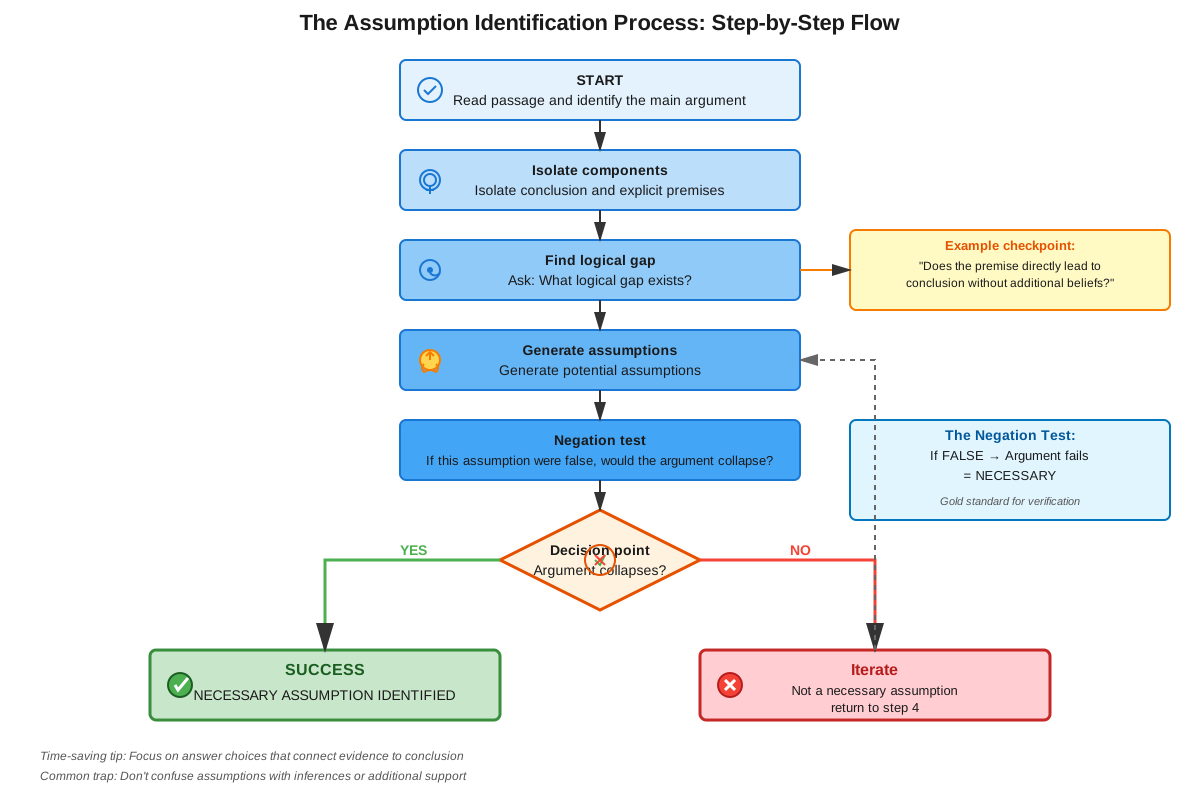
The systematic approach to assumption identification follows four steps:
- Identify the conclusion: Determine what the author is trying to prove or establish
- Catalog the evidence: List all explicitly stated premises supporting the conclusion
- Recognize the gap: Identify the logical space between evidence and conclusion—what's missing?
- Articulate the bridge: State what must be true to connect the evidence to the conclusion
Consider this argument: "The museum should extend evening hours because many working professionals cannot visit during current daytime-only hours." The conclusion is that the museum should extend evening hours. The stated evidence is that working professionals cannot visit during daytime hours. The gap involves several unstated connections: that working professionals want to visit the museum, that they would visit during evening hours if available, that the museum's mission includes serving working professionals, and that the benefits of extended hours outweigh the costs. Each represents an assumption upon which the argument depends.
Distinguishing Assumptions from Related Concepts
| Concept | Definition | Relationship to Text | Example |
|---|---|---|---|
| Assumption | Unstated premise required for argument validity | Not stated; must be true for logic to work | "This policy will succeed" assumes the policy can be implemented |
| Inference | Conclusion drawn from stated information | Not stated; follows logically from what is stated | From "Sales increased 20%," infer "The company performed well" |
| Implication | Consequence that follows from stated premises | Not stated; suggested by what is stated | "Funding was cut" implies "Some programs may be eliminated" |
| Explicit Statement | Directly stated information | Stated clearly in text | "The study included 500 participants" |
Common Assumption Categories in MCAT Passages
Causal assumptions appear when authors claim one thing causes another, assuming no alternative explanations exist and that correlation indicates causation. For instance, "Crime decreased after the new policy was implemented, so the policy reduced crime" assumes the policy caused the decrease rather than other factors like economic changes or demographic shifts.
Representativeness assumptions emerge when authors generalize from samples to populations, assuming the sample accurately represents the broader group. An argument citing a study of college students to make claims about all adults assumes college students are representative of the general adult population.
Feasibility assumptions underlie prescriptive arguments recommending actions, assuming the proposed solution is practically implementable. When an author argues "We should solve traffic congestion by building more subway lines," they assume the city has the financial resources, political will, and geographic conditions to construct subways.
Value assumptions support normative claims about what should be done, assuming certain priorities or ethical frameworks. An argument that "We should prioritize environmental protection over economic growth" assumes environmental protection is more valuable than economic development—a value judgment not everyone shares.
Recognizing Assumption Indicators
Certain argumentative structures signal likely assumptions. Comparative claims ("This approach is better than that approach") assume the comparison uses appropriate criteria and that no superior third option exists. Predictive statements ("This policy will improve outcomes") assume future conditions will resemble past conditions and that no interfering factors will emerge. Categorical statements ("All X are Y") assume no exceptions exist and that the categories are well-defined.
Scope shifts between premises and conclusions often reveal assumptions. If premises discuss a specific case but the conclusion generalizes broadly, the author assumes the specific case represents the general pattern. If premises establish correlation but the conclusion claims causation, the author assumes no confounding variables or reverse causation.
Concept Relationships
Assumption identification serves as the foundation for multiple advanced CARS skills. Argument evaluation depends on assumption identification because assessing argument strength requires determining whether unstated premises are reasonable. An argument with implausible assumptions is weak regardless of how compelling its stated evidence appears. This relationship flows: Assumption Identification → enables → Argument Evaluation → supports → Passage Critique.
The skill connects bidirectionally with inference drawing. While inferences represent conclusions readers draw from stated information, assumptions represent unstated premises authors rely upon. Both require reading between the lines, but in opposite directions: inferences move forward from stated premises to unstated conclusions, while assumption identification moves backward from stated conclusions to unstated premises. Mastering both creates comprehensive analytical capability: Stated Premises → (inference) → Unstated Conclusions and Unstated Premises (assumptions) → Stated Conclusions.
Logical reasoning provides the theoretical framework for assumption identification. Understanding argument structure, validity, and soundness enables systematic assumption recognition. Specifically, the concept of logical gaps directly manifests as assumptions—every gap between premises and conclusion represents an assumption that must be filled. This relationship is hierarchical: Logical Reasoning (parent concept) → contains → Argument Structure → reveals → Logical Gaps → manifest as → Assumptions.
Within the broader CARS Skills framework, assumption identification integrates with author reasoning analysis. Understanding why authors reach certain conclusions requires recognizing both what they state and what they assume. Authors' unstated assumptions often reveal their worldviews, biases, and theoretical commitments more clearly than their explicit statements. This connection enables deeper passage comprehension: Assumption Identification → reveals → Author's Unstated Beliefs → enhances → Understanding of Author's Reasoning.
High-Yield Facts
⭐ Assumptions are always unstated—if a premise appears explicitly in the passage, it cannot be an assumption by definition
⭐ Necessary assumptions, when negated, destroy the argument—this "negation test" helps identify correct answers
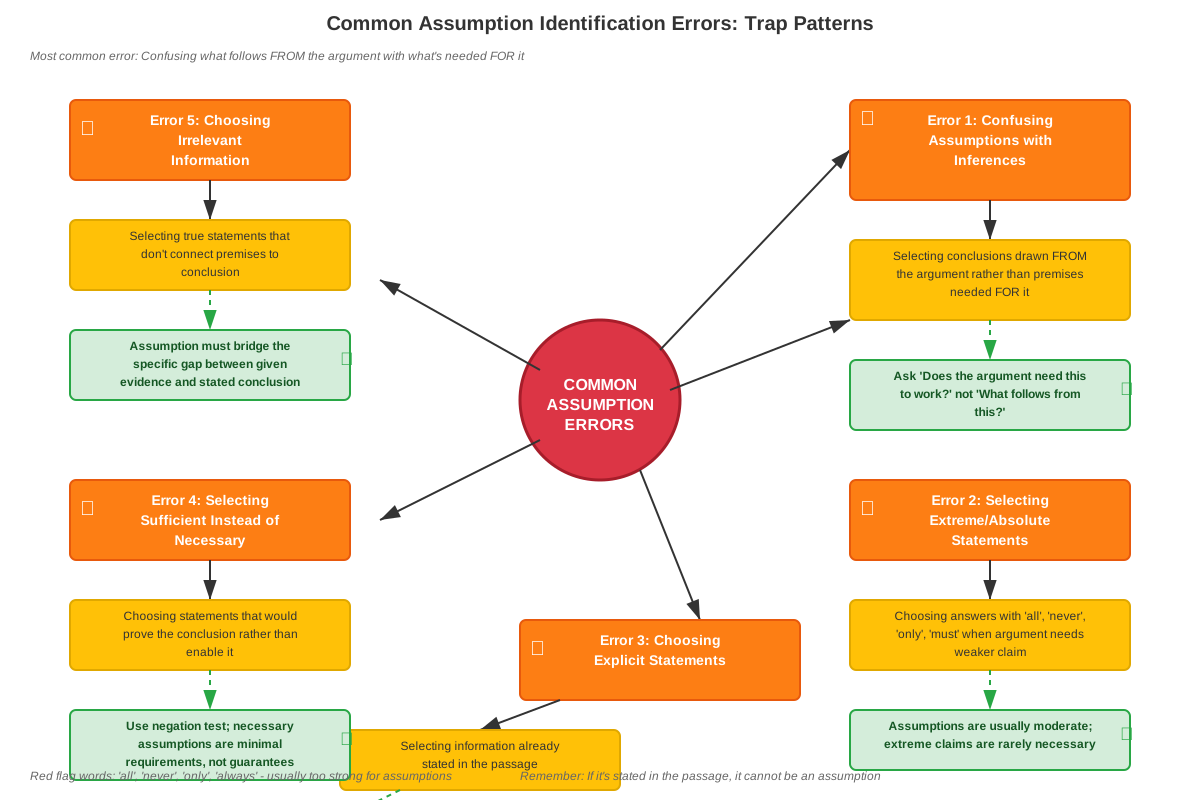
⭐ The most common wrong answers are inferences or implications rather than assumptions—they follow from the argument rather than supporting it
⭐ Assumptions bridge the gap between evidence and conclusion—they connect what is stated to what is concluded
⭐ Scope shifts between premises and conclusions always indicate assumptions—moving from specific to general or vice versa requires unstated premises
- Assumptions can be factual (about what is true) or value-based (about what matters or what should be prioritized)
- Multiple assumptions typically underlie complex arguments—identifying one doesn't mean others don't exist
- Extreme language in answer choices ("always," "never," "only") rarely represents necessary assumptions because arguments typically don't require such strong claims
- Assumptions about causation are among the most frequently tested on the MCAT CARS section
- The author need not consciously recognize their assumptions—they may be implicit in the author's reasoning framework
Quick check — test yourself on Assumption identification so far.
Try Flashcards →Common Misconceptions
Misconception: Assumptions are the same as inferences → Correction: Assumptions are unstated premises that support conclusions, while inferences are conclusions drawn from stated premises. Assumptions work backward (what must be true for this conclusion to follow?), while inferences work forward (what follows from these premises?). On the MCAT, confusing these concepts leads to selecting answer choices that represent logical consequences of the argument rather than logical prerequisites.
Misconception: If something is true in the real world, it must be an assumption of the argument → Correction: An assumption must be necessary for the specific argument's logic, not merely true in general. For example, "The sun rises in the east" might be true but is not an assumption of an argument about museum hours unless the argument's logic specifically depends on this fact. MCAT wrong answers often present true statements that are irrelevant to the argument's logical structure.
Misconception: Assumptions must be controversial or questionable → Correction: Assumptions can be entirely reasonable, widely accepted, or even obviously true—what makes them assumptions is that they're unstated yet necessary for the argument. An argument about improving education might assume students want to learn, which is reasonable but still an assumption. The MCAT tests whether students can identify logical structure, not whether they can find controversial claims.
Misconception: The longest or most complex answer choice is usually the assumption → Correction: Correct assumption answers are often simple, direct statements that clearly bridge the logical gap. Test-makers frequently use complex, convoluted wrong answers to distract from straightforward correct answers. Students should focus on logical necessity rather than answer length or sophistication.
Misconception: Every argument has only one assumption → Correction: Complex arguments typically rest on multiple assumptions at different logical levels. An argument might assume factual claims, causal relationships, value priorities, and feasibility constraints simultaneously. MCAT questions ask for "an assumption" or "which assumption," acknowledging that multiple assumptions exist—the correct answer is simply one that the argument genuinely requires.
Worked Examples
Example 1: Causal Argument Analysis
Passage excerpt: "After the city implemented a new recycling program, the amount of waste sent to landfills decreased by 30%. Therefore, the recycling program successfully reduced waste."
Question: Which of the following is an assumption upon which the argument depends?
Answer choices:
A) Recycling programs are more cost-effective than other waste reduction strategies
B) The decrease in landfill waste was not primarily due to factors other than the recycling program
C) Other cities should implement similar recycling programs
D) Residents were enthusiastic about participating in the recycling program
Step-by-step analysis:
- Identify the conclusion: The recycling program successfully reduced waste
- Catalog the evidence: Landfill waste decreased 30% after program implementation
- Recognize the gap: The evidence shows correlation (timing), but the conclusion claims causation (the program caused the reduction)
- Articulate the bridge: For this causal claim to work, alternative explanations must be ruled out
Evaluating each choice:
- Choice A discusses cost-effectiveness, which is irrelevant to whether the program reduced waste. This is a common distractor—true and related to recycling, but not necessary for this specific argument's logic.
- Choice B directly addresses the causal assumption. If the decrease was primarily due to other factors (economic recession reducing consumption, population decline, new waste-to-energy facility), then the recycling program didn't successfully reduce waste. Negation test: If other factors primarily caused the decrease, the argument fails. This is the correct answer.
- Choice C makes a prescriptive claim about what should happen elsewhere, which is an inference or implication of the argument's success, not an assumption the argument requires.
- Choice D addresses resident enthusiasm, which might affect participation rates but isn't necessary for the argument. The program could reduce waste even with reluctant participation if the system was well-designed.
Connection to learning objectives: This example demonstrates applying assumption identification to exam-style questions by systematically analyzing the logical gap between correlation and causation—one of the highest-yield assumption patterns on the MCAT.
Example 2: Prescriptive Argument Analysis
Passage excerpt: "Medical schools should increase emphasis on communication skills training because studies show that patients report higher satisfaction when physicians demonstrate strong communication abilities. Improved patient satisfaction leads to better health outcomes."
Question: The argument assumes which of the following?
Answer choices:
A) Current medical school curricula inadequately address communication skills
B) Communication skills cannot be learned outside formal training programs
C) Patient satisfaction is the most important measure of healthcare quality
D) All physicians currently lack adequate communication skills
Step-by-step analysis:
- Identify the conclusion: Medical schools should increase emphasis on communication skills training
- Catalog the evidence: (1) Strong physician communication correlates with patient satisfaction, (2) Patient satisfaction leads to better health outcomes
- Recognize the gap: The evidence establishes that communication skills are valuable, but the conclusion recommends increasing emphasis, which implies current emphasis is insufficient
- Articulate the bridge: For "should increase" to make sense, current levels must be inadequate
Evaluating each choice:
- Choice A addresses the feasibility assumption underlying the prescriptive recommendation. If current curricula already adequately address communication skills, increasing emphasis would be unnecessary or redundant. Negation test: If current curricula adequately address communication skills, why should schools increase emphasis? The argument fails. This is the correct answer.
- Choice B makes an extreme claim ("cannot be learned outside formal training") that the argument doesn't require. Communication skills might be learnable elsewhere, but formal training could still be valuable and worth increasing.
- Choice C elevates patient satisfaction to "most important," which is stronger than necessary. The argument only requires that patient satisfaction matters and connects to health outcomes, not that it's the single most important factor.
- Choice D uses extreme language ("all physicians") that the argument doesn't need. Even if many physicians have adequate skills, increasing training emphasis could still be valuable for those who don't or for continuous improvement.
Connection to learning objectives: This example illustrates identifying common mistakes (extreme language in wrong answers) and distinguishing necessary from sufficient assumptions (the argument needs current training to be inadequate, not for all physicians to lack skills).
Exam Strategy
When approaching assumption identification questions on the MCAT, begin by reading the question stem carefully to confirm it's asking for an assumption rather than an inference or implication. Trigger phrases include: "assumes," "depends on," "requires which of the following to be true," "presupposes," "takes for granted," and "relies on the idea that." These phrases signal that the correct answer will be an unstated premise necessary for the argument's logic.
The negation technique is the most powerful tool for assumption identification. Take each answer choice and negate it (make it false), then ask: "If this were false, would the argument fall apart?" If negating the statement destroys the argument, it's a necessary assumption. If the argument could still work, it's not necessary. Practice this technique systematically: for choice B in Example 1, negating "The decrease was not primarily due to other factors" gives "The decrease was primarily due to other factors," which completely undermines the conclusion that the recycling program reduced waste.
Process of elimination for assumption questions should target these common wrong answer types first:
- Inferences/implications: Statements that follow from the argument rather than supporting it (often correct-sounding but backward)
- Extreme statements: Claims using "always," "never," "only," "all," or "none" that are stronger than the argument requires
- Irrelevant truths: Statements that might be factually accurate but don't connect to the argument's logical structure
- Opposite direction: Statements about effects or consequences rather than prerequisites
Time allocation for assumption questions should be approximately 60-90 seconds. These questions require careful logical analysis but shouldn't consume excessive time. If stuck between two choices, apply the negation test to both—the choice whose negation more completely destroys the argument is correct. Avoid overthinking by inventing complex scenarios; focus on the direct logical connection between stated evidence and stated conclusion.
Exam Tip: When the passage presents a causal argument (X caused Y), immediately anticipate that assumption questions will test whether you recognize the author assumes no alternative causes exist. This pattern appears in 30-40% of assumption identification questions.
Watch for scope shifts as red flags indicating assumptions. If premises discuss "some" but the conclusion claims "most," the author assumes the sample is representative. If premises address correlation but the conclusion asserts causation, the author assumes no confounding variables. If premises describe past events but the conclusion predicts future outcomes, the author assumes conditions will remain similar.
Memory Techniques
BRIDGE mnemonic for the assumption identification process:
- Break down the argument (identify conclusion and premises)
- Recognize the gap between evidence and conclusion
- Identify what's unstated but necessary
- Determine if negating it destroys the argument
- Guard against inference/implication confusion
- Eliminate extreme and irrelevant answers
The "Invisible Support Beam" visualization: Picture an argument as a bridge spanning from evidence (one side) to conclusion (other side). Assumptions are the invisible support beams underneath—you can't see them, but without them, the bridge collapses. When reading passages, visualize these invisible beams and ask what must be holding up the logical structure.
SCAN acronym for common assumption categories:
- Scope (does the conclusion match the evidence's scope?)
- Causation (does correlation become causation?)
- Alternatives (are other explanations ruled out?)
- Necessity (what must be true for this to work?)
The Negation Chant: "Flip it and break it"—flip the statement to its opposite, and see if it breaks the argument. This rhythmic phrase helps remember the negation technique during high-pressure testing.
For distinguishing assumptions from inferences, remember: Assumptions are UNDER the argument (supporting from below), Inferences are OVER the argument (built on top). This spatial metaphor clarifies the directional difference between these commonly confused concepts.
Summary
Assumption identification represents a critical MCAT CARS skill requiring students to recognize unstated premises that bridge the logical gap between an argument's evidence and conclusion. Unlike inferences that readers draw from stated information, assumptions are prerequisites for argument validity—if false, they cause the entire argument to collapse. The systematic approach involves identifying the conclusion, cataloging stated evidence, recognizing logical gaps, and articulating what must be true to bridge those gaps. The negation test provides the most reliable method for confirming necessary assumptions: if negating a statement destroys the argument, it's a necessary assumption. Common assumption categories include causal assumptions (ruling out alternative explanations), representativeness assumptions (sample-to-population generalizations), feasibility assumptions (practical implementability), and value assumptions (ethical or priority frameworks). Students must distinguish assumptions from related concepts like inferences, implications, and explicit statements, while avoiding common wrong answers that present extreme claims, irrelevant truths, or logical consequences rather than logical prerequisites. Mastering this skill enables effective argument evaluation, enhances passage comprehension, and directly supports the analytical reasoning essential for medical practice.
Key Takeaways
- Assumptions are unstated premises necessary for an argument's conclusion to follow logically from its stated evidence—they bridge logical gaps
- The negation test definitively identifies necessary assumptions: if negating a statement destroys the argument, it's a necessary assumption
- Assumptions differ from inferences (which follow from stated premises) and implications (which are suggested by stated premises)—assumptions support arguments from below rather than building on top
- Common MCAT assumption patterns include causal assumptions, scope shifts, representativeness claims, and feasibility requirements for prescriptive arguments
- Wrong answers typically present inferences, extreme statements, irrelevant truths, or claims that are too strong to be necessary for the argument
- Approximately 15-20% of CARS questions test assumption identification, making it a medium-to-high yield topic requiring systematic practice
- Trigger phrases like "assumes," "depends on," "requires to be true," and "takes for granted" signal assumption identification questions
Related Topics
Argument Evaluation and Strengthening/Weakening: After identifying assumptions, the next skill involves assessing argument strength and determining what information would strengthen or weaken arguments. Mastering assumption identification provides the foundation for these advanced skills because recognizing unstated premises enables targeted evaluation of argument vulnerabilities.
Logical Fallacies: Understanding common reasoning errors (ad hominem, false dichotomy, slippery slope) builds on assumption identification because many fallacies involve problematic unstated premises. Recognizing that an argument assumes only two options exist (false dichotomy) or that a chain of events will inevitably occur (slippery slope) requires the same analytical skills as assumption identification.
Author's Purpose and Perspective: Identifying assumptions reveals authors' underlying beliefs, values, and theoretical commitments, which illuminates their purpose and perspective. An author who assumes economic growth should be prioritized over environmental protection reveals value commitments that inform their entire argumentative approach.
Inference Questions: While distinct from assumptions, inference questions require similar skills of reading between the lines and understanding logical relationships. Students who master assumption identification typically excel at inference questions because both require recognizing unstated information—assumptions work backward to prerequisites, while inferences work forward to consequences.
Practice CTA
Now that you've mastered the core concepts of assumption identification, it's time to cement your understanding through active practice. Attempt the practice questions and flashcards specifically designed to test these skills in MCAT-style formats. Focus particularly on applying the negation test and distinguishing assumptions from inferences—these are the highest-yield skills that will directly improve your CARS score. Remember that assumption identification is a learnable skill that improves dramatically with deliberate practice. Each question you analyze strengthens your ability to recognize logical gaps and unstated premises, building the analytical foundation essential for MCAT success and future medical practice. You've got this!
Sign up free to keep reading
Create a free AnvayaPrep account to finish this MCAT guide on Assumption identification — plus flashcards and practice questions.