Overview
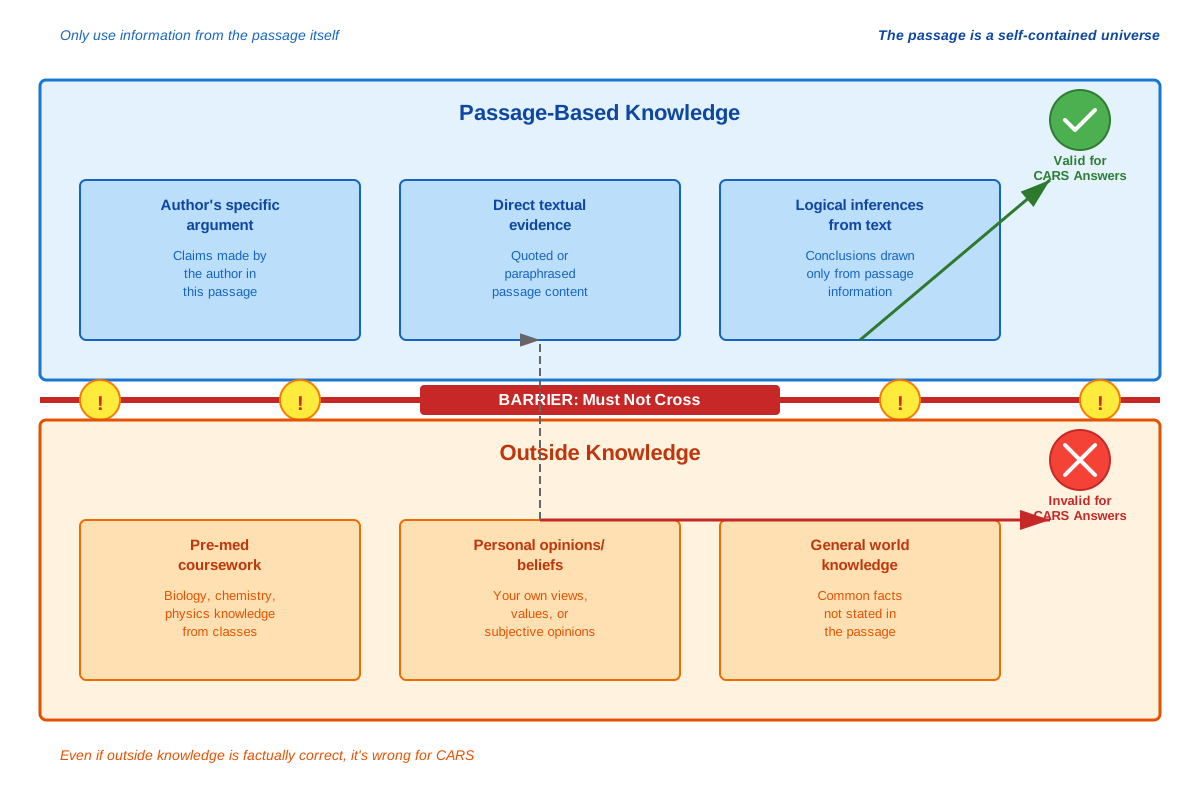
Avoiding outside knowledge is one of the most critical yet counterintuitive skills tested in the Critical Analysis and Reasoning Skills (CARS) section of the MCAT. Unlike the science sections where students are expected to apply their content knowledge, CARS demands that test-takers answer questions based solely on the information presented in the passage—even when that information contradicts what they know to be true from their coursework or general knowledge. This skill requires students to temporarily suspend their own expertise and opinions, treating each passage as a self-contained universe of information.
The CARS section deliberately includes passages on topics ranging from philosophy and art history to economics and literary criticism—subjects where pre-existing knowledge could actually become a liability. When students import their own understanding of a topic rather than carefully reading what the author actually argues, they frequently select answer choices that are factually correct in the real world but unsupported by or contradictory to the passage text. This represents one of the most common reasons high-performing students struggle with CARS despite excelling in content-heavy sections.
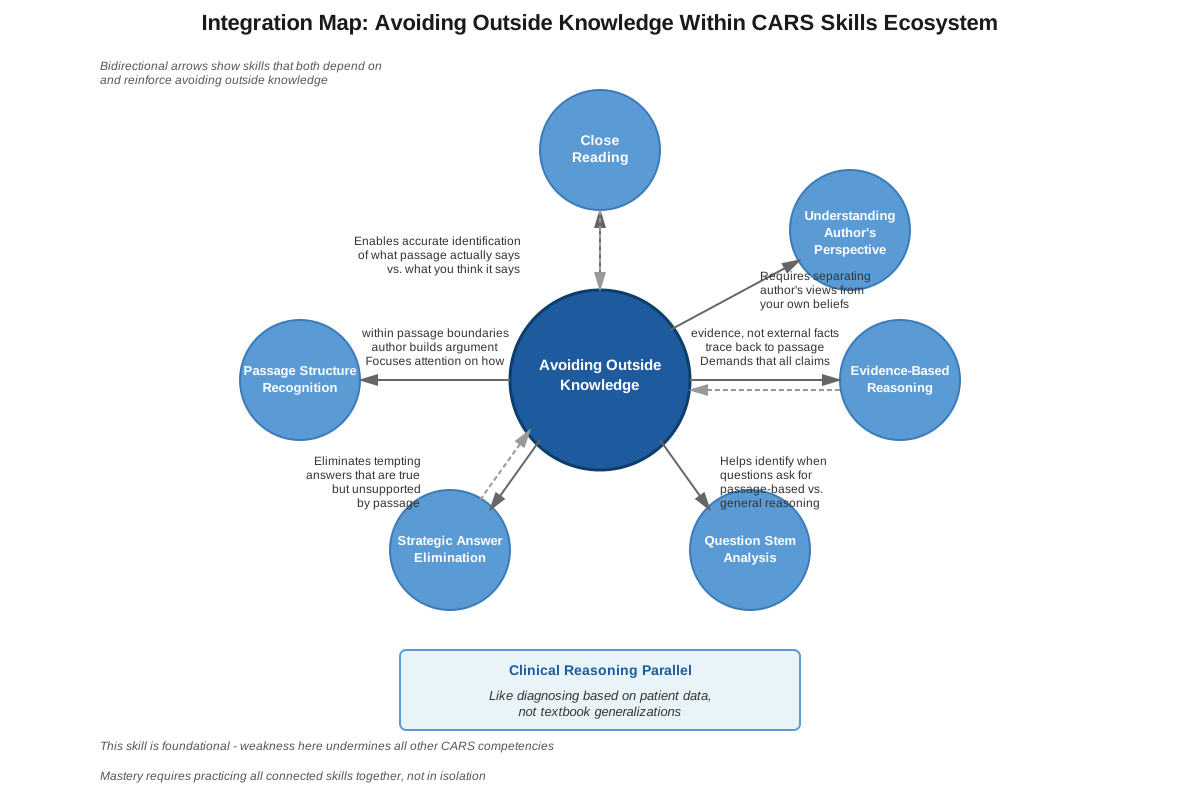
Mastering the art of avoiding outside knowledge connects directly to other essential CARS Skills including close reading, identifying author perspective, and distinguishing between what is stated, implied, and assumed. This skill forms the foundation for evidence-based reasoning—the same type of analytical thinking required in medical practice, where physicians must base diagnoses on patient-specific data rather than general assumptions. For the MCAT, this topic is not merely a test-taking strategy but a fundamental shift in how students approach reading comprehension under timed conditions.
Learning Objectives
- [ ] Define Avoiding outside knowledge using accurate Critical Analysis and Reasoning Skills terminology
- [ ] Explain why Avoiding outside knowledge matters for the MCAT
- [ ] Apply Avoiding outside knowledge to exam-style questions
- [ ] Identify common mistakes related to Avoiding outside knowledge
- [ ] Connect Avoiding outside knowledge to related Critical Analysis and Reasoning Skills concepts
- [ ] Distinguish between passage-supported claims and real-world knowledge
- [ ] Recognize trigger phrases that indicate when outside knowledge is being inappropriately applied
- [ ] Develop a systematic approach to verify that answer choices are grounded in passage evidence
Prerequisites
- Basic reading comprehension: Understanding main ideas, supporting details, and paragraph structure is essential because avoiding outside knowledge requires first accurately identifying what the passage actually says
- Familiarity with MCAT question types: Knowing the difference between Foundation, Reasoning Within the Text, and Reasoning Beyond the Text questions helps determine when limited outside knowledge might be appropriate versus when strict passage adherence is required
- Understanding of evidence-based reasoning: Recognizing the difference between claims and evidence enables students to trace answer choices back to specific textual support
Why This Topic Matters
In clinical practice, physicians must distinguish between general medical knowledge and patient-specific information. A treatment that works for most patients may be contraindicated for a particular individual based on their unique history and presentation. Similarly, CARS passages present specific arguments that may deviate from conventional wisdom, and the ability to analyze what is actually written—rather than what "should" be true—mirrors the evidence-based reasoning essential to medical decision-making.
Avoiding outside knowledge appears in approximately 70-80% of CARS questions, making it one of the highest-yield skills for this section. Questions that test this skill often include answer choices that are factually accurate in the real world but are either not mentioned in the passage or directly contradict the author's argument. The AAMC consistently reports that students who struggle with CARS most frequently cite "overthinking" questions—a symptom of importing outside knowledge rather than staying grounded in the text.
This topic appears most commonly in passages about unfamiliar subjects (obscure philosophical movements, niche historical events, or specialized artistic techniques) where the MCAT deliberately tests whether students can analyze arguments without relying on prior knowledge. It also appears in passages about familiar topics (evolution, psychology, economics) where the author presents a contrarian or nuanced view that differs from textbook explanations. Questions may ask about the author's perspective, the passage's main argument, or what can be reasonably inferred—all requiring strict adherence to textual evidence.
Core Concepts
Definition and Scope of Avoiding Outside Knowledge
Avoiding outside knowledge in Critical Analysis and Reasoning Skills refers to the disciplined practice of answering questions based exclusively on information provided in or reasonably inferable from the passage, rather than relying on pre-existing knowledge, personal opinions, or real-world facts. This does not mean students should pretend to be ignorant; rather, they must treat the passage as the sole authoritative source for that particular question set, even when the passage presents information that seems incomplete, biased, or factually questionable.
The scope of this skill extends beyond simply "not using outside information." It requires active verification that each answer choice can be traced back to specific sentences or paragraphs in the passage. When evaluating answer choices, students must ask: "Where exactly does the passage say or suggest this?" If no clear textual evidence exists, the answer choice is incorrect regardless of its real-world accuracy.
The Passage as a Self-Contained Universe
Each CARS passage creates its own logical universe with its own rules, definitions, and relationships. Within this universe, the author's claims are treated as true for the purpose of answering questions, even if those claims would be disputed by experts in the field. For example, if a passage argues that "abstract expressionism represented a complete break from all previous artistic traditions," students must work within that framework when answering questions—even if their art history coursework taught them about clear continuities between abstract expressionism and earlier movements.
This concept requires students to adopt a temporary suspension of disbelief. The passage might present a simplified version of a complex topic, omit important nuances, or even contain factual errors. None of this matters for CARS purposes. The test is not evaluating whether students can fact-check the passage; it is assessing whether they can analyze the argument as presented.
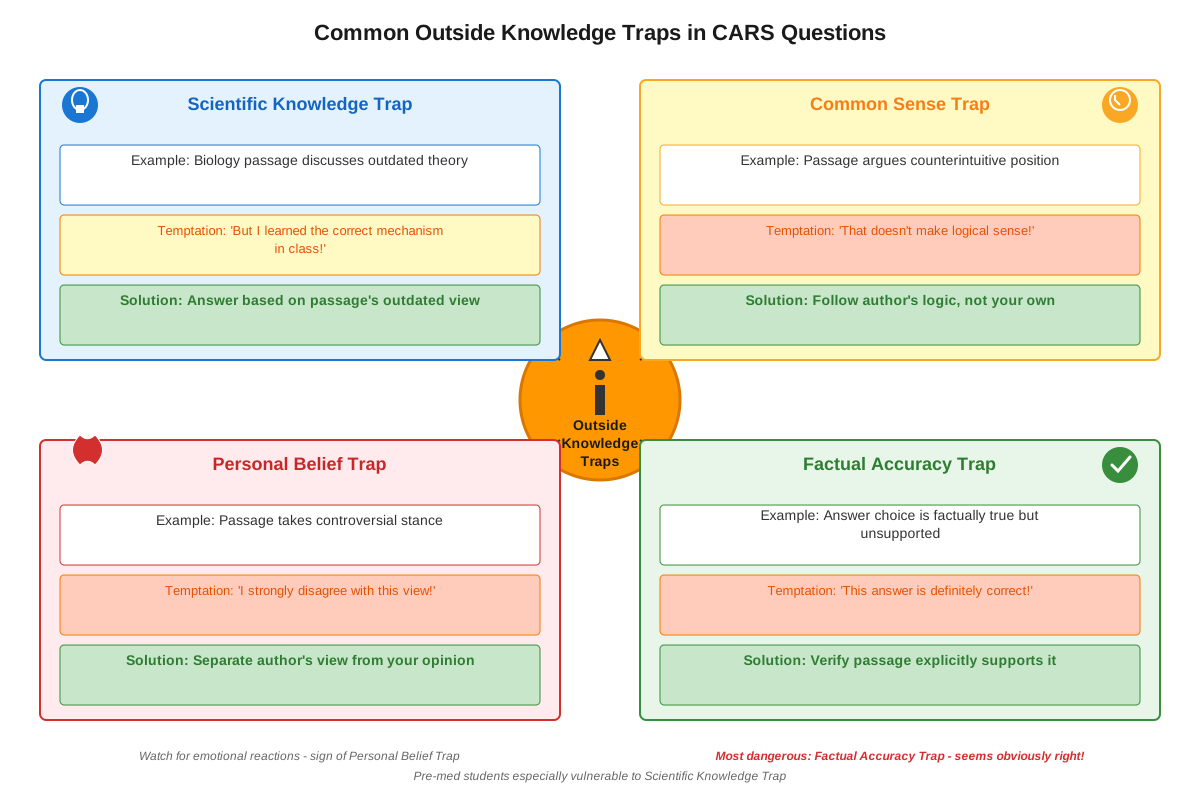
Types of Outside Knowledge and Their Risks
| Type of Outside Knowledge | Example | Risk to CARS Performance |
|---|---|---|
| Academic content knowledge | Biology concepts, historical facts, psychological theories | Leads to selecting answers that are scientifically accurate but not passage-supported |
| Personal experience | "I volunteered at a hospital and saw..." | Creates bias toward answers that match personal observations rather than author's argument |
| Common sense assumptions | "Obviously, people prefer happiness to suffering" | Causes students to fill gaps in passage logic with unstated assumptions |
| Current events | Recent political developments, news stories | Tempts students to interpret passages through contemporary lens rather than author's specific context |
| Cultural or ethical beliefs | Personal values about right and wrong | Leads to selecting answers that align with personal morality rather than passage content |
The Evidence-Tracing Process
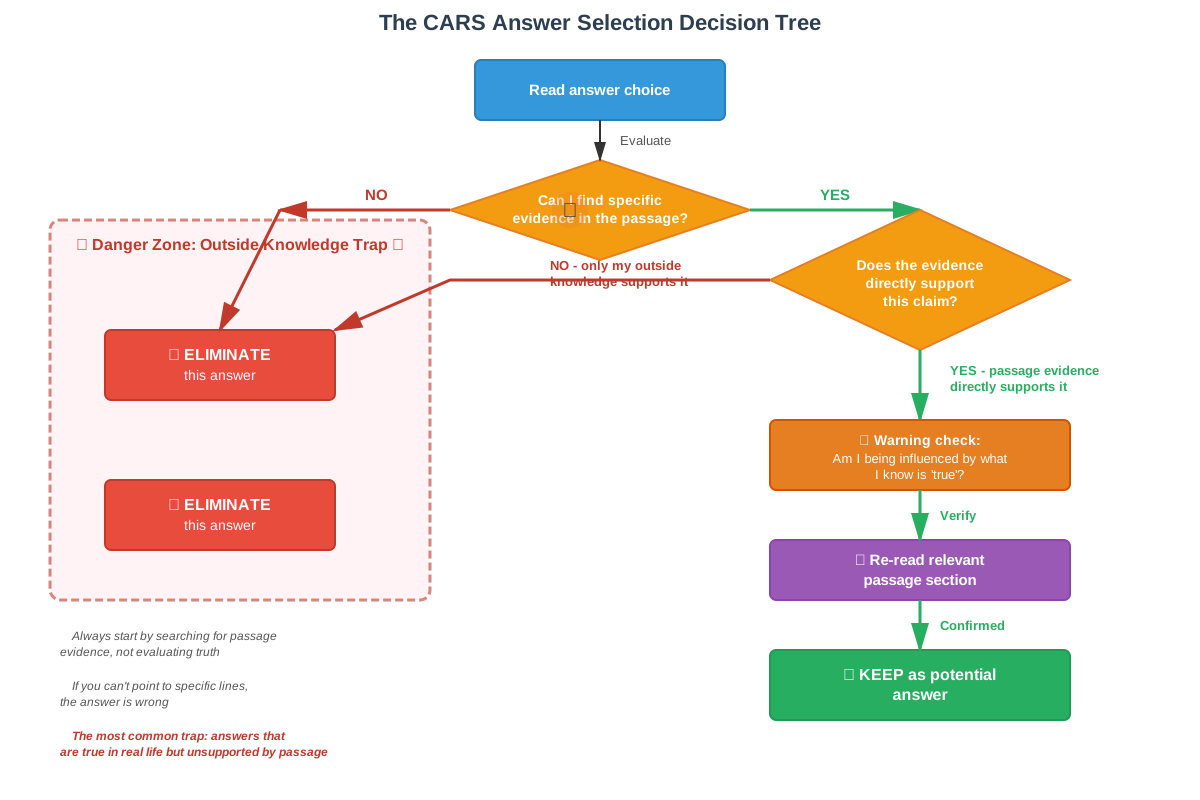
To successfully avoid outside knowledge, students must develop a systematic evidence-tracing process:
- Read the question stem carefully to identify exactly what is being asked
- Predict an answer based on passage content before looking at choices
- Evaluate each answer choice by asking "Where does the passage say this?"
- Locate specific textual evidence (paragraph and approximate location)
- Verify the logical connection between the evidence and the answer choice
- Eliminate choices that require assumptions not supported by the passage
This process transforms CARS from a subjective reading exercise into an objective evidence-matching task. The correct answer will always have a clear "paper trail" back to the passage, while incorrect answers will require students to make logical leaps or import outside information.
Distinguishing Passage-Supported from Real-World Truth
A critical skill within Avoiding outside knowledge MCAT questions is distinguishing between three categories of statements:
Passage-supported statements: Explicitly stated or clearly implied by the text. These can serve as correct answers even if they are oversimplifications or controversial in the real world.
Passage-neutral statements: Neither supported nor contradicted by the passage. These are incorrect answers even if they are true in reality, because they require outside knowledge to evaluate.
Passage-contradicted statements: Directly opposed to what the author argues. These are incorrect answers even if they represent mainstream expert consensus.
For example, if a passage argues that "social media has fundamentally altered human communication patterns," the following statements would fall into different categories:
- Passage-supported: "The author believes communication has changed due to social media"
- Passage-neutral: "Social media companies generate revenue through advertising" (true, but not discussed)
- Passage-contradicted: "Human communication patterns have remained essentially unchanged" (contradicts passage even if some scholars might argue this)
When Limited Outside Knowledge Is Appropriate
While the general rule is to avoid outside knowledge, CARS does assume basic vocabulary, common logical relationships, and fundamental reasoning skills. Students are expected to know:
- Standard English vocabulary at a college-educated level
- Basic logical operators (if/then, cause/effect, necessary/sufficient conditions)
- Common cultural references that would be familiar to a general educated audience
- Fundamental reasoning principles (contradictions cannot both be true, evidence should support claims)
The key distinction is that this "allowable" knowledge consists of tools for understanding language and logic, not content-specific information about the passage topic. Students should use their vocabulary to understand what "hegemony" means, but not their political science knowledge to evaluate whether the passage's claims about hegemony are accurate.
Concept Relationships
The skill of Avoiding outside knowledge serves as a foundational element that connects to virtually every other CARS Skills competency. It directly enables close reading because students must pay careful attention to exactly what the text says rather than skimming and filling gaps with assumptions. This close reading then supports identifying author perspective, as students learn to distinguish between what the author argues versus what they personally believe or what experts in the field might say.
Avoiding outside knowledge → enables → Evidence-based reasoning → supports → Eliminating wrong answers
This skill also connects to distinguishing main ideas from supporting details because students must trace answer choices back to specific passage content, requiring them to understand the passage's organizational structure. When students can identify which paragraphs contain main arguments versus examples, they can more efficiently locate evidence to support or refute answer choices.
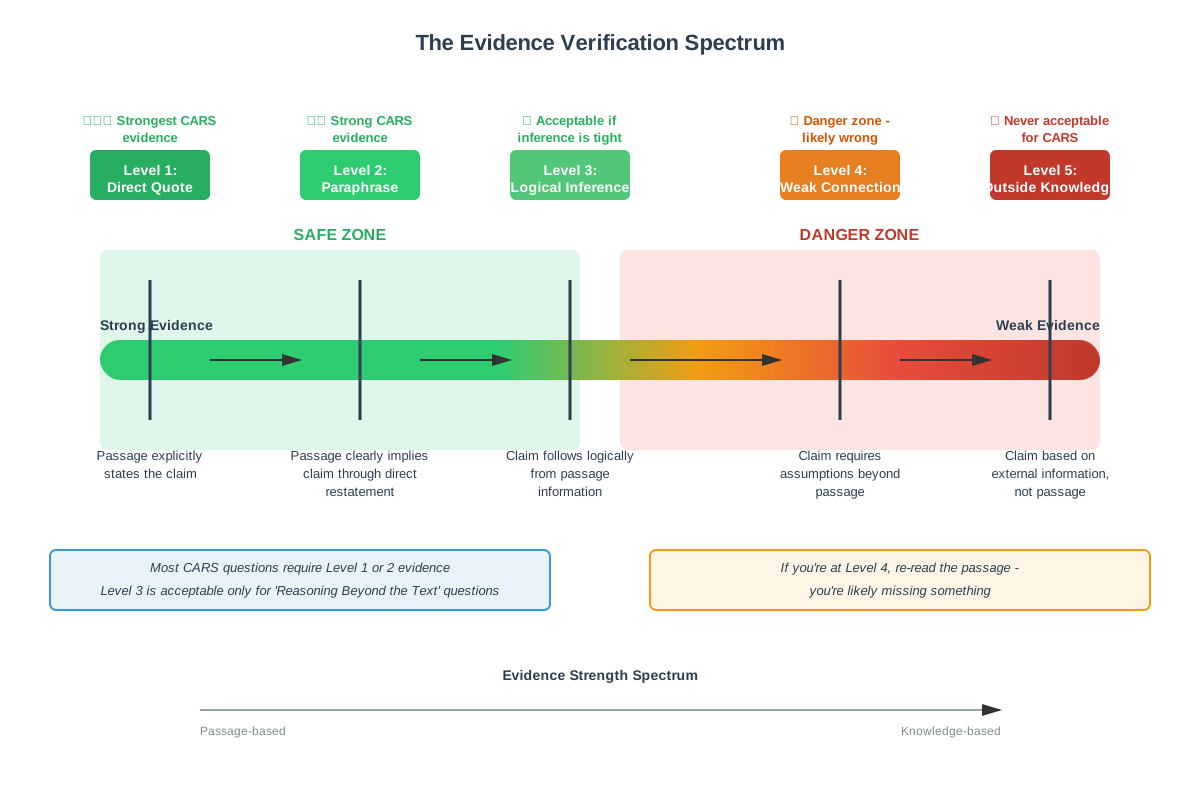
The relationship to inference questions is particularly nuanced. While inference questions ask students to go "beyond" the text, they still require avoiding outside knowledge. Valid inferences must be firmly grounded in passage evidence and represent small logical steps from what is stated. The difference between a valid inference and outside knowledge is that inferences follow necessarily from passage content, while outside knowledge introduces new information not suggested by the text.
Finally, this skill connects to time management in CARS. Students who effectively avoid outside knowledge spend less time debating answer choices because they can quickly verify whether textual evidence exists. Those who import outside knowledge often find themselves torn between multiple "reasonable" answers, wasting precious time on questions that should be straightforward evidence-matching exercises.
High-Yield Facts
⭐ The correct answer to a CARS question will always have specific, identifiable textual support in the passage—if you cannot point to where the passage says or suggests something, it is not the right answer.
⭐ Answer choices that are factually true in the real world but not mentioned or implied in the passage are incorrect—real-world accuracy is irrelevant to CARS.
⭐ When you find yourself thinking "but I know that..." or "obviously..." while evaluating an answer choice, you are likely importing outside knowledge.
⭐ Passages on familiar topics are often more dangerous than passages on unfamiliar topics because pre-existing knowledge creates stronger temptation to rely on what you already know.
⭐ The phrase "according to the passage" in a question stem is an explicit reminder to avoid outside knowledge, but this principle applies to all CARS questions even when not explicitly stated.
- Approximately 30-40% of wrong answer choices in CARS are designed to be factually accurate but passage-unsupported, making them attractive traps for students who use outside knowledge.
- Questions asking about "the author's perspective" or "the passage suggests" are particularly vulnerable to outside knowledge errors because students substitute their own views or general expert consensus.
- Extreme answer choices (using words like "always," "never," "only") are not automatically wrong in CARS—they are correct when the passage makes extreme claims, regardless of real-world nuance.
- The MCAT deliberately includes passages with controversial, outdated, or minority viewpoints to test whether students can analyze arguments they disagree with or know to be disputed.
- Eliminating answer choices that require "one additional assumption" beyond passage content is a reliable strategy, as correct answers should follow directly from the text without logical gaps.
Quick check — test yourself on Avoiding outside knowledge so far.
Try Flashcards →Common Misconceptions
Misconception: CARS passages always present accurate, balanced information that reflects expert consensus in the field.
Correction: CARS passages often present one-sided arguments, controversial positions, or simplified versions of complex topics. The test assesses analytical skills, not factual knowledge, so passages may be deliberately biased or incomplete. Students must analyze what is written, not correct it.
Misconception: If an answer choice is factually true, it cannot be wrong.
Correction: Real-world truth is irrelevant in CARS. An answer choice can be 100% accurate according to scientific consensus but still be incorrect if the passage does not support it. The only "truth" that matters is what the passage states or implies.
Misconception: Inference questions allow students to bring in outside knowledge because they ask you to go "beyond" the text.
Correction: Inference questions require small logical steps firmly grounded in passage evidence. They ask students to identify what must be true or is most likely true based on passage content, not to speculate using outside information. Valid inferences are tightly constrained by textual support.
Misconception: Avoiding outside knowledge means pretending to be ignorant or not using vocabulary knowledge.
Correction: Students should use their vocabulary, logical reasoning skills, and general reading comprehension abilities. "Outside knowledge" refers specifically to content information about the passage topic—historical facts, scientific concepts, philosophical positions—not to the linguistic and analytical tools needed to understand any text.
Misconception: If the passage doesn't explicitly state something, it cannot be the correct answer.
Correction: Correct answers can be implied or suggested by the passage rather than explicitly stated. The key is that the implication must be strongly supported by textual evidence and require minimal logical steps. The distinction is between reasonable inferences (supported) and speculative leaps (outside knowledge).
Misconception: Passages on unfamiliar topics are harder because you lack background knowledge.
Correction: Passages on unfamiliar topics are often easier for avoiding outside knowledge because students have no choice but to rely on the text. Familiar topics are more dangerous because pre-existing knowledge creates interference, making it harder to focus on what the passage actually says versus what you already know.
Worked Examples
Example 1: Philosophy Passage on Free Will
Passage excerpt: "Determinism holds that every event, including human cognition and behavior, is causally determined by prior events. If determinism is true, then the concept of moral responsibility becomes problematic, as individuals cannot be held accountable for actions that were inevitable given prior causes. Some philosophers attempt to reconcile free will with determinism through compatibilism, arguing that freedom consists not in being uncaused, but in acting according to one's desires without external constraint."
Question: According to the passage, compatibilists would most likely agree with which of the following statements?
A) Human actions are not causally determined by prior events.
B) Moral responsibility requires that actions be uncaused.
C) Freedom can exist even if all events are causally determined.
D) External constraints are necessary for genuine freedom.
Student's initial thought process (with outside knowledge): "I remember from my philosophy class that compatibilism is a sophisticated position that involves hierarchical desires and second-order volitions. The answer should reflect that complexity. Also, I know that most modern philosophers are compatibilists, so the answer should present compatibilism favorably..."
Correct approach (avoiding outside knowledge):
- Identify what the passage says about compatibilism: "freedom consists not in being uncaused, but in acting according to one's desires without external constraint"
- Evaluate each choice against passage evidence:
- Choice A: Contradicts the passage's definition of determinism, which compatibilists attempt to reconcile with free will
- Choice B: Directly contradicts the passage statement that compatibilists argue freedom does NOT require being uncaused
- Choice C: Matches the passage's description—compatibilists reconcile free will with determinism, meaning freedom can coexist with causal determination
- Choice D: Contradicts the passage statement about acting "without external constraint"
- Select the answer with clear textual support: Choice C is correct because it directly reflects the passage's explanation that compatibilists reconcile freedom with determinism.
Key lesson: The student's philosophy coursework might provide a more nuanced understanding of compatibilism, but the MCAT question only requires understanding what this specific passage says about the position. The correct answer is a straightforward restatement of passage content, not a demonstration of philosophical expertise.
Example 2: Art History Passage on Impressionism
Passage excerpt: "Critics initially dismissed Impressionist paintings as unfinished sketches, objecting to the visible brushstrokes and lack of fine detail. However, the Impressionists deliberately chose this technique to capture fleeting moments and the play of light, prioritizing immediate sensory experience over academic precision. Their work represented a radical departure from the carefully polished canvases favored by the French Academy."
Question: The passage suggests that the Impressionists' technique was:
A) An unfortunate result of inadequate training in academic methods
B) A conscious artistic choice that served specific aesthetic goals
C) Eventually refined to meet academic standards of finish
D) Less technically sophisticated than traditional academic painting
Student's initial thought process (with outside knowledge): "I know that Impressionists were actually highly trained artists who had studied academic techniques. Monet attended the studio of Charles Gleyre, and Renoir was trained in porcelain painting. So choice A is definitely wrong because they had adequate training. Choice D is also wrong because Impressionist technique is actually very sophisticated, just different from academic painting..."
Correct approach (avoiding outside knowledge):
- Identify relevant passage information:
- "deliberately chose this technique"
- "to capture fleeting moments and the play of light"
- "prioritizing immediate sensory experience over academic precision"
- Evaluate choices based solely on passage evidence:
- Choice A: Contradicts "deliberately chose"—the passage indicates intentionality, not inadequacy
- Choice B: Directly supported by "deliberately chose this technique to capture..." showing conscious choice for aesthetic purposes
- Choice C: Not mentioned; passage says nothing about later refinement
- Choice D: Passage does not compare technical sophistication, only different priorities
- Verify the answer: Choice B restates the passage's clear indication that the technique was deliberate and goal-oriented.
Key lesson: While the student's art history knowledge correctly identifies that Impressionists were well-trained, this information is irrelevant. The passage provides clear evidence about deliberate choice, making B the obvious answer. Time spent considering outside knowledge about training or technical sophistication is wasted time that could be used on other questions.
Exam Strategy
Approaching CARS Questions with Outside Knowledge Awareness
When beginning each CARS passage, consciously note whether the topic is familiar or unfamiliar. For familiar topics, write a brief reminder at the top of your scratch paper: "PASSAGE ONLY" or "NO OUTSIDE INFO." This physical reminder helps counteract the automatic activation of prior knowledge.
Trigger Words That Signal Outside Knowledge Traps
Watch for these phrases in answer choices, which often indicate outside knowledge traps:
- "It is well known that..."
- "Experts agree that..."
- "Obviously..." or "Clearly..."
- "In reality..." or "In fact..."
- "Most people believe..."
These phrases often introduce information that may be true in the real world but is not supported by the passage. When you see these triggers, immediately ask: "Does the passage actually say this, or am I assuming it?"
The Evidence-Location Strategy
For each answer choice you are seriously considering, physically point to or note the paragraph number where the supporting evidence appears. If you cannot identify a specific location, the answer is likely wrong. This physical action slows down your thinking just enough to prevent automatic selection of "reasonable-sounding" answers that lack textual support.
Process of Elimination Specific to Outside Knowledge
Eliminate answer choices in this order:
- First pass: Remove choices that directly contradict the passage
- Second pass: Remove choices that are passage-neutral (neither supported nor contradicted)
- Third pass: Between remaining choices, select the one with the most specific, direct textual support
This systematic approach prevents the common error of eliminating the correct answer because it seems "too simple" while keeping an incorrect answer that seems "more sophisticated" based on outside knowledge.
Time Allocation Advice
Do not spend more than 10-15 seconds per answer choice searching for textual support. If you cannot quickly identify where the passage supports an answer, it is likely wrong. Students who import outside knowledge often spend 60-90 seconds debating between two answers, both of which "seem reasonable." This time drain is unsustainable across 9 passages. Trust the evidence-location strategy and move on.
Memory Techniques
The PASSAGE Acronym
Passage is the sole source
Avoid assumptions
Specific evidence required
Suspend personal beliefs
Answer must be traceable
Ground choices in text
Eliminate unsupported options
Visualization Strategy: The Courtroom
Imagine you are a lawyer who must prove your answer choice to a judge. The only evidence you can present is direct quotes from the passage. If you cannot build a convincing case using only passage quotes, you do not have sufficient evidence. This visualization helps students recognize when they are relying on "common knowledge" rather than textual proof.
The "Where Does It Say That?" Mantra
Before selecting any answer, silently ask yourself: "Where does it say that?" This simple question, repeated consistently, builds the habit of evidence-verification and prevents automatic selection of answers that "sound right" based on outside knowledge.
The Bubble Technique
Imagine each passage exists in a bubble, completely isolated from the outside world. Everything you need to answer questions is inside the bubble. Your outside knowledge exists outside the bubble and cannot penetrate. This spatial metaphor helps students mentally separate passage content from prior knowledge.
Summary
Avoiding outside knowledge is the foundational skill for CARS success, requiring students to answer questions based exclusively on passage content rather than pre-existing knowledge, personal beliefs, or real-world facts. This counterintuitive approach treats each passage as a self-contained universe where the author's claims are accepted as true for analytical purposes, even when those claims are controversial, simplified, or contradicted by expert consensus. Students must develop systematic evidence-tracing habits, verifying that every answer choice has specific textual support and eliminating options that are factually accurate but passage-unsupported. The skill connects directly to close reading, author perspective identification, and evidence-based reasoning—all essential for medical practice where patient-specific data must take precedence over general assumptions. Mastering this skill transforms CARS from a subjective interpretation exercise into an objective evidence-matching task, dramatically improving both accuracy and efficiency.
Key Takeaways
- The correct answer to every CARS question has specific, identifiable textual support—if you cannot point to where the passage says or suggests something, it is wrong
- Real-world accuracy is irrelevant; answer choices can be factually true but incorrect if the passage does not support them
- Passages on familiar topics are often more dangerous than unfamiliar ones because prior knowledge creates interference
- Valid inferences must be firmly grounded in passage evidence and require only small logical steps, not speculative leaps
- Systematic evidence-location for each answer choice prevents time-wasting debates between "reasonable-sounding" options
- The phrase "according to the passage" explicitly signals the need to avoid outside knowledge, but this principle applies to all CARS questions
- Developing the habit of asking "Where does it say that?" before selecting any answer is the single most effective strategy for avoiding outside knowledge errors
Related Topics
Close Reading and Textual Analysis: Mastering the avoidance of outside knowledge naturally leads to developing stronger close reading skills, as students learn to pay attention to precise wording, qualifiers, and the specific claims authors make rather than general topic areas.
Author Perspective and Tone: Once students can reliably distinguish passage content from outside knowledge, they can more accurately identify what the author believes versus what other viewpoints might hold, enabling sophisticated analysis of perspective and rhetorical strategy.
Evidence-Based Reasoning in Science Passages: The same principle of grounding conclusions in provided evidence applies to MCAT science sections, where students must base answers on experimental data and passage information rather than memorized content knowledge alone.
Inference and Implication Questions: After mastering the avoidance of outside knowledge, students can tackle the nuanced skill of making valid inferences—small logical steps firmly supported by passage evidence—without crossing the line into speculation.
Practice CTA
Now that you understand the critical skill of avoiding outside knowledge, it is time to put this knowledge into practice. Attempt the practice questions and flashcards associated with this topic, paying special attention to identifying where in the passage each correct answer is supported. Challenge yourself to articulate the specific textual evidence for your answer choice before confirming your selection. Remember: every CARS question is ultimately an evidence-matching exercise. The more you practice systematic evidence-location, the more automatic this skill becomes, freeing your mental energy for the genuinely challenging analytical work the MCAT requires. You have the tools—now build the habits that will carry you to CARS success.
Sign up free to keep reading
Create a free AnvayaPrep account to finish this MCAT guide on Avoiding outside knowledge — plus flashcards and practice questions.