Overview
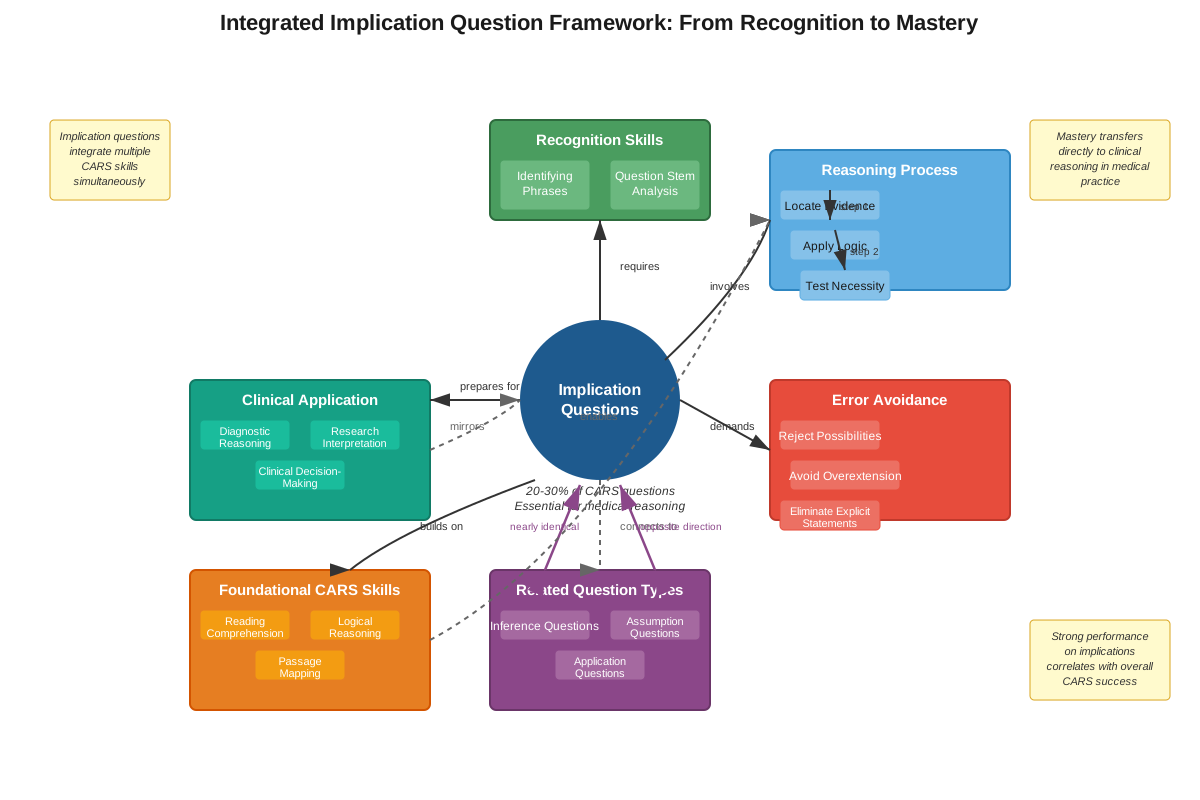
Implication questions represent one of the most challenging and frequently tested question types within the Critical Analysis and Reasoning Skills (CARS) section of the MCAT. These questions require test-takers to extend the author's explicit arguments beyond what is directly stated in the passage, identifying logical consequences, probable outcomes, or unstated assumptions that necessarily follow from the presented information. Unlike straightforward comprehension questions that ask "what does the passage say?", implication questions MCAT items demand that students answer "what must be true based on what the passage says?" This distinction makes them particularly demanding, as they test both reading comprehension and logical reasoning simultaneously.
The ability to identify implications is fundamental to medical practice and scientific reasoning. Physicians must regularly extrapolate from patient presentations to probable diagnoses, from research findings to clinical applications, and from established principles to novel situations. The MCAT tests this skill extensively because it reflects the type of reasoning essential for success in medical school and clinical practice. Implication questions Critical Analysis and Reasoning Skills typically account for 20-30% of CARS questions, making them one of the most common question types students will encounter on test day.
Within the broader framework of CARS Skills, implication questions connect directly to other reasoning tasks including inference, assumption identification, and application questions. They build upon foundational comprehension skills while requiring higher-order thinking that mirrors the analytical demands of medical education. Mastering implication questions strengthens overall CARS performance by developing the logical reasoning abilities that underpin success across all question types in this section.
Learning Objectives
- [ ] Define Implication questions using accurate Critical Analysis and Reasoning Skills terminology
- [ ] Explain why Implication questions matters for the MCAT
- [ ] Apply Implication questions to exam-style questions
- [ ] Identify common mistakes related to Implication questions
- [ ] Connect Implication questions to related Critical Analysis and Reasoning Skills concepts
- [ ] Distinguish between valid implications and unsupported extrapolations in CARS passages
- [ ] Evaluate answer choices for logical necessity versus mere possibility
- [ ] Construct a systematic approach for identifying textual evidence that supports implications
Prerequisites
- Basic reading comprehension: Understanding explicit statements in complex passages is necessary before identifying what those statements imply
- Logical reasoning fundamentals: Recognizing valid argument structures helps distinguish necessary implications from invalid conclusions
- Passage mapping skills: The ability to track main ideas, supporting details, and authorial tone provides the foundation for identifying what follows logically
- Question stem analysis: Understanding what different CARS question types ask enables proper identification of implication questions
Why This Topic Matters
In clinical practice, physicians constantly work with implications. When a patient presents with specific symptoms, the physician must consider what those symptoms imply about underlying pathology. When research demonstrates a particular mechanism, clinicians must understand what that implies for treatment approaches. This same reasoning process—moving from stated information to unstated but necessary conclusions—forms the core of implication questions on the MCAT.
Statistically, implication questions appear in approximately 4-6 questions per CARS section, representing roughly 20-30% of the 53 questions. They appear across all passage types—humanities, social sciences, and natural sciences adapted for CARS—and at all difficulty levels. The AAMC consistently includes these questions because they effectively discriminate between students who merely comprehend text and those who can reason analytically with textual information.
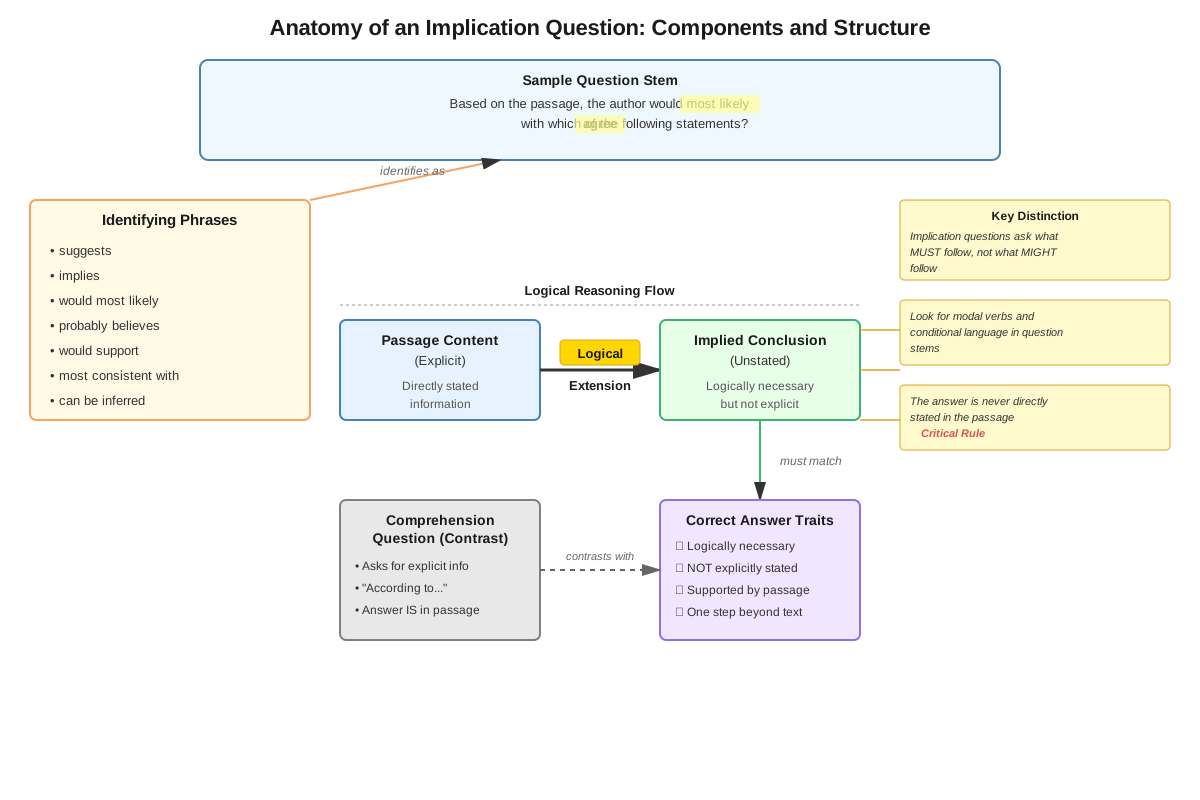
On the exam, implication questions typically appear with stems such as "The author's argument implies that...", "Based on the passage, it is reasonable to conclude that...", "The discussion in paragraph 3 suggests that...", or "If the author's claims are correct, then...". These questions may ask about implications of the entire passage, specific paragraphs, particular arguments, or even individual statements. They frequently test whether students can identify what an author would likely believe about scenarios not explicitly discussed in the passage, making them particularly challenging because the correct answer often addresses content that seems tangential to the passage's main focus.
Core Concepts
Defining Implication Questions
Implication questions are CARS question types that require test-takers to identify conclusions, consequences, or beliefs that logically follow from information stated in the passage, even though these conclusions are not explicitly stated by the author. The key distinguishing feature is that the correct answer must be necessarily true or highly probable based on passage content—not merely possible or consistent with the passage.
The term "implication" in logic refers to a relationship where if statement A is true, then statement B must also be true (or is very likely to be true). In CARS passages, authors rarely state every conclusion that follows from their arguments. Instead, they present premises, evidence, and explicit claims, expecting readers to recognize what these statements imply. Implication questions test whether students can complete this logical chain.
Types of Implications Tested
Logical implications represent conclusions that must be true if the passage statements are true. For example, if a passage states "All effective antibiotics disrupt bacterial cell wall synthesis, and Drug X is an effective antibiotic," the logical implication is that Drug X disrupts bacterial cell wall synthesis. These implications follow deductive reasoning patterns.
Probable implications are conclusions that are highly likely, though not absolutely certain, based on passage information. If an author argues that "economic incentives consistently drive corporate behavior" and discusses a specific corporation, the probable implication is that economic incentives drive that corporation's behavior, even if not explicitly stated.
Authorial belief implications require identifying what the author would likely think about scenarios, examples, or claims not directly discussed in the passage. These questions test whether students understand the author's perspective deeply enough to extrapolate it to new situations. For instance, if an author criticizes reductionist approaches throughout a passage, the implication is that the author would likely criticize a new reductionist theory even if that specific theory isn't mentioned.
Consequence implications ask what would happen if the author's claims are correct, or what must have happened for the author's claims to be true. These test understanding of cause-effect relationships and logical dependencies within the passage's argument structure.
Distinguishing Implications from Other Question Types
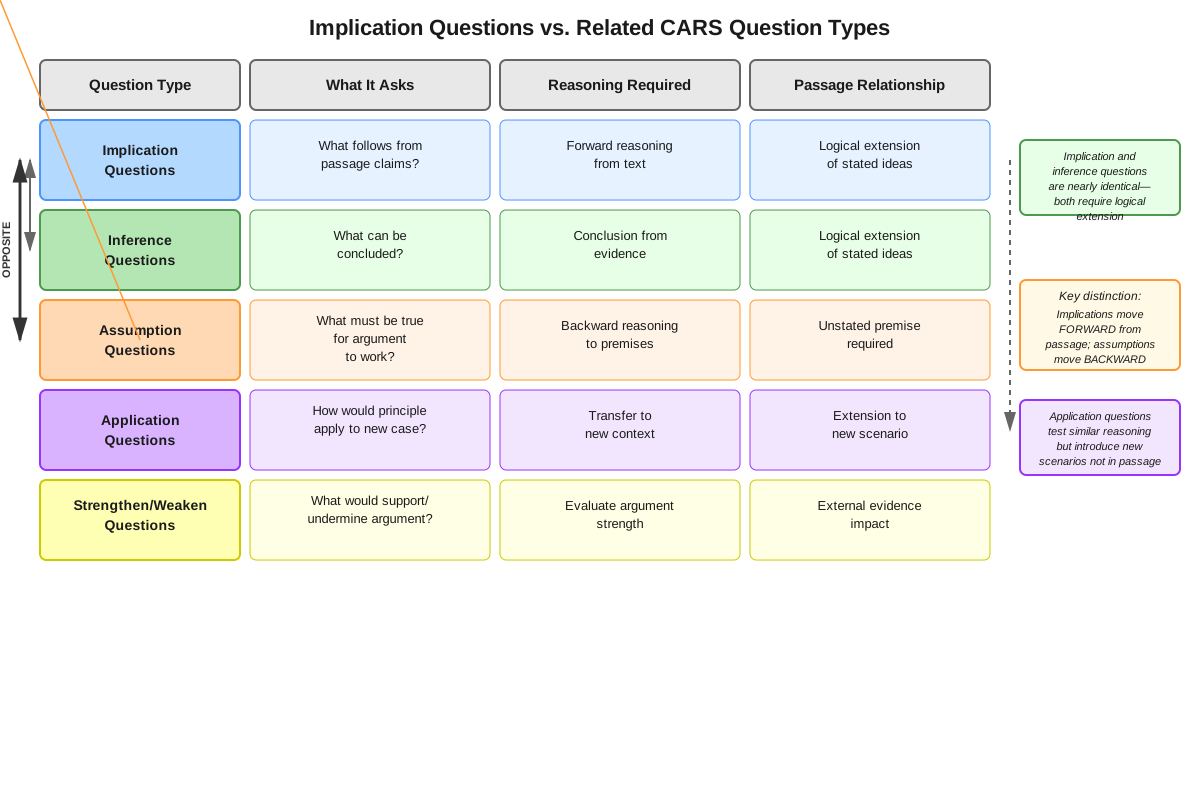
| Question Type | What It Tests | Relationship to Text |
|---|---|---|
| Comprehension | What the passage explicitly states | Direct restatement |
| Implication | What must/likely follows from passage | Logical extension |
| Inference | What can be reasonably concluded | Supported conclusion |
| Application | How passage ideas apply to new scenarios | Transfer of concepts |
| Assumption | What unstated premises support the argument | Logical foundation |
While these categories overlap, implication questions specifically focus on necessary or probable consequences of stated information. The correct answer to an implication question is not stated in the passage but is strongly supported by what is stated.
The Logical Chain in Implication Questions
Understanding implication questions requires recognizing the logical chain: Passage Statement → Logical Connection → Implied Conclusion. The passage provides the premise, the logical connection exists (but may not be explicitly stated), and the implied conclusion is what the question asks students to identify.
For example:
- Passage Statement: "The artist rejected all commercial commissions after 1950."
- Logical Connection: Rejecting commercial commissions means not accepting money for commissioned work.
- Implied Conclusion: The artist did not create any commissioned works for payment after 1950.
The middle step—the logical connection—is what students must supply through reasoning. Strong performance on implication questions requires both recognizing these logical connections and avoiding invalid logical leaps.
Evidence Requirements for Valid Implications
Valid implications must be grounded in specific passage evidence. The strongest wrong answers on implication questions are statements that seem reasonable or true in the real world but lack specific passage support. Students must discipline themselves to ask: "What specific passage content makes this implication necessary or highly probable?"
The evidence supporting an implication may come from:
- Direct statements that logically entail the conclusion
- Patterns of reasoning applied consistently throughout the passage
- The author's explicit perspective on analogous situations
- Cause-effect relationships established in the passage
- Definitions or characterizations that necessitate certain properties
The Necessity vs. Possibility Distinction
Perhaps the most critical concept for implication questions is distinguishing between what must be true (or is highly probable) versus what could be true (but isn't necessarily so). Many wrong answers are merely possible or consistent with the passage but not implied by it.
Consider this passage statement: "The study found that meditation reduced stress in 80% of participants."
- Valid implication: Some participants experienced stress reduction from meditation.
- Invalid implication: Meditation is the most effective stress reduction technique. (Possible, but not implied—no comparison to other techniques is made)
- Invalid implication: The remaining 20% experienced no benefits from meditation. (Possible, but not implied—they may have experienced benefits other than stress reduction)
This distinction requires careful, conservative reasoning. Students must resist the temptation to select answers that seem true or reasonable if they aren't specifically implied by passage content.
Concept Relationships
Implication questions build directly upon comprehension skills—students must first understand what the passage explicitly states before identifying what it implies. This foundational relationship means that struggles with implication questions often reflect underlying comprehension difficulties rather than reasoning deficits.
The relationship between implication questions and inference questions is particularly close. Both require reasoning beyond explicit statements, but implications focus specifically on necessary or probable consequences, while inferences may involve synthesizing multiple passage elements to reach supported conclusions. In practice, the AAMC sometimes uses these terms interchangeably, though "implication" typically signals a more direct logical relationship.
Assumption questions represent the inverse of implication questions. While implication questions ask "what follows from the passage?", assumption questions ask "what must be true for the passage argument to work?" Understanding this inverse relationship helps students recognize the logical structure of arguments: Assumptions → Stated Claims → Implications forms a complete logical chain.
Application questions extend implications further by asking how passage ideas would apply to entirely new scenarios. The reasoning process is similar—both require extending passage content beyond what's explicitly stated—but application questions typically involve more substantial conceptual transfer.
Within the passage itself, implications often connect to authorial tone and perspective. An author's attitude toward a subject strongly constrains what can be validly implied about their views on related subjects. Similarly, main idea and purpose questions relate to implications because understanding what the author is trying to accomplish helps identify what their arguments imply.
The relationship map: Comprehension → Implication → Application represents increasing levels of reasoning complexity, with Assumptions providing the logical foundation beneath comprehension.
High-Yield Facts
⭐ Implication questions ask what must be true or is highly probable based on passage content, not what could possibly be true
⭐ Approximately 20-30% of CARS questions are implication questions, making them one of the most common question types
⭐ The correct answer to an implication question is never explicitly stated in the passage but is strongly supported by what is stated
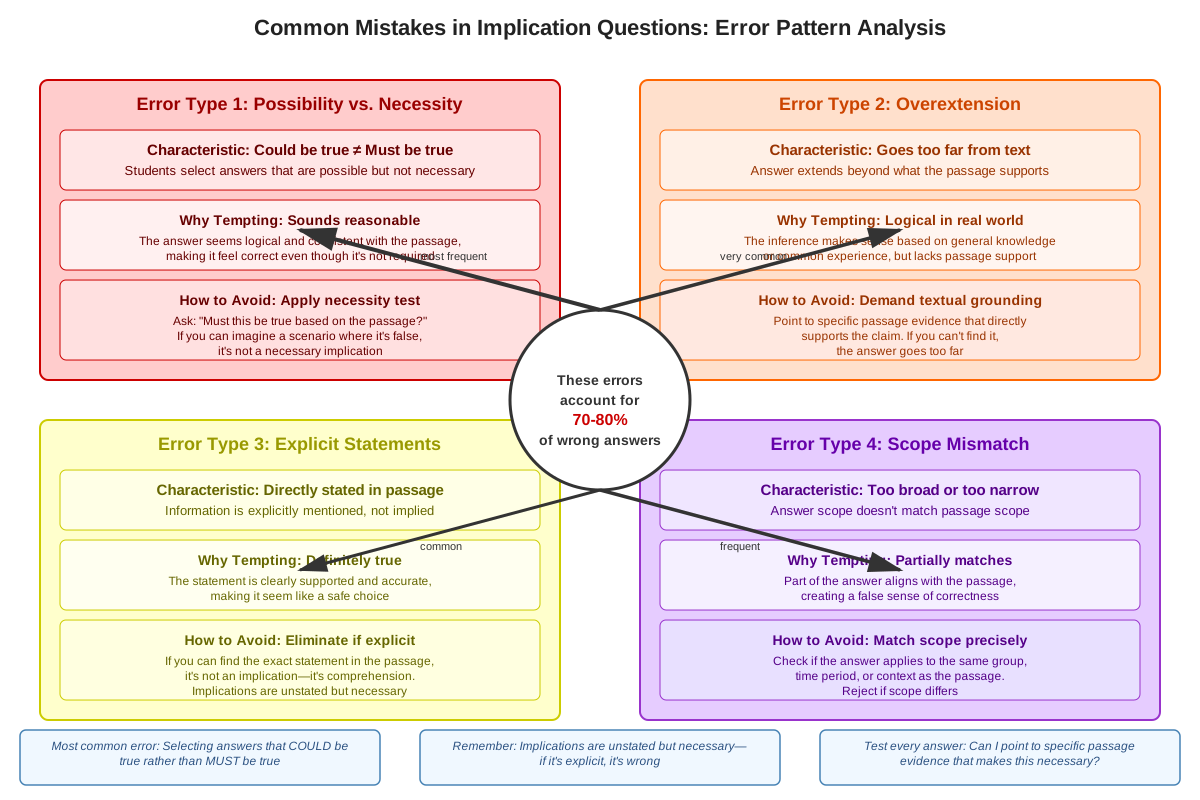
⭐ Common wrong answers include statements that are possible but not necessary, true in reality but not supported by the passage, or too extreme given passage evidence
⭐ Implication question stems typically include words like "implies," "suggests," "indicates," "would likely," or "it is reasonable to conclude"
- Valid implications must be grounded in specific, identifiable passage evidence, not general knowledge or assumptions
- Authors' consistent patterns of reasoning throughout a passage provide strong evidence for implications about their views on related topics
- Implication questions frequently test whether students can identify what an author would think about scenarios not explicitly discussed
- The logical chain for implications is: Passage Statement → Logical Connection → Implied Conclusion
- Distinguishing between "must be true" and "could be true" is the single most important skill for implication questions
- Extreme language in answer choices (always, never, only, all) is often incorrect unless the passage uses equally extreme language
- Implication questions may focus on the entire passage, specific paragraphs, particular arguments, or even individual sentences
- The strongest distractors on implication questions are statements that seem reasonable but lack specific passage support
- Time pressure often causes students to select answers that "feel right" rather than answers with clear textual support
- Practicing implication questions improves overall CARS performance because the reasoning skills transfer to other question types
Quick check — test yourself on Implication questions so far.
Try Flashcards →Common Misconceptions
Misconception: Implication questions ask for any statement that could possibly be true based on the passage.
Correction: Implication questions require identifying what must be true or is highly probable, not merely what is possible or consistent with the passage. Many wrong answers are possible interpretations that lack the logical necessity required for valid implications.
Misconception: If an answer choice is factually true in the real world, it's likely correct for an implication question.
Correction: Real-world truth is irrelevant for CARS questions. The correct answer must be implied by the specific passage content, regardless of whether it's true in reality. Students must base their reasoning exclusively on passage information.
Misconception: Implication questions and inference questions are completely different question types requiring different approaches.
Correction: These question types are closely related and often overlap. Both require reasoning beyond explicit statements, and the AAMC sometimes uses the terms interchangeably. The approach for both involves identifying conclusions strongly supported by passage evidence.
Misconception: The correct answer to an implication question will always closely paraphrase something from the passage.
Correction: While correct answers must be supported by passage content, they often address topics, scenarios, or applications not directly discussed in the passage. The key is that the passage content logically necessitates or strongly supports the conclusion, even if the conclusion discusses new material.
Misconception: Longer, more detailed answer choices are more likely to be correct because they show more sophisticated reasoning.
Correction: Answer length is not correlated with correctness. In fact, longer answers sometimes include additional unsupported claims that make them incorrect. Students should evaluate each answer based solely on whether it's implied by passage content, regardless of length or complexity.
Misconception: If multiple answer choices seem possible, the most interesting or insightful one is probably correct.
Correction: The correct answer is the one most strongly and directly supported by passage evidence, not the most interesting or creative interpretation. Students should resist the temptation to select answers that seem intellectually sophisticated if they lack clear textual support.
Worked Examples
Example 1: Authorial Belief Implication
Passage Excerpt: "Throughout the 19th century, Romantic poets consistently rejected the mechanistic worldview of Enlightenment thinkers, instead emphasizing emotion, intuition, and the sublime power of nature. Wordsworth, for instance, criticized the 'meddling intellect' that 'murders to dissect,' arguing that analytical approaches destroyed the very phenomena they sought to understand. This anti-reductionist stance permeated Romantic thought, from Coleridge's organic theory of imagination to Keats's celebration of 'negative capability'—the capacity to embrace uncertainty without 'irritable reaching after fact and reason.'"
Question: Based on the passage, the author would most likely agree with which of the following statements about a modern scientist who uses reductionist methods to study emotional responses?
A) The scientist's approach would be endorsed by Romantic poets as a way to understand emotion objectively.
B) The scientist's methodology reflects the mechanistic worldview that Romantic poets rejected.
C) The scientist is following Keats's principle of negative capability by embracing uncertainty.
D) The scientist's work represents a synthesis of Romantic and Enlightenment perspectives.
Analysis:
Step 1: Identify what the passage explicitly states about Romantic poets' views:
- They rejected mechanistic worldviews
- They criticized analytical/reductionist approaches
- They valued emotion and intuition over analysis
- They opposed "meddling intellect" that "murders to dissect"
Step 2: Identify what the question asks—an implication about what the author would think about a modern reductionist scientist studying emotions.
Step 3: Evaluate each answer:
Choice A: The passage explicitly states Romantics rejected mechanistic approaches and criticized analytical methods. They would not endorse reductionist methodology. This contradicts passage content. Eliminate.
Choice B: The passage establishes that Romantics rejected mechanistic worldviews and that reductionist methods represent this mechanistic approach. A modern scientist using reductionist methods would exemplify what Romantics opposed. This is a valid implication—the passage content logically necessitates this conclusion.
Choice C: Negative capability involves embracing uncertainty without reaching after fact and reason. A scientist using reductionist methods is doing the opposite—applying systematic analysis to understand phenomena. This contradicts the passage's characterization. Eliminate.
Choice D: Nothing in the passage suggests synthesis between these perspectives. The passage emphasizes opposition and rejection, not integration. This is possible but not implied. Eliminate.
Correct Answer: B
Key Reasoning: This question tests whether students can apply the author's description of Romantic views to a new scenario (modern reductionist science). The implication follows logically: if Romantics rejected mechanistic/reductionist approaches, then a modern reductionist scientist exemplifies what they rejected. The answer doesn't require the passage to explicitly discuss modern science—the logical connection is sufficient.
Example 2: Consequence Implication
Passage Excerpt: "The introduction of the printing press in 15th-century Europe fundamentally altered the relationship between authors and audiences. Prior to Gutenberg's innovation, manuscript production was laborious and expensive, limiting book ownership to wealthy elites and institutions. This scarcity meant that texts were primarily experienced communally—read aloud in groups—rather than individually. The printing press, by dramatically reducing production costs and increasing availability, enabled private, silent reading to become the dominant mode of textual engagement. This shift had profound implications for literacy, education, and the development of individualistic thought patterns characteristic of modernity."
Question: The passage information most strongly supports which of the following claims about pre-printing press literacy?
A) Literacy rates were higher before the printing press because communal reading encouraged broader participation.
B) The experience of texts before the printing press was more social than the experience after its introduction.
C) Wealthy elites were the only people who could read before the printing press was invented.
D) Silent reading was impossible before the printing press made books widely available.
Analysis:
Step 1: Identify relevant passage information:
- Pre-printing press: books scarce, expensive, limited to wealthy/institutions
- Pre-printing press: texts experienced communally, read aloud in groups
- Post-printing press: private, silent reading became dominant
- The shift had implications for literacy and individualistic thought
Step 2: Recognize this asks for an implication about the pre-printing press period based on the comparison the passage makes.
Step 3: Evaluate each answer:
Choice A: The passage doesn't provide information about literacy rates before versus after. While communal reading is mentioned, the passage doesn't imply this increased literacy rates. This makes an unsupported logical leap. Eliminate.
Choice B: The passage explicitly states that pre-printing press texts were "experienced communally—read aloud in groups" while post-printing press reading was "private, silent reading." The implication that pre-printing press reading was more social than post-printing press reading follows directly from this contrast. This is a valid implication.
Choice C: The passage states books were "limited to wealthy elites and institutions," but this doesn't mean only wealthy elites could read—institutions (monasteries, universities) included non-wealthy individuals who could read. This is too extreme. Eliminate.
Choice D: The passage states silent reading "became the dominant mode" after the printing press, not that it was impossible before. "Dominant" implies it existed before but became more common. This is too extreme. Eliminate.
Correct Answer: B
Key Reasoning: This question tests understanding of what the passage's comparison between pre- and post-printing press reading experiences implies. The correct answer requires recognizing that "communal" versus "private" reading directly implies a more social versus less social experience. Students must avoid extreme interpretations (choices C and D) and unsupported claims (choice A), focusing instead on what the passage information directly implies.
Exam Strategy
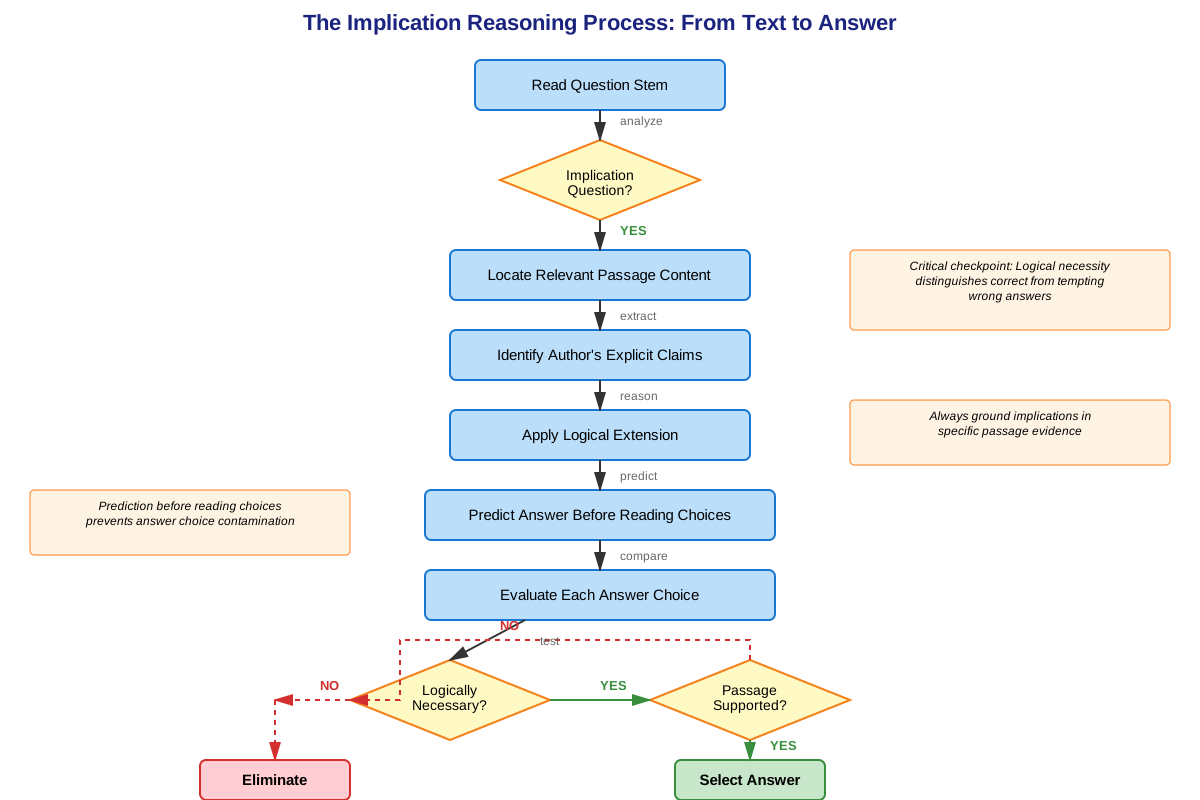
When approaching implication questions on the MCAT, begin by carefully reading the question stem to identify exactly what type of implication is being tested. Look for trigger words like "implies," "suggests," "indicates," "would likely agree," "it is reasonable to conclude," or "based on the passage." These signal that the correct answer won't be explicitly stated but must be logically supported.
Before looking at answer choices, return to the relevant passage section and identify the specific evidence that will support the implication. Ask yourself: "What does this passage content logically require or make highly probable?" Forming a prediction, even a general one, helps prevent being swayed by attractive but unsupported distractors.
Exam Tip: The most common error on implication questions is selecting answers that are possible or consistent with the passage but not actually implied by it. Always ask: "What specific passage content makes this answer necessary or highly probable?"
Use a systematic elimination process. First, eliminate answers that contradict passage content—these are never correct for implication questions. Second, eliminate answers that require information not provided in the passage or that make logical leaps unsupported by passage evidence. Third, eliminate answers that are too extreme unless the passage uses equally strong language.
For remaining answer choices, identify the specific passage evidence that would support each one. The correct answer will have clear, direct textual support even though it's not explicitly stated. If you cannot identify specific passage content that implies an answer choice, it's likely incorrect.
Watch for common wrong answer patterns:
- Real-world truth without passage support: Statements that are true in reality but not implied by this specific passage
- Possible but not necessary: Conclusions that could be true but aren't required by passage logic
- Too extreme: Answers using absolute language (always, never, only, all) when passage evidence is more moderate
- Scope shift: Answers that address topics beyond what the passage discusses or implies
- Reverse logic: Answers that confuse cause and effect or reverse the passage's logical relationships
Time management for implication questions should account for their difficulty. These questions typically require 60-90 seconds—slightly more than straightforward comprehension questions. Don't rush, but if you're stuck between two answers after careful analysis, mark the question and return if time permits. Your first instinct after careful reasoning is often correct.
Exam Tip: If two answers both seem supported, choose the one with more direct, explicit passage support. The correct answer to an implication question should feel like a natural, logical extension of passage content, not a creative interpretation.
Memory Techniques
IMPLY Acronym for evaluating answer choices:
- Identify specific passage evidence
- Must be true or highly probable (not just possible)
- Passage-based reasoning only (ignore outside knowledge)
- Logical connection to stated content
- Yes to "Does the passage require this conclusion?"
The Necessity Test: Before selecting an answer, ask "If the passage statements are true, must this answer be true?" If the answer is "not necessarily," eliminate that choice. This simple test prevents selecting merely possible answers.
The Evidence Anchor: Visualize each answer choice as a boat that must be anchored to specific passage content. If you cannot identify the anchor (specific textual evidence), the answer is drifting and likely incorrect.
Extreme Language Red Flag: Remember "NANO" for language that should trigger careful scrutiny:
- Never
- Always
- No (as in "no exceptions")
- Only
These words aren't automatically wrong, but they require strong passage support to be correct.
The Author's Voice: When questions ask what the author would think about new scenarios, imagine the author speaking in the same tone and perspective used throughout the passage. This helps maintain consistency with authorial viewpoint.
Summary
Implication questions represent a critical MCAT CARS question type that tests the ability to identify conclusions, consequences, and beliefs that logically follow from passage content without being explicitly stated. Success requires distinguishing between what must be true (or is highly probable) versus what merely could be true, grounding all reasoning in specific passage evidence, and avoiding the temptation to select answers that seem reasonable but lack textual support. These questions account for approximately 20-30% of CARS items and appear across all passage types and difficulty levels. The key skills involve recognizing logical chains from stated premises to implied conclusions, understanding authorial perspective deeply enough to extrapolate to new situations, and systematically eliminating answers that are possible but not necessary, too extreme, or based on outside knowledge rather than passage content. Mastering implication questions strengthens overall CARS performance by developing the analytical reasoning abilities essential for medical school success.
Key Takeaways
- Implication questions require identifying what must be true or is highly probable based on passage content, not what merely could be true or is consistent with the passage
- The correct answer is never explicitly stated but must be strongly supported by specific, identifiable passage evidence
- Common wrong answers include statements that are possible but not necessary, true in reality but not passage-supported, or too extreme given passage evidence
- Approximately 20-30% of CARS questions test implications, making this one of the most frequently encountered question types
- Success requires systematic evaluation: identify passage evidence, test for logical necessity, eliminate unsupported answers, and select the choice most directly implied by passage content
- The reasoning skills developed through implication questions—extending stated information to logical conclusions—directly parallel the clinical reasoning required in medical practice
- Distinguishing "must be true" from "could be true" is the single most important skill for mastering implication questions
Related Topics
Inference Questions: While closely related to implication questions, inference questions may involve synthesizing multiple passage elements to reach supported conclusions. Mastering implications provides the foundation for more complex inferential reasoning.
Assumption Questions: These represent the logical inverse of implication questions, asking what must be true for the passage argument to work rather than what follows from it. Understanding both strengthens overall argument analysis skills.
Application Questions: These extend implication reasoning further by asking how passage concepts apply to entirely new scenarios, requiring both understanding implications and transferring them to novel contexts.
Strengthen/Weaken Questions: These build on implication skills by asking what additional information would support or undermine passage arguments, requiring understanding of what the arguments imply about related evidence.
Main Idea and Purpose Questions: Understanding what a passage implies about the author's broader perspective helps identify main ideas and purposes, creating synergy between these question types.
Practice CTA
Now that you've mastered the core concepts of implication questions, it's time to put your knowledge into practice. Work through the accompanying practice questions, focusing on identifying specific passage evidence that supports each implication and distinguishing between necessary conclusions and merely possible interpretations. Use the flashcards to reinforce key concepts like the necessity versus possibility distinction and common wrong answer patterns. Remember: implication questions reward careful, conservative reasoning grounded in textual evidence. With systematic practice, you'll develop the analytical skills that not only improve your CARS score but also prepare you for the clinical reasoning essential to medical practice. You've got this!
Sign up free to keep reading
Create a free AnvayaPrep account to finish this MCAT guide on Implication questions — plus flashcards and practice questions.