Overview
Passage structure refers to the organizational framework and logical architecture that authors use to present ideas, arguments, and information in written texts. In the context of the MCAT, particularly within the Critical Analysis and Reasoning Skills (CARS) section, understanding passage structure is fundamental to efficiently extracting meaning, identifying main ideas, and answering questions accurately. Rather than reading passages word-by-word without strategic awareness, successful test-takers recognize that CARS passages follow predictable organizational patterns that signal the author's purpose, the relationship between ideas, and where key information resides.
The ability to quickly identify passage structure transforms reading from a passive activity into an active analytical process. When students recognize whether a passage follows a problem-solution format, presents multiple perspectives on a debate, or builds toward a thesis through progressive examples, they can anticipate where answers to questions will likely appear. This metacognitive awareness—thinking about how the text is organized while reading it—allows test-takers to create mental roadmaps of passages, making it dramatically easier to locate specific details, understand the author's reasoning, and distinguish between main ideas and supporting evidence.
For the MCAT CARS Skills section, passage structure knowledge directly impacts performance across all question types. Main idea questions require understanding the overall organizational purpose; detail questions benefit from knowing where specific information types typically appear; and inference questions demand recognition of how ideas build upon each other throughout the passage's architecture. Since CARS passages span humanities and social sciences disciplines—from philosophy and literature to economics and cultural studies—recognizing universal structural patterns provides a consistent analytical framework regardless of content familiarity. This skill connects intimately with other Critical Analysis and Reasoning Skills concepts including argument analysis, rhetorical strategy identification, and author's purpose determination.
Learning Objectives
- [ ] Define Passage structure using accurate Critical Analysis and Reasoning Skills terminology
- [ ] Explain why Passage structure matters for the MCAT
- [ ] Apply Passage structure to exam-style questions
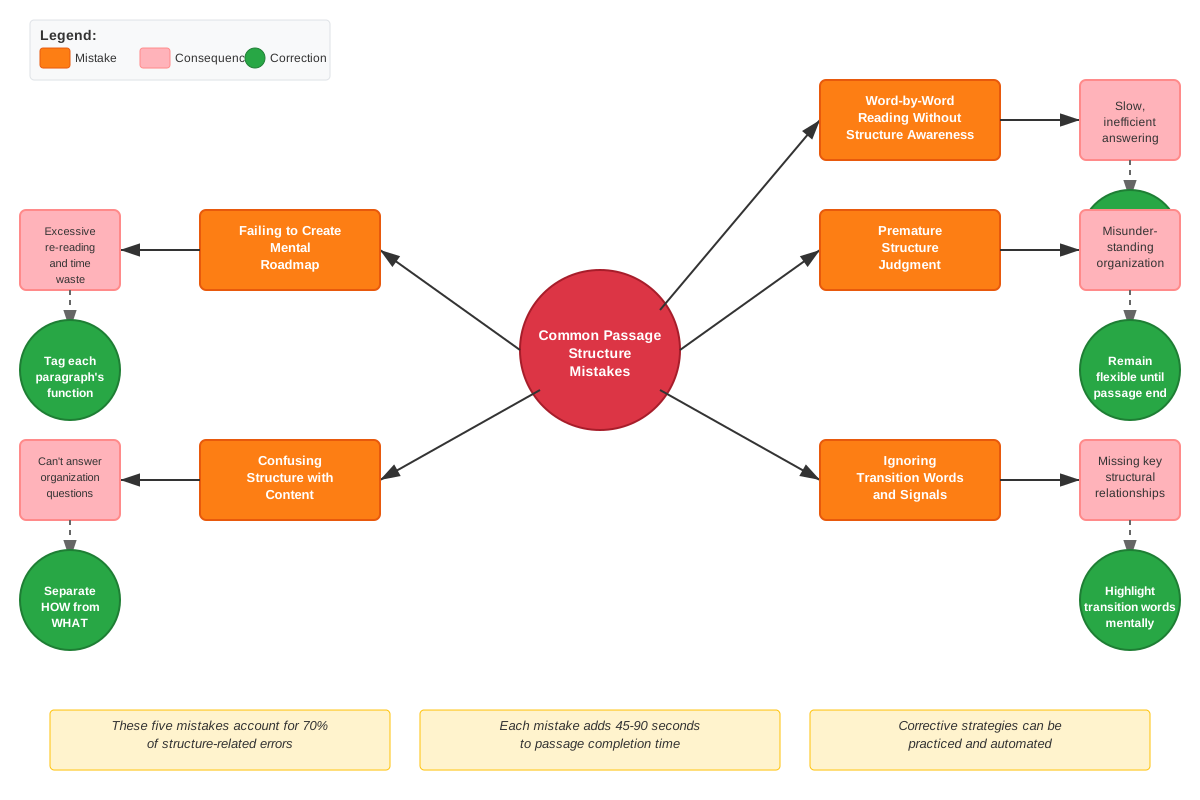
- [ ] Identify common mistakes related to Passage structure
- [ ] Connect Passage structure to related Critical Analysis and Reasoning Skills concepts
- [ ] Recognize and categorize the six most common passage structure types on the MCAT CARS section
- [ ] Construct mental roadmaps of passages during initial reading to facilitate efficient question answering
- [ ] Distinguish between structural elements (organizational framework) and content elements (specific ideas) in passages
Prerequisites
- Basic reading comprehension: Understanding literal meaning of sentences and paragraphs is necessary before analyzing how those elements are organized into larger structures
- Familiarity with paragraph functions: Recognizing that paragraphs serve different purposes (introduction, evidence, counterargument, conclusion) enables identification of structural patterns
- Understanding of thesis statements and main ideas: Distinguishing between central claims and supporting details forms the foundation for recognizing how passages are architecturally organized
- Basic argument components: Knowledge of premises, conclusions, and evidence helps identify how argumentative passages are structured
Why This Topic Matters
Understanding passage structure provides immediate practical advantages on the MCAT CARS section. Research on MCAT performance indicates that students who actively identify passage structure during their initial read answer questions approximately 15-20% faster than those who don't, without sacrificing accuracy. This time savings is critical in a section where test-takers must process nine passages and 53 questions in 90 minutes—an average of just 10 minutes per passage including all associated questions.
On the MCAT, passage structure knowledge appears relevant across multiple question types. Approximately 30-40% of CARS questions directly or indirectly test understanding of how passages are organized. "Main idea" questions (appearing 1-2 times per passage) require recognition of the passage's overall structural purpose. "Function" questions explicitly ask why the author included a particular paragraph or example, which demands understanding of that element's role in the larger organizational framework. Even "detail" and "inference" questions become more manageable when students know where to look based on structural patterns—for instance, recognizing that counterarguments typically appear in the middle sections of argumentative passages.
Common manifestations of passage structure on the MCAT include passages that present a historical progression of ideas, passages that compare and contrast multiple theories or perspectives, passages that identify a problem and evaluate potential solutions, and passages that build toward a controversial thesis through accumulating evidence. Recognizing these patterns within the first 2-3 paragraphs allows strategic reading for the remainder of the passage.
Core Concepts
Defining Passage Structure in CARS Context
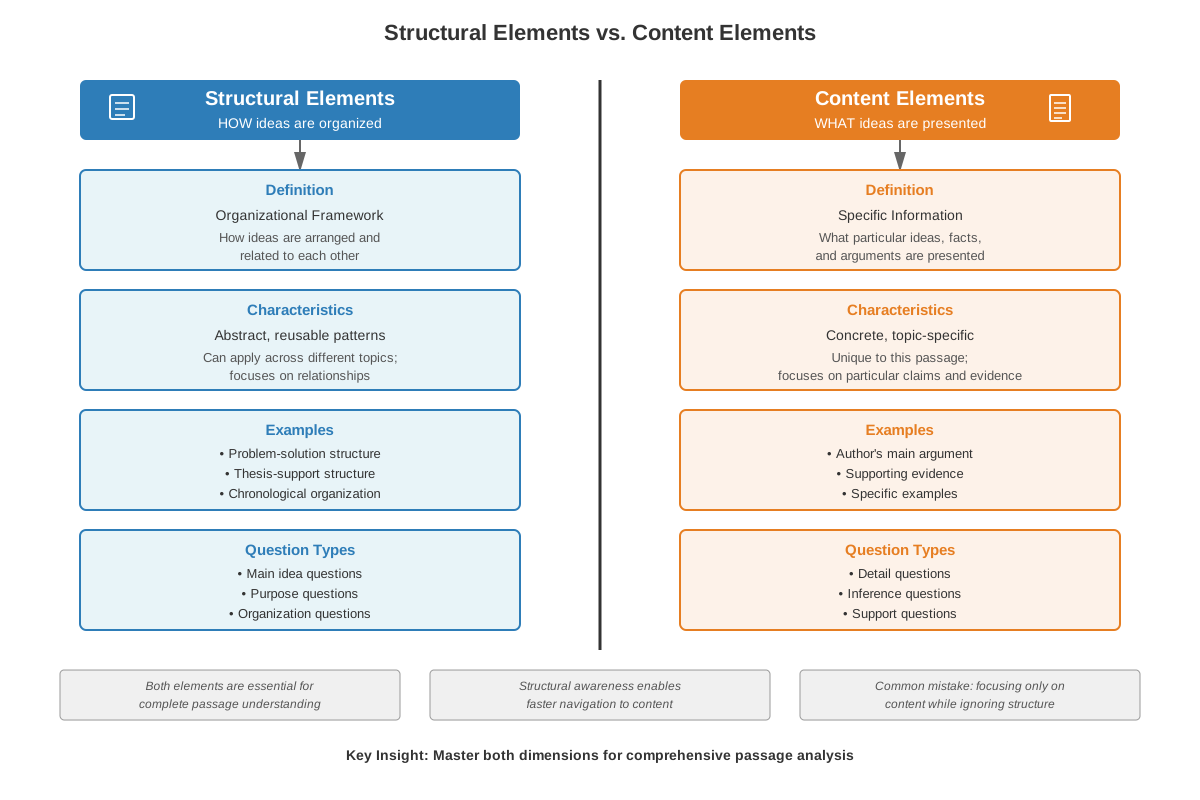
Passage structure in Critical Analysis and Reasoning Skills refers to the deliberate organizational pattern an author employs to arrange ideas, arguments, evidence, and rhetorical elements within a text. Unlike content (what the passage says), structure concerns architecture (how the passage is built). This organizational framework includes the sequence of paragraphs, the logical relationships between sections, the placement of thesis statements and supporting evidence, and the overall progression of ideas from introduction to conclusion.
On the MCAT, passage structure operates at multiple levels: the macro-level (overall passage organization), the meso-level (paragraph-to-paragraph relationships), and the micro-level (sentence-to-sentence connections within paragraphs). Successful CARS test-takers develop the ability to perceive all three levels simultaneously, creating hierarchical mental models of passages that facilitate rapid information retrieval during question answering.
The Six Primary Passage Structure Types
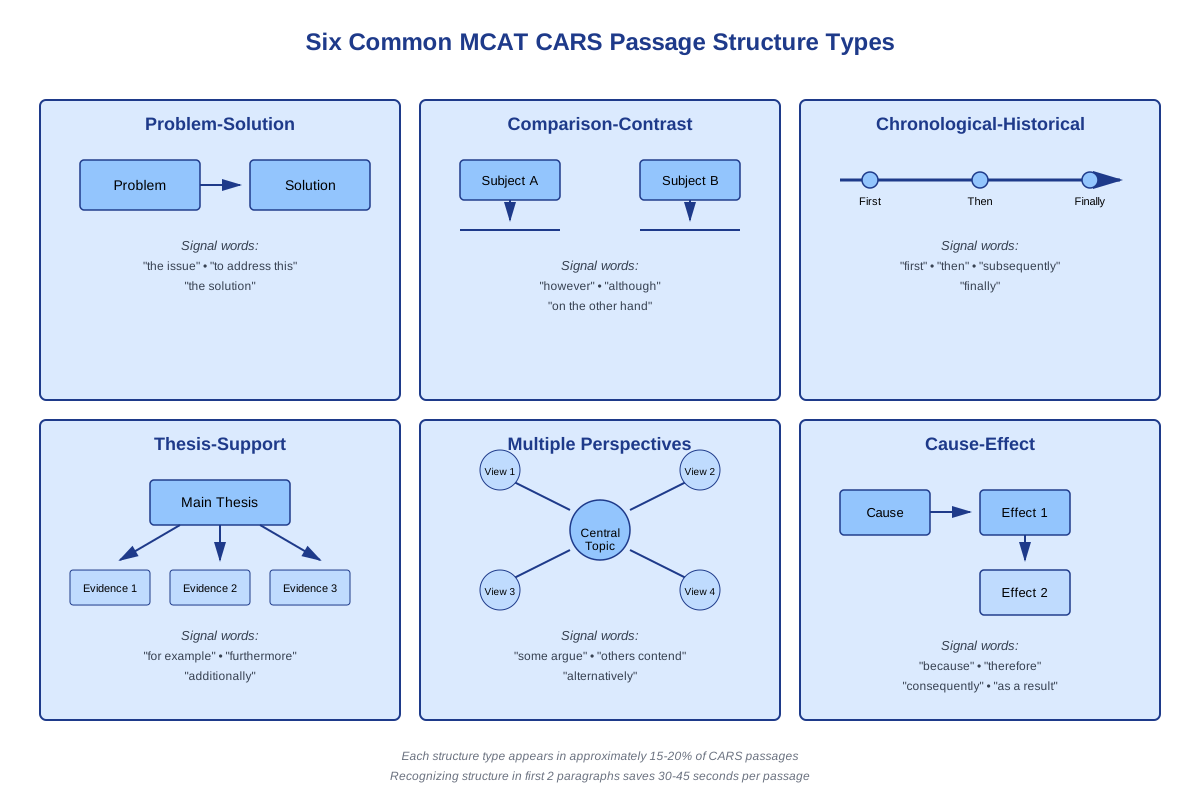
MCAT CARS passages typically follow one of six organizational patterns, each with characteristic features and predictable information placement:
1. Thesis-Support Structure: The author presents a clear main argument early (usually in the first or second paragraph) and devotes the remainder of the passage to providing evidence, examples, and reasoning that support this central claim. This is the most common structure on the MCAT, appearing in approximately 30-35% of passages.
2. Problem-Solution Structure: The passage identifies a problem, puzzle, or question in the opening paragraphs, then explores potential solutions or answers. Often includes evaluation of different solutions' merits and limitations. The author's preferred solution typically appears in the final paragraphs.
3. Compare-Contrast Structure: The passage examines two or more theories, perspectives, approaches, or phenomena, systematically analyzing their similarities and differences. May be organized point-by-point (alternating between subjects) or block-by-block (discussing each subject separately).
4. Chronological/Historical Structure: Ideas, theories, or events are presented in temporal sequence, often tracing the evolution of thought on a topic. Earlier paragraphs discuss past perspectives; later paragraphs present more recent or contemporary views.
5. Cause-Effect Structure: The passage explores causal relationships, either examining multiple effects of a single cause or multiple causes of a single effect. Often includes analysis of mechanisms linking causes to effects.
6. Debate/Multiple Perspectives Structure: The passage presents several competing viewpoints on a controversial issue, often without the author strongly advocating for one position. The author may synthesize perspectives or identify strengths and weaknesses in each view.
Structural Signposts and Transition Language
Authors use specific linguistic markers to signal structural relationships and organizational patterns. Recognizing these structural signposts allows rapid identification of passage architecture:
| Structural Function | Common Signpost Words/Phrases |
|---|---|
| Introducing main thesis | "The central argument is...", "This essay contends that...", "Ultimately..." |
| Adding supporting evidence | "Furthermore", "Additionally", "Moreover", "For example" |
| Introducing counterarguments | "However", "Critics argue", "On the other hand", "Some contend" |
| Refuting counterarguments | "Yet", "Nevertheless", "Despite these objections", "This view fails to consider" |
| Showing cause-effect | "Therefore", "Consequently", "As a result", "This leads to" |
| Comparing | "Similarly", "Likewise", "In the same way", "Analogously" |
| Contrasting | "In contrast", "Conversely", "Unlike", "Whereas" |
| Concluding | "In conclusion", "Ultimately", "Thus", "In sum" |
Paragraph Functions Within Passage Structure
Each paragraph serves a specific structural role within the overall passage architecture. Common paragraph functions include:
- Introduction paragraphs: Establish context, present the topic, and often (but not always) state or hint at the thesis
- Background/context paragraphs: Provide necessary historical, theoretical, or factual information needed to understand the main argument
- Evidence paragraphs: Present data, examples, studies, or reasoning that support the main thesis
- Counterargument paragraphs: Introduce opposing views or potential objections to the author's position
- Refutation paragraphs: Address and rebut counterarguments
- Complication paragraphs: Introduce nuances, limitations, or complexities in the main argument
- Conclusion paragraphs: Synthesize ideas, restate the thesis in light of evidence, or discuss implications
Creating Mental Roadmaps
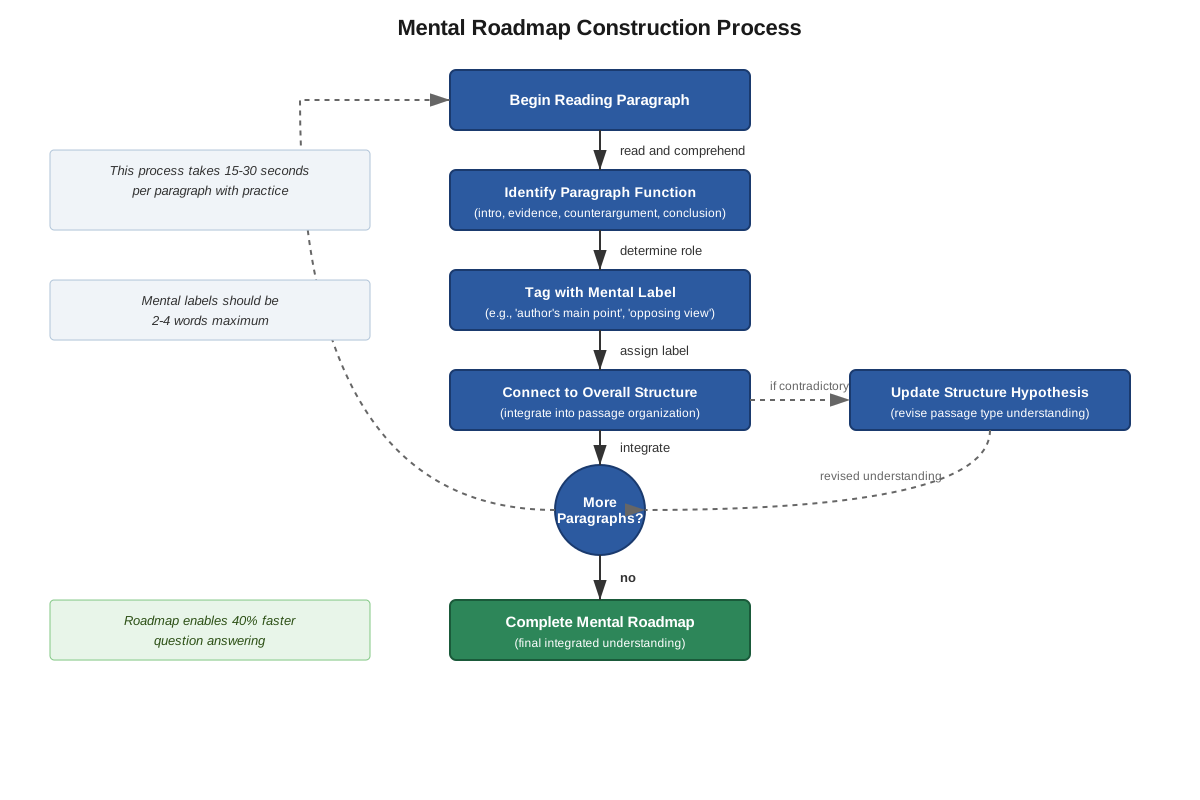
A mental roadmap is a simplified cognitive representation of passage structure that test-takers construct during their initial read. This roadmap doesn't capture every detail but instead notes:
- The main idea or thesis
- The location (paragraph number) of key information types
- The overall structural pattern
- Major transitions or shifts in focus
- The author's tone and purpose
Effective mental roadmaps might be mentally verbalized as: "Paragraph 1 introduces the debate about X. Paragraphs 2-3 present the traditional view. Paragraph 4 introduces the author's alternative perspective with 'However.' Paragraphs 5-6 provide evidence for the author's view. Paragraph 7 concludes by discussing implications."
The Relationship Between Structure and Author's Purpose
Passage structure directly reflects and reveals the author's purpose—what the author aims to accomplish through the text. Different purposes necessitate different structures:
- To persuade: Typically uses thesis-support or problem-solution structures with clear argumentative progression
- To inform/explain: Often employs chronological, cause-effect, or descriptive structures
- To analyze: Frequently uses compare-contrast or debate structures to examine multiple facets of an issue
- To critique: Usually presents a view to be criticized, then systematically identifies flaws
Recognizing the structural pattern helps identify the author's purpose, and vice versa. This bidirectional relationship makes both concepts more accessible.
Concept Relationships
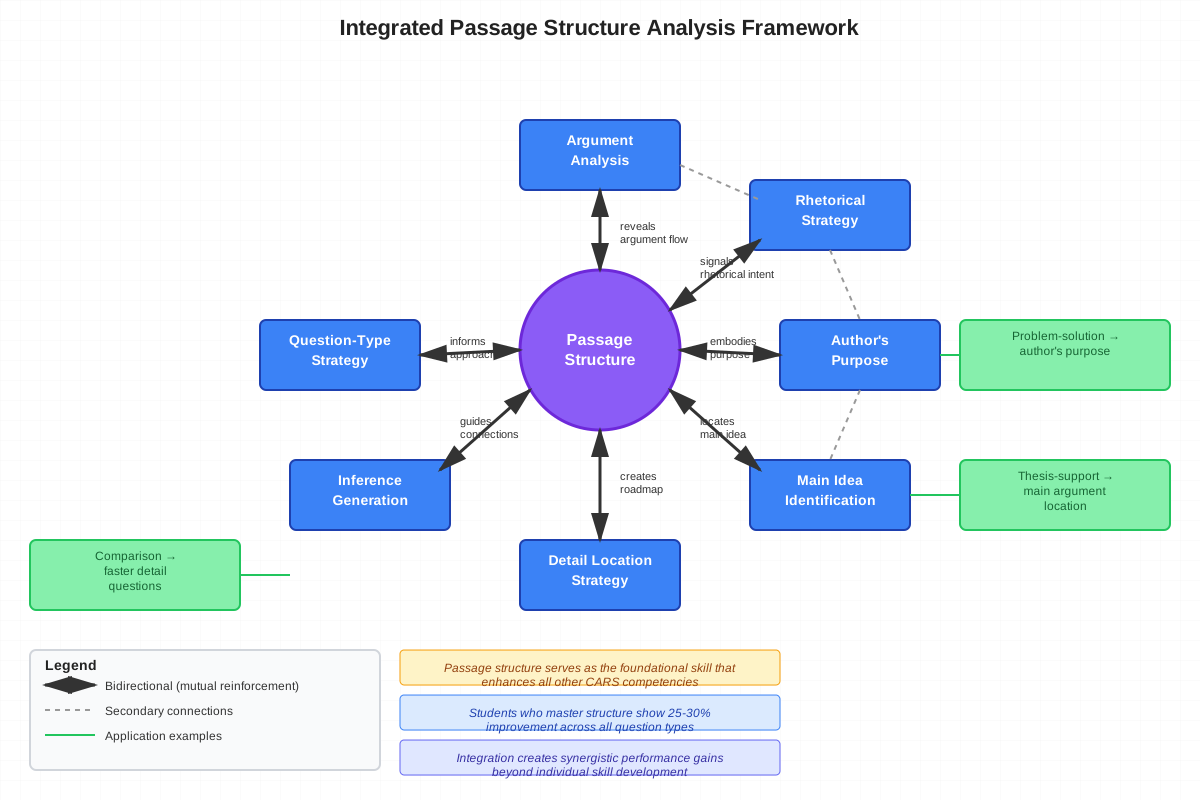
Passage structure serves as a foundational concept that connects to virtually all other CARS Skills on the MCAT. Understanding these relationships creates a comprehensive analytical framework:
Passage Structure → Main Idea Identification: The overall structural pattern reveals where the main idea is likely located and how it's developed. In thesis-support structures, the main idea appears early; in problem-solution structures, it often appears in the conclusion.
Passage Structure → Detail Location: Knowing the structural pattern allows prediction of where specific information types reside. Evidence typically follows thesis statements; counterarguments usually appear in middle paragraphs; implications appear near conclusions.
Passage Structure ↔ Author's Purpose: These concepts are mutually reinforcing. Structure reveals purpose; understanding purpose helps predict structure. Both inform interpretation of the passage's meaning.
Passage Structure → Tone and Attitude: Structural choices reflect authorial attitude. Passages that present multiple perspectives without clear advocacy suggest balanced or analytical tone; passages with strong thesis-support structure often indicate persuasive or argumentative tone.
Passage Structure → Question Strategy: Different question types require different structural knowledge. Main idea questions require macro-level structural understanding; function questions require meso-level paragraph relationship knowledge; detail questions benefit from knowing where information types typically appear.
Paragraph Functions → Overall Passage Structure: Individual paragraph roles combine to create the overall structural pattern. Recognizing that paragraph 3 serves as a counterargument paragraph helps understand the larger debate structure.
This interconnected web means that improving passage structure recognition simultaneously enhances performance across multiple CARS skill areas.
Quick check — test yourself on Passage structure so far.
Try Flashcards →High-Yield Facts
⭐ The most common passage structure on MCAT CARS is thesis-support, appearing in approximately 30-35% of passages
⭐ Transition words like "however," "nevertheless," and "yet" signal structural shifts and often introduce the author's true position after presenting opposing views
⭐ The author's main thesis in argumentative passages most frequently appears in paragraph 1, 2, or the final paragraph
⭐ Counterarguments typically appear in the middle sections of passages (paragraphs 3-5 in a 7-paragraph passage), not at the beginning or end
⭐ Function questions ("The author mentions X in order to...") directly test understanding of structural relationships between passage elements
- Passages with multiple perspectives often don't have a single clear thesis; instead, the author's purpose is to analyze or compare viewpoints
- Chronological structures often signal historical passages where understanding the evolution of ideas is more important than identifying a single thesis
- The first sentence of each paragraph often signals that paragraph's function within the overall structure
- Conclusion paragraphs frequently introduce new implications or applications rather than simply restating earlier ideas
- Recognizing passage structure within the first 2-3 paragraphs allows more strategic reading of remaining paragraphs
Common Misconceptions
Misconception: The main idea always appears in the first paragraph.
Correction: While introductory paragraphs often contain or hint at the main idea, many MCAT passages (particularly problem-solution and debate structures) build toward a thesis that only becomes fully clear in later paragraphs. Some passages present background information first, delaying the main argument until paragraph 2 or 3.
Misconception: Every passage has a clear thesis statement that the author argues for.
Correction: Not all CARS passages are argumentative. Some passages aim to inform, explain, analyze, or present multiple perspectives without advocating a single position. In these passages, the "main idea" is the central topic or analytical framework, not a debatable claim.
Misconception: Longer paragraphs contain more important information than shorter paragraphs.
Correction: Paragraph length doesn't correlate with importance. Short paragraphs often serve crucial structural functions like introducing thesis statements, presenting counterarguments, or drawing conclusions. Some longer paragraphs merely provide extended examples of concepts stated more concisely elsewhere.
Misconception: Understanding passage structure means memorizing where specific details appear.
Correction: Passage structure understanding is about recognizing organizational patterns and paragraph functions, not memorizing content. The goal is to create a mental roadmap that allows efficient information retrieval when answering questions, not to remember every detail from the initial read.
Misconception: All passages within a single CARS section follow the same structural pattern.
Correction: The MCAT deliberately varies passage structures throughout the CARS section. Test-takers must flexibly identify different organizational patterns rather than assuming all passages follow the same structure. Each passage requires fresh structural analysis.
Worked Examples
Example 1: Identifying Structure in a Philosophy Passage
Passage Summary: A 6-paragraph passage discusses theories of aesthetic judgment.
- Paragraph 1: Introduces the question "What makes art beautiful?" and notes this has puzzled philosophers for centuries
- Paragraph 2: Presents the objectivist view that beauty resides in properties of the artwork itself (symmetry, proportion, harmony)
- Paragraph 3: Provides examples of objectivist analysis applied to classical architecture
- Paragraph 4: Introduces the subjectivist view with "However, many philosophers reject this approach," arguing beauty exists only in the viewer's experience
- Paragraph 5: Discusses implications of subjectivism for art criticism
- Paragraph 6: Concludes that both views capture partial truths, suggesting a synthesis
Structural Analysis:
This passage follows a debate/multiple perspectives structure with synthesis. The organizational pattern is:
- Question introduction (paragraph 1)
- First perspective + evidence (paragraphs 2-3)
- Alternative perspective + implications (paragraphs 4-5)
- Synthesis/author's position (paragraph 6)
Application to Questions:
If asked "What is the main idea of the passage?", the answer would focus on the synthesis in paragraph 6, not just one of the two perspectives. If asked "The author mentions classical architecture in order to...", the answer relates to its function as evidence for objectivism (paragraph 3's role). If asked about subjectivism's implications, paragraph 5 is the target location.
The transition word "However" in paragraph 4 signals the structural shift from the first perspective to the alternative view—a high-yield signpost that often indicates where the author's true interest lies.
Example 2: Recognizing Problem-Solution Structure
Passage Summary: A 7-paragraph passage about urban planning.
- Paragraph 1: Describes rapid urbanization in developing nations
- Paragraph 2: Identifies problems: inadequate infrastructure, traffic congestion, pollution
- Paragraph 3: Discusses traditional solution of expanding road networks, noting this approach has failed
- Paragraph 4: Introduces alternative solution: investment in public transportation
- Paragraph 5: Provides evidence from cities that successfully implemented public transit
- Paragraph 6: Acknowledges challenges in implementing this solution (funding, political will)
- Paragraph 7: Concludes that despite challenges, public transit investment is the most viable path forward
Structural Analysis:
This passage follows a problem-solution structure with evaluation:
- Context setting (paragraph 1)
- Problem identification (paragraph 2)
- Inadequate solution + critique (paragraph 3)
- Preferred solution introduction (paragraph 4)
- Supporting evidence (paragraph 5)
- Limitations/complications (paragraph 6)
- Conclusion affirming preferred solution (paragraph 7)
Application to Questions:
If asked "What is the author's primary purpose?", the answer involves advocating for public transit investment as a solution to urban problems. If asked "Why does the author mention road network expansion?", the answer relates to its function as a contrasting inadequate solution (paragraph 3). If asked about challenges to the author's proposal, paragraph 6 is the target.
The phrase "alternative solution" in paragraph 4 signals the introduction of the author's preferred approach. The acknowledgment of limitations in paragraph 6 doesn't undermine the author's position but rather demonstrates balanced analysis—a common feature of problem-solution structures.
Exam Strategy
Initial Reading Strategy
During the first read-through (which should take 3-4 minutes for a typical passage), focus on identifying:
- The structural pattern within the first 2-3 paragraphs
- The location of the thesis or main idea (note the paragraph number)
- Major transitions signaled by "however," "yet," "nevertheless," etc.
- The function of each paragraph in one or two words (e.g., "background," "evidence," "counterargument")
Avoid getting bogged down in complex details during the initial read. The goal is creating a mental roadmap, not memorizing content.
Trigger Words for Structural Recognition
Watch for these high-yield phrases that signal specific structures:
- "This essay argues/contends/maintains" → Thesis-support structure; main idea follows
- "The problem/puzzle/question is" → Problem-solution structure; look for solutions in later paragraphs
- "However/Nevertheless/Yet" → Structural shift; often introduces author's true position or counterargument
- "Similarly/Likewise/In contrast" → Compare-contrast structure
- "Historically/Originally/In recent years" → Chronological structure
- "Some argue... Others contend" → Debate/multiple perspectives structure
Question-Specific Strategies
For Main Idea Questions:
- Identify the overall structural pattern first
- In thesis-support structures, the main idea is usually the thesis
- In problem-solution structures, the main idea often involves the preferred solution
- In debate structures, the main idea may be the analytical framework rather than advocacy for one position
For Function Questions:
- These directly test structural understanding
- Identify the paragraph's role in the overall architecture
- Common functions: provide evidence, introduce counterargument, offer example, present complication
- Wrong answers often describe the paragraph's content rather than its function
For Detail Questions:
- Use your mental roadmap to locate information efficiently
- Evidence typically follows thesis statements
- Counterarguments appear in middle paragraphs
- Implications and applications appear near conclusions
Time Management
Spending 30-45 seconds identifying passage structure during the initial read saves 1-2 minutes during question answering. This investment pays dividends by enabling:
- Faster location of relevant information
- More confident elimination of wrong answers
- Reduced need to re-read entire passages
Memory Techniques
MAPS Mnemonic for Initial Reading
Main idea location
Architectural pattern (which of the six structures?)
Paragraph functions
Shifts and transitions
During your first read, focus on creating a MAPS representation of the passage.
The "However Test"
When you encounter "however," "nevertheless," "yet," or similar transition words, mentally flag this location. In 70-80% of MCAT passages, these transitions introduce either:
- The author's true position (after presenting opposing views)
- A crucial counterargument
- A complication to a seemingly simple idea
These are high-yield locations for both understanding structure and answering questions.
Paragraph Function Shorthand
Develop a personal shorthand for noting paragraph functions during your initial read:
- I = Introduction
- B = Background
- E = Evidence
- C = Counterargument
- R = Refutation
- X = Conclusion
Mentally or physically (if using scratch paper) note these letters next to paragraph numbers to create your roadmap.
The Six-Structure Acronym: "TPCCCD"
Thesis-support
Problem-solution
Compare-contrast
Chronological
Cause-effect
Debate
During practice, consciously identify which of these six structures each passage follows. With repetition, this recognition becomes automatic.
Summary
Passage structure represents the organizational architecture authors use to arrange ideas, arguments, and evidence within texts. For MCAT CARS success, recognizing structural patterns transforms reading from passive content absorption into active analytical engagement. The six primary structures—thesis-support, problem-solution, compare-contrast, chronological, cause-effect, and debate—appear predictably throughout the CARS section, each with characteristic features and information placement patterns. Successful test-takers identify the structural pattern within the first 2-3 paragraphs, note paragraph functions and major transitions, and create mental roadmaps that facilitate efficient question answering. This structural awareness connects intimately with other CARS skills including main idea identification, detail location, author's purpose recognition, and question strategy. By understanding not just what passages say but how they're built, students gain the metacognitive framework necessary for consistent high performance across all CARS question types, regardless of passage content or subject matter familiarity.
Key Takeaways
- Passage structure refers to organizational patterns, not content; focus on how passages are built, not just what they say
- The six primary MCAT CARS structures are thesis-support, problem-solution, compare-contrast, chronological, cause-effect, and debate
- Transition words like "however" and "nevertheless" signal structural shifts and often introduce the author's true position
- Creating a mental roadmap during initial reading (noting structural pattern, thesis location, and paragraph functions) saves significant time during question answering
- Different question types require different structural knowledge: main idea questions need macro-level structure; function questions need paragraph-level relationships
- Paragraph length doesn't indicate importance; short paragraphs often serve crucial structural functions
- Recognizing passage structure within the first 2-3 paragraphs enables strategic, efficient reading of remaining content
Related Topics
Argument Analysis: Understanding how authors construct logical arguments builds directly on structural knowledge, as argument components (premises, conclusions, assumptions) occupy predictable positions within passage structures. Mastering passage structure provides the framework for identifying these argumentative elements.
Rhetorical Strategy: Authors' rhetorical choices (use of examples, analogies, rhetorical questions) serve specific structural functions. Understanding passage architecture enables recognition of why authors employ particular rhetorical devices at specific locations.
Author's Purpose and Tone: These concepts are intimately connected to passage structure. The organizational pattern an author chooses reflects their purpose, and recognizing structure helps identify whether the author aims to persuade, inform, analyze, or critique.
Main Idea and Supporting Details: Structural knowledge directly facilitates distinguishing between central claims and supporting evidence, as these elements occupy different positions within passage architecture.
Question Type Strategies: Each CARS question type (main idea, detail, inference, function, strengthen/weaken) requires specific structural knowledge for optimal performance. Mastering passage structure enables development of targeted strategies for each question category.
Practice CTA
Now that you understand the fundamental principles of passage structure, it's time to apply this knowledge actively. Attempt the practice questions associated with this topic, focusing on identifying structural patterns within the first few paragraphs and creating mental roadmaps before answering questions. Use the flashcards to reinforce recognition of the six primary structures and common transition words that signal structural shifts. Remember: passage structure recognition is a skill that improves dramatically with deliberate practice. Each passage you analyze strengthens your ability to automatically perceive organizational patterns, transforming your CARS performance. You've built the foundation—now apply it consistently to achieve mastery.
Sign up free to keep reading
Create a free AnvayaPrep account to finish this MCAT guide on Passage structure — plus flashcards and practice questions.