Overview
Argument analysis is the systematic process of identifying, dissecting, and evaluating the logical structure of written or spoken reasoning. Within the Critical Analysis and Reasoning Skills (CARS) section of the MCAT, this skill represents one of the most fundamental competencies tested. Unlike the science sections that assess content knowledge, CARS evaluates the ability to comprehend complex passages and critically examine the arguments they contain. Argument analysis requires students to identify an author's main claim (conclusion), understand the evidence or reasons provided to support that claim (premises), recognize underlying assumptions that bridge premises to conclusions, and evaluate the logical strength of the reasoning chain. This process demands active, engaged reading rather than passive comprehension.
For the MCAT, mastery of argument analysis is non-negotiable. Approximately 30-40% of CARS questions directly test argument analysis skills, asking students to identify conclusions, evaluate evidence, recognize assumptions, strengthen or weaken arguments, or identify logical flaws. The remaining questions often indirectly rely on argument analysis abilities, as understanding an author's reasoning structure is prerequisite to answering questions about tone, purpose, or application of ideas. Students who excel at argument analysis can quickly navigate dense philosophical, historical, or social science passages, distinguishing between what an author asserts and what they support with evidence.
Within the broader framework of CARS Skills, argument analysis connects intimately with comprehension, evaluation, and application abilities. It serves as the bridge between basic passage comprehension (understanding what the author says) and higher-order critical thinking (assessing whether the author's reasoning is sound). Argument analysis also underpins skills like identifying rhetorical strategies, understanding counterarguments, and recognizing how authors use evidence to persuade readers. Without strong argument analysis capabilities, students struggle with the most challenging CARS passages—those that present nuanced, multi-layered reasoning or subtle logical relationships.
Learning Objectives
- [ ] Define Argument analysis using accurate Critical Analysis and Reasoning Skills terminology
- [ ] Explain why Argument analysis matters for the MCAT
- [ ] Apply Argument analysis to exam-style questions
- [ ] Identify common mistakes related to Argument analysis
- [ ] Connect Argument analysis to related Critical Analysis and Reasoning Skills concepts
- [ ] Distinguish between premises, conclusions, and assumptions in complex passages
- [ ] Evaluate the logical strength and validity of arguments presented in MCAT passages
- [ ] Recognize common argument structures and logical patterns in CARS passages
- [ ] Identify logical fallacies and reasoning errors that weaken arguments
Prerequisites
- Basic reading comprehension: Understanding literal meaning of sentences and paragraphs is essential before analyzing argument structure
- Familiarity with passage types: Recognizing humanities and social sciences writing styles helps contextualize argumentative approaches
- Vocabulary proficiency: Strong vocabulary enables accurate interpretation of nuanced claims and evidence
- Logical reasoning fundamentals: Basic understanding of cause-effect relationships and if-then logic supports argument analysis
Why This Topic Matters
Argument analysis skills extend far beyond standardized testing into medical practice and professional life. Physicians constantly evaluate arguments: assessing the strength of evidence in medical literature, weighing treatment options based on research findings, communicating reasoning to patients and colleagues, and making diagnostic decisions based on incomplete information. The ability to identify assumptions, evaluate evidence quality, and recognize logical flaws directly translates to evidence-based medicine and clinical decision-making.
On the MCAT specifically, argument analysis appears in approximately 12-15 questions per CARS section (out of 53 total questions), making it a medium-to-high yield topic. These questions typically fall into several categories: "Which of the following assumptions does the author make?", "Which statement would most strengthen/weaken the argument?", "What is the author's main conclusion?", and "Which logical flaw undermines the argument?" The AAMC consistently includes passages from philosophy, ethics, and social sciences that present complex, multi-step arguments requiring careful analysis.
Common manifestations in exam passages include: philosophical arguments about ethics or epistemology with multiple premises building to a conclusion; historical analyses arguing for particular interpretations of events; social science passages presenting theories with supporting evidence; and literary criticism passages arguing for specific interpretations of texts or cultural phenomena. Recognizing these patterns allows efficient identification of argument components and faster, more accurate question answering.
Core Concepts
Components of Arguments
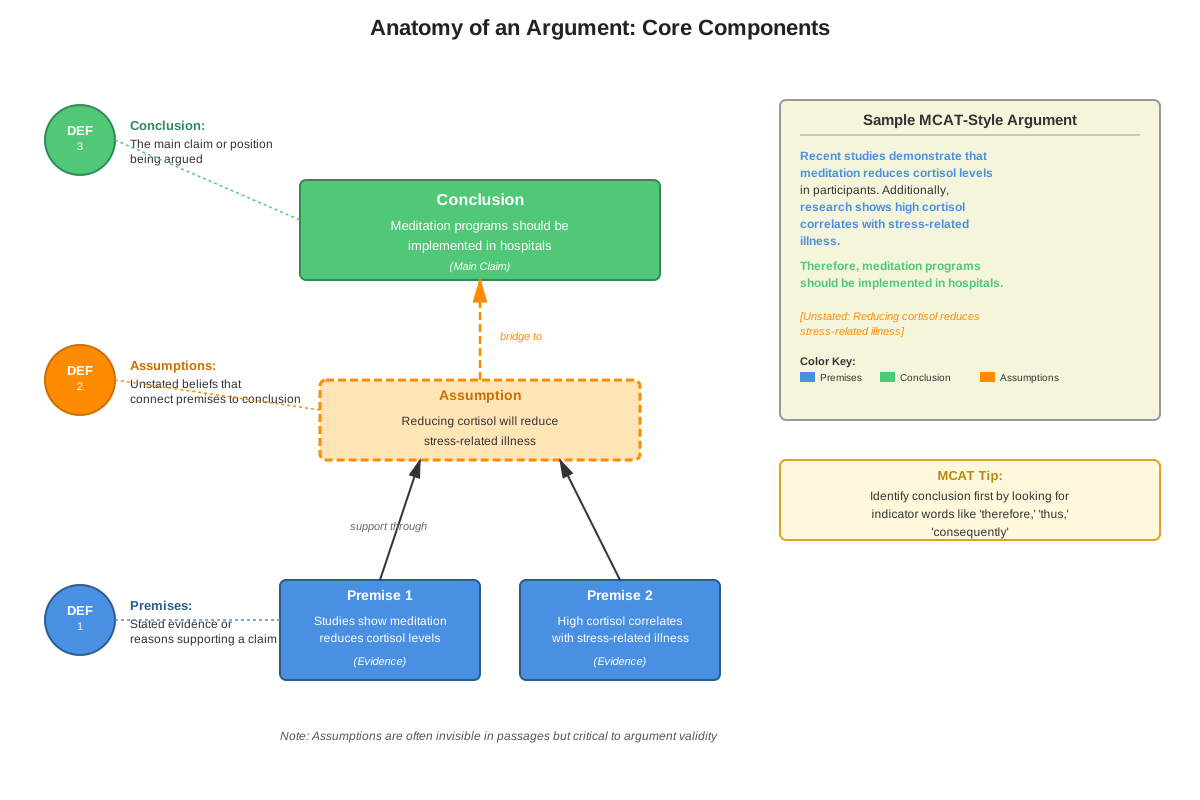
Every argument contains three fundamental elements that students must identify and distinguish. The conclusion represents the main claim or thesis the author seeks to establish—the "point" of the argument. Premises are the reasons, evidence, or facts offered to support the conclusion. Assumptions are unstated beliefs or principles that must be true for the premises to logically support the conclusion.
Identifying conclusions requires recognizing conclusion indicators like "therefore," "thus," "consequently," "it follows that," and "we can conclude." However, MCAT passages often omit these explicit markers, requiring students to identify conclusions by asking: "What is the author trying to prove?" or "What is the main point?" Conclusions may appear anywhere in a passage—beginning, middle, or end—and complex passages may contain intermediate conclusions that serve as premises for the main conclusion.
Premises provide the evidentiary foundation and typically include facts, statistics, expert testimony, examples, analogies, or logical principles. Premise indicators include "because," "since," "given that," "as evidenced by," and "for the reason that." Strong arguments provide relevant, sufficient, and credible premises; weak arguments rely on insufficient, irrelevant, or questionable evidence.
Assumption Identification
Assumptions represent the invisible logical bridges connecting premises to conclusions. They are unstated propositions that must be true for an argument to work. The MCAT frequently tests assumption identification because it requires deep understanding of logical structure. There are two types: necessary assumptions (must be true for the argument to hold) and sufficient assumptions (if true, guarantee the conclusion follows).
To identify assumptions, students should:
- Clearly identify the conclusion and premises
- Look for logical gaps between evidence and claim
- Ask: "What must the author believe for this reasoning to work?"
- Consider what would destroy the argument if proven false
For example, if an author argues "Medical schools should require philosophy courses because critical thinking is essential for physicians," the assumption is that philosophy courses develop critical thinking skills. Without this assumption, the premise doesn't support the conclusion.
Argument Structure and Patterns
MCAT passages employ recognizable argument structures. Understanding these patterns accelerates analysis:
Simple Arguments: Single premise → conclusion
Complex Arguments: Multiple premises → intermediate conclusion → main conclusion
Comparative Arguments: Comparing two positions to argue one is superior
Causal Arguments: Claiming X causes Y based on correlation or mechanism
Analogical Arguments: Drawing parallels between similar situations
Counterargument-Response: Presenting opposing views then refuting them
| Argument Type | Structure | MCAT Frequency | Key Analysis Focus |
|---|---|---|---|
| Causal | Correlation/mechanism → causation claim | High | Alternative explanations, confounding variables |
| Analogical | Situation A is like B → conclusion about B | Medium | Relevance of similarities, significance of differences |
| Comparative | Option A vs. B → A is better | Medium | Evaluation criteria, completeness of comparison |
| Counterargument | Opposing view → refutation → conclusion | High | Strength of refutation, unaddressed objections |
Evaluating Argument Strength
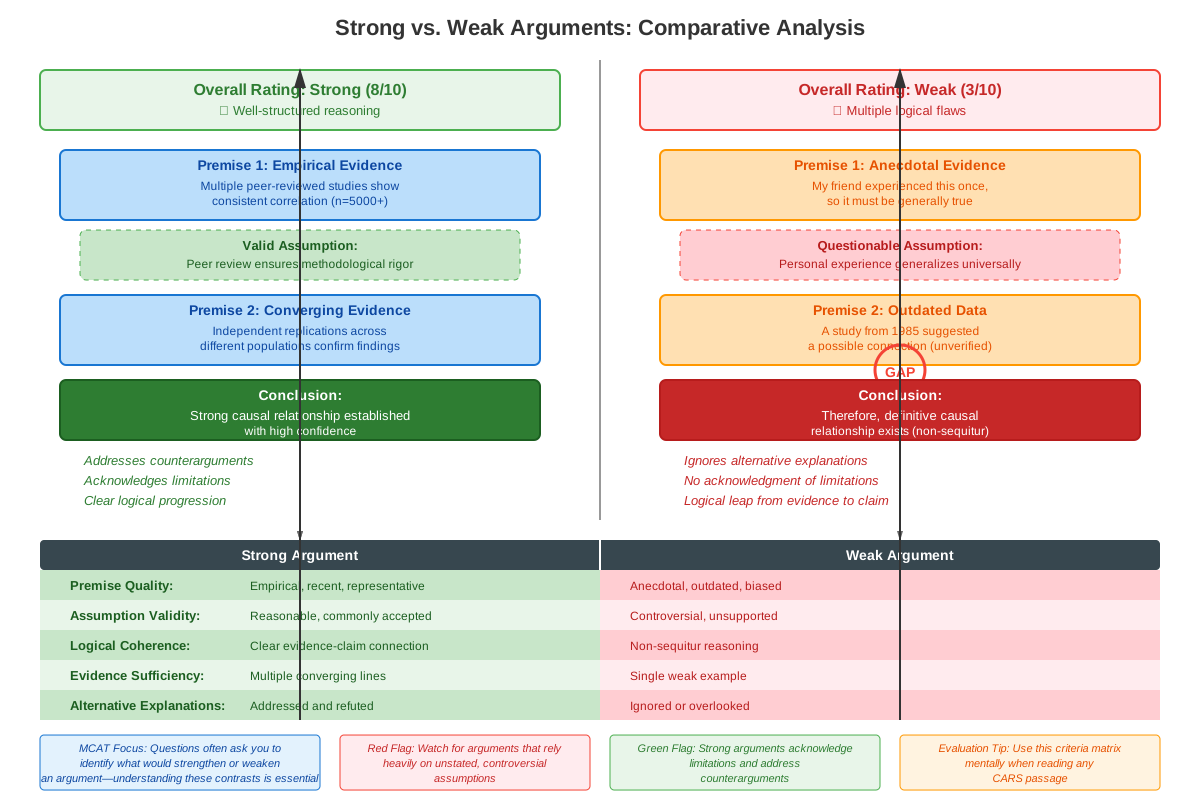
Strong arguments possess several characteristics that MCAT questions frequently test:
- Logical validity: Conclusions follow logically from premises
- Premise truth: Evidence is accurate and credible
- Relevance: Premises directly relate to the conclusion
- Sufficiency: Evidence is adequate in quantity and quality
- Consideration of alternatives: Addresses potential objections or competing explanations
Weak arguments exhibit logical flaws including:
- Hasty generalizations: Drawing broad conclusions from limited evidence
- False dichotomies: Presenting only two options when more exist
- Circular reasoning: Using the conclusion as a premise
- Ad hominem: Attacking the person rather than the argument
- Straw man: Misrepresenting an opposing position to easily refute it
- Slippery slope: Claiming one action inevitably leads to extreme consequences
- Appeal to authority: Relying on authority rather than evidence
- Post hoc ergo propter hoc: Assuming temporal sequence implies causation
Strengthening and Weakening Arguments
MCAT questions frequently ask what would strengthen or weaken a passage argument. To strengthen an argument:
- Provide additional supporting evidence
- Eliminate alternative explanations
- Verify a necessary assumption
- Address potential objections
- Demonstrate the reliability of evidence sources
To weaken an argument:
- Present contradictory evidence
- Identify alternative explanations
- Show an assumption is false
- Reveal logical fallacies
- Demonstrate evidence is unreliable or irrelevant
The key is understanding the argument's logical structure—what it depends on and where it's vulnerable. Students should identify the argument's weakest link: the most questionable premise, the largest logical gap, or the most dubious assumption.
Context and Scope
Understanding an argument's scope (the breadth of the claim) and context (the circumstances surrounding it) is crucial for accurate analysis. Authors may argue about specific cases, general principles, or universal truths. Misidentifying scope leads to incorrect answers.
For example, an argument about "some physicians" differs fundamentally from one about "all physicians" or "physicians in rural areas." MCAT wrong answers often extend arguments beyond their intended scope or apply them to inappropriate contexts. Students must carefully note qualifying language: "often," "typically," "in certain circumstances," "generally," versus absolute terms like "always," "never," "all," "none."
Concept Relationships
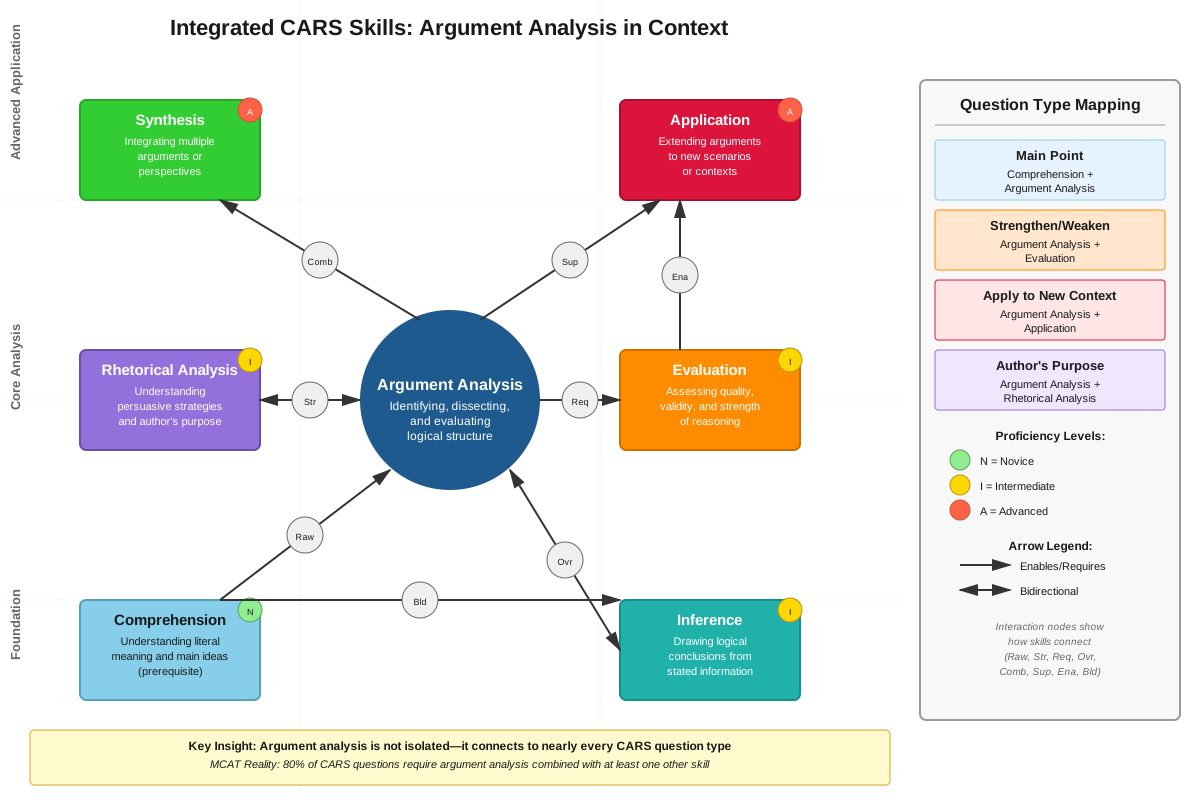
Argument analysis serves as the foundation for multiple interconnected CARS skills. The relationship flows hierarchically: Basic comprehension (understanding what the passage says) → Argument analysis (understanding the logical structure and reasoning) → Evaluation (assessing argument quality) → Application (extending arguments to new situations).
Within argument analysis itself, concepts connect sequentially: Identifying premises and conclusions enables recognition of assumptions (the gaps between them). Understanding assumptions allows evaluation of argument strength. Recognizing argument patterns accelerates identification of all components. Evaluating logical validity requires understanding both structure and common fallacies.
Argument analysis also connects to other CARS skills: Rhetorical analysis examines how authors construct persuasive arguments through language choices. Tone and purpose questions require understanding what the author argues and why. Application questions ask students to extend the argument's logic to new scenarios. Inference questions often require identifying unstated assumptions or logical implications of arguments.
The relationship map: Comprehension → Premise/Conclusion Identification → Assumption Recognition → Argument Structure Analysis → Strength Evaluation → Application to Questions. Each step builds on previous ones, making early steps (accurate identification of components) critical for success in later steps (evaluating strength or applying logic).
High-Yield Facts
⭐ The conclusion is not always at the end—it may appear at the beginning, middle, or be implied rather than explicitly stated
⭐ Assumptions are unstated propositions that must be true for the argument to work—they represent logical gaps between premises and conclusions
⭐ Correlation does not prove causation—causal arguments require ruling out alternative explanations and confounding variables
⭐ Strong arguments address potential counterarguments—passages that acknowledge and refute opposing views demonstrate more robust reasoning
⭐ Necessary assumptions, if false, destroy the argument—the negation test helps identify them: if negating a statement breaks the argument, it's a necessary assumption
- Premise indicators include: because, since, given that, as evidenced by, for the reason that, due to
- Conclusion indicators include: therefore, thus, consequently, it follows that, hence, so, accordingly
- Analogical arguments depend on relevant similarities between compared situations—highlighting differences weakens them
- Circular reasoning (using the conclusion as a premise) is a common logical flaw in MCAT passages
- Scope errors occur when conclusions extend beyond what the evidence supports—watch for qualifying language
- Ad hominem attacks (attacking the person rather than the argument) are irrelevant to argument strength
- The strongest answer to "weaken" questions attacks the argument's central assumption or provides contradictory evidence
- False dichotomies present only two options when more exist—recognizing this flaw is frequently tested
- Hasty generalizations draw broad conclusions from insufficient evidence—sample size and representativeness matter
- Post hoc fallacies assume temporal sequence implies causation—"after this, therefore because of this" reasoning is flawed
Quick check — test yourself on Argument analysis so far.
Try Flashcards →Common Misconceptions
Misconception: The longest or most detailed statement in a passage is always the conclusion.
Correction: Conclusions can be brief statements, while premises often require extensive explanation. Identify conclusions by their logical function (what's being proven) rather than length or detail.
Misconception: All assumptions are problematic or indicate weak arguments.
Correction: Every argument relies on assumptions—they're inevitable. The question is whether assumptions are reasonable and defensible. Strong arguments rest on plausible assumptions; weak arguments depend on questionable ones.
Misconception: Strengthening an argument means proving the conclusion is true.
Correction: Strengthening makes the conclusion more likely or the reasoning more sound, but doesn't necessarily prove truth. Even strengthened arguments can have false conclusions if premises are false.
Misconception: The author's conclusion is always explicitly stated with indicator words like "therefore."
Correction: MCAT passages frequently present conclusions without explicit indicators, requiring students to identify them through logical analysis of what the author is trying to establish.
Misconception: If a passage presents multiple viewpoints, the author agrees with all of them.
Correction: Authors often present opposing views to refute them or provide context. Distinguishing the author's position from views they describe is crucial for accurate argument analysis.
Misconception: Evidence that supports a conclusion automatically makes the argument strong.
Correction: Argument strength depends on evidence relevance, sufficiency, and credibility, plus logical validity. Supporting evidence may be insufficient, irrelevant, or rest on false assumptions.
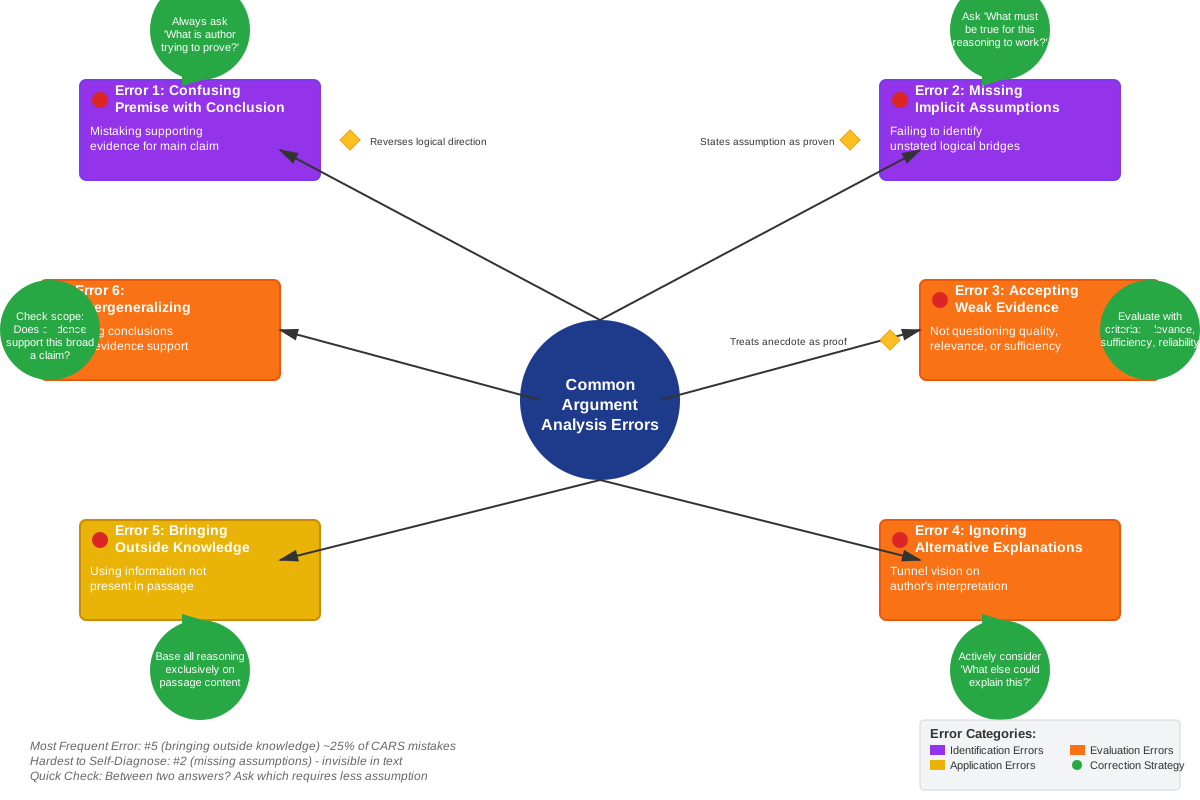
Misconception: Identifying logical fallacies is the primary goal of argument analysis.
Correction: While recognizing fallacies is valuable, comprehensive argument analysis requires identifying all components (premises, conclusions, assumptions), understanding structure, and evaluating overall strength—not just spotting errors.
Worked Examples
Example 1: Philosophy Passage
Passage excerpt: "The rise of social media has fundamentally altered human relationships. Studies show that people spend an average of three hours daily on social platforms, time previously devoted to face-to-face interactions. This shift has resulted in increased reports of loneliness and social isolation, particularly among young adults. Therefore, social media use is detrimental to genuine human connection and should be limited."
Analysis Process:
Step 1: Identify the conclusion
The conclusion appears at the end: "social media use is detrimental to genuine human connection and should be limited." The indicator word "therefore" signals this.
Step 2: Identify premises
- Premise 1: People spend three hours daily on social media
- Premise 2: This time was previously spent on face-to-face interactions
- Premise 3: Reports of loneliness and isolation have increased, especially among young adults
Step 3: Identify assumptions
- Assumption 1: The correlation between social media use and loneliness indicates causation (social media causes loneliness, not just coincides with it)
- Assumption 2: Face-to-face interaction is superior to online interaction for building genuine connection
- Assumption 3: The increased loneliness reports are primarily attributable to social media rather than other factors
- Assumption 4: Limiting social media would reduce loneliness
Step 4: Evaluate argument strength
This argument has several weaknesses:
- Commits post hoc fallacy (assumes temporal correlation proves causation)
- Doesn't rule out alternative explanations for increased loneliness (economic factors, urbanization, etc.)
- Doesn't address potential benefits of social media for connection
- Makes a causal claim based on correlational evidence
Question: Which of the following, if true, would most WEAKEN the argument?
A) Some people use social media to maintain relationships with distant friends
B) Studies show that people who use social media for three or more hours daily report the same loneliness levels as those who primarily interact face-to-face
C) Young adults report higher stress levels than previous generations
D) Social media companies have increased their user base over the past decade
Answer: B—This directly contradicts the causal relationship the argument assumes between social media use and loneliness. If heavy social media users aren't lonelier than those who interact face-to-face, the argument's central claim collapses.
Example 2: Social Science Passage
Passage excerpt: "Proponents of universal basic income (UBI) argue that providing all citizens with unconditional cash payments would reduce poverty and increase economic security. However, this policy overlooks fundamental economic realities. When Finland implemented a UBI pilot program, labor force participation among recipients declined by 2%. If people receive income without working, they have less incentive to seek employment. A nationwide UBI would therefore lead to widespread workforce reduction, decreased productivity, and economic stagnation."
Analysis Process:
Step 1: Identify the conclusion
Main conclusion: "A nationwide UBI would lead to widespread workforce reduction, decreased productivity, and economic stagnation."
Step 2: Identify premises
- Premise 1: Finland's UBI pilot showed 2% decline in labor force participation
- Premise 2: People receiving income without working have less incentive to seek employment
Step 3: Identify the argument structure
This is a counterargument structure: presents opposing view (UBI proponents' position) then argues against it using evidence and reasoning.
Step 4: Identify assumptions
- Assumption 1: Finland's pilot results are generalizable to other countries/contexts
- Assumption 2: A 2% decline in labor participation would scale proportionally in a nationwide program
- Assumption 3: Reduced labor force participation necessarily leads to decreased productivity and economic stagnation
- Assumption 4: The incentive to work is primarily financial rather than driven by other factors (purpose, social connection, achievement)
- Assumption 5: No other factors explain the 2% decline in Finland's program
Step 5: Evaluate argument strength
Moderate strength with vulnerabilities:
- Uses empirical evidence (Finland study)
- Logical reasoning about incentives
- However, relies on limited evidence (single pilot program)
- Makes broad generalizations from specific case
- Doesn't consider alternative explanations or counterbalancing factors
Question: The argument depends on which of the following assumptions?
A) Universal basic income would cost more than current welfare programs
B) Economic productivity depends primarily on labor force participation rates
C) Most people prefer not to work if given the choice
D) Finland's economic conditions are similar to those of other nations
Answer: B—This is a necessary assumption. If productivity doesn't depend primarily on labor force participation (perhaps technology, efficiency, or quality of work matter more), then the conclusion about economic stagnation doesn't follow from the premise about workforce reduction. The negation test confirms this: if productivity does NOT depend primarily on labor force participation, the argument falls apart.
Exam Strategy
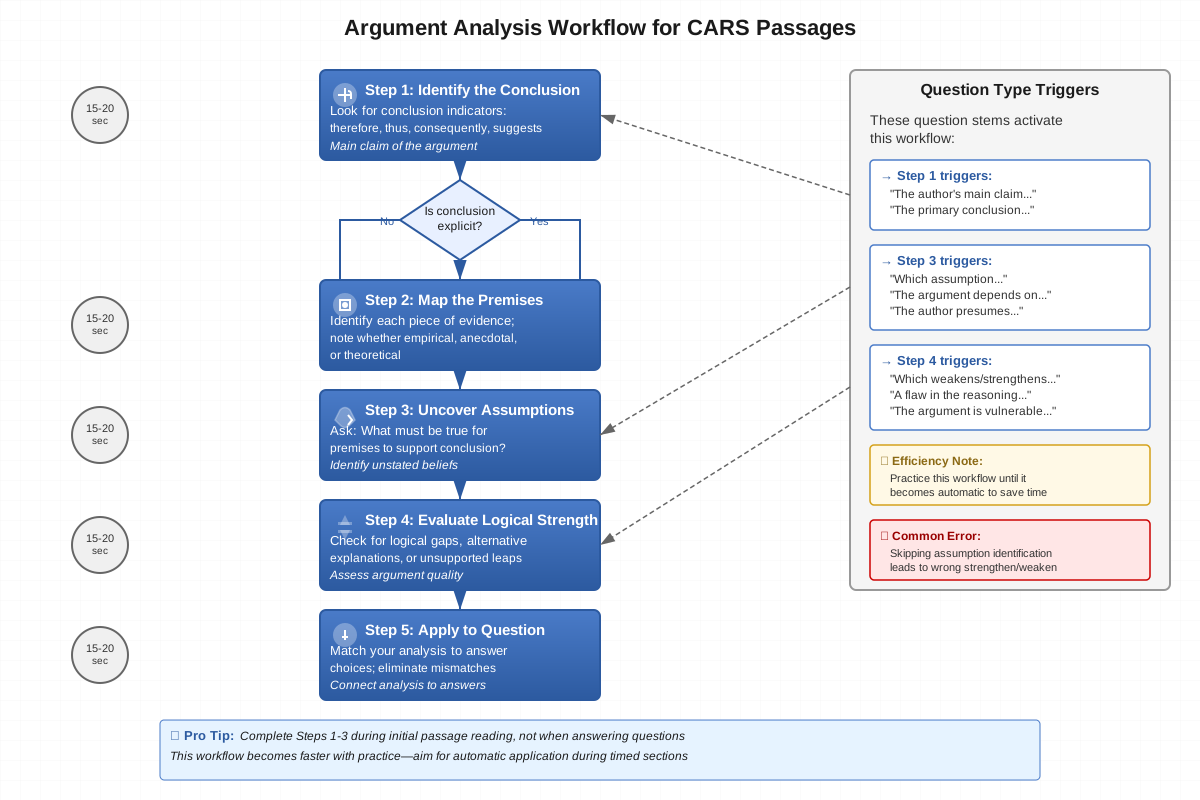
When approaching MCAT argument analysis questions, employ a systematic process that maximizes accuracy while managing time constraints:
Initial Passage Reading (3-4 minutes):
- Actively identify the author's main conclusion as you read
- Mark premise indicators (because, since) and conclusion indicators (therefore, thus)
- Note when the author presents others' views versus their own position
- Flag potential assumptions—logical gaps between evidence and claims
Question Approach:
For "main conclusion" questions: Return to your initial identification; verify by asking "What is the author trying to prove?" The conclusion is what needs support, not what provides support.
For "assumption" questions: Identify the logical gap between premises and conclusion. Use the negation test: if negating the answer choice destroys the argument, it's a necessary assumption. Correct answers often connect concepts mentioned separately in premises and conclusion.
For "strengthen/weaken" questions: First, clearly identify what the argument claims and what it depends on. Strengthening answers provide additional evidence, verify assumptions, or eliminate alternative explanations. Weakening answers present contradictory evidence, show assumptions are false, or provide alternative explanations.
Trigger Words and Phrases:
- "The author assumes..." → Look for unstated logical bridges
- "Which would most weaken..." → Attack the argument's most vulnerable point
- "The argument depends on..." → Identify necessary assumptions
- "The main conclusion is..." → Distinguish what's being proven from what provides proof
- "Which of the following, if true..." → Evaluate impact on argument logic
Process of Elimination:
- Eliminate answers that address irrelevant issues (outside the argument's scope)
- Eliminate answers that strengthen when you need to weaken (or vice versa)
- Eliminate answers that are too extreme for the argument's scope
- Eliminate answers that confuse premises with conclusions
- Be wary of answers that sound sophisticated but don't address the logical structure
Time Management:
Spend 30-45 seconds per argument analysis question. If you can't identify the answer quickly, flag it and return after completing easier questions. Don't get trapped trying to understand every nuance—focus on the logical structure and what the question specifically asks.
Memory Techniques
PACA Framework for argument components:
- Premises (the evidence)
- Assumptions (the gaps)
- Conclusion (the claim)
- Analysis (evaluate strength)
BECAUSE-THEREFORE Method:
Mentally rewrite arguments in this format: "BECAUSE [premises], THEREFORE [conclusion]." This clarifies logical structure and reveals assumptions (what must be true for "because" to lead to "therefore").
The Negation Test Acronym: NADA
- Negate the statement
- Apply to the argument
- Does it destroy the reasoning?
- Assumption confirmed if yes
Weakening vs. Strengthening: WEAK/STRONG
WEAKening attacks:
- Wrong assumptions
- Evidence contradicts
- Alternative explanations
- Key premise questioned
STRONGthening supports:
- Supporting evidence added
- Tests assumptions (confirms them)
- Rules out alternatives
- Objections addressed
- New data confirms
- Gaps filled
Fallacy Recognition: CHAPS
- Circular reasoning
- Hasty generalization
- Ad hominem
- Post hoc
- Straw man
Visualize arguments as bridges: premises are the foundation on one side, conclusion is the destination on the other side, and assumptions are the invisible supports holding up the bridge span. Weakening attacks the supports; strengthening reinforces them.
Summary
Argument analysis represents a core competency for MCAT CARS success, requiring systematic identification and evaluation of logical structures within complex passages. Mastery involves distinguishing premises (evidence) from conclusions (claims), recognizing assumptions (unstated logical bridges), understanding common argument patterns, and evaluating reasoning strength. The MCAT tests these skills through questions asking students to identify conclusions, recognize assumptions, strengthen or weaken arguments, and identify logical flaws. Success requires active reading that focuses on logical structure rather than just content comprehension. Students must recognize that conclusions can appear anywhere in passages, that all arguments rest on assumptions (the question is whether they're reasonable), and that correlation doesn't prove causation without ruling out alternatives. Strong argument analysis skills enable efficient navigation of dense philosophical and social science passages while avoiding common traps like scope errors, premise-conclusion confusion, and fallacy misidentification. The systematic approach—identify components, recognize structure, evaluate strength—provides a reliable framework for tackling even the most challenging CARS passages.
Key Takeaways
- Argument analysis requires identifying three components: premises (evidence), conclusions (claims), and assumptions (unstated logical bridges connecting them)
- Conclusions are not always at the end and may lack explicit indicator words—identify them by asking "What is the author trying to prove?"
- Assumptions represent logical gaps between premises and conclusions; use the negation test to identify necessary assumptions
- Strong arguments provide relevant, sufficient evidence; address counterarguments; and rest on reasonable assumptions
- Common logical fallacies include post hoc reasoning (correlation implies causation), hasty generalizations, false dichotomies, and circular reasoning
- Strengthening answers provide additional evidence, verify assumptions, or eliminate alternatives; weakening answers do the opposite
- Scope awareness is critical—distinguish between claims about "some," "many," or "all" and avoid extending arguments beyond their intended range
Related Topics
Rhetorical Analysis: Examines how authors use language, tone, and persuasive techniques to construct arguments—builds directly on argument analysis by exploring the "how" after understanding the "what"
Inference and Implication: Requires identifying unstated conclusions or logical consequences of arguments—extends argument analysis to what follows logically from stated premises
Passage Structure and Organization: Understanding how authors organize arguments (comparison, cause-effect, problem-solution) accelerates component identification
Evidence Evaluation: Deep dive into assessing evidence quality, credibility, and relevance—refines the argument strength evaluation component
Counterargument Recognition: Specialized skill in identifying when authors present opposing views and how they respond—critical for complex argumentative passages
Mastering argument analysis provides the foundation for all these advanced CARS skills, making it a gateway topic that enables progression to more sophisticated critical reasoning.
Practice CTA
Now that you've mastered the fundamentals of argument analysis, it's time to apply these skills to authentic MCAT-style passages and questions. The practice questions and flashcards will challenge you to identify premises and conclusions under time pressure, recognize subtle assumptions, and evaluate argument strength in complex contexts. Remember: argument analysis is a skill that improves dramatically with deliberate practice. Each passage you analyze strengthens your ability to quickly identify logical structures and avoid common traps. Approach practice systematically, review your mistakes carefully, and watch your CARS score improve. You've built the framework—now reinforce it through application!
Sign up free to keep reading
Create a free AnvayaPrep account to finish this MCAT guide on Argument analysis — plus flashcards and practice questions.