Overview
Buffers are aqueous solutions that resist changes in pH when small amounts of acid or base are added. They represent one of the most clinically and biochemically relevant applications of Acids and Bases principles in General Chemistry. A buffer system typically consists of a weak acid and its conjugate base (or a weak base and its conjugate acid) in roughly equal concentrations. This equilibrium system can neutralize added H⁺ or OH⁻ ions, maintaining relatively stable pH levels that are critical for biological function.
Understanding Buffers is essential for the MCAT because they appear across multiple sections of the exam. In the Chemical and Physical Foundations section, buffer problems test quantitative reasoning through the Henderson-Hasselbalch equation and buffer capacity calculations. In the Biological and Biochemical Foundations section, buffers appear in the context of blood pH regulation, enzyme function, and cellular homeostasis. The MCAT frequently presents buffer questions within experimental passages describing biochemical assays, physiological systems, or laboratory procedures where pH control is critical.
Buffers General Chemistry connects to broader acid-base equilibrium concepts, including Ka and Kb calculations, the common ion effect, and Le Châtelier's principle. Mastery of buffer systems requires integration of equilibrium principles, logarithmic calculations, and conceptual understanding of how weak acid-conjugate base pairs maintain pH stability. This topic builds directly on foundational knowledge of acid-base definitions, equilibrium constants, and pH calculations while serving as a gateway to understanding physiological pH regulation and biochemical reaction conditions tested extensively on the MCAT.
Learning Objectives
- [ ] Define Buffers using accurate General Chemistry terminology
- [ ] Explain why Buffers matters for the MCAT
- [ ] Apply Buffers to exam-style questions
- [ ] Identify common mistakes related to Buffers
- [ ] Connect Buffers to related General Chemistry concepts
- [ ] Calculate buffer pH using the Henderson-Hasselbalch equation with accuracy
- [ ] Predict how buffer pH changes when acid or base is added to a buffer system
- [ ] Determine the optimal buffer system for a target pH based on pKa values
- [ ] Evaluate buffer capacity and explain factors that affect buffering efficiency
Prerequisites
- Acid-Base Definitions (Brønsted-Lowry): Understanding proton donors and acceptors is essential for recognizing conjugate acid-base pairs that form buffer systems
- pH and pOH Calculations: Buffers maintain specific pH values, requiring facility with logarithmic pH calculations and the relationship pH = -log[H⁺]
- Equilibrium Constants (Ka and Kb): Buffer behavior depends on acid dissociation constants, which determine the pH range where buffers function effectively
- Le Châtelier's Principle: Buffer response to added acid or base follows equilibrium shift principles
- Common Ion Effect: Buffers function through the suppression of weak acid or base ionization by the presence of the conjugate species
- Weak Acids and Bases: Buffers require weak acids or bases that can partially ionize and establish equilibrium systems
Why This Topic Matters
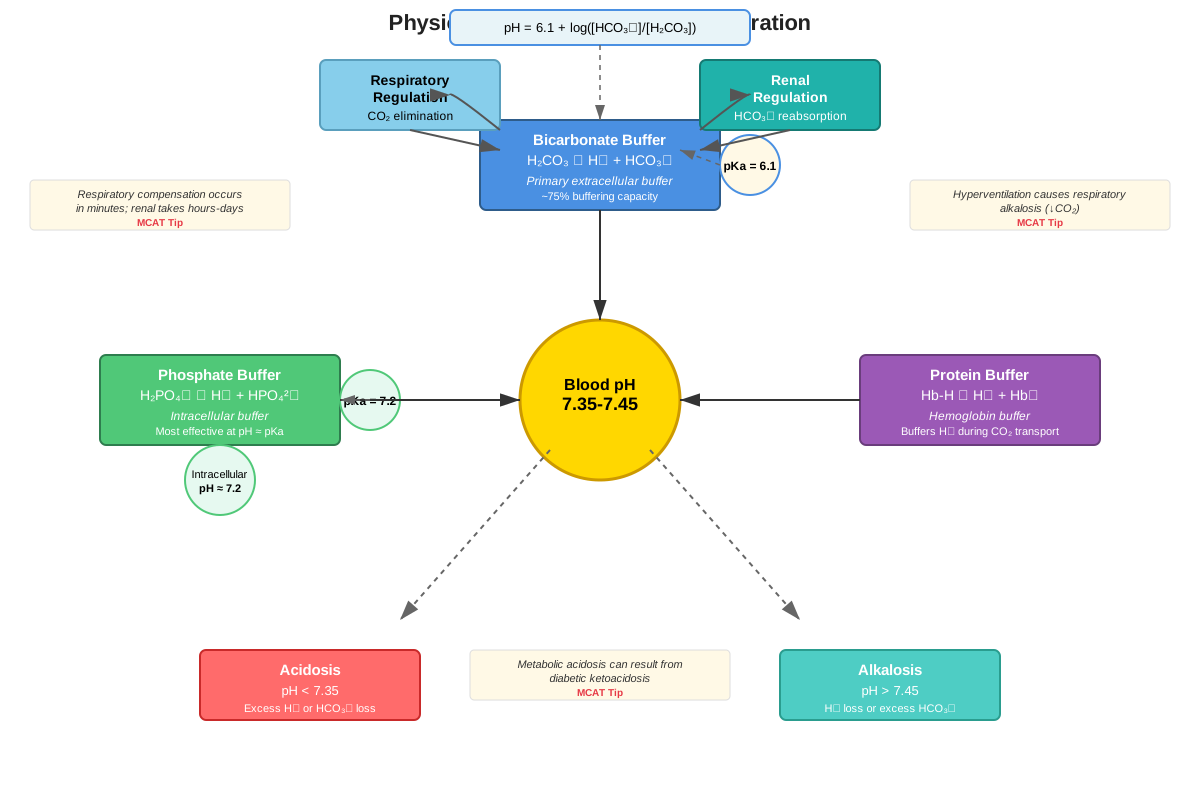
Buffers represent one of the most clinically significant topics in General Chemistry for medical professionals. Human blood maintains a narrow pH range of 7.35-7.45 through the bicarbonate buffer system (H₂CO₃/HCO₃⁻), and deviations outside this range cause acidosis or alkalosis—life-threatening conditions. Enzyme function, protein structure, and cellular metabolism all depend on precise pH control, making buffer systems fundamental to understanding human physiology and disease states.
On the MCAT, buffer questions appear with high frequency across multiple exam sections. Statistical analysis of recent MCAT exams indicates that buffer-related questions constitute approximately 3-5% of Chemical and Physical Foundations questions and appear in 10-15% of biochemistry passages. The exam tests buffers through direct calculation problems, conceptual questions about buffer selection for experiments, and integrated passages describing physiological pH regulation or laboratory protocols.
Common MCAT question formats include: (1) calculating buffer pH using the Henderson-Hasselbalch equation, (2) determining how pH changes when acid or base is added to a buffer, (3) selecting the appropriate buffer system for a target pH based on pKa values, (4) analyzing experimental passages where buffer choice affects enzyme activity or protein stability, and (5) interpreting titration curves to identify buffer regions. The exam frequently presents buffers in the context of blood gas analysis, renal physiology, respiratory compensation, and biochemical assay design—requiring integration of chemistry principles with biological applications.
Core Concepts
Definition and Composition of Buffer Systems
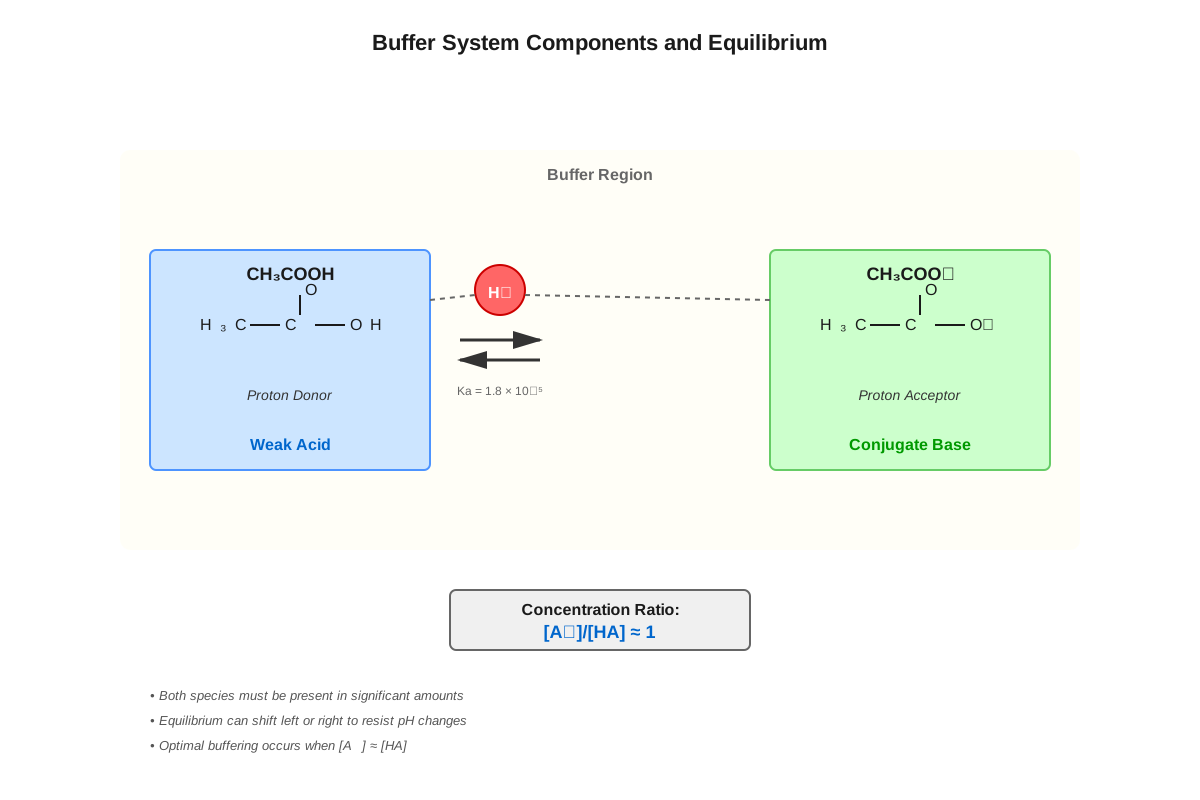
A buffer is an aqueous solution containing a weak acid and its conjugate base (or a weak base and its conjugate acid) that resists pH changes when small amounts of strong acid or strong base are added. The buffer system maintains pH stability through equilibrium reactions that consume added H⁺ or OH⁻ ions. For a weak acid buffer system, the equilibrium is:
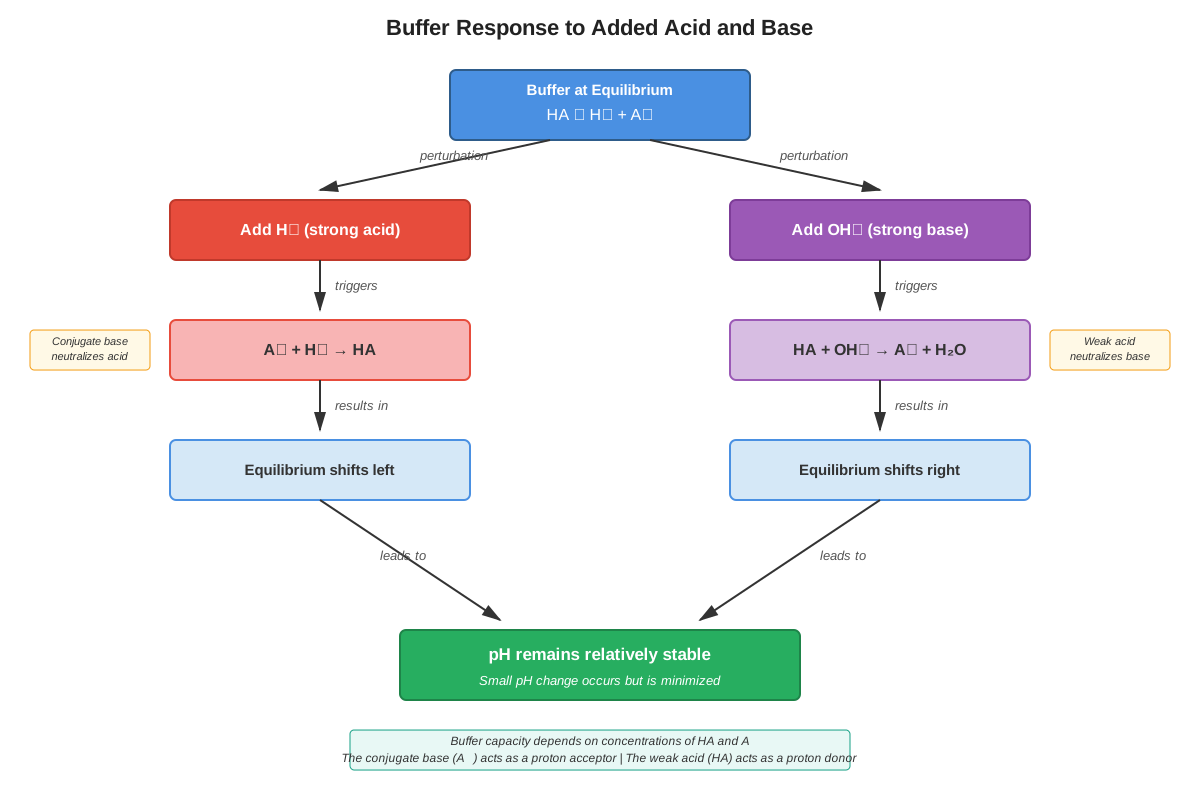
HA ⇌ H⁺ + A⁻Where HA represents the weak acid and A⁻ represents its conjugate base. When a strong acid (H⁺) is added to this buffer, the conjugate base (A⁻) neutralizes it: A⁻ + H⁺ → HA. When a strong base (OH⁻) is added, the weak acid neutralizes it: HA + OH⁻ → A⁻ + H₂O. This bidirectional neutralization capacity distinguishes buffers from simple weak acid or weak base solutions.
Effective buffers contain roughly equal concentrations of the weak acid and conjugate base components (typically within a 10:1 ratio). This composition ensures adequate capacity to neutralize both added acids and bases. Common buffer systems include acetic acid/acetate (CH₃COOH/CH₃COO⁻), phosphate buffer (H₂PO₄⁻/HPO₄²⁻), and the physiologically critical bicarbonate buffer (H₂CO₃/HCO₃⁻).
The Henderson-Hasselbalch Equation
The Henderson-Hasselbalch equation provides the mathematical relationship between buffer pH, the acid dissociation constant (pKa), and the ratio of conjugate base to weak acid concentrations:
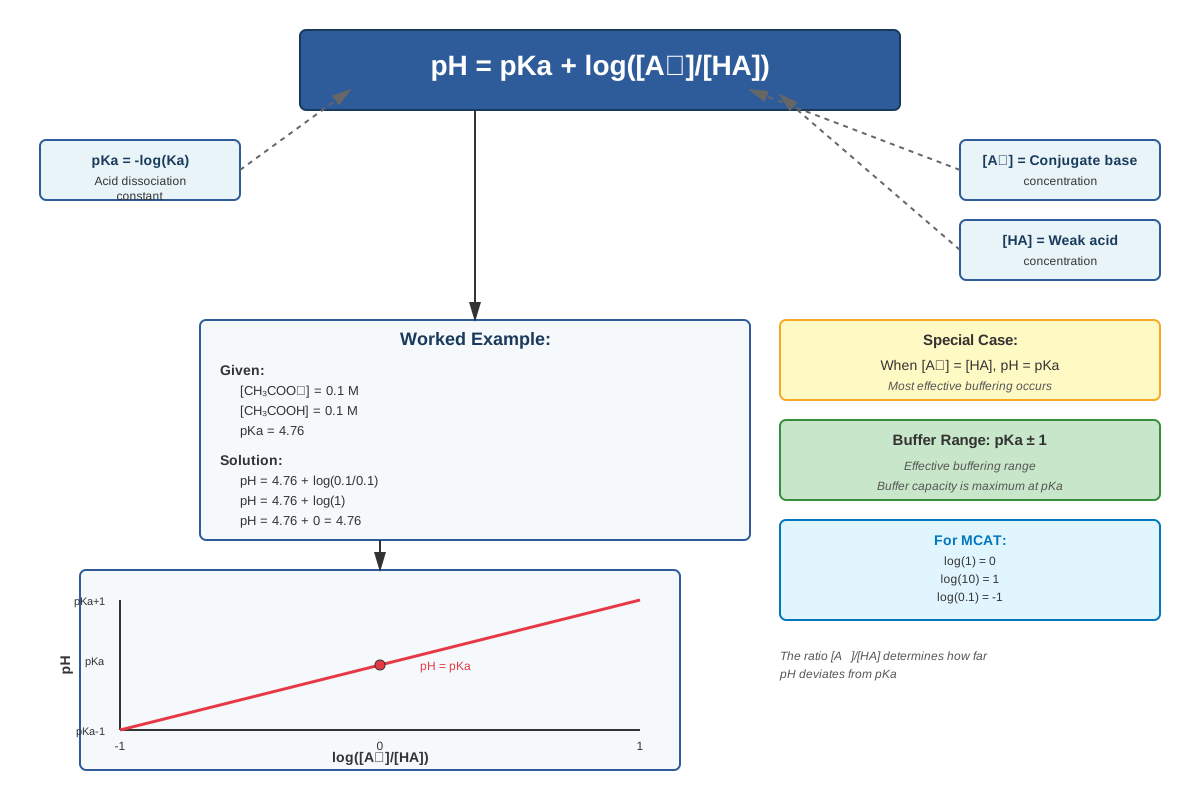
pH = pKa + log([A⁻]/[HA])This equation derives from the Ka expression and logarithmic manipulation. For a weak acid dissociation: Ka = [H⁺][A⁻]/[HA]. Taking the negative logarithm of both sides and rearranging yields the Henderson-Hasselbalch form. The equation reveals that when [A⁻] = [HA], the log term equals zero, and pH = pKa. This represents the optimal buffering point where the system has maximum capacity to neutralize both acids and bases.
The Henderson-Hasselbalch equation enables rapid pH calculations without solving quadratic equations. For MCAT purposes, students must recognize that the equation applies only to buffer systems (not to strong acids, strong bases, or solutions containing only a weak acid or only a weak base). The ratio [A⁻]/[HA] can be approximated as the ratio of moles or initial concentrations when the weak acid ionization is minimal (typically valid when the weak acid is not extremely dilute).
Buffer Capacity and Effective Range
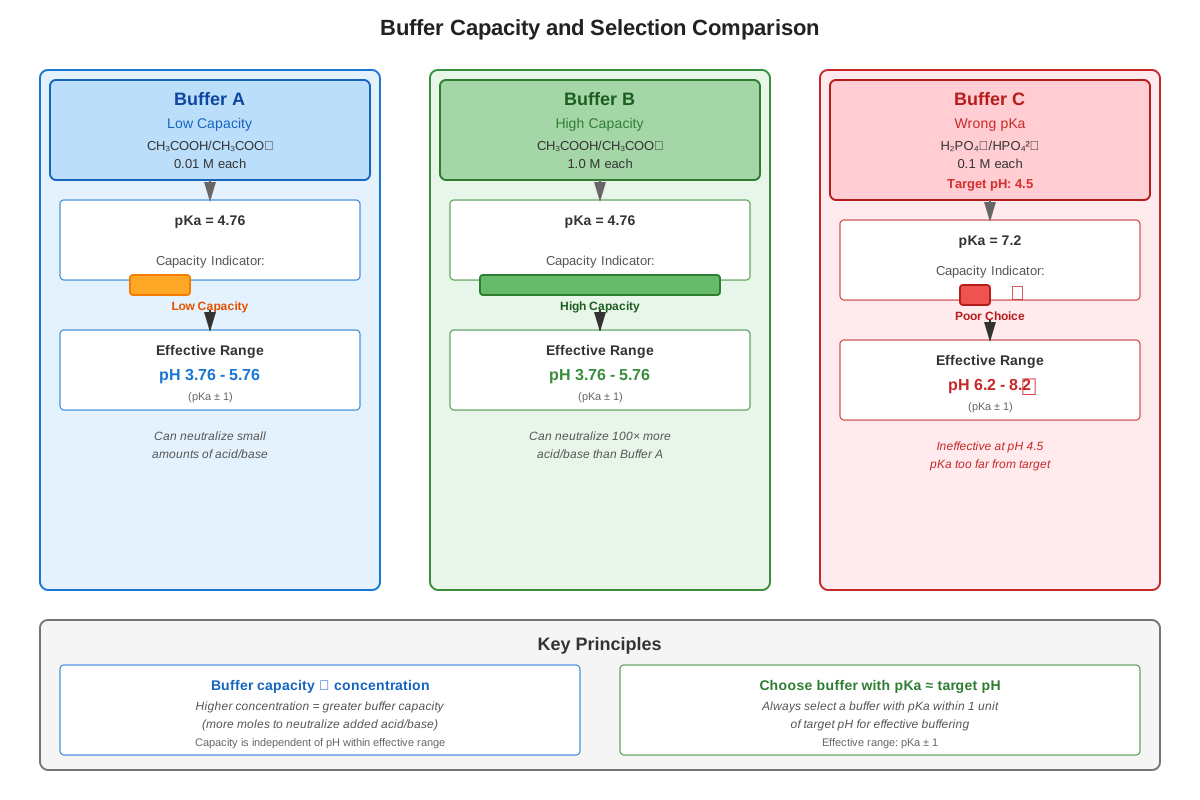
Buffer capacity quantifies the amount of acid or base a buffer can neutralize before experiencing significant pH change. Capacity depends on two factors: (1) the absolute concentrations of buffer components (higher concentrations provide greater capacity), and (2) the ratio of conjugate base to weak acid (optimal capacity occurs at a 1:1 ratio where pH = pKa).
The effective buffering range extends approximately ±1 pH unit from the pKa value. Within this range (pKa - 1 to pKa + 1), the buffer maintains relatively stable pH. Outside this range, the buffer components become too unbalanced to effectively neutralize added acid or base. This principle guides buffer selection: to maintain pH 7.4 in a biological system, choose a buffer with pKa near 7.4 (such as phosphate buffer with pKa₂ = 7.2).
When acid or base is added to a buffer, the pH change can be calculated by determining the new concentrations of buffer components after neutralization, then applying the Henderson-Hasselbalch equation. For example, adding 0.01 mol HCl to 1 L of buffer containing 0.10 M HA and 0.10 M A⁻ converts 0.01 mol A⁻ to HA, yielding [HA] = 0.11 M and [A⁻] = 0.09 M. The new pH = pKa + log(0.09/0.11) = pKa - 0.09.
Physiological Buffer Systems
The bicarbonate buffer system (H₂CO₃/HCO₃⁻) maintains blood pH at 7.4 despite continuous metabolic acid production. This system has unique properties: carbonic acid (H₂CO₃) exists in equilibrium with dissolved CO₂, which can be expelled through respiration. The equilibrium is:
CO₂(g) + H₂O ⇌ H₂CO₃ ⇌ H⁺ + HCO₃⁻The pKa of carbonic acid is 6.1, which appears suboptimal for buffering at pH 7.4 (outside the ideal ±1 pH unit range). However, the bicarbonate system functions effectively because: (1) the body maintains high HCO₃⁻ concentration (24 mM) relative to H₂CO₃ (1.2 mM), creating a 20:1 ratio that yields pH 7.4 via Henderson-Hasselbalch, and (2) the open system allows respiratory and renal compensation to adjust CO₂ and HCO₃⁻ levels independently.
The phosphate buffer system (H₂PO₄⁻/HPO₄²⁻) with pKa = 7.2 provides optimal buffering near physiological pH and functions primarily in intracellular fluid and urine. Protein buffers, particularly hemoglobin, contribute significantly to blood buffering through ionizable amino acid side chains (histidine residues with pKa ≈ 6.0).
Buffer Preparation Methods
Buffers can be prepared through two primary methods:
Method 1: Mixing a weak acid with its conjugate base salt
Directly combine solutions of the weak acid (e.g., acetic acid) and the salt containing its conjugate base (e.g., sodium acetate). Calculate the required ratio using Henderson-Hasselbalch to achieve the target pH.
Method 2: Partial neutralization of a weak acid or weak base
Start with a weak acid solution and add strong base (or start with weak base and add strong acid) until the desired pH is reached. At the half-equivalence point of a titration, pH = pKa because equal amounts of weak acid and conjugate base are present.
| Buffer Component | Function | Response to Added Acid | Response to Added Base |
|---|---|---|---|
| Weak Acid (HA) | Neutralizes added base | Concentration increases | Reacts: HA + OH⁻ → A⁻ + H₂O |
| Conjugate Base (A⁻) | Neutralizes added acid | Reacts: A⁻ + H⁺ → HA | Concentration increases |
Concept Relationships
Buffers integrate multiple foundational Acids and Bases concepts into a unified system. The weak acid-conjugate base pair exists in equilibrium, governed by the acid dissociation constant (Ka), which connects to pH through the Henderson-Hasselbalch equation. This relationship demonstrates how equilibrium principles (Le Châtelier's principle) manifest in pH stability: adding H⁺ shifts equilibrium toward the weak acid, while adding OH⁻ shifts toward the conjugate base, both changes being partially offset by the buffer components.
The common ion effect underlies buffer function—the presence of the conjugate base (common ion) suppresses ionization of the weak acid, and vice versa. This suppression maintains both species at significant concentrations, enabling the bidirectional neutralization capacity that defines buffers. Buffer capacity connects to stoichiometry and limiting reagent concepts: the buffer component present in smaller amount determines maximum neutralization capacity in that direction.
Titration curves reveal buffer behavior graphically. The flat region of a weak acid-strong base titration curve represents the buffer region, where pH changes minimally despite added base. The midpoint of this region (half-equivalence point) occurs at pH = pKa, the optimal buffering point. This connection helps students visualize buffer capacity and effective range.
Physiological buffer systems connect General Chemistry to biochemistry and physiology. The bicarbonate buffer links to respiratory physiology (CO₂ regulation), renal physiology (HCO₃⁻ reabsorption), and metabolic acid-base disorders. Protein buffers connect to amino acid chemistry and protein structure. These relationships make buffers a high-yield integration point for MCAT passages spanning multiple disciplines.
Concept Flow: Weak Acid/Base Equilibrium → Ka/Kb Values → Henderson-Hasselbalch Equation → Buffer pH Calculation → Buffer Capacity → Physiological pH Regulation → Clinical Acid-Base Disorders
Quick check — test yourself on Buffers so far.
Try Flashcards →High-Yield Facts
⭐ The Henderson-Hasselbalch equation is pH = pKa + log([A⁻]/[HA]), where [A⁻] is conjugate base concentration and [HA] is weak acid concentration
⭐ Buffers are most effective within ±1 pH unit of the pKa value of the weak acid component
⭐ When pH = pKa, the buffer contains equal concentrations of weak acid and conjugate base ([A⁻] = [HA]), representing maximum buffer capacity
⭐ Blood pH is maintained at 7.35-7.45 by the bicarbonate buffer system (H₂CO₃/HCO₃⁻) despite the pKa of 6.1 being outside the ideal range
⭐ Buffer capacity increases with higher absolute concentrations of buffer components, not just their ratio
- Adding strong acid to a buffer converts conjugate base to weak acid: A⁻ + H⁺ → HA
- Adding strong base to a buffer converts weak acid to conjugate base: HA + OH⁻ → A⁻ + H₂O
- The phosphate buffer system (H₂PO₄⁻/HPO₄²⁻) with pKa = 7.2 is ideal for buffering near physiological pH
- At the half-equivalence point of a weak acid titration, pH = pKa because [HA] = [A⁻]
- Buffers cannot be made from strong acids or strong bases because they completely dissociate and lack the equilibrium system required for buffering
- The bicarbonate buffer system is an "open" buffer because CO₂ can be expelled through respiration, allowing independent regulation of buffer components
- Diluting a buffer changes its capacity but not its pH (assuming the weak acid approximation remains valid)
Common Misconceptions
Misconception: Buffers prevent any pH change when acid or base is added.
Correction: Buffers resist pH change but do not prevent it entirely. They minimize pH change compared to unbuffered solutions. The pH will shift slightly when acid or base is added, with the magnitude depending on buffer capacity and the amount added.
Misconception: Any mixture of an acid and a base creates a buffer.
Correction: Buffers require a weak acid and its conjugate base (or weak base and its conjugate acid). Mixing a strong acid with a strong base produces a salt solution, not a buffer. Mixing a weak acid with an unrelated weak base does not create a conjugate pair and will not buffer effectively.
Misconception: The Henderson-Hasselbalch equation can be used for strong acid solutions.
Correction: The Henderson-Hasselbalch equation applies only to buffer systems containing a weak acid and its conjugate base. Strong acids completely dissociate, eliminating the equilibrium system required for the equation's validity. For strong acids, use pH = -log[H⁺] directly.
Misconception: A buffer with pKa = 7.0 cannot maintain pH 8.0.
Correction: While buffers are most effective within ±1 pH unit of pKa, they can maintain pH values outside this range if the ratio of conjugate base to weak acid is adjusted appropriately. At pH 8.0 with pKa 7.0, the Henderson-Hasselbalch equation requires [A⁻]/[HA] = 10:1. However, buffer capacity will be reduced because the components are unbalanced.
Misconception: Diluting a buffer by half will change its pH by half.
Correction: Diluting a buffer does not change its pH (assuming the weak acid approximation remains valid) because the ratio [A⁻]/[HA] remains constant—both concentrations decrease proportionally. However, dilution does decrease buffer capacity because the absolute concentrations of buffer components are reduced.
Misconception: The bicarbonate buffer system is ineffective because its pKa (6.1) is far from blood pH (7.4).
Correction: The bicarbonate buffer functions effectively despite the pKa difference because the body maintains a 20:1 ratio of HCO₃⁻ to H₂CO₃, which yields pH 7.4 via Henderson-Hasselbalch. Additionally, the open system allows respiratory and renal compensation to adjust buffer components independently, providing exceptional buffering capacity.
Worked Examples
Example 1: Calculating Buffer pH
Problem: A buffer solution contains 0.15 M acetic acid (CH₃COOH, pKa = 4.76) and 0.25 M sodium acetate (CH₃COO⁻). Calculate the pH of this buffer solution.
Solution:
Step 1: Identify the buffer components. This is a weak acid (acetic acid) and its conjugate base (acetate ion) buffer system.
Step 2: Apply the Henderson-Hasselbalch equation:
pH = pKa + log([A⁻]/[HA])Step 3: Substitute the given values:
- pKa = 4.76
- [A⁻] = [CH₃COO⁻] = 0.25 M
- [HA] = [CH₃COOH] = 0.15 M
pH = 4.76 + log(0.25/0.15)
pH = 4.76 + log(1.67)
pH = 4.76 + 0.22
pH = 4.98
Step 4: Interpret the result. The pH (4.98) is close to the pKa (4.76), confirming this is within the effective buffer range. The pH is slightly higher than pKa because the conjugate base concentration exceeds the weak acid concentration.
Connection to Learning Objectives: This example demonstrates application of the Henderson-Hasselbalch equation to calculate buffer pH, a fundamental skill for MCAT buffer questions.
Example 2: Buffer Response to Added Acid
Problem: A 1.0 L buffer solution contains 0.20 M NH₃ (Kb = 1.8 × 10⁻⁵, pKb = 4.74) and 0.20 M NH₄Cl. Calculate the pH after adding 0.05 mol of HCl to this buffer.
Solution:
Step 1: Recognize this is a weak base/conjugate acid buffer system. Convert pKb to pKa for the conjugate acid (NH₄⁺):
pKa + pKb = 14
pKa = 14 - 4.74 = 9.26
Step 2: Calculate initial pH using Henderson-Hasselbalch:
pH = pKa + log([NH₃]/[NH₄⁺])
pH = 9.26 + log(0.20/0.20)
pH = 9.26 + log(1)
pH = 9.26 + 0
pH = 9.26
Step 3: Determine how added HCl affects buffer components. HCl is a strong acid that will react completely with the weak base (NH₃):
NH₃ + H⁺ → NH₄⁺Step 4: Calculate new concentrations after neutralization:
- Initial moles NH₃ = 0.20 mol/L × 1.0 L = 0.20 mol
- Initial moles NH₄⁺ = 0.20 mol/L × 1.0 L = 0.20 mol
- Added H⁺ = 0.05 mol (from HCl)
After reaction:
- Moles NH₃ = 0.20 - 0.05 = 0.15 mol
- Moles NH₄⁺ = 0.20 + 0.05 = 0.25 mol
New concentrations (in 1.0 L):
- [NH₃] = 0.15 M
- [NH₄⁺] = 0.25 M
Step 5: Calculate new pH:
pH = 9.26 + log(0.15/0.25)
pH = 9.26 + log(0.60)
pH = 9.26 + (-0.22)
pH = 9.04
Step 6: Interpret the result. The pH decreased from 9.26 to 9.04, a change of only 0.22 pH units despite adding a significant amount of strong acid. Without the buffer, adding 0.05 mol HCl to 1.0 L water would produce pH = -log(0.05) = 1.3, demonstrating the buffer's effectiveness.
Connection to Learning Objectives: This example demonstrates predicting buffer pH changes when acid is added, requiring integration of stoichiometry, equilibrium concepts, and the Henderson-Hasselbalch equation—a common MCAT question format.
Exam Strategy
When approaching MCAT buffer questions, first identify whether the problem involves a buffer system by confirming the presence of both a weak acid and its conjugate base (or weak base and conjugate acid). Watch for trigger phrases like "buffer solution," "resist pH change," "mixture of weak acid and its salt," or experimental descriptions mentioning pH maintenance.
For calculation problems, immediately write the Henderson-Hasselbalch equation and identify the pKa value (often given directly or calculable from Ka using pKa = -log Ka). Determine whether the question asks for initial pH, pH after adding acid/base, or buffer selection for a target pH. When acid or base is added, always perform stoichiometry first to find new buffer component concentrations before applying Henderson-Hasselbalch.
Exam Tip: If a question asks about pH change after adding acid or base to a buffer, the answer will always be a small change (typically less than 1 pH unit). Eliminate answer choices showing dramatic pH shifts, as these indicate calculation errors or misidentification of the system as a buffer.
For conceptual questions about buffer selection, remember that optimal buffering occurs when pH = pKa. Eliminate buffer choices with pKa values more than 1-2 units away from the target pH. When comparing buffer capacity, higher concentrations always provide greater capacity, even if the ratio remains constant.
Process-of-elimination strategies for buffer questions:
- Eliminate choices suggesting buffers can be made from strong acids or strong bases
- Eliminate answers stating buffers completely prevent pH change
- Eliminate pH values outside the reasonable buffer range (pKa ± 2 units) unless extreme concentration ratios are specified
- For physiological questions, remember blood pH is 7.35-7.45 and the bicarbonate system is the primary buffer
Time allocation: Simple Henderson-Hasselbalch calculations should take 30-45 seconds. Problems involving added acid/base require stoichiometry and typically need 60-90 seconds. Passage-based questions integrating buffers with experimental design or physiology may require 2-3 minutes for full analysis.
Memory Techniques
Henderson-Hasselbalch Mnemonic: "Pretty Happy People Keep Adding Logs" reminds you that pH = pKa + log(ratio), with the ratio being [A⁻]/[HA] (conjugate base over weak acid).
Buffer Range Mnemonic: "Plus or Minus One" (PMO) reminds you that effective buffering occurs within pKa ± 1 pH unit.
Bicarbonate Buffer Visualization: Picture a seesaw with CO₂ on one side (controlled by lungs/breathing) and HCO₃⁻ on the other side (controlled by kidneys). This visualizes the open buffer system where respiratory and renal systems independently adjust components to maintain pH 7.4.
Buffer Response Acronym: "BAW" (Base Added → Weak acid consumed) and "AAC" (Acid Added → Conjugate base consumed) helps remember which buffer component reacts with added acid or base.
Optimal Buffer Memory: When pH = pKa, visualize a balanced scale with equal amounts of weak acid and conjugate base. This represents maximum buffer capacity and is the "sweet spot" for buffer function.
pKa Values to Memorize:
- Acetic acid: pKa ≈ 4.8 (remember "ACETIC = 5" for quick estimation)
- Carbonic acid: pKa = 6.1 (remember "BLOOD buffer is 6.1")
- Phosphate: pKa₂ = 7.2 (remember "PHOSPHATE = PHYSIOLOGICAL" since 7.2 is close to 7.4)
- Ammonium: pKa ≈ 9.3 (remember "AMMONIA = 9")
Summary
Buffers are aqueous solutions containing a weak acid and its conjugate base that resist pH changes through equilibrium-based neutralization of added acids or bases. The Henderson-Hasselbalch equation (pH = pKa + log([A⁻]/[HA])) provides the mathematical relationship between buffer pH, the acid dissociation constant, and component concentrations. Buffers function most effectively within ±1 pH unit of the weak acid's pKa value, with maximum capacity occurring when pH = pKa ([A⁻] = [HA]). Buffer capacity depends on both the absolute concentrations of components and their ratio. Physiologically, the bicarbonate buffer system maintains blood pH at 7.35-7.45 despite metabolic acid production, while phosphate and protein buffers contribute to intracellular pH regulation. For the MCAT, students must master pH calculations using Henderson-Hasselbalch, predict pH changes when acid or base is added to buffers, select appropriate buffer systems for target pH values, and understand the physiological significance of buffer systems in maintaining homeostasis. Buffer questions appear frequently across multiple MCAT sections, requiring integration of equilibrium principles, stoichiometry, logarithmic calculations, and biological applications.
Key Takeaways
- Buffers resist pH change through a weak acid-conjugate base equilibrium system that neutralizes added H⁺ or OH⁻ ions
- The Henderson-Hasselbalch equation (pH = pKa + log([A⁻]/[HA])) enables rapid buffer pH calculations without solving quadratic equations
- Effective buffering occurs within pKa ± 1 pH unit, with maximum capacity when pH = pKa and [A⁻] = [HA]
- Buffer capacity increases with higher absolute concentrations of buffer components, not just their ratio
- The bicarbonate buffer system (H₂CO₃/HCO₃⁻) maintains blood pH at 7.35-7.45 through respiratory and renal compensation mechanisms
- When acid is added to a buffer, the conjugate base is consumed; when base is added, the weak acid is consumed
- Buffer selection requires matching pKa to target pH for optimal buffering efficiency in experimental and physiological contexts
Related Topics
Acid-Base Titrations: Understanding titration curves reveals buffer regions graphically and connects to buffer capacity concepts. The flat portion of a weak acid-strong base titration represents the buffer region, with the half-equivalence point at pH = pKa.
Acid-Base Disorders: Clinical conditions like metabolic acidosis, respiratory alkalosis, and compensatory mechanisms directly apply buffer principles, particularly the bicarbonate system. Mastering buffers enables understanding of blood gas analysis and pH homeostasis.
Enzyme Kinetics: Enzyme activity depends critically on pH, making buffer selection essential for biochemical assays. Understanding buffers connects to optimal pH for enzyme function and experimental design in biochemistry passages.
Amino Acids and Proteins: Amino acids act as zwitterionic buffers with multiple pKa values. Protein buffers, particularly hemoglobin, contribute significantly to physiological pH regulation through ionizable side chains.
Solubility Equilibria: The common ion effect that underlies buffer function also affects solubility of salts. Understanding how equilibrium shifts in buffer systems transfers to predicting precipitation and dissolution.
Practice CTA
Now that you've mastered the core concepts of buffers, it's time to solidify your understanding through active practice. Attempt the practice questions to test your ability to apply the Henderson-Hasselbalch equation, predict buffer behavior, and solve integrated problems combining buffers with physiological contexts. Use the flashcards to reinforce high-yield facts, pKa values, and key relationships. Remember that buffer questions on the MCAT reward both computational accuracy and conceptual understanding—practice both calculation problems and passage-based questions to build comprehensive mastery. Your ability to quickly identify buffer systems, select appropriate approaches, and avoid common misconceptions will directly translate to points on test day. Keep pushing forward—you're building the foundation for success in both General Chemistry and the biological sciences!
Sign up free to keep reading
Create a free AnvayaPrep account to finish this MCAT guide on Buffers — plus flashcards and practice questions.