Overview
Solubility is a fundamental concept in General Chemistry that describes the maximum amount of a substance (solute) that can dissolve in a given amount of solvent at a specific temperature and pressure to form a homogeneous mixture called a solution. This topic sits at the intersection of thermodynamics, intermolecular forces, and equilibrium chemistry, making it essential for understanding how substances interact in biological and chemical systems. For the MCAT, solubility principles appear across multiple contexts: from predicting whether a precipitate will form in a biochemical pathway to understanding drug absorption in physiological systems.
Solubility MCAT questions frequently test the ability to predict dissolution behavior based on molecular structure, apply solubility rules to ionic compounds, calculate concentrations using the solubility product constant (Ksp), and understand how environmental factors like temperature and pH affect dissolution. The topic bridges multiple areas of General Chemistry, including acid-base chemistry, equilibrium, and thermodynamics, while also connecting to organic chemistry concepts like polarity and intermolecular forces. Mastering solubility enables students to tackle complex passage-based questions that integrate chemical principles with biological applications.
Within the broader context of Solutions and Phase Behavior, solubility represents the quantitative limit of the solution formation process. Understanding this limit—and the factors that influence it—provides insight into phase transitions, colligative properties, and the dynamic equilibrium between dissolved and undissolved species. This knowledge forms the foundation for more advanced topics in physical chemistry and biochemistry that appear throughout the MCAT.
Learning Objectives
- [ ] Define Solubility using accurate General Chemistry terminology
- [ ] Explain why Solubility matters for the MCAT
- [ ] Apply Solubility to exam-style questions
- [ ] Identify common mistakes related to Solubility
- [ ] Connect Solubility to related General Chemistry concepts
- [ ] Calculate the solubility of ionic compounds using Ksp values and predict precipitation reactions
- [ ] Predict relative solubilities based on molecular structure, polarity, and intermolecular forces
- [ ] Analyze how temperature, pressure, pH, and common ion effects influence solubility quantitatively and qualitatively
Prerequisites
- Intermolecular forces (hydrogen bonding, dipole-dipole, London dispersion): Essential for understanding "like dissolves like" and predicting solubility based on molecular structure
- Molarity and concentration units: Required for expressing solubility quantitatively and performing Ksp calculations
- Chemical equilibrium and equilibrium constants: Solubility equilibria follow the same principles as other equilibrium systems
- Ionic compounds and nomenclature: Necessary for applying solubility rules and writing dissolution equations
- Thermodynamics basics (enthalpy, entropy, Gibbs free energy): Dissolution is a thermodynamic process driven by ΔG
Why This Topic Matters
Solubility principles have profound clinical and real-world significance. Kidney stone formation results from precipitation of calcium oxalate or uric acid when their concentrations exceed solubility limits in urine. Drug formulation depends critically on solubility—medications must dissolve sufficiently to be absorbed but remain stable in storage. Atherosclerosis involves cholesterol precipitation in arterial walls when local concentrations exceed solubility in the lipid environment. Environmental chemistry relies on solubility to predict pollutant behavior in water systems and soil.
On the MCAT, solubility appears in approximately 3-5% of Chemical and Physical Foundations questions, typically at medium difficulty. Questions may appear as discrete items testing solubility rules or Ksp calculations, but more commonly emerge within passages about biological systems, pharmaceutical chemistry, or environmental science. The MCAT frequently integrates solubility with acid-base equilibria (testing how pH affects solubility of weak acids/bases), Le Châtelier's principle (common ion effect), and thermodynamics (temperature dependence).
Common exam presentations include: passage-based questions about drug dissolution and bioavailability; discrete questions requiring Ksp calculations to predict precipitation; experimental passages analyzing factors affecting crystallization; and biochemistry passages where solubility determines protein aggregation or membrane permeability. The ability to quickly apply solubility rules and recognize when precipitation occurs gives students a significant advantage on time-pressured exam questions.
Core Concepts
Definition and Fundamental Principles
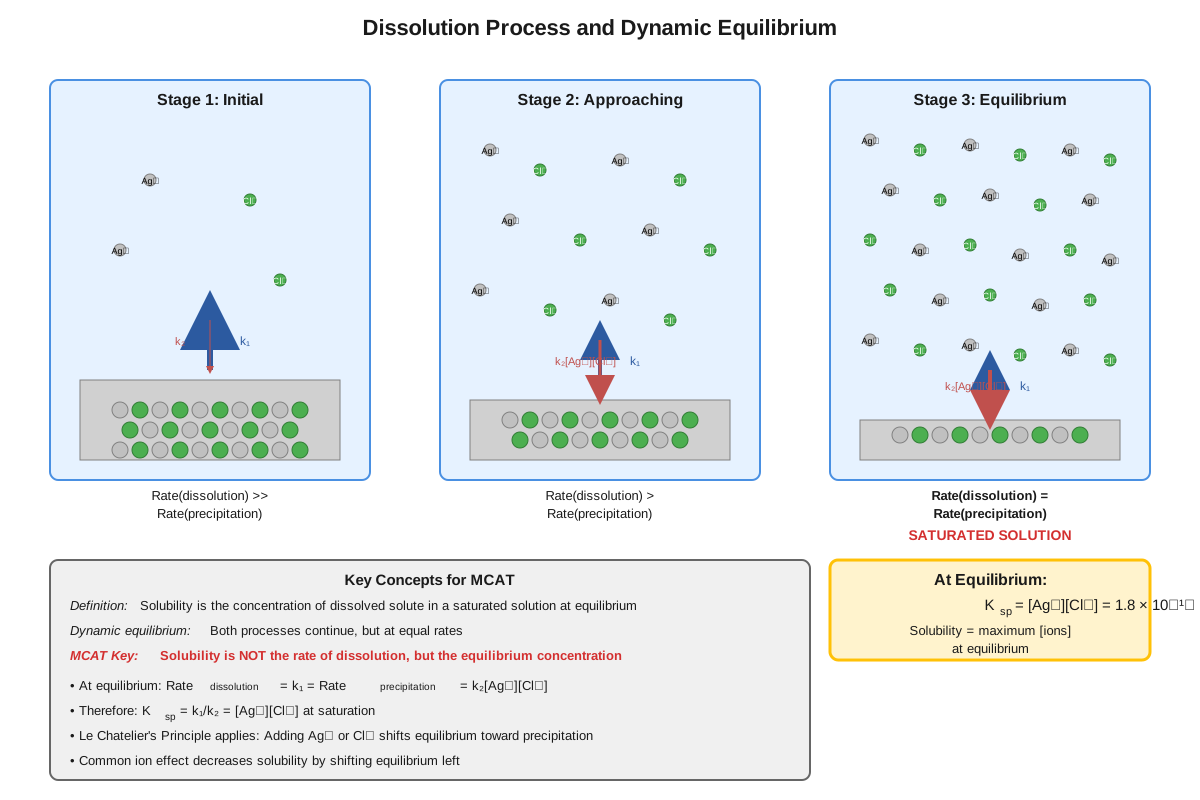
Solubility is defined as the maximum concentration of solute that can dissolve in a solvent at equilibrium under specified conditions (temperature and pressure), typically expressed in grams per 100 mL of solvent (g/100 mL), molarity (mol/L), or mole fraction. When a solution contains the maximum amount of dissolved solute, it is saturated; solutions containing less are unsaturated, while those containing more (a metastable state) are supersaturated.
The dissolution process involves breaking solute-solute interactions and solvent-solvent interactions, then forming new solute-solvent interactions. The thermodynamic favorability depends on the Gibbs free energy change: ΔG = ΔH - TΔS. Dissolution occurs spontaneously when ΔG < 0, which can result from either favorable enthalpy (exothermic dissolution, ΔH < 0) or favorable entropy (increased disorder, ΔS > 0), or both.
The "Like Dissolves Like" Principle
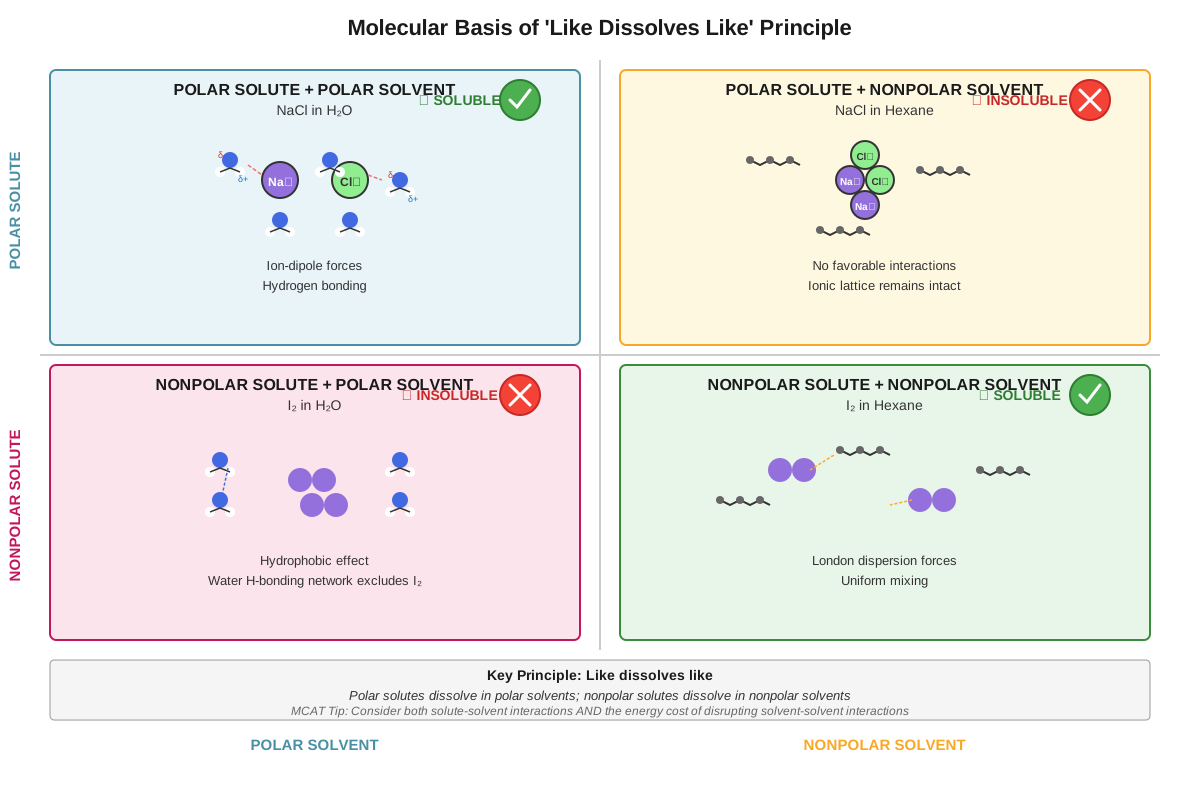
The most fundamental predictive rule in solubility is that polar solvents dissolve polar solutes, and nonpolar solvents dissolve nonpolar solutes. This principle derives from the requirement that solute-solvent interactions must be comparable in strength to the interactions being broken. Water, a highly polar solvent with strong hydrogen bonding capability, readily dissolves ionic compounds and polar molecules. Nonpolar solvents like hexane or benzene dissolve nonpolar substances like lipids and hydrocarbons.
For molecular solutes, polarity depends on both bond polarity and molecular geometry. A molecule with polar bonds may be nonpolar overall if the geometry is symmetrical (e.g., CO₂, CCl₄). Conversely, asymmetric molecules with polar bonds (e.g., H₂O, NH₃, CH₃OH) are polar and water-soluble. The presence of functional groups capable of hydrogen bonding (–OH, –NH₂, –COOH) dramatically increases water solubility.
Solubility Rules for Ionic Compounds
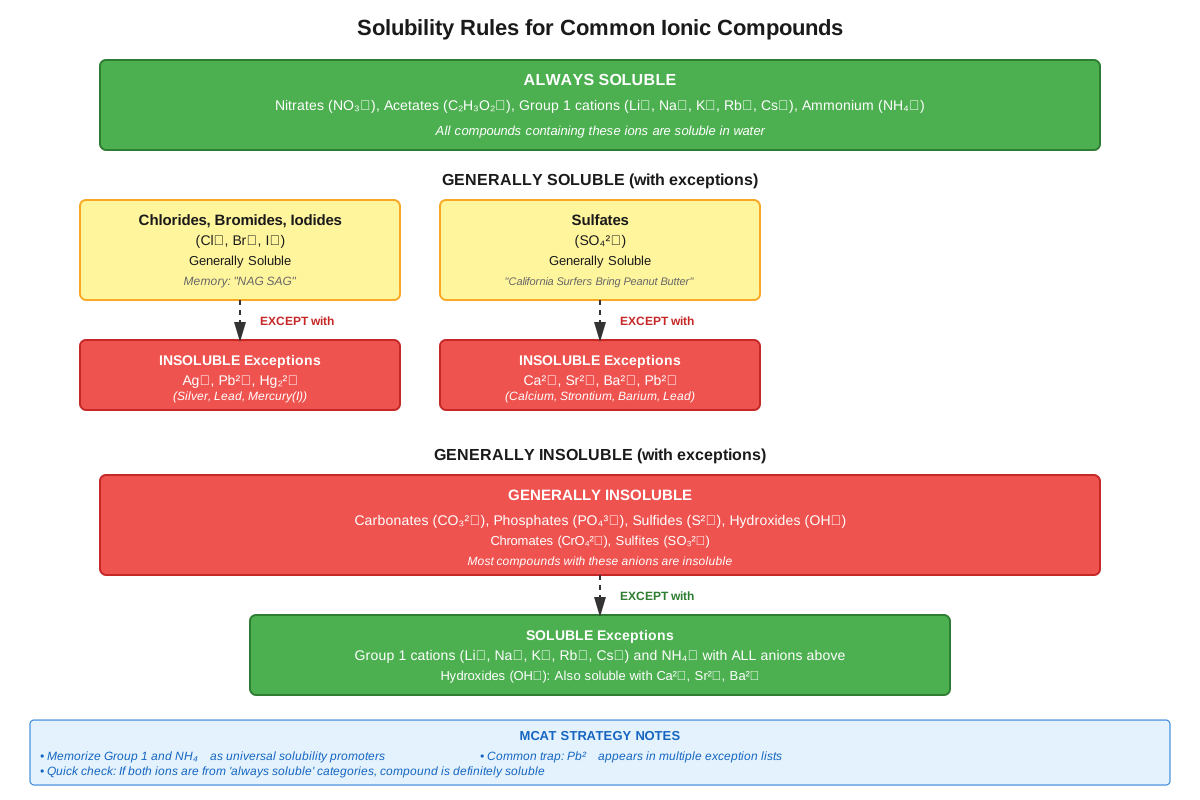
For ionic compounds in water, empirical solubility rules predict whether a compound will dissolve appreciably:
| Ion Type | Solubility | Exceptions |
|---|---|---|
| Group 1 (Li⁺, Na⁺, K⁺, etc.) and NH₄⁺ | Soluble | None |
| Nitrates (NO₃⁻), acetates (C₂H₃O₂⁻), perchlorates (ClO₄⁻) | Soluble | None |
| Chlorides (Cl⁻), bromides (Br⁻), iodides (I⁻) | Soluble | Ag⁺, Pb²⁺, Hg₂²⁺ |
| Sulfates (SO₄²⁻) | Soluble | Ca²⁺, Sr²⁺, Ba²⁺, Pb²⁺ |
| Carbonates (CO₃²⁻), phosphates (PO₄³⁻), sulfides (S²⁻), hydroxides (OH⁻) | Insoluble | Group 1 cations and Ba²⁺ (for OH⁻, also Ca²⁺ is slightly soluble) |
These rules allow rapid prediction of precipitation reactions. When two aqueous solutions mix, if any combination of cations and anions produces an insoluble compound, a precipitate forms.
Solubility Product Constant (Ksp)
For sparingly soluble ionic compounds, the solubility product constant (Ksp) quantifies the equilibrium between the solid and its dissolved ions. For a generic salt MₐXᵦ:
MₐXᵦ(s) ⇌ aM^(b+)(aq) + bX^(a-)(aq)
Ksp = [M^(b+)]^a[X^(a-)]^b
The Ksp expression includes only aqueous species; the solid does not appear because its activity is 1. A larger Ksp indicates greater solubility. For example:
- AgCl: Ksp = 1.8 × 10⁻¹⁰ (sparingly soluble)
- PbCl₂: Ksp = 1.7 × 10⁻⁵ (more soluble than AgCl)
- NaCl: Ksp >> 1 (highly soluble, Ksp not typically used)
To calculate molar solubility from Ksp, set up an ICE table. For AgCl dissolving in pure water:
AgCl(s) ⇌ Ag⁺(aq) + Cl⁻(aq)
Initial: solid, 0, 0
Change: -, +s, +s
Equilibrium: solid, s, s
Ksp = [Ag⁺][Cl⁻] = s² = 1.8 × 10⁻¹⁰
s = 1.3 × 10⁻⁵ M
The Common Ion Effect
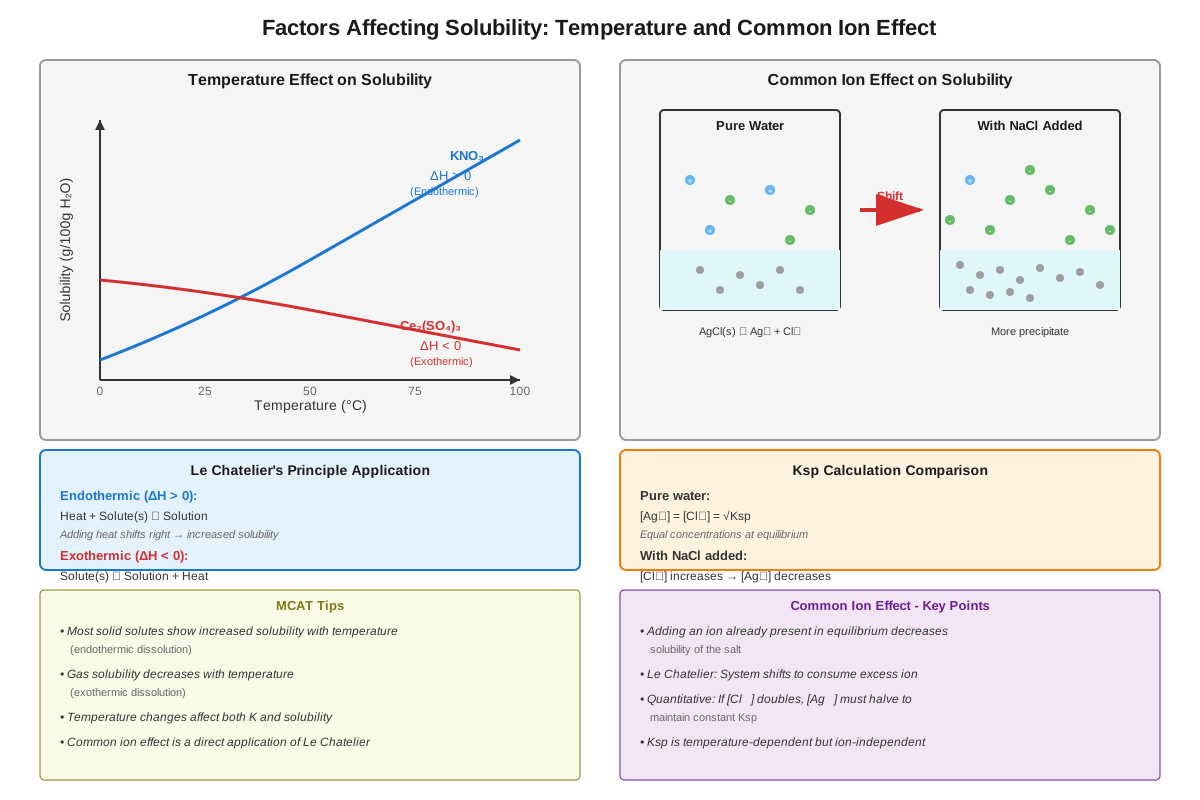
The common ion effect describes the decrease in solubility of an ionic compound when a soluble salt containing one of its ions is added to the solution. This phenomenon follows Le Châtelier's principle: adding a product shifts equilibrium toward reactants (the solid), decreasing solubility.
For example, AgCl is less soluble in 0.1 M NaCl than in pure water because the added Cl⁻ shifts the equilibrium:
AgCl(s) ⇌ Ag⁺(aq) + Cl⁻(aq)If Cl⁻] = 0.1 M initially, then Ksp = [Ag⁺ = 1.8 × 10⁻¹⁰, so [Ag⁺] = 1.8 × 10⁻⁹ M, much less than the 1.3 × 10⁻⁵ M in pure water.
Temperature Dependence
Solubility typically increases with temperature for most solid solutes in liquid solvents, though exceptions exist (e.g., Ce₂(SO₄)₃ becomes less soluble as temperature increases). The temperature dependence relates to the enthalpy of dissolution:
- Endothermic dissolution (ΔH > 0): Solubility increases with temperature (heat is a "reactant")
- Exothermic dissolution (ΔH < 0): Solubility decreases with temperature (heat is a "product")
For gases dissolving in liquids, solubility almost always decreases with increasing temperature because gas dissolution is typically exothermic. This explains why carbonated beverages go flat when warm—CO₂ becomes less soluble at higher temperatures.
Pressure Effects and Henry's Law
Pressure significantly affects gas solubility but has negligible effect on solid or liquid solubility. Henry's Law states that the solubility of a gas in a liquid is directly proportional to the partial pressure of that gas above the liquid:
C = kH × PWhere C is the concentration of dissolved gas, P is the partial pressure, and kH is Henry's law constant (specific to each gas-solvent pair at a given temperature). This principle explains decompression sickness in divers: nitrogen dissolves in blood at high pressure underwater, then forms bubbles when pressure decreases too rapidly during ascent.
pH Effects on Solubility
The solubility of ionic compounds containing basic anions (like OH⁻, CO₃²⁻, PO₄³⁻, S²⁻) or acidic cations increases dramatically in acidic solutions. This occurs because H⁺ reacts with the basic anion, removing it from solution and shifting the dissolution equilibrium forward.
For example, calcium carbonate (CaCO₃) is sparingly soluble in neutral water but dissolves readily in acid:
CaCO₃(s) ⇌ Ca²⁺(aq) + CO₃²⁻(aq)
CO₃²⁻(aq) + 2H⁺(aq) → H₂CO₃(aq) → H₂O(l) + CO₂(g)
The removal of CO₃²⁻ by protonation drives dissolution forward. This principle explains why acidic rain dissolves limestone buildings and why stomach acid helps dissolve calcium supplements.
Predicting Precipitation
To predict whether precipitation occurs when solutions mix, calculate the ion product (Q) and compare it to Ksp:
- If Q < Ksp: Solution is unsaturated; no precipitate forms
- If Q = Ksp: Solution is saturated; at equilibrium
- If Q > Ksp: Solution is supersaturated; precipitate forms until Q = Ksp
For example, if 100 mL of 0.001 M AgNO₃ mixes with 100 mL of 0.001 M NaCl:
After mixing: [Ag⁺] = [Cl⁻] = 0.0005 M (diluted by half)
Q = (0.0005)(0.0005) = 2.5 × 10⁻⁷
Since Q (2.5 × 10⁻⁷) > Ksp (1.8 × 10⁻¹⁰), AgCl precipitates.
Concept Relationships
The core concepts within solubility form an interconnected network. The fundamental "like dissolves like" principle → determines which solute-solvent combinations are favorable → which connects to intermolecular forces (prerequisite knowledge). For ionic compounds, solubility rules → provide qualitative predictions → which are quantified by Ksp values → enabling precipitation calculations using Q vs. Ksp comparisons.
Environmental factors modify these baseline solubilities: the common ion effect → decreases solubility by shifting equilibrium (Le Châtelier's principle) → connecting to chemical equilibrium concepts. Temperature → affects solubility through thermodynamic principles (ΔH of dissolution) → linking to thermodynamics. For gases, pressure → determines solubility via Henry's Law → connecting to gas laws. pH → affects solubility of salts with basic anions or acidic cations → bridging to acid-base chemistry.
These solubility concepts connect to broader General Chemistry topics: equilibrium (Ksp is an equilibrium constant), thermodynamics (ΔG determines spontaneity of dissolution), kinetics (dissolution rate vs. solubility limit), and acid-base chemistry (pH effects). In Solutions and Phase Behavior, solubility → defines the limit of solution formation → which affects colligative properties → and relates to phase diagrams showing solid-liquid equilibria.
Quick check — test yourself on Solubility so far.
Try Flashcards →High-Yield Facts
⭐ Solubility rules: All Group 1 salts and NH₄⁺ salts are soluble; all nitrates, acetates, and perchlorates are soluble; carbonates, phosphates, sulfides, and hydroxides are generally insoluble except with Group 1 cations.
⭐ Ksp expression: For MₐXᵦ(s) ⇌ aM^(b+) + bX^(a-), Ksp = [M^(b+)]^a[X^(a-)]^b; solids are excluded from the expression.
⭐ Common ion effect: Adding a common ion decreases solubility by shifting equilibrium toward the solid phase (Le Châtelier's principle).
⭐ Precipitation prediction: Calculate Q = [cation]^a[anion]^b; if Q > Ksp, precipitation occurs; if Q < Ksp, no precipitation.
⭐ Temperature and solid solubility: Most solids become more soluble at higher temperatures (endothermic dissolution); gases become less soluble at higher temperatures.
- Henry's Law: Gas solubility is directly proportional to partial pressure (C = kH × P); explains decompression sickness and carbonation.
- pH and solubility: Salts with basic anions (CO₃²⁻, PO₄³⁻, S²⁻, OH⁻) become more soluble in acidic solutions due to protonation of the anion.
- "Like dissolves like": Polar solvents dissolve polar/ionic solutes; nonpolar solvents dissolve nonpolar solutes; based on similar intermolecular forces.
- Molar solubility calculation: For a 1:1 salt like AgCl, if Ksp = s², then s = √Ksp; for other stoichiometries, account for coefficients.
- Supersaturation: A metastable state where Q > Ksp but precipitation hasn't occurred; requires nucleation site or disturbance to initiate crystallization.
Common Misconceptions
Misconception: Ksp values can be directly compared to determine relative solubilities for any two salts.
Correction: Ksp values can only be directly compared for salts with the same stoichiometry (e.g., both 1:1 salts). For different stoichiometries, you must calculate molar solubility. For example, AgCl (Ksp = 1.8 × 10⁻¹⁰, s = 1.3 × 10⁻⁵ M) vs. Ag₂CrO₄ (Ksp = 1.1 × 10⁻¹², s = 6.5 × 10⁻⁵ M)—despite the smaller Ksp, Ag₂CrO₄ is actually more soluble.
Misconception: Insoluble means absolutely nothing dissolves.
Correction: "Insoluble" is a relative term meaning very low solubility, not zero. Even "insoluble" compounds like AgCl have measurable Ksp values and dissolve to a small extent. The distinction between soluble and insoluble is practical, not absolute.
Misconception: Adding more solid to a saturated solution increases the concentration of dissolved ions.
Correction: In a saturated solution at equilibrium, adding more solid does not change the concentration of dissolved ions (which equals the solubility). The system is already at equilibrium; excess solid simply remains undissolved.
Misconception: Increasing pressure always increases solubility.
Correction: Pressure significantly affects only gas solubility (Henry's Law). For solids and liquids dissolving in liquids, pressure changes have negligible effects because condensed phases are incompressible.
Misconception: All salts become more soluble at higher temperatures.
Correction: While most salts show increased solubility with temperature (endothermic dissolution), some salts like Ce₂(SO₄)₃ and Ca(OH)₂ become less soluble at higher temperatures (exothermic dissolution). Always consider the sign of ΔH for dissolution.
Misconception: The common ion effect applies only to the cation or only to the anion.
Correction: The common ion effect applies to whichever ion is added in excess, whether cation or anion. Adding either Ag⁺ (from AgNO₃) or Cl⁻ (from NaCl) will decrease the solubility of AgCl.
Worked Examples
Example 1: Calculating Solubility from Ksp
Question: The Ksp of lead(II) iodide (PbI₂) is 7.1 × 10⁻⁹ at 25°C. Calculate the molar solubility of PbI₂ in pure water.
Solution:
Step 1: Write the balanced dissolution equation.
PbI₂(s) ⇌ Pb²⁺(aq) + 2I⁻(aq)Step 2: Write the Ksp expression.
Ksp = [Pb²⁺][I⁻]² = 7.1 × 10⁻⁹Step 3: Set up an ICE table. Let s = molar solubility of PbI₂.
         PbI₂(s) ⇌ Pb²⁺  +  2I⁻
Initial:  solid     0       0
Change:    -        +s      +2s
Equil:    solid     s       2s
Step 4: Substitute into Ksp expression.
Ksp = (s)(2s)² = 4s³ = 7.1 × 10⁻⁹
s³ = 1.775 × 10⁻⁹
s = 1.2 × 10⁻³ MAnswer: The molar solubility of PbI₂ is 1.2 × 10⁻³ M or 1.2 mM.
Key insight: Notice the stoichiometric coefficient of 2 for I⁻ creates a 4s³ term, not s². This demonstrates why Ksp values cannot be directly compared for salts with different stoichiometries—you must calculate actual molar solubility.
Example 2: Predicting Precipitation with Common Ion Effect
Question: Will a precipitate form if 50.0 mL of 0.0020 M AgNO₃ is mixed with 50.0 mL of 0.0040 M MgCl₂? (Ksp of AgCl = 1.8 × 10⁻¹⁰)
Solution:
Step 1: Determine the concentrations after mixing (total volume = 100 mL).
[Ag⁺] = (0.0020 M)(50.0 mL)/(100 mL) = 0.0010 M
[Cl⁻] = (0.0040 M × 2)(50.0 mL)/(100 mL) = 0.0040 M
Note: MgCl₂ provides 2 moles of Cl⁻ per mole of MgCl₂.
Step 2: Calculate the ion product Q.
Q = [Ag⁺][Cl⁻] = (0.0010)(0.0040) = 4.0 × 10⁻⁶Step 3: Compare Q to Ksp.
Q (4.0 × 10⁻⁶) > Ksp (1.8 × 10⁻¹⁰)Answer: Yes, AgCl will precipitate because Q > Ksp.
Step 4 (optional): Calculate how much Ag⁺ remains in solution after precipitation.
After precipitation, the solution reaches equilibrium where Q = Ksp. Since Cl⁻ is in large excess, assume [Cl⁻] ≈ 0.0040 M (barely changes).
Ksp = [Ag⁺][Cl⁻]
1.8 × 10⁻¹⁰ = [Ag⁺](0.0040)
[Ag⁺] = 4.5 × 10⁻⁸ M
This demonstrates the common ion effect: the excess Cl⁻ dramatically reduces Ag⁺ solubility from 1.3 × 10⁻⁵ M (in pure water) to 4.5 × 10⁻⁸ M.
Exam Strategy
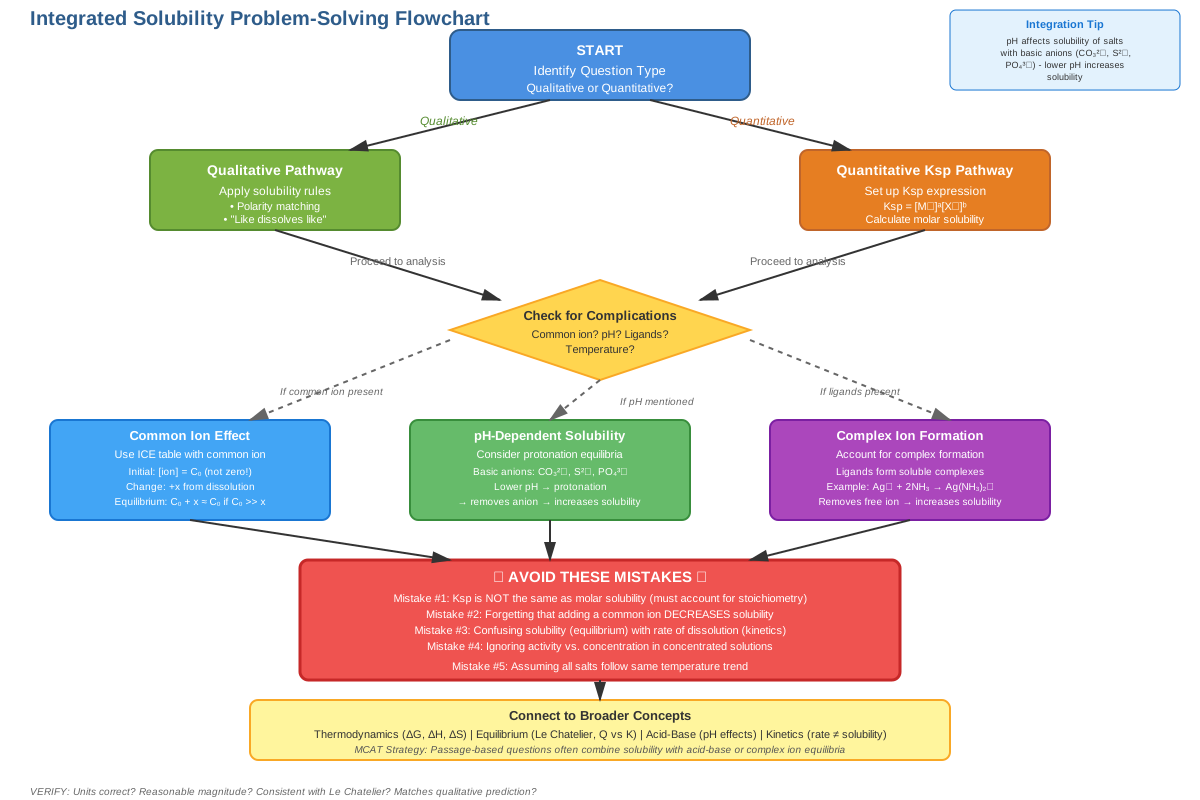
When approaching Solubility MCAT questions, first identify the question type: qualitative prediction (solubility rules, "like dissolves like"), quantitative calculation (Ksp, molar solubility), or precipitation prediction (Q vs. Ksp). This determines your strategy.
Trigger words to recognize:
- "Precipitate forms" or "cloudy solution" → precipitation reaction, use Q vs. Ksp
- "Saturated solution" → at equilibrium, [ions] determined by Ksp
- "Common ion" or "in the presence of" → common ion effect, decreased solubility
- "More soluble in acid" → salt with basic anion, pH effect
- "Increasing temperature" → consider ΔH of dissolution
- "Partial pressure" or "gas dissolves" → Henry's Law
Process-of-elimination tips:
- For solubility rule questions, eliminate answers that violate the "all Group 1 and NH₄⁺ salts are soluble" rule first—this is absolute.
- When comparing Ksp values, if the salts have different stoichiometries, eliminate answers that directly compare Ksp without calculating molar solubility.
- For precipitation questions, if both ions are very dilute (< 10⁻⁴ M), precipitation is unlikely even for sparingly soluble salts—eliminate "precipitate forms" answers.
- If a question mentions adding acid to a solution, eliminate answers suggesting decreased solubility for salts with basic anions.
Time allocation: Discrete solubility rule questions should take 30-45 seconds—memorize the rules for instant recall. Ksp calculations require 60-90 seconds; set up the ICE table quickly and don't waste time on excessive significant figures. Passage-based questions integrating solubility with other concepts may require 90-120 seconds; read carefully to identify which principle applies.
Common trap: Questions may provide Ksp and ask for solubility in g/L instead of mol/L. Don't forget the final conversion using molar mass. Another trap: providing concentrations before mixing in a precipitation problem—always calculate concentrations after mixing (accounting for dilution) before calculating Q.
Memory Techniques
Solubility Rules Mnemonic - "NAG SAG":
- Nitrates, Acetates, Group 1 → Always Soluble
- Sulfates Are Generally soluble (except Ca²⁺, Sr²⁺, Ba²⁺, Pb²⁺)
For insoluble anions - "COPS":
- Carbonates, Oxides (and hydroxides), Phosphates, Sulfides → Generally Insoluble (except Group 1)
Halide exceptions - "Silver Leads to Mercury":
- Silver (Ag⁺), Lead (Pb²⁺), Mercury (Hg₂²⁺) → form insoluble chlorides, bromides, iodides
Temperature effects visualization: Picture a hot cup of tea dissolving sugar faster (most solids) vs. a warm soda going flat (gases). Heat helps solids dissolve but drives gases out.
Q vs. Ksp decision tree:
- Q < Ksp → "Quotient Lacks" → solution can dissolve more (unsaturated)
- Q = Ksp → "Quotient Equals" → at equilibrium (saturated)
- Q > Ksp → "Quotient Exceeds" → precipitation occurs (supersaturated)
Common ion effect: Visualize Le Châtelier's principle as a seesaw—adding product (ions) tips the balance toward reactants (solid), decreasing solubility.
Henry's Law: "Pressure Pushes gas into solution"—higher pressure forces more gas molecules into the liquid phase.
Summary
Solubility represents the maximum concentration of solute that dissolves in a solvent at equilibrium, governed by thermodynamic principles (ΔG = ΔH - TΔS) and the "like dissolves like" rule based on intermolecular forces. For ionic compounds, empirical solubility rules provide qualitative predictions, while the solubility product constant (Ksp) enables quantitative calculations of molar solubility and precipitation predictions by comparing the ion product (Q) to Ksp. The common ion effect decreases solubility by shifting equilibrium toward the solid phase. Temperature generally increases solid solubility (for endothermic dissolution) but decreases gas solubility. Pressure affects only gas solubility according to Henry's Law (C = kH × P). pH dramatically affects solubility of salts containing basic anions or acidic cations through protonation/deprotonation reactions. Mastering these principles—from qualitative predictions using solubility rules to quantitative Ksp calculations—enables students to tackle the diverse ways solubility appears on the MCAT, from discrete questions to complex passage-based scenarios integrating multiple chemical concepts.
Key Takeaways
- Solubility is the maximum concentration of solute that dissolves at equilibrium; "like dissolves like" predicts solubility based on polarity and intermolecular forces
- Memorize solubility rules for ionic compounds: Group 1, NH₄⁺, NO₃⁻, and C₂H₃O₂⁻ salts are always soluble; carbonates, phosphates, sulfides, and hydroxides are generally insoluble
- Ksp quantifies solubility equilibria; calculate molar solubility using ICE tables, accounting for stoichiometric coefficients
- Predict precipitation by comparing Q to Ksp: if Q > Ksp, a precipitate forms until equilibrium is reestablished
- The common ion effect decreases solubility; temperature generally increases solid solubility but decreases gas solubility; pressure affects only gas solubility (Henry's Law)
- pH increases solubility of salts with basic anions (CO₃²⁻, PO₄³⁻, S²⁻, OH⁻) through protonation reactions
- For MCAT success, rapidly apply solubility rules, set up Ksp calculations efficiently, and recognize connections to equilibrium, thermodynamics, and acid-base chemistry
Related Topics
- Colligative Properties: Solubility determines solute concentration, which directly affects vapor pressure lowering, boiling point elevation, freezing point depression, and osmotic pressure
- Acid-Base Equilibria: pH effects on solubility connect to Ka/Kb calculations and buffer systems; understanding protonation of basic anions is essential
- Chemical Equilibrium and Le Châtelier's Principle: The common ion effect and temperature/pressure effects on solubility are applications of equilibrium principles
- Thermodynamics: The spontaneity of dissolution depends on ΔG = ΔH - TΔS; connects to entropy, enthalpy, and Gibbs free energy concepts
- Electrochemistry: Solubility of ionic compounds relates to lattice energy and hydration energy, which connect to reduction potentials and cell voltages
- Complex Ion Formation: Metal ions can form soluble complexes that dramatically increase apparent solubility, extending Ksp concepts
Practice CTA
Now that you've mastered the core concepts of solubility, it's time to reinforce your understanding through active practice. Attempt the practice questions to apply solubility rules, perform Ksp calculations, and predict precipitation reactions under various conditions. Use the flashcards to drill high-yield facts like solubility rules and the relationships between Q, Ksp, and precipitation. Remember: solubility questions on the MCAT reward both conceptual understanding and rapid calculation skills. The more you practice identifying question types and applying the appropriate strategy, the more confident and efficient you'll become on test day. You've built a strong foundation—now strengthen it through deliberate practice!
Sign up free to keep reading
Create a free AnvayaPrep account to finish this MCAT guide on Solubility — plus flashcards and practice questions.