Overview
pKa is one of the most critical quantitative concepts in General Chemistry and serves as a cornerstone for understanding acids and bases throughout the MCAT. The pKa value represents the negative logarithm of the acid dissociation constant (Ka) and provides a standardized measure of acid strength that allows for rapid comparison between different acidic species. While Ka values can span many orders of magnitude (making them cumbersome to work with), pKa values compress this range into manageable numbers typically between -10 and 50, with most biologically relevant acids falling between 0 and 14.
Understanding pKa is essential for predicting the behavior of acids and bases in biological systems, determining the predominant form of a molecule at a given pH, and solving buffer problems—all high-yield topics on the MCAT. The relationship between pKa and pH determines whether a compound will exist primarily in its protonated or deprotonated form, which directly impacts molecular charge, solubility, membrane permeability, and biological activity. This concept bridges general chemistry with biochemistry, organic chemistry, and physiology, making it one of the most frequently tested topics across multiple MCAT sections.
The pKa concept integrates mathematical reasoning with chemical intuition, requiring students to interpret logarithmic relationships, apply the Henderson-Hasselbalch equation, and make qualitative predictions about acid-base equilibria. Mastery of pKa General Chemistry principles enables students to tackle complex passage-based questions involving buffer systems, amino acid ionization states, drug absorption, and enzyme catalysis—all common scenarios in MCAT passages that test both conceptual understanding and quantitative problem-solving skills.
Learning Objectives
- [ ] Define pKa using accurate General Chemistry terminology
- [ ] Explain why pKa matters for the MCAT
- [ ] Apply pKa to exam-style questions
- [ ] Identify common mistakes related to pKa
- [ ] Connect pKa to related General Chemistry concepts
- [ ] Calculate pKa from Ka values and vice versa using logarithmic relationships
- [ ] Predict the predominant ionization state of an acid or base at any given pH
- [ ] Apply the Henderson-Hasselbalch equation to buffer problems and determine pH or concentration ratios
- [ ] Compare relative acid strengths using pKa values and explain structural factors that influence acidity
Prerequisites
- pH and the pH scale: Understanding that pH = -log[H⁺] is essential because pKa follows the same logarithmic relationship with Ka
- Acid dissociation constants (Ka): pKa is derived directly from Ka, so familiarity with equilibrium expressions for acid dissociation is required
- Logarithmic functions: Ability to work with log₁₀ and understand that log(10ˣ) = x and 10^(log x) = x
- Equilibrium principles: Le Chatelier's principle and equilibrium expressions underpin all acid-base behavior
- Conjugate acid-base pairs: Recognizing that every acid has a conjugate base (and vice versa) is fundamental to understanding proton transfer
- Brønsted-Lowry acid-base theory: The definition of acids as proton donors and bases as proton acceptors frames all pKa discussions
Why This Topic Matters
Clinical and Real-World Significance
The pKa concept has profound implications in pharmacology, physiology, and biochemistry. Drug absorption across biological membranes depends critically on whether a drug exists in its ionized or non-ionized form, which is determined by comparing the drug's pKa to the pH of the surrounding environment. For example, aspirin (pKa ≈ 3.5) remains largely protonated in the acidic stomach (pH ≈ 2), allowing it to cross lipid membranes efficiently. Understanding pKa also explains why weak bases like morphine are more readily absorbed in the alkaline environment of the small intestine.
Buffer systems in human blood (bicarbonate buffer, phosphate buffer, and protein buffers) maintain pH homeostasis through the relationship between pKa and pH. The bicarbonate buffer system operates effectively because the pKa of carbonic acid (6.1) is reasonably close to blood pH (7.4), illustrating the principle that buffers work best when pH ≈ pKa. Enzyme active sites often contain amino acid residues with specific pKa values that must be in particular ionization states for catalytic activity, making pKa central to understanding enzyme kinetics and regulation.
MCAT Exam Statistics
pKa appears in approximately 15-20% of General Chemistry questions and is integrated into 10-15% of Biological and Biochemical Foundations questions. The MCAT frequently tests pKa in the context of:
- Passage-based questions involving experimental buffer preparation or pH titrations
- Discrete questions requiring calculation of pH from pKa and concentration ratios
- Amino acid ionization questions asking about charge states at physiological pH
- Drug pharmacokinetics passages discussing absorption and distribution
- Enzyme mechanism passages where active site residues must be in specific protonation states
Questions typically require both conceptual understanding (predicting predominant species) and quantitative skills (using Henderson-Hasselbalch equation). The MCAT rarely asks for pure memorization of pKa values but instead provides them and tests application.
Common Exam Appearances
pKa appears in MCAT passages involving titration curves (identifying the pKa as the midpoint of the buffer region), buffer capacity problems (determining effective buffering range as pKa ± 1), amino acid structure questions (determining net charge at various pH values), and drug design scenarios (optimizing absorption by modifying pKa through structural changes). The concept also appears in organic chemistry passages discussing leaving group ability and nucleophilicity, where lower pKa values indicate stronger acids and better leaving groups.
Core Concepts
Definition and Mathematical Relationship
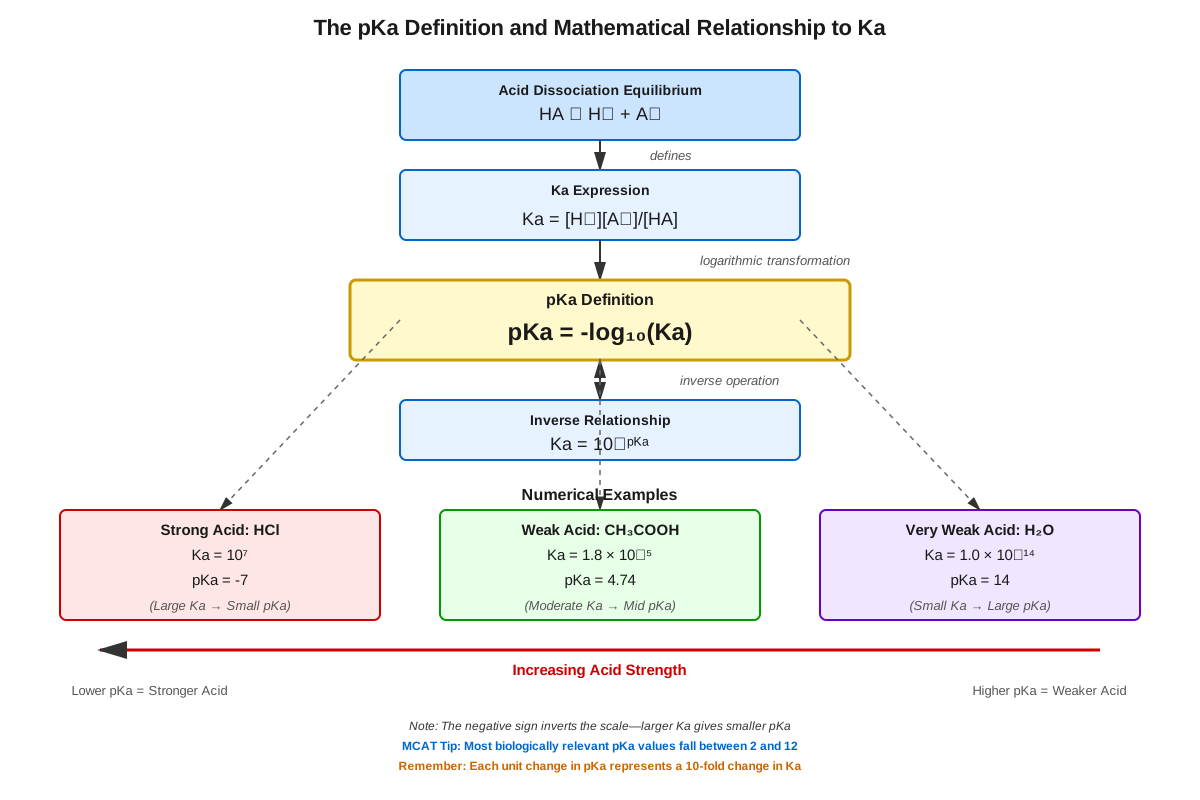
pKa is defined as the negative base-10 logarithm of the acid dissociation constant (Ka):
pKa = -log₁₀(Ka)Conversely, Ka can be calculated from pKa:
Ka = 10^(-pKa)The acid dissociation constant (Ka) describes the equilibrium for the dissociation of a weak acid (HA) in water:
HA ⇌ H⁺ + A⁻
Ka = [H⁺][A⁻]/[HA]
The pKa transformation converts Ka values that may span from 10⁻¹⁵ to 10¹⁰ into a more manageable scale. A strong acid like HCl with Ka ≈ 10⁷ has a pKa of -7, while a very weak acid like methane (CH₄) with Ka ≈ 10⁻⁵⁰ has a pKa of approximately 50.
Interpreting pKa Values
The pKa value provides immediate information about acid strength:
- Lower pKa = stronger acid: A pKa of 2 indicates a stronger acid than a pKa of 5
- Higher pKa = weaker acid: A pKa of 10 indicates a weaker acid (or stronger conjugate base)
- pKa < 0: Very strong acids (HCl, H₂SO₄, HNO₃)
- pKa 0-5: Strong to moderately strong acids (carboxylic acids, phosphoric acid)
- pKa 5-10: Weak acids (ammonium ion, carbonic acid)
- pKa > 10: Very weak acids (alcohols, water, amines)
The inverse relationship between pKa and acid strength is crucial: as pKa decreases by 1 unit, the acid becomes 10 times stronger because Ka increases by a factor of 10.
The Henderson-Hasselbalch Equation
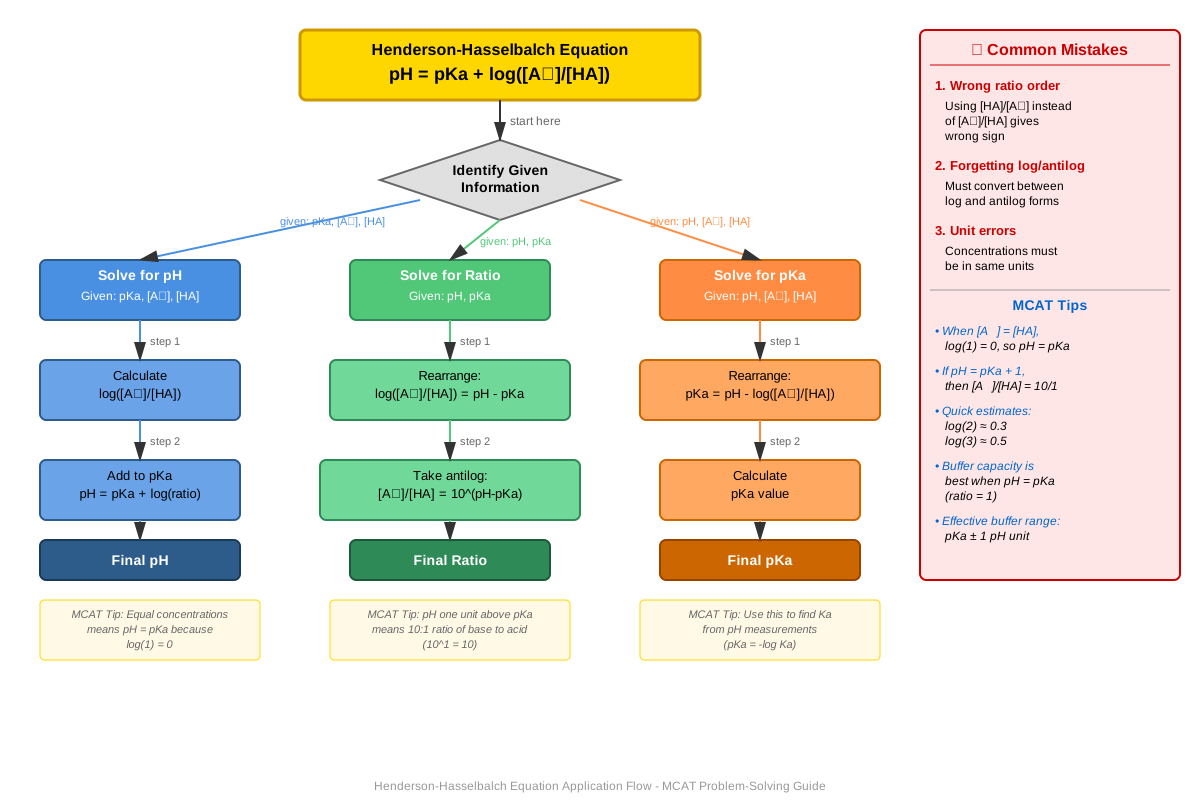
The Henderson-Hasselbalch equation relates pH, pKa, and the ratio of conjugate base to acid:
pH = pKa + log([A⁻]/[HA])This equation is derived from the Ka expression and the definition of pH. It allows calculation of:
- pH when pKa and concentration ratio are known
- Concentration ratio when pH and pKa are known
- pKa when pH and concentration ratio are known
The equation reveals a critical relationship: when pH = pKa, the ratio [A⁻]/[HA] = 1, meaning equal concentrations of acid and conjugate base exist at equilibrium. This is the midpoint of a titration curve and represents maximum buffer capacity.
Predicting Predominant Species
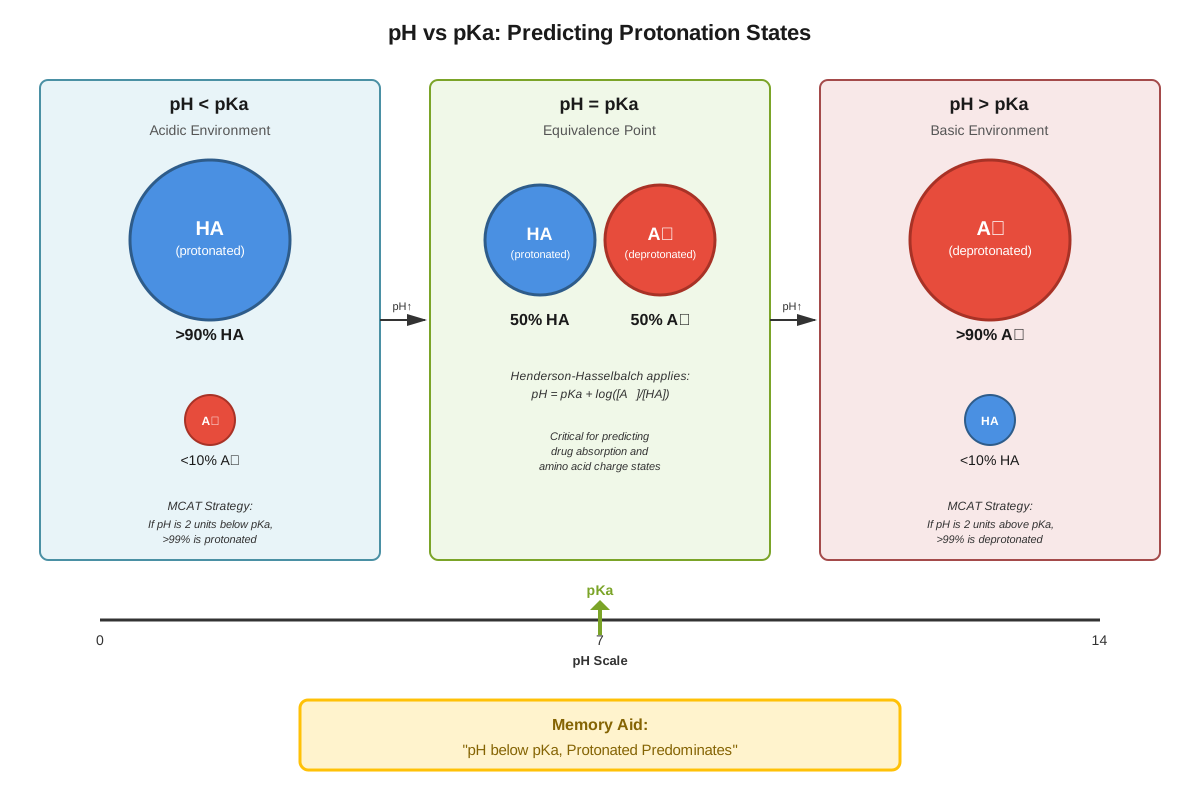
The relationship between pH and pKa determines which form of an acid-base pair predominates:
| Condition | Predominant Form | Ratio |
|---|---|---|
| pH < pKa - 2 | Protonated (HA) | >99% HA |
| pH = pKa - 1 | Mostly protonated | ~90% HA, ~10% A⁻ |
| pH = pKa | Equal amounts | 50% HA, 50% A⁻ |
| pH = pKa + 1 | Mostly deprotonated | ~10% HA, ~90% A⁻ |
| pH > pKa + 2 | Deprotonated (A⁻) | >99% A⁻ |
This relationship is fundamental to MCAT problem-solving. A quick rule: if pH is 2 units away from pKa, one form dominates (>99%). For questions asking about predominant species, simply compare pH to pKa:
- pH < pKa → protonated form dominates
- pH > pKa → deprotonated form dominates
Buffer Systems and pKa
A buffer resists pH changes when small amounts of acid or base are added. Effective buffers contain significant amounts of both a weak acid and its conjugate base. The buffer capacity is maximized when pH = pKa, and buffers work effectively within the range pKa ± 1.
The bicarbonate buffer system in blood illustrates this principle:
CO₂ + H₂O ⇌ H₂CO₃ ⇌ H⁺ + HCO₃⁻With pKa = 6.1 and blood pH = 7.4, the Henderson-Hasselbalch equation predicts:
7.4 = 6.1 + log([HCO₃⁻]/[H₂CO₃])
log([HCO₃⁻]/[H₂CO₃]) = 1.3
[HCO₃⁻]/[H₂CO₃] = 20:1
This 20:1 ratio of bicarbonate to carbonic acid maintains blood pH despite metabolic acid production.
Polyprotic Acids and Multiple pKa Values
Polyprotic acids have multiple ionizable protons and therefore multiple pKa values. Phosphoric acid (H₃PO₄) has three:
- pKa₁ = 2.1 (H₃PO₄ → H₂PO₄⁻ + H⁺)
- pKa₂ = 7.2 (H₂PO₄⁻ → HPO₄²⁻ + H⁺)
- pKa₃ = 12.4 (HPO₄²⁻ → PO₄³⁻ + H⁺)
Each successive proton is harder to remove (higher pKa) because removing a positive proton from an increasingly negative species requires more energy. At any given pH, the predominant species is determined by comparing pH to each pKa value.
Amino acids are also polyprotic, with pKa values for the carboxylic acid group (~2), the amino group (~9), and any ionizable side chain. Understanding which groups are protonated at physiological pH (7.4) is essential for predicting amino acid charge and behavior.
Structural Factors Affecting pKa
Several structural features influence pKa values:
- Electronegativity: More electronegative atoms stabilize the conjugate base, lowering pKa (HF pKa = 3.2 vs. H₂O pKa = 15.7)
- Resonance stabilization: Conjugate bases stabilized by resonance have lower pKa values (acetic acid pKa = 4.8 vs. ethanol pKa = 16)
- Inductive effects: Electron-withdrawing groups stabilize negative charge, lowering pKa (chloroacetic acid pKa = 2.9 vs. acetic acid pKa = 4.8)
- Hybridization: Greater s-character increases acidity (HC≡CH pKa = 25 vs. H₂C=CH₂ pKa = 44 vs. H₃C-CH₃ pKa = 50)
- Atomic size: Larger atoms stabilize negative charge better, lowering pKa (HI pKa = -10 vs. HF pKa = 3.2)
Concept Relationships
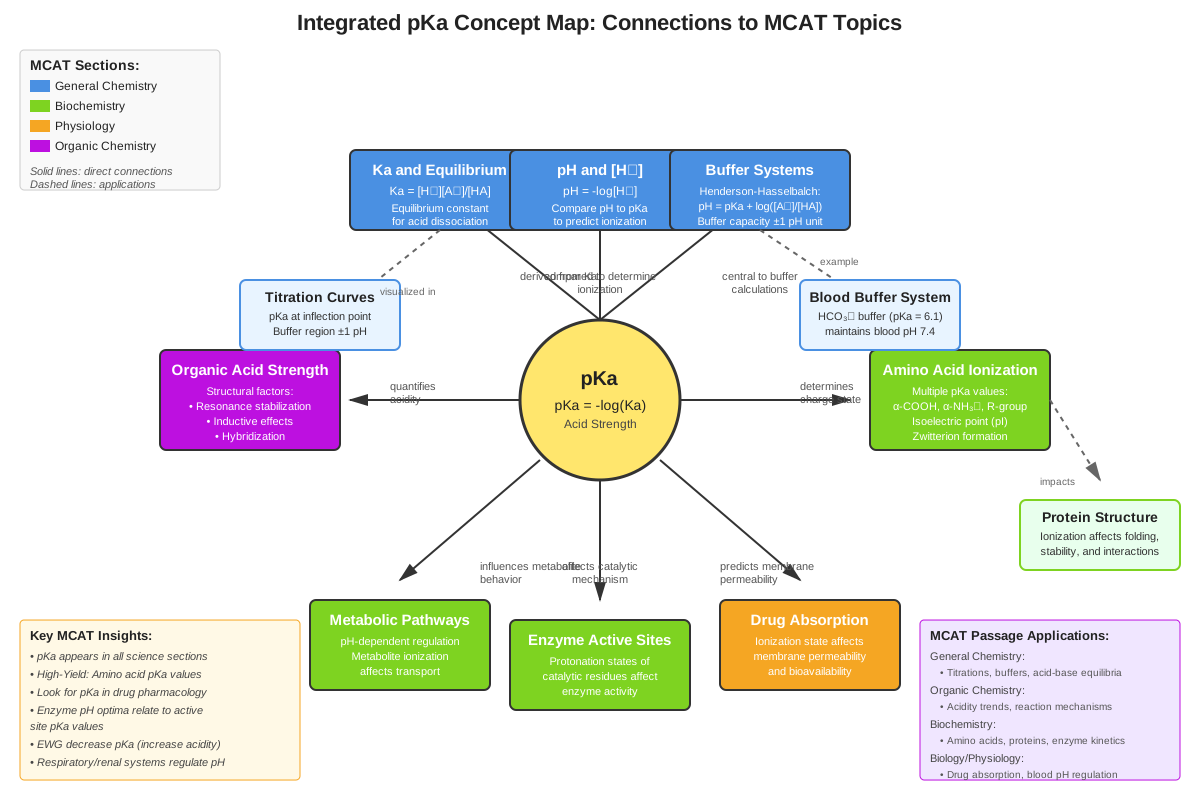
The pKa concept serves as a central hub connecting multiple areas of General Chemistry and biochemistry. The mathematical foundation begins with equilibrium constants → which lead to Ka values → which transform logarithmically into pKa values. This logarithmic transformation parallels the relationship between [H⁺] and pH, creating a consistent framework for discussing acid-base chemistry.
pKa directly determines buffer behavior: the pKa value identifies the optimal pH for buffering (pH = pKa), and the Henderson-Hasselbalch equation quantifies the relationship between pH, pKa, and species distribution. This connects to titration curves, where the pKa appears as the midpoint of the buffer region (the flattest part of the curve where pH changes slowly with added titrant).
The concept extends to molecular structure and reactivity: pKa values reflect the stability of conjugate bases, which depends on resonance, inductive effects, and electronegativity. Lower pKa values indicate more stable conjugate bases, which are weaker bases and better leaving groups in organic reactions. This connects pKa to nucleophilicity and leaving group ability in substitution and elimination reactions.
In biochemistry, pKa determines amino acid ionization states → which affects protein structure (through electrostatic interactions) → which influences enzyme activity (through active site chemistry) → which impacts metabolic pathways. The pKa values of active site residues determine the pH optimum for enzyme function, connecting acid-base chemistry to biological catalysis.
pKa also connects to pharmacology: comparing a drug's pKa to physiological pH values predicts ionization state → which determines membrane permeability → which affects absorption and distribution → which influences bioavailability and therapeutic effect. This relationship explains why acidic drugs are absorbed in the stomach while basic drugs are absorbed in the intestine.
Quick check — test yourself on pKa so far.
Try Flashcards →High-Yield Facts
⭐ pKa = -log(Ka): The fundamental definition; a one-unit decrease in pKa represents a 10-fold increase in acid strength
⭐ When pH = pKa, [A⁻] = [HA]: Equal concentrations of conjugate acid and base exist, representing the midpoint of a titration and maximum buffer capacity
⭐ pH < pKa → protonated form dominates; pH > pKa → deprotonated form dominates: The quick rule for predicting predominant species
⭐ Effective buffer range is pKa ± 1: Outside this range, buffer capacity decreases significantly
⭐ Lower pKa = stronger acid = weaker conjugate base: The inverse relationship between acid strength and conjugate base strength
- The Henderson-Hasselbalch equation (pH = pKa + log([A⁻]/[HA])) can be rearranged to solve for any variable
- When pH differs from pKa by 2 or more units, one species comprises >99% of the total
- Carboxylic acids typically have pKa values around 4-5, while ammonium ions have pKa values around 9-10
- Resonance stabilization of the conjugate base lowers pKa (makes the acid stronger)
- Electron-withdrawing groups decrease pKa through inductive effects, while electron-donating groups increase pKa
- The pKa of water is 15.7, making it a very weak acid but an important reference point
- For polyprotic acids, each successive pKa is higher because removing protons from increasingly negative species is more difficult
- At physiological pH (7.4), carboxylic acids are deprotonated (COO⁻) and amino groups are protonated (NH₃⁺)
Common Misconceptions
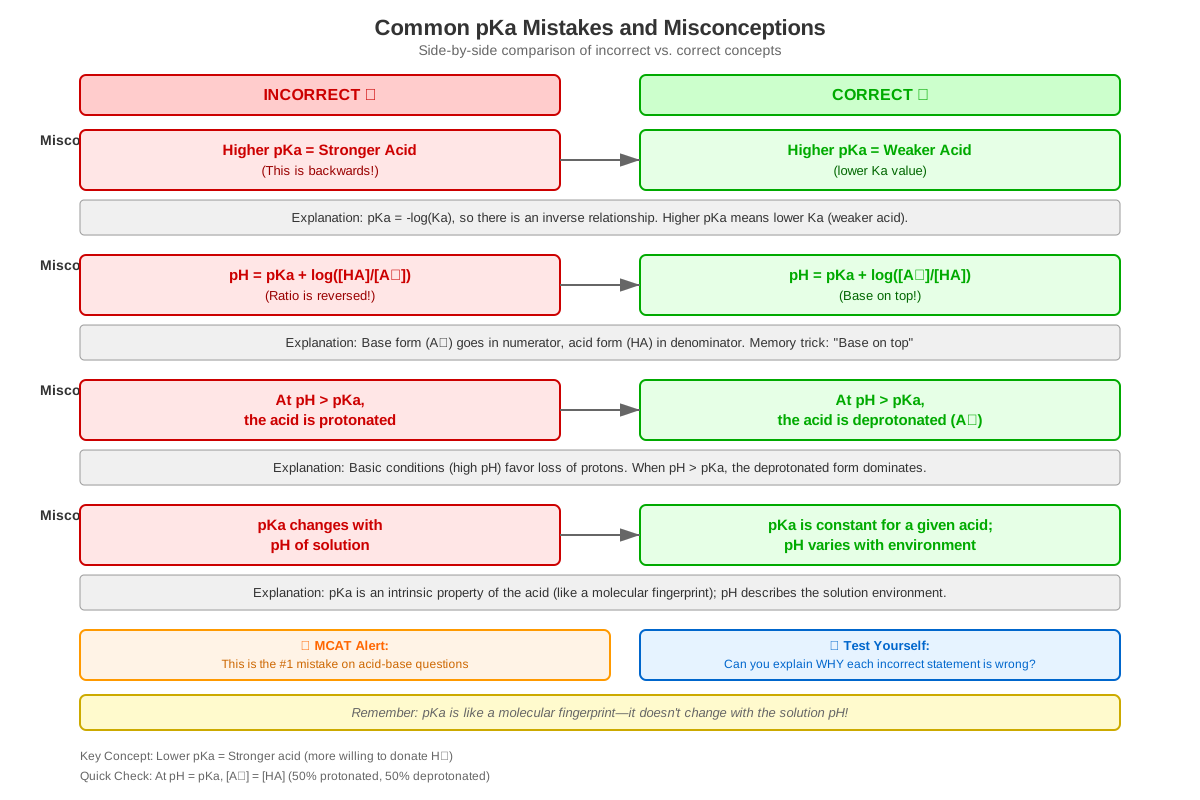
Misconception: pKa and pH are the same thing or interchangeable terms.
Correction: pKa is a property of a specific molecule (its tendency to donate a proton), while pH is a property of a solution (the concentration of H⁺ ions). pKa is constant for a given acid at a specific temperature, but pH varies depending on what's dissolved in solution.
Misconception: A higher pKa means a stronger acid.
Correction: A higher pKa indicates a weaker acid. The negative sign in pKa = -log(Ka) inverts the relationship: as Ka increases (stronger acid), pKa decreases. Think of pKa like golf scores—lower is better (stronger).
Misconception: When pH = pKa, the acid is completely dissociated.
Correction: When pH = pKa, the acid is exactly 50% dissociated, with equal concentrations of HA and A⁻. Complete dissociation (>99%) occurs when pH > pKa + 2.
Misconception: The Henderson-Hasselbalch equation only works for buffers.
Correction: The Henderson-Hasselbalch equation applies to any weak acid-conjugate base system, whether or not it's functioning as a buffer. It's derived from the Ka expression and is always valid for weak acids in aqueous solution.
Misconception: pKa values can be negative, which doesn't make sense.
Correction: Negative pKa values are perfectly valid and indicate very strong acids. Since pKa = -log(Ka), a Ka greater than 1 produces a negative pKa. For example, HCl has a pKa around -7, reflecting its Ka of approximately 10⁷.
Misconception: You need to memorize pKa values for every compound.
Correction: The MCAT provides pKa values when needed for calculations. Focus instead on understanding trends (carboxylic acids ~4-5, ammonium ions ~9-10, phenols ~10) and how to apply given pKa values using the Henderson-Hasselbalch equation and qualitative reasoning.
Misconception: A buffer works equally well at any pH.
Correction: Buffers work best when pH ≈ pKa (specifically within pKa ± 1). Outside this range, there isn't enough of both species present to effectively resist pH changes.
Worked Examples
Example 1: Predicting Predominant Species and Calculating Ratios
Question: Acetic acid has a pKa of 4.8. In a solution at pH 6.8, what is the predominant form of acetic acid, and what is the ratio of acetate ion to acetic acid?
Solution:
Step 1: Compare pH to pKa
- pH (6.8) > pKa (4.8)
- Since pH > pKa, the deprotonated form (acetate ion, CH₃COO⁻) predominates
Step 2: Calculate the exact ratio using Henderson-Hasselbalch equation
pH = pKa + log([A⁻]/[HA])
6.8 = 4.8 + log([CH₃COO⁻]/[CH₃COOH])
2.0 = log([CH₃COO⁻]/[CH₃COOH])
[CH₃COO⁻]/[CH₃COOH] = 10² = 100
Step 3: Interpret the result
- The ratio is 100:1 acetate to acetic acid
- This means approximately 99% exists as acetate ion and 1% as acetic acid
- This confirms our qualitative prediction that the deprotonated form dominates
Connection to learning objectives: This example demonstrates applying pKa to predict species distribution (qualitatively and quantitatively) and using the Henderson-Hasselbalch equation—both essential MCAT skills.
Example 2: Buffer Preparation and pH Calculation
Question: A biochemist needs to prepare a buffer at pH 7.4 using phosphoric acid (H₃PO₄) and its conjugate bases. The pKa values are: pKa₁ = 2.1, pKa₂ = 7.2, pKa₃ = 12.4. Which conjugate acid-base pair should be used, and what ratio of base to acid is needed?
Solution:
Step 1: Select the appropriate pKa
- For effective buffering, choose the pKa closest to the desired pH
- pKa₂ = 7.2 is closest to pH 7.4
- Use the H₂PO₄⁻/HPO₄²⁻ pair
Step 2: Apply Henderson-Hasselbalch equation
pH = pKa + log([HPO₄²⁻]/[H₂PO₄⁻])
7.4 = 7.2 + log([HPO₄²⁻]/[H₂PO₄⁻])
0.2 = log([HPO₄²⁻]/[H₂PO₄⁻])
[HPO₄²⁻]/[H₂PO₄⁻] = 10^0.2 ≈ 1.6
Step 3: Interpret for practical preparation
- Mix HPO₄²⁻ and H₂PO₄⁻ in a ratio of approximately 1.6:1
- For example, use 1.6 M HPO₄²⁻ and 1.0 M H₂PO₄⁻
- This buffer will resist pH changes effectively because pH ≈ pKa
Step 4: Verify the choice
- Using pKa₁ (2.1) would require a ratio of 10^5.3:1, which is impractical
- Using pKa₃ (12.4) would require a ratio of 10^-5:1, also impractical
- The pKa ± 1 rule confirms that pKa₂ is the appropriate choice
Connection to learning objectives: This example integrates multiple concepts—selecting appropriate pKa values for polyprotic acids, applying Henderson-Hasselbalch, and understanding buffer capacity principles—all commonly tested on the MCAT.
Exam Strategy
Approaching MCAT pKa Questions
Step 1: Identify what's being asked
- Is this a qualitative question (which form predominates?) or quantitative (calculate pH or ratio)?
- Qualitative questions can often be answered by simply comparing pH to pKa
- Quantitative questions require Henderson-Hasselbalch or Ka calculations
Step 2: Extract given information
- Locate pKa values (usually provided in passage or question stem)
- Identify pH of the solution
- Note any concentration information
- For polyprotic acids, identify which ionization is relevant
Step 3: Apply the appropriate tool
- For predominant species: compare pH to pKa directly
- For ratios or pH calculations: use Henderson-Hasselbalch
- For buffer questions: check if pH is within pKa ± 1
Trigger Words and Phrases
Watch for these high-yield terms that signal pKa-related questions:
- "Predominant form" or "major species": Compare pH to pKa qualitatively
- "Buffer capacity" or "resist pH changes": Look for pH ≈ pKa
- "Ionization state" or "protonation state": Determine which groups are protonated based on pH vs. pKa
- "Midpoint of titration": This is where pH = pKa
- "Physiological pH": Usually 7.4; compare to pKa values of amino acids or drugs
- "Membrane permeability" or "absorption": Uncharged (protonated acids or deprotonated bases) cross membranes more easily
Process of Elimination Tips
When facing multiple-choice questions:
- Eliminate answers that violate the pH-pKa relationship: If pH > pKa, eliminate choices showing the protonated form as predominant
- Check magnitude: If pH differs from pKa by 2+ units, eliminate answers showing significant amounts of the minor species
- Verify buffer range: Eliminate buffer choices where pH is outside pKa ± 1
- Use limiting cases: If pH >> pKa, the ratio [A⁻]/[HA] should be very large; eliminate small ratios
- Check for mathematical errors: Common wrong answers include forgetting the negative sign in pKa = -log(Ka) or inverting the Henderson-Hasselbalch ratio
Time Allocation
- Qualitative questions (predominant species): 30-45 seconds—these should be quick comparisons
- Henderson-Hasselbalch calculations: 60-90 seconds—practice log calculations to improve speed
- Complex buffer or polyprotic acid questions: 90-120 seconds—these may require multiple steps
- Passage-based questions: Read the passage for pKa values first (15-30 seconds), then tackle questions
Exam Tip: If a calculation seems complex, check if you can estimate. For example, if pH = pKa + 1, you know the ratio is 10:1 without detailed calculation. The MCAT often rewards conceptual understanding over computational precision.
Memory Techniques
Mnemonics
"Lower pKa, Stronger Acid" (LPSA)
- Remember: pKa and acid strength are inversely related
- Think: "Low pKa = Powerful Acid"
"pH Passes pKa, Proton Pops off"
- When pH exceeds pKa, the proton is removed (deprotonated form dominates)
- Alliteration helps cement the relationship
"Equal at Equal"
- When pH equals pKa, concentrations are equal
- Simple but effective for remembering the midpoint condition
Visualization Strategy
The pKa Number Line:
Visualize a horizontal number line with pKa marked. Place pH on the same line:
- If pH is to the LEFT of pKa (lower): protonated form (HA) dominates
- If pH is to the RIGHT of pKa (higher): deprotonated form (A⁻) dominates
- If pH is AT pKa: equal amounts of both
The Seesaw Analogy:
Imagine pKa as the fulcrum of a seesaw:
- When pH < pKa, the "HA side" is down (predominates)
- When pH > pKa, the "A⁻ side" is down (predominates)
- When pH = pKa, the seesaw is balanced (equal amounts)
Acronym for Buffer Selection
"POPS" - Pick One pKa Similar
- When selecting a buffer, Pick the pKa value that's Similar to your target pH
- Effective buffers have pKa within ±1 of desired pH
Remembering Common pKa Ranges
"CAAP" - Carboxylic Acids Around Penta (5)
- Carboxylic acids: pKa ~4-5
- Ammonium ions: pKa ~9-10
- Phenols: pKa ~10
- Water: pKa = 15.7 (remember as "sweet 16 minus a bit")
Summary
pKa represents the negative logarithm of the acid dissociation constant and serves as the primary quantitative measure of acid strength in General Chemistry and biochemistry. Lower pKa values indicate stronger acids, while higher values indicate weaker acids. The relationship between pH and pKa determines the predominant ionization state of molecules: when pH < pKa, the protonated form dominates; when pH > pKa, the deprotonated form dominates; and when pH = pKa, equal concentrations of both forms exist. The Henderson-Hasselbalch equation (pH = pKa + log([A⁻]/[HA])) quantifies this relationship and is essential for buffer calculations and predicting species distribution. Effective buffers operate within pKa ± 1 of the target pH, with maximum capacity at pH = pKa. Understanding pKa enables prediction of amino acid ionization states, drug absorption characteristics, enzyme activity, and buffer behavior—all high-yield topics on the MCAT that appear frequently in both discrete questions and passage-based scenarios across multiple sections of the exam.
Key Takeaways
- pKa = -log(Ka) establishes an inverse relationship between pKa and acid strength; lower pKa means stronger acid
- The pH-pKa comparison instantly reveals predominant species: pH < pKa favors HA (protonated), pH > pKa favors A⁻ (deprotonated)
- Henderson-Hasselbalch equation (pH = pKa + log([A⁻]/[HA])) is the quantitative tool for all buffer and ionization calculations
- When pH = pKa, concentrations of conjugate acid and base are equal, representing the titration midpoint and maximum buffer capacity
- Effective buffers require pH within pKa ± 1, and the optimal buffer has pKa equal to the desired pH
- Structural features (electronegativity, resonance, inductive effects) that stabilize the conjugate base lower pKa values
- MCAT applications span amino acid ionization, drug pharmacokinetics, enzyme mechanisms, and buffer systems—making pKa one of the most versatile and frequently tested concepts
Related Topics
Henderson-Hasselbalch Equation: While covered briefly here, a deeper exploration of derivation, applications, and limitations provides additional problem-solving tools for complex buffer scenarios.
Titration Curves: Understanding how pH changes during titration, identifying buffer regions, and locating equivalence points all depend on pKa concepts and provide graphical representations of acid-base equilibria.
Amino Acid Structure and Ionization: Amino acids have multiple pKa values (α-carboxyl, α-amino, and side chain groups), and predicting their charge at physiological pH is a direct application of pKa principles essential for biochemistry.
Buffer Systems in Physiology: The bicarbonate, phosphate, and protein buffer systems maintain blood pH homeostasis through pKa-pH relationships, connecting general chemistry to human physiology.
Acid-Base Catalysis in Enzymes: Many enzyme mechanisms involve proton transfer steps where active site residues must be in specific ionization states, determined by comparing their pKa values to the local pH environment.
Drug Design and Pharmacokinetics: Modifying drug structures to adjust pKa values optimizes absorption, distribution, and therapeutic efficacy—a practical application of acid-base chemistry in medicinal chemistry.
Practice CTA
Now that you've mastered the core concepts of pKa, it's time to solidify your understanding through active practice. Work through the practice questions to test your ability to apply Henderson-Hasselbalch, predict predominant species, and solve buffer problems under timed conditions. Use the flashcards to reinforce key relationships and common pKa values until they become automatic. Remember: understanding pKa isn't just about memorizing equations—it's about developing the chemical intuition to predict molecular behavior in any acid-base scenario. The more you practice, the faster and more confident you'll become at tackling these high-yield MCAT questions. You've got this!
Sign up free to keep reading
Create a free AnvayaPrep account to finish this MCAT guide on pKa — plus flashcards and practice questions.