Overview
Titration curves are graphical representations that plot pH (y-axis) against the volume of titrant added (x-axis) during an acid-base titration. These curves provide a visual roadmap of how pH changes throughout a titration and reveal critical information about the chemical species present at each stage of the neutralization reaction. Understanding titration curves is fundamental to mastering acids and bases in General Chemistry, as they integrate multiple concepts including pH calculations, buffer systems, equivalence points, and the Henderson-Hasselbalch equation into a single, interpretable format.
For the MCAT, titration curves represent a high-yield topic that appears frequently in both discrete questions and passage-based scenarios. The exam tests not only the ability to interpret these curves but also to predict their shapes based on the strength of acids and bases involved, identify key regions (buffer zones, equivalence points, half-equivalence points), and apply quantitative reasoning to calculate pH values at specific points. Titration curves MCAT questions often integrate with biochemistry passages involving amino acids and proteins, making this topic essential for both the Chemical and Physical Foundations section and the Biological and Biochemical Foundations section.
The study of titration curves General Chemistry connects directly to broader concepts in acid-base equilibria, including Ka and Kb calculations, conjugate acid-base pairs, buffer capacity, and the common ion effect. Mastery of titration curves enables students to visualize abstract equilibrium concepts and provides a framework for understanding polyprotic acids, isoelectric points of amino acids, and the buffering capacity of biological systems—all topics that appear regularly on the MCAT.
Learning Objectives
- [ ] Define titration curves using accurate General Chemistry terminology
- [ ] Explain why titration curves matter for the MCAT
- [ ] Apply titration curves to exam-style questions
- [ ] Identify common mistakes related to titration curves
- [ ] Connect titration curves to related General Chemistry concepts
- [ ] Predict the shape of a titration curve based on the strength of the acid and base involved
- [ ] Calculate pH at the half-equivalence point, equivalence point, and buffer regions
- [ ] Distinguish between monoprotic and polyprotic acid titration curves and identify their characteristic features
Prerequisites
- pH and pOH calculations: Essential for determining pH values at any point along a titration curve and understanding the relationship between hydrogen ion concentration and pH scale
- Strong vs. weak acids and bases: Required to predict curve shapes and understand why different acid-base combinations produce distinct titration curve profiles
- Henderson-Hasselbalch equation: Necessary for calculating pH in buffer regions and at the half-equivalence point where pH = pKa
- Equilibrium constants (Ka, Kb): Fundamental for understanding the relationship between acid strength and the position of equivalence points on titration curves
- Buffer systems: Critical for interpreting the buffer region of titration curves where pH changes minimally with added titrant
- Stoichiometry: Required for determining equivalence point volumes and calculating concentrations of species at various points during titration
Why This Topic Matters
Titration curves have profound clinical and laboratory significance. In medical practice, understanding acid-base equilibria through titration principles is essential for interpreting arterial blood gas results, managing metabolic acidosis and alkalosis, and understanding drug pharmacokinetics where pH affects drug ionization and absorption. Laboratory medicine relies heavily on titration techniques for quantitative analysis of biological samples, including determining protein concentrations and analyzing metabolic markers.
On the MCAT, titration curves appear in approximately 3-5% of Chemical and Physical Foundations questions and frequently integrate with biochemistry passages. The exam commonly presents titration curves in several formats: interpreting a provided curve to identify equivalence points and pKa values, predicting which curve corresponds to a given acid-base pair, or calculating pH at specific points during titration. Passage-based questions often embed titration curves within amino acid chemistry contexts, requiring students to identify isoelectric points or predict the charge state of proteins at different pH values.
The MCAT particularly favors questions that test conceptual understanding rather than rote memorization. Students must recognize that the buffer region (where the curve is flattest) occurs when pH ≈ pKa, that the equivalence point for weak acid-strong base titrations occurs at pH > 7, and that polyprotic acids produce multiple equivalence points. Questions frequently require integration of titration curve interpretation with calculations, making this a high-yield topic that rewards thorough understanding over superficial familiarity.
Core Concepts
Fundamental Definition and Components
A titration curve is a graphical representation of pH as a function of titrant volume added during an acid-base neutralization reaction. The curve provides a complete picture of the chemical equilibria occurring throughout the titration process. The x-axis represents the volume of titrant (the solution being added, typically from a buret), while the y-axis represents the pH of the solution being titrated (the analyte). The shape of the curve depends critically on the strength of both the acid and base involved in the reaction.
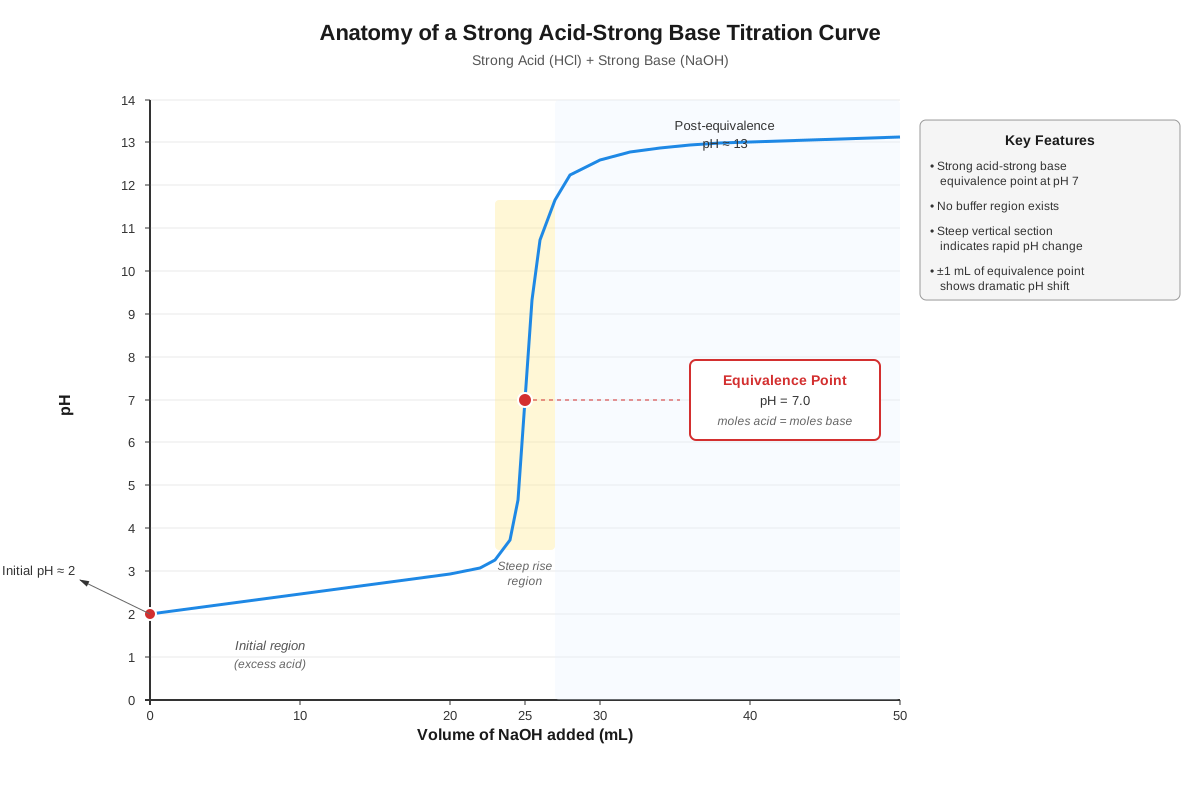
Every titration curve contains several key features: the initial pH (before any titrant is added), the buffer region (where pH changes gradually), the half-equivalence point (where pH = pKa for weak acids), the equivalence point (where moles of acid equal moles of base), and the post-equivalence region (where excess titrant determines pH). Understanding each region requires integrating knowledge of acid-base equilibria, stoichiometry, and pH calculations.
Strong Acid-Strong Base Titrations
When titrating a strong acid with a strong base (or vice versa), the resulting curve has a characteristic steep, S-shaped profile. The initial pH for a strong acid titration begins at a very low value (typically pH 1-2 for 0.1 M HCl). As strong base is added, the pH increases gradually at first, then rises sharply near the equivalence point, creating a nearly vertical section of the curve. The equivalence point for strong acid-strong base titrations always occurs at pH 7.0 because the products are a neutral salt and water, with no hydrolysis occurring.
The steep rise at the equivalence point spans several pH units (typically from pH 4 to pH 10) with the addition of just a single drop of titrant. This dramatic change occurs because, at the equivalence point, all the strong acid has been neutralized, and any additional base dramatically increases the pH. There is no buffer region in strong acid-strong base titrations because neither the acid nor base has a conjugate partner that can resist pH changes. The curve is symmetric around the equivalence point, reflecting the equal strength of the acid and base.
Weak Acid-Strong Base Titrations
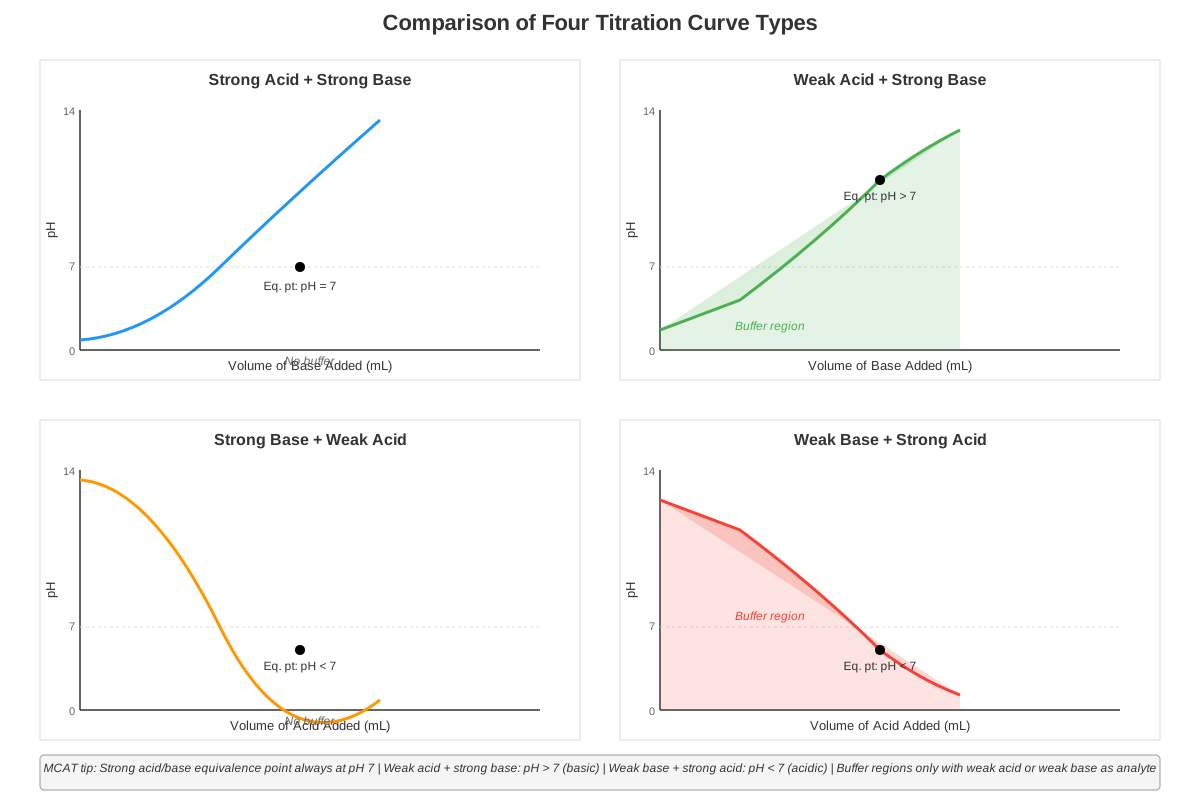
Titrating a weak acid with a strong base produces a curve with distinctly different characteristics from the strong acid-strong base case. The initial pH is higher (typically pH 3-5 for a 0.1 M weak acid) because weak acids only partially dissociate. As strong base is added, it reacts with the weak acid (HA) to form its conjugate base (A⁻), creating a buffer system that resists pH changes. This buffer region appears as a relatively flat portion of the curve where pH changes gradually.
The half-equivalence point occurs when exactly half the weak acid has been neutralized. At this point, [HA] = [A⁻], and according to the Henderson-Hasselbalch equation (pH = pKa + log([A⁻]/[HA])), the pH equals the pKa of the weak acid. This relationship provides a practical method for determining pKa values experimentally: simply read the pH at the half-equivalence point (half the volume needed to reach the equivalence point).
The equivalence point for weak acid-strong base titrations occurs at pH > 7 (typically pH 8-10). This occurs because, at the equivalence point, all the weak acid has been converted to its conjugate base (A⁻), which undergoes hydrolysis: A⁻ + H₂O ⇌ HA + OH⁻. This hydrolysis reaction produces hydroxide ions, making the solution basic. The exact pH at the equivalence point depends on the Kb of the conjugate base (which relates to the Ka of the original weak acid through Ka × Kb = Kw).
Strong Acid-Weak Base Titrations
When titrating a strong acid with a weak base (or equivalently, a weak base with a strong acid), the curve is inverted compared to the weak acid-strong base case. The initial pH for a weak base solution is moderately basic (typically pH 9-11 for 0.1 M NH₃). As strong acid is added, it reacts with the weak base (B) to form its conjugate acid (BH⁺), creating a buffer system. The buffer region again appears as a flat portion of the curve.
The half-equivalence point occurs when [B] = [BH⁺], and at this point, pOH = pKb (or pH = 14 - pKb = pKa of the conjugate acid). The equivalence point occurs at pH < 7 (typically pH 4-6) because the conjugate acid (BH⁺) undergoes hydrolysis: BH⁺ + H₂O ⇌ B + H₃O⁺, producing hydronium ions and making the solution acidic.
Polyprotic Acid Titrations
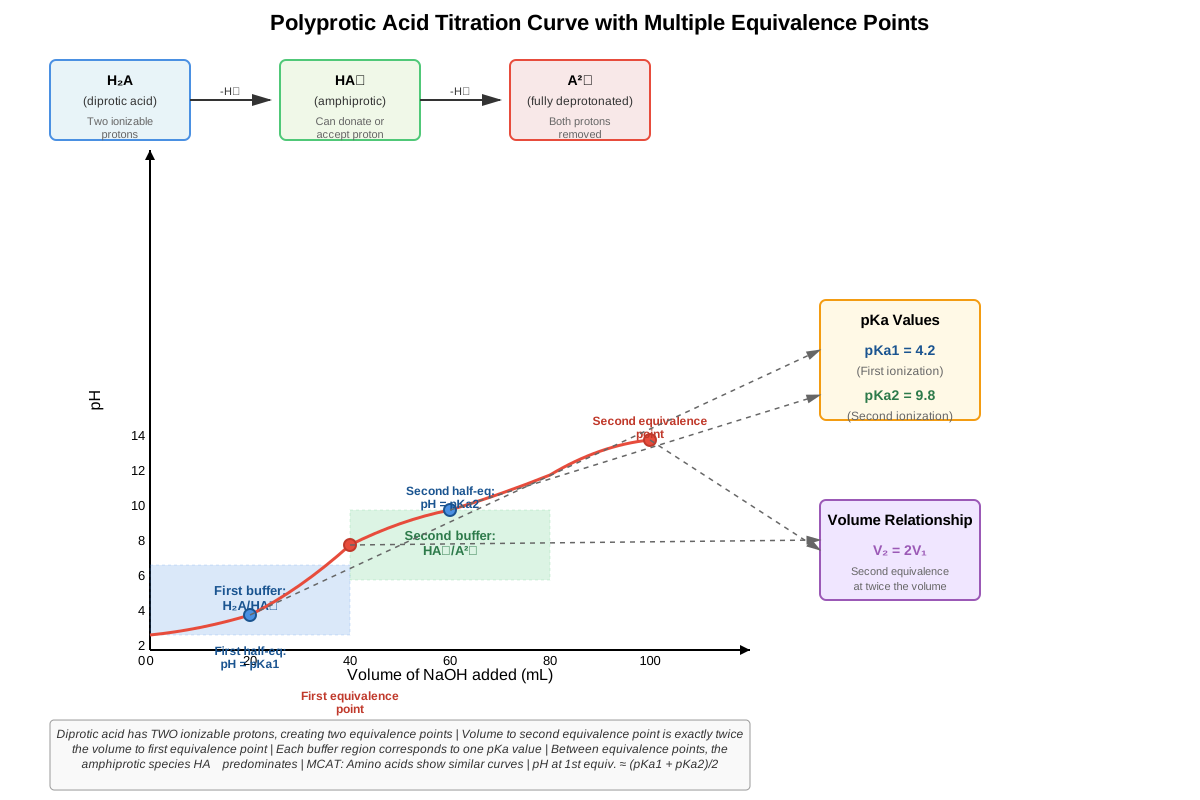
Polyprotic acids contain multiple ionizable protons and produce titration curves with multiple equivalence points—one for each ionizable proton. A diprotic acid (like H₂CO₃ or H₂SO₃) produces a curve with two distinct equivalence points and two buffer regions. Each equivalence point corresponds to the neutralization of one proton, and each buffer region corresponds to a different conjugate acid-base pair.
For a diprotic acid H₂A, the first equivalence point occurs when H₂A has been converted to HA⁻, and the second occurs when HA⁻ has been converted to A²⁻. The first half-equivalence point gives pH = pKa1, and the second half-equivalence point gives pH = pKa2. The separation between equivalence points depends on the difference between pKa1 and pKa2—if the pKa values differ by at least 3-4 units, the equivalence points are clearly distinguishable as separate inflection points on the curve.
Triprotic acids (like H₃PO₄) produce three equivalence points and three buffer regions. The MCAT frequently tests polyprotic acid titrations in the context of amino acids, which have at least two ionizable groups (the carboxyl group and the amino group) and sometimes a third ionizable group on the side chain.
Buffer Capacity and the Buffer Region
The buffer region of a titration curve represents the pH range where the solution resists changes in pH most effectively. This region extends approximately ±1 pH unit from the pKa value (from pKa - 1 to pKa + 1). Within this range, the ratio of [A⁻]/[HA] varies from 0.1 to 10, providing effective buffering according to the Henderson-Hasselbalch equation.
Buffer capacity is greatest at the half-equivalence point (where pH = pKa) because the concentrations of the weak acid and conjugate base are equal and maximized. As the titration proceeds away from this point, buffer capacity decreases because the ratio of conjugate base to weak acid becomes increasingly unbalanced. Understanding buffer capacity is crucial for interpreting the slope of titration curves—steeper slopes indicate lower buffer capacity and greater pH sensitivity to added titrant.
Indicator Selection
Acid-base indicators are weak acids or bases that change color over a specific pH range. For accurate endpoint detection in titrations, the indicator's transition range should overlap with the steep portion of the titration curve near the equivalence point. For strong acid-strong base titrations, almost any indicator with a transition range between pH 4-10 works well because the equivalence point jump is so large.
For weak acid-strong base titrations, the indicator must transition in the basic range (pH 8-10) to match the equivalence point pH. Phenolphthalein (transition range pH 8.2-10.0) is commonly used for these titrations. For weak base-strong acid titrations, the indicator must transition in the acidic range (pH 4-6), making methyl orange (transition range pH 3.1-4.4) or bromocresol green appropriate choices.
Quantitative Calculations
Several important calculations relate to titration curves:
- pH at the initial point: For weak acids, use Ka and the ICE table; for strong acids, pH = -log[H⁺]
- pH in the buffer region: Use the Henderson-Hasselbalch equation: pH = pKa + log([A⁻]/[HA])
- pH at the half-equivalence point: pH = pKa (for weak acid titrations)
- pH at the equivalence point: For weak acid-strong base, calculate [A⁻] and use Kb to find [OH⁻]
- pH in the post-equivalence region: Calculate excess [OH⁻] from the strong base
| Titration Type | Initial pH | Equivalence Point pH | Half-Equivalence Point |
|---|---|---|---|
| Strong acid + Strong base | Very low (~1-2) | 7.0 | Not applicable |
| Weak acid + Strong base | Moderate (~3-5) | >7 (typically 8-10) | pH = pKa |
| Strong acid + Weak base | High (~9-11) | <7 (typically 4-6) | pOH = pKb |
| Weak acid + Weak base | Variable | Variable (~7) | Not well-defined |
Quick check — test yourself on Titration curves so far.
Try Flashcards →Concept Relationships
The concepts within titration curves are deeply interconnected. The initial pH depends on acid/base strength and concentration → this determines the starting point of the curve → as titrant is added, stoichiometry determines how much acid/base remains → the presence of both weak acid and conjugate base creates the buffer region → at the half-equivalence point, equal concentrations of conjugate pairs make pH = pKa → continued addition reaches the equivalence point where stoichiometric neutralization is complete → the pH at equivalence depends on whether hydrolysis occurs → beyond equivalence, excess titrant determines pH.
Titration curves connect to prerequisite topics through multiple pathways. pH calculations provide the mathematical foundation for determining y-axis values at each point. Equilibrium constants (Ka, Kb) determine the position and shape of buffer regions. The Henderson-Hasselbalch equation enables pH calculations throughout the buffer region. Stoichiometry determines equivalence point volumes and the amount of each species present at any titration stage.
The topic extends to related concepts in biochemistry and analytical chemistry. Amino acid titrations represent polyprotic acid curves where the isoelectric point (pI) can be determined from the curve. Buffer preparation relies on understanding the buffer region of titration curves. Analytical chemistry uses titration curves for quantitative determination of unknown acid/base concentrations. Biological pH regulation mirrors the buffer principles visible in titration curves, particularly the bicarbonate buffer system that maintains blood pH.
High-Yield Facts
⭐ The half-equivalence point of a weak acid titration occurs at pH = pKa, providing an experimental method to determine acid strength
⭐ The equivalence point for weak acid-strong base titrations always occurs at pH > 7 due to hydrolysis of the conjugate base
⭐ The equivalence point for strong acid-strong base titrations always occurs at pH = 7 because no hydrolysis occurs
⭐ The buffer region extends approximately ±1 pH unit from the pKa value, where the Henderson-Hasselbalch equation applies
⭐ Polyprotic acids produce multiple equivalence points—one for each ionizable proton—visible as separate inflection points when pKa values differ by ≥3-4 units
- The steepest part of a titration curve occurs at the equivalence point, where buffer capacity is zero
- Strong acid-strong base titration curves have no buffer region because neither species can resist pH changes
- The volume of titrant at the equivalence point is determined by stoichiometry: n₁V₁ = n₂V₂ (for equal molarities)
- The initial pH of a weak acid solution is always higher than that of a strong acid of equal concentration
- Buffer capacity is maximum at the half-equivalence point where [HA] = [A⁻]
- For diprotic acids, the pH at the midpoint between the two equivalence points equals the average of pKa1 and pKa2
- The post-equivalence region pH is determined entirely by the excess strong base (or acid) added
- Weak acid-weak base titrations produce poorly defined equivalence points and are rarely used analytically
Common Misconceptions
Misconception: The equivalence point always occurs at pH 7.
Correction: Only strong acid-strong base titrations have equivalence points at pH 7. Weak acid-strong base titrations have equivalence points at pH > 7 due to conjugate base hydrolysis, while strong acid-weak base titrations have equivalence points at pH < 7 due to conjugate acid hydrolysis.
Misconception: The half-equivalence point and equivalence point are the same thing.
Correction: The half-equivalence point occurs when exactly half the acid has been neutralized (where pH = pKa for weak acids), while the equivalence point occurs when all the acid has been neutralized. The half-equivalence point volume is exactly half the equivalence point volume.
Misconception: The steepest part of the curve represents the best buffering.
Correction: The opposite is true—the steepest part (at the equivalence point) represents zero buffer capacity where pH changes dramatically with minimal titrant addition. The flattest part of the curve (the buffer region) represents maximum buffering capacity.
Misconception: All polyprotic acids show clearly separated equivalence points on their titration curves.
Correction: Equivalence points are only clearly distinguishable when successive pKa values differ by at least 3-4 units. If pKa values are too close together, the equivalence points merge into a single, broad inflection point.
Misconception: The initial pH of a weak acid solution can be calculated using pH = -log[HA].
Correction: This calculation only works for strong acids that completely dissociate. For weak acids, you must use the Ka expression and an ICE table (or the approximation pH ≈ ½(pKa - log[HA]) for dilute solutions) because weak acids only partially dissociate.
Misconception: Adding more concentrated titrant will change the pH at the equivalence point.
Correction: The pH at the equivalence point depends only on the identity of the acid and base (their Ka and Kb values), not on their concentrations. Concentration affects the volume needed to reach equivalence and the steepness of the curve, but not the equivalence point pH itself.
Worked Examples
Example 1: Identifying Key Features of a Weak Acid Titration Curve
Problem: A 25.0 mL sample of 0.100 M acetic acid (CH₃COOH, Ka = 1.8 × 10⁻⁵) is titrated with 0.100 M NaOH. (a) Calculate the initial pH. (b) Calculate the pH at the half-equivalence point. (c) Calculate the volume of NaOH needed to reach the equivalence point. (d) Determine whether the pH at the equivalence point will be <7, =7, or >7, and explain why.
Solution:
(a) Initial pH: Before any base is added, we have a weak acid solution. Using the Ka expression:
Ka = [H⁺][CH₃COO⁻]/[CH₃COOH]
1.8 × 10⁻⁵ = x²/(0.100 - x) ≈ x²/0.100
x² = 1.8 × 10⁻⁶
x = [H⁺] = 1.34 × 10⁻³ M
pH = -log(1.34 × 10⁻³) = 2.87
(b) pH at half-equivalence point: At this point, exactly half the acetic acid has been converted to acetate, so [CH₃COOH] = [CH₃COO⁻]. According to the Henderson-Hasselbalch equation:
pH = pKa + log([CH₃COO⁻]/[CH₃COOH])
pH = pKa + log(1) = pKa + 0 = pKa
pKa = -log(1.8 × 10⁻⁵) = 4.74
pH = 4.74
(c) Volume at equivalence point: Using stoichiometry, at equivalence, moles of acid = moles of base:
n(CH₃COOH) = 0.100 M × 0.025 L = 0.0025 mol
n(NaOH) = 0.0025 mol
V(NaOH) = 0.0025 mol / 0.100 M = 0.025 L = 25.0 mL
(d) pH at equivalence point: The pH will be >7 (basic). At the equivalence point, all the acetic acid has been converted to acetate ion (CH₃COO⁻), which is the conjugate base of a weak acid. This conjugate base undergoes hydrolysis:
CH₃COO⁻ + H₂O ⇌ CH₃COOH + OH⁻This reaction produces hydroxide ions, making the solution basic. The pH at the equivalence point for any weak acid-strong base titration is always greater than 7.
Connection to learning objectives: This problem demonstrates application of titration curve principles to quantitative calculations, identification of key curve features (initial pH, half-equivalence point, equivalence point), and understanding of the relationship between acid strength and equivalence point pH.
Example 2: Interpreting a Diprotic Acid Titration Curve
Problem: The titration curve of a 50.0 mL sample of a diprotic acid H₂A with 0.200 M NaOH shows two distinct equivalence points. The first equivalence point occurs at 40.0 mL of added NaOH, and the second occurs at 80.0 mL. The pH at 20.0 mL is 4.2, and the pH at 60.0 mL is 8.8. (a) Determine the concentration of the original H₂A solution. (b) Determine pKa1 and pKa2. (c) Identify the predominant species at 40.0 mL of added NaOH.
Solution:
(a) Concentration of H₂A: At the first equivalence point, all H₂A has been converted to HA⁻. The moles of NaOH added equals the moles of the first proton:
n(NaOH) = 0.200 M × 0.040 L = 0.008 mol
This equals n(H₂A) = 0.008 mol
[H₂A] = 0.008 mol / 0.050 L = 0.16 M
(b) Determining pKa values:
- At 20.0 mL (half of the first equivalence point volume), we're at the first half-equivalence point where [H₂A] = [HA⁻], so pH = pKa1:
pKa1 = 4.2- At 60.0 mL (halfway between the first and second equivalence points), we're at the second half-equivalence point where [HA⁻] = [A²⁻], so pH = pKa2:
pKa2 = 8.8(c) Predominant species at 40.0 mL: At the first equivalence point, all H₂A has been converted to HA⁻, but none of the HA⁻ has been converted to A²⁻ yet. Therefore, the predominant species is HA⁻ (the intermediate form of the diprotic acid).
Connection to learning objectives: This problem demonstrates interpretation of polyprotic acid titration curves, identification of multiple equivalence points and half-equivalence points, and the relationship between curve features and pKa values. It also reinforces stoichiometric calculations and species distribution at different titration stages.
Exam Strategy
When approaching MCAT questions on titration curves, begin by identifying the type of titration (strong-strong, weak-strong, or polyprotic) based on the curve shape or the information provided. Look for key diagnostic features: Does the curve have a buffer region (flat portion)? Is there more than one equivalence point? Where does the equivalence point occur relative to pH 7?
Trigger words and phrases to watch for include: "half-equivalence point" (signals pH = pKa), "equivalence point" (signals stoichiometric neutralization), "buffer region" (signals Henderson-Hasselbalch application), "initial pH" (requires weak acid/base calculation or strong acid/base direct calculation), and "indicator selection" (requires matching indicator transition range to equivalence point pH).
For process-of-elimination strategies, remember these rules:
- Eliminate any answer showing equivalence point at pH 7 for weak acid-strong base titrations
- Eliminate answers suggesting buffer regions exist in strong acid-strong base titrations
- Eliminate answers that place pKa at the equivalence point rather than the half-equivalence point
- Eliminate answers suggesting pH < pKa when [A⁻] > [HA] in the buffer region
Time allocation: Spend 30-45 seconds identifying the titration type and key features, 60-90 seconds on calculations if required, and 15-30 seconds eliminating wrong answers. For passage-based questions with titration curves, spend extra time analyzing the curve initially, as multiple questions will likely reference the same curve. Mark key points (half-equivalence, equivalence) directly on the figure if allowed.
When calculations are required, use approximations strategically. For weak acid initial pH calculations, if Ka is very small (< 10⁻⁴) and concentration is moderate (> 0.01 M), the approximation [H⁺] ≈ √(Ka × [HA]) works well. For buffer region calculations, the Henderson-Hasselbalch equation is always faster than ICE tables.
Memory Techniques
Mnemonic for equivalence point pH: "Weak acid makes it Wet (basic, pH > 7)" and "Strong-Strong Stays Seven (pH = 7)"
Mnemonic for buffer region: "FLAT = Flat Line At The pKa" (remember the buffer region is the flat part of the curve centered at pKa)
Visualization strategy: Picture a titration curve as a mountain climb. The initial pH is your starting elevation. The buffer region is a gentle slope where you can rest (the system resists change). The equivalence point is a steep cliff (dramatic pH change). The half-equivalence point is the midpoint of your gentle slope where you're perfectly balanced (pH = pKa).
Acronym for polyprotic acids: "MEPS" = Multiple Equivalence Points Separated (remember that polyprotic acids have multiple equivalence points, one for each proton)
Memory device for indicator selection: Match the indicator color change to the equivalence point pH. Think "PINK for Polyprotic and weak acid-strong base" (phenolphthalein turns pink in basic range), and "ORANGE for Opposite" (methyl orange for acidic equivalence points).
Conceptual anchor: Always remember that the half-equivalence point is where pH = pKa. This single relationship unlocks many titration curve problems and serves as a reference point for understanding the entire buffer region.
Summary
Titration curves are graphical representations of pH versus titrant volume that integrate multiple acid-base equilibrium concepts into a single interpretable format. The shape and features of a titration curve depend critically on the strength of the acid and base involved. Strong acid-strong base titrations produce curves with steep equivalence points at pH 7 and no buffer regions. Weak acid-strong base titrations feature buffer regions centered at pKa, half-equivalence points where pH = pKa, and equivalence points at pH > 7 due to conjugate base hydrolysis. Polyprotic acids produce multiple equivalence points corresponding to each ionizable proton. Understanding titration curves requires integrating stoichiometry, equilibrium calculations, the Henderson-Hasselbalch equation, and concepts of buffer capacity. For the MCAT, students must be able to identify curve features, predict curve shapes based on acid-base strength, perform quantitative pH calculations at key points, and connect titration principles to biochemical applications including amino acid chemistry and biological buffering systems.
Key Takeaways
- The half-equivalence point of a weak acid titration always occurs at pH = pKa, providing a direct experimental method to determine acid strength
- Equivalence point pH depends on whether hydrolysis occurs: pH = 7 for strong-strong, pH > 7 for weak acid-strong base, pH < 7 for strong acid-weak base
- The buffer region (flat portion of the curve) extends approximately ±1 pH unit from pKa and represents maximum resistance to pH change
- Polyprotic acids produce multiple equivalence points and buffer regions, with clear separation only when pKa values differ by ≥3-4 units
- Strong acid-strong base titrations have no buffer region because neither species can resist pH changes through conjugate pair formation
- The steepest part of any titration curve occurs at the equivalence point where buffer capacity is zero
- Quantitative analysis of titration curves requires integration of stoichiometry, Henderson-Hasselbalch equation, and equilibrium calculations
Related Topics
Buffer Systems and Capacity: Mastering titration curves provides the foundation for understanding how buffers resist pH changes and why buffer capacity is maximum when pH = pKa. This connects directly to biological buffering systems including bicarbonate, phosphate, and protein buffers.
Amino Acid Chemistry: Amino acids are polyprotic acids with at least two ionizable groups, making their titration curves essential for understanding isoelectric points, charge states at different pH values, and protein behavior in biological systems.
Acid-Base Indicators: Understanding titration curves enables proper indicator selection by matching the indicator transition range to the equivalence point pH, a practical skill tested on the MCAT.
Solubility Equilibria: The principles of pH-dependent equilibria in titration curves extend to understanding how pH affects the solubility of salts and the precipitation of compounds.
Electrochemistry and pH Measurement: Titration curves connect to electrochemical concepts through pH electrodes and potentiometric titrations, where electrical potential is measured instead of pH.
Practice CTA
Now that you've mastered the core concepts of titration curves, it's time to solidify your understanding through active practice. Attempt the practice questions and flashcards to test your ability to interpret curves, perform calculations, and apply these principles to MCAT-style scenarios. Focus particularly on identifying curve features quickly and accurately—this skill will serve you well on test day when time is limited. Remember, titration curves integrate multiple concepts, so each practice problem strengthens your overall understanding of acid-base chemistry. You've built a strong foundation; now reinforce it through deliberate practice!
Sign up free to keep reading
Create a free AnvayaPrep account to finish this MCAT guide on Titration curves — plus flashcards and practice questions.