Overview
The periodic table organization represents one of the most fundamental frameworks in General Chemistry, serving as both a classification system and a predictive tool for understanding chemical behavior. For MCAT test-takers, mastery of periodic table organization extends far beyond simple memorization of element positions—it provides the conceptual foundation for predicting reactivity patterns, understanding bonding behavior, and explaining physical properties across diverse chemical systems. The periodic table's structure reflects the underlying quantum mechanical principles that govern electron configuration, making it an essential bridge between atomic theory and observable chemical phenomena.
Understanding periodic table organization is critical for MCAT success because questions rarely ask students to simply recall element positions. Instead, the exam tests the ability to use periodic trends to predict outcomes, compare properties, and explain chemical behavior in biological contexts. This topic appears across multiple MCAT sections, including Chemical and Physical Foundations of Biological Systems and Biological and Biochemical Foundations of Living Systems, particularly when questions address enzyme cofactors, electrolyte balance, or drug-receptor interactions that depend on specific elemental properties.
The organization of the periodic table directly connects to virtually every other concept in Atomic Structure and Periodic Trends, including electron configuration, effective nuclear charge, ionization energy, electron affinity, atomic radius, and electronegativity. These relationships form a coherent conceptual network where understanding the table's structure enables prediction of all these properties without memorization. This interconnectedness makes periodic table organization a high-yield investment of study time, as mastering this single topic provides dividends across numerous question types and content areas throughout the MCAT.
Learning Objectives
- [ ] Define periodic table organization using accurate General Chemistry terminology
- [ ] Explain why periodic table organization matters for the MCAT
- [ ] Apply periodic table organization to exam-style questions
- [ ] Identify common mistakes related to periodic table organization
- [ ] Connect periodic table organization to related General Chemistry concepts
- [ ] Predict periodic trends based on element position within groups and periods
- [ ] Distinguish between representative elements, transition metals, and inner transition metals based on electron configuration patterns
- [ ] Analyze how periodic table organization reflects quantum mechanical principles and electron shell filling
Prerequisites
- Atomic structure basics: Understanding protons, neutrons, and electrons is essential because periodic table organization is based on atomic number (number of protons)
- Electron configuration fundamentals: Knowledge of orbitals (s, p, d, f) and electron filling order is necessary because the periodic table's block structure directly reflects electron configuration patterns
- Basic quantum numbers: Familiarity with principal quantum number (n) helps explain why periods correspond to electron shells
- Valence electrons concept: Understanding that valence electrons determine chemical properties explains why elements in the same group exhibit similar behavior
Why This Topic Matters
The periodic table organization MCAT questions appear with remarkable frequency across multiple test sections, making this a medium-to-high yield topic despite its classification. Approximately 3-5 questions per exam directly or indirectly test periodic table knowledge, with additional questions requiring this understanding as foundational knowledge for solving more complex problems. Questions typically appear in three formats: discrete questions testing trend predictions, passage-based questions requiring property comparisons, and integrated questions where periodic trends explain biological phenomena.
In clinical and real-world contexts, periodic table organization explains critical biological processes. For example, understanding why sodium and potassium (Group 1 elements) behave similarly but have different cellular distributions requires knowledge of periodic trends in ionic radius and hydration energy. The periodic table explains why calcium (Group 2) serves as a signaling molecule, why iron's position as a transition metal enables its role in hemoglobin, and why iodine's position as a halogen makes it essential for thyroid hormone synthesis. These biological applications frequently appear in MCAT passages that integrate chemistry with physiology.
Common exam passage contexts include: comparing properties of elements used as diagnostic imaging agents (technetium-99m vs. iodine-131), explaining metal toxicity based on periodic trends (lead mimicking calcium), analyzing drug design where halogen substitution affects pharmacokinetics, and understanding electrolyte disorders where periodic trends predict ion behavior. The MCAT particularly favors questions that require students to apply periodic trends to unfamiliar elements or predict behavior in novel biological contexts, rather than simply recalling memorized facts.
Core Concepts
Fundamental Organization Principles
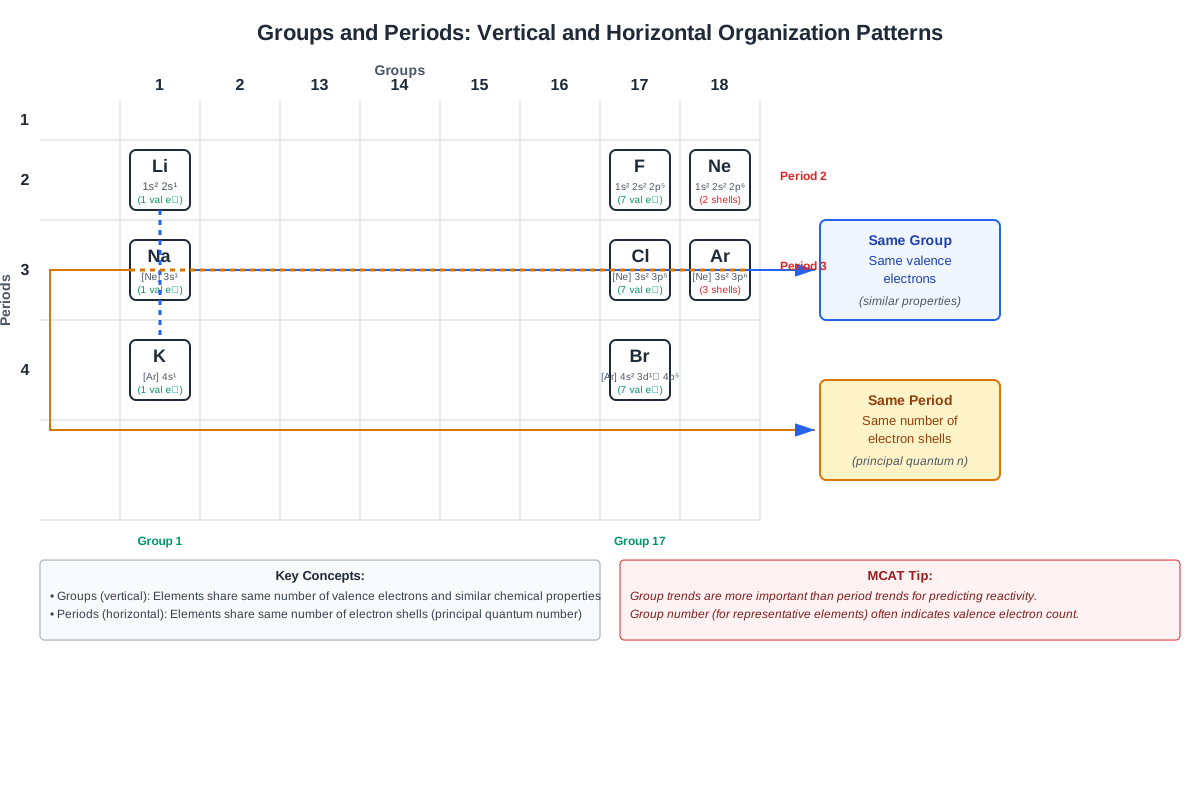
The periodic table arranges elements in order of increasing atomic number (number of protons), creating a systematic organization where elements with similar chemical properties appear in vertical columns called groups or families. This organization is not arbitrary—it reflects the periodic recurrence of electron configuration patterns as atomic number increases. The horizontal rows, called periods, correspond to the filling of successive electron shells, with each period representing a new principal quantum number (n value).
The modern periodic table contains 118 confirmed elements arranged in 7 periods and 18 groups. The periodic law states that when elements are arranged by increasing atomic number, their physical and chemical properties vary periodically. This periodicity arises because elements in the same group have the same number of valence electrons (electrons in the outermost shell), which primarily determine chemical behavior. For MCAT purposes, focus on the first four periods and the most common representative elements, transition metals, and halogens.
Groups and Families
Groups are the vertical columns numbered 1-18 in the modern IUPAC system (older systems used Roman numerals I-VIII with A and B designations). Elements within a group share the same valence electron configuration, leading to similar chemical properties. The most important groups for the MCAT include:
| Group Number | Common Name | Valence Electrons | Key Properties |
|---|---|---|---|
| 1 | Alkali metals | 1 | Highly reactive, +1 oxidation state, soft metals |
| 2 | Alkaline earth metals | 2 | Reactive, +2 oxidation state, harder than Group 1 |
| 13 | Boron group | 3 | Metalloids to metals, +3 common oxidation state |
| 14 | Carbon group | 4 | Nonmetals to metals, diverse bonding |
| 15 | Pnictogens (Nitrogen group) | 5 | Nonmetals to metals, -3 to +5 oxidation states |
| 16 | Chalcogens (Oxygen group) | 6 | Nonmetals to metalloids, -2 common oxidation state |
| 17 | Halogens | 7 | Highly reactive nonmetals, -1 oxidation state |
| 18 | Noble gases | 8 (except He: 2) | Unreactive, complete valence shells |
Representative elements (also called main group elements) include Groups 1, 2, and 13-18. These elements have their valence electrons in s or p orbitals, and their group number (in the modern system) often relates directly to valence electron count. For example, Group 15 elements have 5 valence electrons, and Group 17 elements have 7 valence electrons.
Periods and Electron Shells
Periods are horizontal rows that indicate the number of electron shells (or energy levels) an element possesses. Period 1 contains only hydrogen and helium (1 electron shell), Period 2 contains lithium through neon (2 electron shells), and so forth. The period number equals the highest principal quantum number (n) for electrons in that element's ground state configuration.
Each period begins with an alkali metal (except Period 1) and ends with a noble gas, reflecting the filling and completion of an electron shell. Period length varies because different subshells (s, p, d, f) accommodate different numbers of electrons:
- Periods 1: 2 elements (1s subshell only)
- Periods 2-3: 8 elements each (s and p subshells)
- Periods 4-5: 18 elements each (s, p, and d subshells)
- Periods 6-7: 32 elements each (s, p, d, and f subshells)
Block Structure and Electron Configuration
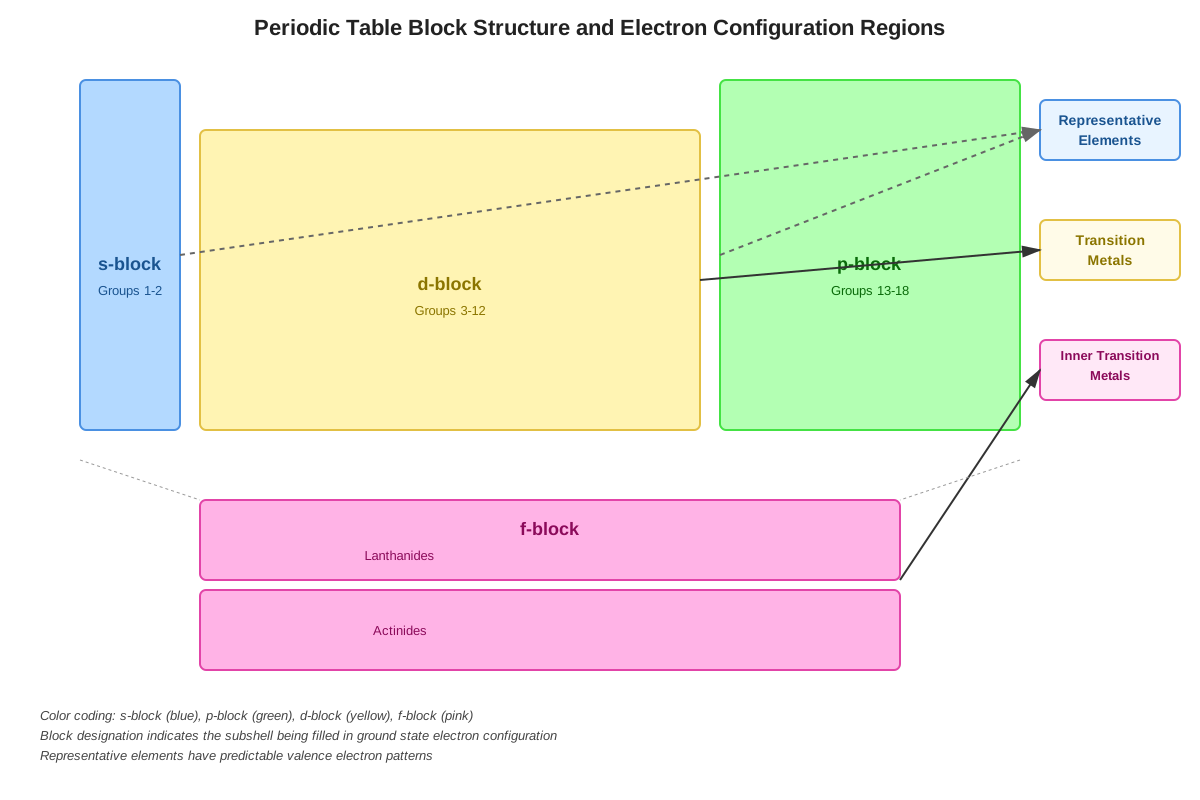
The periodic table divides into four blocks based on which subshell receives the highest-energy electron:
s-block (Groups 1-2): Elements where the outermost electron enters an s orbital. This includes alkali metals (Group 1: ns¹) and alkaline earth metals (Group 2: ns²). These elements are highly reactive metals with low ionization energies.
p-block (Groups 13-18): Elements where the outermost electron enters a p orbital. This block contains the greatest diversity, including metals, metalloids, nonmetals, and noble gases. The p-block spans from boron (2p¹) through the noble gases (np⁶, where n is the period number).
d-block (Groups 3-12): The transition metals where electrons fill d orbitals. These elements occupy Periods 4-7 and are characterized by variable oxidation states, colored compounds, and catalytic properties. The d-block is "inserted" between the s and p blocks, reflecting the fact that d orbitals fill after the s orbital of the next shell (e.g., 4s fills before 3d).
f-block: The inner transition metals including the lanthanides (Period 6, filling 4f orbitals) and actinides (Period 7, filling 5f orbitals). These are typically shown separately below the main table to maintain compact formatting. For the MCAT, detailed knowledge of f-block elements is generally not required.
Metals, Nonmetals, and Metalloids
The periodic table exhibits a diagonal division between metals and nonmetals, with metalloids (or semimetals) forming a staircase boundary. This classification reflects fundamental differences in physical and chemical properties:
Metals (left and center of table): Characterized by metallic luster, malleability, ductility, high electrical and thermal conductivity, and tendency to lose electrons (forming cations). Metals generally have low ionization energies and low electronegativities.
Nonmetals (upper right of table): Characterized by lack of metallic luster, brittleness in solid form, poor conductivity, and tendency to gain electrons (forming anions). Nonmetals have high ionization energies and high electronegativities.
Metalloids (along the staircase): Elements with intermediate properties, including boron (B), silicon (Si), germanium (Ge), arsenic (As), antimony (Sb), tellurium (Te), and sometimes polonium (Po). Metalloids are semiconductors, making them technologically important.
The metal-nonmetal distinction correlates with position: metallic character increases moving down a group and moving left across a period. This trend reflects changes in atomic size and effective nuclear charge.
Special Groups and Categories
Several groups merit special attention for MCAT preparation:
Alkali metals (Group 1): Lithium, sodium, potassium, rubidium, cesium, and francium are the most reactive metals, reacting vigorously with water to produce hydrogen gas and metal hydroxides. They exist as +1 cations in compounds and are never found free in nature. Biologically, sodium and potassium are critical for nerve transmission and cellular osmotic balance.
Alkaline earth metals (Group 2): Beryllium, magnesium, calcium, strontium, barium, and radium are reactive metals forming +2 cations. Calcium and magnesium play essential biological roles in bone structure, muscle contraction, and enzyme cofactors.
Halogens (Group 17): Fluorine, chlorine, bromine, iodine, and astatine are highly reactive nonmetals that exist as diatomic molecules (F₂, Cl₂, etc.) in elemental form. They readily form -1 anions and are strong oxidizing agents, with reactivity decreasing down the group. Chlorine and iodine have important biological and medical applications.
Noble gases (Group 18): Helium, neon, argon, krypton, xenon, and radon have complete valence shells (octet configuration, except helium with 2 electrons), making them extremely unreactive. Their lack of reactivity makes them useful as inert atmospheres in chemical reactions and medical applications.
Transition metals (d-block): These elements exhibit characteristic properties including multiple oxidation states, formation of colored compounds due to d-d electron transitions, paramagnetism, and catalytic activity. Biologically important transition metals include iron (hemoglobin), copper (electron transport), zinc (enzyme cofactors), and cobalt (vitamin B₁₂).
Concept Relationships
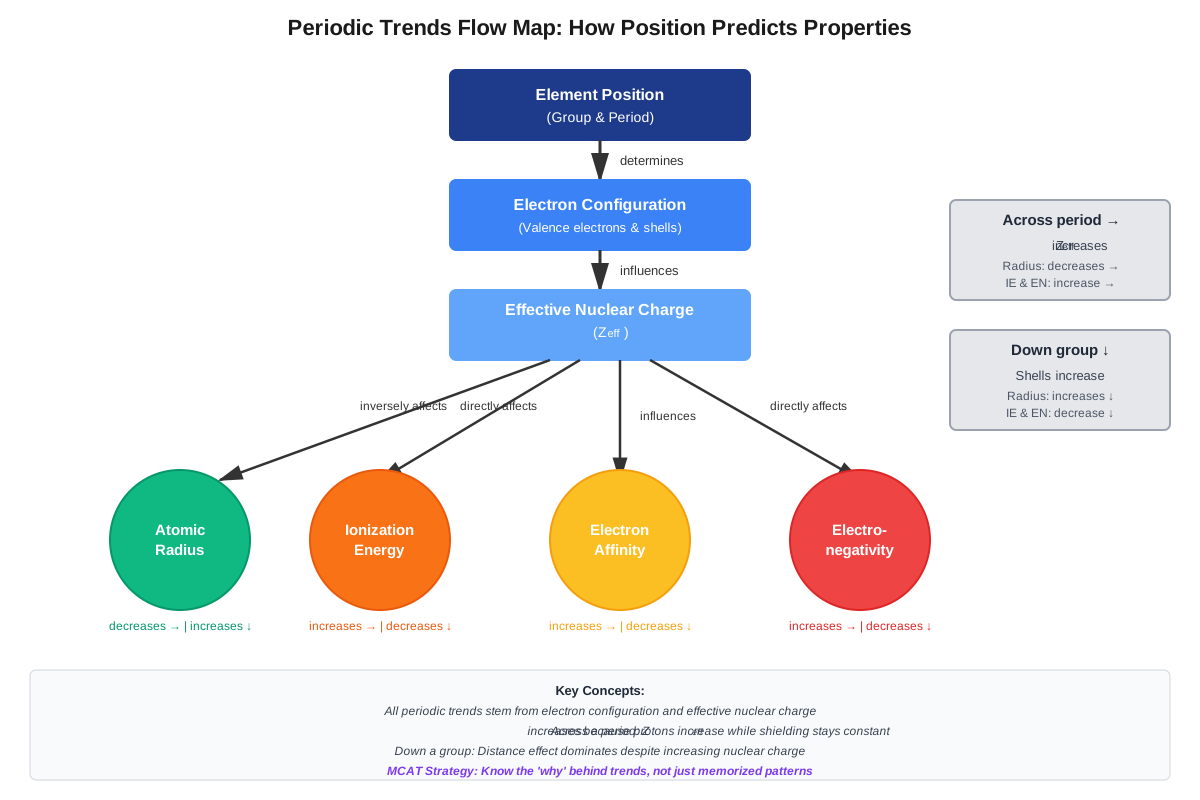
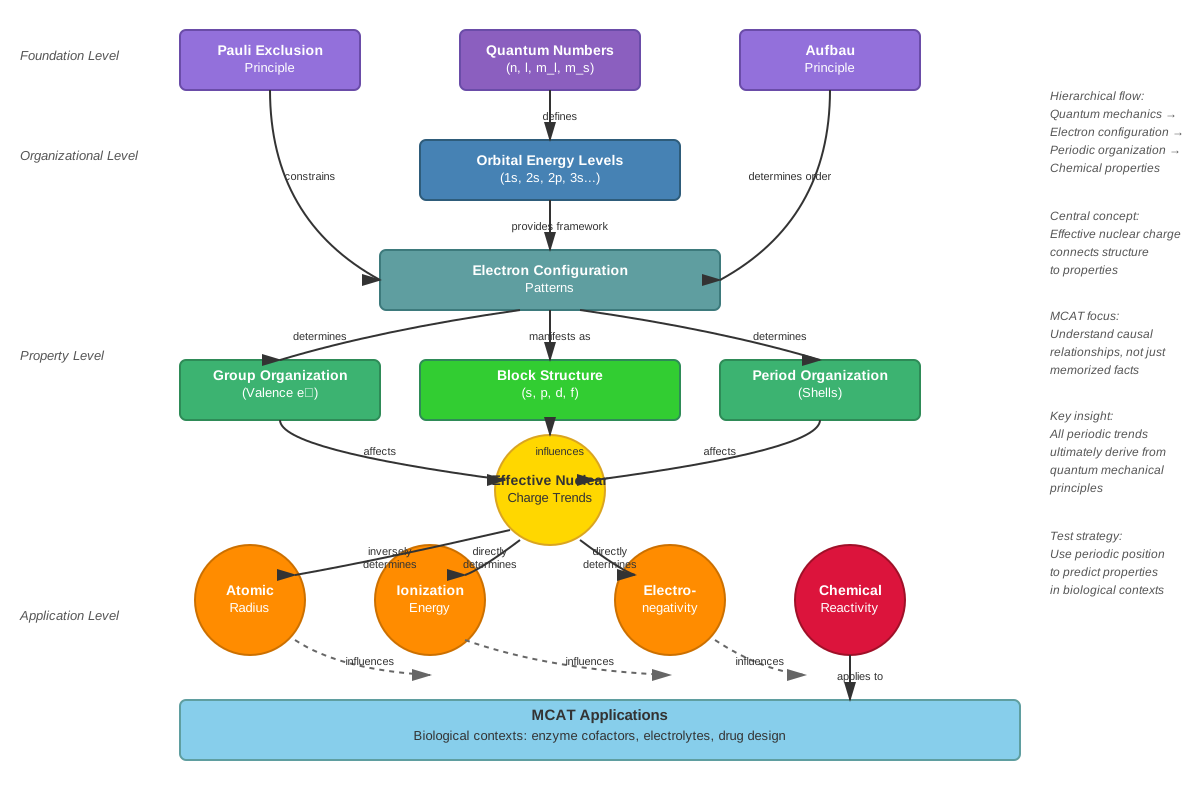
Periodic table organization serves as the central organizing framework connecting multiple related concepts in General Chemistry. The table's structure directly reflects electron configuration patterns: as atomic number increases, electrons fill orbitals in a predictable sequence (1s, 2s, 2p, 3s, 3p, 4s, 3d, etc.), and the periodic table's block structure mirrors this filling order. Understanding this relationship allows prediction of electron configuration from position and vice versa.
The organization enables prediction of periodic trends: moving left to right across a period, effective nuclear charge increases because protons are added while electrons enter the same shell, providing minimal shielding. This increasing effective nuclear charge drives trends in atomic radius (decreases), ionization energy (increases), electron affinity (becomes more negative), and electronegativity (increases). Moving down a group, additional electron shells are added, increasing atomic radius and decreasing ionization energy despite increasing nuclear charge.
The conceptual flow follows this pattern:
Atomic number → Electron configuration → Block and group position → Valence electrons → Chemical properties → Periodic trends → Reactivity patterns → Bonding behavior
This cascade means that knowing an element's position immediately provides information about its electron configuration, which determines its valence electrons, which predict its chemical behavior and trends in properties. For example, knowing that chlorine is in Group 17, Period 3 tells us it has 7 valence electrons (3s² 3p⁵), will readily gain one electron to achieve noble gas configuration, has high electronegativity, forms -1 ions, and is a strong oxidizing agent.
The relationship extends to chemical bonding: elements on opposite sides of the periodic table (metals and nonmetals) form ionic bonds, while elements with similar electronegativity (both nonmetals) form covalent bonds. The periodic table organization thus predicts not only individual element properties but also how elements will interact with each other.
High-Yield Facts
⭐ The periodic table is organized by increasing atomic number (number of protons), not atomic mass, which explains rare inversions like argon (Z=18) before potassium (Z=19).
⭐ Group number (in modern 1-18 system) indicates valence electrons for representative elements: Group 1 has 1 valence electron, Group 17 has 7 valence electrons.
⭐ Period number equals the number of electron shells (principal quantum number of outermost electrons) for all elements in that row.
⭐ Elements in the same group have similar chemical properties because they have the same number of valence electrons and similar electron configurations.
⭐ The four blocks (s, p, d, f) correspond to the subshell receiving the highest-energy electron, with block width matching the maximum electron capacity of that subshell (s=2, p=6, d=10, f=14).
- Metals occupy the left and center portions of the periodic table, while nonmetals occupy the upper right, with metalloids forming a diagonal boundary between them.
- Transition metals (d-block) exhibit variable oxidation states because both s and d electrons can participate in bonding.
- Noble gases (Group 18) are unreactive because they have complete valence shells (octet configuration, except helium with duet).
- Alkali metals (Group 1) and halogens (Group 17) are among the most reactive elements because they are one electron away from noble gas configuration.
- The lanthanides and actinides (f-block) are placed separately below the main table for formatting convenience but belong in Periods 6 and 7 respectively.
- Hydrogen is unique and sometimes placed separately because while it's in Group 1, it's a nonmetal that can both lose and gain electrons.
- The periodic table's structure directly reflects the quantum mechanical principle that electron shells fill in order of increasing energy.
Quick check — test yourself on Periodic table organization so far.
Try Flashcards →Common Misconceptions
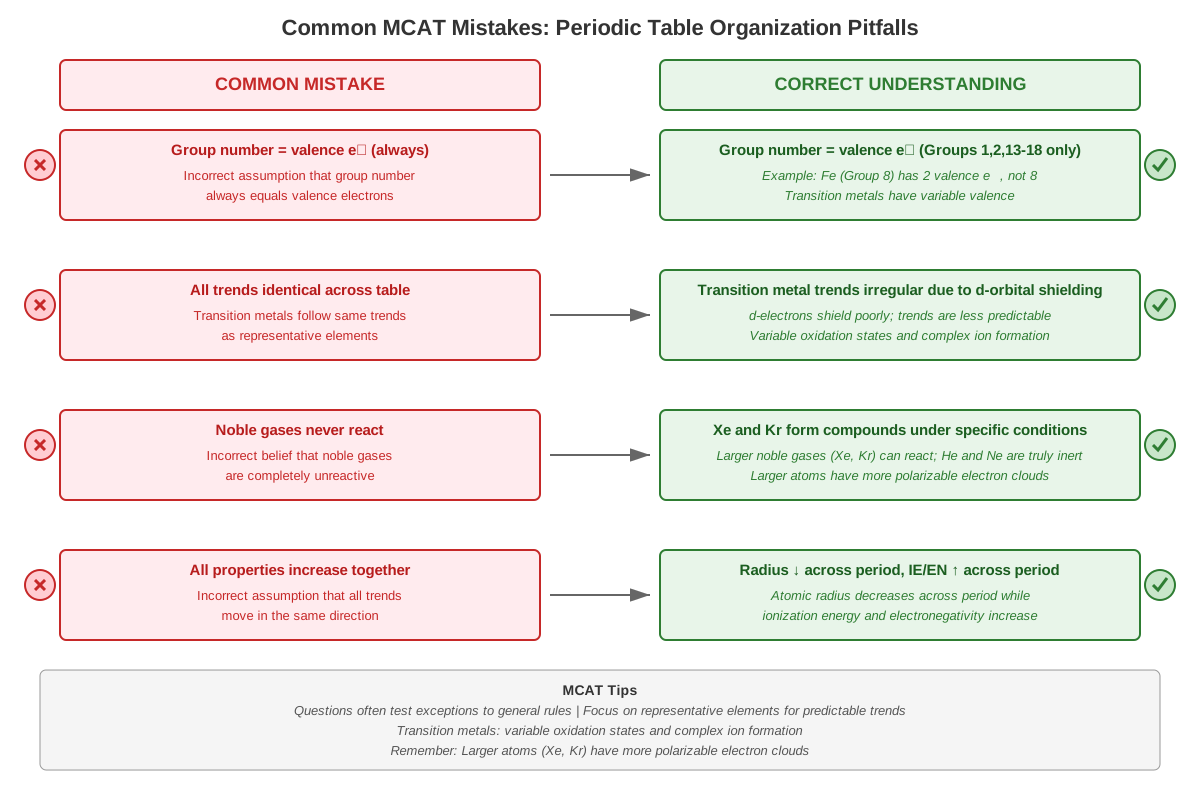
Misconception: Group numbers directly indicate valence electrons for all elements, including transition metals.
Correction: Group numbers reliably indicate valence electrons only for representative elements (Groups 1, 2, 13-18). Transition metals (Groups 3-12) have more complex electron configurations where both s and d electrons can act as valence electrons, making the group number less directly predictive of valence electron count.
Misconception: Elements are arranged by atomic mass on the periodic table.
Correction: The modern periodic table is organized by atomic number (number of protons), not atomic mass. This distinction is crucial and explains why argon (atomic mass 39.95) appears before potassium (atomic mass 39.10)—argon has 18 protons while potassium has 19. Mendeleev's original table used atomic mass, but the modern table corrected this based on understanding of atomic structure.
Misconception: All elements in the same period have the same number of valence electrons.
Correction: Elements in the same period have the same number of electron shells, not the same number of valence electrons. Valence electron count varies across a period (increasing from left to right for representative elements), while it remains constant down a group. This distinction is fundamental to understanding periodic trends.
Misconception: The d-block elements belong to Groups 3-12 and therefore have 3-12 valence electrons.
Correction: Transition metals typically have 1-2 valence electrons in their outermost s orbital, despite their group numbers. The d electrons are in an inner shell (n-1) and, while they can participate in bonding, they are not counted as valence electrons in the same way as for representative elements. This explains why many transition metals commonly form +2 ions by losing their two s electrons.
Misconception: Hydrogen belongs definitively in Group 1 with the alkali metals.
Correction: Hydrogen's placement is ambiguous because while it has one valence electron like alkali metals, it's a nonmetal with properties vastly different from Group 1 metals. Some periodic tables place hydrogen separately, above the table, or even in Group 17 (since it's one electron short of a complete shell, like halogens). For MCAT purposes, recognize hydrogen's unique position and don't assume it behaves like sodium or potassium.
Misconception: Noble gases are completely unreactive and never form compounds.
Correction: While noble gases are extremely unreactive due to complete valence shells, heavier noble gases (particularly xenon and krypton) can form compounds under specific conditions, especially with highly electronegative elements like fluorine and oxygen. However, for MCAT purposes, treating noble gases as unreactive is generally appropriate unless a question specifically addresses noble gas compounds.
Misconception: The periodic table's organization is arbitrary or based solely on chemical similarity.
Correction: The periodic table's organization directly reflects quantum mechanical principles and electron configuration patterns. The table's structure is not arbitrary—it's a visual representation of how electron shells and subshells fill according to the Aufbau principle, Pauli exclusion principle, and Hund's rule. This deep connection to atomic structure makes the table predictive, not merely descriptive.
Worked Examples
Example 1: Predicting Properties from Position
Question: An unknown element X is located in Group 16, Period 3 of the periodic table. Predict: (a) its electron configuration, (b) the number of valence electrons, (c) the most common ion it forms, and (d) whether it's a metal, nonmetal, or metalloid.
Solution:
Step 1: Identify the element
Group 16, Period 3 corresponds to sulfur (S), atomic number 16. However, we can answer all questions without knowing the element's identity, using only its position.
Step 2: Determine electron configuration
Period 3 means the outermost electrons are in the third shell (n=3). Group 16 is in the p-block, specifically the fourth column of the p-block (since p-block spans Groups 13-18, that's 6 columns). The element has filled 1s, 2s, 2p, 3s, and is filling 3p.
- Electron configuration: 1s² 2s² 2p⁶ 3s² 3p⁴
- Alternatively, using noble gas notation: [Ne] 3s² 3p⁴
Step 3: Count valence electrons
Valence electrons are those in the outermost shell (n=3): 3s² 3p⁴ = 2 + 4 = 6 valence electrons
This matches the group number pattern: Group 16 → 6 valence electrons.
Step 4: Predict most common ion
With 6 valence electrons, the element is 2 electrons short of a complete octet (noble gas configuration). It will tend to gain 2 electrons to achieve stability.
- Most common ion: X²⁻ (gains 2 electrons)
- Ion configuration: 1s² 2s² 2p⁶ 3s² 3p⁶ = [Ar]
Step 5: Classify as metal, nonmetal, or metalloid
Group 16 is in the p-block on the right side of the periodic table. Elements in this region are nonmetals (oxygen, sulfur) or metalloids (selenium, tellurium) as you move down the group. Period 3 is relatively high in the table, so this element is a nonmetal.
Answer Summary: The element has (a) electron configuration [Ne] 3s² 3p⁴, (b) 6 valence electrons, (c) forms X²⁻ ions, and (d) is a nonmetal. This example demonstrates how periodic table position alone provides extensive information about an element's properties.
Example 2: Comparing Elements Using Periodic Organization
Question: A researcher is comparing three elements for potential use as electrolytes in a biological buffer system: sodium (Na), magnesium (Mg), and aluminum (Al). Based on their positions in the periodic table, predict and explain: (a) which forms the most stable +1 cation, (b) which has the highest first ionization energy, and (c) which would be most suitable as a divalent cation (+2) in biological systems.
Solution:
Step 1: Locate elements on the periodic table
- Sodium (Na): Group 1, Period 3 (alkali metal)
- Magnesium (Mg): Group 2, Period 3 (alkaline earth metal)
- Aluminum (Al): Group 13, Period 3 (p-block metal)
All three are in Period 3, so they have the same number of electron shells. They differ in group position, moving left to right: Na → Mg → Al.
Step 2: Determine electron configurations
- Na: [Ne] 3s¹ (1 valence electron)
- Mg: [Ne] 3s² (2 valence electrons)
- Al: [Ne] 3s² 3p¹ (3 valence electrons)
Step 3: Answer part (a) - most stable +1 cation
Sodium forms the most stable +1 cation because removing one electron gives it noble gas configuration [Ne].
- Na → Na⁺ + e⁻ results in [Ne] configuration (very stable)
- Mg → Mg⁺ + e⁻ results in [Ne] 3s¹ configuration (unstable, unpaired electron)
- Al → Al⁺ + e⁻ results in [Ne] 3s² configuration (less stable than Na⁺)
Answer (a): Sodium forms the most stable +1 cation because it achieves noble gas configuration.
Step 4: Answer part (b) - highest first ionization energy
Moving left to right across a period, ionization energy increases due to increasing effective nuclear charge with constant shielding. Aluminum has the most protons (13) pulling on electrons in the same shell distance.
- Expected order: Na < Mg < Al
However, there's a subtle exception: Aluminum's first ionization energy is slightly lower than expected because removing the 3p¹ electron leaves a stable, filled 3s² subshell. Despite this nuance, among these three elements, aluminum still has the highest first ionization energy.
Answer (b): Aluminum has the highest first ionization energy due to its position furthest right in Period 3, experiencing the greatest effective nuclear charge.
Step 5: Answer part (c) - most suitable divalent cation
Magnesium naturally forms +2 cations because removing two electrons achieves noble gas configuration:
- Mg → Mg²⁺ + 2e⁻ results in [Ne] configuration
Magnesium is the only one of these three that naturally and stably forms +2 ions. Sodium would need to lose two electrons (very unfavorable, requiring removal of a core electron), while aluminum more commonly forms +3 ions.
Answer (c): Magnesium is most suitable as a divalent cation because it naturally forms stable Mg²⁺ ions with noble gas configuration, making it ideal for biological systems (indeed, Mg²⁺ is a crucial cofactor for many enzymes).
Key Insight: This example demonstrates how periodic table organization predicts not just individual properties but also relative comparisons between elements, which is exactly how MCAT questions test this concept.
Exam Strategy
When approaching periodic table organization MCAT questions, employ these strategic approaches:
Trigger Word Recognition: Watch for phrases like "element in Group X," "Period Y element," "same family as," "similar properties to," or "alkali metal/halogen/noble gas." These phrases signal that you should immediately visualize the periodic table and recall the properties associated with that position. Questions asking you to "predict" or "compare" properties almost always rely on periodic table organization.
Position-First Strategy: When given an unfamiliar element or asked to compare elements, immediately identify their positions (group and period) before attempting to answer. Position tells you: number of valence electrons (for representative elements), number of electron shells, block (s, p, d, or f), and general classification (metal, nonmetal, metalloid). This information alone often allows you to eliminate 2-3 answer choices.
Trend Application Process: For questions involving periodic trends, use this systematic approach:
- Identify what property is being asked about (atomic radius, ionization energy, electronegativity, etc.)
- Recall the trend direction (increases/decreases across period and down group)
- Locate the elements on the periodic table
- Apply the trend to predict the relationship
- Verify your answer makes chemical sense
Process of Elimination Tips:
- Eliminate answers that violate basic periodic trends (e.g., claiming an element in Period 2 has more electron shells than one in Period 4)
- Eliminate answers that contradict group properties (e.g., suggesting a noble gas is highly reactive)
- Eliminate answers that confuse groups with periods or mix up trend directions
- Watch for answers that incorrectly apply transition metal rules to representative elements or vice versa
Time Management: Periodic table questions should be among your fastest to answer (30-45 seconds for discrete questions) because they rely on pattern recognition rather than complex calculations. If you find yourself spending more than one minute on a periodic table organization question, you likely don't have the foundational knowledge memorized and should flag it, make your best guess, and move on. Return to review this topic after the exam.
Common Question Formats:
- Comparison questions: "Which element has the largest atomic radius?" → Identify positions, apply trend
- Prediction questions: "An element in Group 15 would most likely form which ion?" → Count valence electrons, determine what's needed for octet
- Property explanation questions: "Why does element X have property Y?" → Connect position to electron configuration to property
- Passage-based applications: Often involve unfamiliar elements or biological contexts → Use periodic table position to predict behavior even for elements you've never studied
Red Flag Phrases: Be cautious when you see "always," "never," "all," or "none" in answer choices about periodic properties. These absolute statements are often incorrect because there are exceptions (like the slight ionization energy dip at aluminum, or noble gas compounds). However, for MCAT purposes, these exceptions are rarely tested, so don't overthink.
Memory Techniques
Mnemonic for Periodic Table Blocks: "Scientists Prefer Doing Fun experiments" helps remember the order of blocks from left to right (s-block, p-block, d-block, f-block) and their relative positions.
Group Names Mnemonic: "All Astronauts Have Nice Clean Suits" for the major groups:
- Alkali metals (Group 1)
- Alkaline earth metals (Group 2)
- Halogens (Group 17)
- Noble gases (Group 18)
- Chalcogens (Group 16)
- Some people add: Pnictogens (Group 15)
Valence Electron Visualization: For representative elements, use the "last digit" rule: the last digit of the group number (in 1-18 system) gives valence electrons for Groups 13-18. For Groups 1-2, the group number itself is the valence electron count. Visualize this as a simple subtraction: Group 16 → 16 - 10 = 6 valence electrons (subtracting 10 accounts for the transition metals).
Period = Shells Rhyme: "Period number, shells you count, that's the total amount" reinforces that period number equals electron shells.
Metal-Nonmetal Boundary: Visualize a "staircase" starting at boron and descending to astatine. Everything to the left and below is metal, everything to the right and above is nonmetal, and elements touching the staircase are metalloids. Draw this staircase on your scratch paper at the start of the exam.
Reactivity Patterns:
- For metals: "Left and Down = More reactive" (Left on table, Down the group)
- For nonmetals: "Right and Up = More reactive" (Right on table, Up the group)
- This creates an "X" pattern with most reactive elements at the corners (except noble gases)
Block Width Memory: Remember "2, 6, 10, 14" for the widths of s, p, d, and f blocks respectively. These numbers also represent the maximum electrons each subshell can hold, creating a dual-purpose memory aid. Visualize the periodic table as expanding: narrow (s), wider (p), widest (d), and f-block shown separately.
Transition Metal Trick: Transition metals are "in transition" between the s and p blocks, which helps remember their position and that they're filling d orbitals (which are "in between" in energy).
Summary
Periodic table organization represents the fundamental framework for understanding chemical behavior and predicting element properties based on systematic patterns. The modern periodic table arranges elements by increasing atomic number into periods (horizontal rows indicating electron shells) and groups (vertical columns indicating valence electrons and similar chemical properties). This organization directly reflects quantum mechanical principles of electron configuration, with the table's block structure (s, p, d, f) mirroring the subshell filling order. Understanding an element's position immediately reveals its electron configuration, number of valence electrons, and classification as metal, nonmetal, or metalloid, which in turn predicts its chemical reactivity, bonding behavior, and physical properties. For MCAT success, students must master the relationships between position and properties, particularly for representative elements (Groups 1, 2, 13-18), transition metals (d-block), and special groups including alkali metals, alkaline earth metals, halogens, and noble gases. The periodic table serves as both a reference tool and a predictive framework, enabling students to answer questions about unfamiliar elements by applying systematic trends rather than relying on memorization alone.
Key Takeaways
- The periodic table organizes elements by atomic number (not mass), with periods indicating electron shells and groups indicating valence electrons for representative elements
- Block structure (s, p, d, f) directly corresponds to electron configuration patterns and determines element properties and chemical behavior
- Elements in the same group share similar chemical properties because they have identical valence electron configurations
- The table divides into metals (left/center), nonmetals (upper right), and metalloids (diagonal boundary), with this classification predicting bonding and reactivity patterns
- Major groups (alkali metals, alkaline earth metals, halogens, noble gases) have distinctive properties that frequently appear in MCAT questions
- Periodic table position enables prediction of all periodic trends without memorization, making it a high-yield conceptual framework
- Understanding periodic table organization provides the foundation for predicting chemical behavior in biological contexts, which is how the MCAT tests this concept
Related Topics
Periodic Trends: Building directly on periodic table organization, this topic explores how atomic radius, ionization energy, electron affinity, and electronegativity vary systematically across periods and down groups. Mastering periodic table organization is essential before studying these trends because position determines trend predictions.
Electron Configuration: The quantum mechanical basis for periodic table organization, explaining why elements are arranged in their specific pattern and how to write electron configurations from position (and vice versa). This topic provides the theoretical foundation for understanding why the periodic table works.
Chemical Bonding: Periodic table organization predicts bonding behavior—metals and nonmetals form ionic bonds, nonmetals form covalent bonds, and position determines bond polarity through electronegativity differences. Understanding element positions enables prediction of bond types and molecular properties.
Oxidation States and Redox Chemistry: Group position predicts common oxidation states (Group 1 forms +1, Group 17 forms -1, transition metals show variable states), which is essential for balancing redox reactions and understanding electron transfer in biological systems.
Coordination Chemistry and Transition Metals: The d-block elements exhibit unique properties including complex ion formation, colored compounds, and catalytic activity. Understanding transition metal position and electron configuration is prerequisite for studying coordination compounds.
Practice CTA
Now that you've mastered the fundamental organization of the periodic table, it's time to solidify your understanding through active practice. Challenge yourself with practice questions that require you to predict properties from position, compare elements across groups and periods, and apply periodic table organization to biological contexts. Use flashcards to drill group names, block structures, and the positions of high-yield elements until you can visualize the periodic table instantly. Remember: the periodic table is not just a reference chart to memorize—it's a powerful predictive tool that, once mastered, will accelerate your performance across all General Chemistry topics. Your investment in understanding periodic table organization will pay dividends throughout your MCAT preparation and beyond!
Sign up free to keep reading
Create a free AnvayaPrep account to finish this MCAT guide on Periodic table organization — plus flashcards and practice questions.