Overview
Electron configuration is a fundamental concept in General Chemistry that describes the arrangement of electrons within an atom's orbitals. This systematic notation reveals how electrons occupy specific energy levels and subshells around the nucleus, following predictable patterns governed by quantum mechanical principles. Understanding electron configuration is essential for predicting chemical behavior, bonding patterns, and periodic trends—all of which are heavily tested on the MCAT. The electron configuration of an atom determines its reactivity, ionization energy, atomic radius, and ability to form chemical bonds, making it a cornerstone concept that connects atomic structure to molecular chemistry.
For the MCAT, electron configuration serves as a bridge between atomic theory and practical chemistry applications. Questions frequently require students to write configurations for neutral atoms and ions, predict magnetic properties, explain periodic trends, or identify elements based on their electron arrangements. The Atomic Structure and Periodic Trends unit relies heavily on electron configuration as the underlying explanation for why elements in the same group share similar chemical properties and why trends exist across periods. Mastery of this topic enables students to quickly analyze chemical scenarios without memorizing countless individual facts.
The relationship between electron configuration and other General Chemistry concepts is extensive and bidirectional. Electron configuration explains periodic trends (ionization energy, electronegativity, atomic radius), predicts bonding behavior (valence electrons determine bonding capacity), and underlies molecular orbital theory. It connects directly to quantum numbers, which define the specific quantum states electrons occupy, and to the periodic table itself, which is organized according to electron filling patterns. This topic appears across multiple MCAT sections, including Chemical and Physical Foundations of Biological Systems and occasionally in biochemistry contexts when discussing metal cofactors or redox-active centers in proteins.
Learning Objectives
- [ ] Define electron configuration using accurate General Chemistry terminology
- [ ] Explain why electron configuration matters for the MCAT
- [ ] Apply electron configuration to exam-style questions
- [ ] Identify common mistakes related to electron configuration
- [ ] Connect electron configuration to related General Chemistry concepts
- [ ] Write complete electron configurations for atoms and ions up to Z=36 (krypton)
- [ ] Apply the Aufbau principle, Pauli exclusion principle, and Hund's rule to predict electron arrangements
- [ ] Determine valence electron configurations and predict chemical properties from electron arrangements
- [ ] Identify exceptions to standard filling order (particularly chromium and copper)
Prerequisites
- Atomic structure basics: Understanding protons, neutrons, electrons, and the nuclear model is essential because electron configuration describes how electrons arrange themselves around the nucleus
- Quantum numbers: Familiarity with n, l, m_l, and m_s provides the theoretical foundation for why orbitals exist and how many electrons each can hold
- Periodic table organization: Knowledge of groups, periods, and element positions enables quick determination of electron configurations without extensive calculation
- Orbital shapes and types: Understanding s, p, d, and f orbitals (their shapes and capacities) is necessary to visualize where electrons reside
- Basic mathematical notation: Comfort with superscripts and subscripts allows proper reading and writing of electron configuration notation
Why This Topic Matters
Electron configuration has profound clinical and real-world significance beyond its theoretical importance. The magnetic properties of atoms and ions, determined by unpaired electrons in their configurations, form the basis of magnetic resonance imaging (MRI), one of medicine's most powerful diagnostic tools. Transition metal ions in biological systems—such as iron in hemoglobin, copper in cytochrome c oxidase, and zinc in numerous enzymes—derive their catalytic properties from their specific d-electron configurations. Understanding why certain oxidation states are stable for these metals requires knowledge of electron configuration and the relative stability of half-filled and fully-filled subshells.
On the MCAT, electron configuration appears with moderate to high frequency across multiple question types. Approximately 3-5 questions per exam directly or indirectly test this concept. Discrete questions often ask students to identify elements from configurations, write configurations for ions, or predict magnetic properties. Passage-based questions frequently embed electron configuration concepts within broader contexts: coordination chemistry passages may require understanding d-orbital splitting, bioenergetics passages may involve electron transfer between species with different configurations, and periodic trends passages invariably connect to underlying electron arrangements. The Chemical and Physical Foundations section tests this topic most heavily, but it also appears in biochemistry contexts involving metalloenzymes and redox cofactors.
Common exam presentations include: (1) identifying an element or ion from its electron configuration, (2) predicting which species is paramagnetic or diamagnetic, (3) explaining periodic trends using electron configuration principles, (4) determining the number of unpaired electrons in transition metal complexes, (5) comparing ionization energies based on electron removal from specific orbitals, and (6) predicting chemical reactivity based on valence electron arrangements. The MCAT particularly favors questions that require applying multiple principles simultaneously—for example, writing the configuration of Fe²⁺ requires knowing both the standard filling order and the exception that 4s electrons are removed before 3d electrons during ionization.
Core Concepts
Fundamental Definition and Notation
Electron configuration represents the distribution of electrons among the orbitals of an atom in its ground state. The standard notation uses numbers to indicate principal energy levels (shells), letters to designate subshells (s, p, d, f), and superscripts to show the number of electrons in each subshell. For example, the electron configuration of carbon (Z=6) is written as 1s²2s²2p², indicating two electrons in the 1s orbital, two in the 2s orbital, and two in the 2p orbitals. This notation provides a complete description of where all electrons reside within an atom.
The orbital is a region of space where there is a high probability of finding an electron. Each orbital can hold a maximum of two electrons with opposite spins, as dictated by the Pauli exclusion principle. The four types of orbitals (s, p, d, f) have different shapes and capacities: s orbitals are spherical and hold 2 electrons, p orbitals are dumbbell-shaped with three orientations holding 6 electrons total, d orbitals have more complex shapes with five orientations holding 10 electrons total, and f orbitals have seven orientations holding 14 electrons total.
The Aufbau Principle
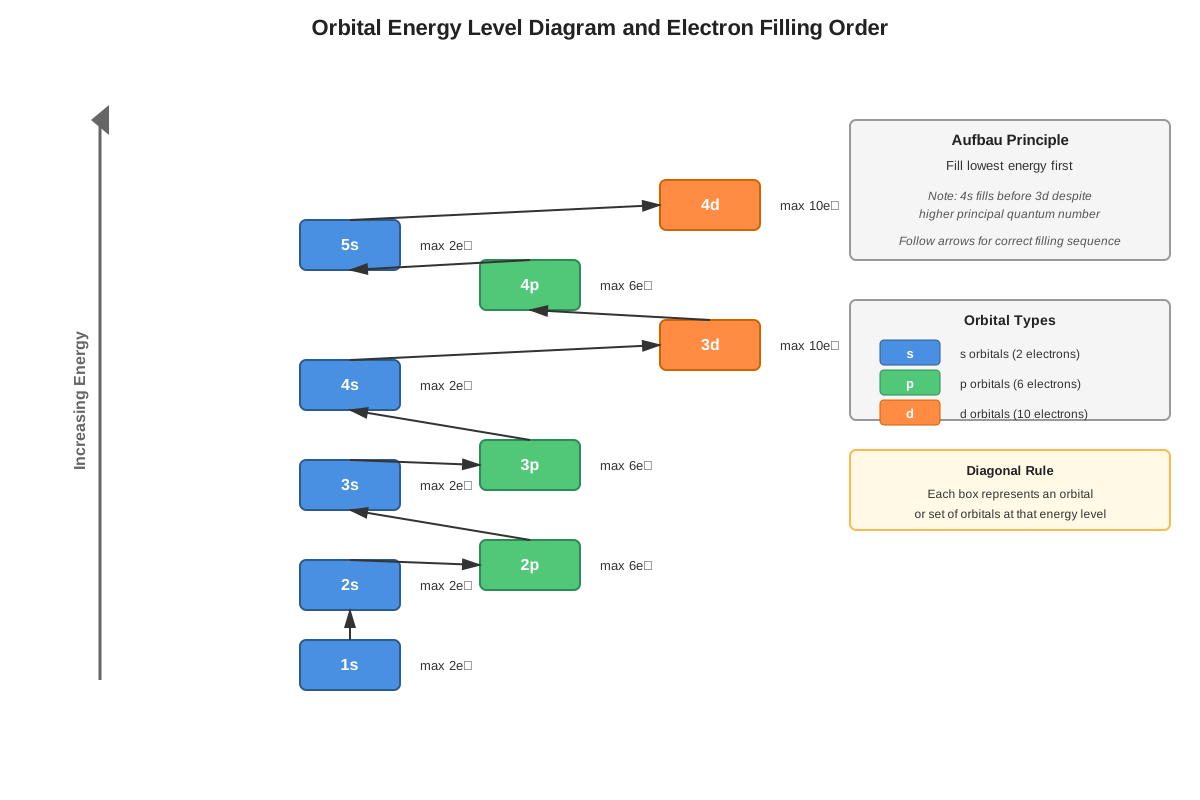
The Aufbau principle (from German "aufbauen," meaning "to build up") states that electrons fill orbitals starting with the lowest energy level and progressing to higher energy levels. This principle provides the foundation for predicting electron configurations systematically. The filling order follows the sequence: 1s, 2s, 2p, 3s, 3p, 4s, 3d, 4p, 5s, 4d, 5p, 6s, 4f, 5d, 6p, 7s, 5f, 6d. A useful memory aid for this sequence is the diagonal rule, where orbitals are filled following diagonal arrows through a chart arranged by n and l values.
The energy ordering of orbitals becomes more complex as atomic number increases due to electron-electron repulsions and shielding effects. A critical point for the MCAT is that the 4s orbital fills before the 3d orbitals because 4s is lower in energy for neutral atoms. However, when forming cations, electrons are removed from the 4s orbital first, even though it filled first. This counterintuitive behavior explains why Fe²⁺ has the configuration [Ar]3d⁶ rather than [Ar]4s²3d⁴.
Hund's Rule
Hund's rule states that electrons occupy degenerate orbitals (orbitals of equal energy) singly with parallel spins before pairing up. This minimizes electron-electron repulsion and maximizes total spin, creating a more stable configuration. For example, carbon's 2p² configuration places one electron in two different p orbitals with parallel spins (↑ ↑ _) rather than pairing them in one orbital (↑↓ _ _). This principle is crucial for determining magnetic properties and predicting the most stable electron arrangements.
The application of Hund's rule becomes particularly important for transition metals and their ions. When filling d orbitals, electrons first occupy all five d orbitals singly before any pairing occurs. This creates special stability for half-filled (d⁵) and fully-filled (d¹⁰) configurations, which explains some of the exceptions to standard filling order. The number of unpaired electrons, determined by applying Hund's rule, directly determines whether a species is paramagnetic (attracted to magnetic fields, has unpaired electrons) or diamagnetic (weakly repelled by magnetic fields, all electrons paired).
The Pauli Exclusion Principle
The Pauli exclusion principle states that no two electrons in an atom can have the same set of four quantum numbers (n, l, m_l, m_s). Since electrons in the same orbital share the first three quantum numbers, they must have opposite spins (m_s = +½ and -½). This fundamental principle limits each orbital to a maximum of two electrons and underlies the entire structure of the periodic table. The principle explains why electron shells have specific capacities: the first shell holds 2 electrons, the second holds 8, the third holds 18, and so forth, following the formula 2n².
Exceptions to Standard Filling Order
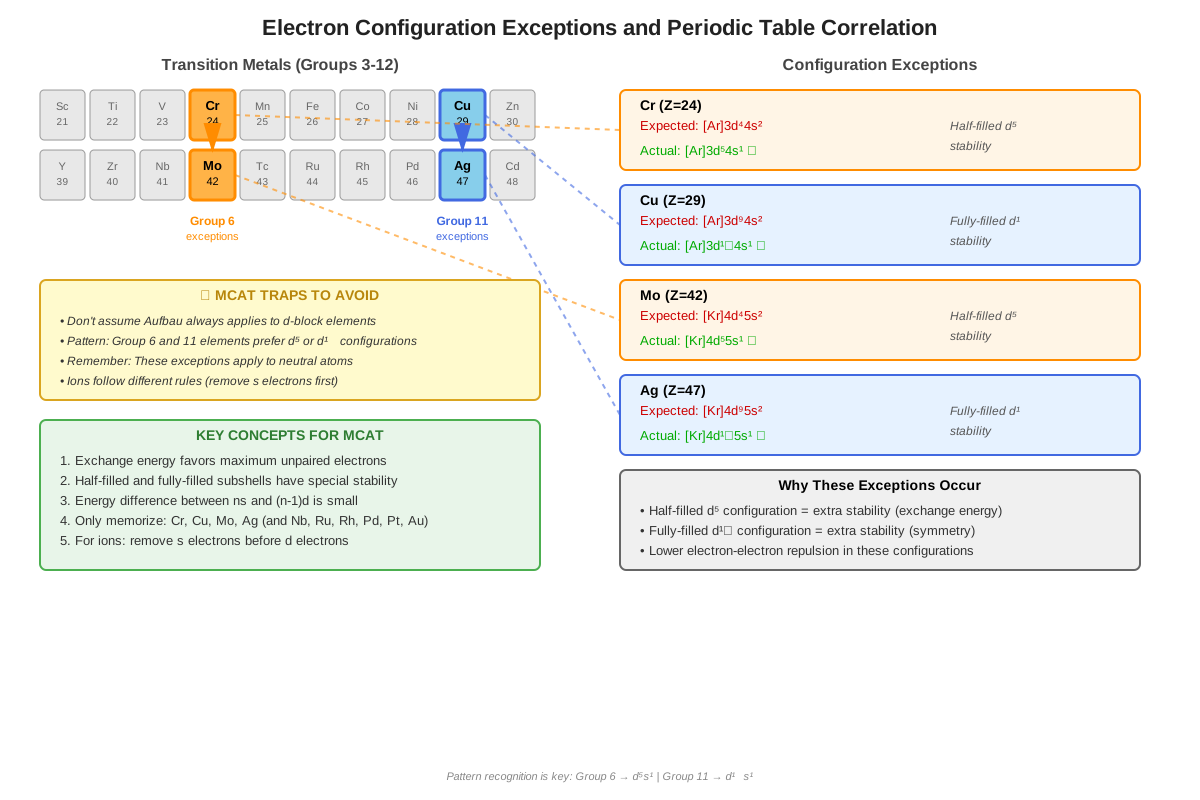
While the Aufbau principle predicts most electron configurations accurately, several important exceptions exist that are frequently tested on the MCAT. Chromium (Z=24) has the configuration [Ar]3d⁵4s¹ rather than the expected [Ar]3d⁴4s², and copper (Z=29) has [Ar]3d¹⁰4s¹ instead of [Ar]3d⁹4s². These exceptions occur because half-filled and fully-filled subshells provide extra stability due to exchange energy and symmetry considerations.
Other notable exceptions include molybdenum ([Kr]4d⁵5s¹), silver ([Kr]4d¹⁰5s¹), and gold ([Xe]4f¹⁴5d¹⁰6s¹). While memorizing all exceptions is unnecessary for the MCAT, understanding that d⁴s² and d⁹s² configurations often shift to d⁵s¹ and d¹⁰s¹ respectively helps predict these anomalies. The underlying principle is that the energy cost of promoting one s electron to a d orbital is offset by the stability gained from achieving half-filled or fully-filled d subshells.
Noble Gas Configuration Shorthand
To simplify writing electron configurations for larger atoms, the noble gas configuration shorthand uses the symbol of the previous noble gas in brackets to represent all filled inner shells. For example, iron (Z=26) can be written as [Ar]3d⁶4s² instead of 1s²2s²2p⁶3s²3p⁶3d⁶4s². This notation emphasizes the valence electrons—those in the outermost shell that participate in chemical bonding—while condensing the core electrons into a compact form. The noble gases (He, Ne, Ar, Kr, Xe, Rn) serve as convenient reference points because they represent completely filled electron shells.
Valence Electrons and Chemical Properties
Valence electrons are the electrons in the outermost shell of an atom and are primarily responsible for chemical behavior. For main group elements, valence electrons are those in the highest principal energy level (highest n value). For transition metals, both the outermost s electrons and the d electrons in the shell below are considered valence electrons because both participate in bonding. The number of valence electrons determines an element's group number in the periodic table and predicts its bonding capacity and typical oxidation states.
Elements in the same group have identical valence electron configurations, explaining their similar chemical properties. For example, all alkali metals (Group 1) have one s¹ valence electron, making them highly reactive and prone to forming +1 cations. All halogens (Group 17) have seven valence electrons (s²p⁵), making them one electron short of a stable octet and highly reactive nonmetals that readily form -1 anions. This connection between electron configuration and periodic table organization is fundamental to predicting chemical behavior.
Electron Configuration of Ions
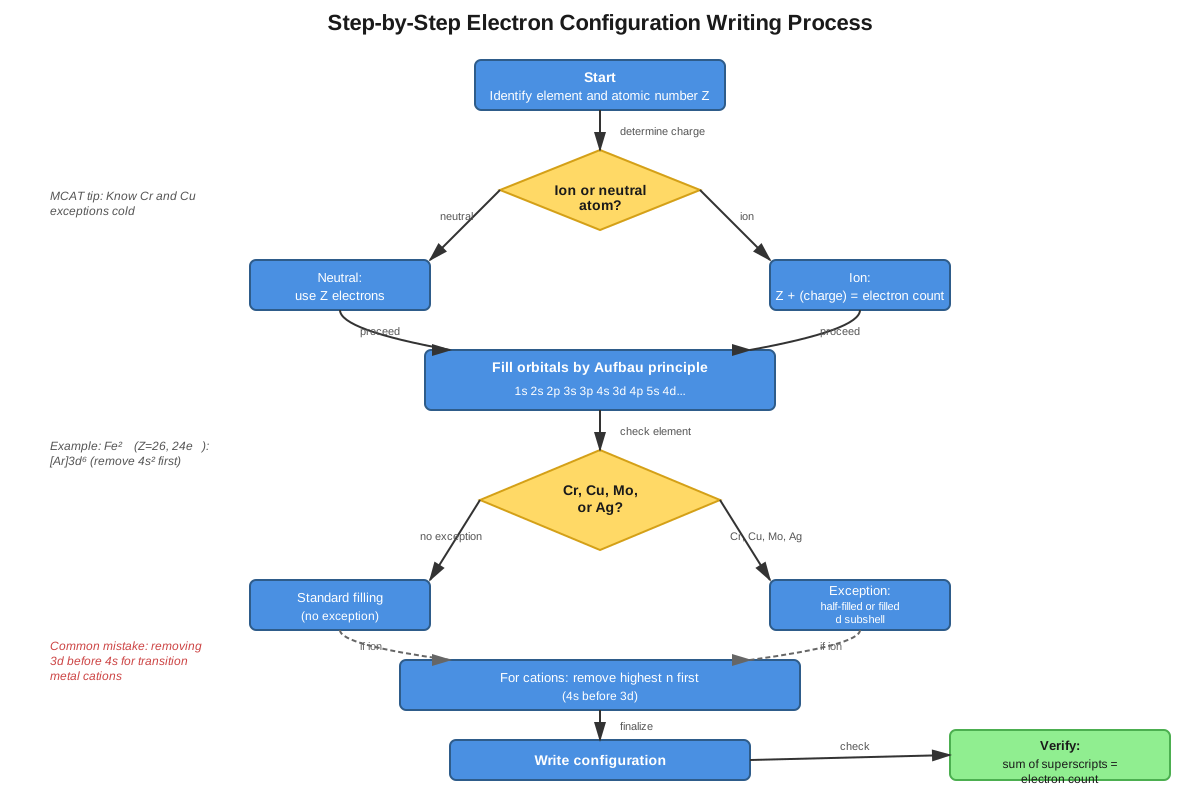
Writing electron configurations for ions requires understanding which electrons are removed during cation formation or added during anion formation. For main group elements, cations form by removing electrons from the highest energy level first. For example, Mg²⁺ (from Mg: [Ne]3s²) has the configuration [Ne], having lost both 3s electrons. Anions form by adding electrons to the lowest available orbital, so O²⁻ (from O: [He]2s²2p⁴) becomes [He]2s²2p⁶ or [Ne].
For transition metals, the situation is more complex and frequently tested. When transition metal cations form, electrons are removed from the 4s orbital before the 3d orbitals, even though 4s filled first. This occurs because once 3d orbitals begin filling, they become lower in energy than 4s due to increased nuclear charge and electron-electron repulsions. Therefore, Fe²⁺ is [Ar]3d⁶ (not [Ar]4s²3d⁴), and Fe³⁺ is [Ar]3d⁵. This principle is crucial for correctly predicting the properties of transition metal ions in coordination complexes and biological systems.
Relationship to Periodic Trends
Electron configuration provides the mechanistic explanation for all major periodic trends. Ionization energy (the energy required to remove an electron) increases across a period because electrons are held more tightly as nuclear charge increases with the same shielding. It decreases down a group because electrons are farther from the nucleus and more shielded. Discontinuities in ionization energy trends occur when electron removal disrupts particularly stable configurations (filled or half-filled subshells).
Atomic radius decreases across a period as increasing nuclear charge pulls electrons closer, and increases down a group as electrons occupy higher energy levels farther from the nucleus. Electronegativity follows similar trends to ionization energy because both reflect how strongly an atom attracts electrons. Understanding these trends through the lens of electron configuration allows students to predict and explain chemical behavior rather than memorizing isolated facts.
Concept Relationships
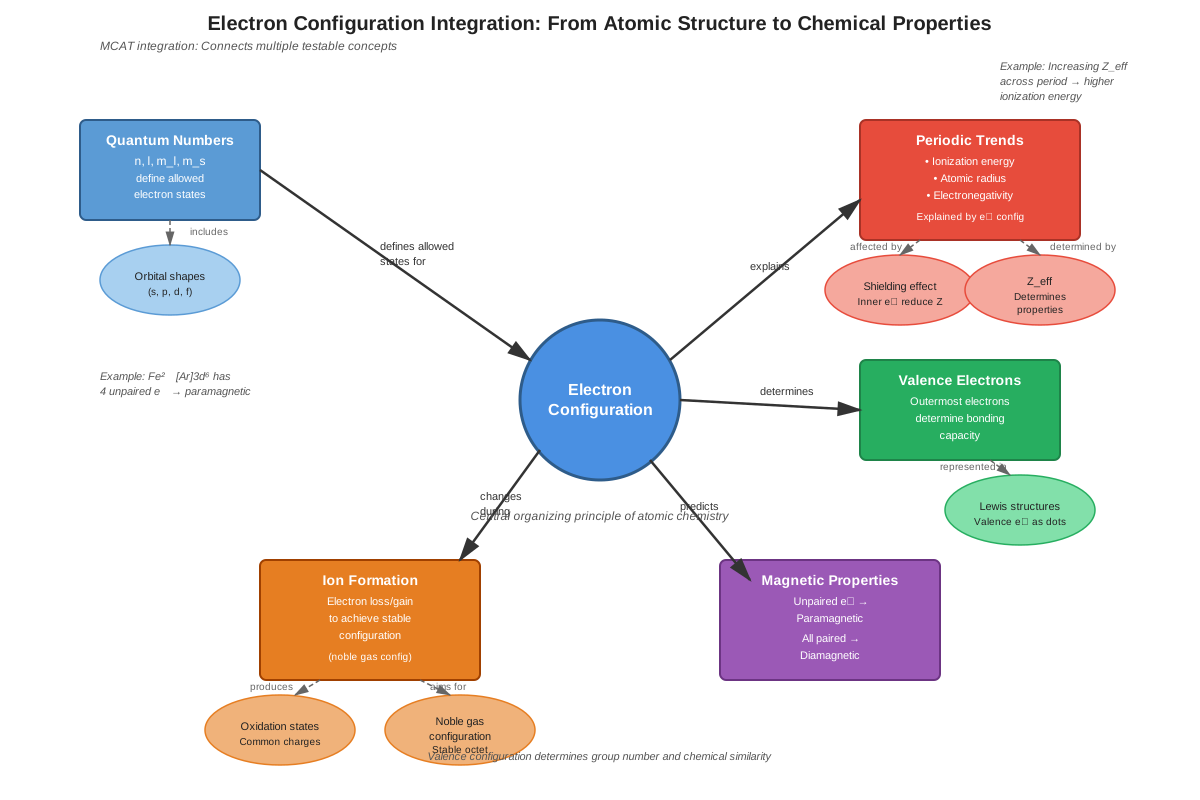
Electron configuration serves as the central organizing principle connecting multiple concepts within atomic structure and periodic trends. The quantum numbers (n, l, m_l, m_s) define the specific quantum states that electrons occupy → these quantum states group into orbitals (s, p, d, f) → orbitals fill according to the Aufbau principle, Pauli exclusion principle, and Hund's rule → the resulting electron configuration determines the element's position in the periodic table → the periodic table position predicts chemical properties through valence electron count → valence electrons determine bonding behavior and oxidation states.
The relationship between electron configuration and periodic trends is bidirectional and reinforcing. Electron configuration explains why periodic trends exist (ionization energy, electronegativity, atomic radius all derive from how tightly electrons are held), while periodic trends provide a quick way to predict electron configurations (group number indicates valence electrons). This interconnection extends to chemical bonding: covalent bonding involves sharing valence electrons to achieve stable configurations, ionic bonding involves electron transfer to achieve noble gas configurations, and metallic bonding involves delocalized electrons from partially filled valence shells.
Electron configuration also connects forward to more advanced topics. Molecular orbital theory extends atomic orbital concepts to molecules, where atomic orbitals combine to form bonding and antibonding molecular orbitals. Crystal field theory and ligand field theory, relevant for coordination chemistry, describe how d-orbital electron configurations split in energy when transition metals form complexes. Spectroscopy and color in transition metal compounds arise from electronic transitions between d orbitals with different energies. Understanding ground-state electron configurations is prerequisite for understanding excited states and electronic transitions.
Quick check — test yourself on Electron configuration so far.
Try Flashcards →High-Yield Facts
⭐ The electron configuration of an atom determines its chemical properties, particularly its valence electrons, which are responsible for bonding behavior.
⭐ For transition metal cations, electrons are removed from the 4s orbital before the 3d orbitals, even though 4s fills first (e.g., Fe²⁺ is [Ar]3d⁶, not [Ar]4s²3d⁴).
⭐ Chromium and copper are common exceptions: Cr is [Ar]3d⁵4s¹ and Cu is [Ar]3d¹⁰4s¹ due to the stability of half-filled and fully-filled d subshells.
⭐ Paramagnetic species have unpaired electrons and are attracted to magnetic fields; diamagnetic species have all electrons paired and are weakly repelled.
⭐ Elements in the same group have the same valence electron configuration, explaining their similar chemical properties.
- The maximum number of electrons in each subshell: s=2, p=6, d=10, f=14, following the formula 2(2l+1).
- Hund's rule requires electrons to occupy degenerate orbitals singly with parallel spins before pairing, minimizing electron-electron repulsion.
- Noble gas configurations represent particularly stable, low-energy electron arrangements with completely filled shells.
- The Pauli exclusion principle limits each orbital to two electrons with opposite spins, preventing any two electrons from having identical quantum numbers.
- Isoelectronic species (same number of electrons) have identical electron configurations but different nuclear charges, affecting their sizes and properties.
- The filling order follows increasing n+l values, and when n+l is equal, the orbital with lower n fills first (e.g., 3d before 4p because both have n+l=5, but 3d has lower n).
- Half-filled and fully-filled subshells (d⁵, d¹⁰, p³, p⁶) have extra stability due to exchange energy and electron symmetry.
Common Misconceptions
Misconception: Electrons are removed from the same orbitals they were added to when forming cations.
Correction: For transition metals, electrons are removed from the ns orbital before the (n-1)d orbitals during ionization, even though the ns orbital filled first. This occurs because once d orbitals begin filling, they become lower in energy than the ns orbital. Always remove s electrons first when forming transition metal cations.
Misconception: The 4s orbital is always lower in energy than the 3d orbitals.
Correction: The 4s orbital is lower in energy than 3d only for the first few elements (K, Ca). Once the 3d orbitals begin filling, they become lower in energy than 4s due to electron-electron repulsions and increased nuclear charge. This energy reversal explains why 4s electrons are removed first during ionization.
Misconception: All elements follow the standard Aufbau filling order without exception.
Correction: Several elements, particularly chromium and copper, deviate from predicted configurations because half-filled and fully-filled d subshells provide extra stability. Cr is [Ar]3d⁵4s¹ (not 3d⁴4s²) and Cu is [Ar]3d¹⁰4s¹ (not 3d⁹4s²). Recognize that d⁴s² and d⁹s² configurations often shift to d⁵s¹ and d¹⁰s¹.
Misconception: Valence electrons are always those in the highest principal energy level.
Correction: For transition metals, both the outermost s electrons and the d electrons in the (n-1) shell are considered valence electrons because both participate in bonding and determine oxidation states. For main group elements, only the highest n-level electrons are valence electrons.
Misconception: Paramagnetic means strongly magnetic like a permanent magnet.
Correction: Paramagnetic species are weakly attracted to external magnetic fields due to unpaired electrons but do not retain magnetization when the field is removed. Only ferromagnetic materials (like iron metal) exhibit strong, permanent magnetism. Paramagnetism simply indicates the presence of unpaired electrons.
Misconception: Noble gas configuration shorthand can be used for any element by using the nearest noble gas.
Correction: The noble gas shorthand must use the noble gas from the previous period (lower atomic number) that represents all completely filled inner shells. For example, iron uses [Ar] not [Kr], because argon represents all the filled shells before iron's valence electrons.
Misconception: Hund's rule means electrons must fill all orbitals in a subshell before any pairing occurs anywhere in the atom.
Correction: Hund's rule applies only to degenerate orbitals (orbitals of equal energy within the same subshell). Electrons in lower energy subshells will already be paired before higher energy subshells begin filling. For example, in oxygen (1s²2s²2p⁴), the 1s and 2s electrons are paired, while the 2p electrons follow Hund's rule within the 2p subshell.
Worked Examples
Example 1: Writing Electron Configuration and Determining Magnetic Properties
Question: Write the complete electron configuration for manganese (Mn, Z=25) and determine whether it is paramagnetic or diamagnetic. Then write the electron configuration for Mn²⁺ and determine its magnetic properties.
Solution:
Step 1: Determine the total number of electrons. Manganese has 25 electrons.
Step 2: Fill orbitals according to the Aufbau principle:
- 1s² (2 electrons, total: 2)
- 2s² (2 electrons, total: 4)
- 2p⁶ (6 electrons, total: 10)
- 3s² (2 electrons, total: 12)
- 3p⁶ (6 electrons, total: 18)
- 4s² (2 electrons, total: 20)
- 3d⁵ (5 electrons, total: 25)
Step 3: Write the complete configuration:
Mn: 1s²2s²2p⁶3s²3p⁶4s²3d⁵ or [Ar]4s²3d⁵
Step 4: Determine magnetic properties. Apply Hund's rule to the 3d⁵ configuration. The five d electrons occupy all five d orbitals singly with parallel spins: ↑ ↑ ↑ ↑ ↑. Since there are five unpaired electrons, manganese is paramagnetic.
Step 5: For Mn²⁺, remove two electrons. Remove from 4s first (higher energy for cations):
Mn²⁺: [Ar]3d⁵
Step 6: The 3d⁵ configuration still has five unpaired electrons (↑ ↑ ↑ ↑ ↑), so Mn²⁺ is also paramagnetic. In fact, Mn²⁺ is one of the most paramagnetic ions due to having the maximum number of unpaired d electrons.
Key Insight: This example demonstrates the critical principle that 4s electrons are removed before 3d electrons during ionization. It also shows how Hund's rule determines magnetic properties through the number of unpaired electrons.
Example 2: Identifying Elements and Explaining Exceptions
Question: An element has the electron configuration [Ar]3d¹⁰4s¹. (a) Identify the element. (b) Explain why this configuration exists instead of the expected [Ar]3d⁹4s². (c) Write the electron configuration for the +2 cation of this element and determine if it is paramagnetic or diamagnetic.
Solution:
Step 1: Count total electrons. [Ar] represents 18 electrons, plus 10 in 3d and 1 in 4s gives 29 total electrons. The element with Z=29 is copper (Cu).
Step 2: Explain the exception. The expected configuration based on the Aufbau principle would be [Ar]3d⁹4s². However, copper adopts [Ar]3d¹⁰4s¹ because a fully-filled d¹⁰ subshell provides extra stability due to:
- Exchange energy: More possible electron exchanges in a filled subshell
- Symmetry: Fully-filled subshells have spherical symmetry, lowering energy
- The energy cost of promoting one 4s electron to 3d is offset by the stability gained from achieving d¹⁰
This is one of the most commonly tested exceptions on the MCAT, along with chromium.
Step 3: Write the configuration for Cu²⁺. Remove two electrons, starting with 4s:
- Remove the one 4s electron first: [Ar]3d¹⁰
- Remove one 3d electron: [Ar]3d⁹
Cu²⁺: [Ar]3d⁹
Step 4: Determine magnetic properties. The 3d⁹ configuration has one unpaired electron (↑↓ ↑↓ ↑↓ ↑↓ ↑), making Cu²⁺ paramagnetic. This explains why copper(II) compounds are often colored and show magnetic behavior.
Key Insight: This example illustrates the importance of recognizing exceptions to standard filling order and correctly applying the rule that s electrons are removed before d electrons during ionization. The d⁹ configuration of Cu²⁺ is also responsible for the Jahn-Teller distortion commonly seen in copper(II) complexes.
Exam Strategy
When approaching MCAT questions on electron configuration, begin by identifying what the question is actually asking: Are you writing a configuration, identifying an element, predicting properties, or explaining a trend? Many students waste time writing complete configurations when only valence electrons matter. For questions about chemical properties or bonding, focus immediately on valence electrons rather than core electrons.
Trigger words and phrases to watch for include: "ground state" (use standard filling rules), "excited state" (electrons have been promoted to higher orbitals), "paramagnetic" or "diamagnetic" (count unpaired electrons), "isoelectronic" (same number of electrons, different nuclear charge), "valence electrons" (outermost shell only for main group, ns and (n-1)d for transition metals), and "most stable configuration" (consider half-filled and fully-filled subshell stability).
For process-of-elimination strategies, remember these principles: (1) Any configuration that violates the Pauli exclusion principle (more than two electrons in an orbital) is automatically wrong. (2) For transition metal cations, any answer showing 4s electrons remaining while 3d is not fully filled is wrong. (3) For paramagnetic/diamagnetic questions, eliminate answers that contradict the presence or absence of unpaired electrons. (4) When comparing ionization energies or other periodic trends, eliminate answers that ignore electron configuration effects like half-filled subshell stability.
Time allocation for electron configuration questions should be approximately 60-90 seconds for discrete questions and up to 2 minutes for passage-based questions requiring multiple steps. If a question asks you to write a complete electron configuration for a large atom, consider whether the noble gas shorthand would be faster and whether the question truly requires the complete configuration or just the valence portion. Practice writing configurations for the first 36 elements (through Kr) until you can do so quickly and accurately, as these are the most commonly tested.
When a question involves transition metals, immediately recall the "4s before 3d" filling rule but "4s removed first" ionization rule. This single principle resolves most transition metal configuration questions. For questions about exceptions (Cr, Cu, Mo, Ag), if you cannot remember the specific exception, recognize that d⁵ and d¹⁰ configurations are particularly stable and guess accordingly.
Memory Techniques
Aufbau Filling Order Mnemonic: Use the diagonal rule visualization or remember the phrase "Silly People Do Funny things" for the orbital types. For the filling sequence, memorize: 1s, 2s, 2p, 3s, 3p, 4s, 3d, 4p, 5s, 4d, 5p, 6s, 4f, 5d, 6p, 7s, 5f, 6d. Notice that each s orbital (bold) starts a new period.
Electron Capacity Mnemonic: Remember "2, 6, 10, 14" for s, p, d, f capacities using the phrase "Two Silly People Danced Fourteen times" (2 for s, 6 for p, 10 for d, 14 for f).
Chromium and Copper Exception: "Chromium and Copper are Crazy" - both prefer half-filled or fully-filled d subshells. Specifically: Cr ends in d⁵s¹ (half-filled d), Cu ends in d¹⁰s¹ (fully-filled d). Remember "5 and 10, again and again" for the stable d configurations.
Transition Metal Ionization: "Steal from Susan first" - remove s electrons before d electrons when forming cations. Or visualize that s electrons are in the "Suburbs" (farther out) so they leave first, while d electrons are "Downtown" (closer to nucleus) and stay longer.
Paramagnetic vs. Diamagnetic: "Paramagnetic has pairs missing" - if electrons aren't all paired, it's paramagnetic. Or remember "Diamagnetic = Done pairing" (all electrons paired).
Hund's Rule Visualization: Picture electrons as people on a bus - they spread out to empty seats (orbitals) before anyone has to sit next to someone else (pair up). Everyone faces the same direction (parallel spins) until forced to pair.
Valence Electron Quick Reference: For main group elements, the group number equals valence electrons (Group 1 = 1 valence electron, Group 17 = 7 valence electrons). For transition metals, remember "Transition metals are Tricky" - count both s and d electrons as valence.
Summary
Electron configuration describes the systematic arrangement of electrons in atomic orbitals, following the Aufbau principle (fill lowest energy first), Pauli exclusion principle (maximum two electrons per orbital with opposite spins), and Hund's rule (occupy degenerate orbitals singly before pairing). The standard filling order proceeds through s, p, d, and f orbitals with notable exceptions for chromium and copper, which achieve extra stability through half-filled and fully-filled d subshells. For transition metal cations, electrons are removed from the ns orbital before (n-1)d orbitals despite the ns orbital filling first. Electron configuration determines all chemical properties through valence electrons, explains periodic trends through shielding and nuclear charge effects, and predicts magnetic properties through the presence or absence of unpaired electrons. Mastery requires understanding both the rules and the mechanistic reasons behind them, enabling prediction of chemical behavior across the periodic table. This topic connects atomic structure to bonding, periodic trends, and transition metal chemistry, making it essential for MCAT success.
Key Takeaways
- Electron configuration follows three fundamental principles: Aufbau (lowest energy first), Pauli exclusion (two electrons maximum per orbital), and Hund's rule (single occupancy before pairing in degenerate orbitals)
- For transition metal cations, always remove 4s electrons before 3d electrons, even though 4s fills first (e.g., Fe²⁺ is [Ar]3d⁶, not [Ar]4s²3d⁴)
- Chromium ([Ar]3d⁵4s¹) and copper ([Ar]3d¹⁰4s¹) are critical exceptions due to the stability of half-filled and fully-filled d subshells
- Valence electrons determine chemical properties: for main group elements, count only the highest n-level electrons; for transition metals, include both ns and (n-1)d electrons
- Paramagnetic species have unpaired electrons and are attracted to magnetic fields; diamagnetic species have all electrons paired and are weakly repelled
- Electron configuration provides the mechanistic explanation for all periodic trends, including ionization energy, atomic radius, and electronegativity
- Noble gas shorthand notation simplifies configurations by representing filled inner shells with the previous noble gas symbol in brackets
Related Topics
Quantum Numbers and Atomic Orbitals: Understanding the four quantum numbers (n, l, m_l, m_s) provides the theoretical foundation for why electron configurations follow specific patterns and why orbitals have particular shapes and capacities. Mastering electron configuration enables deeper understanding of orbital hybridization and molecular geometry.
Periodic Trends: Electron configuration explains the mechanistic basis for ionization energy, electron affinity, electronegativity, and atomic radius trends. Understanding configurations allows prediction of these trends rather than memorization, particularly for explaining discontinuities and exceptions.
Chemical Bonding and Lewis Structures: Valence electron configurations determine bonding capacity and molecular structure. Progression from electron configuration to Lewis structures requires understanding which electrons participate in bonding and how atoms achieve stable configurations.
Transition Metal Chemistry and Coordination Complexes: The d-electron configurations of transition metals determine their oxidation states, colors, magnetic properties, and catalytic activities. Crystal field theory builds directly on electron configuration concepts to explain d-orbital splitting.
Molecular Orbital Theory: Atomic electron configurations extend to molecular orbitals, where atomic orbitals combine to form bonding and antibonding molecular orbitals. Understanding atomic configurations is prerequisite for predicting bond order and molecular stability.
Practice CTA
Now that you have mastered the fundamental concepts of electron configuration, it's time to solidify your understanding through active practice. Attempt the practice questions and flashcards to test your ability to write configurations quickly, identify exceptions, and apply these concepts to MCAT-style scenarios. Focus particularly on transition metal configurations and ions, as these are high-yield and frequently tested. Remember that electron configuration is not just a memorization task—it's a logical system that, once understood, allows you to predict chemical behavior across the entire periodic table. Your investment in mastering this topic will pay dividends throughout your MCAT preparation and beyond!
Sign up free to keep reading
Create a free AnvayaPrep account to finish this MCAT guide on Electron configuration — plus flashcards and practice questions.